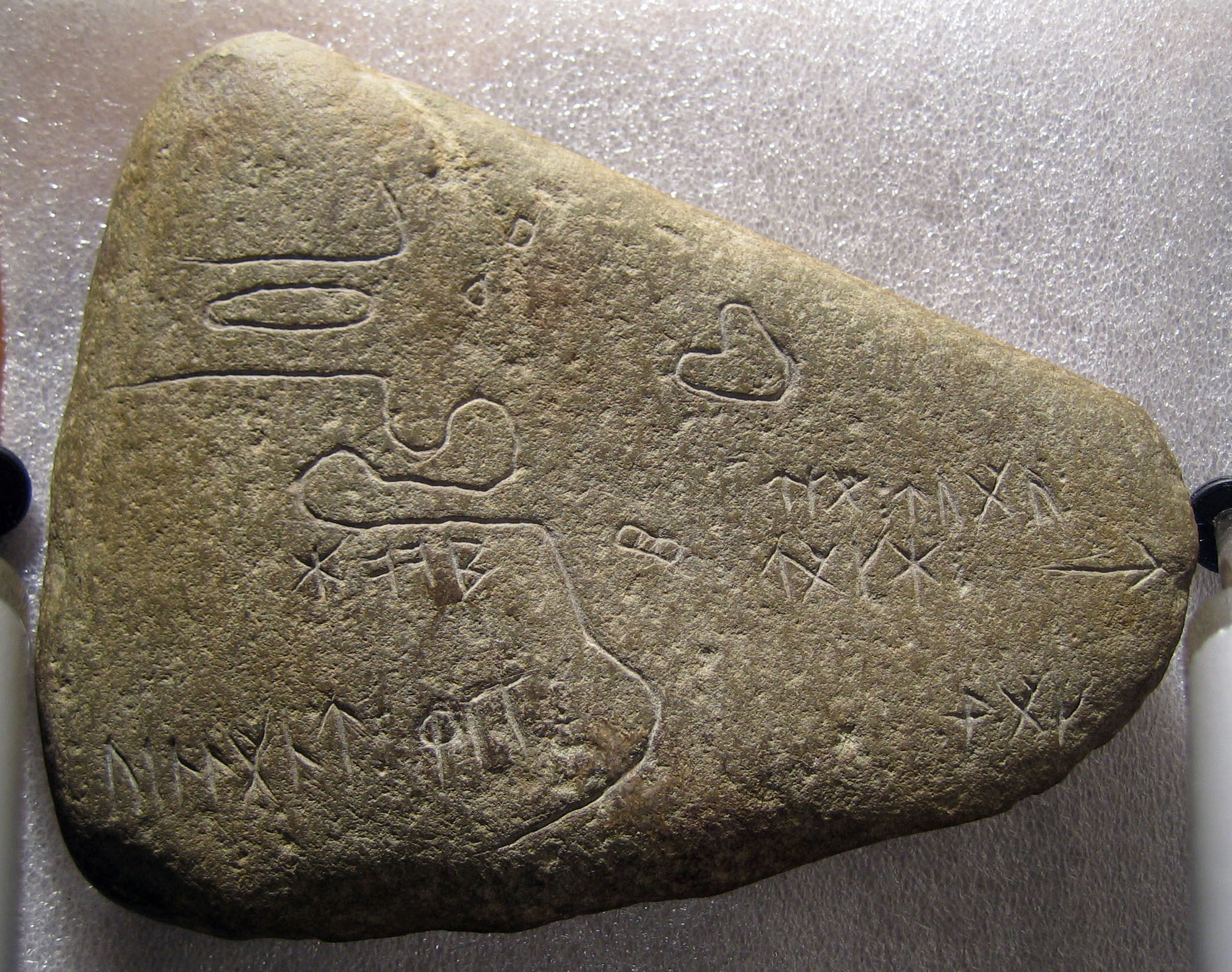
 Map Stone – Front. Photo Scott Wolter ©2009. Used with permission.
Index
Introduction ⇓⇓
SP-3, Inscription stone ⇓⇓
-
- Transliteration of Inscription ⇓⇓
- Henricus ⇓⇓
- Front Side Date ⇓⇓
- Rear Side Date ⇓⇓
- Center Pictogram ⇓⇓
- More Anagrams of a Sort ⇓⇓
- The Author and Inscriber ⇓⇓
- The Acrostic and Telestic ⇓⇓
- Over Lined Rune Ciphers ⇓⇓
- Rhode Island ⇓⇓
- Longitude and Latitude ⇓⇓
- Founding Family ⇓⇓
- Full Translation ⇓⇓
- Summary Translation ⇓⇓
Similar Articles by the same author ⇓⇓
References ⇓⇓
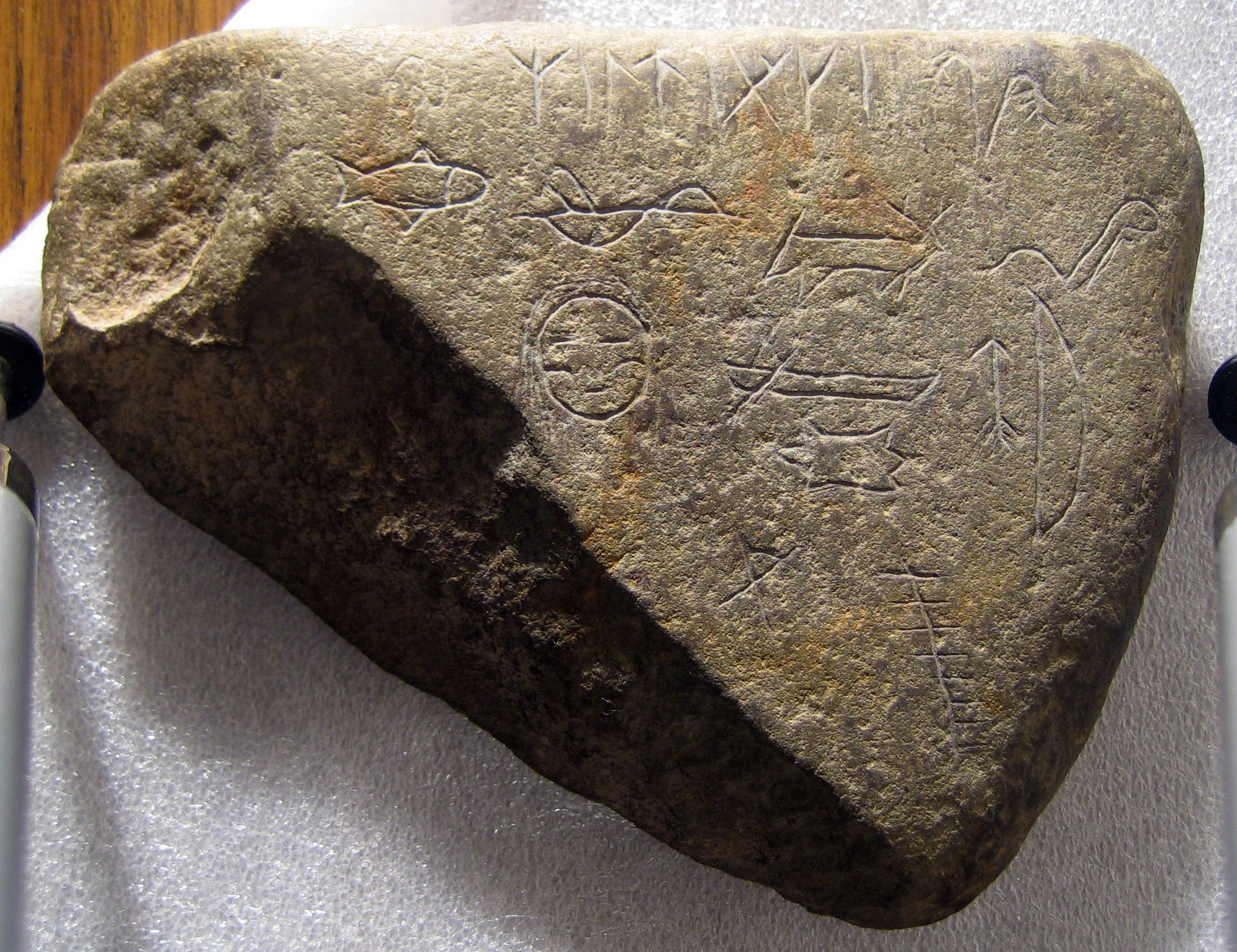
Map stone – obverse. Photo Scott Wolter ©2009. Used with permission.
Introduction
The Spirit Pond Stone with the longest inscription is studied here. There are several plain text readings that have been done, which are vastly different from what is presented. For the most part, the inability to read the stone has led professionals to assume it is fake. It is suggested that this is a riddle, a sort of cross-word puzzle and like any cross word it cannot be ‘read’. One must read this stone’s letters up and down, sometimes backwards, and often as anagrams. Consider it is a puzzle laboriously designed for amusement and the telling of a story. They are meant to take a lot of time to solve so …. do not expect to get it by just ‘reading.’ And since there might be mistakes here, feel free to disagree. In the paper entitled “Validating North American Runic Inscriptions” (PDF), by this author, the Spirit Pond Rune stones were discussed briefly. Reading the first paper is essential to understanding the importance of the numeric information that is given here and followed by ✓ marks. The ciphers in The Inscription Stone (SP-3) are extensive. This is the most thorough study of these inscriptions to date. It follows the work of others who began this study many decades ago. It completes it except for the preservation of the original works. It is up to the reader to motivate those who can. There are four stones from Spirit Pond, Maine that Scott Wolter discusses in The Hooked X: Key to the Secret History of North America. Cyrus Gordon discusses them in Riddles in History. O.G. Landsverk discusses Alf Mongé’s study of them in his books. The Inscription stone (SP-3) has ten lines on the front and on the back there are 5 full lines with the start of a 6th. And thus it begins 56.✓ Apologies are given in advance. This is end to end numbers which makes for poor reading. Do not let the number work deter one from discovering what lays within the inscriptions. The essence can be grasped regardless of the level of interest in the math. Back to Top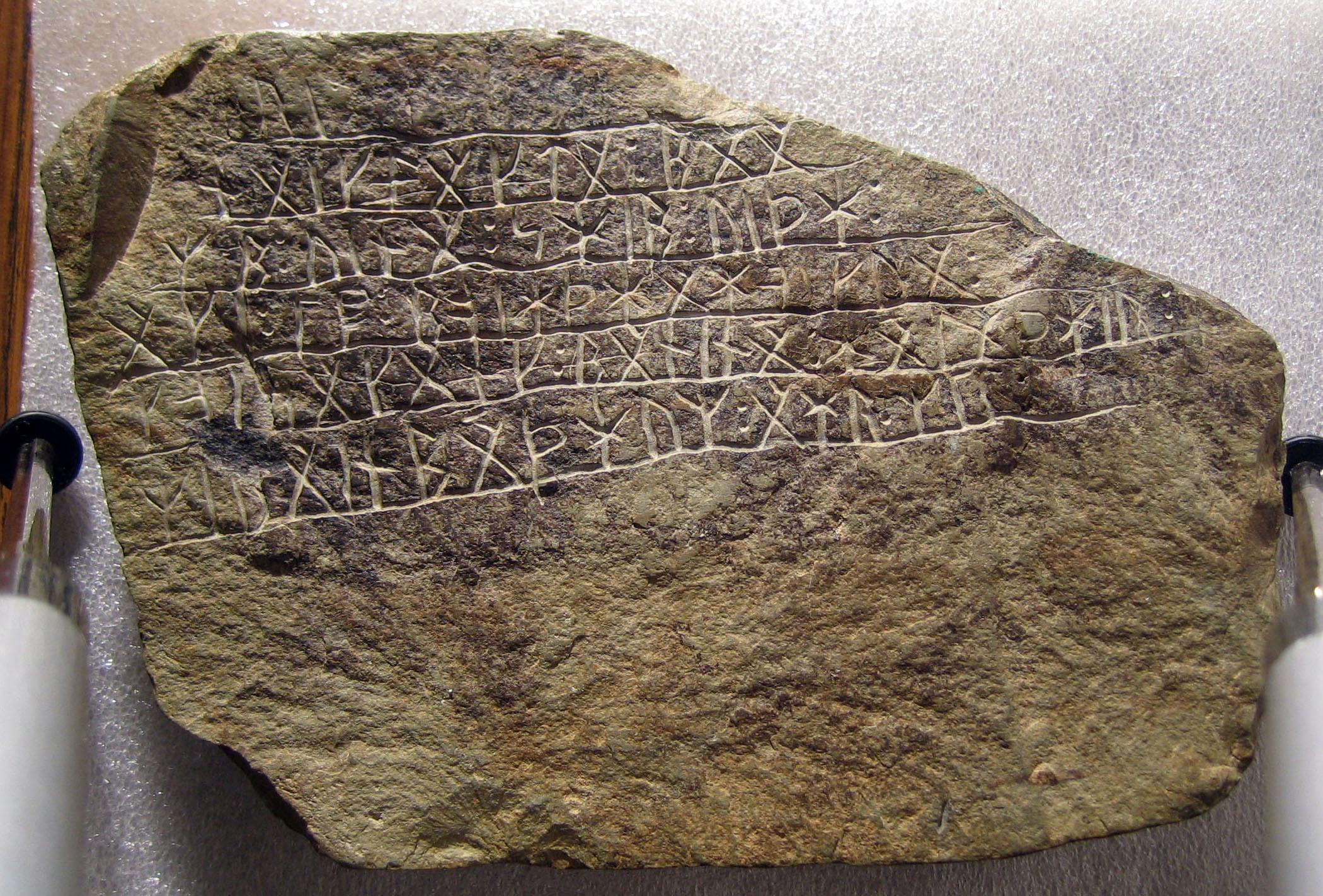
Inscription stone – obverse. Photo Scott Wolter ©2009. Used with permission.
SP-3 Inscription Stone
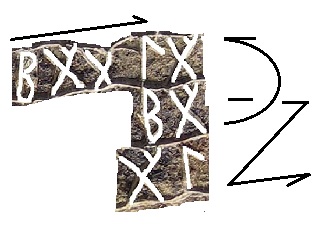
Baal found three times.
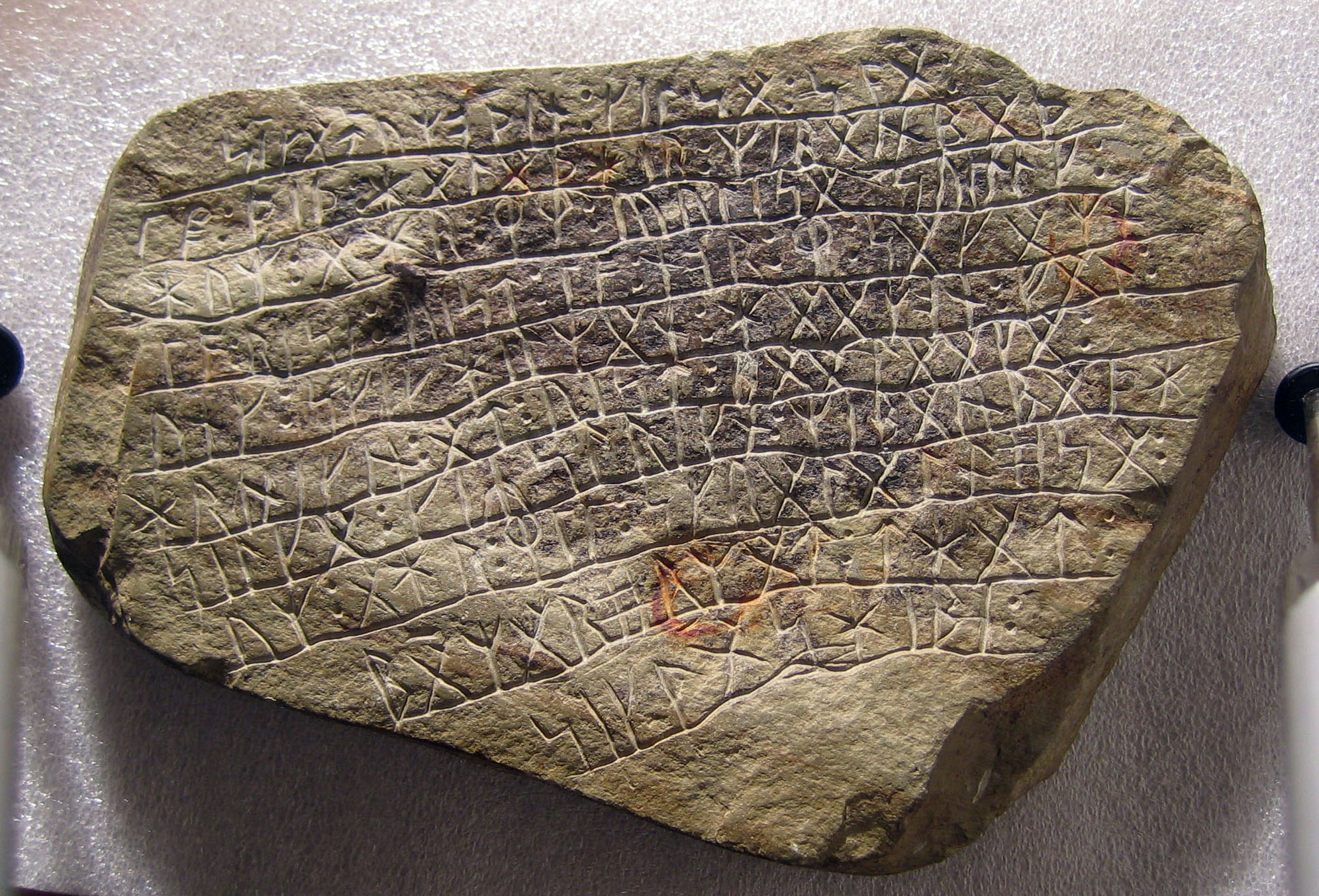
Inscription stone – front. Photo Scott Wolter ©2009. Used with permission.
Transliteration of Inscription Stone, SP-3
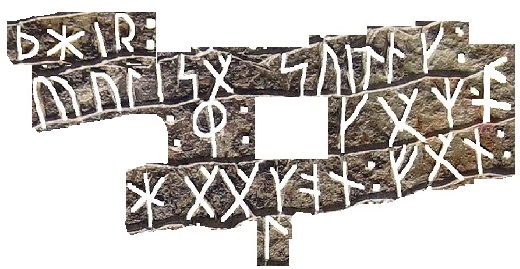
1. SIKATUMODIN : KILSA : S[LI]A : 2. 17 : DID : HALADHIR : MIBAINBAD 3. HUM : AHR : 1010 : [UU] ULISA SUITNK : 4. 12 : RISI : UIST : 12 : NOR : 10 : SAKAM[LI] 5. UNK : SKIKHILMAN : HAAKON : FAN : 6. HR[IN]IKIN : AT : UIST : BAALAAKA : 7. SILKA : KIYSLRIKN : MIBAINBADH 8. UM : AHR : 1011: SMUALAL[LI][OO]SA : 9. BAMAR[OO]RMAT : THAT : 10. SIKLASHIBI : 11. RI: 12. NAIK[IL]AKTA : BAA 13. MB : UINA : SHIB : UIDH : 14. AKI : 17 : ROIHDHAHOIKUA : 15. KOISAKANK : BANINA : HALADHIR : 16. MIBAINBADHUM : AHR : M11 : Over lined runes are in bold. Bindrunes are underlined or in [ ]. This transliteration was checked against Gordon’s (pg. 138-140). In line 8 he has SK vs. SM here.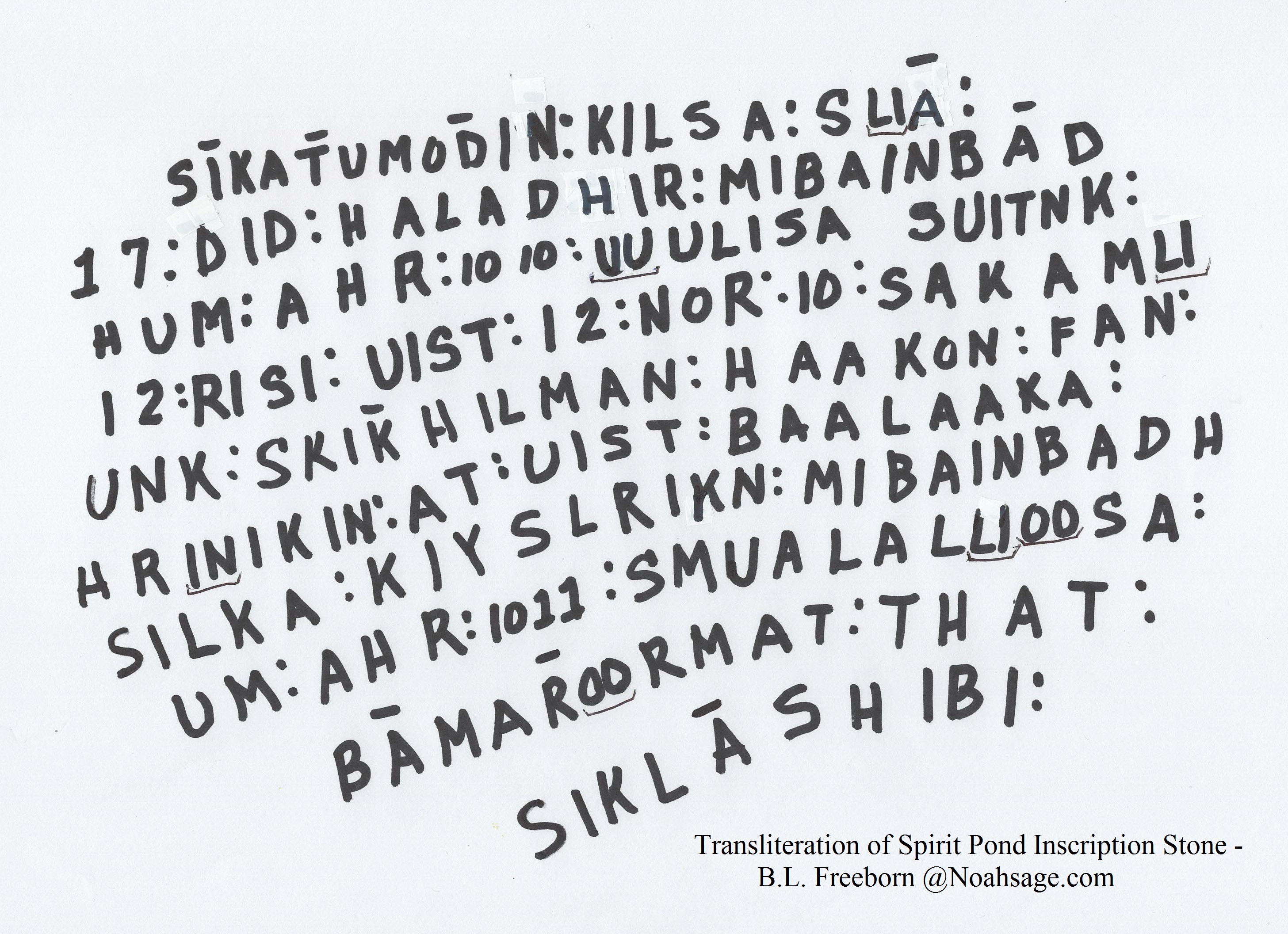
Transliteration of Spirit Pond Inscription Stone- Letter placement is maintained creating the uneven depiction. -B.L. Freeborn @Noahsage.com.
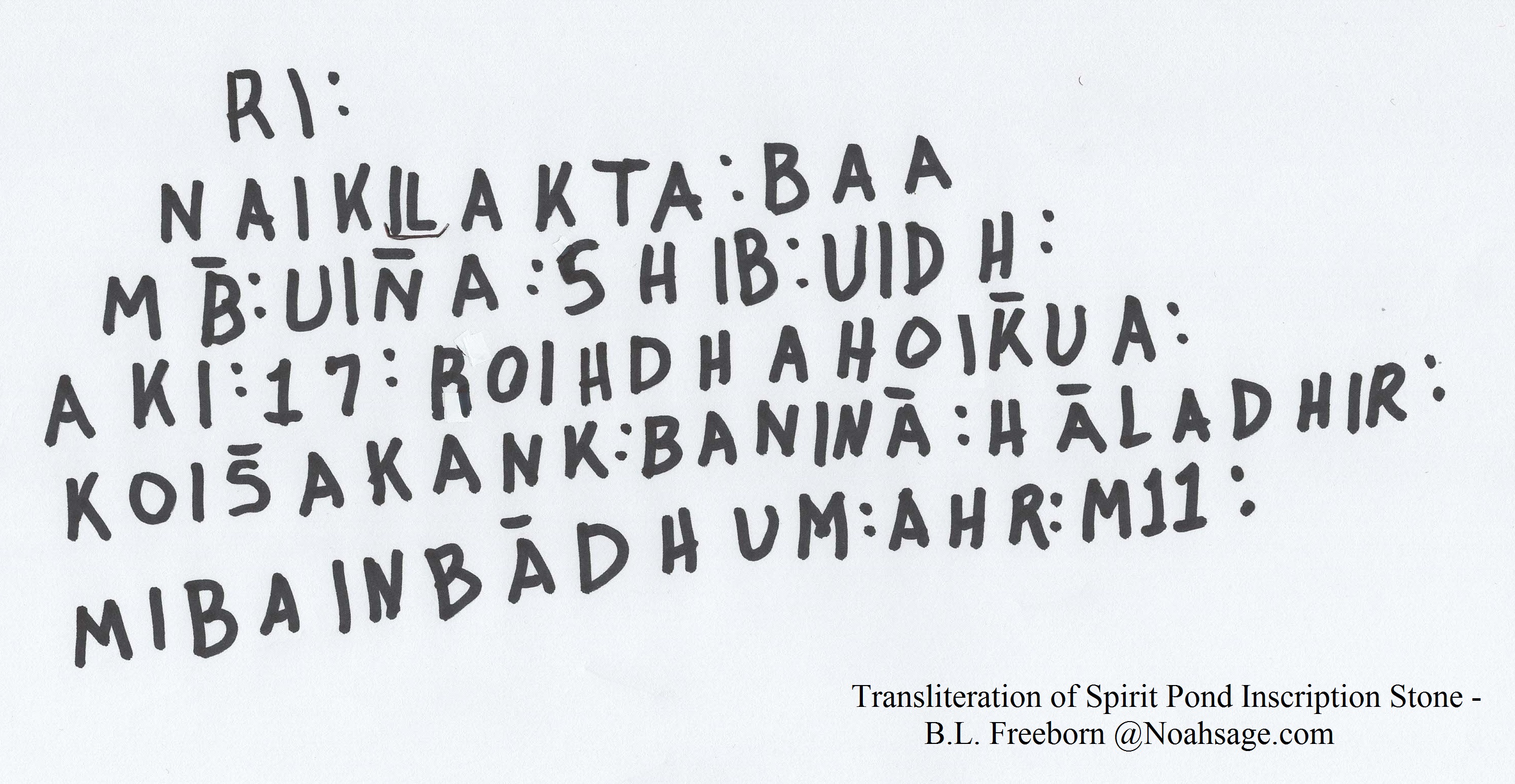
Transliteration of Spirit Pond Inscription Stone- Letter placement is maintained creating the uneven depiction. -B.L. Freeborn @Noahsage.com.
Henricus
What else might this text have to say? Mongé found the name Henricus several times in the Spirit Pond rune stones. (Gordon, pgs 142-143.) This example Gordon gives is from the first two lines of text. Below it is transliterated retaining letter placement. (Bold letters are over lined runes on the stone and this rune master used D for Th.)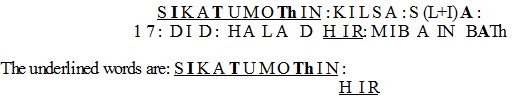 Remove the bold letters: I,T,Th and form HINRIKUS with AMO remaining. In Latin ‘amo’ is ‘love.’ Bishop Henricus (aka Eirikr Gnupson) was believed to be the first bishop in Vinland, America. He was sent by Pope Paschal II (AD 1099-1118). (Gordon, pg. 93) This dating and Mongé’s finding of the name Henricus can be filled out further by the text in the vicinity of the name. Notice the 17 on line #2. If this implies 1117, then it is within this time period. Instead of reading DID (or ThITh) as ‘dead’, as most translators do, read it as ‘did.’ Then one finds it says: Amo Henricus in 17 did he lead.
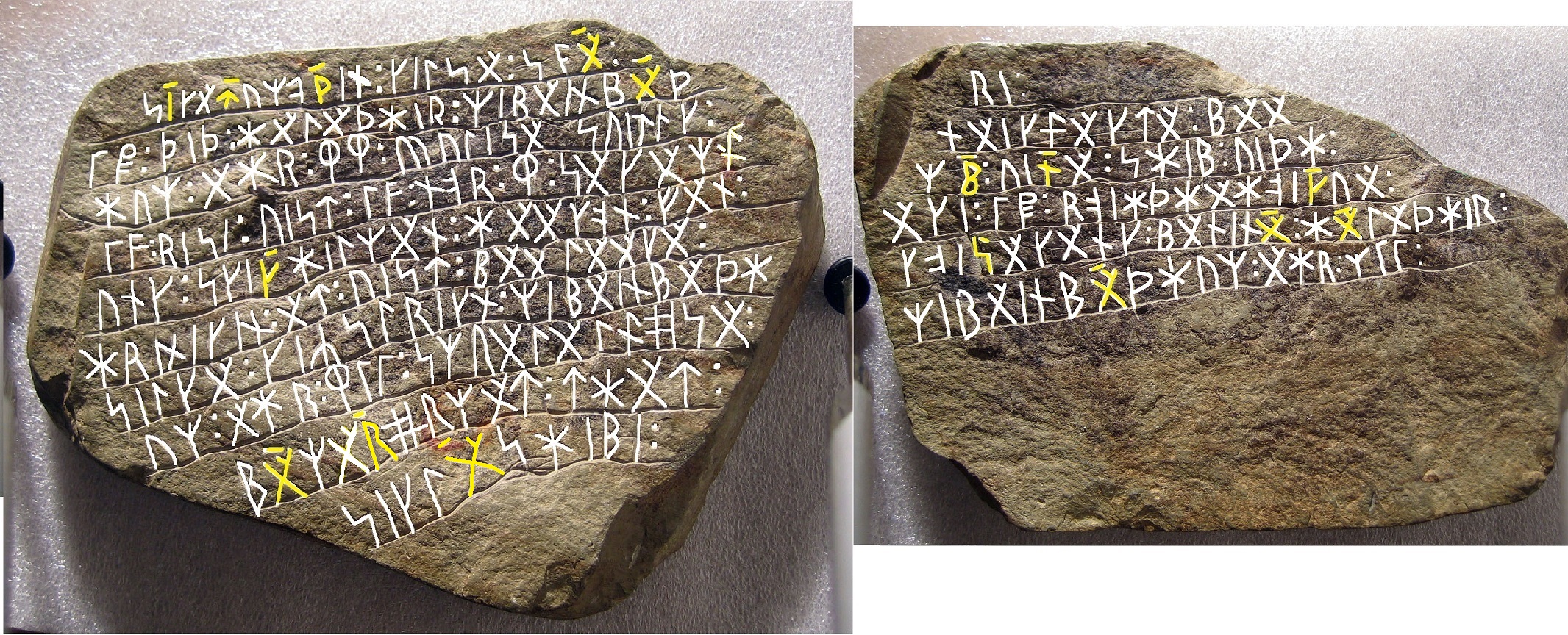
Inscription Stone with runes traced in white and yellow. Yellow runes are over lined runes.
 If one reads HIR as if it means ‘here’, then perhaps the answer is found. Note that H, I are 7,9 while the sum is 21 or 7921.✓
The first word on the next line is HUM implying home. It is actually a continuation of the word from the previous line so it might complete the sentence or it begins a new thought since everything here is well placed. The next word is year spelled (AHR), as it was on the Kensington Rune Stone, and then it is followed by 1010. Since Henricus is mentioned and he lived long after 1010 this can only be a commemoration date. Home implies the settlement of Hoop began in that year. The mention of a date suggests one should be found here. Year (AHR) is mentioned again in line 8 and on the reverse in line 6. There they both state the year as 1011. Oddly though, the last 1011 is spelled with a runic M for Roman M or 1000. Even more oddly, there is a rune just after the date 1010 (line 3) that looks like an M -or- it is a bindrune of 2 U’s followed by another U. The word containing these runes is clearly in two parts without a word divider so something is to be found here. The first part sums to 51✓ (using a bindrune of 2 U’s or 4) which was seen just above and the last part to 48.
During the years 1010 and 1011, Thorfinn Karlsefini reportedly attempted to colonize Vinland. The last place he stopped he called Hop. Here there are stones in a place called Hoop that mention those years. Mongé believed Henricus created the Spirit Pond stones since his name can be found in ciphers on them. However, would Henricus also embed ‘amo’ with his own name? This suggests someone else wrote at least SP-3.
Back to Top
If one reads HIR as if it means ‘here’, then perhaps the answer is found. Note that H, I are 7,9 while the sum is 21 or 7921.✓
The first word on the next line is HUM implying home. It is actually a continuation of the word from the previous line so it might complete the sentence or it begins a new thought since everything here is well placed. The next word is year spelled (AHR), as it was on the Kensington Rune Stone, and then it is followed by 1010. Since Henricus is mentioned and he lived long after 1010 this can only be a commemoration date. Home implies the settlement of Hoop began in that year. The mention of a date suggests one should be found here. Year (AHR) is mentioned again in line 8 and on the reverse in line 6. There they both state the year as 1011. Oddly though, the last 1011 is spelled with a runic M for Roman M or 1000. Even more oddly, there is a rune just after the date 1010 (line 3) that looks like an M -or- it is a bindrune of 2 U’s followed by another U. The word containing these runes is clearly in two parts without a word divider so something is to be found here. The first part sums to 51✓ (using a bindrune of 2 U’s or 4) which was seen just above and the last part to 48.
During the years 1010 and 1011, Thorfinn Karlsefini reportedly attempted to colonize Vinland. The last place he stopped he called Hop. Here there are stones in a place called Hoop that mention those years. Mongé believed Henricus created the Spirit Pond stones since his name can be found in ciphers on them. However, would Henricus also embed ‘amo’ with his own name? This suggests someone else wrote at least SP-3.
Back to Top
Front Side Date
Returning to the idea of a date, note that there are two 17’s, one on the front and one on the rear. On the fourth line, there are two 12’s. There is a single 10 in this same line with word dividers on both sides. Between the two 12’s are two words with 4 runes each that each sum to 34.✓ Their total sum then is 68. The word between the 17 and 10 (NOR) sums to 17 as well. For clarity the numbers on this line are: #12 : 34 : 34 : #12 : 17 : #10 : 51+24 Note that 90 – 34 = 56.✓ Also, note that there are 24 hours in a day as measured from a place at latitude 51.51.✓ Finding the year is confusing. After much trial and error it seems to be plainly stated by the repeating numerals or year 1217. To confirm this the GN is 2 and the DL is 1. Both of which must have been difficult to embed and even more difficult to identify. The single #10 follows the date (digit sum is 1) and it has word dividers on each side so that it clearly stands out. If this implies GN 1 then a two should be near by. The single word above is divided into two with one empty space between. The left half of the word has 3 U’s (each are a 2) and two of them are joined. There are 2 X’s below, 2 X’s below that and two in succession above. There is a risk here of seeing what is not there. Another confirmation is that this date is five years after the date found on SP-1, the Map Stone. It is also 100 years after the suggested date Henricus arrived, as if it was meant to commemorate his arrival. Further confirmation of his arrival in 1117 is found by reviewing SP-1. This stone then is dated to 1217. The years 1117 and 1217 are further confirmed by a vertical line on the front side. It begins at the bottom at the H I and then straight up as TABL – KS to the 1 space that breaks 2 words. This must refer to the Easter Tables. Examining this further find: HI (7,9) is 16 and the GN for 1117. The sum of KS (6,11) is 17 or the year. The H is 7 or the DL. At the other end of TABL is the space and two words. For year 1217 GN is 2 and DL is 1. Both then are confirmed.✓ While here, notice two other points of interest on line ten. The HI (7,9) is followed by BI (13,9) or 22 so that the series 7922 is formed.✓ The line also begins with SIKLA which is an anagram for KILSA and also ‘a – skill .’ SIKL is (11,9,6,15) and sums to 41 with the A it is 51. The remainder of the line sums to 49. So, that the total sum is 100. The sums of the two words confirming 1217 just above are 51 and 48 as previously mentioned. These numbers will be of use later.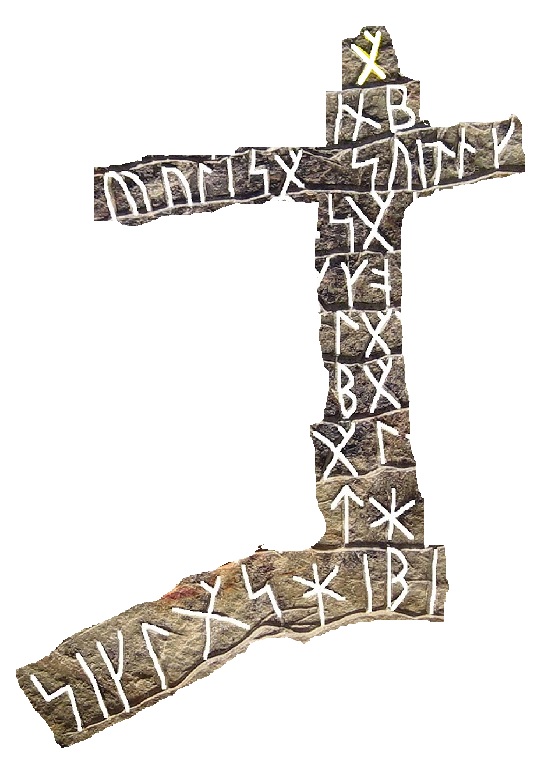 Running next to TABL is another vertical line. It spells out BHLAAOA SU INB A which is an anagram of: BAAL SU A BAIN HOL … or … Baal sow A baneful hole.
Back to Top
Running next to TABL is another vertical line. It spells out BHLAAOA SU INB A which is an anagram of: BAAL SU A BAIN HOL … or … Baal sow A baneful hole.
Back to Top
Rear Side Date
Noteworthy numbers on the reverse: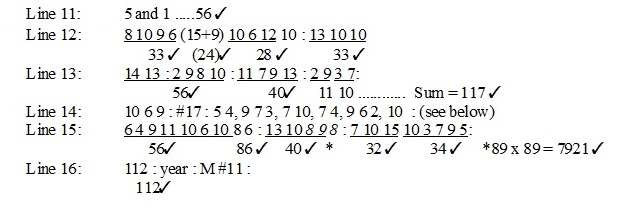 The date 1117 is found and confirmed again on the reverse. The numbers #17 and #11 here imply 1117. This year has GN 16 and DL 7. The GN is found by observing M11 is 14+1+1 = 16. This phrase is found on Line 16. Line 13 sums to 117. The M11 also implies year 1011 since M equals 1000 in Roman numerals.
On Line 14 the numbers following #17 are: 5 4, 9 7 3 or 9, 19. Year 1117 is on Calendar Line #19. ✓ For that year the DL is 7. Continuing within that word the next rune/numbers are 7 10 7 4. There are three 7’s in this word. The numbers around each 7 sum to 17. The 10 and 7 sum to 17. The 7, 10 sum to 17. The 7,3,7 to 17. The last two (7,4) to 11. Clearly 1117 is indicated here. The end of the word is 9 6 2 = 17 and A(10). In addition, the two runes above the #17 are UI or 11 which repeats 1117. There are 16 runes on Line 14 which is another confirmation of the GN 16. This date is confirmed.
The sum of the letters preceding the over lined X on line 16 is 76 or the period of Halley’s Comet.✓ The sum of the entire word is 112 or 2 x 56.✓
The following is deduced from this: 1010 to 1011 is the year Hoop was settled by Karlsefini. Year 1117 was when Henricus arrived at the settlement. Year 1217 is the year this was written to memorialize these dates.
Back to Top
The date 1117 is found and confirmed again on the reverse. The numbers #17 and #11 here imply 1117. This year has GN 16 and DL 7. The GN is found by observing M11 is 14+1+1 = 16. This phrase is found on Line 16. Line 13 sums to 117. The M11 also implies year 1011 since M equals 1000 in Roman numerals.
On Line 14 the numbers following #17 are: 5 4, 9 7 3 or 9, 19. Year 1117 is on Calendar Line #19. ✓ For that year the DL is 7. Continuing within that word the next rune/numbers are 7 10 7 4. There are three 7’s in this word. The numbers around each 7 sum to 17. The 10 and 7 sum to 17. The 7, 10 sum to 17. The 7,3,7 to 17. The last two (7,4) to 11. Clearly 1117 is indicated here. The end of the word is 9 6 2 = 17 and A(10). In addition, the two runes above the #17 are UI or 11 which repeats 1117. There are 16 runes on Line 14 which is another confirmation of the GN 16. This date is confirmed.
The sum of the letters preceding the over lined X on line 16 is 76 or the period of Halley’s Comet.✓ The sum of the entire word is 112 or 2 x 56.✓
The following is deduced from this: 1010 to 1011 is the year Hoop was settled by Karlsefini. Year 1117 was when Henricus arrived at the settlement. Year 1217 is the year this was written to memorialize these dates.
Back to Top
Center Pictogram
There is more of interest besides dates hidden here. There is a pictogram in the center of the front. It runs through the center of all ten lines. View each rune as a picture instead of the rune and find it begins with the ‘two’ dots. Below is a ‘star’ suggesting two stars. The stars fall, as the legs of the letter M show. They strike and strike. (The N’s form skewed X’s.) Then it says it went up (an arrow and line) and fanned out the way the runes are shaped like trees. It ends at an enlarged X. Line 1: – : – Rune to the right is K(6).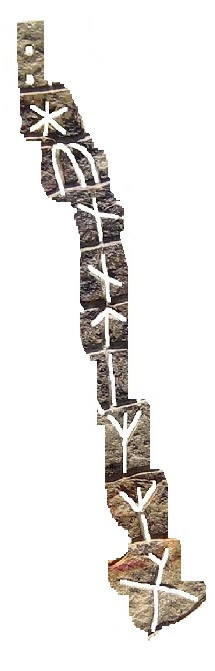 Line 2: H (7) Rune above is 6 or 7..6… 76.✓ See below.
Line 3: U+U or M, (2+ 2) or (M = 14) and next U(2)…. 14 x 2 = 28✓
Line 4: N (8) Two 2’s from bindrune just above and 8 twice or 2…8 ⇒28✓
Line 5: N (8) ⇒ 28✓ (Two from bindrune above. Used second time.)
Line 6: T (12) Sum 8 + 8 + 12 = 28✓
Line 7: I (9) Letters to each side are R I K or R|K …5|6✓
Line 8: M (14)
Line 9: M (14) Sum 14 + 14 = 28
Sum to here is (7,4,8,8,12,9,14,14) = 76.✓
Line 10: A (10) Total sum is 86.✓
The arrow and line (TI) in a vertical line in this manner appears on the Kensington rune stone and the Rök Runestone in Sweden. In Elder Futhark it is 17 and 11 which is 28.✓
Some words can be made out in this vertical list. Hu sounds like ‘how.’ The double N could be ‘none.’ Tie has been seen before. Ma is ‘more’ and it ends with the hooked X which looks like two darts heading into a peak or mountain. There is much to ponder here. Surely though, it was set up to repeat 28’s (half of 56).✓ The repetition of 76 at the top and in the sum suggest the period of Halley’s comet. The rune master infers two comets struck by using that number/time period and the depiction.
Back to Top
Line 2: H (7) Rune above is 6 or 7..6… 76.✓ See below.
Line 3: U+U or M, (2+ 2) or (M = 14) and next U(2)…. 14 x 2 = 28✓
Line 4: N (8) Two 2’s from bindrune just above and 8 twice or 2…8 ⇒28✓
Line 5: N (8) ⇒ 28✓ (Two from bindrune above. Used second time.)
Line 6: T (12) Sum 8 + 8 + 12 = 28✓
Line 7: I (9) Letters to each side are R I K or R|K …5|6✓
Line 8: M (14)
Line 9: M (14) Sum 14 + 14 = 28
Sum to here is (7,4,8,8,12,9,14,14) = 76.✓
Line 10: A (10) Total sum is 86.✓
The arrow and line (TI) in a vertical line in this manner appears on the Kensington rune stone and the Rök Runestone in Sweden. In Elder Futhark it is 17 and 11 which is 28.✓
Some words can be made out in this vertical list. Hu sounds like ‘how.’ The double N could be ‘none.’ Tie has been seen before. Ma is ‘more’ and it ends with the hooked X which looks like two darts heading into a peak or mountain. There is much to ponder here. Surely though, it was set up to repeat 28’s (half of 56).✓ The repetition of 76 at the top and in the sum suggest the period of Halley’s comet. The rune master infers two comets struck by using that number/time period and the depiction.
Back to Top
Anagrams of a Sort
Lines eight and nine provide interesting anagrams. Line nine has two over lined runes (in bold). The eleven rune word beginning line nine reads: BAMAR[OO]RMAT. ⇒ ROM or ROOM as ‘room’ is obvious. Take the over lined (bold) as a hint and remove those as AR or ‘are’ or perhaps ARA as ‘area’ and what remains is BMAOT. One can see A TOMB remains so that it might read: Area a room, tomb.✓ This is another typical Baalist statement. The sum of the word is 79+22 or 79 AT. The long ‘word’ in line eight is SMUALAL[LI][OO]SA. This is Baalist in nature as well. To read it several other lines are included: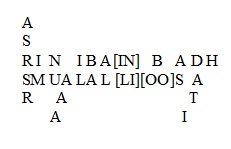 Find: RSRSA, RIM, NU, AN, XXX, LI, BAAL, LI, ╢╢, BAIN, SA, SA, 3, HIT, A and HATI which forms 7,10,12,9 or 7922.✓ This might read: Raze, raze, rim, now, An, XXX, lie, eye, Baal, lie, net, bane, bucket, bucket, 3, hit, A. It also can be read as five word anagram: AS MU I ALL LOOSA.
It was razed and razed until it is a rim now. Upon An were the three strikes by Baal. It lies in the net at the baneful buckets from the three hits on A. As it mowed the eye all was loosened.
Back to TopThe Author and Inscriber
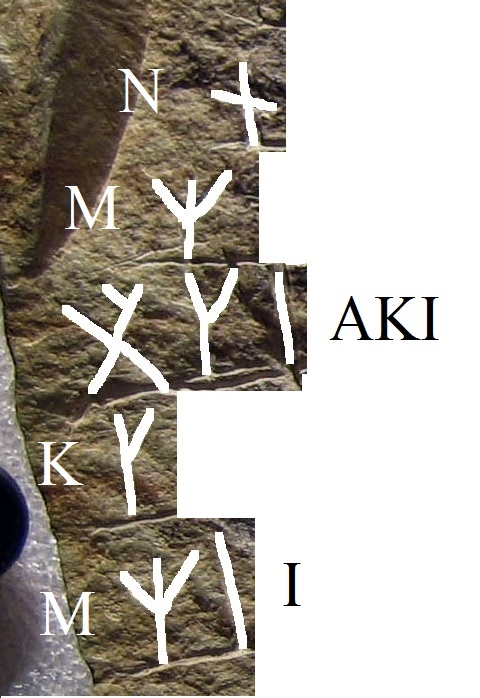 Because this author also designed SP-1, The Map Stone, it is easy to spot his name. On the rear, left side, Line 4 find AKI. Perfectly lined up beneath is MK for ‘make’ and just to the right is another I. So it is: I make, Aki. Just above Aki is an M and above this is an N or NM for ‘name’ which clarifies Aki is a name.
My name is Aki and I made this.
Acrostic and Telestic
Typically there are ciphers that run along the outside edges called the acrostic and telestic. Part of one was found above when the inscriber’s name was located. This works easily on the reverse. The number of words on each line is counted. Then from the left or right count in that many runes. Here the first line is RI, one word, and count from the right 1 to find I. Similarly the next line has one word (count :’s) and find A. Repeating this from the right for all lines reveals: I A U K H 1. This reads in both directions alternating: AK1⇒ ⇐HUI or I how Aki… which clearly means he designed it as well:
I Aki – how made.
Do the same from the right and find: RAIIIB. Read it by alternating in both directions. It reveals: RI I BI A or 56 I Bi-A or … At 56 is the eye and the bisected A. This is typical of Baalist statements which is very unsatisfying to us because it seems like nonsense. Reading the front in the same manner produces nothing. However, reading it in reverse acrostic-telestic is productive. This means the word count from the first line is used on the last etc. in a reverse manner. Example: #number of words in line one is three. In the last line, front side, count from the right and left to find K and I.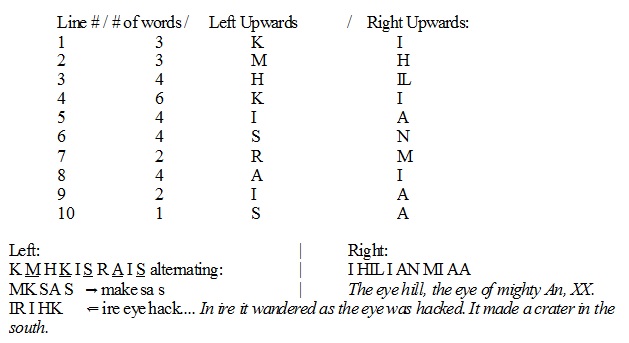 Again these are typical Baalist statements that tell of a double comet striking the mighty hill of An and in ire it wanders as the eye was hacked. It made a crater in the south. – This describes the details of the apocalypse. The root words of which are the same: a- poc-collapse or at ‘a’ there is a (poc)crater which caused the collapse. Further study of runes, ancient riddles and words will reveal to the reader whether this is accurate.
No doubt Mongé in his extensive study of this inscription found these same lines but ignored them as gibberish. He did obtain a readable acrostic (from the left end) by ignoring the lines with numbers. He also continued working until he found a brilliant substitution cipher using the over lined runes which contains Henricus. (Landsverk, pg. 205-206)
Back to Top
Again these are typical Baalist statements that tell of a double comet striking the mighty hill of An and in ire it wanders as the eye was hacked. It made a crater in the south. – This describes the details of the apocalypse. The root words of which are the same: a- poc-collapse or at ‘a’ there is a (poc)crater which caused the collapse. Further study of runes, ancient riddles and words will reveal to the reader whether this is accurate.
No doubt Mongé in his extensive study of this inscription found these same lines but ignored them as gibberish. He did obtain a readable acrostic (from the left end) by ignoring the lines with numbers. He also continued working until he found a brilliant substitution cipher using the over lined runes which contains Henricus. (Landsverk, pg. 205-206)
Back to Top
Over Lined Rune Ciphers
There are 9 over lined runes on the front. (I,T,D,A,A,K,A,R,A). There are 7 on the reverse (B,N,S,A,A,K,A). 79✓ The sum of the seven is 68 or 86 in reverse. ✓ The sum of the 9 runes on the front is 75 or 24+ 51. Recall there are 24 hours of longitude and the reader was directed to find 51.51̊ earlier. Notice that the first three (I T D) when read in reverse (Th/D is 3) are ‘3 TI’ or ‘3 at the Tie.’ Two of the A’s (X’s) are next to a B and bindrune (I+L). It is easy to arrange BAAL I or ‘Baal eye’ out of this. The remaining are A ARK or perhaps ‘ark at X.’ On the reverse. AKA appears. Aka can also be taken as AGA which may be ‘āga’⇒ own;‘ege’⇒ terror; ‘oga’⇒ ogre; ‘aga’ ⇒go away. So, perhaps it is ‘The eye of Baal lies where it owned it.’ The other over lined letters on the back: BN SA suggests ‘bane bucket.’ Or perhaps:The eye of Baal lies in 3 arks at the tie where it owned it. The baneful craters are horrifying.
Back to TopRhode Island
In that complicated line #14 which was where all the 17’s were found hides something else of interest. The line reads ‘AKI : 17 : ROIHDHAHOIKUA:’. The name AKI on the left was found above as the author. The long word appears to be a four word anagram. Remove the following letters from the long word: I, AKI, HU and what remains is ROHDAHO. ‘OH’ means ‘island’ so remove that ⇒ ROHDA?…. RHODA OH ……… ⇒ I, Aki how in Rhode Island. On the reverse there is another phrase that is very clear. Begin on the right side third line down reading in a straight line is: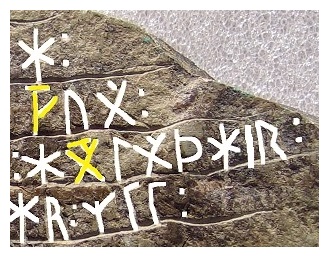 HKHR which ends at the ‘r’ in year (AHR).⇒ ⇒ hack here year…
Next column: UAM (2,10,14) or 1214. ⇒⇒ 1214
Indeed, the full word is HALADHIR or ‘He led here.’ And where is here? It also includes two anagrams with L as a divider. Find: HA – ADHIR ⇒ Rhadi Ah ⇒ Rhode Oh ⇒ Rhode Island. It repeats! (Recall there are 50 X’s in this. Some o’s and æ’s must have been sacrificed to achieve that number. I can be either e or I.)
So:
HKHR which ends at the ‘r’ in year (AHR).⇒ ⇒ hack here year…
Next column: UAM (2,10,14) or 1214. ⇒⇒ 1214
Indeed, the full word is HALADHIR or ‘He led here.’ And where is here? It also includes two anagrams with L as a divider. Find: HA – ADHIR ⇒ Rhadi Ah ⇒ Rhode Oh ⇒ Rhode Island. It repeats! (Recall there are 50 X’s in this. Some o’s and æ’s must have been sacrificed to achieve that number. I can be either e or I.)
So:
Aki cut in 1214 for the 100 year anniversary of Henricus’ arrival at Rhode Island where he led.
Back to TopLongitude and Latitude
Finding the longitude and latitude hidden in these inscriptions requires knowing it in advance. It cannot just be read off. The text gave us the clue Rhode Island so we shall have some area to work with, assuming it is the same Rhode Island we know of today. The location of Newport Tower is 41.48̊N and 71.31̊W and the location of nearby Narragansett is 41.45̊N and 71.45̊W with respect to the Greenwich Meridian. Interspersed through the text is Pentadic numbers such as seen on line two and three. A listing of these in order with the words North and West as they appear in the text follows. There are four tens and they are all the circle and stick shape. The M in the final date is excluded since it is not Pentadic: 17, 10, 10, 12, West, 12, Nor, 10, West, 10, 11,………reverse side: 17, 11 Total sum = 120. Sum from beginning to just after Nor (17+10+10+12+12+10) is 71. Sum from the end to just before Nor (11+17+11+10+10+12) is 71 ⇒ 71 North 71 Sum of numbers excluding 10’s to just after West is (17+12+12) is 41. Sum of remaining numbers excluding 10’s is (11+17+11) is 39. Sum of numbers from beginning to first West is (17+10+10+12) is 49. Sum of numbers from second West to end is (10+11+11+17) is 49. Sum of numbers on reverse side is 28. Additionally, numbers 17 and 12 are lined up over each other on the left so 29. Line three reads – UUULISA SUINK which is 41 A 48. Line four reads – 12 : RISI : UIST : 12 : NOR : 10 : SAKAM[LI] as all numbers this is… 12 : 34 : 34 : 12 : 17 : 10 : 75 The sum of just the numbers 12, 12 and 10 on this line is 34. Two words sum to 34. Line ten summed to 41 A 49. (See above.) The text clearly indicates 41.49 / 41.48 and 71.34. These coordinates bring one to just north of Fort Adams (at 41.48̊N and 71.34̊W) and west of Newport in the bay area off Aquidneck Island in Rhode Island. It would seem Aki did mean to indicate the Fort Adams / Newport area where stands the Newport Tower. Its apparent accuracy suggests they were using the Greenwich Meridian as opposed to other available meridians. (See Post: The Newport Tower: Finding the Date of Dedication, its Designer and Builder.) Back to TopFounding Family
There is another section of the text that is of interest. Line five ends with: HAAKON : FAN . Gordon (pg. 142) felt this meant ‘Haakon found.’ Haakon is a common name. A closer look at the text reveals more. As before this requires several lines not just one. Running vertically from FAN is FAN so it forms a square: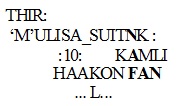
 Now one can find KAM, NAM and FAMLI in the square implying ‘Haakon (name) came and is the founding family.’ But there is more here. Notice the LOK at a diagonal and the AT both pointing to the same place or ‘look at.’ What then is in this odd word SUITNK? AKI the author’s name can also be found with the A below. Removing AKI what is left is SUTN which suggests NUT … ‘not’ and/or SUN … ‘son’ or ‘is not Aki.’
Perhaps, we are close to it. KINK/G or KUNK/G is here with the K below. King Haakon IV of Norway began his rule as a child in 1204. Removing these from SUITNK leaves SUT or SIT which seems to imply ‘sit.’ King Haakon IV was ‘sitting’ then but this entire inscription suggests the settlement is much older. Newport can be dated to at least 1116 by the Newport Tower (Freeborn, 2022). This is a hundred years prior to Haakon IV. The text offers another possibility. To the left is the name (UU/M) U -LISA with (D)THIR just above as if it says MUTHIR LISA or ‘mother Lisa.’ SUITNK is also an anagram of Kitsun. Just below the IT is K which repeats Kit. So it is: KITSUN KAM 10. Year 1010 is the date stated in the plain text. Perhaps, the founder of Rhode Island then was:
Now one can find KAM, NAM and FAMLI in the square implying ‘Haakon (name) came and is the founding family.’ But there is more here. Notice the LOK at a diagonal and the AT both pointing to the same place or ‘look at.’ What then is in this odd word SUITNK? AKI the author’s name can also be found with the A below. Removing AKI what is left is SUTN which suggests NUT … ‘not’ and/or SUN … ‘son’ or ‘is not Aki.’
Perhaps, we are close to it. KINK/G or KUNK/G is here with the K below. King Haakon IV of Norway began his rule as a child in 1204. Removing these from SUITNK leaves SUT or SIT which seems to imply ‘sit.’ King Haakon IV was ‘sitting’ then but this entire inscription suggests the settlement is much older. Newport can be dated to at least 1116 by the Newport Tower (Freeborn, 2022). This is a hundred years prior to Haakon IV. The text offers another possibility. To the left is the name (UU/M) U -LISA with (D)THIR just above as if it says MUTHIR LISA or ‘mother Lisa.’ SUITNK is also an anagram of Kitsun. Just below the IT is K which repeats Kit. So it is: KITSUN KAM 10. Year 1010 is the date stated in the plain text. Perhaps, the founder of Rhode Island then was:
Haakon, son of Lisa and Kit, was the founding family in 1010.
Back to TopA Full Translation
By now we have seen many subjects touched on in this inscription. The first was Baal followed by Henricus in 1117; and the founding family of Haakon Kitson in 1010; Rhode Island and its location; and its author, Aki, in 1214. However, there are many words as yet not discussed. After reviewing each line and looking at the remaining words a summary translation that is not so jumbled will be made. The transliterated image retains letter placement to facilitate reading of the text.
Line #1: SIKATUMODIN: KILSA ; SLAI :
The first word was found to be a partial anagram for Henricus and ‘amo’ which means ‘love.’ SIKATUMODIN includes the A, R below the M. This is an anagram of several words: SIT KAM MAR U ODIN or site, came, mar, U, Odin ⇒ At the site of Odin it came. It is a mar, a cup, an O den. KILSA describes the place again: where it killed is a bucket. KILSA is also an anagram for ‘a skill.’ The last word is an anagram for ‘sail.’
Line #2 : 17 : DID : HALADHIR : MIBAINBAD-HUM
17 was used to calculate the longitude/latitude and the years 1117 and 1217. DID is ‘did,’ and HALADHIR was seen to be both ‘he led here’ and ‘Rhode Island.’ MIBAINBAD-HUM appears to be plain text joined words: My baneful bad home. Note that BAD is directly above the SUITNK which was found to include ‘not king.’ So it is ‘Haakon is not the bad king.’
Running vertically under the ‘did’ is AIKI or I, Aki, did.
Line #3 : HUM : AHR : 1010 : [UU] ULISA SUITNK :
HUM is ‘home.’ AHR is both ‘year’ and an anagram of HAR or ‘here.’ 1010 is the year. [UU]U is part of the center pictogram and suggests ‘three cups.’ [UU] is also a Latin M so that MU with the R just below and a TH (D) just above as if it says MOThR LISA or ‘mother Lisa.’ SUITNK with the K below was ‘not sit King.’ It was otherwise an anagram of ‘Kitson.’
Line #4 : 12 : RISI : UIST : 12 : NOR : 10 : SAKAM[LI] – UNK
The numbers refer to the years 1217 and 1010. They were also used to calculate the longitude/latitude. UIST and NOR are ‘North’, ‘west’ or ‘waste.’ Above the NOR is RU or ‘row north.’ RISI with the M and A above form RIM and SAI or ‘rim’ and ‘sea.’ RISI with the A above forms ‘Æsir.’ The Æsir were the primary gods ruled by Odin. The line ends with SAKAM[LI]. SAK is either ‘sack’ or ‘sag’. It can also be SA KAM LI. ‘Sa’ is a bucket in Old English so it becomes ‘bucket came lie.’ The AMLI was part of the words ‘family’ and ‘fan.’ The K has I above and N below so ‘kin.’ If this is an anagram SAM KIN FAN FAMLI or ‘same kin founding family’ certainly makes sense. The word continues onto the next line. The LIUNK is UNKLE or ‘uncle.’ This Haakon Kitson is then uncle to the bad King Haakon.
Line #5 : UNK : SKIKHILMAN : HAAKON : FAN :
The first word UNK is KNO ⇒‘know.’ SKIKHILMAN is ‘skill hill hike man.’ Then follows the founders actual name spelled out, Haakon, with fan repeated both horizontally and vertically which seems to imply ‘founder.’
Line #6 : HR[IN]IKIN : AT : UIST : BAALAAKA :
The first word is an anagram of Henricus using the U and S above. This leaves ‘in.’ Above KIN is another K suggesting ‘king’ again and also ‘kin.’ The ‘in’ is followed by AT or ‘at.’ This ‘in at’ sounds redundant, however AT in Hebrew gematria is 79. HR[IN]IKIN is also HIR NI KIN or here nigh kin of king.
The H with U above and S below suggests SHU ⇒ ‘show.’
Then follows UIST or ‘west’ or ‘waste.’ Baal follows three times in different directions as shown above. LAAKA is ‘lake’ spelled with three A’s repeating the idea of 3.
Line #7 : SILKA : KIYSLRIKN : MIBAINBADH
SILKA as before is both ‘Kilsa’ and also ‘a skill.’ KIʀSLRIKN seems unintelligible which it should since it is an anagram for ‘Skrilingʀ’ ⇒ ‘scræling’ or foreign person. The last word, ‘my baneful bad home,’ was discussed before. It repeats three times as the refrain of the piece. Mongé felt Kilsa was the year 1124. (See Map Stone.)
Line #8 : UM : AHR : 1011: SMUALAL[LI][OO]SA :
This was discussed above. It was: It was razed and razed until it is a rim now. Upon An were the three strikes by Baal. It lies in the net at the baneful buckets from the three hits on A. As it mowed the eye, all was loosened.
This additional comment is added. The vertical runes running through the S might also include the A on the bottom line so that it becomes: ARSRSA of ‘Aesir, Aesir.’
Line #9 : BAMAR[OO]RMAT : THAT :
This was also discussed above. It was: ‘Area a room, tomb.’ THAT is ‘that’ and also was part of the end line anagram HATI or ‘hit A.’
Line #10 : SIKLASHIBI :
SIKLASHIBI appears complicated. It reads better with the M above the A included and the AT above the last I so that it says: ‘I am skil at ship’ ⇒ ‘I am skilled at ship’ which suggests he is either a skilled builder of ships or sailor.
Line #11 : RI :
RI is both 51 and 56. It appears on the Kensington rune stone on the side at the far right; and on the Rok rune stone in Sweden on the top at the far right.
Line #12 : NAIK[IL]AKTA : BAA
NAIK[IL]AKTA with the M below at the start of the line and the IN below the K reads: MANI KIL KIN ATAK ⇒ many kin killed in attack. The BAA is with the B below and DO is ‘ababod.’ This is Old English ‘æbebod’ which means an ‘edict of law.’
Line #13 : MB : UINA : SHIB : UIDH :
MB : UINA : SHIB : UIDH is almost straightforward plain text: move Vine ship with ⇒ moved to Vineland on a ship with…. Also find DOA running down with another A below and to the side N,M which implies …Doa (name). The runes in the square UID /HO spell out: HU I DO ⇒ how I do. The last H begins the ‘hack here Rhode Island 1214’ found previously which runs vertically to the right.
VINA has an R below the A which creates VINAR or an anagram for Vanir. The Vanir are another group of gods in Norse Mythology.
Line #14 : AKI : 17 : ROIHDHAHOIKUA :
The first word is the author’s name, Aki, and as discussed before the acrostic says: I Aki (name) make. The long word, also discussed above, is: I, Aki how in Rhode Island.
Line #15 : KOISAKANK : BANINA : HALADHIR :
The first two words are new. KOISAKANK is an anagram for I KO AS KANK ⇒ I go as King. KANK is directly over BAD so once again he states the King is bad.
BANINA is combined with the AB above the N so that it clearly says BAN, BAN. The U below the N creates ‘now.’ There is an M below the INA so that it is MANI or ‘many.’
Line #16 : MIBAINBADHUM : AHR : M11
MIBAINBADHUM was My baneful bad home. The H is part of another restatement of HAAKON. It moves up and to the left as HKON and up to the right as HAA. One of those A’s is part of BANINA and the M below it forms the word ‘name’ which confirms that it was intentional.
The remaining letters of AHR : M11 were a part of the vertical lines discussed above.
Vertical lines :
Vertical lines included the center pictogram, the Table Date line, and the line next to it which gave: Baal sow baneful hole.
Back to Top
Summary Translation
In order to summarize these jumbled ideas, their positioning in the inscription and topic will be taken into account. For example: ‘know, skill hike man’ are part of the Henricus anagram so presumably this refers to him. With that said, it translates more or less to: ………51 / 56 Rhode Island was founded in 1010. Haakon Kitson, son of Lisa and Kit, was the founding family. He was uncle and kin to the sitting bad King Haakon at my baneful bad home. Beloved Henricus in 1117 did he lead here in Rhode Island. He was a skilled sailor. Henricus was a knowledgeable man and a skilled outdoors man. Henricus hired nigh the kin of the King of the Scrælings to go west to the Baal lakes and show him. He rowed north and sailed with the scrælings in 1124. I, Aki, made and designed this. I am a skilled sailor. Many of my kin were killed in an attack because of an edict of law at my baneful bad home. I go as the bad King Haakon banned now my many gods. I moved to Vineland on a ship with Doa. This is how I came. For 1217, I, Aki, cut this and designed it in Rhode Island. He banned my gods Vanir, Odin, and Æsir, Æsir! At the site of Odin it came. It is a mar, a cup, an O den. It was killed at the bucket. The home of the three cups from Baal is here. It wasted the north and it became a rimmed sea. It was sacked as it sagged to where the bucket came to lie. Baal, Baal, Baal! There are 3 lakes. Baneful and bad was its home. Two comets struck the eye which is the tie. It flew up as it was struck. It was razed and razed until it is a rim now. Upon An were the three strikes by Baal. It lies in the net at the baneful buckets. As it mowed the eye all was loosened. In ire it wandered south as the eye was hacked. The area is a room, a tomb. That is where it hit. The eye hill at the eye is where many struck. At 56 is the eye and the bisected A. It made the craters. The eye of Baal lies in three arks at the tie where it owned it. The baneful craters are horrifying. Baal sowed a baneful hole. I, Aki, made this in 1214 for the 100 year anniversary of Henricus’ arrival at Rhode Island, 41.48̊N and 71.34̊W, where he led.Back to Top This concludes the Spirit Pond stones but there is another stone from the same period somewhat south which also provides …… a runic riddle. (Continues with The Nomans Land – Leif Eriksson Inscription – which was this previous post and the Narragansett Inscription here.) Back to TopEnd Translation It would take a miracle to read this inscription as plain text!
Previous… Newport Tower Post Next … Shawnee Runestone
Younger Futhark Runic Alphabet
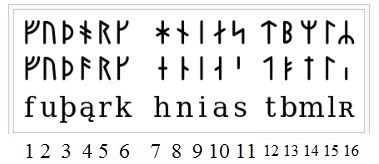
From Wikipedia
Similar Articles by the Same Author in PDF and Post:
*Easter Tables** For numeric background see:
**Freeborn, B.L., Validating North American Runic Inscriptions, noahsage.com, November 2022. PDF only. Freeborn, B.L., Ancient Riddles to Test Our Wits: The Secret Chamber, noahsage.com, January 2016. Post here. Freeborn, B.L., Another Riddle in Stone from Canada, noahsage.com, August 2025. Post here. Freeborn, B.L., Deciphering the Spirit Pond, Nomans Land and Narragansett Runic Inscriptions, noahsage.com, November 2022. Amulet post. Map stone post. PDF only. Freeborn, B.L., Et in Arcadia Ego – OUOSVAVV DM – Deciphered, noahsage.com, December 2022. Post here. Freeborn, B.L., Kensington Rune Stone: A New Translation, noahsage.com, February 2023. Post here. Freeborn, B.L., Rök runestone of Sweden, noahsage.com, April 2023. Post here. Freeborn, B.L., Runic Riddles: Time Capsules, noahsage.com, December 2022. Post here. Freeborn, B.L. The Long Debated Bourne Stone, noahsage.com, January 2023. Post here. Freeborn, B.L., The Nomans Land – Leif Eriksson Inscription, noahsage.com, December 2022. Post here. Freeborn, B.L., The Narragansett Inscription: A Translation with its Date of Dedication, Author and Inscriber, noahsage.com, October 2022. Post here. Freeborn, B.L., The Newport Tower: Finding the Date of Dedication, its Designer and Builder, noahsage.com, October 2022. Post here. Freeborn, B.L., The Wawa Stone and Its Viking Ship, noahsage.com, August 2025. Post here. noahsage