B.L. Freeborn © March 2023 (Full article as PDF)
Another riddle presents itself. The origin and meaning of the inscription on the Feather Stone of Eastern Canada like many others is debated.
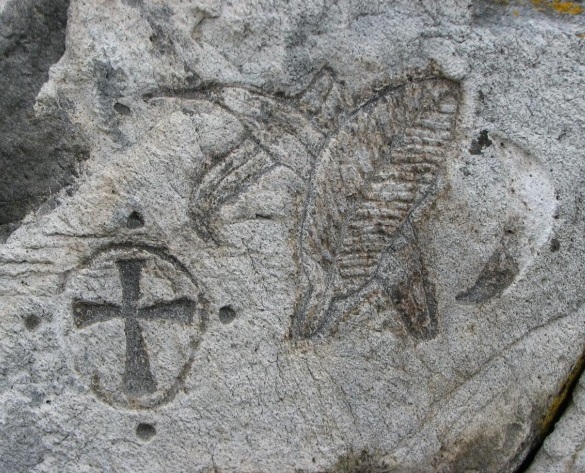
Upper carving on stone.
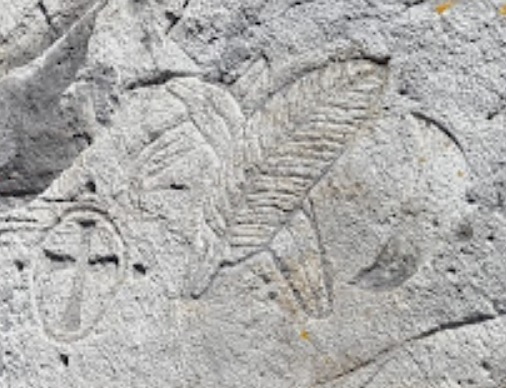
Upper carving.
The first of these carvings is a rebus. The second (see below) is a pictogram. Once you see it, there is no going back! The upper carving reads:
Father Henricus left (us) in 1124.
OM to leave for north cup tie in 1154.
Baal hit north (at) cup.
Similarly, the lower carving reads:
Henricus 1116-1117
(at) site Bael’s cup, (the) pole tie.
Daggers hit pole (and it) turned.
Baal hit (the) peg (at the) arc (and) hole.
1123-1124
The upper carving appears Christian. The observer is supposed to think it is, to protect it. [To continue this protection, because of vandalism, its location is not stated. It is off limits to the public now.] This seems to have worked since it still exists. The message is the same in both. These are pagan / Baalist statements similar to others found in the Spirit Pond stones, the Kensington Rune Stone and the Vinland Map. The date given on the map stone and others from Spirit Pond for Henricus’ departure is 1124.(Monge) Those stones date from around 1214-16 (Freeborn) and were written to commemorate Henricus who is clearly described in the long legend of the Vinland Map as having been the Bishop of Greenland around 1117. The next bishop was named in 1124. These must have been carved after 1124 but before Henricus faded from hero status in Vinland which provides a date span.
Interpretation of Upper Carving
The artist was clever. He spells out Henricus. The ‘feather’ provides the letter I which is a straight line in both Latin and Futhark alphabets. The ‘two leaves’ create a T. Now the word TI can be formed or ‘tie.’ They are also arranged in such a manner as to create an H, which is the same in both Latin and Elder Futhark. This creates HIT or ‘hit.’ This is also the H of Henricus. The I was just found. There is a notable similarity between ‘father’ and ‘feather.’ See it as ‘father + E.’ (Spellings varied at the time.) Now we have an E for Henricus.
The crescent provides a U and C depending on your view. It is also an arc which also provides an ‘a’,‘r’ and ‘c.’ So if you do not like the idea of getting an ‘e’ from feather then the ‘a’ and ‘e’ can switch, however the reader might want to see it. Then again, in the Younger Futhark, ‘I’ is also an ‘e’ so once again the E of Henricus is found.
The R is there as well. The arc/crescent provides the upper curve of R. The feather is the upright and the end of the leaf is the downstroke of R. We now have HE_RICU_. What of the S and N? There are ‘2 leaves’ or ‘to leave + S.” The S is found.
Now, where to find the N? That circle and cross is supposed to emphasize this is Christian. That is important in an era when Christians are committing genocide of pagans and Baalists. Look at it again and you will see it is a compass. The cross is a Futhark N in an O. (See tables at end.) This same idea is found on the Kensington Rune Stone. The 4 dots further indicate the cardinal directions. The compass implies North. The O and N spells ‘on.’ The N of Henricus is found. Additionally, the O represents Baal and where it hit is provided by the idea of North in the compass.
Now we have the phrase ‘to leave on’ which suggests a date must be here. Knowing it in advance is perhaps cheating. There is 1 arc, 1 feather, 2 leaves and 4 dots ⇒ 1124. This can additionally be confirmed by the Elder Futhark letter/number equivalents. The letter values for H and U are 9 and 2 which sums to 11. The value for O is 24 so that 1124 is found again. The Golden Number (GN) used in the Perpetual Easter Table (see table) is 4 for that year. The Day Letter (DL) value for that year is 5. Around the O are 4 dots. Furthermore, there is a 5th dot pecked directly above which is the DL. The Elder Futhark E is shaped like an M. The two leaves and feather can be seen as an M or as stated, a Futhark E with value 19. This is the line number for years 1116 to 1124. The year then is confirmed.
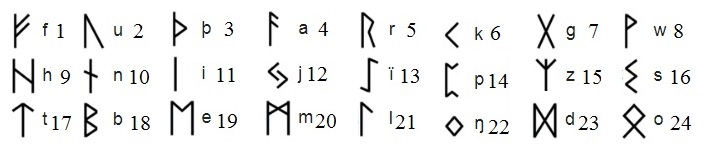
Elder Futhark Alphabet sound and numerical value.
Now that it has been decided what this carving says, an additional bit reveals the artist himself. As stated, the compass provides an O. If the leaves and feather form an M, then perhaps these are initials OM. The date could be 1154 for similar reasons as stated above. The artist names himself and states when he carved this. This is the work of OM and he traveled here in 1154. This OM left other beautiful art work that shall be discussed in another article. So, we add the artist to this interpretation.
It reads quite easily now:
Father Henricus left us in 1124.
OM to leave for north cup tie in 1154.
Baal hit north (at) cup.
Interpretation of Lower Carving
The second inscription is more weathered probably due to its lower position on the stone in a climate with a lot of snow. Typically the bottom two portions are read as 06 07 which are Arabic numerals. These were in use within mathematical circles in Europe before the 1100’s. If the intention was to emphasize these, then they suggest a date of inscription of 1206-1207 for reasons as stated above. However, they are not just an 06 and 07. The images here show this is what we want to see because that is what we expect and what is actually there seems …well…odd.
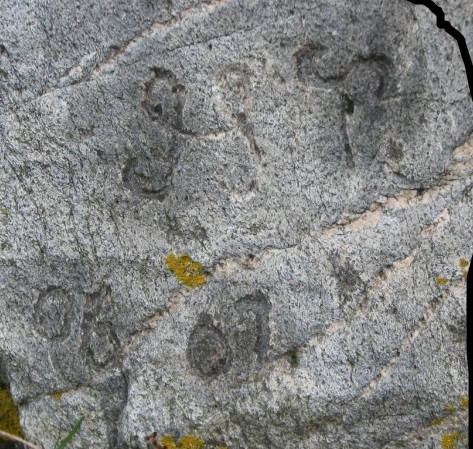
Lower carving on stone.
The 06 begins with an O as in the name O-den. It represents a hole. Then the arc as seen in the upper carving is represented here and connects the O to a peg. The ‘6’ is Baal, a round object with a tail, that strikes the peg or pole. In plain language, ‘a comet strikes the north pole.’ This is a pictogram of an event that is an essential part of the pagan / Baalist religion. It is similar in nature to statements found on the Kensington Rune Stone, Spirit Pond stones and even the Vinland map etc.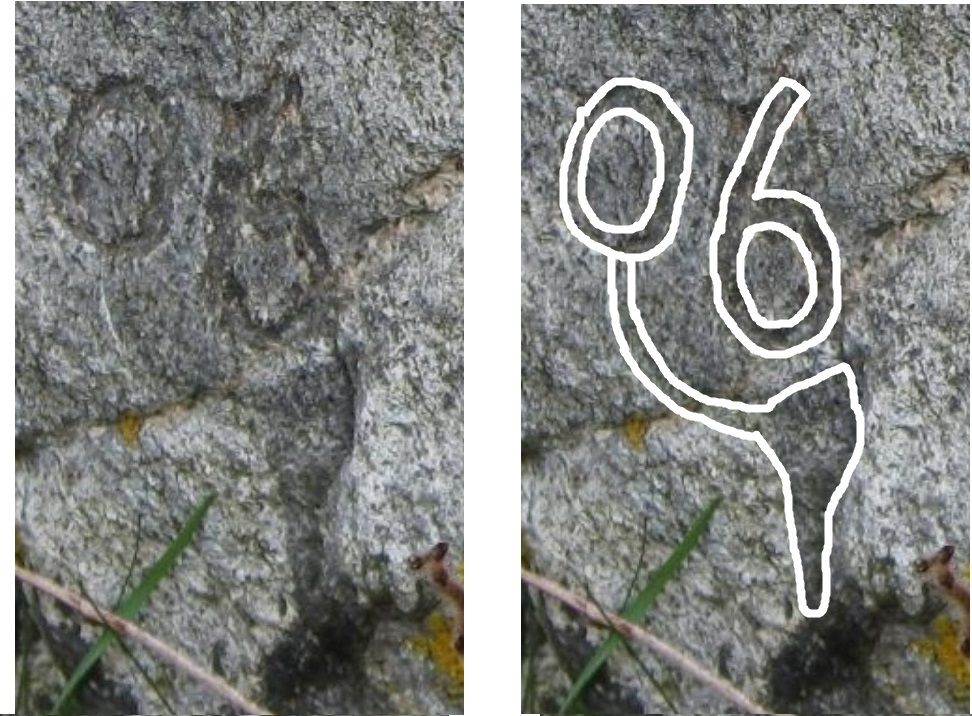
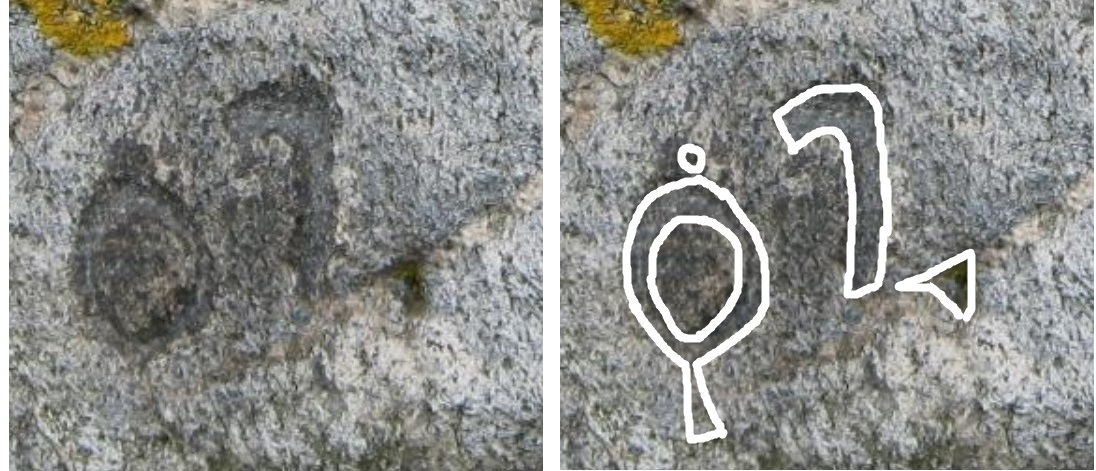
The 07 provides an O on a peg as well. The slightly curved 7 is very useful. It suggests a pole, an arc, small ‘r’ and the upright stroke of an L. The small wedge at its base completes the L and also creates a V shape. The ‘r’ is turned. The pictogram tells us the ‘dagger struck the pole on top of the world and it turned.’
 The cursive looking H is most certainly the first letter of Henricus. The cup and U are found within the H at the top. C is in the left vertical. A cursive/lower ‘e’ is at the top left. The lower M shape of the H might also be seen as an Elder Futhark E. The right upright provides P. The double loop at the top is both a Latin and Futhark B. The left intersection is a Futhark N and the right is an A. We now have: HENR_CU_ , BAEL and also POLE. The I and S of Henricus are obvious in the letter to the right that creates a T as well. Now the words are complete with Henricus, Bael, tie, hit, sit/site and pole.
If a date is suggested here, it appears to be …24. The carving is on 2 lines with 4 groups which suggests 24. A similar date can be found by counting parts. The ‘06’ has 2 parts and the ‘07’ has 3 parts …23. These years are seen in the Bourne Stone, Newport Tower, Long Inscription Stone from Spirit Pond in reference to Henricus. The repetition of these numbers suggests it commemorates these dates.
For those who are interested – for year 1123: the Line # is 19, the GN is 3 and the DL is 7. If that useful H is seen as an Elder Futhark ‘E’ then 19 is found. Similarly, for year 1124: the Line # is 19, GN is 4 and DL is 5 and 6 (a leap year). The 19, 4 and 6 have all been found.
Two other dates are apparent. The year of Henricus’ arrival in Vinland is considered to be 1116-1117 per the Spirit Pond Stones, Vinland Map and the Newport Tower inscription. That same I of the T, on the right side, has value 11 in Elder Futhark, an S has value 16 and the T has value 17 so ….1116 – 1117.
The interpretation reads:
Henricus 1116-1117
(at) site Bael’s cup, (the) pole tie.
Daggers hit pole (and it) turned.
Baal hit (the) peg (at the) arc (and) hole.
1123-1124
The reader might want to explore the references below to confirm these translations are supported elsewhere. It would appear the extent of Norse / northern peoples exploration and occupation in North America is vastly misunderstood and underestimated. Overall, they are both clever reminders that Henricus once led Vinland and he was important to people of northeast North America.
Similar Articles by the Same Author in PDF and Post:
** For numeric background see:
**Freeborn, B.L., Validating North American Runic Inscriptions, noahsage.com, November 2022. PDF only.
Freeborn, B.L., The Vinland Map Ciphers, noahsage.com, December 2025. Book only see post.
Freeborn, B.L., The Vinland Map Ciphers Addendum, noahsage.com, December 2025. PDF only.
Freeborn, B.L., Ancient Riddles to Test Our Wits: The Secret Chamber, noahsage.com, January 2016. Post here.
Freeborn, B.L., Another Riddle in Stone from Canada, noahsage.com, August 2025. Post here.
Freeborn, B.L., Deciphering the Spirit Pond, Nomans Land and Narragansett Runic Inscriptions, noahsage.com, November 2022. Amulet post. Map stone post. PDF only.
Freeborn, B.L., Et in Arcadia Ego – OUOSVAVV DM – Deciphered, noahsage.com, December 2022. Post here.
Freeborn, B.L., Kensington Rune Stone: A New Translation, noahsage.com, February 2023. Post here.
Freeborn, B.L., Runic Riddles: Time Capsules, noahsage.com, December 2022. Post here.
Freeborn, B.L. The Long Debated Bourne Stone, noahsage.com, January 2023. Post here.
Freeborn, B.L., The Nomans Land – Leif Eriksson Inscription, noahsage.com, December 2022. Post here.
Freeborn, B.L., The Narragansett Inscription: A Translation with its Date of Dedication, Author and Inscriber, noahsage.com, October 2022. Post here.
Freeborn, B.L., The Newport Tower: Finding the Date of Dedication, its Designer and Builder, noahsage.com, October 2022. Post here.
Freeborn, B.L., The Wawa Stone and Its Viking Ship, noahsage.com, August 2025. Post here.
Freeborn, B.L., Rok Rune Stone and its ciphers, noahsage.com, November 2024. Post here.
 noahsage