B.L. Freeborn © August 2025, Updated September 2025 (Full article PDF here.)
The Wawa Runestone is an excellent topic for study. It is located in Wawa, Ontario above Lake Superior. More information and photos are available at OCARE, Ontario Centre for Archaelogical Research & Education.
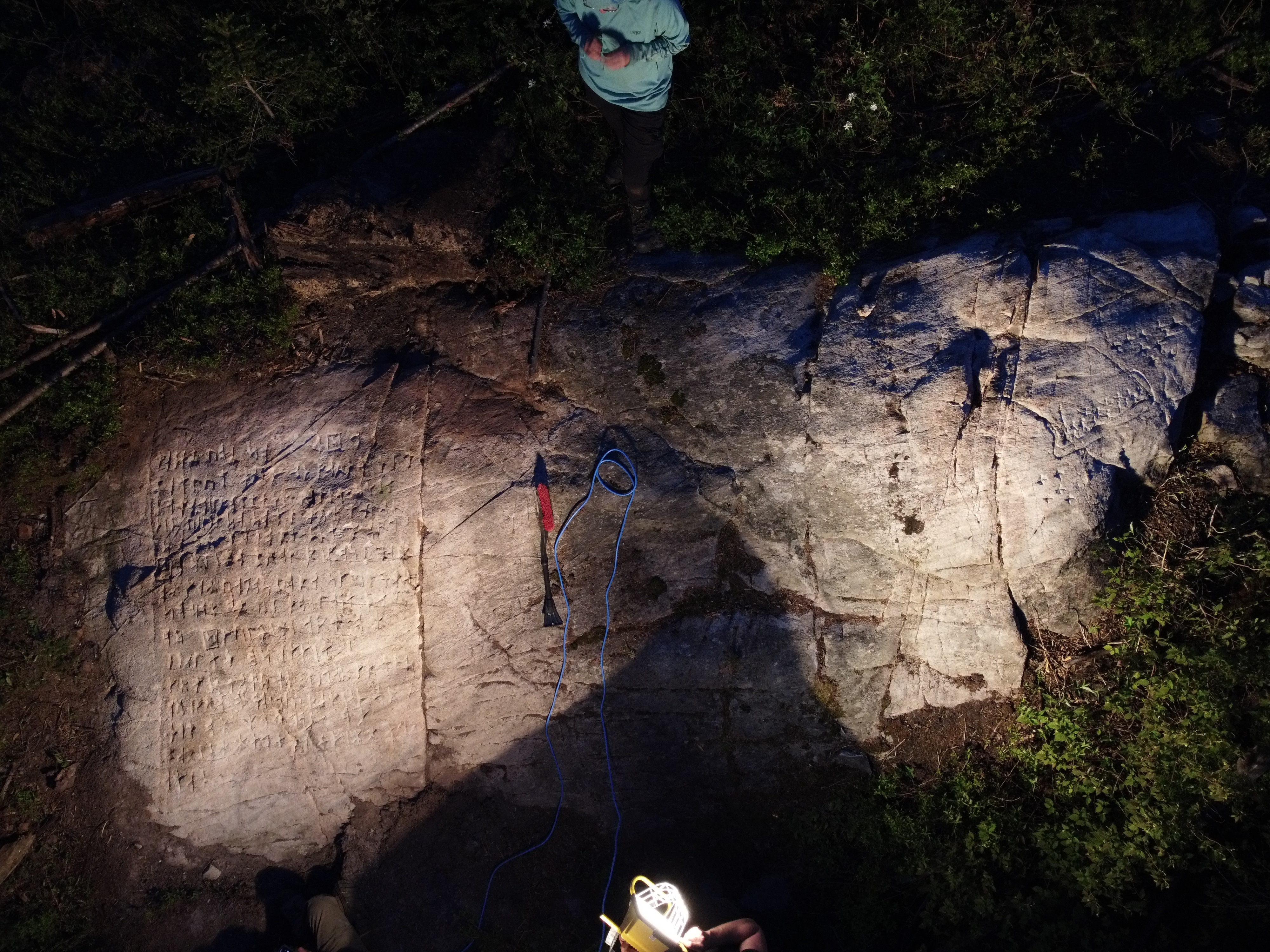
Image from OCARE.
The runestone is composed of two parts. There is an extensive inscription in runes on the left and higher up on the rock to the right is a ship in a Viking style. Dr. Henrik Williams was first to study the inscription and will be publishing a paper on the topic. In the meantime, a video is available where he discusses the stone with David Pompeani. (YouTube link here.) In that discussion, he states that often a runic inscription has no relation to the art presented and that the two parts may have been done by different people. That seems to be true here. Indeed, the reader can see easily that the long inscription was done with a sharper, finer tool while the ship was done with a more blunt tool and a much stronger arm. Dr. Williams has identified the inscription as a protestant version of the Lord’s Prayer in modern Swedish. The inscriber did not date the inscription which leaves room for some discussion. It is believed to be of 17th to 19th century origin.
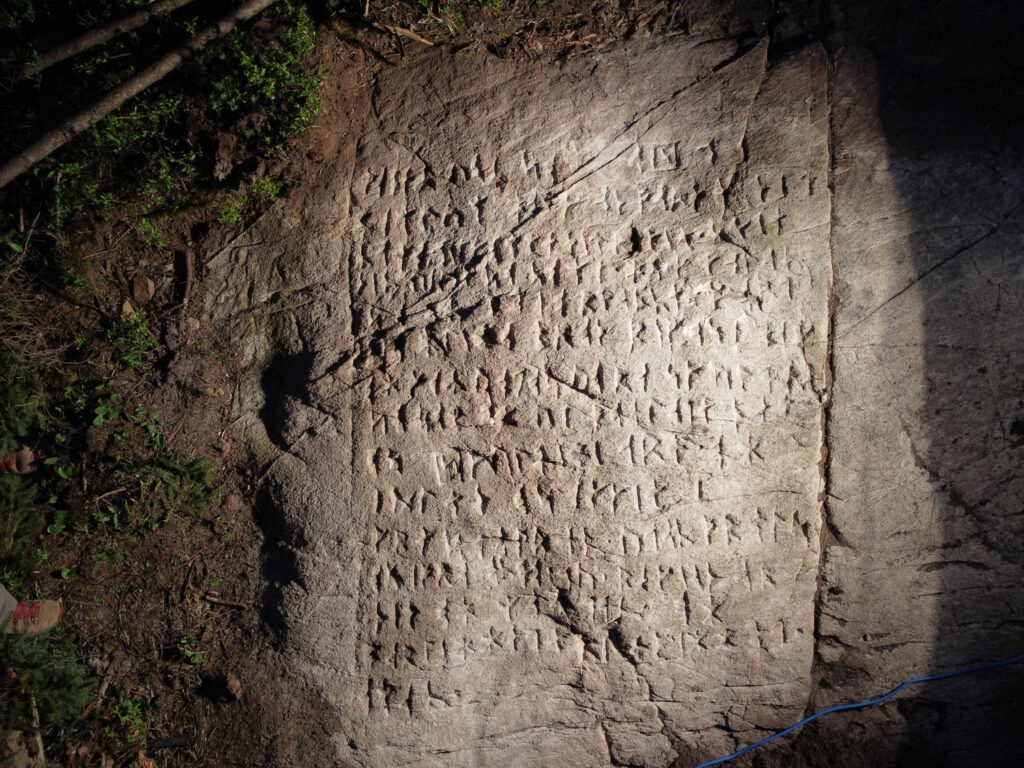
Image from OCARE – Long inscription on left side of Wawa Stone.
As far as the right side with the Viking ship, Dr. Williams could not comment on it, nor did he know the meaning of the X’s. Many would presume these X’s are burial crosses but that implies Christianity, and the Vikings were not necessarily Christian despite their supposed conversion. People converted at knife point are seldom true believers. What then did the artist intend to convey with the crosses? There are no runes present to give any further clues.
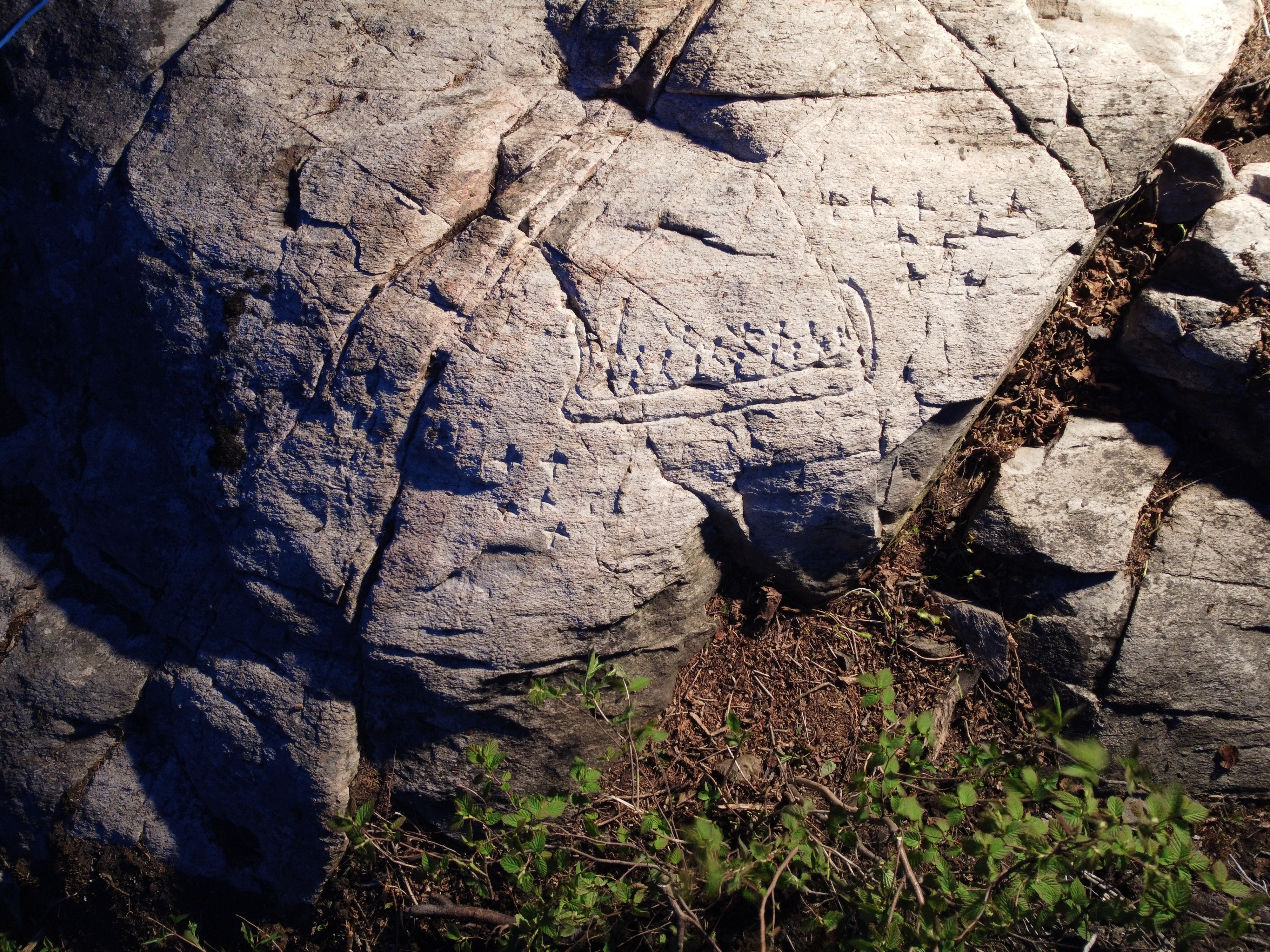
Image from OCARE – Ship on right.
Let this not deter us from further study. Notice the artist has presented us with two groups of crosses separated by the ship which implies the number of X’s has some significance. There are five on the left and ten on the right. The number of people shown in the ship appears to be seventeen but others count sixteen. This gives 17, 10 and 5 which is hardly enlightening. However, on closer inspection one notices that the 5 X’s are so arranged to provide two groups of 3 and 2. This grouping then provides 5,3,2. (See image below.)
Closer inspection of the group of ten on the right provides 5 X’s in the first horizontal line, 3 in the next and 2 in the last so that 5,3,2 repeats. This is significant. The Perpetual Easter Calendar/Table was used in the Catholic Church from early times and was still in use long after the Viking era ended. Since calendars were not available, a device was invented similar to a slide rule that allowed the user to determine on what day of the week the first Sunday would fall for each year (known as the Dominical or Day Letter). It repeats every 532 years. (See PDF – Easter Table.) The artist may not have known his letters/runes but he knew his numbers. By providing the 532 in each group of X’s the artist makes it clear there is a date here.
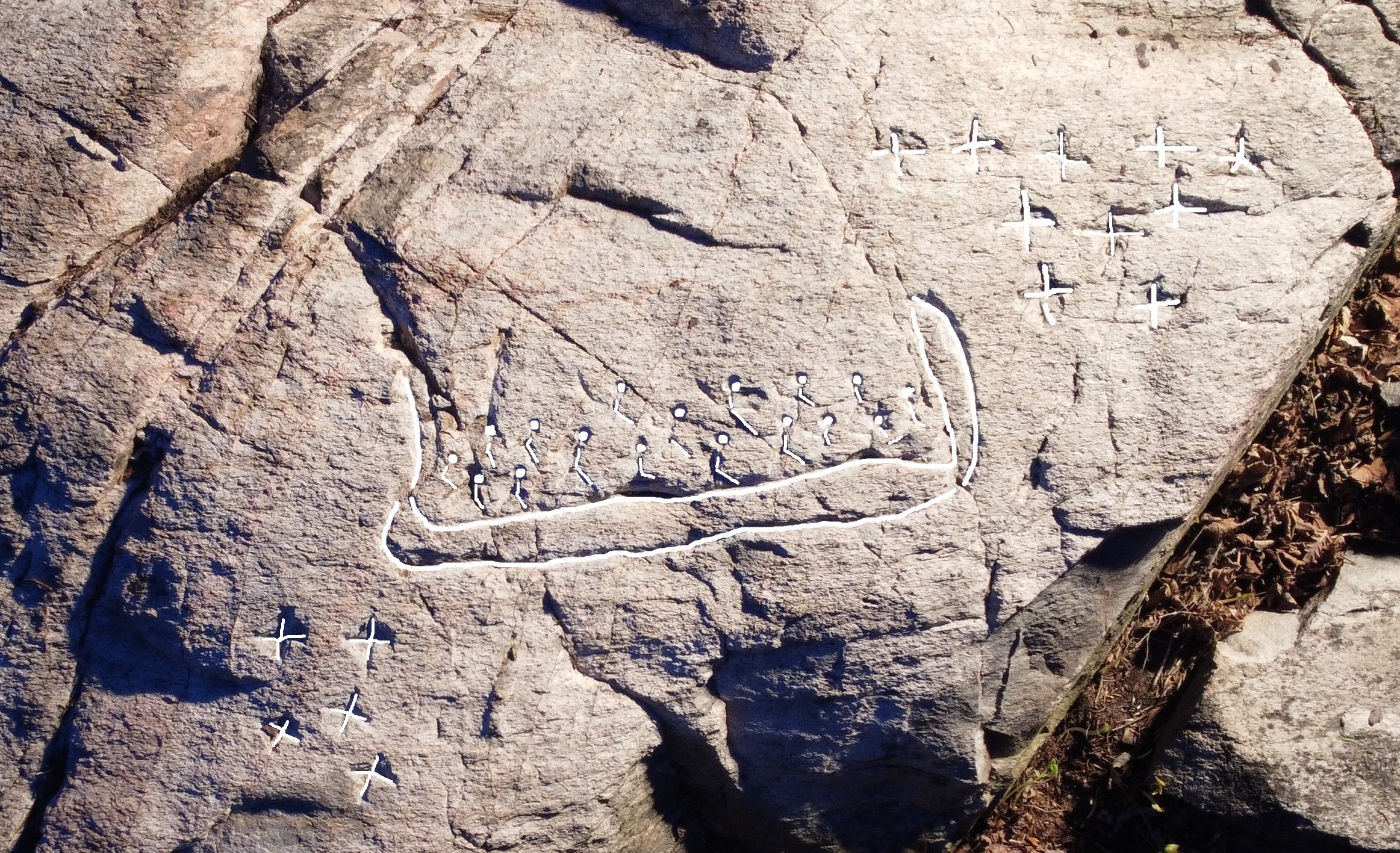
Men and X’s highlighted in white.
To obtain a date from the Table one needs a Line Number #, Golden Number (numbers within the table) and the Dominical Letter/Day Letter (DL) which runs along the top. A proper dating should repeat the date in someway in a more straight forward manner. Presumably, this is the purpose of the X’s.
If one uses the numbers 5, 10 and 17 as provided by the groupings there is no match within the table. However, if the X’s were to announce a date is present, then the 17 men must imply the date in some way. Perhaps it is 1017,1117,1217, etc. But which century?
Year 1217 is on Line #3 with Golden Number (GN) 2 and Dominical Letter (DL) #1. These numbers are provided easily by the three groups of numbers, two of which are X’s and one of which is men. This makes this date a strong possibility. However, it is more likely they refer to year 1123. The Spirit Pond Stones speak of Henricus who was the Bishop in the Vinland Map. He traveled to Vinland circa 1116 and died presumably in 1123, based on church records for his replacement.
The number 23 is easily found in more than one way by the positioning of the X’s. The year 1123 has Table numbers: Line #19, GN 3 and DL # 7. The value 19 is not represented but the right hand grouping of X’s can be easily separated into 3 and 7.
Other dates were studied with mixed results. One might say that the artist did not mean for us to use the calendar to derive the date. But the artist certainly used the number 532 to alert us to the presence of dates.
Both 1117 and 1123 are strongly supported by the art. Indeed, they are both supported by the Spirit Pond Stones (link to study), the Feather Stone of northeast Canada (link here) and 1117 is supported by a runestone found in the Newport Tower (link to study). Both of these dates refer to the arrival and departure of Bishop Henricus in Vinland as mentioned in the Vinland Map. According to both the Spirit Pond Long Inscription Stone and the Vinland Map, he explored up the St. Lawrence and down into Hudson Bay. The proximity of Wawa to Hudson Bay should be noted. The 1117 and 1123 would then be commemorative dates. They mark the beginning of exploration of northern North America by the Vikings. Continued exploration should have followed which explains who may have carved this ship and suggests when.
The unknown artist commemorates
Henricus and his Viking sailors’ exploration
in 1117-1123.
Sadly, virtually everything found in North America that might indicate any European explorer from the dawn of time tread here before Columbus has been declared a fake, destroyed or intentionally forgotten. One such notable work that discusses this topic is “The Rediscovery of Lost America” by Arlington Mallery and Mary Roberts Harrison, 1979. This work has also been denigrated but if one takes the time to read his references, then his work speaks volumes.
What then happened to the Vikings / Norse / Normans who came to America? Why has history forgotten them? There is a simple answer. If these people were anti-Catholic, then it would have been essential to keep the continent and their colonies a secret. If they lived very simple lives in longhouses and communities, then they left little behind. If they remained in contact, on the sly, with northern Europe, then the Black Death came with the sailors and wiped them out in the late 1300’s as well as any memory of them that existed in Northern Europe.
PREVIOUS POST – NEXT POST ON THE FEATHER STONE
Similar Articles by the Same Author in PDF and Post:
** For numeric background see:
**Freeborn, B.L., Validating North American Runic Inscriptions, noahsage.com, November 2022. PDF only.
Freeborn, B.L., The Vinland Map Ciphers, noahsage.com, December 2025. Book only see post.
Freeborn, B.L., The Vinland Map Ciphers Addendum, noahsage.com, December 2025. PDF only.
Freeborn, B.L., Ancient Riddles to Test Our Wits: The Secret Chamber, noahsage.com, January 2016. Post here.
Freeborn, B.L., Another Riddle in Stone from Canada, noahsage.com, August 2025. Post here.
Freeborn, B.L., Deciphering the Spirit Pond, Nomans Land and Narragansett Runic Inscriptions, noahsage.com, November 2022. Amulet post. Map stone post. PDF only.
Freeborn, B.L., Et in Arcadia Ego – OUOSVAVV DM – Deciphered, noahsage.com, December 2022. Post here.
Freeborn, B.L., Kensington Rune Stone: A New Translation, noahsage.com, February 2023. Post here.
Freeborn, B.L., Runic Riddles: Time Capsules, noahsage.com, December 2022. Post here.
Freeborn, B.L. The Long Debated Bourne Stone, noahsage.com, January 2023. Post here.
Freeborn, B.L., The Nomans Land – Leif Eriksson Inscription, noahsage.com, December 2022. Post here.
Freeborn, B.L., The Narragansett Inscription: A Translation with its Date of Dedication, Author and Inscriber, noahsage.com, October 2022. Post here.
Freeborn, B.L., The Newport Tower: Finding the Date of Dedication, its Designer and Builder, noahsage.com, October 2022. Post here.
Freeborn, B.L., The Wawa Stone and Its Viking Ship, noahsage.com, August 2025. Post here.
Freeborn, B.L., Rok Rune Stone and its ciphers, noahsage.com, November 2024. Post here.
 noahsage
the boat Looks more like a native’s canoe , or an explorer’s canoe.
One would think the Vikings had a canoe version of their ships that did not have sails for use in exploring rivers.