Where Magic Lies

By B.L. Freeborn © 2013

We have detailed a magnificent earthwork to be constructed. It will be a mile in length so it will require a large plane. It will use three circles to display an idea composed of numbers. If it is properly placed, its power will be so great it will defy the ravages of time.

It is decided that it will be placed 79.2 miles from the place that links many places of power and it will be placed 32 degrees longitude from another place of power. This number 32 is the most important squaring of 5.656 while 79.2 represents the diameter of the Earth. This mile long work of art actually exists just as described. It is laid out in a plain, not too close to the East Fork Works, with its mounds that run in straight lines, and not to near the great works in Newark with its similar design of concentric circles of mounds and ditches. The great ones of the past chose a flat plane that lies on line of longitude one, 1 , where many other mounds have been built. This mile long structure begins 79.07 miles north of Lincoln Cathedral, England and ends 80.05 miles north which places 79.2 miles within the middle of the structure. Indeed, it lies 32 degrees from the Great Pyramid in Egypt. But to add more power to the placement of these two great structures, they will be 32 degrees and 40 seconds apart. This number, 40, is great in beauty and power. We recall its power was used to poetically describe how long it rained during Noah’s travails and how many years Moses endured in the wilderness: 40 days, 40 years, and now 40 seconds. And what does this simple number reveal?

A square 40 to the side has a circumference of 160 and an area of 1600. This is the important number 16 we saw in the Decalogue Stone: 16 x 16 = 256 or the number of letters on the stone. But most importantly a square of 40 has a diagonal of 56.56 and this most secret number is always with us.

The site for this great work is chosen by aligning it with other places of power. Thornborough Henge in its newly finished form shimmered with white gypsum some 5000 years ago, 3500 to 2500 BC. It lies an ocean away from Ohio and the home of the mound builders. And so our mystery is now convoluted by time and great distance…..

Thornborough Henge in England. Image by

Thornborough Henge in England. Image by 2013 Google, Digitalglobe, Infoterra Ltd. & Amp; Bluesky.

The Ohio mounds, we are told, are rather recent being almost as old as the language in which this is written. Newark Earthworks, the largest complex in the world, are dated to 250 – 500 AD. Surely, scientists have discovered that Watson Brake complex in Louisiana dates to 5400 years ago or the same era as the Thornborough Henge.

The Newark Earthworks were built, we are led to believe, by people who had newly discovered the geometry of a circle and how to use a rope to make one. Yet, the missing East Fork works suggests otherwise. We are further led to believe their significance had to do with their cosmology and it had no relation to our present day life other than being the historical religion of the native people at that time. These people, we are fervently told, came via a land bridge from Asia some 10,000 years ago even though they have lost the characteristics typical of Asians and look Caucasian-African. And while trucking over the continent they were stopped in Louisiana by a large gulf and there, some 5400 years ago, they built mounds. If these fellows had a ship, like the Egyptians of their era, they could have gone all the way to England and seen the distant ancestors of the English who had also just created mound earthworks! What a marvelous synchronicity! Oh, but what a dilemma for the scientist! Alas, he must choose between evidence of synchronicity or pre-Columbian (and pre-Leif) contact!

Perhaps if we understood what message lies hidden in this great earthwork in England we could grasp why they are similar? What is it that we still do not understand about them and these numbers? What is the importance of 56 and even 860? Of 16 and 584?

Longitude measured by Neolithic people? Hidden messages, people traveling great distances, measurements that ought not be there, and identical structures built on unknown continents? This is all contrary to our education! So it cannot be.

Perhaps there is something here we really do not want to understand. Perhaps they have drawn it out for us as plain as day but because of our education we cannot see it.

Back to Previous Post

Back to Table of Contents

Forward to NEXT POST

A Magnificent Array of Numbers Awaits

By B.L. Freeborn © 2013

Before we move on let us collect together all the numbers we have seen so far. In the Decalogue we had 16, 56, 5656, 58, 69, 69.2, 70, 79, 86 and 864. At the East Fork Works we found 864,000 and 860. We also found 66, 584 and 792, and 1859 twice. We also found conversion from feet to inches to repeat numbers. The tenth mile, 528, appeared here and at the High Bank Works. 900 was used twice, .333 appeared as acreage, and Millon’s 187 appeared as its half 935. We found 560, 440 and 30 degrees and showed how the circumference of the planet, 24880, is related to 440 and 565.

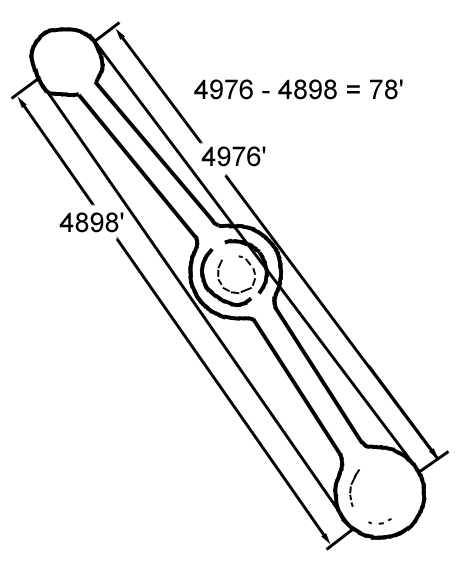
thornoverallThis is a considerable list. Let us resume by looking at these last few. Let us say we want to make a diagram that is simple yet complex, elegant and magical all in one. We begin with the concept of the circle and create two 860 feet in diameter. Then set the centers at 2400 feet apart. The 24 will represent the number of hours in a day on our planet. This means the distance between the two circles will be joined by a path 1540 feet long or 2 x 770. This is perfectly ideal since it reflects the number of days in the week and 7 is a purely magical number.

We add a third circle to our drawing. This circle has a diameter of 640 or twice 320. We choose this value for several reasons. Note that 640 + 860 equals 1500 and a planet that turns once in 24 hours turns 15 degrees in an hour. This value 320 can be thought of as 10 x 32, or 10 x 5.656 x 5.656 and that makes it truly magic. It is 56 squared!

What distance should they be set apart? What about 2480 feet? This will give us the circumference of the planet. The distance between these two final circles will then be 2480 – 320 – 430 = 1730. And what is this number but 2 x 865 feet which …almost… completes the elegance of the idea.thornpaths.

But something is missing….. Three circles all in a row with one small and two large gives us 1 and 2 or 12, or the number of houses of the zodiac at 30 degrees each. The overall length of the structure becomes 5630 feet. It needs to be a few feet larger or smaller. If we push the circles out of alignment we can change the overall length to 5600 feet and we do it in a manner so that the tangents drawn from each side of the outer circles differ in length by the final magic number 79. Indeed, because the first circle is of a radius of 320 feet and we desire an overall length of 5600 then the center of the first circle lies exactly one mile, 5280 feet, from the outer edge of the furthest circle. To do this the structure must bend about 5 degrees. Almost perfect…. We can perfect it by making the paths between the circles 200 feet across or 2400 inches for the hours in the day and this will mean the area of the upper path is 7.94 acres (nearly the desired 7.92)  and the lower becomes 7.07 acres.

thorntangentsThe magic need not end there. This work will betray more numbers as the circles are surrounded by ditches and within them concentric circles of mounds and more ditches will be built. The structure will be in all ways a great tribute.

But where shall we put this large and magnificent display of the most important numbers in the world?

Back to PREVIOUS POST

Back to TABLE OF CONTENTS

Forward to NEXT POST

.

A Simple Idea Only a Foot Long

By B.L. Freeborn © 2013, updated Nov. 2018

Hanukkiah Earthworks or East Fork Works of Southern Ohio with Dimensions

Hanukkiah Earthworks or East Fork Works of Southern Ohio with Dimensions

The ancient world took their Ruler very seriously. The King or Ruler as represented by a man would confirm and declare the standards of measure of his land or the ruler. The terms are not meant to be a play on words. It is just that we have forgotten how important standards of measure are. We forget that is until we are at the gas pump and we think we have been shorted! Oh! Then we remember and call the local weights and measures guy and file a complaint with our current Ruler that the law is not being followed. This tradition is alive and well.

The unit of length found by Rene Millon at Teotihuacan near Mexico City was a length of 57 meters or 187 feet.

Hugh Harleston, Jr. in 1972 found that the unit of length at the same site was 41.66″.1

Robert Horn and Ray Hively2 suggested in 1982 the standard length of Newark was 1054 feet. (This is 527 times two.) They called it an OCD (Observatory Circle Diameter). They otherwise measure in meters.

William Romain follows Horn and Hively and uses OCD’s but he otherwise measures in feet.

Marshall notes a radius of 528 feet at the High Bank Works. This 528 is 1/10th of a mile.

The scale on the East Fork Works indicates the candelabra is 528 feet across or 1/10th mile.

The resemblance between the Indus Inch, Sumerian Inch, and English inch is not by chance. In fact, it can be shown with relative ease the basis for Harleston’s length of 41.66″ is the 36″ yard.  Notice that 36/ 41.66 is .864 and this number is found in the diameter of the Sun at 864,000 miles. The same cannot be done for Millon’s length of 187 feet. Notice also how impractical this unit is. A measuring tape of 100 feet can be bought today for a good price and this is almost half the length Millon is proposing. Nobody routinely carries around a 100′ tape. It is unwieldy. People do routinely carry 16 foot tapes, nearly the length of the standard rod of the old surveyor of 16.5 feet. If one makes it into two pieces it is a stick 8.25′ long or if three pieces 5.5 feet in length. In other words, it can double as a walking stick. If 187 feet is absurd then a standard of 1054 feet or an OCD fails for the same reason.

Unless!… they are suggesting the basic unit was a foot and 187 feet then takes on a whole other meaning. The OCD or 1054 feet takes on another meaning as well. If the diameter is 1054 then the radius is 527 or one foot shy of 528. We should consider a factor called error. The ropes were either not taunt enough to get an accurate measure of 528 feet (1/10th mile) or their foot measure was off by .19%. This is a negligible error when talking about a single foot but the error multiples at greater distances and adds up in this case to a foot.

Most of the world will not agree, but the silliest mistake being made in the study of ancient monuments is the use of the meter. They did not use meters. We should not use meters to measure their monuments. The measure closest to what they probably used is still commercially available, very affordable and still in use in the US. There is a big downside to not understanding why the foot /mile measure should be rigidly adhered to at ancient sites. The lengths and numbers had religious importance and the words through gematria reflected the numbers. For example, in the East Fork we just examined, can one see Millon’s value of 187 feet? It appears on the long side as 187 / 2 = 93.5 or 10 times this = 935 feet. We see it quickly because it is a multiple of 10. Compare the converted units. This 93.5 feet becomes 28.5 meters and then one tenth of this is 2.85 meters. The value preferred in the Torah is 186. It repeats the 86 found in Elohim (Lord).  If we are using 2.85, 28.5, or even 57 meters we will never see the repetition in the gematria of the words. We will certainly never arrive at the concept to which they were alluding. The Sumerian cush was discussed in another article and how via gematria one can arrive at its length. The ancient cush is otherwise called a Megalithic Yard.

Here is another example showing how 66 from a partial inch to thousands of miles appears in the foot system and the metric system:

.66″           66″        66′            660′            66 mile       66,000 mile

equates to:

1.68 cm   168 cm   20.11 m    201.17 m   106.2 km    106,216 km

The message gets lost in the units.

The 187 foot length is not their unit of length as Millon deduced. Its repetition at Teotihuacan merely meant the site was built to focus (worship, recall) that length and its meaning. Observe the same phenomena in the East Fork. The repetition of 66 and its repeat in 132 and even 110 feet as 1320 inches does not mean their base unit was 66 feet. It simply means their base unit was the foot and inch, and that they are trying to tell us something important by emphasizing these lengths.

These numbers 66 and 187 still have valid measurable meaning today. Handed down by the “gods” to the Kings to the people and down through generations to us we are still using these units. We do not remember why they have meaning and we do not remember why 66 and 187 and the rest of this growing number list is important but we are slowing getting there. The mystery is unraveling.

One more important concept about East Fork is to be seen before we move on. The left side has an angle. The line is 825 feet high and the line angled at 30 degrees is 440 feet long. (Note that 825 is 528 reversed and recall there are 5280 feet in a mile.) The base length of the candelabra is 560 feet long. The 30 degrees represents the double hour. Every two hours the earth turns 30 degrees, a basic fact in navigation. The circumference of the earth (7920 x pi = 24880 miles) divided by 440 equals 56.55 which is very nearly this value 560 feet and the number we found on the Decalogue in the form het, vav, het, vav or 5656. This number, 56, is going to pop up everywhere. As far as all the other numbers… let us assemble them in another extraordinary way.

Back to PREVIOUS POST

Back to TABLE OF CONTENTS

Forward to NEXT POST

_____________________________

  1. Tompkins, Peter, “Mysteries of the Mexican Pyramids,” New York: Harper & Row, Publishers, 1976.
  2. Hively, Ray, and Horn, Robert, Geometry and Astronomy in Prehistoric Ohio, “Journal for the History of Astronomy, Archaeoastronomy,” Supplement, Vol. 13, p.S1; also Science History Publications, 1982.      See:  http://articles.adsabs.harvard.edu
  3. Freeborn, B.L., “The Inch, The Megalithic Yard, and The Sumerian Inch,” 2013. See: https://noahsage.com/2013/01/13/the-inch-the-megalitic-yard-and-the-sumerian-inch

.

Squaring the Circle and other School Lessons

By B.L. Freeborn © 2013

We did not learn how to square the circle in school but if one takes geometry one will learn how to draw a square around a circle. One might even learn how to draw a square within a circle. Other terms used in describing this are: the square circumscribed around a circle, converting the diameter of the circle into a square, the circle circumscribed around a square and a circle of equal area to a square, etc. These are Old World math problems that date back thousands of years. School lessons on clay tablets from Sumeria reveal students studied this topic hundreds of generations past. What do the terms mean? This is best shown in a picture.

Squaring the Circle

The Old World problem called squaring the circle.

James P. Scherz states it very well: “A careful survey of the earthworks at Newark Ohio has revealed not only a solution to the ancient Old World geometrical riddle of “Squaring the Circle” by use of rope geometry (associated with legends of the Great Pyramid of Egypt), but also three different units of measure, which were also used together in ancient Egypt (and other lands influenced by that region).” 1

Anyone who has attempted to study gematria runs into this Old World problem. “Dimensions of Paradise” 2 which is John Michell’s study of the New Testament’s Greek gematria is laced with this problem. It is an inescapable part of Old World religions. We see it boldly displayed even in the image of the East Fork Works. Notice the small circle at the top has a diameter of 132 feet. The small square at the bottom has sides 132 by 110. If it were square, 132 x 132, it would be the square that can be circumscribed around the circle. They sneak it in again in a second place. At the top of the lamp is a curve that begins as if it has a radius of 584 feet or diameter of 1168 feet. If one were to complete the circle, the square that can be inscribed within it would have sides of 826 feet. From the top of the small square to the point is 825 feet (vs. 826 is a negligible error) or the side of the square required.

This idea appears blatantly in the High Bank works where the circle is set almost next to a square that is beginning to distort into an octagon. The idea appears repetitively, as we shall see, in the Newark Earthworks.

Scherz also brings up the topic of units. We will continue next with some modern day guesses as to the units used in pre-Columbus America.

_____________________________________

  1. Scherz, James P. Old World Units of Measure Found in the Layout Geometry of Prehistoric Earthworks at Newark, Ohio, “Midwestern Epigraphic Journal,” Vol. 16, No. 1, 2002.  See:  http://www.midwesternepigraphic.org/scherz.html
  2. Michell, John, “The Dimensions of Paradise: Sacred Geometry, Ancient Science, and the Heavenly Order of the Earth,”  Rochester, Vermont: Inner Traditions International, 2008.

Back to PREVIOUS SECTION

Back to TABLE OF CONTENTS

Forward to NEXT POST

The Mounds that were Imagined by the Army

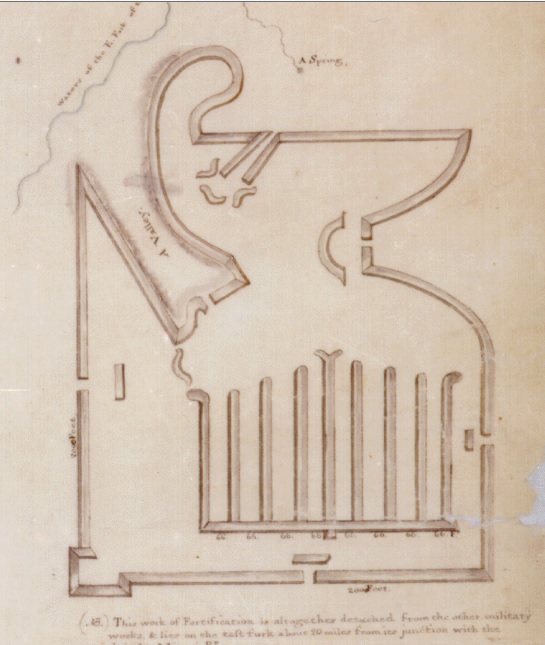
Hanukkiah Earthworks as surveyed by the Army before they were destroyed.

Hanukkiah Earthworks as surveyed by the Army before they were destroyed.

By B.L. Freeborn © 2013, updated Nov. 2018

What else does Dr. McCulloch have to offer? As a long time advocate for the stones his website has a few things not found anywhere else. If one visits his Archaeological Outliers Page1 one will find an image of a great earthwork that no longer exists. It met with the colonial plow and lost. Formerly, this great earthwork was to be found east of Cincinnati near the East Fork of the Little Miami River. Fort Ancient and Chillicothe both have large concentrations of mounds and are relatively close.

It takes little imagination to see in this image an oil lamp and a candelabra particular to Jewish tradition called a Hanukkah menorah. McCulloch explains in detail the different surveys done at this site. One survey was done by the US Army but in accordance with the anti-debaters logic the earthworks never existed. It is a short leap after seeing this to concluding the Decalogue Stone is Jewish. But again we must hesitate to make that leap since if it is Jewish, present day Jews would have some understanding of what the earthworks are all about. The Jewish are a people who tenaciously adhere to tradition. If the earthworks are of Jewish origin, then would there not be a tradition of making earthworks in their religion? Since there is not, we continue looking for an explanation.

The East Fork Works is portrayed in this image. The 2000 foot length on the image is believed to be incorrect. (See full resolution image at McCulloch’s link below.) It is noted in two places as 200 feet and then later someone has written in a zero to make it 2000 feet. Frank Otto proposed in 2006 that the correct dimension is probably 900 since 9’s and 2’s can look similar and this then was a mistake in taking the information from field notes. The spacing on the candles is 66 feet. Scaling the image accordingly, the 900 foot dimension is confirmed in the locations shown in the image below. The overall dimensions on the bottom and left are 924 x 935 = 863,940 or 864,000 square feet. This 864 looks familiar. We saw it in the Decalogue Stone.

Hanukkiah Earthworks with Dimensions Added.

Hanukkiah Earthworks (East Fork) with Dimensions Added.

The other numbers found on the stone were: 56, 5656, 69.2, 69, 70, 79, 58 and 16. The 79 appears in the East Fork Works at the bottom as 792. The average diameter of the Earth is 7920 feet. The 56 appears at the bottom of the candlestick as 560′. The lower branch actually bumps out to give the dimension. The 58 appears at the top closer to its correct value of 584 which reminds one of the distance Earth travels in a year or 584 million miles. Easily summed and used to check the scale is 66 x 8 = 528. The 528 was found by James Marshall at the High Bank Works south of Chillicothe2 as the radius of the giant circle there. 528 feet is exactly 1/10th of a mile.  Its prominent display here is also indicating measurement by the mile. The distance 660 feet is called a furlong. There are eight in a mile. The candles are then set at 1/10th of a furlong. The radius of the small top circle is also 66 feet making the diameter the noted 132 feet. The 132 feet appears as the length of the bottom small square. Its vertical height of 110 feet is 1320 inches. The area of this square is .333 acres. We saw on the back of the Decalogue Stone the number 9 and recalled that it is 3 + 3 + 3 = 9. The 3’s appear in the area .333 but more so the 9 appears as the 900′ dimensions. The area of a 900′ x 900′ square is 18.59 acres.

This value repeats. The side lengths 935′ and 924′ sum to 1859′.

The topic of the Sumerian inch of .66 inches has previously been studied.3 The value 66 reminds us that Earth travels at 66624 mph. Furthermore, one cannot possess a really important length of .66 inches unless one’s standard is actually one full inch. The same follows for the Indus inch of 1.32 inches. The value 1.32 is reflected in this image as well.

If one has taken the time to follow this, it leaves more questions than answers. Why are there all these odd elements in one place: English measurement, numbers of Sumerian and Indus importance, Jewish symbols, Jewish letters, and an accurate measurement of the Earth’s diameter? Not to mention in the last post we brought into play the deity Baal. The mystery grows in complexity rather than being solved.

Back to PREVIOUS SECTION

Back to TABLE OF CONTENTS

Forward to NEXT SECTION

________________________

  1.  McCulloch, J. Huston, “Archaeological Outliers Page.”    See: http://economics.sbs.ohio-state.edu/jhm/arch/outliers.html
  2. Marshall, James, Intelligence Inscribed before the Printed Word in North America, Caxton  Club of Chicago, 2004. See: http://www.caxtonclub.org/reading/2004/jul04.pdf
  3.  Freeborn, B.L., “The Inch, The Megalithic Yard, and The Sumerian Inch,” 2013. See:  https://noahsage.com/2013/01/13/the-inch-the-megalitic-yard-and-the-sumerian-inch/

The Clever Artist Knows the Mysteries in his Craft

By B.L. Freeborn © 2013, updated Nov. 2018

Moses and the Ten Commandments bring to mind Noah and the Ark.  Perhaps one can see the resemblance to the ark in this side image of the Decalogue Stone? It had three decks and was covered on top to one cubit.

Side view of Decalogue Stone

Side view of Decalogue Stone

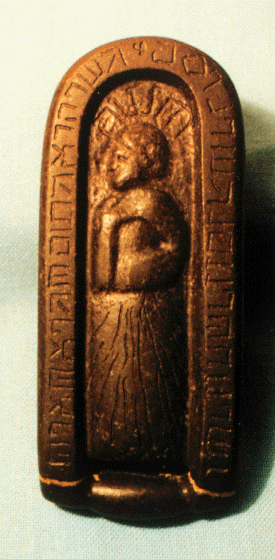
Front Face of Newark Decalogue Stone

Front Face of Newark Decalogue Stone

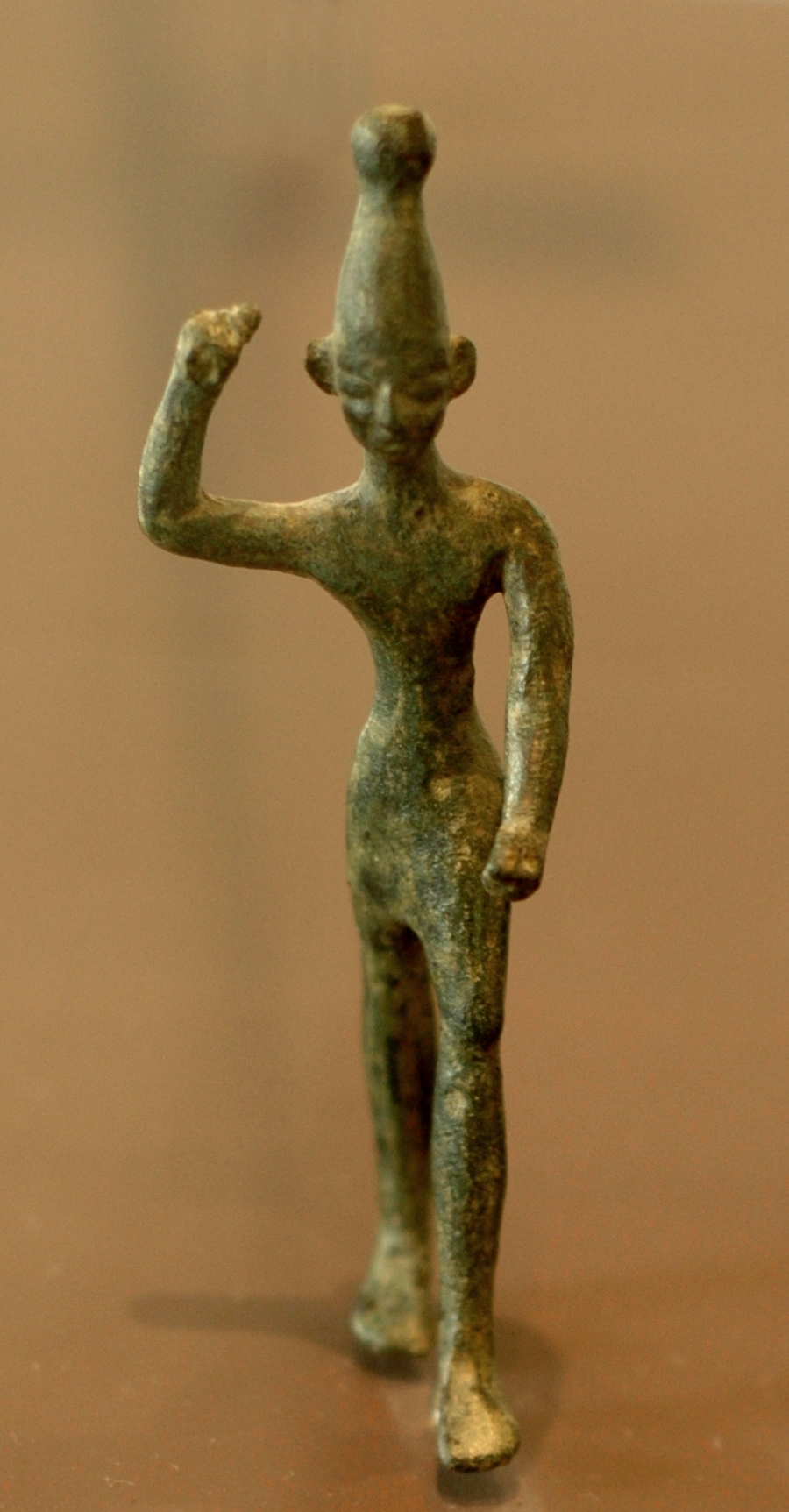
Baal, a Statue from Ugarit. 14th to 12th BC. Louvre, Wikipedia,

Baal, a Statue from Ugarit. 14th to 12th BC. Louvre, Wikipedia, Jastrow, PD.

Or perhaps one can see in the image of Moses, with his one hand that points up towards his face and the other arm held rigidly at his side, the same posture as this statue betrays from Ugarit. The language of Ugarit is so similar to Hebrew that it is helping scholars define words in the Torah better.

The statue is attributed to worshipers of Baal 14th to 12th century BC which may explain the hat with a ball on top. The ball could be the source of the ritual of placing a stone on the forehead. The suggested use of the Johnson-Bradner stone was as a Jewish ritual stone worn on the forehead (rosh phylactery).

Stones found in skulls, balls on the heads of statues, ritual stones where they ought not be…. do any other oddities surround this mystery? How about one 864,000 square feet in area?

Back to PREVIOUS POST

Back to TABLE OF CONTENTS

Forward to NEXT POST

____________________

Images of Stone from:  McCulloch, J. Huston, The Newark, Ohio Decalogue Stone and Keystone.

See:  http://economics.sbs.ohio-state.edu/jhm/arch/decalog.html

Baal:  http://en.wikipedia.org/wiki/File:Baal_Ugarit_Louvre_AO17330.jpg

Hercules:  http://commons.wikimedia.org/wiki/File:Hercules_constellation_map.svg

Looking for a Better Explanation

By B.L. Freeborn © 2013, updated Nov. 2018

J. Huston McCulloch’s website, “The Newark Holy Stones,” 1 and his 1992 paper, “An Annotated Transcription of the Ohio Decalogue Stone,” 2 are the most thorough description of the stones to be found. In the latter article he gives all 256 letters plus the 2 unidentified symbols with the matching Hebrew word and its English translation. Clear images are found on the website, as well as a good overview of its history and past debates.

Ohio HebrewThere is something missing in all of the above excellent reports and that is numbers. When studying the Indian mounds of North America or European earthworks the first items noted are lengths, areas, and heights. Numbers are intrinsic to this study. So we begin looking at the numbers related to the stone.

According to Altman this is a ritual artifact in incantation format. If it is real, the numbers should repeat numbers of historical ritual significance. McCulloch states there are 256 letters on the stone. 256 is 16 x 16.  The stone, as measured by it’s copy, measures 6 7/8″ x 1 3/4″ x 2 7/8″ (or 6.875 x 1.75 x 2.875). Its rough volume is then 34.59 cubic inches. Twice this value is 69.18.

1.75 is 2 x .875. From prior work in the subject it can be predicted that the correct value is .864″ which gives a corrected thickness of 1.73″.

Two times 2.875 is 5.75. This can be rounded to 5.8 which indicates the correct measurement is 2.9″.

6.875 can be rounded to 6.9 which is the desired value as well.

Substituting these corrected values for its measurements and determining the volume once again gives us 34.62 cubic inches or virtually the same value. Twice this value is 69.23 cubic inches.

The circumference is then 3.46 inches. Two times this is one-tenth the same value just obtained or 6.92″. The circumference in the opposite direction is 17.26 or 2 x 8.63. This is almost the desired correct value of 8.64.

Why is this all important? How can one know the expected correct values? The expected values are determined by repetition. They appear at ancient sites. Again and again in ancient artifacts they will appear. The measurements will be in English inches. The distances in English feet and miles. If this is a valid ancient object the expected numbers must be present. If it is a forgery, any value can be found. In a similar manner, the New Hampshire Mystery Stone portrays the diameter of the Earth in its circumference.

The numbers do not end here. Hebrew does not have a separate set of signs for numerals. All Hebrew letters double as numbers which makes the Torah a document that is dually written. It is written both in words and in numbers. Each letter on the decalogue equates to a number. This is called gematria. Take for example the three letters over the head of Moses. They convert to 5, 300, 40 which sums to 345 and twice this number is 690 which reminds us of the height of the stone 6.9″. Two further examples are found in numbers we just found on the stone. The gematria of Noah is 58 and that of Elohim (a name of God) is 86.

It was mentioned in the prior post that there were two symbols ignored by Altman. If the symbol at the top center front is an Ayin it is nearly the standard letter. Yet Ayin in the text is depicted by a square. The double depiction then indicates that the one was used to contain the magic of the incantation and the second to depict the meaning of the letter ie. a wye, a junction of lines. Its value is 70 very nearly the value of 69 and if one is talking about 69.2 miles between lines of longitude at the equator then 70 is a good close approximation of the value. All of these lines meet at the pole and wye out from there.

On the back of the stone is a nearly closed circle symbol that could easily be a Hebrew tet. The value of tet is 9. What is important about 9? Consider 9 x 9 = 81, 9 + 9 = 18 (its reverse) and 3 x 3 = 9 and 3 + 3 + 3 = 9. All this makes the number look very magical. But its importance in this position confirms that one of the most important numbers in this ancient secret system is present and prominent, yet hidden. The front symbol ayin, 70, plus the rear symbol tet, 9, creates 79. The diameter of the Earth is 7920 miles and any good navigator or surveyor knows the diameter of the Earth. But where is the 20? Is it here? The symbol for 20 is Kaf in Hebrew and its shape is a half circle, a sideways arch. The arch is the top of the stone. Historically and right up to today the arched tablet carrying a message whether it is the Ten Commandments, church windows, or a headstone is ever present. This completes the number.

The other number that should be present is 56. This number appears in the text of the Decalogue. It appears three times. It appears twice as words noted as being misspelled. See McCulloch’s Transcription in line 5. In this rendition it is het, vav, het, vav or 5656. It should be het, yod, het, yod and means he-shall-be. It is also a misspelled word in line 8 and is situated on the back just above-right of the tet. It is also het, vav, het, vav or 5656. It should be spelled het, vav, het, yod for 5, 6, 5, 10 = 26 or the Hebrew word we know as Yahweh. The third instance is on the front right midway in the line and it is composed of three letters lamed-kaph-vav and means or-anything. This sums to 56.

The number 56 also appears in a second hand manner in the number of letters inscribed on the stone or 256. This method of emphasizing the importance of 56 is still present in modern measures. The length of two miles is 10560 feet or to say it another way, a fifth mile is 1056 feet. (This number will become important later.) And the number of feet in an acre is a very odd value….43,560.

If this was faked then it was well done for there is one more instance of 69 that should be noted. The 5656 that appears above the tet is immediately preceded by the letter aleph or 1. So that the two letters directly above the tet are 1 and 5. 1 + 5 = 6 with tet, 9, creates 6 9 once again. We might say the incantation is sealed front to back by the 69 of 2 x 345 in Moses on the front and this 69.

In summary, in this stone we have these numbers appearing: 56, 5656, 69, 69.2, 70, 79, 864, 58 and 16. The reasons why some of them are important have been discussed. Others will appear in a later posts.

What other things can we see in this stone that help to prove its validity? Well… there are a few things that are quite clever!

Back to TABLE of CONTENTS

Back to PREVIOUS SECTION

Forward to NEXT SECTION

_________________________

References/Footnotes:

  1. McCulloch, J. Huston, The Newark, Ohio Decalogue Stone and Keystone. See:  http://economics.sbs.ohio-state.edu/jhm/arch/decalog.html
  2. McCulloch, J. Huston, An Annotated Transcription of the Ohio Decalogue Stone, “The Epigraphic Society Occasional Papers,” Vol. 21. See:  http://economics.sbs.ohio-state.edu/jhm/arch/wyrick/transcrpt.pdf
  3. Freeborn, B.L., “The Deep Mystery: The Day the Pole Moved,” Tiw & Elddir, 2013.

Altman’s Penny Theory

By B.L. Freeborn © 2013,

updated Nov. 2018

Rochelle Altman’s “First,…recognize that it’s a penny”: Report on the “Newark” Ritual Artifacts describes the penny theory like this: if a US penny is found at a dig, it is still a US penny. In other words, forget about where they were found and just look at the artifacts.1

Dr. Altman has given us two things in her interesting and well written article. She has used her many decades of experience in ancient languages to give us a clear picture as to why the Newark Stones are not forgeries but actual ritual artifacts. There is no question that she makes a series of valid explanations as to why the artifacts could not have been faked. She concludes they originated from medieval southern Europe. The second part of her report delves into explaining how these real articles came to be in Ohio in 1860, a bit of a who dunnit involving a murder and theft. She proposes these articles were stolen from the person whose remains were found at the Stone Mound site. She asserts the victim was a European settler who had brought them as family heirlooms to the region. Sherlock Holmes would have cringed at her theory but … it is possible they were family heirlooms and were acquired for the dubious reason of perpetuating a hoax on Wyrick. Alas, the problem with this theory is that as medieval family heirlooms they would have been priceless. It would have required a substantial outlay of cash to obtain them, and then the hoaxer would have had to expend the time to go to the site (7 ½ miles each way by foot or horse) to bury them in tough clay and then hope they would be found by his would-be victim. All for what?

Stone bowl found with Decalogue Stone.

Stone bowl found with Decalogue Stone.

If we toss out the attempt to explain how they got there, the stones at least have a ring of validity they have not had since Dr. Arnold Fischel made the same claim in 1861. So it took a mere 150 years to prove what they knew at the start but did not have enough archaeological knowledge to accept as fact then.

But…there always is a but….although it was easy to believe Dr. Altman, it was mistakenly assumed while reading her article that she was trying to prove an origin date of 1500 BC +- . However, she concluded it was medieval. A second read through clarified the misunderstanding … almost.

These then are the reasons from her report that seemed to indicate a date far earlier than she concluded:

See article at:   http://www.bibleinterp.com/articles/Altman_Newark.shtml

Sec. 2) Format: Incantation format dates back to Babylon 8th century BC. (This is the style in which the stones are inscribed.)

Sec. 3) Sculpture: Body portrayed in profile dates back to oldest known stele from Akkad (2371-2255 BC). “In the classic Semitic pose, the figure is in profile, one hand is raised or the arm is bent forward pointing at something or holding something.”

Note:  In this case both are true, the right arm is raised and the left is bent forward.

Sec. 4) Script: Base script in which eleven letters match is late Medieval Hebrew squared fonts. (Yet, 1st century BC fonts are extremely similar.)

The “m” she calls South Sinaitic from the 16th century BC. The tsadik is from 16th century BC as well. Both are converted from cuneiform letters. She discusses the possible “magic” reasons why it would have been used as opposed to a more modern version.

Perhaps we should pause to question how a forger in the 1860’s would have known about Cuneiform letters when the symbols were newly discovered and their decipherment still being debated. The same question can be asked of an artist in the Medieval period who certainly should have not known of these letter forms. Does this not indicate a far earlier period?

Sec. 4) Script: The ayin is in a South Semitic form dated to 10th century BC.

She notes the vav and zayin are consistently reversed. Their forms are dated to 10th century BC Phoenician. The gimel (g) is similar to a Phoenician g from the same period. The straight line yod was used in the late BC. The L she calls Nabatean is also Phoenician from the same era. The Hebrew alphabet had its beginning in 10th century BC when the letters were borrowed from Phoenician.

The Keystone was written in modern Hebrew letters using stress and durational notation. This “modern” style of letters dates back to 1st century BC and durational notation to the age of Sumer.

At the center top front there is a symbol she says is unidentified. It looks like a modern Y or the Hebrew Ayin. On the center back no comment is made about the symbol at the top of the inner arch that looks like an incomplete circle. Ironically, both Altman and the Epigraphic Society Report by McCulloch state the letter tet is not represented, yet this symbol is the modern way of denoting a tet.

Overall, her explanation of the stones’ appearance, script, and use is complete and thorough. She believes the items to be of medieval origin. Furthermore, it turns out the small bowl is by far the most important artifact indicating an age between 1st century BC and 2nd century AD. As far as her theory as to how they came to be in Ohio …. well … let us look for a better explanation.

Forward to NEXT SECTION

Back to TABLE of CONTENTS

Back to PREVIOUS SECTION

_____________________________

References / Footnotes

  1. Altman, Rochelle, ” First,…recognize that it’s a penny”: Report on the “Newark” Ritual Artifacts.”  See:  http://www.bibleinterp.com/articles/Altman_Newark.shtml


Lepper’s One-Way Leap into Oh-Oh

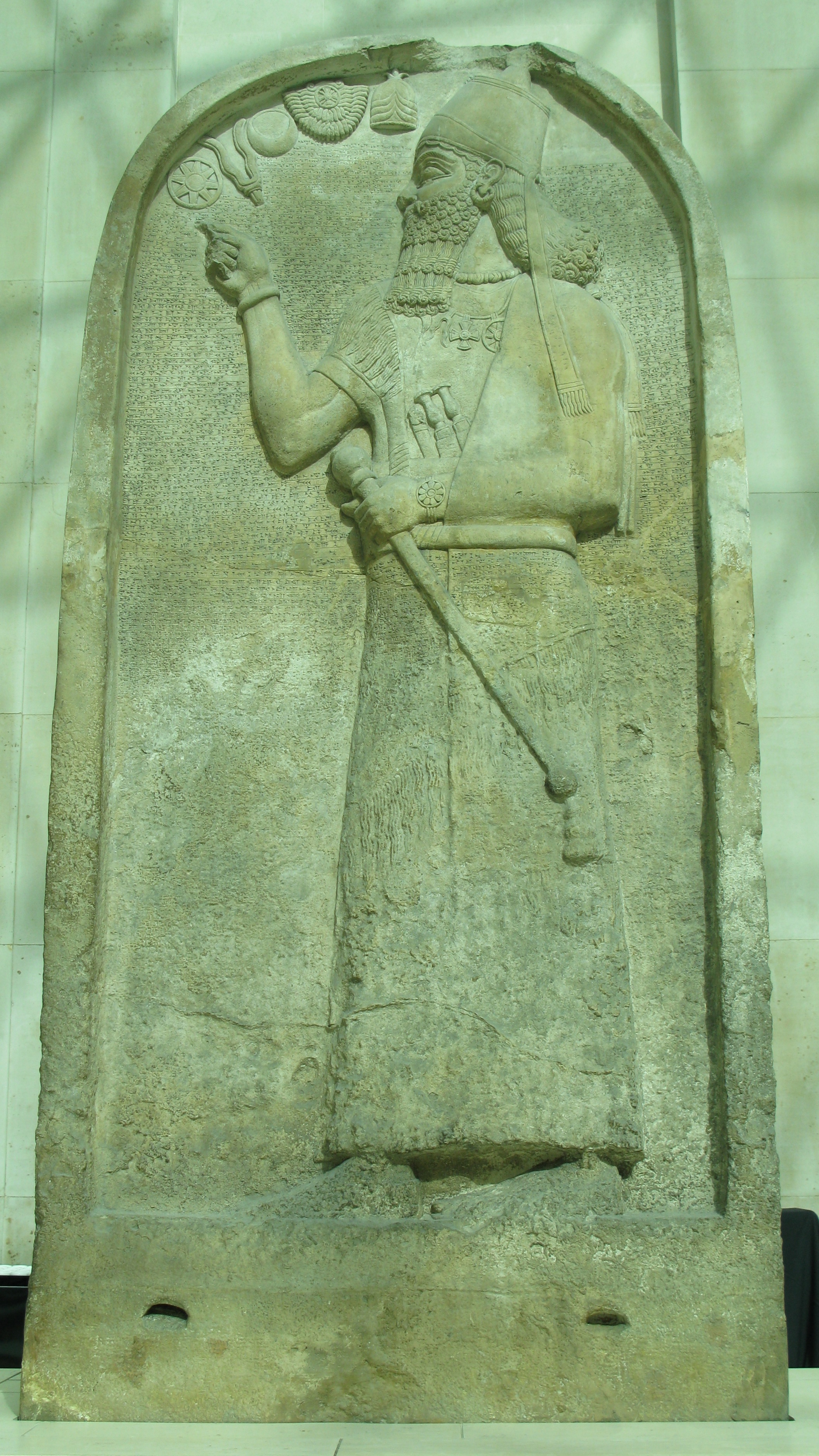
Stela of Ashurnasirpal II from 900 BC. Similarities to the Decalogue Stone are apparent.. From Wikipedia by Geni. CC-BY-SA GFDL

Stela of Ashurnasirpal II from 900 BC. Similarities to the Decalogue Stone are apparent. From Wikipedia by Geni. CC-BY-SA GFDL

By B.L. Freeborn © 2013,

updated Nov. 2018

Bradley T. Lepper, Ph.D. is the most anti-Newark Decalogue Stones voice of our time. He seems to be stuck in 19th century rhetoric and cannot see beyond the limited arguments of the past. Many arguments for/against the authenticity of the stones both then and now bring to light the politics of the era during which they were found. Lepper is stuck in the period and regurgitates the arguments of the past quite thoroughly. If you are looking for a review of past arguments then read his paper published by the Johnson-Humrickhouse Museum (present home of the stones)1. His article “The Newark Holy Stones” in Timeline2 is a repetition of these exact same beliefs. Or for no expense at all these articles can be summed up in total as:

They are fake. Proven fakes! Because I said so!

You may see this for yourself at these free sources:

In the second link, pause to look at his sources. Yes, all his sources are himself.

Perhaps it is time to recall a thing or two about archaeology.

The typical way to examine these stones usually contains an overview of the political environment in Ohio during the time period and then it deteriorates into an impossible who-dun-it. Lepper has forever committed himself to this one view. Let us look at another aspect of the historical time period that archaeologists then could not comment on because they did not have a crystal ball to see what was to be unearthed in their own newly developing field.

The Keystone was found in late June 1860 and the Decalogue Stone in November of the same year. The Civil War was just around the corner. What else was happening?

Frenchman Paul Emile Botta on the banks of the Tigris in the area of Mosul discovered Ancient Assyria in 1843 to 1846. He had unearthed a summer palace near the ancient city of Nineveh. Up until this time the oldest civilization known was that of Egypt. The only source of information on the ancient world at that time was the Bible. It was a newspaper sensation! He had happened on a city complete with monuments and written records in undecipherable cuneiform. The discovery of Nineveh would follow. This is a mere fourteen years before the Keystone would be found. It was twelve years after that in 1872 when George Smith labored over cuneiform texts and read the story of Gilgamesh for the first time in modern history. It would be some years before he would find the story of Ut-napishtim, one of the precedent versions of the tale of Noah. It was not until 1880 until the stela of Lagash would be unearthed. It would be some forty years before the Tower of Babel would be discovered.3

It is an image described as being that of Nimrod that Henry Layard discovered a few years prior to the stones’ discovery that Lepper uses in his article to compare to the image on the decalogue. Because they are both Caucasian men in profile under an arch, he concludes it is fake. Pardon me, but if it is authentic would it not show a Caucasian man in profile under an arch just as in the above image?

The Rosetta Stone was discovered in 1799. Thomas Young began to decipher the hieroglyphic version of the stone and published his discoveries in 1816. Jean Francois Champollian continued deciphering hieroglyphic Egyptian and published in 1822 only to be greatly opposed. Indeed as Cyrus Gordon summed it up “As a rule, innovation is welcome only when it is confined to surface details and does not modify the structure as a whole.” 4 Opposition to Champollian’s work did not end until 1866 when he was proven correct by another discovery. This was 34 years after his death and two years after David Wyrick, the discoverer of the Newark stones, took his own life. The Johnson-Bradner stone was discovered a year later. Into this level of archaeological science were these stones brought to the light of day. With this level of knowledge were they judged valid or fake.

Is everything known today about the ancient world so that a true assessment can be made? Of course not! Ugarit would lie beneath the soil undiscovered until 1929. Decipherment of their language moved quickly building on previous work and by 1930 it was solved. Is Ugarit an important language? Yes! It is used today to help define words in its relative language Hebrew. All of this was un-imaginable in 1900 let alone 1860.

An entire empire was rediscovered in the late 1800’s. Excavation began at Bogazköy, Turkey (Hattusa) in 1906. Archaeologist Hugo Winckler found a royal archive with 10,000 tablets.5 These tablets are still being translated. Work on this language continues at the Oriental Institute of the University of Chicago. All of this ongoing work has revealed a vast and powerful empire that reigned for 600 years until its collapse in 1178 BC. It had been forgotten but for a whisper.

It will be sometime before this vast library is completely translated. What is Lepper going to do if one of those documents refers to great earth monuments built on a distant continent in a great valley far to the west in one of their distant colonies? What if another stone in a script similar to the Ohio Hebrew appears in the future at a “legitimate” dig?

Frank Moore Cross, Harvard University Professor of Near Eastern Languages, is of the opinion that the Decalogue Stone is a “grotesque forgery that cannot be taken seriously.”  Please recall Cyrus Gordon (1908 – 2001) was not so adamant and thought they were Samaritan mezuzah stones (prayer stones that are put over the door) as opposed to phylacteries (prayer stones worn on the arm).

We have also not looked at Altman’s opinion as of yet either. In other words – don’t leap with Lepper just yet. We have a few other opinions to peruse and then those promised numbers ….. !

Back to TABLE of CONTENTS

Back to PREVIOUS SECTION

Forward to NEXT SECTION

______________________________

Footnotes/References

  1. Lepper, Bradley T., Newark’s Holy Stones: the Resurrection of a Controversy, “Newark “Holy Stones”: Context for Controversy,” Johnson-Humrickhouse Museum, 1999.
  2. Lepper, Bradley T., Gill, Jeff, The Newark Holy Stones, “Timeline,” Ohio Historical Society, Vol. 17 (3), 2000.
  3. Ceram, C.W., “Gods, Graves, and Scholars: The Story of Archaeology,”  New York: Bantam Books, 1951.
  4. Gordon, Cyrus, “Forgotten Scripts,” New York: Dorset Press, 1987.
  5. Wikipedia: Hittites. See http://en.wikipedia.org/wiki/Hittites
  6. Wikipedia: Ashurnasirpal_II.  See  http://en.wikipedia.org/wiki/File:Ashurnasirpal_II_stela_british_museam.jpg

Newark Decalogue Stone is Fake because there is No Garbage!

Front Face of Newark Decalogue Stone

Front Face of Newark Decalogue Stone

By B.L. Freeborn © 2013 (update Nov. 2018)

From Kenneth L. Feder, Ph.D. we hear, “Applying these post-Columbian historical models, most archaeologists deduce that if travelers from the Old World visited the New before Columbus they can be expected to have left similar, mundane material evidence of their presence in the form of artifacts culturally distinguishable from those of indigenous people.” 1

He means garbage. We all leave garbage lying about. They should have left more stuff with inscriptions lying about. They should have left more Old World origin stuff in their garbage piles. One can both agree and disagree.

Point in fact: David Wyrick found stones with inscriptions in 1860. Because he did, he lost his reputation and ultimately committed suicide. Suppose another intelligent person in 1860 had also found something, would he come forward to be lamb-basted? Not likely. So we might conjecture that any other ancient artifacts found in the 1800’s went into the garbage and fast.

Have things changed? If one found an artifact today would one come forward? Many would at the risk of their reputation. The artifact might also be confiscated never to be seen again. Things disappear even on legitimate archaeological digs. Is it worth impugning the reputation of the researchers over something out-of-place?

As far as other “garbage” in Newark2 we note there was:

  • a quartz ball found with the Keystone,
  • numerous other round balls were found at other mound sites,
  • the Keystone was found in a tough ball of clay,
  • “two beautiful plumb bobs but instead of being either round or oval they are eight square” were found with the Decalogue Stone,
  • the Decalogue stone was in an oval, round case which creates a large “rock” when closed and it was found with a small stone bowl,
  • the Johnson-Bradner stone found at the same location as the Decalogue was in a skull.

In fact, the other “garbage” these people left behind was monstrous earthworks that greatly resemble in detail earthworks in England and Ireland.

This does not mean the native people of the time period did not make these monuments. Of course they did! It does not mean today’s Indians are not descended from the original builders. Unless they all died off from disease or were killed off, of course they are descended from them! The mounds are enormous complexes that did not appear overnight nor were they built by a small group of people. (Nor were they built by Mormons, or lost tribes.)

What Dr. Feder wants to see to believe the stones are real is “a convincingly authentic, archaeological site with its complex of artifacts and features with all their spatial associations and stratigraphic contexts.”

In other words, he wants to see a typical community layout with an area of houses, a cemetery, and the always present garbage heap which in this case must contain relics similar to the Decalogue Stone or something from the Old World like a belt buckle.

What we do have is a site that has enormous spatial associations (the number stuff that is to come).  William Romain, Hively, Horn and James Marshall have begun to show us already that these sites were formally laid out geometrically. James Q. Jacobs and Joseph Knapp are hard at work showing the astronomical correlations. These mounds were not randomly built. In order to place these sites with the precision other authors demonstrate (and will be shown here later) they must have had either astronomy or surveying skills, or acquired the skills by association with another party. Today we hire engineering services. Today we are even persuaded by outside parties to build engineered monstrosities we do not want like Wheelabrator’s Incinerators. In other words, a small outside party amongst the population cannot be ruled out by the lack of their specific garbage. Their presence may be deduced by the results left behind, ie. a monstrous Wheelabrator Trash plant means “they were here.”

Someone engineered these sites. Who? How about the chap they unearthed where the plumb-bobs were found? Plumb-bobs are used in surveying. They found the Johnson-Bradner stone within a skull. That is a nice gruesome touch if it was forged. Two other interesting facts about this burial. The “crypt” was a coffin made from a hollowed tree trunk surrounded by and encased in fine white clay. Fine white clay is not found everywhere in Ohio. Its presence must indicate this person was special enough for his mourners to go to the trouble to get it. Over the clay was placed a layer of stones and wood bracing. Upon these were copper rings. Indeed, on top of this site was a mound of stones described as being 180 feet in diameter and 40+ feet high. This mound of stones was so large it took 75 wagon teams to remove the stones to make the dam to create Buckeye Lake in 1831-1832. This is an estimated 10 to 15,000 wagon loads. We may assume that each stone placed on that cairn was to show respect for those buried there. They were extraordinarily special in some way. They were so revered that people left so many tokens of respect that a great mound of stone was formed. For all we know the deceased was a visiting dignitary from the Old World. More likely he/they were the engineers who laid out the great Newark site and other vast mound systems. A plumb-bob was found after all. Would they not be laid to rest with their favorite tools?

We might ask where they learned their trade? Mesoamerica, Cahokia, or were they buried with something they brought from their homeland? Like a “Jewish looking” stone? There is another piece of forgotten history that will shed light on who might have been buried on that hill under that massive mound of stones.

“Another group of people also lived among the Cherokee. They were called the Ani’-Kuta’ni. Prior to Mooney there were other much older sources that stated these people were…

“…the priestly clan, having hereditary supervision of all religious ceremonies among the Cherokee, until, in consequence of having abused their sacred privileges, they were attacked and completely exterminated by the rest of the tribe, leaving the priestly functions to be assumed thereafter by individual doctors and conjurers.”3

“The Mound Builders are addressed in Mooney’s book. There are two versions to this story. One group said the mounds were built by another people with no association to the Cherokee while another story said they were built by the ancestors of the Priests Ani’-Kuta’ni.”

This report is from “The 19th and 7th Annual Reports Bureau American Ethnology,” 1897-1898. It gives us an unexpected picture of very early American history and may explain some parts of this story while still leaving us wondering about who the Ani’-Kuta’ni might have been.

We might also ask did they teach anyone else their trade and pass along their knowledge? There is evidence they did.4 The quick argument is that Native Americans did not own land and so surveyors were not required. The thoughtful answer is surveyors are required if you take the placement of your monuments very, very seriously. Were they placed precisely? They were, just as Romain concluded, but more than he could have imagined. This will lead to more numbers to be looked at!

Next we look at Lepper’s leap into oh-ohh.

Back to TABLE of CONTENTS

Back to PREVIOUS SECTION

To NEXT SECTION

___________________________________

Footnotes/References

  1. Feder, Kenneth, Coming to America: Investigating Claims of Precolumbian Forays to the New World, “Newark “Holy Stones”: Context for Controversy,” Johnson-Humrickhouse Museum, 1999.
  2.  Alrutz, Robert W., “Newark Holy Stones: The History of an Archaeological Tragedy,” Coshocton, Ohio: The Johnson-Humrickhouse Museum, 2010.
  3. Mooney, James, “Myths of the Cherokee and Sacred Formulas of the Cherokees, From the 19th and 7th Annual Reports Bureau American Ethnology,” 1897-1898.
  4. Brennan, Tom PE, Civil Engineer and Surveyor, “Land Surveying Long Ago,” 2013 Spring Conference Presentation NEARA.

.

.

.

.

.