B.L. Freeborn © October 30, 2022, Rewritten December 2025 (PDF version here.)
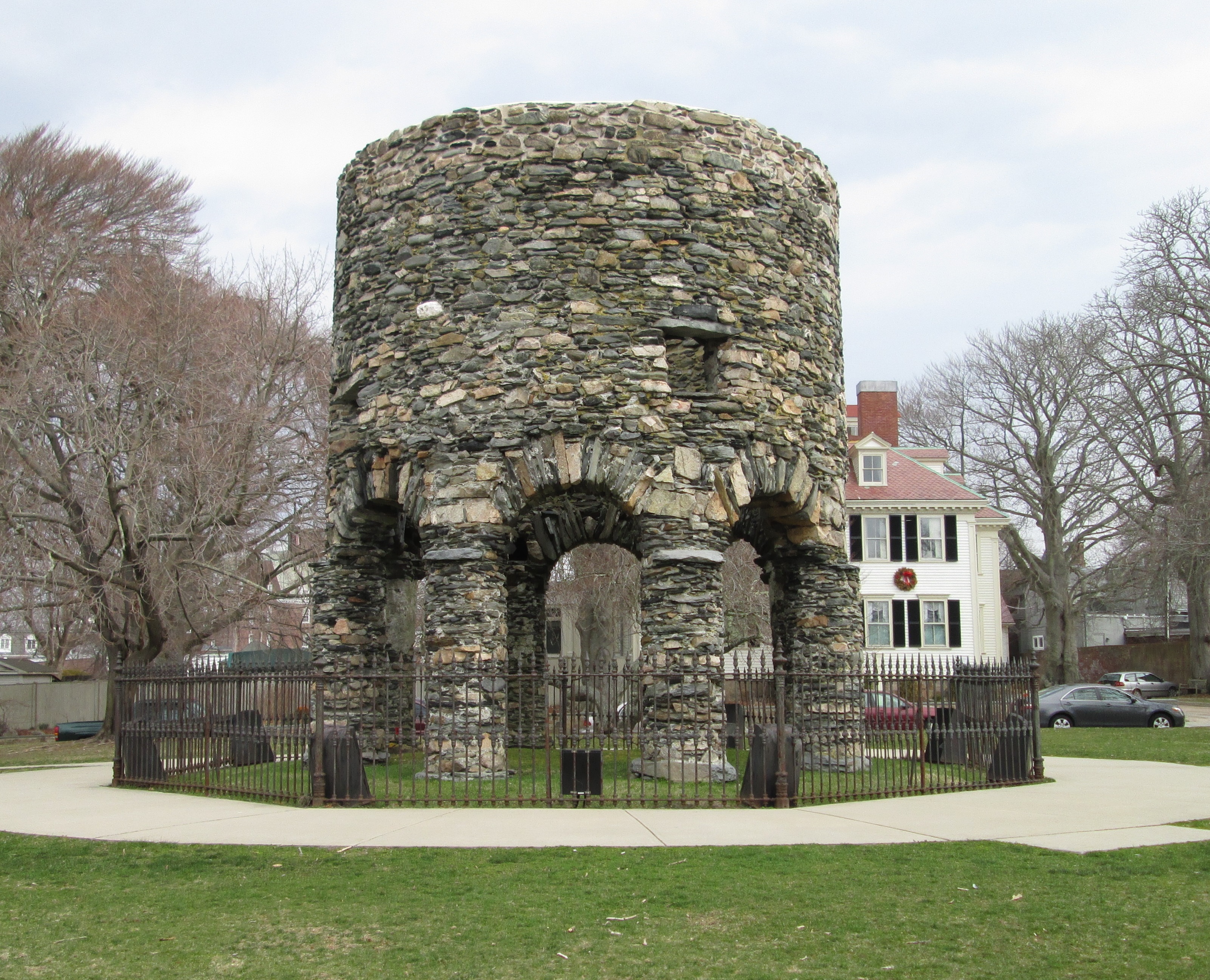
Newport Tower in 2023
Who built the Newport Tower is a long standing question. It has been well proven by James Eagan that the tower is used for keeping time as the celestial bodies align with its numerous small windows. Eagan also noticed that certain letters formed with stones appear in the arches of the structure. Most notable and hard to miss is the >OI<. He found the Delta and P (shown as R). He also thought the h was a Greek η. From there he determined, probably correctly, it spells out Rode as in Rhode Island. His theory states John Dee had the tower built in 1583 in connection with a colonization attempt which failed.
The tower is shown on the “Woods Map 1635’ by William Woods a colonist in Providence, RI (Syverson, pg.32) The map notes it as Old Plymouth. This is the earliest known record and predates Benedict Arnold senior’s ownership. Evidently Arnold knew what it was and probably who built it, but because of the possibility of these prior claims resurfacing he referred to it as an old windmill knowing very well only a fool would believe that.
After studying Eagan’s discovery, the other letters shown below were identified. There are eight arches. Three of which have one letter displayed and five display two each. There is also a round stone on the interior opposite the >OI< stone which is on the northwest side. (See below.) This makes fourteen altogether. In addition, there is a runic inscription found over the southwest pillar (see below). It was translated by Mongé (1967) and it reads Henricus 1116. This refers to Bishop Henricus of the Vinland Map. Other theories as to the tower’s origin abound. The Henricus theory is at least supported by not only an inscription imbedded into the tower itself in the manner of a corner stone but references to the tower in The Long Inscription Stone of Spirit Pond.
This paper is a study of the inscription and stone letters. One may want to read Validating North American Runic Inscriptions (PDF link below.) to further understand the meaning of the numbers.
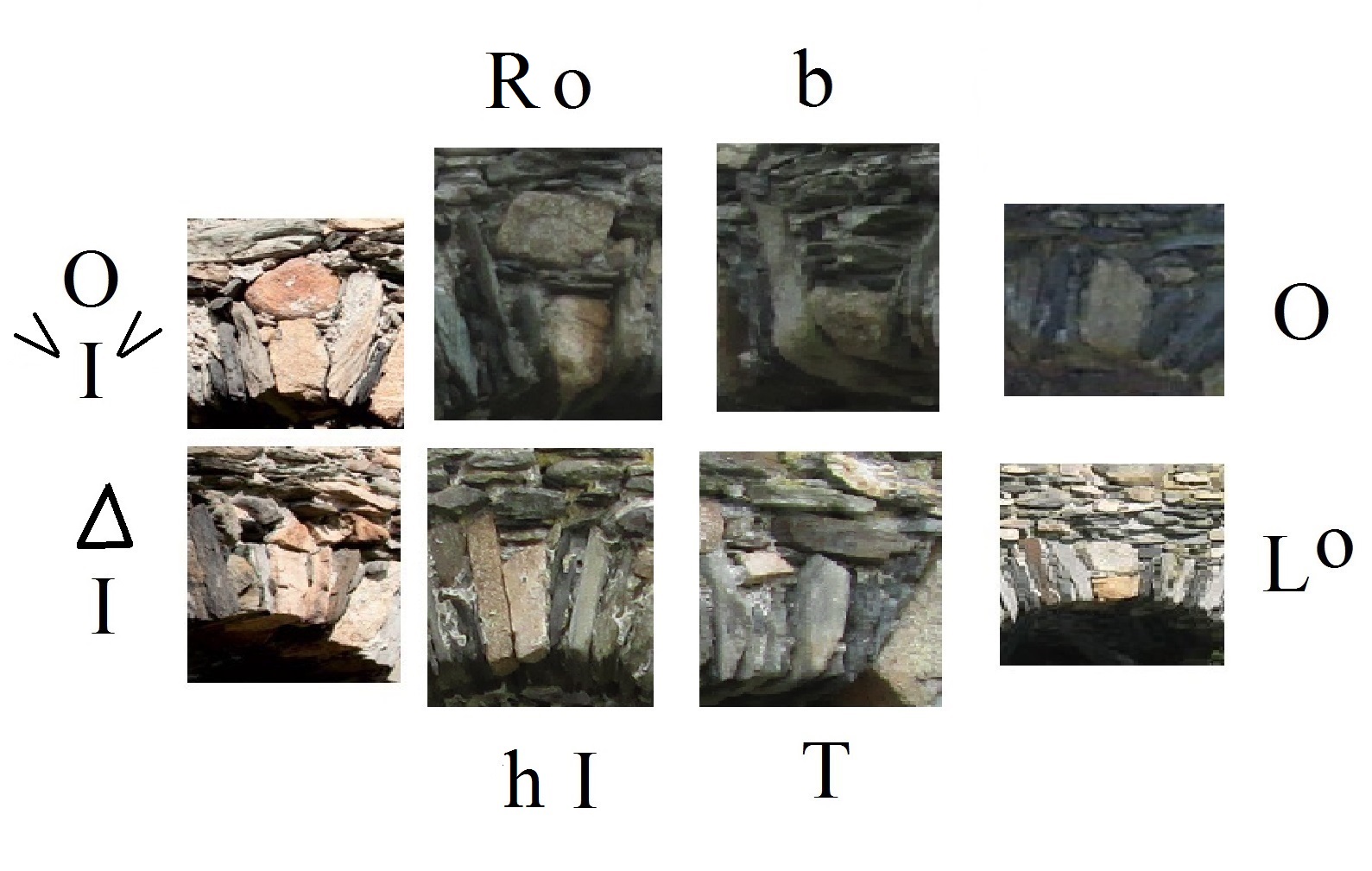 Transliteration
The round stone on a peg in the NW arch is as indicative of Baal as a cross is to Christ. (The >OI< stones.) Furthermore, it would seem the stone letters spell out Baal. This leads to studying the ‘inscription’ as if it is of Baalist origin and if so, certain numbers must be present. Validating North American Runic Inscriptions describes how certain numbers are embedded in Baalist inscriptions. One should recall that the Catholic Church went to great lengths to stamp out paganism in the time preceding, during and after Henricus’ tenure as Bishop. Apparently, Baal was central to that religion which is why there are so many references to it hidden in runic riddles. The dedication to Baal at Newport tower is unmistakable.
The stone letters are repeated here:
Reading in a clockwise manner – b O O L T I h Δ I O >I< P/R O
These are transliterated as: B A A L T I h D I A I R O
Note that the P in some scripts/languages is R. The O’s can be either O or A. Similarly, the I can be E. In Futhark runes B can be P.
Reading from the top clockwise find: RO, BAAL, TI, HI, HID, DI, O, >I<, LOT
Also find: HIT, I TOOL, O LO, BOR, ROB, POL, RODE or RHODE and OH.
The first line suggests: Row, Baal, Tie, die, high, hide, eye, two strikes at I.
The second adds: hit, I tool Rob, hole low, bore, pole; rod, red or road; and oh.
The words suggest a typical Baalist statement:
Baal at the high tie hit. It hit twice at the eye in rows.
The hole is low where it bored the eye of the pole.
Rhode Island
Rhode Island perhaps requires an explanation. RHODE appears to be a combined anagram for Rod (or Red) and Oh (meaning island). A rod is a measuring length of 16.5 feet. The clay on the shores of Rhode Island is notably red so it might also refer to red. This suggests the name, Rhode Island, is much older than cited by modern authorities. Rhodes is also the name of an ancient city.
Runic Inscription Study
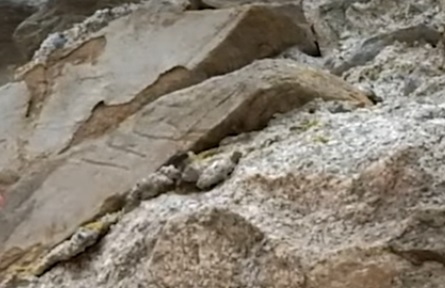
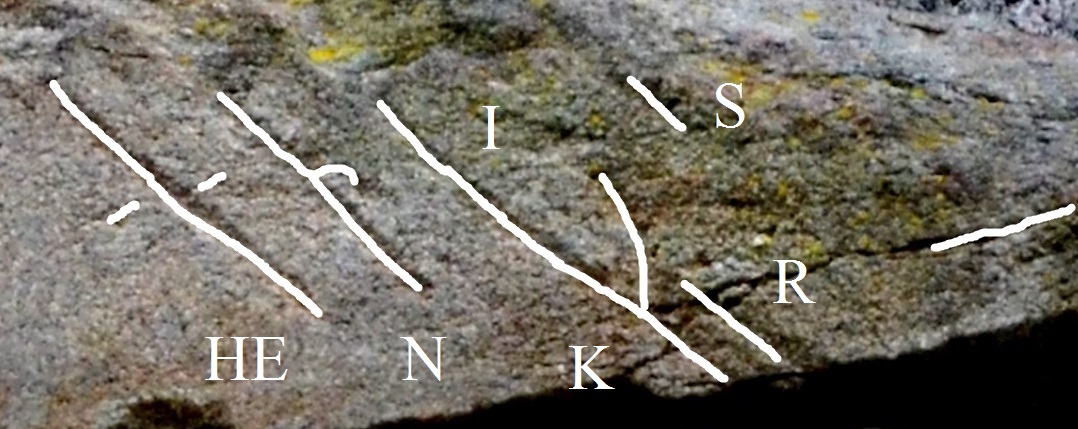
Above the southwest pillar of the tower is a runic inscription. Harek Williams examines it in a video with James Eagan and confirms it is human carved and nothing more. A much better source for proving it is an authentic runic carving is Alf Mongé. Why the latter? Harek Williams reads plain text runes from that period. He does not delve into runic puzzles or dated riddles. Alf Mongé was a cryptologist. He deciphered the deep scratch marks into runic letters and decoded them. He found it reads: Henricus 1116. This gives a lower limit to the age of the tower. Based on other runic inscriptions found along the east coast and the Narragansett inscription nearby this seems plausible.
Briefly, this is a summary of Mongé’s decipherment of this small stone imbedded above one of the pillars shown in the image above. It is a group of five runes and two are joined runes: (HE) N (IK) ʀ S or Henricus. There is an arrow to the right. The arrow is another feature common on Baalist inscriptions.** Using runic gematria, the year 1116 is found. The (HE) is 16. The S is 11. The ʀ is 16. The (IK) is 15. Reading in reverse find 1116. The repetition of the 16 and 15 help confirm the interpretation. It is worth reading Mongé’s study (Mongé, pgs 128-129).
Then Comes Henricus
The rapidity with which the tower is giving away to nature demands that it must be under constant care. This requires that, regardless of when it was built, it must have been periodically repaired. It has been nine hundred years since Bishop Henricus visited (circa 1116) as stated in the Vinland Map legend. The Spirit Pond stones are dated to the same period. (Freeborn, Deciphering.., 2022) They describe Henricus. The Kensington Stone’s date is 1362. (Freeborn, Kensington.., 2023) It states the travelers came from Rhode Island. In 1525 Verazzanno explored the coast but did not mention the tower. In 1583 John Dee sent an expedition to the area. By the 1600’s it was settled by colonists and it came under the care of Benedict Arnold senior. This could mean it received periodic maintenance since the time of its construction, on or after 1116, until Arnold’s ownership five hundred years later.
The date and builder need not be total speculation. The aforementioned inlaid letters tell the story of Baal. If they were chosen in the manner of a runic riddle they may reveal more. Since Henricus was a master at runic riddles, and if this was built by him or in honor of him, then the symbols should contain further information. These riddles often contained a date. Indeed, The Long Inscription Stone from Spirit Pond in its ‘Overlined Letters Cipher’ attributes the planning and building of a ‘tall tower’ in Rhode Island to Henricus, aka OM.
As far as John Dee being the designer, it is not that likely. He was a Christian and this tower is clearly a dedication to Baal. A study of Dee’s mathematics does not display the numbers so prevalent in Baalist inscriptions which again suggests he is not the creator. The two religions are not mutually exclusive since Henricus was a Bishop of the church, but he lived at the point in time when paganism, through genocide, was actively being stamped out. To continue their religion and live, they were forced underground or in this case, off the European continent.
After a mathematical study ,which follows, of the letters’ number equivalents more information was derived. As seen, it was erected to commemorate the great story of Baal. It also commemorates Henricus’ visit in 1116 and suggests an erection date from 1116 to 1161. This is some thirty years after his supposed death.
Designed and Built by O.M.
To Honor and Remember Baal
Rhode Island
Number Work and Proof of Transliteration
Certain numbers** appear when the letters in any Baalist inscription is converted to their numerical equivalent (gematria). The Newport Tower’s hidden letter/numbers are studied here. Numbers that are typically found are noted by a ✓ check mark. Simply put, if the numbers are not found, it is -not- a true Baalist inscription -or- the letters have been misinterpreted. Once the correct letters are proven via their gematria then the message about Baal can be read and also, possibly, who wrote it and when. The result of this study is as noted above.
The proposed transcription of symbols imbedded in the arches of the Newport Tower is shown below. The numbers are studied for repetitions and pertinent numbers.
Norse Runic Gematria

Sum from T and around to first A = 79. From the same A to L is 23. So that it is 79,23.✓
Total sum is 98 or 89 in reverse which reminds one 89 x 89 = 7921.✓
The sum from the Δ around again to the 7 is 89. ✓ The 79 is also imbedded in the text.✓
Even more notable the 9,3,9 sum to 21 so it becomes 7921.✓
The sum from the first A to first I is 51.✓ The sum from H to the right and around to L is 86.✓
The 28 appears twice which is half of 56.✓ The sum from B to the left around to the I (by H) is 56.✓
The sum from first I to the last O is 43. Twice 43 is 86.✓
The tower also spells out RHODI or Rhode. These letters have values: 5,7,4,3,9 = 28 and twice this is 56 ✓
Note the 12’s at T, ID, DI. Note the 13 at AI just following the 12.
Note the 14 at IR. Lastly, note 7 and 9 sum to 16.
By summing adjoining numbers find: 13,17, 19, 15, 19,12, 16, 12, 12, 13, 13, 14, 9, 17…
On either side of the 16 is a 12, then 12, 12, 13, 13, 14.
The presence of numbers indicative of Baalist documents is well proven here. ✓✓✓
Looking further, a possible date is suggested just above. Years 1112,1113, 1114, 1115,1116 and 1117 are all implied by the series. These numbers coincide with the period of time Henricus was believed to be in Vinland. In dated runic riddles the Golden Number (GN), Day Letter (DL) and Line # are used to denote a year since every year has specific values that can be found in Easter Tables (a calendar device created in 525 AD).
The main legend on the Vinland Map has the phrase: ‘anno p. ss. nrj.’. This uses a 1, 2, 3 sequence in the abbreviations. Since ‘anno’ means year, this is clearly a reference to ‘year 1123’ when Bishop Henricus was replaced by Bishop Arnold and his death was therefore presumed. As an example, if it implies Line #1, Golden Number (GN) 2 and Day Letter (DL) 3 then 1161 is indicated. (See tables at end.)
In this instance, for year 1116, the values are Line #19, GN 14, and DL 3. There are two sums of value 19 with a 15 in between. The delta is the only letter in Greek. D has value 3 in Futhark. This 3 would be the DL. This then easily points to a date of 1116. The date has additional merit as seen below. Without corroborating information as seen in the imbedded stone and Vinland map, other dates remain as possibilities.
The Long Inscription Stone from Spirit Pond (shown here) repetitiously points to the year 1117.
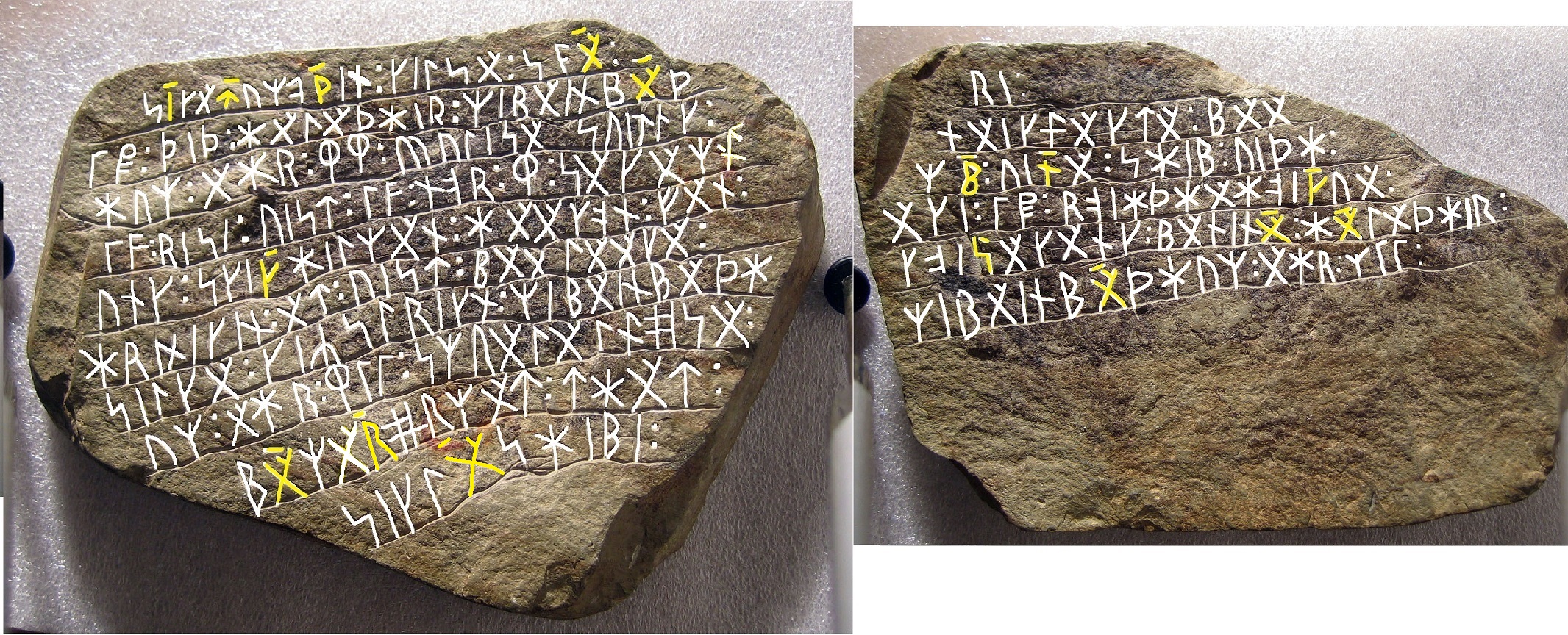
Both sides of Spirit Pond Stone Long Inscription. Runes highlighted. Runes in yellow are overlined. Photo by Scot Walter. Used with permission.
The Structure Contributes
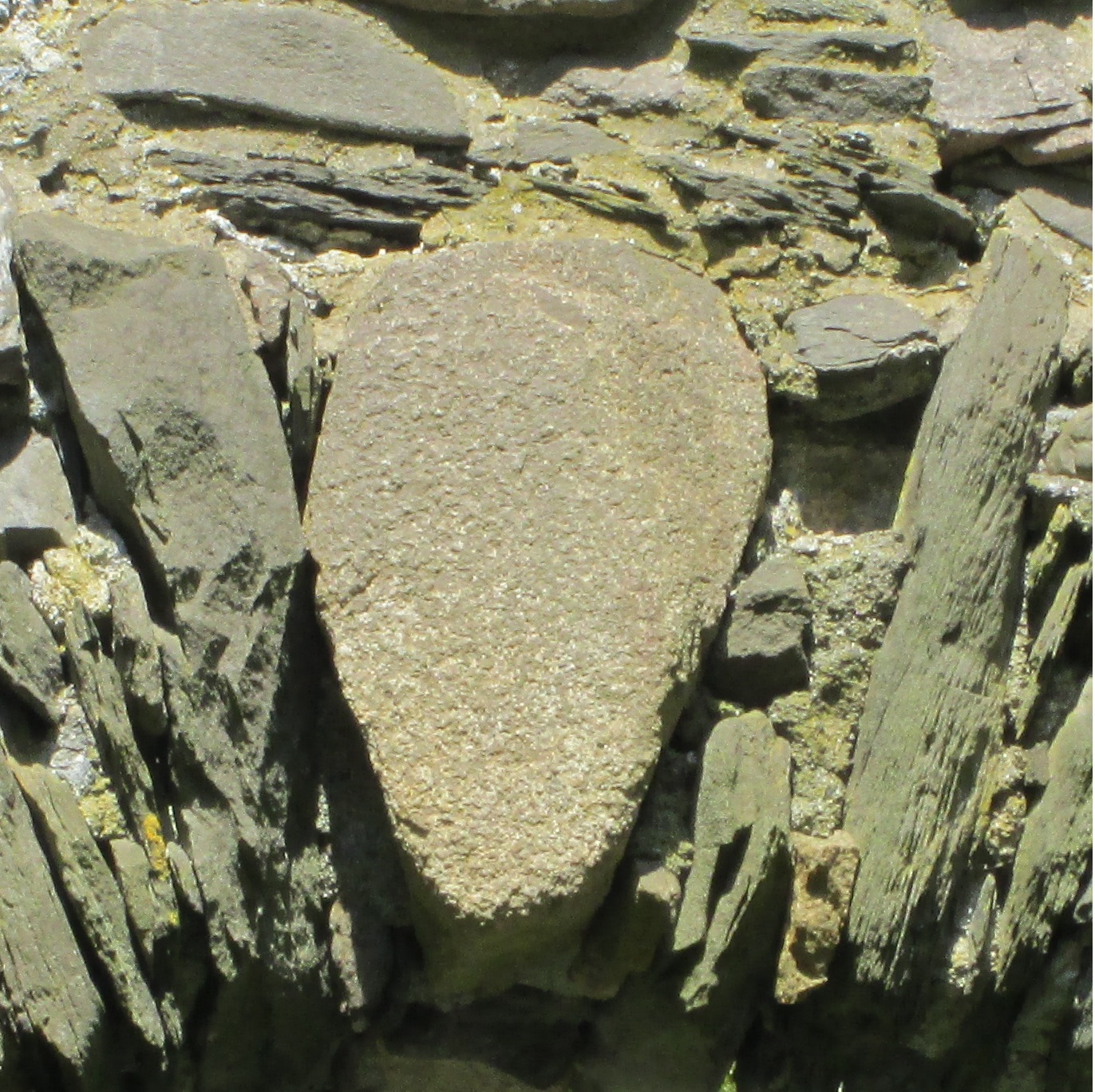
Round sun stone on interior.
The structure is set up to provide numbers as well. There are 8 pillars and 10 symbols that appear on five arches (two each). One symbol (the round sunstone) is in the inside and three arches have only one symbol for a total of 14 symbols. 4 x 14 = 56.✓
There are five arches with two symbols each or 10.
There are three with one each for 3. Total 13.
There is a single round stone on the interior. So 1. Then 1 and 13 ➟ 113 = 56.5 x 2.✓
There are 8 pillars and of course, 8 arches. A square of sides 5.656 has a diagonal of 8.✓
There are double symbols in 5 arches and single symbols in 3 which suggests 532. This is the number of years in the Easter Table before it repeats.
If the first arch with B is #1, then the arches with two symbols are found on: 3, 5, 6, 7,8. The ever present 3 is represented, then 56 and 7 x 8 is 56 again.✓ Similarly, if B is #1, then it is 1 symbol, then 1 symbol, then 2 symbols; or 112 which is twice 56.✓
One may again conclude after finding so many numbers typically found in Baalist documents that the transliteration is correct. Let us view this another way. There are 3 arches with only 1 symbol. This is part of the story of Baal. There are 3 arcs.✓ The repeating 2’s emphasize that there were 2 Baals ✓.
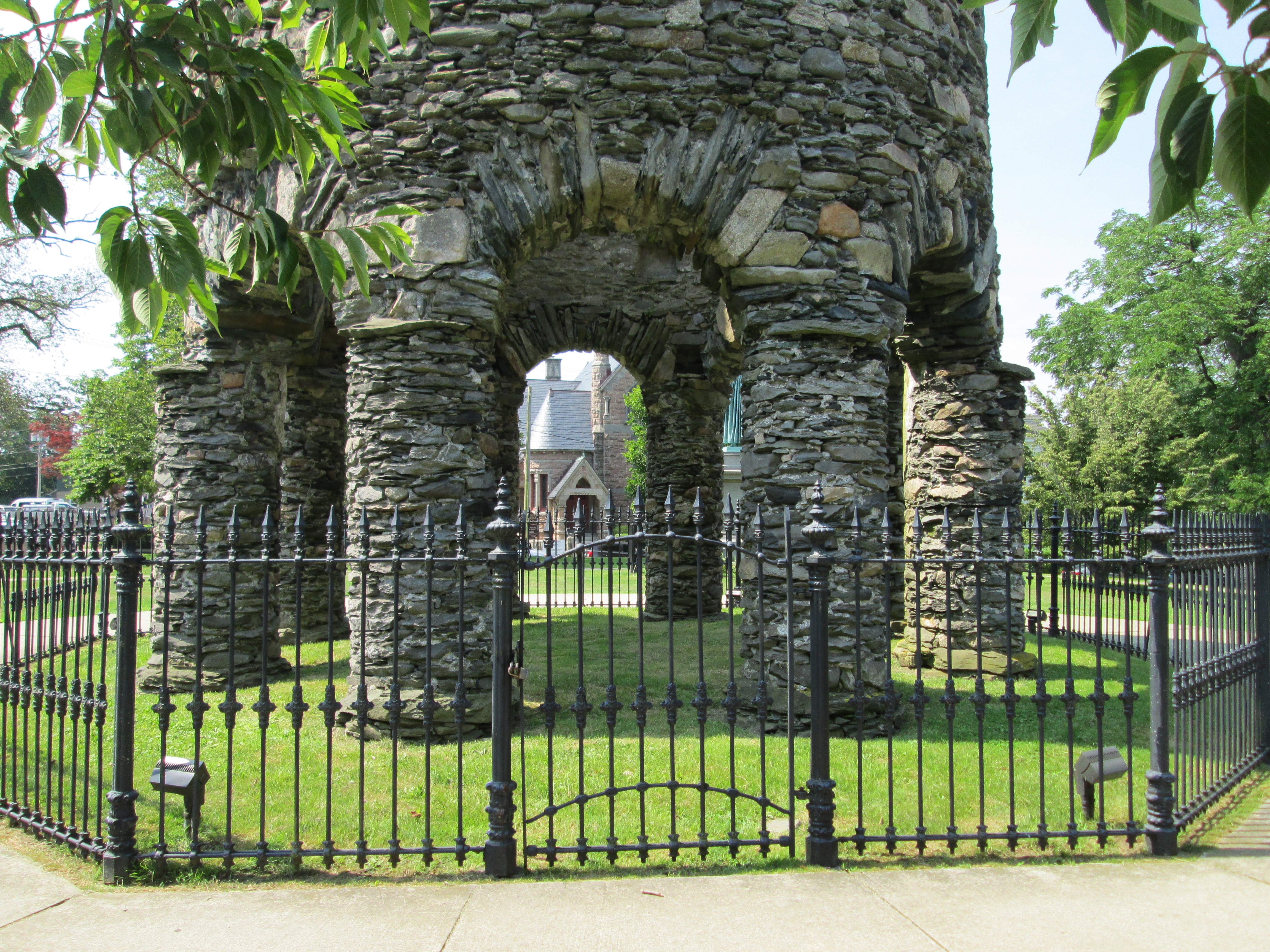
Newport Tower with OM on side. Round stone is O. Adjoining arches form M.
Who was the Builder?
Further information is here about Henricus. If the letter sequence is viewed using the Elder Futhark gematria we find:
18 24 24 21 17 9 11 23 11 24 11 5 24 … sum equals 222.✓
B O O L T H I D I O I R O… B ⇒… repeats..
It is believed Henricus died in 1123 because a new Bishop of Greenland was consecrated in 1124. Note that 1123/1124 is emphasized in the sequence.
Find: I, DI, H 1123…… I die 1123 (as) Henricus.
I HID 1123/1124 ……… I hid 1123/1124.
I R O B …. or… I Rex Oystein be… or… Be Oystein Rex.
In other runic riddles such phrases are anagrams. Recall first that the O’s were also considered to be A’s and find in these letters –
B A A L T H I D I A I R O the following:
I DI REAL PA AT OH ………. I die. Real father at island. (OH = island)
I ROB LOT I AID HA ………. I rob (the) lot. I aid. Ha!
I HID A O ROB IT AL ………. I hid. I ring rob it all.
I A O I HID ROB LOT ………. I a ring. I hid. Rob lot.
I HI PA O RAID LOT ………. I high father (bishop). Ring raid lot.
I PA H I O RAID LOT ………. I Father H. I ring (that) raid lot.
IT A O ROB AL I HID ………. It a ring. Rob all. I hid.
I PA O HID AL AT RI ………. I father. Ring hid all at RI (Rhode Island).
RHODE IT AL I A PA ………. Rhode. It all I, a father.
This sounds like the confession of a thief who robbed and aided. Furthermore, it suggests he hid it at RI, which one might think refers to treasure. It is more likely it means he was using his ill gotten gains to ‘aid’ his fellow man and hiding those people at Rhode Island. What sort of people needed to be hidden in that era? And is there a thief known as Rob who stole from the rich and gave to the poor? Who then was Henricus? Who was Rob?
Perhaps a couple more phrases might help.
I O PA HID AL AT RI ………. I O. Father (who) hid all at RI. (Rhode Island)
I O R PA AL HAT I DI ………. I O . Are Father (of) all. Hate I die.
I O R PA AL HAT I DI ………. I O . Are pa. All hate I die.
The image of the side of the tower shows a round stone between two arches. (See above.) If the round stone is an O then might not the two arches represent an M? Who then was OM and was OM a king?
It just so happens that a king also died in 1123 and his name was Oystein Magnusson who co-ruled Norway with his brother Sigurd the Crusader. Sigurd was a warrior and killer. It is then possible it was Oystein who named Henricus as Bishop to Greenland.
A study of the two kings’ relationship can be seen in the historical account of Snorri. They were not friends. The need arises for a new bishop in Greenland in 1123. It is Sigurd that names him since Oystein has died unexpectedly.
So then we might ask:
• Did King Oystein name himself as Bishop and travel to Rhode Island as Henricus?
• Was King Oystein spiriting his people away from the genocides in Norway and sending them to Rhode Island?
• Was he funding his enterprise by robbing?
• King Oystein was a fabulous architect and builder of ships, bridges and churches. Did he design the tower?
• Did he hide from his murderous brother and later return to Rhode Island to oversee the tower’s construction?
Perhaps if one looks closer at the Vinland map (yes… it’s been declared a fake…), one can find his initials OM there as well. (Hint: use two copies against a sunny window.) Did King Oystein also pen the map? There are other interesting images to be seen in the Vinland Map Cipher Addendum.
Conclusion
The Newport Tower’s embedded letters when converted to gematria reveal numbers typical of Baalist documents. Their transliteration and subsequent translation educate us in a long lost religion. That this tower displays these features severely narrows the field of possible builders. It also strongly suggests that the northern peoples, Norse and others, inhabited this region known as Rhode Island for some time and built an elegant edifice by the year 1161. Pagan / Baalist beliefs are apparent in the design of the structure. Regardless of who designed and built this Tower, it is a marvelous feat of time keeping / engineering.
This still leaves us plenty of mystery but the time period has narrowed to a window beginning in 1116 to around 1161. Furthermore, new evidence of the builder/architect is presented here pointing to a man who used the alias Henricus and who signed his work O.M.
Similar Articles by the Same Author in PDF and Post:
** For numeric background see:
**Freeborn, B.L., Validating North American Runic Inscriptions, noahsage.com, November 2022. PDF only.
Freeborn, B.L., The Vinland Map Ciphers, noahsage.com, December 2025. Book only see post.
Freeborn, B.L., The Vinland Map Ciphers Addendum, noahsage.com, December 2025. PDF only.
Freeborn, B.L., Ancient Riddles to Test Our Wits: The Secret Chamber, noahsage.com, January 2016. Post here.
Freeborn, B.L., Another Riddle in Stone from Canada, noahsage.com, August 2025. Post here.
Freeborn, B.L., Deciphering the Spirit Pond, Nomans Land and Narragansett Runic Inscriptions, noahsage.com, November 2022. Amulet post. Map stone post. PDF only.
Freeborn, B.L., Et in Arcadia Ego – OUOSVAVV DM – Deciphered, noahsage.com, December 2022. Post here.
Freeborn, B.L., Kensington Rune Stone: A New Translation, noahsage.com, February 2023. Post here.
Freeborn, B.L., Runic Riddles: Time Capsules, noahsage.com, December 2022. Post here.
Freeborn, B.L. The Long Debated Bourne Stone, noahsage.com, January 2023. Post here.
Freeborn, B.L., The Nomans Land – Leif Eriksson Inscription, noahsage.com, December 2022. Post here.
Freeborn, B.L., The Narragansett Inscription: A Translation with its Date of Dedication, Author and Inscriber, noahsage.com, October 2022. Post here.
Freeborn, B.L., The Newport Tower: Finding the Date of Dedication, its Designer and Builder, noahsage.com, October 2022. Post here.
Freeborn, B.L., The Wawa Stone and Its Viking Ship, noahsage.com, August 2025. Post here.
Freeborn, B.L., Rok Rune Stone and its ciphers, noahsage.com, November 2024. Post here.
References
Creedon, Marc, Runologist Henrik Williams Examines the Newport Tower, Youtube, April 2015.
Eagan, James Alan, Elizabethan America: The John Dee Tower of 1583/ A Renaissance horologium in Newport, Rhode Island, Cosmopolite Press, Newport, Rhode Island, 2011.
*Monge, Alf & O.G. Landsverk, Norse Medieval Cryptography in Runic Carvings, Norseman Press, Glendale, California, 1967.
Syversen, Earl, Norse Runic Inscriptions with Their Long-forgotten Cryptography, The Vine Hill Press, Sebastopol, California, 1979.
Derogatory article by Aslak Liestol of Alf Mongé’s work: http://collections.mnhs.org/MNHistoryMagazine/articles/41/v41i01p034-042.pdf and….
…Landsverk responded to these comments in Ancient Norse Messages pg. 126-129; and often in Runic Records of the Norsemen in America.
 noahsage
I really hate it when a good argument is tainted by a big problem. In this case that is the coordinates. The Prime Meridian was established in 1884. In 1200 those coordinates would have no meaning. It was not selected based on “traditions” only politics.
It was selected by the majority who were using it because it goes way way way way way back, which is somewhat different from what you have said.
My friend and I have had this (heated) argument. It is a point many will make.
Here are two points on my side of the argument: Greenwich is at latitude 51.47 (now). Smyth discusses in “The Great Pyramid” that the angle seems to be decreasing with time. (?)
Compare to Angle of rise of Great Pyramid at 51.51 degrees.
This number 51 repeated can be looked at as 5 + 1 =6 or 5 then 6. So it is 5656 which repeats the pattern seen in the numeric spelling of Yahweh (565,10).
They seemed to be quite persistent in making this number (565) appear and had numerous ways of expressing it.
Besides, it only matters if this group of people were using it at that time. How likely is it they were using the Paris meridian?
Just some food for thought before tossing the location theory.