Isosceles and Other Equals

By B.L. Freeborn © 2013

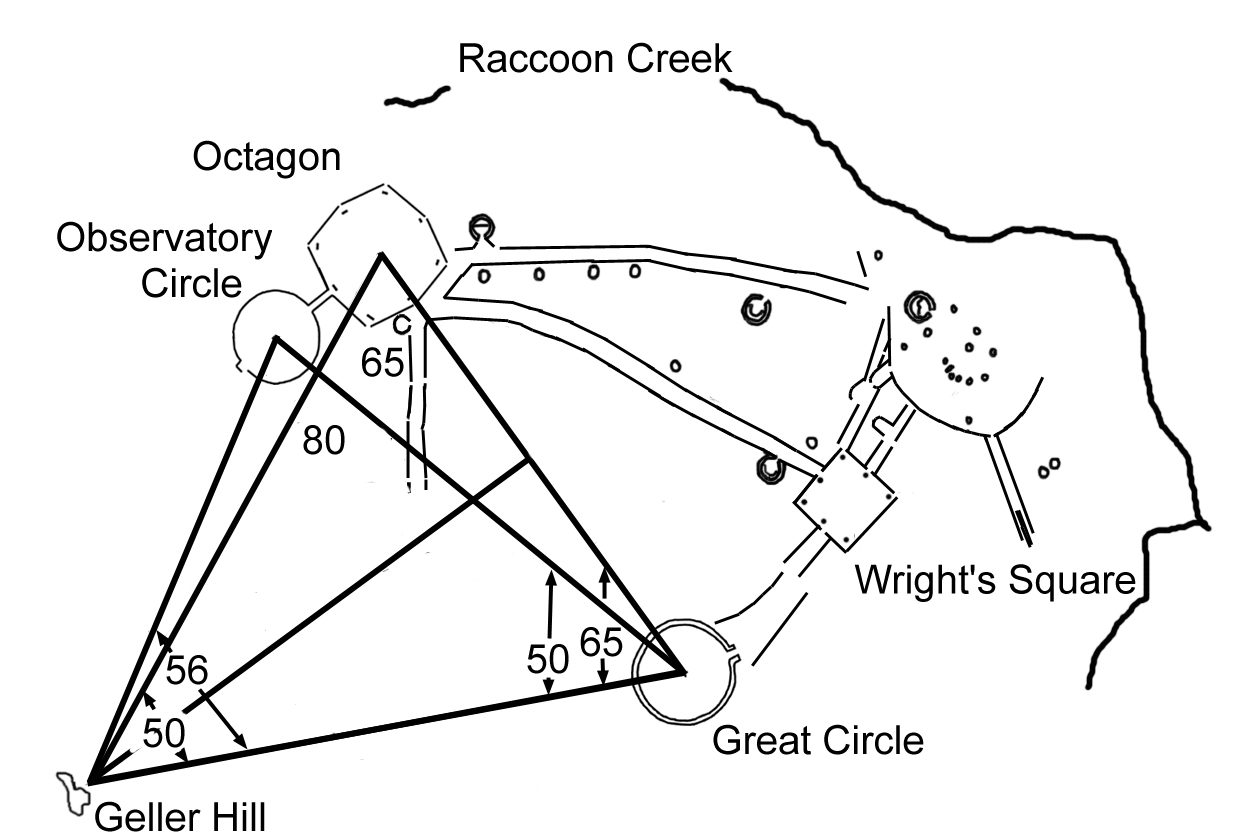
Because the Great Circle and Octagon are equally placed from Geller Hill an isosceles triangle is formed. (See image from Geller Hill at bottom.) The angle between them is 50 degrees. The line bisecting it is on the azimuth of 52.2  and this is said to be the same azimuth as the line running through the octagon-circle centerline making them parallel.

Isosceles triangles formed at Newark, Ohio Earthworks. Positions as located by satellite image. Drawing by B.L. Freeborn.

Isosceles triangles formed at Newark, Ohio Earthworks. Positions as located by satellite image. Drawing by B.L. Freeborn, 2013.

The line from Geller Hill to the center of the Observatory Circle creates an angle of 56 degrees as shown in the image. The triangle formed from the intersection of these two triangles is another isosceles triangle of degrees 50 80 50. These three numbers remind us of the numbers that compose 58.5 or very nearly the 584 we saw in the East Fork Works. In the same manner the 50 65 65 triangle reminds us of 5.6565.

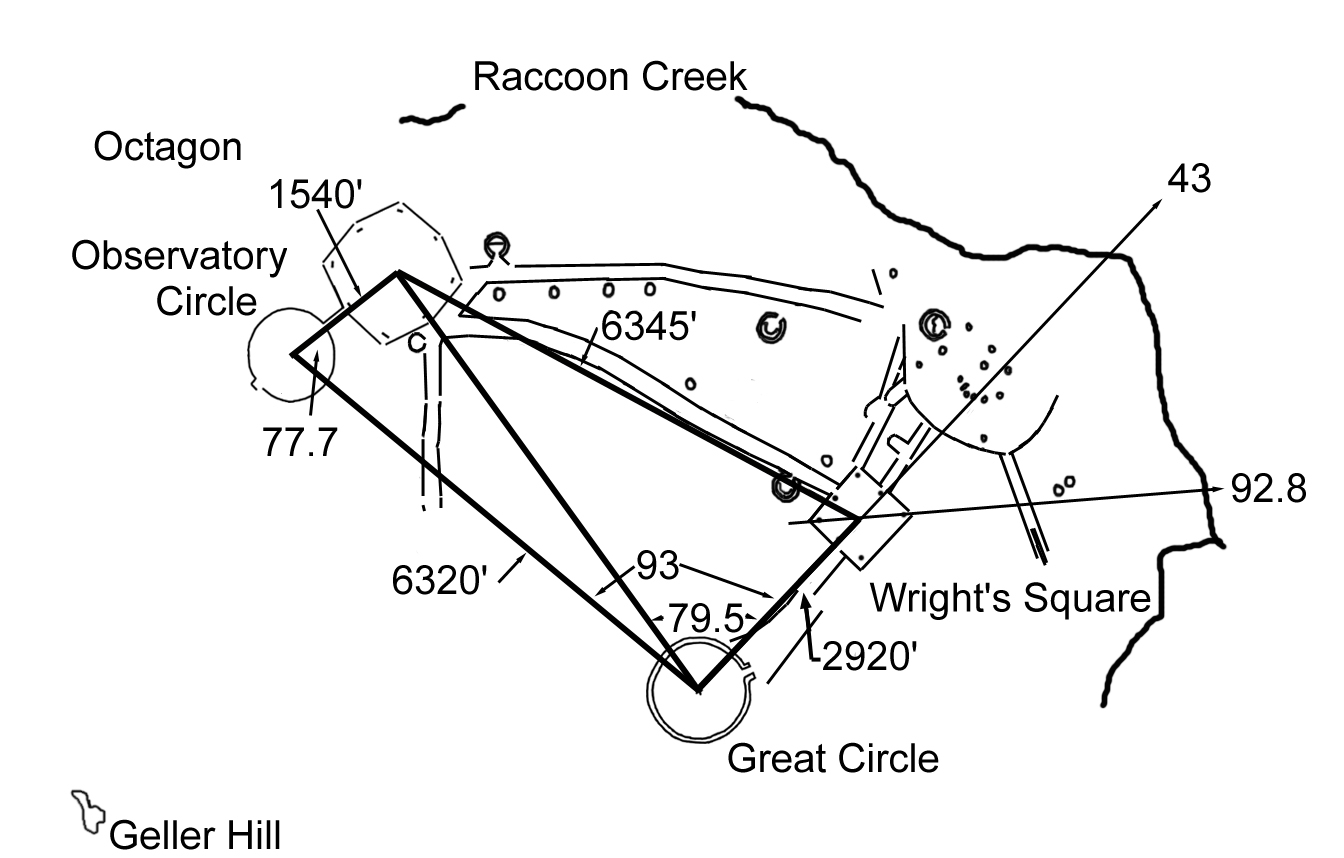
It can be determined that the azimuth angle from the center of the Great Circle through the center of Wright Square is 43 degrees. Recall that we had 86 on our number list and 2 x 43 equals 86. Using this angle and 1540 foot distance between the centers of the Octagon-Circle and Hively/Horn’s lengths for the translation of the figures across the plane, we can calculate the distance between the center of the Great Circle and Wright Square as 2920 feet. The image below was created by drawing over a satellite image using what appears to be correct centers and the Square’s position shown by Romain in his diagrams. This distance does not appear to be all that important but in fact 2 x 2920 = 5840. The angle that closes the polygon is 93 degrees or virtually the angle 92.8  at which Wright Square is set. The final angle, 79.5, repeats the idea of 79.2.

All of which confirms the numbers on our list. But there is another set of numbers we should see before we move on to looking at the Octagon and its development.

Hively and Horn base their report on the idea that these structures were built on complex ideas of archaeoastronomy which include rise and set points of the sun, moon and other celestial occurrences. But at certain times they are confused by obvious angles that do not meet with their expectations. The angle through the Wright Square at 92.8 degrees is one and the angle which passes through the center of the Great Circle and out through the center of its neck is another. One might say that if these structures were built to verifiable celestial alignments that this is one very important angle that is off. They calculate its measured azimuth at 66.6  an error of .9 degrees or nearly one full degree from what they expect to find. This does not sound like very much but this sort of error adds up quickly in layouts of this magnitude.

Calculated distance between Great Circle and Wright Square. By B.L. Freeborn 2013.

Calculated distance between Great Circle and Wright Square. By B.L. Freeborn 2013.

But we have seen this number, 66, before. We saw it at East Forks. It is repeated no less than eleven times there. It is in the length and width of the square corner of East Fork, the radius of the top circle and it is used 8 times to space the candles. But this is the only time we have seen 66 in this earthwork … or maybe not!

Note that 7 OCD = 7/5ths mile = 1.4 miles = 7392 feet which equals 66 x 56 x 2 feet. This gives us not only 66 but 56.

Additionally, the distance 6 OCD = 6/5ths mile = 1.2 miles = 6336 feet = 56 x 56.5 x 2 feet. This gives both forms of 56. All of which is remarkably equal once again. And if we were in the habit of writing fractions as 5 of 7 or 5 of 6, then 56 appears again. The 57 is another number of importance. It is seen in the conversion from degrees to radians. There are 57.29 degrees to a radian. People who study objects that move in circles, like planets, prefer to calculate with radians.

Forward to NEXT SECTION

Back to PREVIOUS POST

Back to TABLE OF CONTENTS

___________________________

References/Footnotes:

  1. Hively, Ray, and Horn, Robert, Geometry and Astronomy in Prehistoric Ohio, “Journal for the History of Astronomy, Archaeoastronomy,” Supplement, Vol. 13, p.S1; also Science History Publications, 1982.      See:   http://articles.adsabs.harvard.edu
  2. Romain, William F., Ph.D., Newark Earthwork Cosmology: This Island Earth, “Hopewell Archeology: The Newsletter of Hopewell Archeology in the Ohio River Valley,” Vol.6 (2), March 2005.   See:  http://www.nps.gov/mwac/hopewell/v6n2/one.htm
  3. Romain, William F., Ph.D., Design and Layout of the Newark Earthwork Complex, “Hopewell Archeology: The Newsletter of Hopewell Archeology in the Ohio River Valley,” Vol.6 (2), March 2005.  See:   http://www.nps.gov/mwac/hopewell/v6n2/two.htm
View from Geller Hill looking north towards Great Circle and Octagon. 2013

View from Geller Hill looking north towards Great Circle and Octagon. 2013

Creeping Away with Time

By B.L. Freeborn © 2013

How is that more than one researcher can claim these mounds are precisely laid out yet they are so out of round that they vary in their diameter? The Great Circle varies from 1163 to 1189 feet. The Observatory Circle varies from 1050 to 1058 feet. The Octagon is visibly unsymmetrical. It is wider at the end joining the circle.

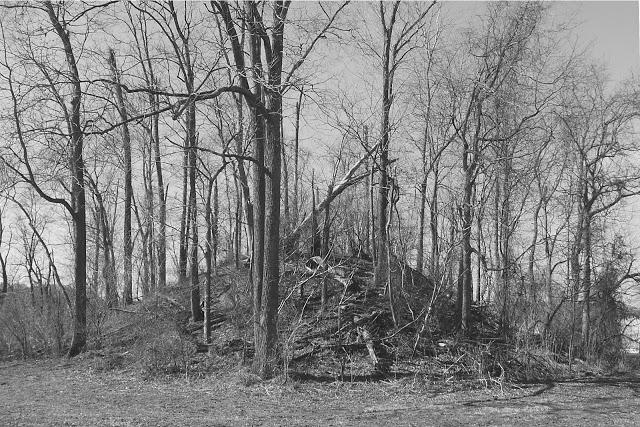
Large burial mound overlooking Ohio River. See more images of mounds at http://moundbuilder.blogspot.com/p/27-largest-burial-mounds-in-ohio.html

There are three plausible explanations for these irregularities. The first is the variation was intentional as was suggested in the difference between the sides of Wright Square of 926 and 928 and later numbers will show that this stretching was done to achieve certain distances. The second explanation is that when they were reconstructed by the Ohio National Guard and others (see complete explanation in Hively/Horn) they were altered.

The last explanation is creep. Let us say the mounds are thousands of years old and that the reason they still exist today is that on a regular basis they were maintained. The manner in which this is done can contribute to their movement.

The Miamisburg Mound is burned every other year to keep weeds and trees from overtaking it. Many mounds throughout Ohio are owned by the Ohio Historical Society and they allow massive trees to take root. Over time the roots push out, break down and do their part in returning the mounds to the landscape. In effect the Society is allowing that which they have been charged with preserving to be destroyed. The Newark Octagon is a golf course and is groomed with precision machines. The grass cover keeps the soil in place.

Carbon dating of charcoal at the Alligator Mound tells us it was built about a 1000 BP. Or does this actually tell us the date of a forest fire or a controlled burn to maintain the site?

Trees, erosion and careless reconstruction all contribute to creep but there is another way they creep out of round.  Persons charged with digging the dirt out of the ditch at the Great Circle and putting it back onto the top of the mound year after year work around the circle. Each and every year slight variations are introduced. The change is so incrementally small that it is never noticed until someone comes back a thousand years later and says, “Yo, your circle looks like an oval!” They creep out of shape. What can contribute even faster to creeping is a sloped site. Fortunately, few are on slopes. Numerous reconstructions and rearrangements in areas such as Thornborough indicate that over the centuries different generations have left their mark, so too we must assume this has happened at both Hopewell and Adena sites.

Forward to NEXT POST

Back to PREVIOUS POST

Back to TABLE OF CONTENTS

___________________________

References/Footnotes:

  1. Hively, Ray, and Horn, Robert, Geometry and Astronomy in Prehistoric Ohio, “Journal for the History of Astronomy, Archaeoastronomy,” Supplement, Vol. 13, p.S1; also Science History Publications, 1982.      See:   http://articles.adsabs.harvard.edu
  2. Image of Mound from: http://moundbuilder.blogspot.com/p/27-largest-burial-mounds-in-ohio.html

The Remains according to Romain

By B.L. Freeborn © 2013

William Romain asserts in his article Newark Earthwork Cosmology: This Island Earth that Geller Hill is the center of the measurements for the earthworks. The hill is 1150 feet long by 700 feet wide by 35 feet high (later noted as 75 feet high) in the otherwise level terrain of Newark.

Newark Earthworks as laid out from Geller Hill as William Romain suggested. Drawing by B.L. Freeborn.

Newark Earthworks as laid out from Geller Hill as William Romain suggested. The Great Circle and Octagon are equal distance from Geller Hill. The layout forms an isosceles triangle. Drawing by B.L. Freeborn.

Romain determined that the Octagon center is 7392 feet and the Great Circle center is 7498 feet distant from Geller Hill. Using Hively and Horn’s OCD (Observatory Circle Diameter) of 1054 feet, this is 7.01 OCD and 7.11 OCD respectively. Oddly enough, or should we say not so very coincidentally, these distances are 7.000 fifths mile and 7.1 fifth mile. He further suggests that the direction of the midline of the angle formed is at 53.3 degrees which corrects to an azimuth of 52.2 degrees and this further correlates to the azimuth of the Octagon found by Hively and Horn of 52 degrees.

We need only observe that 7 x 52.2 = 365.4 or almost exactly the number of days in a year!

Hively and Horn further discovered that the Observatory Circle is 5.99 OCD’s from the Great Circle (aka Fairground Circle) and the Octagon is 6.02 OCD’s from Wright Square. A bit of math shows this is 6313 and 6345 feet respectively or 5.98 Fifth miles and exactly 6.00 Fifth miles.

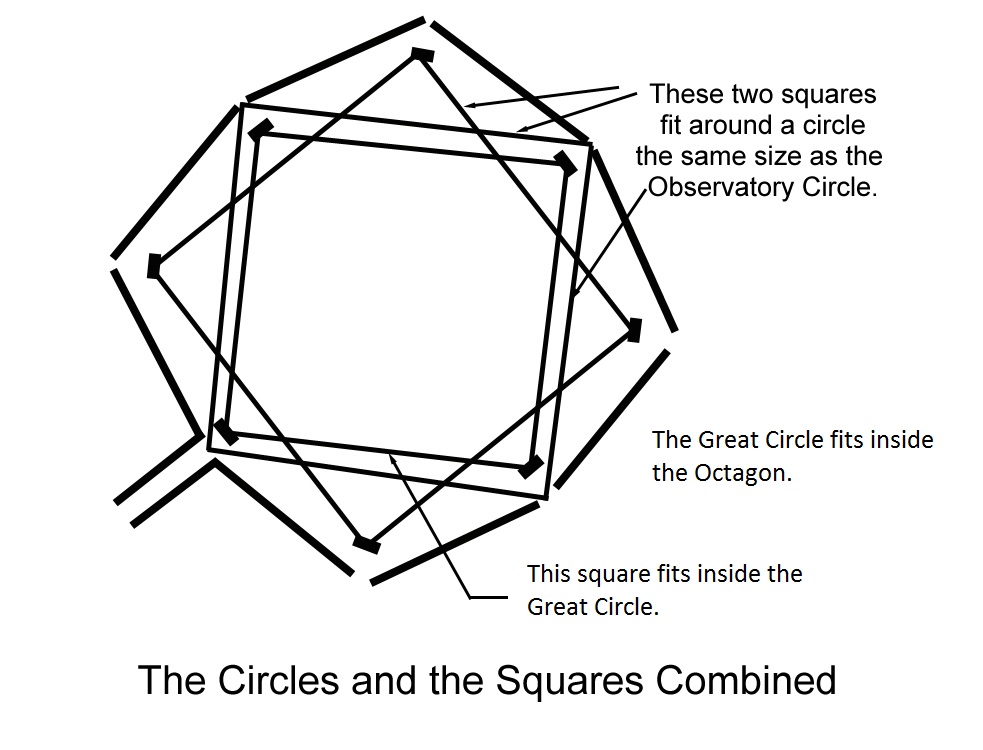
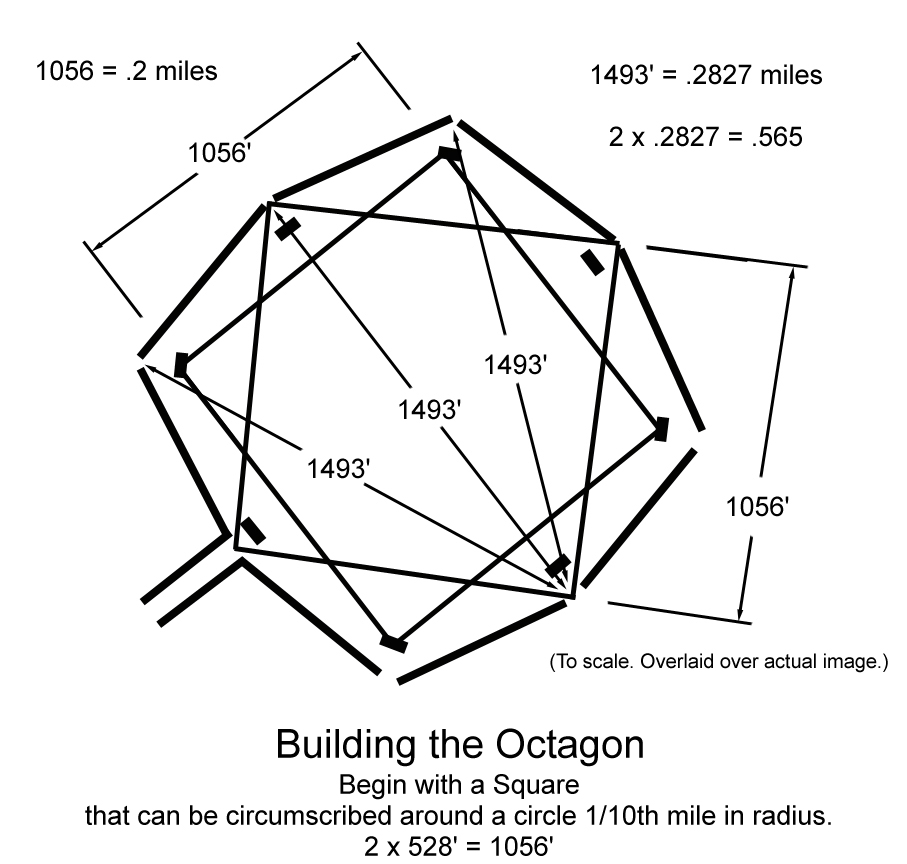
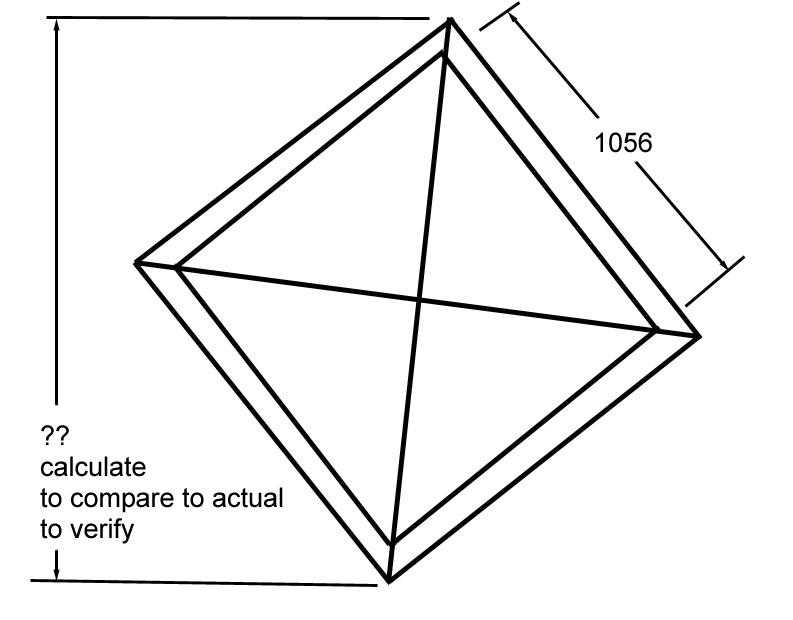
The OCD is based on the diameter of the Observatory Circle. Because the circle is slightly distorted there is plenty of room to accommodate the diameter 1054 as well as 1056. The latter number indicates that the circle is the same size as Marshall’s measurement at the High Bank Works. The radius there is 528 feet or one tenth mile.

The distances between the structures at Newark Earthworks creates the number 76. It is repeated further in angles and center distances. Drawing by B.L. Freeborn.

The distances between the structures at Newark Earthworks creates the number 76. It is repeated further in angles and center distances. Drawing by B.L. Freeborn.

Returning to Romain’s findings we note that it is possible to find a spot on Geller Hill that gives an equal value of 7 fifth miles distance to each structure. Hively/Horn demonstrated that the circle-octagon translates across the plane a distance of 6 OCD units to the circle-square. By combining this conclusion with the 7 unit distance we find the number 76 reappears twice. (See diagram.) Indeed, it appears more often than that. Hively/Horn noted that the small circle adjoining the Octagon had a diameter of 1/7th OCD. Expressing the radius as 76 feet seems simpler. Further still, the angle between the lines projected from Geller Hill is 50 degrees which has a sine of .766. Similarly, the angle formed from the lines joining the Hill to the Great Circle and from there to the Observatory Circle is also 50 degrees with sine of .766 as shown. Turning and continuing to the Octagon forms an angle of 77.7 degrees which correlates with the distance between the two centers of 770 feet x 2 or 1540 feet.

There are four things to consider about this 1540′ distance:

  1. Referring back to the Thornborough Henge layout, the path distance between the two southern circles calculated to this same value 2 x 770 = 1540.
  2. Hively and Horn incorrectly state this distance is 2 OCD or 2108 feet.
  3. Romain in his geometric layout states the distance is 1½ OCD or 1581 feet or 2 x 790. A difference of 40 feet.
  4. Because neither the Octagon or Observatory are purely symmetrical there is no true center which allows for differing opinions as to where the center lies contributing to the above differences.

Further and unfortunately, Romain’s geometric reconstruction of the earthworks fails under the scrutiny of protractor and sharp pencil. However, his conclusion that they were precisely laid out is accurate and provable far beyond what he has demonstrated.

Forward to NEXT POST

Back to PREVIOUS POST

Back to TABLE OF CONTENTS

___________________________

References/Footnotes:

  1. Hively, Ray, and Horn, Robert, Geometry and Astronomy in Prehistoric Ohio, “Journal for the History of Astronomy, Archaeoastronomy,” Supplement, Vol. 13, p.S1; also Science History Publications, 1982.   See:   http://articles.adsabs.harvard.edu
  2. Romain, William F., Ph.D., Newark Earthwork Cosmology: This Island Earth, “Hopewell Archeology: The Newsletter of Hopewell Archeology in the Ohio River Valley,” Vol.6 (2), March 2005.   See:  http://www.nps.gov/mwac/hopewell/v6n2/one.htm
  3. Romain, William F., Ph.D., Design and Layout of the Newark Earthwork Complex, “Hopewell Archeology: The Newsletter of Hopewell Archeology in the Ohio River Valley,” Vol.6 (2), March 2005.  See:   http://www.nps.gov/mwac/hopewell/v6n2/two.htm
Perfection Lost, Perfection Found

By B.L. Freeborn © 2013, updated Nov. 2018

Right side of Newark Earthworks from Burks drawing.

Right side of Newark Earthworks from Burks drawing.

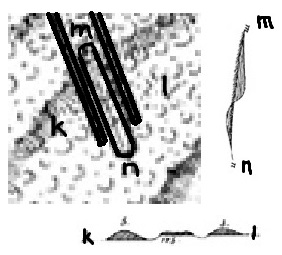
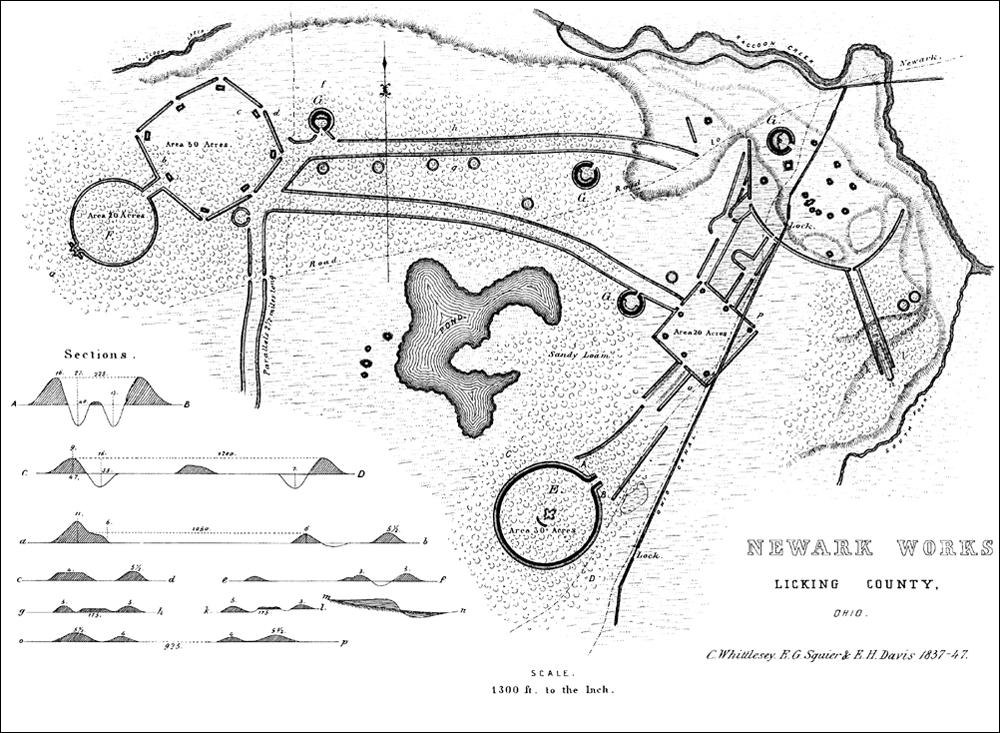
The most accurate existing map of the Newark Mounds was made by David Wyrick who found the much debated Holy Stones. It is similar in appearance to a map made by Burks and is found in Alrutz’s book. The most striking difference between the latter two and the Squier-Davis map is in the depiction of the large oval north of Wright Square which appears as a half circle in the Squier image. The structure lay very close to Raccoon Creek which was probably used to fill the oval for ceremonial use during spring festivals when the creek would have been full. The Squier survey gives a cross section of the neck of the oval that projects to the southwest towards the creek. It seems to be constructed in such a manner that water flow could have been restricted. (The east-west straight line is a railroad and the north-south wavy line is the canal built through the structures.)

Detail through neck of Oval at Newark Earthworks from Squier-Davis drawing.

Detail through neck of Oval at Newark Earthworks from Squier-Davis drawing.

The concept that this Oval could have been filled with water would be even more important to the Decalogue Debate if it can be shown to relate to the story of Noah, the ark and the flood as was suggested in the sideways “ark” appearance of the Decalogue Stone.

We leave the oval and notice that the square and oval are connected via mound lined paths to the Octagon very similar to those we saw at Thornborough. Those were about 200 feet across. These are also 200 feet across. The path from the Oval is different in that its middle is raised perhaps to allow foot traffic while the ditch on each side is flooded ceremonially.

new6paths

The paths at Newark Earthworks form angles as they meet at the Octagon. Drawing made from satellite image and blending in missing portions from Squier-Davis Drawing. By B.L. Freeborn.

Having arrived at the Octagon via the path we note that the paths form angles as they converge. They are depicted by each artist in a strikingly similar manner. Their angles and a bit of math is shown in the above image. We find a repeat of the number 56 and the reappearance of 584. The 140 is twice 70 which we have seen before. A new and simple number appears and that is an angle of 50 degrees.

Does 50 have any pertinence to our growing list? Indeed it does! The engineer of the past left no possible element in his design to chance. The sin 50 degrees = .766. We have seen this number in Newark’s distance from the Serpent Mound (76.6 nautical miles). We shall see it again. We might want to pause to note that the square root of 7.66 is 2.76767…. (repeating infinitely) which makes it quite interesting. While the root of 7.7 is a slightly less impressive 2.77 although the 7’s are repeated in the root. From Geller Hill, which sits rather quietly to the southwest of the Earthworks, it is 7.7 miles south to where Wyrick and others found the Decalogue stone at the site where the Great Stone Mound was. In other words, Geller Hill and Great Stone Mound are located 7.7 miles apart. We might want to add that from Grave Creek Mound it is 79.2 miles to Geller Hill, a strikingly important number! We shall look next at what else Romain discovered about this hill.

Forward to NEXT POST

Back to PREVIOUS POST

Back to TABLE OF CONTENTS

The Cross that Tells Us…

By B.L. Freeborn © 2013

Book of Kells, Chi Rho Page. PD.

Book of Kells, Chi Rho Page. Wikipedia. PD.

The Cross amid the art of the Book of Kells symbolizes the cross of Christ. Or does it? Why would a people be led to constantly remember this shape through the retelling of the death of its messiah? A not so simple answer is that once upon a time someone wanted something else entirely remembered and since they were soon to become a conquered people they worked their own beliefs into the newly arrived religion. So we see in this art a beautiful cross and what do we see laid out quite neatly in Newark? Why a cross! And amid the cross is a diagonally placed square just as we see in the Book of Kells!

A  cross imbedded in the layout of Newark Earthworks. Wright Square is similar to the diamond that appears in the Book of Kells Cross.

A cross imbedded in the layout of Newark Earthworks. Wright Square is similar to the diamond that appears in the Book of Kells Cross.

We begin telling the story portrayed in Newark’s layout by examining the square within the cross. This portion of Newark Earthworks called the Wright Square is all but gone. There is a small portion that remains that marks the spot and other than that there are only survey notes. The beautiful Squier-Davis image is known to be incorrect for scaling despite its details. We know from a survey by Thomas in 1894 it was 928 feet by 926 feet. It is assumed by Romain1 2 and others that this is an error from an ideal of 925 feet yet these measures are not too far off for we see 926′ x 928′ gives us an area of 859,328 feet or very nearly 860,000 feet. Hively and Horn report that the east-west axis of the square is 92.8 degrees.3 They felt this was a .8 degree error from the Lunar rise-set point. Yet, one should pause to note the similarity between this number and the size of the square, 928′, which suggests there is no error here.

Going further they report the northwest entrance path runs perfectly straight for 160 m (useless meter!) or 525 feet (or was it 528?) at an azimuth of 306.8 degrees. It then enters the square at an angle.  With a bit of math it is easily determined this is an angle of 56 degrees to the azimuth of the north-south axis. (360 – 306.8 + 2.8 = 56) Furthermore, they were perplexed as to why this avenue did not enter at the center of the side but instead at 30m (useless meters again!) north of the center of the side. We calculate 98.4 feet + 926/2 = 561.4 feet. In other words, the opening breaks the side into two portions: one 561 feet and the other 365 feet. We should immediately recognize the meaning of the latter! This notably repeats the value of the angle of the path at 56 degrees.

Let’s not stop here because the picture is not complete. We have not added them! 926 + 928 = 1854 which is very nearly a number we saw twice at the East Fork. Indeed, 926 and 928 are quite close to 924 and 935 feet we saw there. They were also positioned perpendicularly. Their sum was 1859. Both sets of numbers are portraying not the idea of a simple radius but the idea of an oval, an oblate sphere as we saw in the egg at the Serpent Mound. To do this the values must be similar yet “off.” So they have described quite completely an object with this string of numbers: 365, 926, 928, 1854, 859,000 or at East Fork they used 924, 935, 1859 and 864,000. They threw in two additional reminders of 56 as well.

The square has been discussed first because it seems so insignificant but it appears in all ancient art. It is usually portrayed as the literal seat of all measurement.

Overall, we see in this layout of Newark two structures on the left and three on the right. Two and three create the number 23 or perhaps it is 32 if read right to left. We have seen that the square of 5.656 is 32. Perhaps we should think of it as 23 degrees and 32 minutes and add it to our growing number list.

Does this place with its mounds and ditches speak of the gods? Does it speak of Baal? We note that in Hebrew gematria bet, B, is 2 and lamed, L, is 30. So, the value of the name Baal is 32. The layout then “counts” the name. But if it is 23 then kaph, k, is 20 and gimel, g, is 3. Keg  in Old English is the modern word keg. Might this layout “counted” out mean Baal’s keg? Or Baal’s crater?

What other mysterious coincidences might lie here?

Forward to NEXT POST

Back to PREVIOUS POST

Back to TABLE OF CONTENTS

_________________

  1. Romain, William F., Ph.D., Newark Earthwork Cosmology: This Island Earth, “Hopewell Archeology: The Newsletter of Hopewell Archeology in the Ohio River Valley,” Vol.6 (2), March 2005.   See:  http://www.nps.gov/mwac/hopewell/v6n2/one.htm
  2. Romain, William F., Ph.D., Design and Layout of the Newark Earthwork Complex, “Hopewell Archeology: The Newsletter of Hopewell Archeology in the Ohio River Valley,” Vol.6 (2), March 2005.  See:   http://www.nps.gov/mwac/hopewell/v6n2/two.htm
  3. Hively, Ray, and Horn, Robert, Geometry and Astronomy in Prehistoric Ohio, “Journal for the History of Astronomy, Archaeoastronomy,” Supplement, Vol. 13, p.S1; also Science History Publications, 1982.      See:   http://articles.adsabs.harvard.edu
  4. Book of Kells Image from Wikipedia. See:   http://en.wikipedia.org/wiki/File:KellsFol034rChiRhoMonogram.jpg

A Holy Place Lies Here

By B.L. Freeborn © 2013, updated Nov. 2018

Famous drawing of Earthworks in Newark, Ohio by Squier, Davis and Whittlesey, 1837-1847.

Famous drawing of Earthworks in Newark, Ohio by Squier, Davis and Whittlesey, 1837-1847.

Hopewell is a name of coincidence. It is the name given to the mound builders of Ohio. Adena is the other name bestowed on them. Hopewell comes from the name of the man who settled land on which mounds were situated. Adena, similarly, came from the name of a homestead. Neither name has any historic relevance. Yet when these mounds were laid out, did not their designers Well Hope they would last for eons? Would they have situated them where they had the best chance of surviving? If we can figure out how they were placed will that give us a clue to the knowledge within the minds that placed them?

We have noted the importance of 40 in Judaism. What is 40 miles from nowhere on a vast empty continent? Nothing. But line of latitude 40 runs through the middle of this flat, open terrain. In fact, Newark lies only 2 minutes of latitude north of it. J.Q. Jacobs notes that the Serpent Mound lies at longitude 83 degrees 25′ 52″ and the Newark Earthworks lie at 82 degrees 25′ 48″. This is one degree of longitude separation.1 2 The Serpent holds an egg in its mouth and this egg is an oval 120 feet by 70 feet. The inner diameter of this oval is 76 feet across. We have seen this 70 before. We have seen 12 before and we shall soon see many references to 76.

Main layout of Earthworks in Newark, Ohio

Layout of Earthworks in Newark, Ohio created by drawing over satellite image and blending area above Great Circle and paths with those portions from Squier-Davis Drawing. — Drawing by B.L. Freeborn.

Surely, this Serpent has something to do with the placement of Newark or vice versa. The Newark Earthworks lies 76.6 nautical miles or 88.15 miles north of the Serpent. Indeed, from the prominently placed Miamisburg Mound the distance is 87.7 nautical miles or 100.9 miles. But these are two local monuments. Do they align with any other great monument? Why was the Newark complex placed here?

Romain posits that the Newark Octagon and the Great Circle are both placed in reference to Geller Hill at a distance of 7 OCD from each. Geller Hill is located at 40 degrees 2′ 12″ N latitude.  Let’s look at that closer 40, 2 and 12. The numbers sound familiar. But the longitude is 82 degrees 27′ 26″. This is not very pretty at all. However….maybe this spot was chosen for another reason. The distance between the Great Pyramid and this innocuous hill in Ohio is 113 degrees 35′ or 113 degrees and .583 degrees. We can see the 583 reminds us of the 584 we saw at East Fork but that can be purely coincidental ….well… until one adds it to 113 and recall the ancients loved to double. So 113.583 equals 2 x 56.7916. What are the odds that 56 and 7916, nearly 7920, would show up here? Consider further that 113 is 2 x 56.5. Let me throw this additional coincidence out. In the story of Noah it rained for 40 days and Noah lived to the grand toothless age of 950 years. Are we supposed to convert that 950 say from years to months, or inches to feet, to obtain 79.16? What other not so pure coincidences can be found at Newark?

____________________

  1. Jacobs, James Q., “The Great Circle Earthwork, Newark, Ohio,” 2006.  See:  http://www.jqjacobs.net/archaeo/newark.html
  2. Jacobs, James Q., “Newark Octagon, Newark, Ohio,” 2006.  See: http://www.jqjacobs.net/archaeo/octagon.html

Back to Previous Section

Back to Table of Contents

Forward to NEXT SECTION

A Simple Idea Only a Foot Long

By B.L. Freeborn © 2013, updated Nov. 2018

Hanukkiah Earthworks or East Fork Works of Southern Ohio with Dimensions

Hanukkiah Earthworks or East Fork Works of Southern Ohio with Dimensions

The ancient world took their Ruler very seriously. The King or Ruler as represented by a man would confirm and declare the standards of measure of his land or the ruler. The terms are not meant to be a play on words. It is just that we have forgotten how important standards of measure are. We forget that is until we are at the gas pump and we think we have been shorted! Oh! Then we remember and call the local weights and measures guy and file a complaint with our current Ruler that the law is not being followed. This tradition is alive and well.

The unit of length found by Rene Millon at Teotihuacan near Mexico City was a length of 57 meters or 187 feet.

Hugh Harleston, Jr. in 1972 found that the unit of length at the same site was 41.66″.1

Robert Horn and Ray Hively2 suggested in 1982 the standard length of Newark was 1054 feet. (This is 527 times two.) They called it an OCD (Observatory Circle Diameter). They otherwise measure in meters.

William Romain follows Horn and Hively and uses OCD’s but he otherwise measures in feet.

Marshall notes a radius of 528 feet at the High Bank Works. This 528 is 1/10th of a mile.

The scale on the East Fork Works indicates the candelabra is 528 feet across or 1/10th mile.

The resemblance between the Indus Inch, Sumerian Inch, and English inch is not by chance. In fact, it can be shown with relative ease the basis for Harleston’s length of 41.66″ is the 36″ yard.  Notice that 36/ 41.66 is .864 and this number is found in the diameter of the Sun at 864,000 miles. The same cannot be done for Millon’s length of 187 feet. Notice also how impractical this unit is. A measuring tape of 100 feet can be bought today for a good price and this is almost half the length Millon is proposing. Nobody routinely carries around a 100′ tape. It is unwieldy. People do routinely carry 16 foot tapes, nearly the length of the standard rod of the old surveyor of 16.5 feet. If one makes it into two pieces it is a stick 8.25′ long or if three pieces 5.5 feet in length. In other words, it can double as a walking stick. If 187 feet is absurd then a standard of 1054 feet or an OCD fails for the same reason.

Unless!… they are suggesting the basic unit was a foot and 187 feet then takes on a whole other meaning. The OCD or 1054 feet takes on another meaning as well. If the diameter is 1054 then the radius is 527 or one foot shy of 528. We should consider a factor called error. The ropes were either not taunt enough to get an accurate measure of 528 feet (1/10th mile) or their foot measure was off by .19%. This is a negligible error when talking about a single foot but the error multiples at greater distances and adds up in this case to a foot.

Most of the world will not agree, but the silliest mistake being made in the study of ancient monuments is the use of the meter. They did not use meters. We should not use meters to measure their monuments. The measure closest to what they probably used is still commercially available, very affordable and still in use in the US. There is a big downside to not understanding why the foot /mile measure should be rigidly adhered to at ancient sites. The lengths and numbers had religious importance and the words through gematria reflected the numbers. For example, in the East Fork we just examined, can one see Millon’s value of 187 feet? It appears on the long side as 187 / 2 = 93.5 or 10 times this = 935 feet. We see it quickly because it is a multiple of 10. Compare the converted units. This 93.5 feet becomes 28.5 meters and then one tenth of this is 2.85 meters. The value preferred in the Torah is 186. It repeats the 86 found in Elohim (Lord).  If we are using 2.85, 28.5, or even 57 meters we will never see the repetition in the gematria of the words. We will certainly never arrive at the concept to which they were alluding. The Sumerian cush was discussed in another article and how via gematria one can arrive at its length. The ancient cush is otherwise called a Megalithic Yard.

Here is another example showing how 66 from a partial inch to thousands of miles appears in the foot system and the metric system:

.66″           66″        66′            660′            66 mile       66,000 mile

equates to:

1.68 cm   168 cm   20.11 m    201.17 m   106.2 km    106,216 km

The message gets lost in the units.

The 187 foot length is not their unit of length as Millon deduced. Its repetition at Teotihuacan merely meant the site was built to focus (worship, recall) that length and its meaning. Observe the same phenomena in the East Fork. The repetition of 66 and its repeat in 132 and even 110 feet as 1320 inches does not mean their base unit was 66 feet. It simply means their base unit was the foot and inch, and that they are trying to tell us something important by emphasizing these lengths.

These numbers 66 and 187 still have valid measurable meaning today. Handed down by the “gods” to the Kings to the people and down through generations to us we are still using these units. We do not remember why they have meaning and we do not remember why 66 and 187 and the rest of this growing number list is important but we are slowing getting there. The mystery is unraveling.

One more important concept about East Fork is to be seen before we move on. The left side has an angle. The line is 825 feet high and the line angled at 30 degrees is 440 feet long. (Note that 825 is 528 reversed and recall there are 5280 feet in a mile.) The base length of the candelabra is 560 feet long. The 30 degrees represents the double hour. Every two hours the earth turns 30 degrees, a basic fact in navigation. The circumference of the earth (7920 x pi = 24880 miles) divided by 440 equals 56.55 which is very nearly this value 560 feet and the number we found on the Decalogue in the form het, vav, het, vav or 5656. This number, 56, is going to pop up everywhere. As far as all the other numbers… let us assemble them in another extraordinary way.

Back to PREVIOUS POST

Back to TABLE OF CONTENTS

Forward to NEXT POST

_____________________________

  1. Tompkins, Peter, “Mysteries of the Mexican Pyramids,” New York: Harper & Row, Publishers, 1976.
  2. Hively, Ray, and Horn, Robert, Geometry and Astronomy in Prehistoric Ohio, “Journal for the History of Astronomy, Archaeoastronomy,” Supplement, Vol. 13, p.S1; also Science History Publications, 1982.      See:  http://articles.adsabs.harvard.edu
  3. Freeborn, B.L., “The Inch, The Megalithic Yard, and The Sumerian Inch,” 2013. See: https://noahsage.com/2013/01/13/the-inch-the-megalitic-yard-and-the-sumerian-inch

.

Squaring the Circle and other School Lessons

By B.L. Freeborn © 2013

We did not learn how to square the circle in school but if one takes geometry one will learn how to draw a square around a circle. One might even learn how to draw a square within a circle. Other terms used in describing this are: the square circumscribed around a circle, converting the diameter of the circle into a square, the circle circumscribed around a square and a circle of equal area to a square, etc. These are Old World math problems that date back thousands of years. School lessons on clay tablets from Sumeria reveal students studied this topic hundreds of generations past. What do the terms mean? This is best shown in a picture.

Squaring the Circle

The Old World problem called squaring the circle.

James P. Scherz states it very well: “A careful survey of the earthworks at Newark Ohio has revealed not only a solution to the ancient Old World geometrical riddle of “Squaring the Circle” by use of rope geometry (associated with legends of the Great Pyramid of Egypt), but also three different units of measure, which were also used together in ancient Egypt (and other lands influenced by that region).” 1

Anyone who has attempted to study gematria runs into this Old World problem. “Dimensions of Paradise” 2 which is John Michell’s study of the New Testament’s Greek gematria is laced with this problem. It is an inescapable part of Old World religions. We see it boldly displayed even in the image of the East Fork Works. Notice the small circle at the top has a diameter of 132 feet. The small square at the bottom has sides 132 by 110. If it were square, 132 x 132, it would be the square that can be circumscribed around the circle. They sneak it in again in a second place. At the top of the lamp is a curve that begins as if it has a radius of 584 feet or diameter of 1168 feet. If one were to complete the circle, the square that can be inscribed within it would have sides of 826 feet. From the top of the small square to the point is 825 feet (vs. 826 is a negligible error) or the side of the square required.

This idea appears blatantly in the High Bank works where the circle is set almost next to a square that is beginning to distort into an octagon. The idea appears repetitively, as we shall see, in the Newark Earthworks.

Scherz also brings up the topic of units. We will continue next with some modern day guesses as to the units used in pre-Columbus America.

_____________________________________

  1. Scherz, James P. Old World Units of Measure Found in the Layout Geometry of Prehistoric Earthworks at Newark, Ohio, “Midwestern Epigraphic Journal,” Vol. 16, No. 1, 2002.  See:  http://www.midwesternepigraphic.org/scherz.html
  2. Michell, John, “The Dimensions of Paradise: Sacred Geometry, Ancient Science, and the Heavenly Order of the Earth,”  Rochester, Vermont: Inner Traditions International, 2008.

Back to PREVIOUS SECTION

Back to TABLE OF CONTENTS

Forward to NEXT POST

The Mounds that were Imagined by the Army

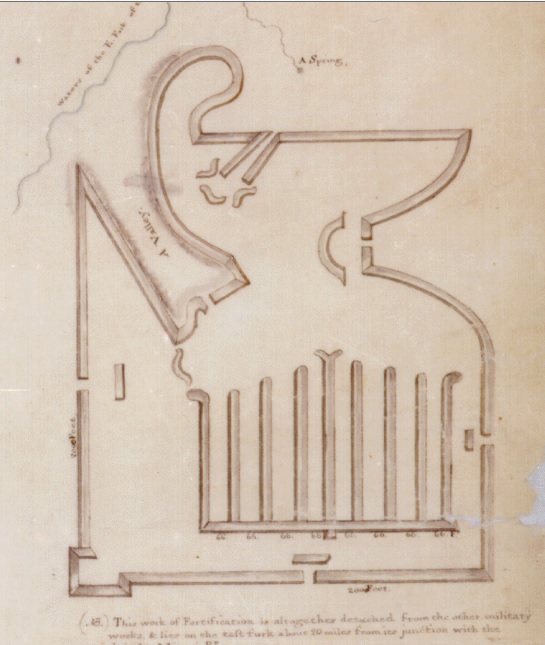
Hanukkiah Earthworks as surveyed by the Army before they were destroyed.

Hanukkiah Earthworks as surveyed by the Army before they were destroyed.

By B.L. Freeborn © 2013, updated Nov. 2018

What else does Dr. McCulloch have to offer? As a long time advocate for the stones his website has a few things not found anywhere else. If one visits his Archaeological Outliers Page1 one will find an image of a great earthwork that no longer exists. It met with the colonial plow and lost. Formerly, this great earthwork was to be found east of Cincinnati near the East Fork of the Little Miami River. Fort Ancient and Chillicothe both have large concentrations of mounds and are relatively close.

It takes little imagination to see in this image an oil lamp and a candelabra particular to Jewish tradition called a Hanukkah menorah. McCulloch explains in detail the different surveys done at this site. One survey was done by the US Army but in accordance with the anti-debaters logic the earthworks never existed. It is a short leap after seeing this to concluding the Decalogue Stone is Jewish. But again we must hesitate to make that leap since if it is Jewish, present day Jews would have some understanding of what the earthworks are all about. The Jewish are a people who tenaciously adhere to tradition. If the earthworks are of Jewish origin, then would there not be a tradition of making earthworks in their religion? Since there is not, we continue looking for an explanation.

The East Fork Works is portrayed in this image. The 2000 foot length on the image is believed to be incorrect. (See full resolution image at McCulloch’s link below.) It is noted in two places as 200 feet and then later someone has written in a zero to make it 2000 feet. Frank Otto proposed in 2006 that the correct dimension is probably 900 since 9’s and 2’s can look similar and this then was a mistake in taking the information from field notes. The spacing on the candles is 66 feet. Scaling the image accordingly, the 900 foot dimension is confirmed in the locations shown in the image below. The overall dimensions on the bottom and left are 924 x 935 = 863,940 or 864,000 square feet. This 864 looks familiar. We saw it in the Decalogue Stone.

Hanukkiah Earthworks with Dimensions Added.

Hanukkiah Earthworks (East Fork) with Dimensions Added.

The other numbers found on the stone were: 56, 5656, 69.2, 69, 70, 79, 58 and 16. The 79 appears in the East Fork Works at the bottom as 792. The average diameter of the Earth is 7920 feet. The 56 appears at the bottom of the candlestick as 560′. The lower branch actually bumps out to give the dimension. The 58 appears at the top closer to its correct value of 584 which reminds one of the distance Earth travels in a year or 584 million miles. Easily summed and used to check the scale is 66 x 8 = 528. The 528 was found by James Marshall at the High Bank Works south of Chillicothe2 as the radius of the giant circle there. 528 feet is exactly 1/10th of a mile.  Its prominent display here is also indicating measurement by the mile. The distance 660 feet is called a furlong. There are eight in a mile. The candles are then set at 1/10th of a furlong. The radius of the small top circle is also 66 feet making the diameter the noted 132 feet. The 132 feet appears as the length of the bottom small square. Its vertical height of 110 feet is 1320 inches. The area of this square is .333 acres. We saw on the back of the Decalogue Stone the number 9 and recalled that it is 3 + 3 + 3 = 9. The 3’s appear in the area .333 but more so the 9 appears as the 900′ dimensions. The area of a 900′ x 900′ square is 18.59 acres.

This value repeats. The side lengths 935′ and 924′ sum to 1859′.

The topic of the Sumerian inch of .66 inches has previously been studied.3 The value 66 reminds us that Earth travels at 66624 mph. Furthermore, one cannot possess a really important length of .66 inches unless one’s standard is actually one full inch. The same follows for the Indus inch of 1.32 inches. The value 1.32 is reflected in this image as well.

If one has taken the time to follow this, it leaves more questions than answers. Why are there all these odd elements in one place: English measurement, numbers of Sumerian and Indus importance, Jewish symbols, Jewish letters, and an accurate measurement of the Earth’s diameter? Not to mention in the last post we brought into play the deity Baal. The mystery grows in complexity rather than being solved.

Back to PREVIOUS SECTION

Back to TABLE OF CONTENTS

Forward to NEXT SECTION

________________________

  1.  McCulloch, J. Huston, “Archaeological Outliers Page.”    See: http://economics.sbs.ohio-state.edu/jhm/arch/outliers.html
  2. Marshall, James, Intelligence Inscribed before the Printed Word in North America, Caxton  Club of Chicago, 2004. See: http://www.caxtonclub.org/reading/2004/jul04.pdf
  3.  Freeborn, B.L., “The Inch, The Megalithic Yard, and The Sumerian Inch,” 2013. See:  https://noahsage.com/2013/01/13/the-inch-the-megalitic-yard-and-the-sumerian-inch/

The Clever Artist Knows the Mysteries in his Craft

By B.L. Freeborn © 2013, updated Nov. 2018

Moses and the Ten Commandments bring to mind Noah and the Ark.  Perhaps one can see the resemblance to the ark in this side image of the Decalogue Stone? It had three decks and was covered on top to one cubit.

Side view of Decalogue Stone

Side view of Decalogue Stone

Front Face of Newark Decalogue Stone

Front Face of Newark Decalogue Stone

Baal, a Statue from Ugarit. 14th to 12th BC. Louvre, Wikipedia,

Baal, a Statue from Ugarit. 14th to 12th BC. Louvre, Wikipedia, Jastrow, PD.

Or perhaps one can see in the image of Moses, with his one hand that points up towards his face and the other arm held rigidly at his side, the same posture as this statue betrays from Ugarit. The language of Ugarit is so similar to Hebrew that it is helping scholars define words in the Torah better.

The statue is attributed to worshipers of Baal 14th to 12th century BC which may explain the hat with a ball on top. The ball could be the source of the ritual of placing a stone on the forehead. The suggested use of the Johnson-Bradner stone was as a Jewish ritual stone worn on the forehead (rosh phylactery).

Stones found in skulls, balls on the heads of statues, ritual stones where they ought not be…. do any other oddities surround this mystery? How about one 864,000 square feet in area?

Back to PREVIOUS POST

Back to TABLE OF CONTENTS

Forward to NEXT POST

____________________

Images of Stone from:  McCulloch, J. Huston, The Newark, Ohio Decalogue Stone and Keystone.

See:  http://economics.sbs.ohio-state.edu/jhm/arch/decalog.html

Baal:  http://en.wikipedia.org/wiki/File:Baal_Ugarit_Louvre_AO17330.jpg

Hercules:  http://commons.wikimedia.org/wiki/File:Hercules_constellation_map.svg