Thence Came Baal

By B.L. Freeborn © 2013, updated Nov. 2018
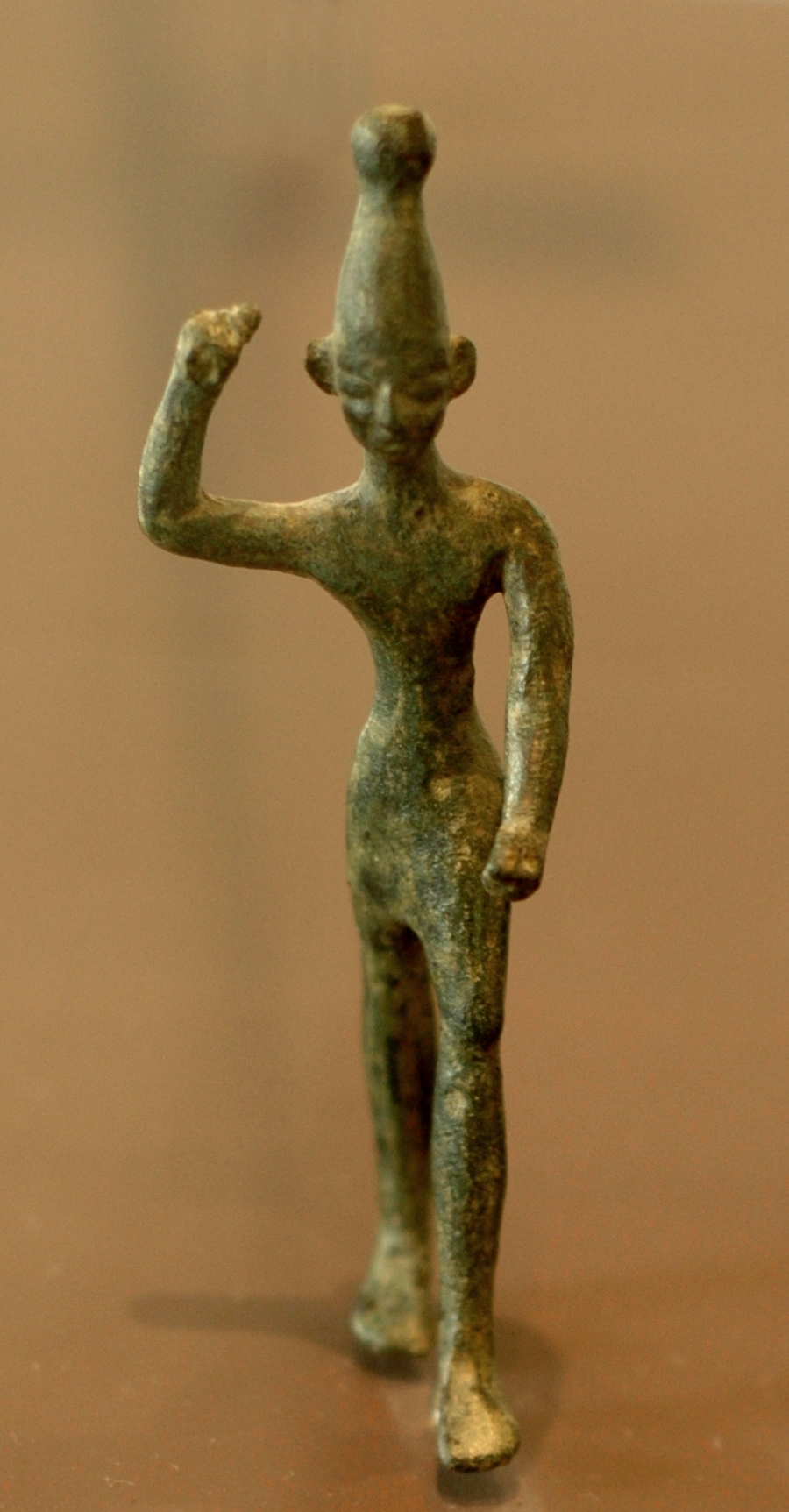
Baal, a Statute from Ugarit.14th to 12th BC. Louvre, Wikipedia,

Baal, a Statute from Ugarit.14th to 12th BC. Louvre, Wikipedia.

Beltane and Baal, are they related? It has already been proposed that they are. The scant information on Beltane suggests it involved building bonfires, the union of male and female, fertility, and the maypole. The maypole ceremony involves weaving long ribbons around a large pole held vertically. This idea is usually interpreted in the classic phallic manner. Yet, we might travel further in our understanding of the ancient world if we broaden our minds a bit. Can we not represent the north pole as a vertically held pole? Do not the lines of longitude project out from the pole in the same manner as the ribbons on the maypole? Certainly then, the object of weaving the lines about the pole is to remind us that lines of longitude and latitude are measured from this central point. This concept can be found not only in the Cuneiform records but it can also be found in Native American lore, just as the Noah story appears in both places. It is a relatively easy concept to understand but twice as easy to misunderstand if one has never been taught about longitude and latitude. It was simple then to relegate the maypole to a sanitized sexual symbol.

The word Beltane conjures up the image of a bell. While the word Baal brings to mind a ball which is reinforced by images such as we see in this Baal-Ugarit Statue. Yet these images converge if we picture that a fiery ball might appear as a bell and indeed, in Old English, a baelfire is a funerary pyre. What possible connection can there be between a maypole and a ball-fire? This is one facet of the story Newark might help answer.
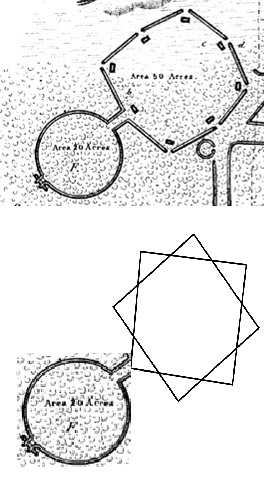
Circle and Octagon of Newark, Ohio Earthworks portrayed as a circle joining with a square.

Circle and Octagon of Newark, Ohio Earthworks portrayed as a circle joining with a square.

The pieces of Beltane we are left with is the concept of male, female and fertility. Since it is a spring festival we might assume these latter parts are all self-explanatory but we can take them another way as well. We look directly at Newark now and see that Baal, Bael, can be described by the circle which leaves the square as its counterpart. So then, in the circle-square we have the union of male and female which is indicated by the circle-octagon with the neck between them. Let us say the circle impacts with the square and causes it to rotate. There are two identical squares within the Octagon which are rotated. Let us say that the union is so abrupt and intense that the square breaks outwards. It is shattered and torn. The Old English word for torn is teon which is of course derived from the number ten and our fingers. Our ten fingers are used to tear apart. Hence, ten becomes teon. Now we have a better understanding of the word Beltane. It is Baal-teon which is then correctly illustrated here. Baal has impacted with the square which we may assume is Earth and it is torn apart. The image of Newark explains the effect of the impact is not only a rotation but a shattering. The images further relate a shift occurred which is portrayed to us by the translation of the two images across the plane equidistantly 6 diameters or 1.2 miles which echoes the statement “the earth was created in 6 days.

Circle and Octagon translate 6 OCD across plane to become circle and square. Drawing by B.L. Freeborn.

Circle and Octagon translate 6 OCD across plane to become circle and square. Drawing by B.L. Freeborn.

Right side of Newark Earthworks taken from Burks drawing.

Right side of Newark Earthworks taken from Burks drawing.

We can then postulate that the three images on the right indicate the condition of Earth after meeting Baal, its new relationship to the Sun, and an oval which we do not understand as of yet. The Great Circle as the Earth indicates the distance it travels in a year, the length of its day, and its velocity via the numbers 580, 1200 x 2, and 66.6. But we need to interpret the steeply formed neck, the bird, and the crescent in relation to the circle. The answer is supplied  by the artifacts which have been found: balls, crescents and meteoric iron. In fact, there is another clue supplied in an article by Romain.1 The Great Serpent Mound is built very near the Serpent Mound Impact Crater in southern Ohio. The .8 mile diameter crater was caused by a meteor impact between (we are told) 256 and 330 million years ago. All things considered it would seem then that the “bird” within the Great Circle is a meteor and the steeply formed neck is its impact site into the Earth. The crescent below the bird then is its crater driven deep into Earth. This suggests more than a passing understanding of the formation of craters such as the one found in southern Ohio.

Moving to the second of the earthworks on the right side we have a square. This exhibits measurements present in Earth’s orbit. The square as a symbol of measurement is found identically in Olmec art and Assyrian art.2 It is presented in Egyptian art and identically in Sumerian art. The square is the foundation of measurement. We can see this for ourselves on any map that shows longitude and latitude. The lines form squares.

This leaves us once again at the Oval where we remain perplexed for just a wee longer.

Forward to NEXT POST

Back to PREVIOUS POST

Back to TABLE OF CONTENTS

_______________

References/Footnotes:

  1. Romain, William F., Ph.D., LiDAR Views of the Serpent Mound Impact Crater, “Ohio Archaeological Council,” January 2012.  See: http://www.ohioarchaeology.org/joomla/index.php?option=com_content&task=view&id=361&Itemid=32
  2. Freeborn, B.L., “The Odd Little Purse in Olmec and Assyrian Art.”  See: https://noahsage.com/2013/02/17/the-odd-little-purse-in-olmec-and-assyrian-art/
  3. Baal Image: Wikipedia, Jastrow, PD.  http://en.wikipedia.org/wiki/File:Baal_Ugarit_Louvre_AO17330.jpg

The New Debate Begins

By B.L. Freeborn © 2013

Stone bowl found with Decalogue Stone.

Stone bowl found with Decalogue Stone.

The old debate revolved around the authenticity of the Decalogue Stone, the Keystone, the Johnson-Bradner Stone and the little teacup size stone bowl. The new debate will be much more fierce. The presence of the little bowl from a specific point in time has much to say in the argument. When excavating at Qumran bowls of this nature were found and they are used to date sites to no later than 200 AD. Their original use was for ritual bathing before prayer. This concurs with the date given for construction of Newark Earthworks from 250 – 500 AD. Whether we like it or not, these objects are from the appropriate period which weighs heavily for their validity not only as being real but a true component of the Newark Earthworks. Discarding them because they just don’t fit our picture is grossly negligent science.

But as Feder points out there is little if any other surviving evidence that people from the Old World were in Ohio except for these random few objects and…..the artifacts hundreds of feet in diameter. Despite the cohesive numbering system, the identical nature of structures supposedly built thousands of years apart on different continents, which just happened to be aligned by longitude and latitude to sites a half a world away, despite all this, we are told that tribal people got up one day and said lets dig a ditch in the shape of a circle because …. we are inspired by….? by what?

Coincidences are explained away far too easily. We are told the early North Americans could not have understood latitude and longitude thousands of years before we did. The very, very early neolithic Englander had just mastered stone tools. Therefore, we take the stance they could not understand it either. These assumptions are then used as proof that they are not aligned. Period. Despite numerical evidence to the contrary this is the assumption we are asked to accept!

More difficult to understand about all these sites, and especially Newark where we have evidence that not one but perhaps three of these phylactery sets existed, is despite the obvious Jewish connection, there is no knowledge of any such connection in the Jewish Rabbinical sources. Further still, there is no acknowledgment that words such as mentioned above (Yahweh, Noah, Moses, Elohim) have any relationship to celestial measures as noted. Which in the end proves only that if the Decalogue Stone and Key Stone have been in Ohio for two thousand years they were not the property of a person of Jewish belief. But this statement contradicts the Johnson-Bradner stone’s presence in the skull. Finding it there suggests the person was ceremonially laid to rest with the stone in the correct position upon the forehead as a believer would use it.

There are other elements to this whole story we have let drop out of the argument. There were quartz balls found. Round pyrite balls have been found at other sites. The case of the Decalogue Stone when closed forms a rounded stone. Recently beneath Teotihuacan balls were found. From the Jewish Old Testament comes stories of execution of large numbers of Baalists. There is a celebration called Beltane that existed in early Irish culture the meaning of which is reduced to a fertility ceremony today. We have also discussed the resemblance of the Decalogue’s man in profile to a Ugaritic statue. And have we forgotten in our haste to return to status quo the idea that the site spells out via gematria 23 32 or Keg Baal?

Could Baal be a comet that left a crater like a keg? Let us follow this last idea and tell the story of Baal using Newark as an illustration and see how the debate proceeds from there.

Forward to NEXT POST

Back to PREVIOUS POST

Back to TABLE OF CONTENTS

_________________________

References:

  1. Alrutz, Robert W., “Newark Holy Stones: The History of an Archaeological Tragedy,” Coshocton, Ohio: The Johnson-Humrickhouse Museum, 2010.
  2. Rochelle Altman, “First,…recognize that it’s a penny”: Report on the “Newark” Ritual Artifacts.”  See:    http://www.bibleinterp.com/articles/Altman_Newark.shtml

The Cross that Tells Us…

By B.L. Freeborn © 2013

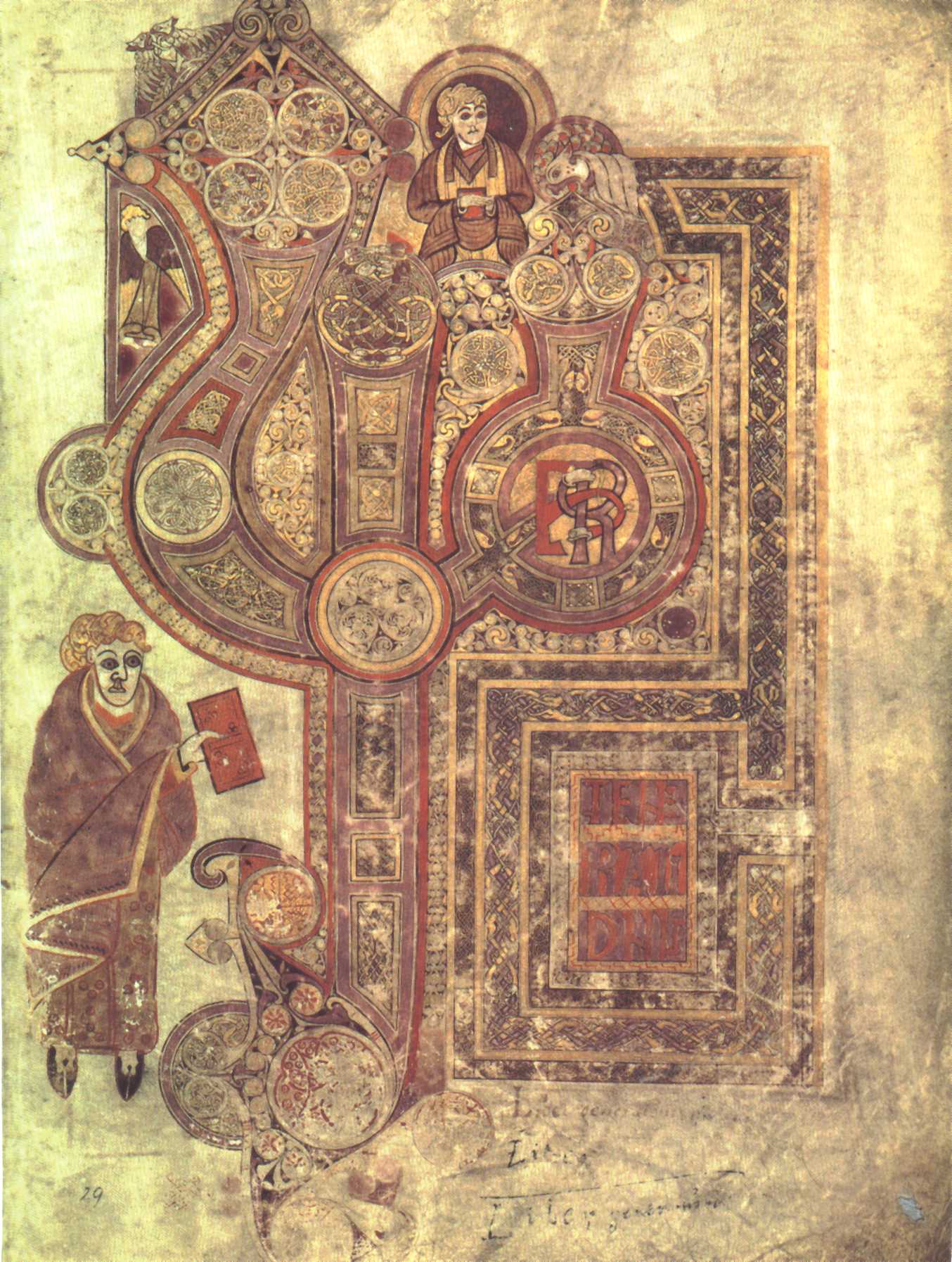
Book of Kells, Chi Rho Page. PD.

Book of Kells, Chi Rho Page. Wikipedia. PD.

The Cross amid the art of the Book of Kells symbolizes the cross of Christ. Or does it? Why would a people be led to constantly remember this shape through the retelling of the death of its messiah? A not so simple answer is that once upon a time someone wanted something else entirely remembered and since they were soon to become a conquered people they worked their own beliefs into the newly arrived religion. So we see in this art a beautiful cross and what do we see laid out quite neatly in Newark? Why a cross! And amid the cross is a diagonally placed square just as we see in the Book of Kells!

A  cross imbedded in the layout of Newark Earthworks. Wright Square is similar to the diamond that appears in the Book of Kells Cross.

A cross imbedded in the layout of Newark Earthworks. Wright Square is similar to the diamond that appears in the Book of Kells Cross.

We begin telling the story portrayed in Newark’s layout by examining the square within the cross. This portion of Newark Earthworks called the Wright Square is all but gone. There is a small portion that remains that marks the spot and other than that there are only survey notes. The beautiful Squier-Davis image is known to be incorrect for scaling despite its details. We know from a survey by Thomas in 1894 it was 928 feet by 926 feet. It is assumed by Romain1 2 and others that this is an error from an ideal of 925 feet yet these measures are not too far off for we see 926′ x 928′ gives us an area of 859,328 feet or very nearly 860,000 feet. Hively and Horn report that the east-west axis of the square is 92.8 degrees.3 They felt this was a .8 degree error from the Lunar rise-set point. Yet, one should pause to note the similarity between this number and the size of the square, 928′, which suggests there is no error here.

Going further they report the northwest entrance path runs perfectly straight for 160 m (useless meter!) or 525 feet (or was it 528?) at an azimuth of 306.8 degrees. It then enters the square at an angle.  With a bit of math it is easily determined this is an angle of 56 degrees to the azimuth of the north-south axis. (360 – 306.8 + 2.8 = 56) Furthermore, they were perplexed as to why this avenue did not enter at the center of the side but instead at 30m (useless meters again!) north of the center of the side. We calculate 98.4 feet + 926/2 = 561.4 feet. In other words, the opening breaks the side into two portions: one 561 feet and the other 365 feet. We should immediately recognize the meaning of the latter! This notably repeats the value of the angle of the path at 56 degrees.

Let’s not stop here because the picture is not complete. We have not added them! 926 + 928 = 1854 which is very nearly a number we saw twice at the East Fork. Indeed, 926 and 928 are quite close to 924 and 935 feet we saw there. They were also positioned perpendicularly. Their sum was 1859. Both sets of numbers are portraying not the idea of a simple radius but the idea of an oval, an oblate sphere as we saw in the egg at the Serpent Mound. To do this the values must be similar yet “off.” So they have described quite completely an object with this string of numbers: 365, 926, 928, 1854, 859,000 or at East Fork they used 924, 935, 1859 and 864,000. They threw in two additional reminders of 56 as well.

The square has been discussed first because it seems so insignificant but it appears in all ancient art. It is usually portrayed as the literal seat of all measurement.

Overall, we see in this layout of Newark two structures on the left and three on the right. Two and three create the number 23 or perhaps it is 32 if read right to left. We have seen that the square of 5.656 is 32. Perhaps we should think of it as 23 degrees and 32 minutes and add it to our growing number list.

Does this place with its mounds and ditches speak of the gods? Does it speak of Baal? We note that in Hebrew gematria bet, B, is 2 and lamed, L, is 30. So, the value of the name Baal is 32. The layout then “counts” the name. But if it is 23 then kaph, k, is 20 and gimel, g, is 3. Keg  in Old English is the modern word keg. Might this layout “counted” out mean Baal’s keg? Or Baal’s crater?

What other mysterious coincidences might lie here?

Forward to NEXT POST

Back to PREVIOUS POST

Back to TABLE OF CONTENTS

_________________

  1. Romain, William F., Ph.D., Newark Earthwork Cosmology: This Island Earth, “Hopewell Archeology: The Newsletter of Hopewell Archeology in the Ohio River Valley,” Vol.6 (2), March 2005.   See:  http://www.nps.gov/mwac/hopewell/v6n2/one.htm
  2. Romain, William F., Ph.D., Design and Layout of the Newark Earthwork Complex, “Hopewell Archeology: The Newsletter of Hopewell Archeology in the Ohio River Valley,” Vol.6 (2), March 2005.  See:   http://www.nps.gov/mwac/hopewell/v6n2/two.htm
  3. Hively, Ray, and Horn, Robert, Geometry and Astronomy in Prehistoric Ohio, “Journal for the History of Astronomy, Archaeoastronomy,” Supplement, Vol. 13, p.S1; also Science History Publications, 1982.      See:   http://articles.adsabs.harvard.edu
  4. Book of Kells Image from Wikipedia. See:   http://en.wikipedia.org/wiki/File:KellsFol034rChiRhoMonogram.jpg

As Plain as Day

By B.L. Freeborn © 2013, updated Nov. 2018

Book of Kells, Chi Rho Page. PD.

Book of Kells, Chi Rho Page. PD. Wikipedia.

Some things we know as plain as day and other things we see and do not comprehend. Let us return to the debate surrounding the Decalogue Stone. Two events were occurring in 1860. Mormonism, a newly created religion by the dubious con man Joseph Smith, was seeking legitimacy and the 84-year-old predominantly Christian nation of the United States was on the brink of collapse into civil war. A religion was rising, a nation was falling and for those involved in these issues life and faith hung in the balance. Their world became myopic and they could not recall that this is the way of things. History was repeating itself. Just as Scientology rises today, Mormonism rose then and before that Islam rose, and before that it was Christianity. And there we tend to stop. We know that with the rise of the United States a people and their land was conquered. We know that Islam today vows to conquer all. We know that young men in white shirts and ties come to our doors and attempt to persuade us to join their religion. They are subtle conquerors as all peaceful missionaries before them.

Do we recall a time when Christianity swept north through Europe with the advance of Roman soldiers and conquered the Pagans? And from whence did the Christians come? They arose as followers of Paul’s church who distorted Judaism to suit his needs. From whence did the Jews come? They tell us they came out of Egypt and were allowed to return to their homeland. To Canaan they went where the cities of Ugarit lay buried beneath the soil. Or did they come out of Babylon in 485 BC? The priests of Babylon had been massacred by the Greeks. This is the story of another conquered people and the fall of a great religion that had lasted for centuries. And eventually Paganism, after fighting a long and hard battle, vanished in the middle ages in the burning and torture of its last beholders. We forget how very much history we lost as a result of the Greeks killing the intellectuals of their era followed by the killing of the Pagan priests in later centuries. The Pagan and Babylonian Priests were the keepers of their history. As victor, the Greeks wrote history and in that history they usurped achievements of bygone eras. But they could not lay claim to that which they could not comprehend such as measurement of longitude. The Pagan priests did not vanish in total, nor did the Babylonian Priests. They left us something as plain as day and yet we do not see it.

The monks of Ireland, newly Christian, laced their beliefs into their art as they decorated their new doctrine. From the art in the Book of Kells we see their beliefs have passed through time to us. And what is this image? We see a cross curled round and around the cross are circles. Does the art depict Christian or Pagan beliefs?

Does Jewish history reveal anything of the Pagans? Or perhaps we should call them Baalists, worshipers of Baal. This deity is little understood. Baal was the most significant god in the Canaanite pantheon.1 The religion conflicted with Judaism. The Book of Kings I tells how Elijah met the priests of Baal and had 450 of them killed. Book of Kings II relates that the “cult” arose again and was put down once more. This “cult” arose yet again and was again put down.

Book of Kells, Incipit to the Gospel of Matthew. PD. Wikipedia.

Book of Kells, Incipit to the Gospel of Matthew. PD. Wikipedia.

“Cult” makes it sound so small, trivial and such a local phenomena. Yet according to 17th century historian Geoffrey Keating at each Beltane in medieval Ireland there was a sacrifice made to a god named Beil. Some doubt the veracity of Keating’s facts.2 Either way, Beltane is a festival celebrated on May Day that involves the union of male and female, and this is symbolized by the maypole and the cords woven around it. Very little ancient information is available on the significance of Beltane except that it involved bonfires and blessings. Martin Brennan in his book “The Stones of Time: Calendars, Sundials, and Stone Chambers of Ancient Ireland” relates that “Baal or Bel is another name for the sun and forms part of many place names in Ireland including Bel-ain, which means ‘Bel’s ring’ or the sun’s circuit.” 3 The name is similarly found in place names in the area of Israel.

Brennan also tells of the old native Irish god Dagda who was all-powerful and omniscient. This deity was considered to be the good god and Lord of Great Knowledge. In the distant Mediterranean archaeologists have uncovered the Temple of Dagon in Ugarit. Whereas Baal, “the King,” was the son of El; Dagon was the god of fertility and wheat.4 So we have two gods of similar names in these two distant lands. Is this the roots of Paganism, the religion that Judaism in its rise to power in the Middle East sought to conquer? Or were the Jews Baalists all along pretending to be someone else to avoid persecution by the Greeks? Perhaps this was not a small cult but a religion that spanned all of Europe and was finally annihilated by the Christians rather recently.

The beauty in the Book of Kells cannot be argued. Do the images conceal Pagan beliefs? Is that the cross of Christ or the intersection of longitude and latitude in the first image? Is that diamond square a decoration or does it mean something significant? Is that backwards L a measuring square? Is that the maypole of Beltane next to it and the cords wrapping around it? In the next image, is that a serpent winding and twisting about in the monogram which is to remind us of something important, just as the Great Serpent Mound that graces southern Ohio?

When we look at the Decalogue stone and the little bowl found with it, are we looking at a piece of long forgotten history? Judaism was not always the seamless religion it appears to be today. It had its own battles as the Book of Kings I tells us to gain prominence, just as the religions we see rising into acceptance currently. Did the Baalists continue on by hiding their beliefs from those in power? Did Dagas/Dagon and Baal play a role in Newark, Ohio?

We return to Ohio and the mysteries of the mounds laid out there for us to ponder across time.

_________________

  1. Douglas, J.D., and Tenney, Merrill C., “NIV Compact Dictionary of the Bible,” Grand Rapids, Michigan: Zondervan Publishing House, 1989.
  2. Wikipedia article: Beltane.  See:  http://en.wikipedia.org/wiki/Beltane
  3. Brennan, Martin, “The Stones of Time: Calendars, Sundials, and Stone Chambers of Ancient Ireland,” Rochester, Vermont: Inner Traditions International, 1994.
  4. Wikipedia article: http://en.wikipedia.org/wiki/Ugarit
  5. Book of Kells, Chi Rho Page Image. See:  http://en.wikipedia.org/wiki/File:KellsFol034rChiRhoMonogram.jpg
  6. Book of Kells, Incipit to the Gospel of Matthew Image. See:  http://en.wikipedia.org/wiki/File:KellsFol029rIncipitMatthew.jpg

Back to PREVIOUS POST

Back to TABLE OF CONTENTS

Forward to NEXT POST

The Clever Artist Knows the Mysteries in his Craft

By B.L. Freeborn © 2013, updated Nov. 2018

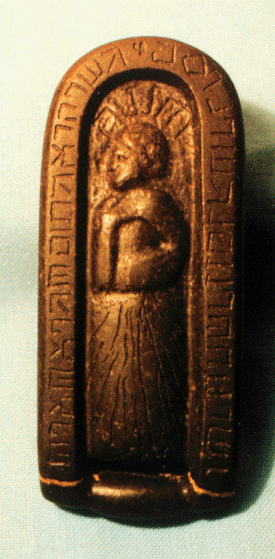
Moses and the Ten Commandments bring to mind Noah and the Ark.  Perhaps one can see the resemblance to the ark in this side image of the Decalogue Stone? It had three decks and was covered on top to one cubit.

Side view of Decalogue Stone

Side view of Decalogue Stone

Front Face of Newark Decalogue Stone

Front Face of Newark Decalogue Stone

Baal, a Statue from Ugarit. 14th to 12th BC. Louvre, Wikipedia,

Baal, a Statue from Ugarit. 14th to 12th BC. Louvre, Wikipedia, Jastrow, PD.

Or perhaps one can see in the image of Moses, with his one hand that points up towards his face and the other arm held rigidly at his side, the same posture as this statue betrays from Ugarit. The language of Ugarit is so similar to Hebrew that it is helping scholars define words in the Torah better.

The statue is attributed to worshipers of Baal 14th to 12th century BC which may explain the hat with a ball on top. The ball could be the source of the ritual of placing a stone on the forehead. The suggested use of the Johnson-Bradner stone was as a Jewish ritual stone worn on the forehead (rosh phylactery).

Stones found in skulls, balls on the heads of statues, ritual stones where they ought not be…. do any other oddities surround this mystery? How about one 864,000 square feet in area?

Back to PREVIOUS POST

Back to TABLE OF CONTENTS

Forward to NEXT POST

____________________

Images of Stone from:  McCulloch, J. Huston, The Newark, Ohio Decalogue Stone and Keystone.

See:  http://economics.sbs.ohio-state.edu/jhm/arch/decalog.html

Baal:  http://en.wikipedia.org/wiki/File:Baal_Ugarit_Louvre_AO17330.jpg

Hercules:  http://commons.wikimedia.org/wiki/File:Hercules_constellation_map.svg