The Mounds that were Imagined by the Army

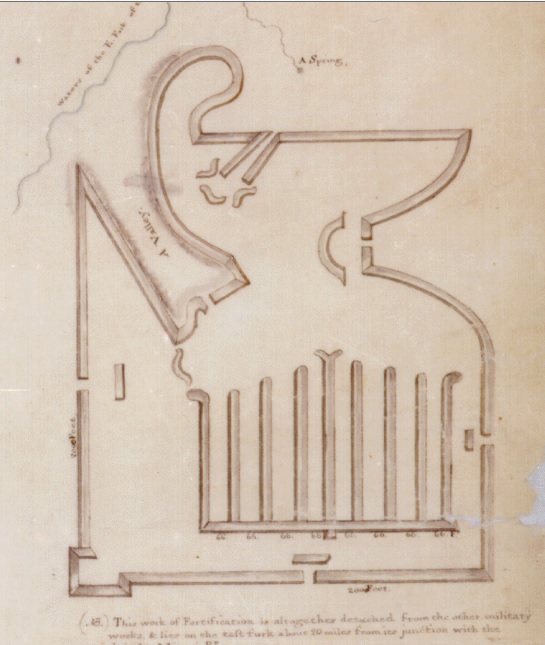
Hanukkiah Earthworks as surveyed by the Army before they were destroyed.

Hanukkiah Earthworks as surveyed by the Army before they were destroyed.

By B.L. Freeborn © 2013, updated Nov. 2018

What else does Dr. McCulloch have to offer? As a long time advocate for the stones his website has a few things not found anywhere else. If one visits his Archaeological Outliers Page1 one will find an image of a great earthwork that no longer exists. It met with the colonial plow and lost. Formerly, this great earthwork was to be found east of Cincinnati near the East Fork of the Little Miami River. Fort Ancient and Chillicothe both have large concentrations of mounds and are relatively close.

It takes little imagination to see in this image an oil lamp and a candelabra particular to Jewish tradition called a Hanukkah menorah. McCulloch explains in detail the different surveys done at this site. One survey was done by the US Army but in accordance with the anti-debaters logic the earthworks never existed. It is a short leap after seeing this to concluding the Decalogue Stone is Jewish. But again we must hesitate to make that leap since if it is Jewish, present day Jews would have some understanding of what the earthworks are all about. The Jewish are a people who tenaciously adhere to tradition. If the earthworks are of Jewish origin, then would there not be a tradition of making earthworks in their religion? Since there is not, we continue looking for an explanation.

The East Fork Works is portrayed in this image. The 2000 foot length on the image is believed to be incorrect. (See full resolution image at McCulloch’s link below.) It is noted in two places as 200 feet and then later someone has written in a zero to make it 2000 feet. Frank Otto proposed in 2006 that the correct dimension is probably 900 since 9’s and 2’s can look similar and this then was a mistake in taking the information from field notes. The spacing on the candles is 66 feet. Scaling the image accordingly, the 900 foot dimension is confirmed in the locations shown in the image below. The overall dimensions on the bottom and left are 924 x 935 = 863,940 or 864,000 square feet. This 864 looks familiar. We saw it in the Decalogue Stone.

Hanukkiah Earthworks with Dimensions Added.

Hanukkiah Earthworks (East Fork) with Dimensions Added.

The other numbers found on the stone were: 56, 5656, 69.2, 69, 70, 79, 58 and 16. The 79 appears in the East Fork Works at the bottom as 792. The average diameter of the Earth is 7920 feet. The 56 appears at the bottom of the candlestick as 560′. The lower branch actually bumps out to give the dimension. The 58 appears at the top closer to its correct value of 584 which reminds one of the distance Earth travels in a year or 584 million miles. Easily summed and used to check the scale is 66 x 8 = 528. The 528 was found by James Marshall at the High Bank Works south of Chillicothe2 as the radius of the giant circle there. 528 feet is exactly 1/10th of a mile.  Its prominent display here is also indicating measurement by the mile. The distance 660 feet is called a furlong. There are eight in a mile. The candles are then set at 1/10th of a furlong. The radius of the small top circle is also 66 feet making the diameter the noted 132 feet. The 132 feet appears as the length of the bottom small square. Its vertical height of 110 feet is 1320 inches. The area of this square is .333 acres. We saw on the back of the Decalogue Stone the number 9 and recalled that it is 3 + 3 + 3 = 9. The 3’s appear in the area .333 but more so the 9 appears as the 900′ dimensions. The area of a 900′ x 900′ square is 18.59 acres.

This value repeats. The side lengths 935′ and 924′ sum to 1859′.

The topic of the Sumerian inch of .66 inches has previously been studied.3 The value 66 reminds us that Earth travels at 66624 mph. Furthermore, one cannot possess a really important length of .66 inches unless one’s standard is actually one full inch. The same follows for the Indus inch of 1.32 inches. The value 1.32 is reflected in this image as well.

If one has taken the time to follow this, it leaves more questions than answers. Why are there all these odd elements in one place: English measurement, numbers of Sumerian and Indus importance, Jewish symbols, Jewish letters, and an accurate measurement of the Earth’s diameter? Not to mention in the last post we brought into play the deity Baal. The mystery grows in complexity rather than being solved.

Back to PREVIOUS SECTION

Back to TABLE OF CONTENTS

Forward to NEXT SECTION

________________________

  1.  McCulloch, J. Huston, “Archaeological Outliers Page.”    See: http://economics.sbs.ohio-state.edu/jhm/arch/outliers.html
  2. Marshall, James, Intelligence Inscribed before the Printed Word in North America, Caxton  Club of Chicago, 2004. See: http://www.caxtonclub.org/reading/2004/jul04.pdf
  3.  Freeborn, B.L., “The Inch, The Megalithic Yard, and The Sumerian Inch,” 2013. See:  https://noahsage.com/2013/01/13/the-inch-the-megalitic-yard-and-the-sumerian-inch/

The Clever Artist Knows the Mysteries in his Craft

By B.L. Freeborn © 2013, updated Nov. 2018

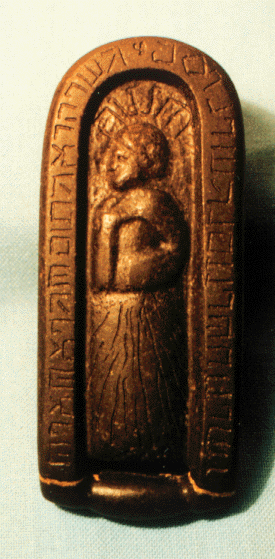
Moses and the Ten Commandments bring to mind Noah and the Ark.  Perhaps one can see the resemblance to the ark in this side image of the Decalogue Stone? It had three decks and was covered on top to one cubit.

Side view of Decalogue Stone

Side view of Decalogue Stone

Front Face of Newark Decalogue Stone

Front Face of Newark Decalogue Stone

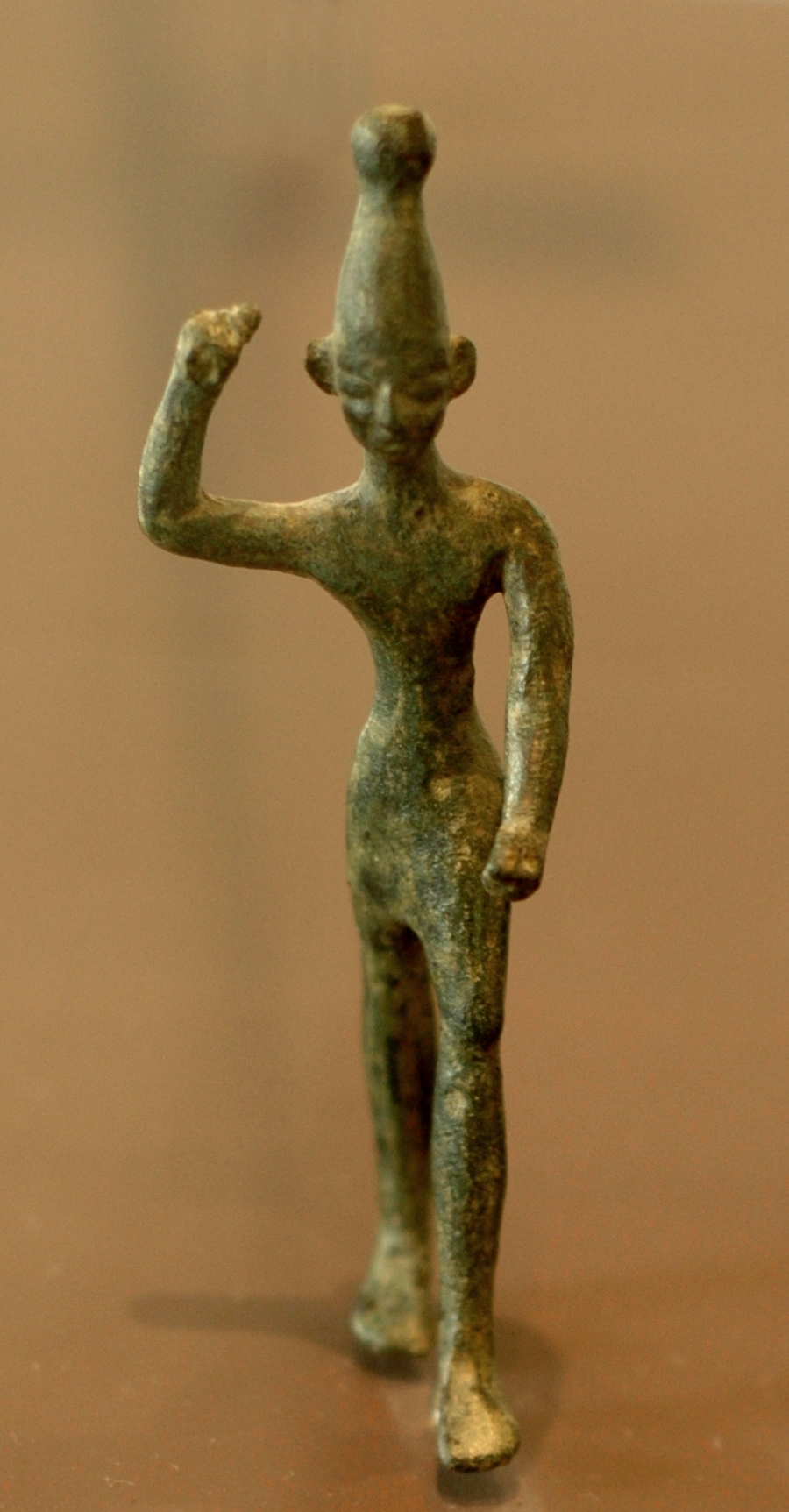
Baal, a Statue from Ugarit. 14th to 12th BC. Louvre, Wikipedia,

Baal, a Statue from Ugarit. 14th to 12th BC. Louvre, Wikipedia, Jastrow, PD.

Or perhaps one can see in the image of Moses, with his one hand that points up towards his face and the other arm held rigidly at his side, the same posture as this statue betrays from Ugarit. The language of Ugarit is so similar to Hebrew that it is helping scholars define words in the Torah better.

The statue is attributed to worshipers of Baal 14th to 12th century BC which may explain the hat with a ball on top. The ball could be the source of the ritual of placing a stone on the forehead. The suggested use of the Johnson-Bradner stone was as a Jewish ritual stone worn on the forehead (rosh phylactery).

Stones found in skulls, balls on the heads of statues, ritual stones where they ought not be…. do any other oddities surround this mystery? How about one 864,000 square feet in area?

Back to PREVIOUS POST

Back to TABLE OF CONTENTS

Forward to NEXT POST

____________________

Images of Stone from:  McCulloch, J. Huston, The Newark, Ohio Decalogue Stone and Keystone.

See:  http://economics.sbs.ohio-state.edu/jhm/arch/decalog.html

Baal:  http://en.wikipedia.org/wiki/File:Baal_Ugarit_Louvre_AO17330.jpg

Hercules:  http://commons.wikimedia.org/wiki/File:Hercules_constellation_map.svg

Altman’s Penny Theory

By B.L. Freeborn © 2013,

updated Nov. 2018

Rochelle Altman’s “First,…recognize that it’s a penny”: Report on the “Newark” Ritual Artifacts describes the penny theory like this: if a US penny is found at a dig, it is still a US penny. In other words, forget about where they were found and just look at the artifacts.1

Dr. Altman has given us two things in her interesting and well written article. She has used her many decades of experience in ancient languages to give us a clear picture as to why the Newark Stones are not forgeries but actual ritual artifacts. There is no question that she makes a series of valid explanations as to why the artifacts could not have been faked. She concludes they originated from medieval southern Europe. The second part of her report delves into explaining how these real articles came to be in Ohio in 1860, a bit of a who dunnit involving a murder and theft. She proposes these articles were stolen from the person whose remains were found at the Stone Mound site. She asserts the victim was a European settler who had brought them as family heirlooms to the region. Sherlock Holmes would have cringed at her theory but … it is possible they were family heirlooms and were acquired for the dubious reason of perpetuating a hoax on Wyrick. Alas, the problem with this theory is that as medieval family heirlooms they would have been priceless. It would have required a substantial outlay of cash to obtain them, and then the hoaxer would have had to expend the time to go to the site (7 ½ miles each way by foot or horse) to bury them in tough clay and then hope they would be found by his would-be victim. All for what?

Stone bowl found with Decalogue Stone.

Stone bowl found with Decalogue Stone.

If we toss out the attempt to explain how they got there, the stones at least have a ring of validity they have not had since Dr. Arnold Fischel made the same claim in 1861. So it took a mere 150 years to prove what they knew at the start but did not have enough archaeological knowledge to accept as fact then.

But…there always is a but….although it was easy to believe Dr. Altman, it was mistakenly assumed while reading her article that she was trying to prove an origin date of 1500 BC +- . However, she concluded it was medieval. A second read through clarified the misunderstanding … almost.

These then are the reasons from her report that seemed to indicate a date far earlier than she concluded:

See article at:   http://www.bibleinterp.com/articles/Altman_Newark.shtml

Sec. 2) Format: Incantation format dates back to Babylon 8th century BC. (This is the style in which the stones are inscribed.)

Sec. 3) Sculpture: Body portrayed in profile dates back to oldest known stele from Akkad (2371-2255 BC). “In the classic Semitic pose, the figure is in profile, one hand is raised or the arm is bent forward pointing at something or holding something.”

Note:  In this case both are true, the right arm is raised and the left is bent forward.

Sec. 4) Script: Base script in which eleven letters match is late Medieval Hebrew squared fonts. (Yet, 1st century BC fonts are extremely similar.)

The “m” she calls South Sinaitic from the 16th century BC. The tsadik is from 16th century BC as well. Both are converted from cuneiform letters. She discusses the possible “magic” reasons why it would have been used as opposed to a more modern version.

Perhaps we should pause to question how a forger in the 1860’s would have known about Cuneiform letters when the symbols were newly discovered and their decipherment still being debated. The same question can be asked of an artist in the Medieval period who certainly should have not known of these letter forms. Does this not indicate a far earlier period?

Sec. 4) Script: The ayin is in a South Semitic form dated to 10th century BC.

She notes the vav and zayin are consistently reversed. Their forms are dated to 10th century BC Phoenician. The gimel (g) is similar to a Phoenician g from the same period. The straight line yod was used in the late BC. The L she calls Nabatean is also Phoenician from the same era. The Hebrew alphabet had its beginning in 10th century BC when the letters were borrowed from Phoenician.

The Keystone was written in modern Hebrew letters using stress and durational notation. This “modern” style of letters dates back to 1st century BC and durational notation to the age of Sumer.

At the center top front there is a symbol she says is unidentified. It looks like a modern Y or the Hebrew Ayin. On the center back no comment is made about the symbol at the top of the inner arch that looks like an incomplete circle. Ironically, both Altman and the Epigraphic Society Report by McCulloch state the letter tet is not represented, yet this symbol is the modern way of denoting a tet.

Overall, her explanation of the stones’ appearance, script, and use is complete and thorough. She believes the items to be of medieval origin. Furthermore, it turns out the small bowl is by far the most important artifact indicating an age between 1st century BC and 2nd century AD. As far as her theory as to how they came to be in Ohio …. well … let us look for a better explanation.

Forward to NEXT SECTION

Back to TABLE of CONTENTS

Back to PREVIOUS SECTION

_____________________________

References / Footnotes

  1. Altman, Rochelle, ” First,…recognize that it’s a penny”: Report on the “Newark” Ritual Artifacts.”  See:  http://www.bibleinterp.com/articles/Altman_Newark.shtml


Newark Decalogue Stone is Fake because there is No Garbage!

Front Face of Newark Decalogue Stone

Front Face of Newark Decalogue Stone

By B.L. Freeborn © 2013 (update Nov. 2018)

From Kenneth L. Feder, Ph.D. we hear, “Applying these post-Columbian historical models, most archaeologists deduce that if travelers from the Old World visited the New before Columbus they can be expected to have left similar, mundane material evidence of their presence in the form of artifacts culturally distinguishable from those of indigenous people.” 1

He means garbage. We all leave garbage lying about. They should have left more stuff with inscriptions lying about. They should have left more Old World origin stuff in their garbage piles. One can both agree and disagree.

Point in fact: David Wyrick found stones with inscriptions in 1860. Because he did, he lost his reputation and ultimately committed suicide. Suppose another intelligent person in 1860 had also found something, would he come forward to be lamb-basted? Not likely. So we might conjecture that any other ancient artifacts found in the 1800’s went into the garbage and fast.

Have things changed? If one found an artifact today would one come forward? Many would at the risk of their reputation. The artifact might also be confiscated never to be seen again. Things disappear even on legitimate archaeological digs. Is it worth impugning the reputation of the researchers over something out-of-place?

As far as other “garbage” in Newark2 we note there was:

  • a quartz ball found with the Keystone,
  • numerous other round balls were found at other mound sites,
  • the Keystone was found in a tough ball of clay,
  • “two beautiful plumb bobs but instead of being either round or oval they are eight square” were found with the Decalogue Stone,
  • the Decalogue stone was in an oval, round case which creates a large “rock” when closed and it was found with a small stone bowl,
  • the Johnson-Bradner stone found at the same location as the Decalogue was in a skull.

In fact, the other “garbage” these people left behind was monstrous earthworks that greatly resemble in detail earthworks in England and Ireland.

This does not mean the native people of the time period did not make these monuments. Of course they did! It does not mean today’s Indians are not descended from the original builders. Unless they all died off from disease or were killed off, of course they are descended from them! The mounds are enormous complexes that did not appear overnight nor were they built by a small group of people. (Nor were they built by Mormons, or lost tribes.)

What Dr. Feder wants to see to believe the stones are real is “a convincingly authentic, archaeological site with its complex of artifacts and features with all their spatial associations and stratigraphic contexts.”

In other words, he wants to see a typical community layout with an area of houses, a cemetery, and the always present garbage heap which in this case must contain relics similar to the Decalogue Stone or something from the Old World like a belt buckle.

What we do have is a site that has enormous spatial associations (the number stuff that is to come).  William Romain, Hively, Horn and James Marshall have begun to show us already that these sites were formally laid out geometrically. James Q. Jacobs and Joseph Knapp are hard at work showing the astronomical correlations. These mounds were not randomly built. In order to place these sites with the precision other authors demonstrate (and will be shown here later) they must have had either astronomy or surveying skills, or acquired the skills by association with another party. Today we hire engineering services. Today we are even persuaded by outside parties to build engineered monstrosities we do not want like Wheelabrator’s Incinerators. In other words, a small outside party amongst the population cannot be ruled out by the lack of their specific garbage. Their presence may be deduced by the results left behind, ie. a monstrous Wheelabrator Trash plant means “they were here.”

Someone engineered these sites. Who? How about the chap they unearthed where the plumb-bobs were found? Plumb-bobs are used in surveying. They found the Johnson-Bradner stone within a skull. That is a nice gruesome touch if it was forged. Two other interesting facts about this burial. The “crypt” was a coffin made from a hollowed tree trunk surrounded by and encased in fine white clay. Fine white clay is not found everywhere in Ohio. Its presence must indicate this person was special enough for his mourners to go to the trouble to get it. Over the clay was placed a layer of stones and wood bracing. Upon these were copper rings. Indeed, on top of this site was a mound of stones described as being 180 feet in diameter and 40+ feet high. This mound of stones was so large it took 75 wagon teams to remove the stones to make the dam to create Buckeye Lake in 1831-1832. This is an estimated 10 to 15,000 wagon loads. We may assume that each stone placed on that cairn was to show respect for those buried there. They were extraordinarily special in some way. They were so revered that people left so many tokens of respect that a great mound of stone was formed. For all we know the deceased was a visiting dignitary from the Old World. More likely he/they were the engineers who laid out the great Newark site and other vast mound systems. A plumb-bob was found after all. Would they not be laid to rest with their favorite tools?

We might ask where they learned their trade? Mesoamerica, Cahokia, or were they buried with something they brought from their homeland? Like a “Jewish looking” stone? There is another piece of forgotten history that will shed light on who might have been buried on that hill under that massive mound of stones.

“Another group of people also lived among the Cherokee. They were called the Ani’-Kuta’ni. Prior to Mooney there were other much older sources that stated these people were…

“…the priestly clan, having hereditary supervision of all religious ceremonies among the Cherokee, until, in consequence of having abused their sacred privileges, they were attacked and completely exterminated by the rest of the tribe, leaving the priestly functions to be assumed thereafter by individual doctors and conjurers.”3

“The Mound Builders are addressed in Mooney’s book. There are two versions to this story. One group said the mounds were built by another people with no association to the Cherokee while another story said they were built by the ancestors of the Priests Ani’-Kuta’ni.”

This report is from “The 19th and 7th Annual Reports Bureau American Ethnology,” 1897-1898. It gives us an unexpected picture of very early American history and may explain some parts of this story while still leaving us wondering about who the Ani’-Kuta’ni might have been.

We might also ask did they teach anyone else their trade and pass along their knowledge? There is evidence they did.4 The quick argument is that Native Americans did not own land and so surveyors were not required. The thoughtful answer is surveyors are required if you take the placement of your monuments very, very seriously. Were they placed precisely? They were, just as Romain concluded, but more than he could have imagined. This will lead to more numbers to be looked at!

Next we look at Lepper’s leap into oh-ohh.

Back to TABLE of CONTENTS

Back to PREVIOUS SECTION

To NEXT SECTION

___________________________________

Footnotes/References

  1. Feder, Kenneth, Coming to America: Investigating Claims of Precolumbian Forays to the New World, “Newark “Holy Stones”: Context for Controversy,” Johnson-Humrickhouse Museum, 1999.
  2.  Alrutz, Robert W., “Newark Holy Stones: The History of an Archaeological Tragedy,” Coshocton, Ohio: The Johnson-Humrickhouse Museum, 2010.
  3. Mooney, James, “Myths of the Cherokee and Sacred Formulas of the Cherokees, From the 19th and 7th Annual Reports Bureau American Ethnology,” 1897-1898.
  4. Brennan, Tom PE, Civil Engineer and Surveyor, “Land Surveying Long Ago,” 2013 Spring Conference Presentation NEARA.

.

.

.

.

.

153 Years and the Debate Still Rages: Newark Mounds and Decalogue Stone

Front Face of Newark Decalogue Stone

Newark Decalogue Stone, photo by J. Huston McCulloch

By B.L. Freeborn © 2013 (updated Nov 2018)

If the Newark Indian Mounds of Newark, Ohio were not large enough to contain a golf course (which they do) they would have been declared a fraud and a hoax. The Decalogue Stone and Keystone, two stones with Hebrew inscriptions found at and near the site have been declared both a fake and real. The debate over the stones has raged 153 years.

Today’s greatest anti-stone debaters are: Kenneth L. Feder, Ph.D., Professor of Anthropology at Central Connecticut State University and Bradley T. Lepper, Ph.D., Affiliated Scholar at Denison University in Granville, Ohio and Archeology Education Coordinator at the Ohio Historical Society.  They are joined by others who parrot their words such as Keith Fitzpatrick-Matthews, Archaeology Officer at North Hertfordshire District Council, England, educated at University of Lancaster and Letchworth Grammar School and is a former nightclub DJ who writes “Badarcheaology.”

They are opposed by J. Huston McCulloch, Ph.D., Professor of Economics and Finance at Ohio State University; Rochelle I. Altman, Ph. D. Medieval English Literature, Scotland, a specialist in ancient phonetic-based writing systems; Suzanne O. Carlson, architect and NEARA Board member, James Guthrie, retired industrial chemist and avocational epigrapher, and others.

Some of their arguments are logical. Some of them are not.

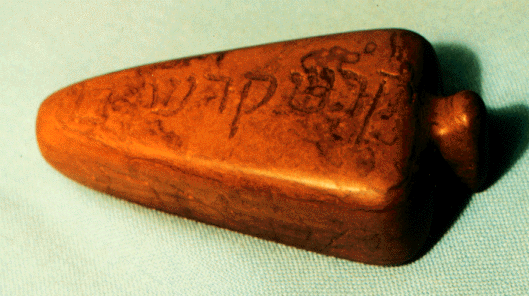
Keystone found near Octagon in Newark, Ohio

Keystone found near Octagon in Newark, Ohio,
Photo by J. Huston McCulloch

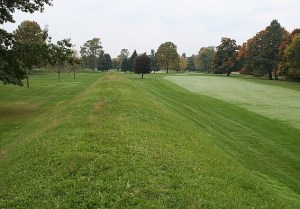
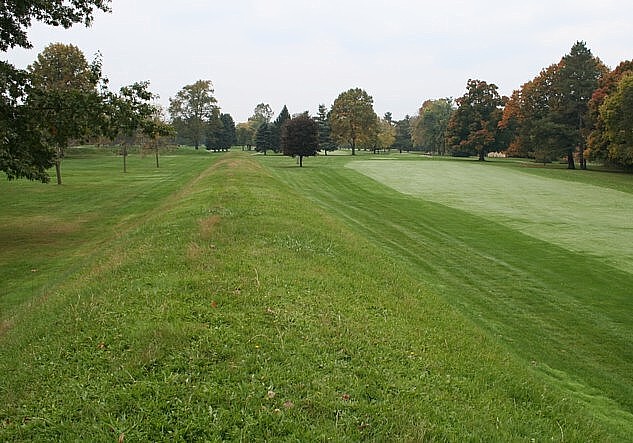
There is considerably less written on the Newark Mounds since there is just not as much to debate. They exist. They existed prior to European settlement so they are not forged. They have been altered but that work was either done in the interest of preserving them or removing them from existence, which is why three large portions of the mounds are in viewable park-like condition today and the rest has made way for progress. There is serious academic work being done on them with some pretty cool new instruments like LiDAR. William F. Romain, Ph.D. Archaeoastronomy, Research Associate for Newark Earthworks Center, Ohio State University leads in this field by far. He picked up where Ray Hively and Robert Horn of Earlham College, Richmond, Indiana left off in 1982. Joseph M. Knapp has written web-articles “Hopewell Lunar Astronomy: The Octagon Earthworks” and “On the Great Hopewell Road” which begins in Newark. He introduces us to James A. Marshall who has spent many hours actually surveying the mounds and has studied the geometry used in building them. This lovely image of the mounds is from James Q. Jacobs extensive site on the archaeoastronomy of ancient sites.

Newark Earthworks, Link to James Q. Jacobs Site and Photos.

Newark Earthworks, Link to James Q. Jacobs Site and Photos.

No one can say academic archaeologists are ignoring this topic. It is a mainstream debate and the arguments are becoming increasingly scientific … well…. except for Lepper’s and the Dj’s. To add to the topic at this point either good tools and/or observations are required.

There are a few gaffs in the arguments on the Stones on both sides. Perhaps the only way to really resolve the issue is to look at the Mounds themselves. Instead of debating endless rounds of “who is/is not guilty of faking them” perhaps we should change the question entirely. To do so we might have to throw out a lot of what we presume is actual fact. We need to see if there are any circumstances under which it would be appropriate for a “Jewish looking” stone to be found at the mounds pre-Columbus. In my mind their presence can only be logical and legitimate if they can be associated to the mounds themselves.

So we begin looking at the Stones by looking at some of the arguments of the current debaters and then there is a good deal of mathematical information about the mounds to share. The legitimacy of the stones aside, the geometric study proves a great intelligence lies behind the design and layout of the mounds. When done you will have a solid opinion …of some sort.

So we will pick up next with………… “They left no garbage!”

Forward to NEXT SECTION

Back to TABLE OF CONTENTS

Back to posts on KNOWTH KERBSTONES

_______________

Footnotes

  1. Newark Decalogue Stone and Keystone photos by J. Huston McCulloch.  http://economics.sbs.ohio-state.edu/jhm/arch/decalog.html
  2. Knapp, Joseph M., “Hopewell Lunar Astronomy: The Octagon Earthworks,” 1998.  http://www.copperas.com/octagon/oindex.html
  3. Knapp, Joseph M., “On the Great Hopewell Road,” 1998.  http://coolohio.com/octagon/onroad.htm
  4. More photos and archaeoastronomy information by J. Q. Jacobs.  http://www.jqjacobs.net/archaeo/octagon.html

Newark Decalogue Stone and Earthworks: An Unraveling Mystery

The following twenty-five posts were a pleasure to write and even more so to share with you. 

Newark Decalogue Stone and Earthworks: An Unraveling Mystery  … Full document as pdf.

B.L. Freeborn   © July 2013

“As a rule, innovation is welcome only when it is confined to surface details and does not modify the structure as a whole.” – Cyrus Gordon

Table of Contents

  1. Lepper’s One-Way Leap into Oh-Oh

    Front Face of Newark Decalogue Stone

    Front Face of Newark Decalogue Stone

  2. The Remains according to Romain

    Keystone found near Octagon in Newark, Ohio

    Keystone found near Octagon in Newark, Ohio

  3. Ohh… Let It Not be True

    Newark Earthworks, Link to James Q. Jacobs Site and Photos.

    Newark Earthworks, Link to James Q. Jacobs Site and Photos.

BACK TO PREVIOUS POST

See another example of Ohio Hebrew here.

The Odd Little Purse in Olmec and Assyrian Art

Assyrian Relief with Winged Genius, Walters Art Museum, Wikimedia

Assyrian Relief with Winged Genius, Walters Art Museum, Wikimedia

File:La Venta Stele 19 (Delange).jpg

La Venta, Mexico, Olmec Monument 19, Photo by Audrey and George Delange, Wikimedia

B.L. Freeborn, February 2013

Once in a while it is nice to spot a co-incidence that leads us to new understanding. Illustrated here are two stone reliefs from two different hemispheres of the world. The Assyrian relief, (Ancient Iraq), on the left, is dated to 880 – 859 BC. The Olmec relief, (Ancient Mesoamerica), on the right, is dated to 1200 to 400 BC.

Notice these similarities between these detailed works of art. The giant carries in his hand a square purse. His hand is depicted with four fingers up. The Olmec man is holding a nearly identical purse with four fingers up as well.

The giant holds in his right hand a pine cone/egg shaped object. The Olmec man sits in an accentuated curved pose with feet outstretched to the rear in a manner which imitates the egg shape.

The giant is winged and strong. The feathered serpent wrapped around the man is equally fierce.

It is as if these two artists are using the exact same symbols to describe the same story. It might also be indisputable proof that these two cultures were in communication and contemporary to each other.

When used in Assyrian art it is said the purse holds magic dust. When depicted in Olmec art they postulate it contains herbs for getting high. Could it actually be a weight such as in a standard of measure? If it is, why would this become an important part of a story on two continents?

An actual purse has been found! See it here.

PREVIOUS POST        NEXT POST

More on the Purse Image Here

More on Purse Images at Göbeckli Tepe.

Re-writing English History while Solving the Sator-Rotas, Part I

-B.L.Freeborn, (c) Oct. 2012 -last updated Sept. 2022

The “Sator Rotas” to an archaeologist is a trivial, long worn out mystery. To any fifth grader it is a quick puzzle. After the fifth grader explains it to the archaeologist then it becomes an out-of-place artifact.

File:Rotas square from Cirencester.jpg

Sator-Rotas from Cirencester, Wikipedia.

Let us first discover what is known and believed about this grid before we look at the way an un-influenced mind would perceive it.

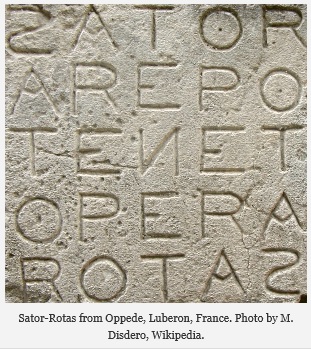
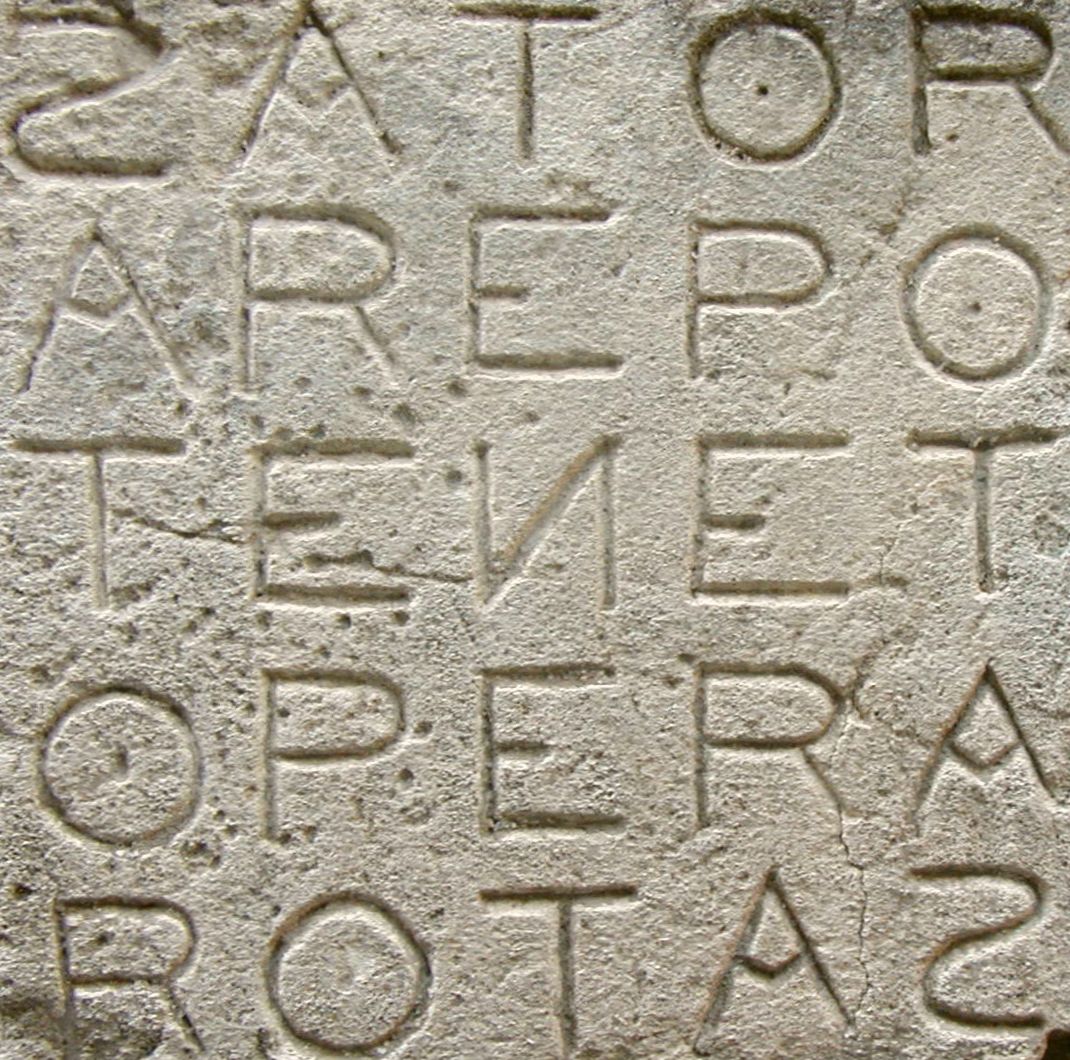
It is a five by five grid of letters that has been found in several places spanning both time and distance. The oldest is dated to 79 AD from Pompeii. The clear representation pictured below is from Oppede, France. A number of them have been found in England. Others have been found throughout Europe and one has been found in Syria. It is assumed it is in Latin. It is thought to be a secretive sign between Christians but others consider it magical. There are others who think it is a Jewish puzzle.

Before we throw the current translation out, let us reiterate it:

From Wikipedia we have………

“Sator Sower, planter; founder, progenitor (usually divine); originator

Arepo (arrepo) (I) creep/move stealthily towards, also trust, or likely an invented proper name. Its similarity with arrepo, from ad repo, ‘I creep towards’, may be coincidental

Tenet holds, keeps; comprehends; possesses; masters; preserves

Opera work, care; aid, service, (an) effort/trouble

Rotas (rota) wheel, rotate; (roto) (I) whirl around, revolve rotate; used in the Vulgate Psalms as a synonym for whirlwind and in Ezekiel as plain old wheels.”

They continue with …

“One likely translation is “The farmer Arepo has [as] works wheels [a plough]”; that is, the farmer uses his plough as his form of work. Although not a significant sentence, it is grammatical; it can be read up and down, backwards and forwards. C. W. Ceram also reads the square boustrophedon (in alternating directions). But since word order is very free in Latin, the translation is the same.”

Now let’s think about this….. They have been found in England. They have been found in Italy – Pompeii, Portugal, France, and Syria. So is it logical to conclude it is written in Latin? Probably. However – let us pause to think like a modern fifth grader who speaks the language spoken in England at this current time which is conveniently – this one.

What would a fifth grader see?

I suspect he/she could make a rather large list of words very similar to the list compiled below. The first two words any fifth grader is likely to identify are TEN and NET. Surely, the word ten appears four times and when read in the opposite direction they spell net. The four “nets” create a picture which forms a net spread out from the central N.

These are in fact two very revealing words which will lead us forward – momentarily. Our fifth graders would also spot the words SAT and ARE very quickly. A very bright child might find the word OPERA and then OPERATOR. We would not expect them to find TOR since it is not commonly used today but they would see the commonly used English word TENET. They might go on to find POT, OPEN and AT. They of course would not realize that they are finding Modern English words in a puzzle written many years before the creation of the language they speak. Unless!!!! There is something we do not understand about English.

This has led us off topic but it is a necessary deviation. The history of the English language must be checked. Is it possible this is written in modern English or even Old English?

No.

Or that is what we must infer from references such as the quote below from Wikipedia: English Language which does not conflict with other references on the subject. (Reference notes are found in Wikipedia article.)

“Historically, English originated from the fusion of closely related dialects, now collectively termed Old English, which were brought to the eastern coast of Great Britain by Germanic (Anglo-Saxons) settlers by the 5th century – with the word English being derived from the name of the Angles, and ultimately from their ancestral region of Angeln (in what is now Schleswig-Holstein).[12] A significant number of English words are constructed based on roots from Latin, because Latin in some form was the lingua franca of the Christian Church and of European intellectual life.[13] The language was further influenced by the Old Norse language due to Viking invasions in the 8th and 9th centuries.

The Norman conquest of England in the 11th century gave rise to heavy borrowings from Norman-French, and vocabulary and spelling conventions began to give the appearance of a close relationship with Romance languages[14][15] to what had then become Middle English. The Great Vowel Shift that began in the south of England in the 15th century is one of the historical events that mark the emergence of Modern English from Middle English.”

So, according to this English, even as Old English, was a dialect developed 400 years too late.

Darn!!! And it works so well in English if you look at the gematria. Like, the four tens actually are made of four 10’s!

Well, they do! Look…..

Using the Hebrew sounds for these letters, not a modern gematria for English letters and not translating them to Greek or Roman gematrias we substitute according to this:

A = 70

E = 1

R = 200

S =  60

T = 9

P = 80

N = 50 but if it considered to be a Hebrew Alef then = 1

let O =  6

S    A    T    O    R                        60      70       9       6    200

A    R   E    P     O                       70    200        1     80        6

T    E   N    E     T                         9         1     50       1        9

O    P   E    R     A                          6       80      1   200      70

R    O   T    A     S                     200         6       9     70      60

By this replacement, using the sounds provided by the Hebrew letters, we observe that indeed the tens create ten. There are four of them around a central 50.

The four tens sum to 40. This is a significant number. A square of sides of 40 has a diagonal of 56.56 which is a number often pointed out as important in these posts.  Or they might see it as a very Biblical number as in “Moses wandered for 40 years and it rained for 40 days and 40 nights.”

When the 40 is added to the 50 it sums to 90. Furthermore, each ten is at 90 degrees to the other which is true if the longitude and latitude of the planet is called a “net” and the four cardinal directions are then at 90 degrees to each other just as shown.

In other words: North, South, East and West are at 90 degrees to each other and each is depicted by the word NET fanning out from the center.

We take this idea one step further. Each degree of longitude and latitude is made of 60 minutes and each of those minutes of 60 seconds. Note that each 9 + 1 or ten when added to the central 50 creates 60. There are four 9’s on the exterior of the net and 4 x 9 = 36 which then suggests the number of minutes in a degree or 360.

Not convinced?
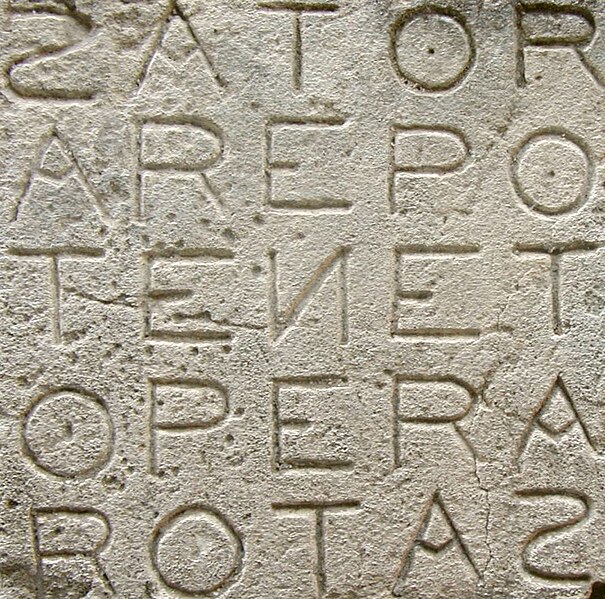
File:Sator Square at Oppède.jpg

Sator-Rotas from Oppede, France, Wikipedia

Hmmm. In this image of the Sator Rotas from France the N is reversed which calls attention to it. The Hebrew Alef and the letter N are very similar. This letter in Hebrew has the value 1. Now if the central  letter is allowed both values, both 50 and 1, then their sum is 51 and 51 degrees is the latitude of Greenwich, England from which longitude is measured today. It is in the  center of both the puzzle and the Net created by longitude and latitude numbered from Greenwich.

If the letters surrounding the center (REPEREPE) are summed, the number 564 is obtained.  This is significant. The value ‘560’ was discussed in the prior post about the Hebrew alphabet. 40, 56, and 79 are the three most important numbers in this secret system. The 40 we have touched upon. The 79 appears as the word AT and might be said to refer to the diameter of the Earth at 7920 miles. It most certainly refers to something the ancients kept as an ultimate secret. Indeed, the word AT is very appropriate. The 56 appears in the sum of the letters REPEREPE (564) surrounding the middle. It is often found in secret writings as 565 or 56.5. If the center is allowed to be 1 then the 565 appears quite nicely. This also repeats in the RPNPR diagonal. 560 + 50 or 56.50?! But that can also be said to be 610 which repeats the 60’s.

Is this all that is hidden here?

No, it is a very plush garden of numerical facts. Notice that our ten’s reveal something else. The closest distance Earth comes to the sun is considered to be 91.4 million miles. Our 9 + 1 + 50 can be re-written as 91.50 miles. Not too bad for a bit of graffiti!

The circumference of the Sun is 2.72 million miles. Ra is the Sun God of the Egyptians. R = 200 and A = 70 …..Ra.  RA appears four times.

More? Yes!

I would be disappointed if the diameter of the Sun was not easily found and there….summing the exterior letters we find it equals 860. The diameter of the Sun is 864,000 miles plus a few.

Here then is another point. Hebrew does not have the letter O so the value for ‘v’, which also serves for letters w and u, was used as 6. There is some logic to using 7 for the O. Seven is the value for the letter ‘z’  in Hebrew. Z is the first letter in zero and zero was originally called ‘cipher.’ If the value 7 is used then the exterior sum is 864 and that perfectly reflects the diameter of the Sun. What is more, ATO would then sum to 86 which would repeat it.

This then is no simple rhyme about farmers with fabricated names tilling soil. It is in fact a dire message.

To obtain this message we must take a daring step. We will declare the establishment, quite respectfully of course, in grave error. For this is a grave matter and an even deadlier message. We will accept that this is not written in Modern English but will allow it to be plain OLD ENGLISH. Why Old English and not French, German or Russian? 10 !!! How is it said in French – dix, in Spanish – diaz, in German – zehn, in Russian – desyat, in Hebrew – yod, in Latin!!! – decem, and in English both old and new – ten!!! So, English it is!

We think these willy nilly old timers knew nothing of longitude and latitude. Maybe that is an incorrect perception as well! We have already seen the 60’s. We even found 610 in one diagonal. The sum of the opposing diagonal SRNRS is 570. What is 570 and why is it pertinent to longitude and latitude? The value of a radian is 57.29 degrees. Radians are used in circular measure. That is important in longitude and latitude, and other matters involving the circular movement of objects.

Shall we explore further? Shall we look at what has become an eerily out-of-place artifact? Is this evidence of time travel or evidence that we just do not understand something?

So, we diligently continue………………………..

We find these words in this little 25 letter grid.

In bold-italics is the Old English Spelling as provided by “The Student’s Dictionary of Anglo-Saxon,” by Henry Sweet, Oxford at the Clarendon Press, 1896. A few spellings are provided by “The American Heritage Dictionary of the English Language,” Houghton Mifflin Company, 1976. The Modern English equivalent is then provided. ME denotes Middle English, OF – Old French, and bold-italic – Old English.

From the Sator Rotas we read:

a = a, meaning ………always

ar = ar = meaning……….brass, copper, counting device, ær = early

aras = arise??? aries, arisan = rise, arasian = explore, detect

are = ar = aer = early, reverence, before

as = as ME = alswa = as

asa = assay ME = assai OF = ascian

aten = ateon = to draw out

at, ato, ate = æt = origin, ate

= Ea, one supreme god, æ = divine law

ene = ane = one time, ænne = anne = one

era = ar = brass, copper, counting device, ær = early

net = nett = net, mesh

open = open

opera = opera = work, drama

= apperen ME = appear

aparian =  to take in the act

operator = operator

opor = ? opportune

opo = oppose, against- pose, pose from post

or = or = before, beginning, origin

oro = ora = bank, shore

ot = ut = out, oth = until

per = aparian = take in the act, see doing = appear = peer

po = fa = foe (if P is soft) = fæh

po = pawa = pea = pea, pee, poor, pour, pore

po = River Po in Italy

po = pohhe = pouch, purse

por = poren ME = pour = to stream forth

por = porus = pore = passage, porr = leek (vegetable), see ‘po’

pot = pott = pot

potenet = potent ME, Scottish = power

ra = Ra (god), ray, ra = to raid

rasa = ræs = attack, running rush

= race = course

= ræsc = shower of rain

rep = repan = to reap, rip = reap, rap = rope, riepan = to spoil, rape

repe = ripan = to reap, ripien = to ripen = repeat

ro = reow = row, order

rope = rap = rope

rot = rot = hrot

rota = rotare = wheel

rotas = rotates ????

rotare = rotare = wheel

roten = rote = repeat,  rotian = rotung = decay

sa = seah = see, sa = bucket

sara = sare = sore, sorrow, sarian = to be painful, sad

sat = sæt = ambush, lair

sator = sætere = robber

satoro = satori = Buddhist enlightenment

tare = taru = tear

tas = teoso = injury, tæsan = to tease (wool)

ten = teon = draw, drag, make, tien = ten

tenet = belief, tan  = twig, tænen = of twigs

to = to

top = topp = summit

tor = torr = tor, rock

torot = tarot = Italian 14th century game, plural of Torah

This is a substantial list of Old English words. What is very odd is that the Sator words are closer to modern English than Old English. From this we might easily conclude that the historian’s have misunderstood something. This simple out-of-place artifact suggests Old English was spoken as a distinct language some 500 years before it was supposedly invented.

Perhaps our understanding can be improved by looking at the numbers. They have not all been sought out. This and a more proper translation is the topic of the next post.

We shall let this mystery rest for a few days before we study the numbers.

Post as a full article

         PREVIOUS POST               NEXT SECTION
Re-writing English History while Solving the Sator-Rotas, Part II

– B. L. Freeborn (c) Oct. 2012 -last updated Sept. 2022

We have been discussing the Sator-Rotas and how it changes our understanding of the English language.

Curiosity piqued? Must we toss out all the history books?

Link to full article.

Perhaps our understanding can be improved by looking at the numbers. They have not all been sought out.

Let us continue…Alas, there are many numbers. If you dread them more than the pox skip to the bottom.

We repeat for ease of study…

Sator-Rotas

Numbers:

A = 70

E = 1

R = 200

S = 60

T = 9

P = 80

N = 50 but if it considered to be a Hebrew Alef then = 1

O =   6

Center number is both 1 (Hebrew Alef = 1) and N = 50 which sums to 51….. 51

S    A    T    O    R           60      70       9          6    200

A    R    E    P    O           70    200       1        80        6

T    E    N    E    T              9         1      50/1    1        9

O    P    E    R    A              6       80      1      200      70

R    O    T    A    S          200         6      9        70      60

Significant numbers are on the right side.

T, E = 9 + 1= 10

4 x ten = 4 x 10 = 40

10 x 4 = 40 and……………………………..40² + 40² = 56.56²

56 refers to their secret

Corner letters are S = 60…………………………. 60

Minutes in an hour

2 x 60 = 120…………………………………………    12

Signs of the Zodiac

R = 200 and 2 R’s = 400……………………….. 400

Ratio of Diameter of Moon/Sun

Four T’s of 9 = 4 x 9 = 36…………………….. 3600

Seconds in an hour

Four A’s of 70 = 4 x 70 = 280 and 280 x 2 = 560

Refers to their secret

Four O’s 4 x 6 = 24…………………………………..   24

Hours in a day

A T = 70 + 9 = 79…………………………………….7920

Diameter of Earth

A R E = 70 + 200 + 1 = 271……………………..   271

Circumference of Sun

RA in four places = 200 + 70 = 270…………….  270

Circumference of Sun

ENE (in middle) 1 + 50 + 1 = 52……………….     52

Weeks in a year

PR (in two corners) = 80 + 200 = 280, 280 x 2 = 560……

Their secret

PO in four places = 80 + 6 = 86……………………  86

Gematria of Elohim and Diameter of the Sun

OPO in two places = 6 + 80 + 6 = 92……………  92

Distance of Earth to Sun

Two corners of RSAA 200 + 70 + 70 + 60 = 400

Ratio of distance Earth to Moon / Earth to Sun

Two corners of OPOR = 6 + 80 + 6 + 200 = 292 times 2 = 584

Circumference of Earth’s orbit around the Sun

All four corners = RRSS = 200 + 200 + 60 + 60 = 520…  52

Weeks in a year

Center ring of 8 letters:

REPEREPE = 200 + 1 + 80 + 1 + 200 + 1 + 80 + 1 = 564 +

(center as  1) + 1  = 565………….. 565

Their secret about the reaper.

Sum of 16 exterior letters: SATOROTASATOROTA

60+70+9+6+200+6+9+70+60+70+9+6+200+6+9+70 = 860……860

Diameter of the Sun

Sum of first / last row: SATOR = 345……………………………………………. 345

345 x 2 = 690 or 69………………..  69

345 = 18.57²

345² + 345² = 238,050

345 = Gematria Value of Moses,

69 = approximate distance between two degrees of longitude,

18.57 = diameter of Earth’s orbit,

238000 distance between Earth and Moon

Sum of second /fourth row: AREPO = 357……357² + 357² = 254,900

Distance between Earth and Moon

Sum of middle row: TENET = 70………..(if  N = 50)……………………… 70

Approximate distance between two degrees of longitude

Sum of entire square = 345 + 357 + 70 + 357 + 345 = 1474

1474 = 79.2 x 18.6

Diameter of Earth x diameter of Earth’s orbit.

Let O’s = zero = 0 then…

Sum is = 1450, 1450 x 4 = 5800 or 58…………………………….. 58

Gematria of Noah and circumference of Earth’s orbit

16 exterior letters…………………. 16

Earth moves 1.6 million miles per day

Diagonal SRNRS sums to 570

Number of degrees in one radian is 57.29

And who is the author of this ancient puzzle? Whose secret message was this?

English is the modern way of saying Engle, Anglo, or Angle. And how does one determine latitude? Do we not take a measurement in degrees off the Sun? Do we not measure its angle? Perhaps we should call the Sun – Ra and measure its rays? We can deduce that the puzzle is the work of: an Anglo, who knew Hebrew numbers and letters, the Latin Alphabet, and key astronomical values. The author was also initiated into the secrets of the Anglos, Egyptians and the Hebrews.

And so we come to understand the very beginnings of the English language. We now know a little more about who spoke it, when they spoke it, and where the word Anglo for English comes from. We can also date the use of Greenwich as the zero longitude line to the early days of the Christian era or before.

A new understanding is revealed so neatly by a little puzzle!

PREVIOUS POST                       NEXT POST

A Little Mystery Hidden in the Hebrew Alphabet

– B. L Freeborn, Oct. 2012   (last updated Nov. 2018)

There is a similarity between the Hebrew Alphabet and the Sator-Rotas. A few minutes of time spent looking at the alphabet may help us with the long worn out mystery of the Sator-Rotas.

In 1933, J.P. Frey suggested that Latin speaking Jews were the likely source of the Sator-Rotas Square because of their love of puzzles and because there were Jewish settlements in the area of Pompeii, the location of the oldest known encryption. Duncan Fishwick, MA, University of St. Michael, Toronto discussed this and other ideas in his 1959 article about the Square.

The Sator Rotas has perplexed many noble minds. The more time that passes the more answers are proposed. I am not proposing an answer just yet. That can wait a few more posts. I am only building on Frey’s observation noted above. Duncan’s complete article is available here.

Sator-Rotas from Oppede, Luberon, France. Photo by M. Disdero, Wikipedia.

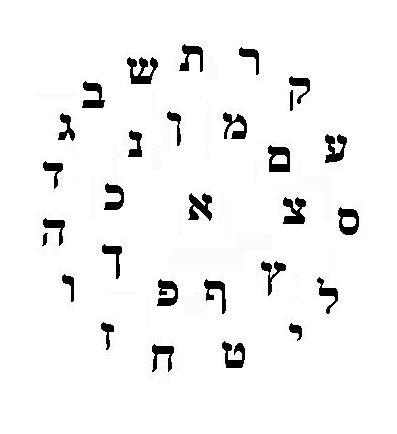
The Sator-Rotas dates back to 79 AD Pompeii. We look at the Square and note that around a central N is two circles of letters in a square fashion. The inner ring of letters is EPEREPER. The exterior circle creates the name of the puzzle: Sator-Rotas or Rotas-Sator. Now observe the similarity of this puzzle to the Hebrew Alphabet.

Recall that the Latin Alphabet is composed of 52 symbols for 26 sounds. There are two symbols for each sound which are a capital letter and a small letter. Similarly, the Hebrew Alphabet is composed of 27 symbols for 22 sounds. Only five sounds have two symbols but they are not “capitals.” They are used when the sound falls at the end of a word. So we might group this alphabet into two parts.

Those without endcaps:

   and the five pairs with their endcaps:   

The first seventeen letters do not have ‘caps.’ The last ten letters are the pairs for the sounds which equate to k, m, n, p and ts in English.

The first letter that looks like an ‘N’ is the letter ‘Alef’. Because of its similarity to ‘N’ and its central place in the Sator puzzle we will pull it out and make it the center once again. Now we have our central letter “N” or  Alef, the inner circle composed of the ten letters that have endcaps and the outer ring composed of the 16 other letters.

Similarity between Hebrew Alphabet and Sator-Rotas

If the alphabet is also a puzzle then we are left with a clue by understanding that each letter represents a number as well as a sound. The letter ‘Alef’ equals one. The next letter equals 2, and so forth. The sum of all 27 letters in this alphabet is 1775. This letter for a number is what is called the gematria values. From here the puzzle unravels in numbers.  Take note of the following:

The total sum of the alphabet is 1775 and 1775 = pi x 565. Interestingly 1/1775 = .000563.

The central number of the alphabet is 1 and sums to 1.

The outside sixteen letter group of the alphabet sums to 1214.  This is interesting but not significant here. However, it is important that the exterior ring on the Sator Square is also made of 16 letters.

It is of ultimate importance that the ten letters with endcaps sum to 560.  This is nearly the same as 565 seen above.

So, we have an image created by 1 in the center, then 560 and then 1214.

Compare then this next similarity to the Sator puzzle. If “one” is considered to be the center then the EPEREPER inner ring, when converted to numbers using the Hebrew equivalents, becomes:

E = 1

R = 200

P = 80

This gives us the string of numbers: 1, 80, 1, 200, 1, 80, 1, 200 which sums to 564

and plus the central ‘Alef’ or 1 equals 565.

The 560 and 565 of the alphabet reappears in this puzzle as the 564 or 565 of the center of the puzzle.

All those familiar with Hebrew will recognize this pattern, 565, from the letters which spell Yahweh or 5,6,5,10.

Interest piqued? Note this other little mathematical fact about the alphabet. That 1 and 560 appears in other places. Two instances are 10560 and 1056.

In what year was Noah born? 1056    (Biblical counting that is. Not real years.)

And 10560 is 2 x 5280.  Which is easily recognized!  No? How many feet are in a mile?

We are led on a further quest…..Who designated the feet in a mile? Who designed the alphabet? What is the meaning of 56?

I let this whole matter rest for consideration before the Sator Rotas is examined further.

Thanks for reading. Feel free to leave a question or a comment.

More on the Hebrew Alphabet and secrets

PREVIOUS POST            NEXT POST