The Clever Artist Knows the Mysteries in his Craft

By B.L. Freeborn © 2013, updated Nov. 2018

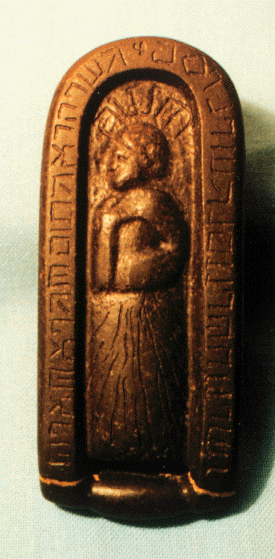
Moses and the Ten Commandments bring to mind Noah and the Ark.  Perhaps one can see the resemblance to the ark in this side image of the Decalogue Stone? It had three decks and was covered on top to one cubit.

Side view of Decalogue Stone

Side view of Decalogue Stone

Front Face of Newark Decalogue Stone

Front Face of Newark Decalogue Stone

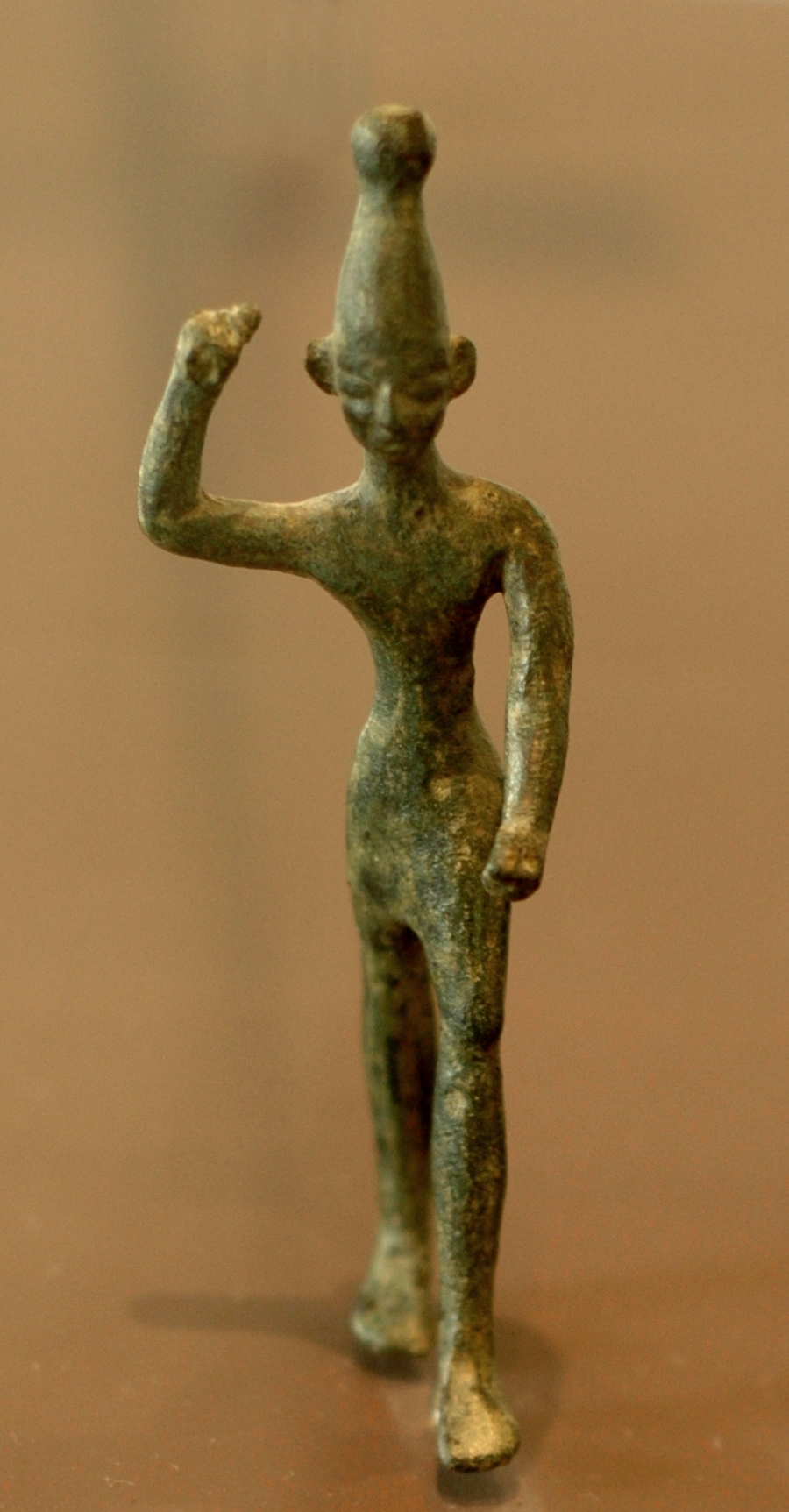
Baal, a Statue from Ugarit. 14th to 12th BC. Louvre, Wikipedia,

Baal, a Statue from Ugarit. 14th to 12th BC. Louvre, Wikipedia, Jastrow, PD.

Or perhaps one can see in the image of Moses, with his one hand that points up towards his face and the other arm held rigidly at his side, the same posture as this statue betrays from Ugarit. The language of Ugarit is so similar to Hebrew that it is helping scholars define words in the Torah better.

The statue is attributed to worshipers of Baal 14th to 12th century BC which may explain the hat with a ball on top. The ball could be the source of the ritual of placing a stone on the forehead. The suggested use of the Johnson-Bradner stone was as a Jewish ritual stone worn on the forehead (rosh phylactery).

Stones found in skulls, balls on the heads of statues, ritual stones where they ought not be…. do any other oddities surround this mystery? How about one 864,000 square feet in area?

Back to PREVIOUS POST

Back to TABLE OF CONTENTS

Forward to NEXT POST

____________________

Images of Stone from:  McCulloch, J. Huston, The Newark, Ohio Decalogue Stone and Keystone.

See:  http://economics.sbs.ohio-state.edu/jhm/arch/decalog.html

Baal:  http://en.wikipedia.org/wiki/File:Baal_Ugarit_Louvre_AO17330.jpg

Hercules:  http://commons.wikimedia.org/wiki/File:Hercules_constellation_map.svg

Looking for a Better Explanation

By B.L. Freeborn © 2013, updated Nov. 2018

J. Huston McCulloch’s website, “The Newark Holy Stones,” 1 and his 1992 paper, “An Annotated Transcription of the Ohio Decalogue Stone,” 2 are the most thorough description of the stones to be found. In the latter article he gives all 256 letters plus the 2 unidentified symbols with the matching Hebrew word and its English translation. Clear images are found on the website, as well as a good overview of its history and past debates.

Ohio HebrewThere is something missing in all of the above excellent reports and that is numbers. When studying the Indian mounds of North America or European earthworks the first items noted are lengths, areas, and heights. Numbers are intrinsic to this study. So we begin looking at the numbers related to the stone.

According to Altman this is a ritual artifact in incantation format. If it is real, the numbers should repeat numbers of historical ritual significance. McCulloch states there are 256 letters on the stone. 256 is 16 x 16.  The stone, as measured by it’s copy, measures 6 7/8″ x 1 3/4″ x 2 7/8″ (or 6.875 x 1.75 x 2.875). Its rough volume is then 34.59 cubic inches. Twice this value is 69.18.

1.75 is 2 x .875. From prior work in the subject it can be predicted that the correct value is .864″ which gives a corrected thickness of 1.73″.

Two times 2.875 is 5.75. This can be rounded to 5.8 which indicates the correct measurement is 2.9″.

6.875 can be rounded to 6.9 which is the desired value as well.

Substituting these corrected values for its measurements and determining the volume once again gives us 34.62 cubic inches or virtually the same value. Twice this value is 69.23 cubic inches.

The circumference is then 3.46 inches. Two times this is one-tenth the same value just obtained or 6.92″. The circumference in the opposite direction is 17.26 or 2 x 8.63. This is almost the desired correct value of 8.64.

Why is this all important? How can one know the expected correct values? The expected values are determined by repetition. They appear at ancient sites. Again and again in ancient artifacts they will appear. The measurements will be in English inches. The distances in English feet and miles. If this is a valid ancient object the expected numbers must be present. If it is a forgery, any value can be found. In a similar manner, the New Hampshire Mystery Stone portrays the diameter of the Earth in its circumference.

The numbers do not end here. Hebrew does not have a separate set of signs for numerals. All Hebrew letters double as numbers which makes the Torah a document that is dually written. It is written both in words and in numbers. Each letter on the decalogue equates to a number. This is called gematria. Take for example the three letters over the head of Moses. They convert to 5, 300, 40 which sums to 345 and twice this number is 690 which reminds us of the height of the stone 6.9″. Two further examples are found in numbers we just found on the stone. The gematria of Noah is 58 and that of Elohim (a name of God) is 86.

It was mentioned in the prior post that there were two symbols ignored by Altman. If the symbol at the top center front is an Ayin it is nearly the standard letter. Yet Ayin in the text is depicted by a square. The double depiction then indicates that the one was used to contain the magic of the incantation and the second to depict the meaning of the letter ie. a wye, a junction of lines. Its value is 70 very nearly the value of 69 and if one is talking about 69.2 miles between lines of longitude at the equator then 70 is a good close approximation of the value. All of these lines meet at the pole and wye out from there.

On the back of the stone is a nearly closed circle symbol that could easily be a Hebrew tet. The value of tet is 9. What is important about 9? Consider 9 x 9 = 81, 9 + 9 = 18 (its reverse) and 3 x 3 = 9 and 3 + 3 + 3 = 9. All this makes the number look very magical. But its importance in this position confirms that one of the most important numbers in this ancient secret system is present and prominent, yet hidden. The front symbol ayin, 70, plus the rear symbol tet, 9, creates 79. The diameter of the Earth is 7920 miles and any good navigator or surveyor knows the diameter of the Earth. But where is the 20? Is it here? The symbol for 20 is Kaf in Hebrew and its shape is a half circle, a sideways arch. The arch is the top of the stone. Historically and right up to today the arched tablet carrying a message whether it is the Ten Commandments, church windows, or a headstone is ever present. This completes the number.

The other number that should be present is 56. This number appears in the text of the Decalogue. It appears three times. It appears twice as words noted as being misspelled. See McCulloch’s Transcription in line 5. In this rendition it is het, vav, het, vav or 5656. It should be het, yod, het, yod and means he-shall-be. It is also a misspelled word in line 8 and is situated on the back just above-right of the tet. It is also het, vav, het, vav or 5656. It should be spelled het, vav, het, yod for 5, 6, 5, 10 = 26 or the Hebrew word we know as Yahweh. The third instance is on the front right midway in the line and it is composed of three letters lamed-kaph-vav and means or-anything. This sums to 56.

The number 56 also appears in a second hand manner in the number of letters inscribed on the stone or 256. This method of emphasizing the importance of 56 is still present in modern measures. The length of two miles is 10560 feet or to say it another way, a fifth mile is 1056 feet. (This number will become important later.) And the number of feet in an acre is a very odd value….43,560.

If this was faked then it was well done for there is one more instance of 69 that should be noted. The 5656 that appears above the tet is immediately preceded by the letter aleph or 1. So that the two letters directly above the tet are 1 and 5. 1 + 5 = 6 with tet, 9, creates 6 9 once again. We might say the incantation is sealed front to back by the 69 of 2 x 345 in Moses on the front and this 69.

In summary, in this stone we have these numbers appearing: 56, 5656, 69, 69.2, 70, 79, 864, 58 and 16. The reasons why some of them are important have been discussed. Others will appear in a later posts.

What other things can we see in this stone that help to prove its validity? Well… there are a few things that are quite clever!

Back to TABLE of CONTENTS

Back to PREVIOUS SECTION

Forward to NEXT SECTION

_________________________

References/Footnotes:

  1. McCulloch, J. Huston, The Newark, Ohio Decalogue Stone and Keystone. See:  http://economics.sbs.ohio-state.edu/jhm/arch/decalog.html
  2. McCulloch, J. Huston, An Annotated Transcription of the Ohio Decalogue Stone, “The Epigraphic Society Occasional Papers,” Vol. 21. See:  http://economics.sbs.ohio-state.edu/jhm/arch/wyrick/transcrpt.pdf
  3. Freeborn, B.L., “The Deep Mystery: The Day the Pole Moved,” Tiw & Elddir, 2013.

Altman’s Penny Theory

By B.L. Freeborn © 2013,

updated Nov. 2018

Rochelle Altman’s “First,…recognize that it’s a penny”: Report on the “Newark” Ritual Artifacts describes the penny theory like this: if a US penny is found at a dig, it is still a US penny. In other words, forget about where they were found and just look at the artifacts.1

Dr. Altman has given us two things in her interesting and well written article. She has used her many decades of experience in ancient languages to give us a clear picture as to why the Newark Stones are not forgeries but actual ritual artifacts. There is no question that she makes a series of valid explanations as to why the artifacts could not have been faked. She concludes they originated from medieval southern Europe. The second part of her report delves into explaining how these real articles came to be in Ohio in 1860, a bit of a who dunnit involving a murder and theft. She proposes these articles were stolen from the person whose remains were found at the Stone Mound site. She asserts the victim was a European settler who had brought them as family heirlooms to the region. Sherlock Holmes would have cringed at her theory but … it is possible they were family heirlooms and were acquired for the dubious reason of perpetuating a hoax on Wyrick. Alas, the problem with this theory is that as medieval family heirlooms they would have been priceless. It would have required a substantial outlay of cash to obtain them, and then the hoaxer would have had to expend the time to go to the site (7 ½ miles each way by foot or horse) to bury them in tough clay and then hope they would be found by his would-be victim. All for what?

Stone bowl found with Decalogue Stone.

Stone bowl found with Decalogue Stone.

If we toss out the attempt to explain how they got there, the stones at least have a ring of validity they have not had since Dr. Arnold Fischel made the same claim in 1861. So it took a mere 150 years to prove what they knew at the start but did not have enough archaeological knowledge to accept as fact then.

But…there always is a but….although it was easy to believe Dr. Altman, it was mistakenly assumed while reading her article that she was trying to prove an origin date of 1500 BC +- . However, she concluded it was medieval. A second read through clarified the misunderstanding … almost.

These then are the reasons from her report that seemed to indicate a date far earlier than she concluded:

See article at:   http://www.bibleinterp.com/articles/Altman_Newark.shtml

Sec. 2) Format: Incantation format dates back to Babylon 8th century BC. (This is the style in which the stones are inscribed.)

Sec. 3) Sculpture: Body portrayed in profile dates back to oldest known stele from Akkad (2371-2255 BC). “In the classic Semitic pose, the figure is in profile, one hand is raised or the arm is bent forward pointing at something or holding something.”

Note:  In this case both are true, the right arm is raised and the left is bent forward.

Sec. 4) Script: Base script in which eleven letters match is late Medieval Hebrew squared fonts. (Yet, 1st century BC fonts are extremely similar.)

The “m” she calls South Sinaitic from the 16th century BC. The tsadik is from 16th century BC as well. Both are converted from cuneiform letters. She discusses the possible “magic” reasons why it would have been used as opposed to a more modern version.

Perhaps we should pause to question how a forger in the 1860’s would have known about Cuneiform letters when the symbols were newly discovered and their decipherment still being debated. The same question can be asked of an artist in the Medieval period who certainly should have not known of these letter forms. Does this not indicate a far earlier period?

Sec. 4) Script: The ayin is in a South Semitic form dated to 10th century BC.

She notes the vav and zayin are consistently reversed. Their forms are dated to 10th century BC Phoenician. The gimel (g) is similar to a Phoenician g from the same period. The straight line yod was used in the late BC. The L she calls Nabatean is also Phoenician from the same era. The Hebrew alphabet had its beginning in 10th century BC when the letters were borrowed from Phoenician.

The Keystone was written in modern Hebrew letters using stress and durational notation. This “modern” style of letters dates back to 1st century BC and durational notation to the age of Sumer.

At the center top front there is a symbol she says is unidentified. It looks like a modern Y or the Hebrew Ayin. On the center back no comment is made about the symbol at the top of the inner arch that looks like an incomplete circle. Ironically, both Altman and the Epigraphic Society Report by McCulloch state the letter tet is not represented, yet this symbol is the modern way of denoting a tet.

Overall, her explanation of the stones’ appearance, script, and use is complete and thorough. She believes the items to be of medieval origin. Furthermore, it turns out the small bowl is by far the most important artifact indicating an age between 1st century BC and 2nd century AD. As far as her theory as to how they came to be in Ohio …. well … let us look for a better explanation.

Forward to NEXT SECTION

Back to TABLE of CONTENTS

Back to PREVIOUS SECTION

_____________________________

References / Footnotes

  1. Altman, Rochelle, ” First,…recognize that it’s a penny”: Report on the “Newark” Ritual Artifacts.”  See:  http://www.bibleinterp.com/articles/Altman_Newark.shtml


Lepper’s One-Way Leap into Oh-Oh

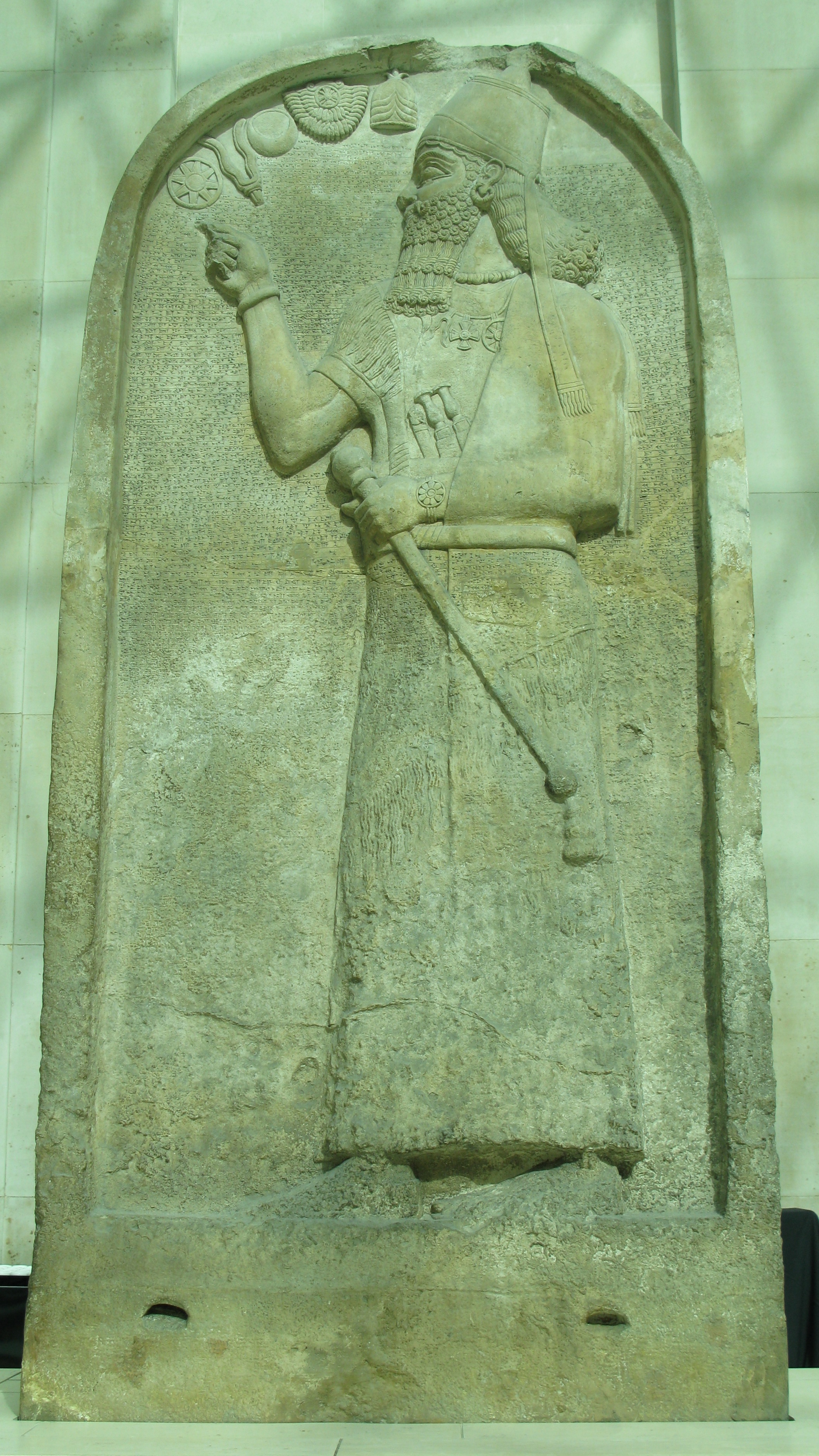
Stela of Ashurnasirpal II from 900 BC. Similarities to the Decalogue Stone are apparent.. From Wikipedia by Geni. CC-BY-SA GFDL

Stela of Ashurnasirpal II from 900 BC. Similarities to the Decalogue Stone are apparent. From Wikipedia by Geni. CC-BY-SA GFDL

By B.L. Freeborn © 2013,

updated Nov. 2018

Bradley T. Lepper, Ph.D. is the most anti-Newark Decalogue Stones voice of our time. He seems to be stuck in 19th century rhetoric and cannot see beyond the limited arguments of the past. Many arguments for/against the authenticity of the stones both then and now bring to light the politics of the era during which they were found. Lepper is stuck in the period and regurgitates the arguments of the past quite thoroughly. If you are looking for a review of past arguments then read his paper published by the Johnson-Humrickhouse Museum (present home of the stones)1. His article “The Newark Holy Stones” in Timeline2 is a repetition of these exact same beliefs. Or for no expense at all these articles can be summed up in total as:

They are fake. Proven fakes! Because I said so!

You may see this for yourself at these free sources:

In the second link, pause to look at his sources. Yes, all his sources are himself.

Perhaps it is time to recall a thing or two about archaeology.

The typical way to examine these stones usually contains an overview of the political environment in Ohio during the time period and then it deteriorates into an impossible who-dun-it. Lepper has forever committed himself to this one view. Let us look at another aspect of the historical time period that archaeologists then could not comment on because they did not have a crystal ball to see what was to be unearthed in their own newly developing field.

The Keystone was found in late June 1860 and the Decalogue Stone in November of the same year. The Civil War was just around the corner. What else was happening?

Frenchman Paul Emile Botta on the banks of the Tigris in the area of Mosul discovered Ancient Assyria in 1843 to 1846. He had unearthed a summer palace near the ancient city of Nineveh. Up until this time the oldest civilization known was that of Egypt. The only source of information on the ancient world at that time was the Bible. It was a newspaper sensation! He had happened on a city complete with monuments and written records in undecipherable cuneiform. The discovery of Nineveh would follow. This is a mere fourteen years before the Keystone would be found. It was twelve years after that in 1872 when George Smith labored over cuneiform texts and read the story of Gilgamesh for the first time in modern history. It would be some years before he would find the story of Ut-napishtim, one of the precedent versions of the tale of Noah. It was not until 1880 until the stela of Lagash would be unearthed. It would be some forty years before the Tower of Babel would be discovered.3

It is an image described as being that of Nimrod that Henry Layard discovered a few years prior to the stones’ discovery that Lepper uses in his article to compare to the image on the decalogue. Because they are both Caucasian men in profile under an arch, he concludes it is fake. Pardon me, but if it is authentic would it not show a Caucasian man in profile under an arch just as in the above image?

The Rosetta Stone was discovered in 1799. Thomas Young began to decipher the hieroglyphic version of the stone and published his discoveries in 1816. Jean Francois Champollian continued deciphering hieroglyphic Egyptian and published in 1822 only to be greatly opposed. Indeed as Cyrus Gordon summed it up “As a rule, innovation is welcome only when it is confined to surface details and does not modify the structure as a whole.” 4 Opposition to Champollian’s work did not end until 1866 when he was proven correct by another discovery. This was 34 years after his death and two years after David Wyrick, the discoverer of the Newark stones, took his own life. The Johnson-Bradner stone was discovered a year later. Into this level of archaeological science were these stones brought to the light of day. With this level of knowledge were they judged valid or fake.

Is everything known today about the ancient world so that a true assessment can be made? Of course not! Ugarit would lie beneath the soil undiscovered until 1929. Decipherment of their language moved quickly building on previous work and by 1930 it was solved. Is Ugarit an important language? Yes! It is used today to help define words in its relative language Hebrew. All of this was un-imaginable in 1900 let alone 1860.

An entire empire was rediscovered in the late 1800’s. Excavation began at Bogazköy, Turkey (Hattusa) in 1906. Archaeologist Hugo Winckler found a royal archive with 10,000 tablets.5 These tablets are still being translated. Work on this language continues at the Oriental Institute of the University of Chicago. All of this ongoing work has revealed a vast and powerful empire that reigned for 600 years until its collapse in 1178 BC. It had been forgotten but for a whisper.

It will be sometime before this vast library is completely translated. What is Lepper going to do if one of those documents refers to great earth monuments built on a distant continent in a great valley far to the west in one of their distant colonies? What if another stone in a script similar to the Ohio Hebrew appears in the future at a “legitimate” dig?

Frank Moore Cross, Harvard University Professor of Near Eastern Languages, is of the opinion that the Decalogue Stone is a “grotesque forgery that cannot be taken seriously.”  Please recall Cyrus Gordon (1908 – 2001) was not so adamant and thought they were Samaritan mezuzah stones (prayer stones that are put over the door) as opposed to phylacteries (prayer stones worn on the arm).

We have also not looked at Altman’s opinion as of yet either. In other words – don’t leap with Lepper just yet. We have a few other opinions to peruse and then those promised numbers ….. !

Back to TABLE of CONTENTS

Back to PREVIOUS SECTION

Forward to NEXT SECTION

______________________________

Footnotes/References

  1. Lepper, Bradley T., Newark’s Holy Stones: the Resurrection of a Controversy, “Newark “Holy Stones”: Context for Controversy,” Johnson-Humrickhouse Museum, 1999.
  2. Lepper, Bradley T., Gill, Jeff, The Newark Holy Stones, “Timeline,” Ohio Historical Society, Vol. 17 (3), 2000.
  3. Ceram, C.W., “Gods, Graves, and Scholars: The Story of Archaeology,”  New York: Bantam Books, 1951.
  4. Gordon, Cyrus, “Forgotten Scripts,” New York: Dorset Press, 1987.
  5. Wikipedia: Hittites. See http://en.wikipedia.org/wiki/Hittites
  6. Wikipedia: Ashurnasirpal_II.  See  http://en.wikipedia.org/wiki/File:Ashurnasirpal_II_stela_british_museam.jpg

Newark Decalogue Stone is Fake because there is No Garbage!

Front Face of Newark Decalogue Stone

Front Face of Newark Decalogue Stone

By B.L. Freeborn © 2013 (update Nov. 2018)

From Kenneth L. Feder, Ph.D. we hear, “Applying these post-Columbian historical models, most archaeologists deduce that if travelers from the Old World visited the New before Columbus they can be expected to have left similar, mundane material evidence of their presence in the form of artifacts culturally distinguishable from those of indigenous people.” 1

He means garbage. We all leave garbage lying about. They should have left more stuff with inscriptions lying about. They should have left more Old World origin stuff in their garbage piles. One can both agree and disagree.

Point in fact: David Wyrick found stones with inscriptions in 1860. Because he did, he lost his reputation and ultimately committed suicide. Suppose another intelligent person in 1860 had also found something, would he come forward to be lamb-basted? Not likely. So we might conjecture that any other ancient artifacts found in the 1800’s went into the garbage and fast.

Have things changed? If one found an artifact today would one come forward? Many would at the risk of their reputation. The artifact might also be confiscated never to be seen again. Things disappear even on legitimate archaeological digs. Is it worth impugning the reputation of the researchers over something out-of-place?

As far as other “garbage” in Newark2 we note there was:

  • a quartz ball found with the Keystone,
  • numerous other round balls were found at other mound sites,
  • the Keystone was found in a tough ball of clay,
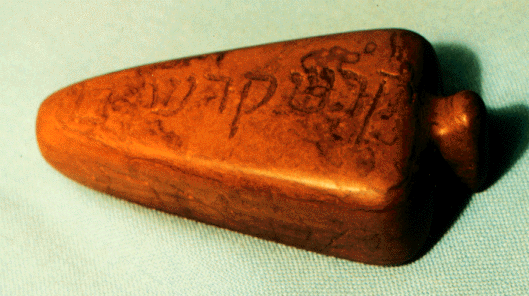
  • “two beautiful plumb bobs but instead of being either round or oval they are eight square” were found with the Decalogue Stone,
  • the Decalogue stone was in an oval, round case which creates a large “rock” when closed and it was found with a small stone bowl,
  • the Johnson-Bradner stone found at the same location as the Decalogue was in a skull.

In fact, the other “garbage” these people left behind was monstrous earthworks that greatly resemble in detail earthworks in England and Ireland.

This does not mean the native people of the time period did not make these monuments. Of course they did! It does not mean today’s Indians are not descended from the original builders. Unless they all died off from disease or were killed off, of course they are descended from them! The mounds are enormous complexes that did not appear overnight nor were they built by a small group of people. (Nor were they built by Mormons, or lost tribes.)

What Dr. Feder wants to see to believe the stones are real is “a convincingly authentic, archaeological site with its complex of artifacts and features with all their spatial associations and stratigraphic contexts.”

In other words, he wants to see a typical community layout with an area of houses, a cemetery, and the always present garbage heap which in this case must contain relics similar to the Decalogue Stone or something from the Old World like a belt buckle.

What we do have is a site that has enormous spatial associations (the number stuff that is to come).  William Romain, Hively, Horn and James Marshall have begun to show us already that these sites were formally laid out geometrically. James Q. Jacobs and Joseph Knapp are hard at work showing the astronomical correlations. These mounds were not randomly built. In order to place these sites with the precision other authors demonstrate (and will be shown here later) they must have had either astronomy or surveying skills, or acquired the skills by association with another party. Today we hire engineering services. Today we are even persuaded by outside parties to build engineered monstrosities we do not want like Wheelabrator’s Incinerators. In other words, a small outside party amongst the population cannot be ruled out by the lack of their specific garbage. Their presence may be deduced by the results left behind, ie. a monstrous Wheelabrator Trash plant means “they were here.”

Someone engineered these sites. Who? How about the chap they unearthed where the plumb-bobs were found? Plumb-bobs are used in surveying. They found the Johnson-Bradner stone within a skull. That is a nice gruesome touch if it was forged. Two other interesting facts about this burial. The “crypt” was a coffin made from a hollowed tree trunk surrounded by and encased in fine white clay. Fine white clay is not found everywhere in Ohio. Its presence must indicate this person was special enough for his mourners to go to the trouble to get it. Over the clay was placed a layer of stones and wood bracing. Upon these were copper rings. Indeed, on top of this site was a mound of stones described as being 180 feet in diameter and 40+ feet high. This mound of stones was so large it took 75 wagon teams to remove the stones to make the dam to create Buckeye Lake in 1831-1832. This is an estimated 10 to 15,000 wagon loads. We may assume that each stone placed on that cairn was to show respect for those buried there. They were extraordinarily special in some way. They were so revered that people left so many tokens of respect that a great mound of stone was formed. For all we know the deceased was a visiting dignitary from the Old World. More likely he/they were the engineers who laid out the great Newark site and other vast mound systems. A plumb-bob was found after all. Would they not be laid to rest with their favorite tools?

We might ask where they learned their trade? Mesoamerica, Cahokia, or were they buried with something they brought from their homeland? Like a “Jewish looking” stone? There is another piece of forgotten history that will shed light on who might have been buried on that hill under that massive mound of stones.

“Another group of people also lived among the Cherokee. They were called the Ani’-Kuta’ni. Prior to Mooney there were other much older sources that stated these people were…

“…the priestly clan, having hereditary supervision of all religious ceremonies among the Cherokee, until, in consequence of having abused their sacred privileges, they were attacked and completely exterminated by the rest of the tribe, leaving the priestly functions to be assumed thereafter by individual doctors and conjurers.”3

“The Mound Builders are addressed in Mooney’s book. There are two versions to this story. One group said the mounds were built by another people with no association to the Cherokee while another story said they were built by the ancestors of the Priests Ani’-Kuta’ni.”

This report is from “The 19th and 7th Annual Reports Bureau American Ethnology,” 1897-1898. It gives us an unexpected picture of very early American history and may explain some parts of this story while still leaving us wondering about who the Ani’-Kuta’ni might have been.

We might also ask did they teach anyone else their trade and pass along their knowledge? There is evidence they did.4 The quick argument is that Native Americans did not own land and so surveyors were not required. The thoughtful answer is surveyors are required if you take the placement of your monuments very, very seriously. Were they placed precisely? They were, just as Romain concluded, but more than he could have imagined. This will lead to more numbers to be looked at!

Next we look at Lepper’s leap into oh-ohh.

Back to TABLE of CONTENTS

Back to PREVIOUS SECTION

To NEXT SECTION

___________________________________

Footnotes/References

  1. Feder, Kenneth, Coming to America: Investigating Claims of Precolumbian Forays to the New World, “Newark “Holy Stones”: Context for Controversy,” Johnson-Humrickhouse Museum, 1999.
  2.  Alrutz, Robert W., “Newark Holy Stones: The History of an Archaeological Tragedy,” Coshocton, Ohio: The Johnson-Humrickhouse Museum, 2010.
  3. Mooney, James, “Myths of the Cherokee and Sacred Formulas of the Cherokees, From the 19th and 7th Annual Reports Bureau American Ethnology,” 1897-1898.
  4. Brennan, Tom PE, Civil Engineer and Surveyor, “Land Surveying Long Ago,” 2013 Spring Conference Presentation NEARA.

.

.

.

.

.

153 Years and the Debate Still Rages: Newark Mounds and Decalogue Stone

Front Face of Newark Decalogue Stone

Newark Decalogue Stone, photo by J. Huston McCulloch

By B.L. Freeborn © 2013 (updated Nov 2018)

If the Newark Indian Mounds of Newark, Ohio were not large enough to contain a golf course (which they do) they would have been declared a fraud and a hoax. The Decalogue Stone and Keystone, two stones with Hebrew inscriptions found at and near the site have been declared both a fake and real. The debate over the stones has raged 153 years.

Today’s greatest anti-stone debaters are: Kenneth L. Feder, Ph.D., Professor of Anthropology at Central Connecticut State University and Bradley T. Lepper, Ph.D., Affiliated Scholar at Denison University in Granville, Ohio and Archeology Education Coordinator at the Ohio Historical Society.  They are joined by others who parrot their words such as Keith Fitzpatrick-Matthews, Archaeology Officer at North Hertfordshire District Council, England, educated at University of Lancaster and Letchworth Grammar School and is a former nightclub DJ who writes “Badarcheaology.”

They are opposed by J. Huston McCulloch, Ph.D., Professor of Economics and Finance at Ohio State University; Rochelle I. Altman, Ph. D. Medieval English Literature, Scotland, a specialist in ancient phonetic-based writing systems; Suzanne O. Carlson, architect and NEARA Board member, James Guthrie, retired industrial chemist and avocational epigrapher, and others.

Some of their arguments are logical. Some of them are not.

Keystone found near Octagon in Newark, Ohio

Keystone found near Octagon in Newark, Ohio,
Photo by J. Huston McCulloch

There is considerably less written on the Newark Mounds since there is just not as much to debate. They exist. They existed prior to European settlement so they are not forged. They have been altered but that work was either done in the interest of preserving them or removing them from existence, which is why three large portions of the mounds are in viewable park-like condition today and the rest has made way for progress. There is serious academic work being done on them with some pretty cool new instruments like LiDAR. William F. Romain, Ph.D. Archaeoastronomy, Research Associate for Newark Earthworks Center, Ohio State University leads in this field by far. He picked up where Ray Hively and Robert Horn of Earlham College, Richmond, Indiana left off in 1982. Joseph M. Knapp has written web-articles “Hopewell Lunar Astronomy: The Octagon Earthworks” and “On the Great Hopewell Road” which begins in Newark. He introduces us to James A. Marshall who has spent many hours actually surveying the mounds and has studied the geometry used in building them. This lovely image of the mounds is from James Q. Jacobs extensive site on the archaeoastronomy of ancient sites.

Newark Earthworks, Link to James Q. Jacobs Site and Photos.

Newark Earthworks, Link to James Q. Jacobs Site and Photos.

No one can say academic archaeologists are ignoring this topic. It is a mainstream debate and the arguments are becoming increasingly scientific … well…. except for Lepper’s and the Dj’s. To add to the topic at this point either good tools and/or observations are required.

There are a few gaffs in the arguments on the Stones on both sides. Perhaps the only way to really resolve the issue is to look at the Mounds themselves. Instead of debating endless rounds of “who is/is not guilty of faking them” perhaps we should change the question entirely. To do so we might have to throw out a lot of what we presume is actual fact. We need to see if there are any circumstances under which it would be appropriate for a “Jewish looking” stone to be found at the mounds pre-Columbus. In my mind their presence can only be logical and legitimate if they can be associated to the mounds themselves.

So we begin looking at the Stones by looking at some of the arguments of the current debaters and then there is a good deal of mathematical information about the mounds to share. The legitimacy of the stones aside, the geometric study proves a great intelligence lies behind the design and layout of the mounds. When done you will have a solid opinion …of some sort.

So we will pick up next with………… “They left no garbage!”

Forward to NEXT SECTION

Back to TABLE OF CONTENTS

Back to posts on KNOWTH KERBSTONES

_______________

Footnotes

  1. Newark Decalogue Stone and Keystone photos by J. Huston McCulloch.  http://economics.sbs.ohio-state.edu/jhm/arch/decalog.html
  2. Knapp, Joseph M., “Hopewell Lunar Astronomy: The Octagon Earthworks,” 1998.  http://www.copperas.com/octagon/oindex.html
  3. Knapp, Joseph M., “On the Great Hopewell Road,” 1998.  http://coolohio.com/octagon/onroad.htm
  4. More photos and archaeoastronomy information by J. Q. Jacobs.  http://www.jqjacobs.net/archaeo/octagon.html

Newark Decalogue Stone and Earthworks: An Unraveling Mystery

The following twenty-five posts were a pleasure to write and even more so to share with you. 

Newark Decalogue Stone and Earthworks: An Unraveling Mystery  … Full document as pdf.

B.L. Freeborn   © July 2013

“As a rule, innovation is welcome only when it is confined to surface details and does not modify the structure as a whole.” – Cyrus Gordon

Table of Contents

  1. Lepper’s One-Way Leap into Oh-Oh

    Front Face of Newark Decalogue Stone

    Front Face of Newark Decalogue Stone

  2. The Remains according to Romain

    Keystone found near Octagon in Newark, Ohio

    Keystone found near Octagon in Newark, Ohio

  3. Ohh… Let It Not be True

    Newark Earthworks, Link to James Q. Jacobs Site and Photos.

    Newark Earthworks, Link to James Q. Jacobs Site and Photos.

BACK TO PREVIOUS POST

See another example of Ohio Hebrew here.

A Simple and Elegant Neolithic Oops

– B.L. Freeborn (c) 2013, updated Sept. 2022
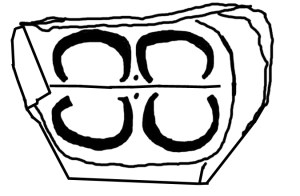
Sketch of Kerbstone 86

Sketch of Kerbstone 86

There is an oops in this drawing that reveals all. You won’t see it right off in its simple symmetric shape of four crescents, a line and two dots but here is the thing. If you examine image after image of art from Knowth, Dowth, Loughcrew and Newgrange you will see abstract shapes of swirls, curves, zigzags, crescents etc. but you will never see anything that looks specifically like a distinct letter. A crescent does but it is not distinct enough for one to point at a specific alphabet and say ahah! that is from Ancient ….. It is as though these artists did not have a written language and that is why symbols that appear to be letters or hieroglyphs are absent. There seems to be an overwhelming agreement these ancient builders were illiterate. Yet it is a simple idea that no letters were used in their art because these monuments were built for the eons and people (like us) who would not speak their specific language but who might speak – the one universal language.

So the oops is the letter dead center in the image. A line with a dot on each side according to the eminent Dr. Cyrus Gordon is part of the Hittite (now called Luwian) Hieroglyphic system and it is the letter “wa.” It does not mean this is the Luwian language but if it is “wa” then it confirms these people spoke an Indo-European language just as we would expect. We will come back to this.

Shall we read this mathematical message to us sent across time?

As before, we immediately count 4 C’s in a square shape and draw the conclusion we must square four!  Or 4² + 4² = 5.65².   And there we have the incredibly important and secret number 56 that is central to the deep mystery and appears at Stonehenge (see post) and is incorporated into the Giza Pyramid.

The C shape looks like the Hebrew K so we shall equate it to 20. What then might we equate the “wa” to? In Hebrew gematria the “wa” sound is often indicated by the ‘vav’ which equals 6. This gives us 4 C’s at 20 + 6 or 86. And this is the incredibly important value of the Sun with its diameter in miles at 864,000.

Can there be any other mathematical secrets in this figure?

Let us read it as we did others. 2 C, 1 wa, 2 C equates to 212. ????

But perhaps they meant us to add the 21 and 12 to get 33. Does 33 mean anything special? As a matter of fact it does. It is one of the often repeated numbers.

So let us go one step further. If they had an alphabet, then what language did they speak?

Missing Stone at Cairn F, Loughcrew, Ireland. After Brennan, After Du Noyer.

Missing Stone at Cairn F, Loughcrew, Ireland. After Brennan, After Du Noyer.

Perhaps the answer to that has been stolen from us. Martin Brennan records in his book the inscription on a stone which was removed from Loughcrew, Ireland. This is a mountain site which is much older than Knowth and Newgrange. I repeat the symbols here with the warning that they have been reproduced in succession and errors may have crept in.

This then suggests these people did have a written language distinct from the art. Since we would like to think we are quick of wit, let us try to solve the present riddle at hand. We have 2 C’s, a “wa”, and 2 C’s.

Since this decipherment into words is novel we shall do it thrice:

Try One:

C is the initial sound in crescent, comet, cup and cave and its shape repeats the idea of each word’s meaning. This suggests it has sound value K. So let us stick with it and pronounce the word.  CCwaCC or KwaK.

I am told that at one time all the letters in words were pronounced. So when we read light as lite it is incorrect. The gh in light was once pronounced. This suggests the c and k of quick were both pronounced. Because Knowth is on an island once solidly joined to Britain and Germany by land, and in close proximity regardless, it is not too far a cry to suggest this is one of two English words: quake or quick. The latter has the double c preserved and both preserve the k-wa sound. And if you think about it, they say the same thing. In Old English, according to J.R. Clark Hall, quake and quick are spelled cwac and cwic respectively. And he reminds us that it means “living, trembling”, and “living, alive.”  From Indo-European roots it is found as gwei which is the root of both English “quick” and German “Kwi(k)waz” also meaning alive.  (Old languages did not always differentiate between g and k.) In support of this interpretation, quick and quake are both appropriate to the diagram itself once the over all meaning of the site is understood.

This then suggests once again the impossible, just as an analysis of the Sator-Rotas revealed, and that is, that the English language did not begin around 500 AD as we are educated. For these sites are older than the pyramids. It helps piece together a past for the English language that might just pre-date High German. Is this possible? Time will tell.

Try Two:

As above we have CCwaCC. The Old English word ceac meaning vessel can be represented by the two letters CC. In Old English ‘wa’ is the word “woe, a sorrow.” It is also the root word of water. The -ter suffix changes the word into a noun. Hence, the word can also represent water. So this translation suggests there were two vessels, woe, two vessels. The image reinforces this translation.

Try Three:

We look once again at the Luwian and find that the large bold C symbol is the hieroglyph for the word meaning “great.” So then our image reads great, great, wa, great, great. The hieroglyph is associated with the sound ur. Ur was a very great city of the past. Perhaps this is why the linguists have happened upon the association. In Old English we note that ur can mean our, ore or origin. So then, the image takes on the meaning origin-woe. To understand this better we note that sometimes the hieroglyphs did not represent a sound but the object itself. In this case it could mean great, great woe. So we have “the origin of the great woe.” And if this woe was water then perhaps they are explaining the origin of the great flood itself.

So in total we have “the origin of the great woe” that was quick and a quake. It speaks of a great sorrow, a quake, a tragedy, a great woe and great vessels. It speaks of the deluge and perhaps the Day the Pole Moved.

Many more mysteries to unravel…..

Thank you for reading!

See more of fantastic Knowth and Dowth at this link:

http://www.knowth.com


(1) Cyrus H. Gordon, “Forgotten Scripts.” NY: Dorset Press, 1968. See pg. 98.

(2) Martin Brennan, “The Stones of Time.” Rochester, Vermont: Inner Traditions International, 1994. See pg. 165.

(3) J.R. Clark Hall , “A Concise Anglo-Saxon Dictionary.”  Toronto: University of Toronto, 1894.

(4) “The American Heritage Dictionary of the English Language,” Boston: Houghton Mifflin Company, 1976. See Indo-European Roots, pg. 1519.

PREVIOUS POST                NEXT POST

A Loughcrew Neolithic Petroglyph Translation

-B.L. Freeborn (c) 2013, updated Nov. 2018

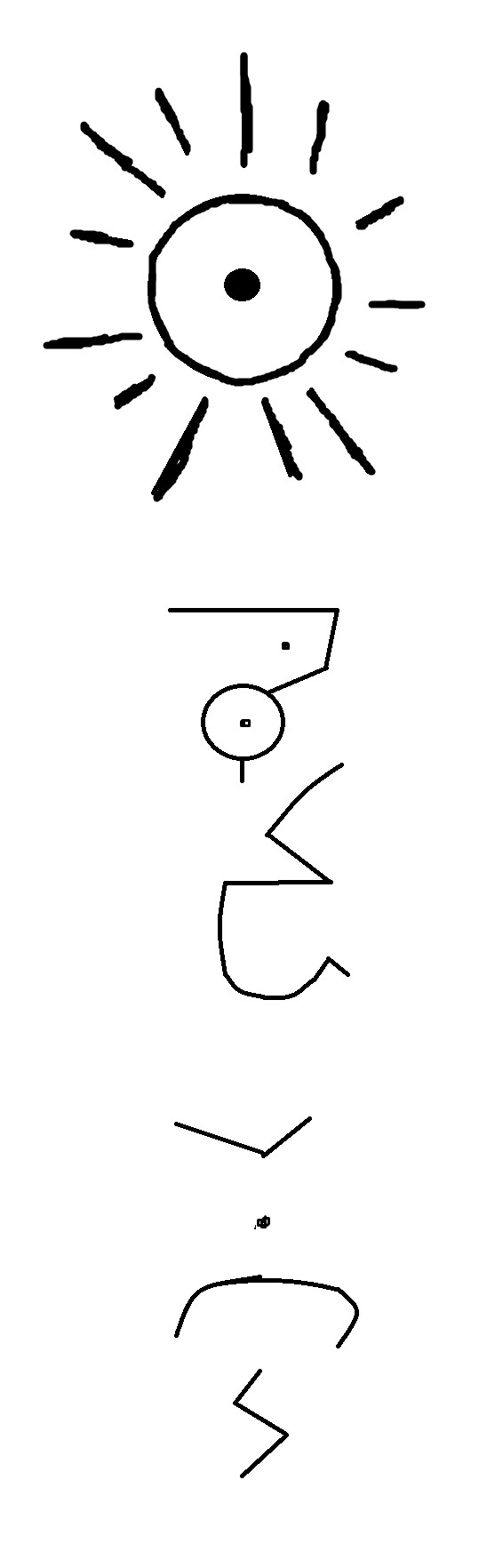
There was a petroglyph etched into a stone at Loughcrew recorded by George De Noyer and found in Martin Brennan’s book, “The Stones of Time.” The stone itself has been removed from the site. A translation shall be attempted here.

Missing Stone at Cairn F, Loughcrew, Ireland. After Brennan, After Du Noyer.

Missing Stone at Cairn F, Loughcrew, Ireland. After Brennan, After Du Noyer.

Note there are six symbols and a dot acting as either a word divider or sentence divider. There are too few symbols to be individual letters unless this is only one or two words. In studying Kerbstone 86 from Knowth the appearance of the letter “wa” and hieroglyph for “great” from the Hittite/Luwian Heiroglyph system was noted. The symbol for great appears in this image as well. It is the face down C second from the bottom.

Symbol One: The sun is the most prominent image at the top and since the Loughcrew site is built to capture and measure light we assume this message is then directly related to the site and/or the sun. Another possibility exists that this is a compound symbol and should be seen as a circle and dot surrounded by rays. The circle and dot is SCUTELLA 402 (Latin for shield) pronounced “sa”. The word “sa” in Old English means bucket.

The next two symbols are what might be called hieroglyphic cursive. Each is composed of three signs joined together.

Symbol two: The top part is very close to the hieroglyph SUPER 70 (Latin for above) with no sound identified. The circle and dot is SCUTELLA 402 (Latin for shield) pronounced “sa”. The small tail is “ra” 383. So we have ABOVE-sara.

Symbol three: This is also composed of three symbols. The first symbol is the same as symbol six: a zigzag of three lines. This is similar to SOLIUM 299 (throne) pronounced “i.” The cup shape is similar to CAELUM 182 (heaven) sign and to OCCIDENS 379 (west). The heaven symbol is a closed half circle with a horizontal line within while the west symbol is the same as here except with an upright staff in it. The last symbol is “ra.” So the word is  i, …….., ra.

Symbol four: There is no sign in Luwian that is similar to this. However, it appears on Kerbstone 93 (see post) and it seems to imply what it would today: to include, they, or this.

Symbol five: Is the MAGNUS 363 meaning great and sound “ur.”

Symbol six: Is the same as the first part of three. SOLIUM 299 (throne) and sound “i.”

In summary the six words are then: Sun or bucket, above-sara, i ……. ra, they, great, i. This needs a bit of work before we can equate it to modern words.

We could take the word SUN at face value or we could say from “the bucket it spread.” The dual meaning together suggests from the explosion like the Sun it spread.

Looking at Above-sara note that sara could be either sare meaning sore or sar spelled today as sear meaning dry. Both are related terms. The word asear means to dry out. So we shall leave it as “above was seared.”

The third symbol contains the i,……,ra. The middle syllable should be related to heaven and direction in some manner and the idea of a year fits. Old English for year is gear. Similarly there is the word gore and “gar” meaning spear. Both gore and gar reinforce the idea of an explosion. Surprisingly there is a word in Old English that is i,gar,ra and it is egor. Egor means flood, deluge. So this third symbol might very well mean flood.

The forth symbol we have temporarily equated to “they” or “this.” The fifth symbol was directly from Luwian as “great” which leaves us only to interpret the last symbol which from Luwian is Solium “throne” or the sound “i.” We might understand this symbol better if we realize that the “throne” or “ruler” determined the standard of measure (the length of the inch, mile, meter). The symbol then is a surveyor’s chain which is long and folds. If we look back to “egor” it reconfirms the idea of a measure of water or flood.

Putting it all together we have: Explosion, seared above, floods. They are great in measure.

This seems to be a serious lamentation rather than a weather report which might give us some insight as to why Loughcrew was built so high above the surrounding area and why they might have been studying the movement of the Sun. All in all, it is consistent with and confirms the findings presented in other posts.

This translation suggests that English was a written language some 4000 years earlier than than believed today. But then again for hundreds of years we were taught the world began in 4004 BC!

As mysteries unravel others appear…………
———————————————————————————–

(1) Cyrus H. Gordon, “Forgotten Scripts.” NY: Dorset Press, 1968. See pg. 98.

(2) Martin Brennan, “The Stones of Time.” Rochester, Vermont: Inner Traditions International, 1994. See pg. 165.

(3) J.R. Clark Hall , “A Concise Anglo-Saxon Dictionary.”  Toronto: University of Toronto, 1894.

(4) “The American Heritage Dictionary of the English Language,” Boston: Houghton Mifflin Company, 1976.

(5) Luwian Symbols by: Gunter Anders at http://www.hethport.uni-wuerzburg.de/luwglyph/Signlist.pdf

Previous Post    Next Post

Through the Mists of Time Comes a Message

Sketch of Kerbstone 93, Knowth, Ireland, after Brennan, after A. Murphy.

Sketch of Kerbstone 93, Knowth, Ireland, after Brennan, after A. Murphy.

-B. L. Freeborn © 2013, updated Sept. 2022

My posts have been described as “a cohesive but crazy time cube.” I continue in my cohesively crazy manner to explain the Neolithic art at Knowth, Ireland on Kerbstone 93.

Kerbstone 93 is a perfect “napkin” drawing that should be common knowledge today but somehow we missed this obvious and simple concept. These ancient artists are telling us how the Earth behaves under an infinitely large impact load. They knew this information was important and they did the impossible. Not only did they survive such an event against all odds, but they left us a written record of it.

Kerbstone 93 is a simple drawing which is realistic in its depiction of an event with two key numbers beneath it. The two numbers we have seen before at this site so it is not surprising to find them so boldly depicted. The two numbers are 33 and 56. Because of a beautiful image by A. Murphy we can correct the right side of Martin Brennan’s sketch as shown. The correction depicts 2 C’s, an inclusive parentheses and a large crescent. This we might interpret as many craters were created from the each one. A reading of these 3 C’s followed by 3 C’s when read right left is: many craters were created from the each one. There are 3 at 33. Which is factually correct.

Notice there are 8 peaks and 9 valleys in the bottom glyph.  The square root of 7920 is 89. Note that 56 is read quite simply. The large line parenthesis beneath the cycle line marks out 5 peaks and 6 valleys.

The dot divides the peaks into 3 and 2 or 32 which is the square of 5.65. This repeats the 56 idea. Recall 90 degrees minus 56.5 is 33.5 which gives additional meaning to the 33.

The diagram clearly depicts an event. Reading it left to right, we see an object with a center. It is approaching the Earth which is correctly depicted as viewed from above with lines of latitude shown. The short line at 11:00 depicts the impact site of the object on the left and the two lines at 2:00 show its final position. The swirl to the right is an explanation to the viewer. The artist explains simply, “It turned.”

This then is the message of Knowth from the scientists of an ancient era to the scientists of today. It is simple. It is straightforward and it is logical.

__________________________________________________________________________

(1) Martin Brennan, “The Stones of Time.” Rochester, Vermont: Inner Traditions International, 1994.

(2) A. Murphy, 2000 at http://mythicalireland.com/ancientsites/knowth/lunarknowth.html

PREVIOUS POST                NEXT POST