The Mounds that were Imagined by the Army

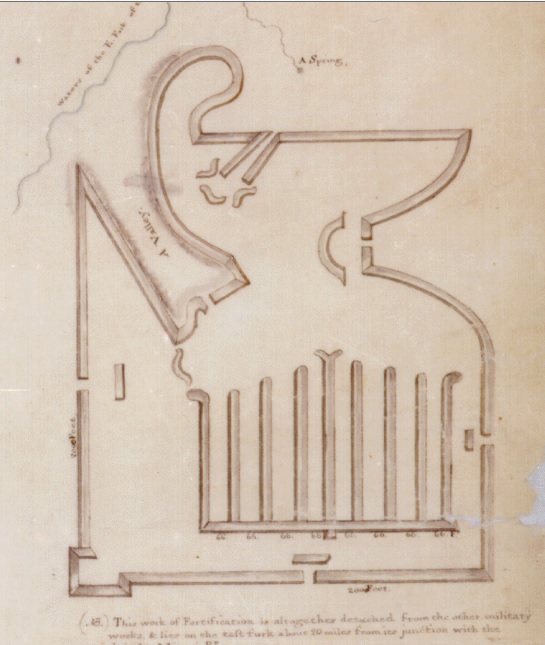
Hanukkiah Earthworks as surveyed by the Army before they were destroyed.

Hanukkiah Earthworks as surveyed by the Army before they were destroyed.

By B.L. Freeborn © 2013, updated Nov. 2018

What else does Dr. McCulloch have to offer? As a long time advocate for the stones his website has a few things not found anywhere else. If one visits his Archaeological Outliers Page1 one will find an image of a great earthwork that no longer exists. It met with the colonial plow and lost. Formerly, this great earthwork was to be found east of Cincinnati near the East Fork of the Little Miami River. Fort Ancient and Chillicothe both have large concentrations of mounds and are relatively close.

It takes little imagination to see in this image an oil lamp and a candelabra particular to Jewish tradition called a Hanukkah menorah. McCulloch explains in detail the different surveys done at this site. One survey was done by the US Army but in accordance with the anti-debaters logic the earthworks never existed. It is a short leap after seeing this to concluding the Decalogue Stone is Jewish. But again we must hesitate to make that leap since if it is Jewish, present day Jews would have some understanding of what the earthworks are all about. The Jewish are a people who tenaciously adhere to tradition. If the earthworks are of Jewish origin, then would there not be a tradition of making earthworks in their religion? Since there is not, we continue looking for an explanation.

The East Fork Works is portrayed in this image. The 2000 foot length on the image is believed to be incorrect. (See full resolution image at McCulloch’s link below.) It is noted in two places as 200 feet and then later someone has written in a zero to make it 2000 feet. Frank Otto proposed in 2006 that the correct dimension is probably 900 since 9’s and 2’s can look similar and this then was a mistake in taking the information from field notes. The spacing on the candles is 66 feet. Scaling the image accordingly, the 900 foot dimension is confirmed in the locations shown in the image below. The overall dimensions on the bottom and left are 924 x 935 = 863,940 or 864,000 square feet. This 864 looks familiar. We saw it in the Decalogue Stone.

Hanukkiah Earthworks with Dimensions Added.

Hanukkiah Earthworks (East Fork) with Dimensions Added.

The other numbers found on the stone were: 56, 5656, 69.2, 69, 70, 79, 58 and 16. The 79 appears in the East Fork Works at the bottom as 792. The average diameter of the Earth is 7920 feet. The 56 appears at the bottom of the candlestick as 560′. The lower branch actually bumps out to give the dimension. The 58 appears at the top closer to its correct value of 584 which reminds one of the distance Earth travels in a year or 584 million miles. Easily summed and used to check the scale is 66 x 8 = 528. The 528 was found by James Marshall at the High Bank Works south of Chillicothe2 as the radius of the giant circle there. 528 feet is exactly 1/10th of a mile.  Its prominent display here is also indicating measurement by the mile. The distance 660 feet is called a furlong. There are eight in a mile. The candles are then set at 1/10th of a furlong. The radius of the small top circle is also 66 feet making the diameter the noted 132 feet. The 132 feet appears as the length of the bottom small square. Its vertical height of 110 feet is 1320 inches. The area of this square is .333 acres. We saw on the back of the Decalogue Stone the number 9 and recalled that it is 3 + 3 + 3 = 9. The 3’s appear in the area .333 but more so the 9 appears as the 900′ dimensions. The area of a 900′ x 900′ square is 18.59 acres.

This value repeats. The side lengths 935′ and 924′ sum to 1859′.

The topic of the Sumerian inch of .66 inches has previously been studied.3 The value 66 reminds us that Earth travels at 66624 mph. Furthermore, one cannot possess a really important length of .66 inches unless one’s standard is actually one full inch. The same follows for the Indus inch of 1.32 inches. The value 1.32 is reflected in this image as well.

If one has taken the time to follow this, it leaves more questions than answers. Why are there all these odd elements in one place: English measurement, numbers of Sumerian and Indus importance, Jewish symbols, Jewish letters, and an accurate measurement of the Earth’s diameter? Not to mention in the last post we brought into play the deity Baal. The mystery grows in complexity rather than being solved.

Back to PREVIOUS SECTION

Back to TABLE OF CONTENTS

Forward to NEXT SECTION

________________________

  1.  McCulloch, J. Huston, “Archaeological Outliers Page.”    See: http://economics.sbs.ohio-state.edu/jhm/arch/outliers.html
  2. Marshall, James, Intelligence Inscribed before the Printed Word in North America, Caxton  Club of Chicago, 2004. See: http://www.caxtonclub.org/reading/2004/jul04.pdf
  3.  Freeborn, B.L., “The Inch, The Megalithic Yard, and The Sumerian Inch,” 2013. See:  https://noahsage.com/2013/01/13/the-inch-the-megalitic-yard-and-the-sumerian-inch/

The Clever Artist Knows the Mysteries in his Craft

By B.L. Freeborn © 2013, updated Nov. 2018

Moses and the Ten Commandments bring to mind Noah and the Ark.  Perhaps one can see the resemblance to the ark in this side image of the Decalogue Stone? It had three decks and was covered on top to one cubit.

Side view of Decalogue Stone

Side view of Decalogue Stone

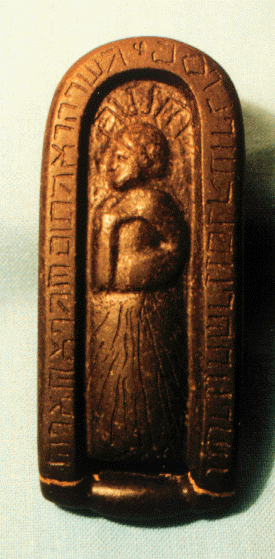
Front Face of Newark Decalogue Stone

Front Face of Newark Decalogue Stone

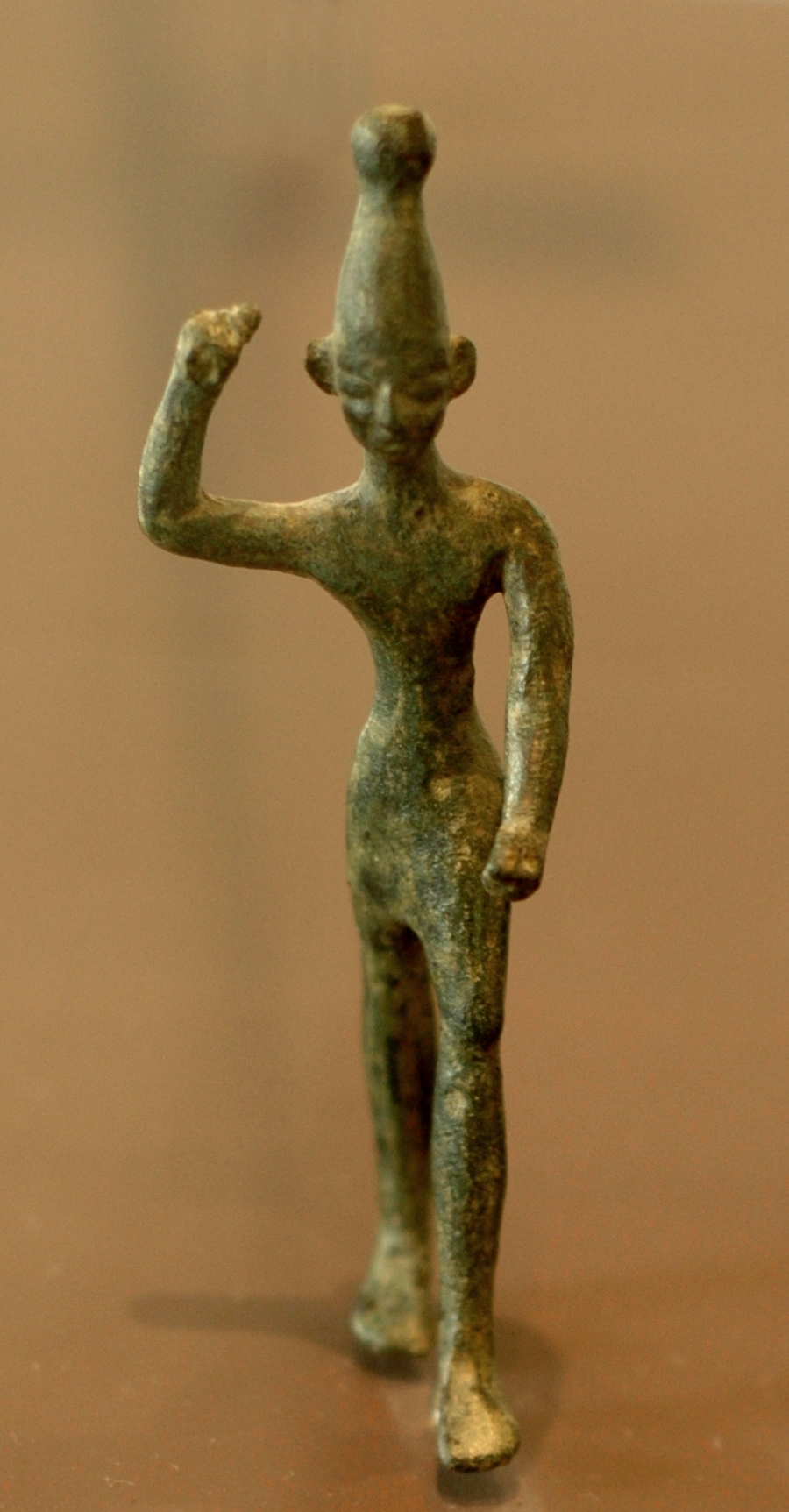
Baal, a Statue from Ugarit. 14th to 12th BC. Louvre, Wikipedia,

Baal, a Statue from Ugarit. 14th to 12th BC. Louvre, Wikipedia, Jastrow, PD.

Or perhaps one can see in the image of Moses, with his one hand that points up towards his face and the other arm held rigidly at his side, the same posture as this statue betrays from Ugarit. The language of Ugarit is so similar to Hebrew that it is helping scholars define words in the Torah better.

The statue is attributed to worshipers of Baal 14th to 12th century BC which may explain the hat with a ball on top. The ball could be the source of the ritual of placing a stone on the forehead. The suggested use of the Johnson-Bradner stone was as a Jewish ritual stone worn on the forehead (rosh phylactery).

Stones found in skulls, balls on the heads of statues, ritual stones where they ought not be…. do any other oddities surround this mystery? How about one 864,000 square feet in area?

Back to PREVIOUS POST

Back to TABLE OF CONTENTS

Forward to NEXT POST

____________________

Images of Stone from:  McCulloch, J. Huston, The Newark, Ohio Decalogue Stone and Keystone.

See:  http://economics.sbs.ohio-state.edu/jhm/arch/decalog.html

Baal:  http://en.wikipedia.org/wiki/File:Baal_Ugarit_Louvre_AO17330.jpg

Hercules:  http://commons.wikimedia.org/wiki/File:Hercules_constellation_map.svg

Lepper’s One-Way Leap into Oh-Oh

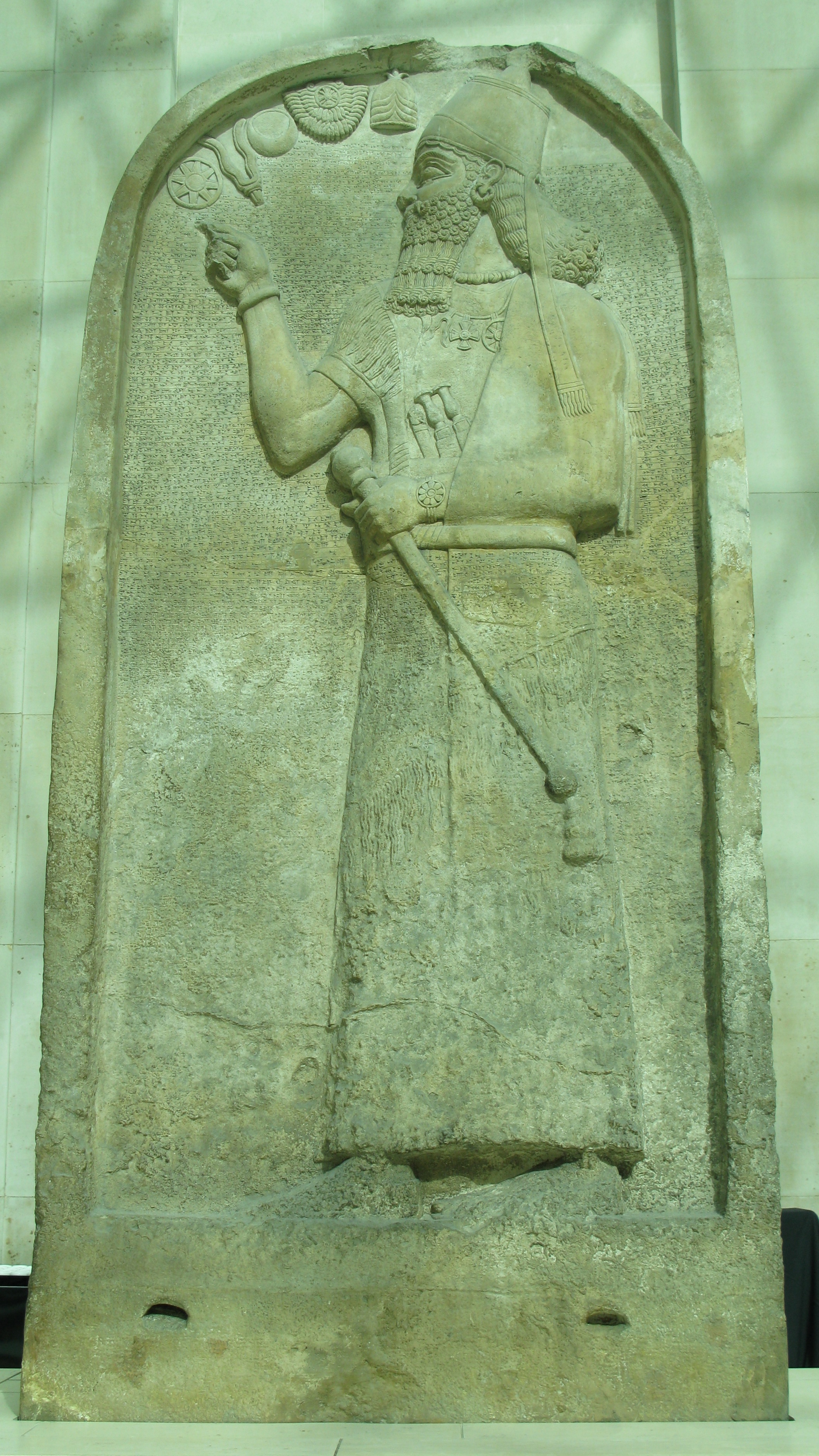
Stela of Ashurnasirpal II from 900 BC. Similarities to the Decalogue Stone are apparent.. From Wikipedia by Geni. CC-BY-SA GFDL

Stela of Ashurnasirpal II from 900 BC. Similarities to the Decalogue Stone are apparent. From Wikipedia by Geni. CC-BY-SA GFDL

By B.L. Freeborn © 2013,

updated Nov. 2018

Bradley T. Lepper, Ph.D. is the most anti-Newark Decalogue Stones voice of our time. He seems to be stuck in 19th century rhetoric and cannot see beyond the limited arguments of the past. Many arguments for/against the authenticity of the stones both then and now bring to light the politics of the era during which they were found. Lepper is stuck in the period and regurgitates the arguments of the past quite thoroughly. If you are looking for a review of past arguments then read his paper published by the Johnson-Humrickhouse Museum (present home of the stones)1. His article “The Newark Holy Stones” in Timeline2 is a repetition of these exact same beliefs. Or for no expense at all these articles can be summed up in total as:

They are fake. Proven fakes! Because I said so!

You may see this for yourself at these free sources:

In the second link, pause to look at his sources. Yes, all his sources are himself.

Perhaps it is time to recall a thing or two about archaeology.

The typical way to examine these stones usually contains an overview of the political environment in Ohio during the time period and then it deteriorates into an impossible who-dun-it. Lepper has forever committed himself to this one view. Let us look at another aspect of the historical time period that archaeologists then could not comment on because they did not have a crystal ball to see what was to be unearthed in their own newly developing field.

The Keystone was found in late June 1860 and the Decalogue Stone in November of the same year. The Civil War was just around the corner. What else was happening?

Frenchman Paul Emile Botta on the banks of the Tigris in the area of Mosul discovered Ancient Assyria in 1843 to 1846. He had unearthed a summer palace near the ancient city of Nineveh. Up until this time the oldest civilization known was that of Egypt. The only source of information on the ancient world at that time was the Bible. It was a newspaper sensation! He had happened on a city complete with monuments and written records in undecipherable cuneiform. The discovery of Nineveh would follow. This is a mere fourteen years before the Keystone would be found. It was twelve years after that in 1872 when George Smith labored over cuneiform texts and read the story of Gilgamesh for the first time in modern history. It would be some years before he would find the story of Ut-napishtim, one of the precedent versions of the tale of Noah. It was not until 1880 until the stela of Lagash would be unearthed. It would be some forty years before the Tower of Babel would be discovered.3

It is an image described as being that of Nimrod that Henry Layard discovered a few years prior to the stones’ discovery that Lepper uses in his article to compare to the image on the decalogue. Because they are both Caucasian men in profile under an arch, he concludes it is fake. Pardon me, but if it is authentic would it not show a Caucasian man in profile under an arch just as in the above image?

The Rosetta Stone was discovered in 1799. Thomas Young began to decipher the hieroglyphic version of the stone and published his discoveries in 1816. Jean Francois Champollian continued deciphering hieroglyphic Egyptian and published in 1822 only to be greatly opposed. Indeed as Cyrus Gordon summed it up “As a rule, innovation is welcome only when it is confined to surface details and does not modify the structure as a whole.” 4 Opposition to Champollian’s work did not end until 1866 when he was proven correct by another discovery. This was 34 years after his death and two years after David Wyrick, the discoverer of the Newark stones, took his own life. The Johnson-Bradner stone was discovered a year later. Into this level of archaeological science were these stones brought to the light of day. With this level of knowledge were they judged valid or fake.

Is everything known today about the ancient world so that a true assessment can be made? Of course not! Ugarit would lie beneath the soil undiscovered until 1929. Decipherment of their language moved quickly building on previous work and by 1930 it was solved. Is Ugarit an important language? Yes! It is used today to help define words in its relative language Hebrew. All of this was un-imaginable in 1900 let alone 1860.

An entire empire was rediscovered in the late 1800’s. Excavation began at Bogazköy, Turkey (Hattusa) in 1906. Archaeologist Hugo Winckler found a royal archive with 10,000 tablets.5 These tablets are still being translated. Work on this language continues at the Oriental Institute of the University of Chicago. All of this ongoing work has revealed a vast and powerful empire that reigned for 600 years until its collapse in 1178 BC. It had been forgotten but for a whisper.

It will be sometime before this vast library is completely translated. What is Lepper going to do if one of those documents refers to great earth monuments built on a distant continent in a great valley far to the west in one of their distant colonies? What if another stone in a script similar to the Ohio Hebrew appears in the future at a “legitimate” dig?

Frank Moore Cross, Harvard University Professor of Near Eastern Languages, is of the opinion that the Decalogue Stone is a “grotesque forgery that cannot be taken seriously.”  Please recall Cyrus Gordon (1908 – 2001) was not so adamant and thought they were Samaritan mezuzah stones (prayer stones that are put over the door) as opposed to phylacteries (prayer stones worn on the arm).

We have also not looked at Altman’s opinion as of yet either. In other words – don’t leap with Lepper just yet. We have a few other opinions to peruse and then those promised numbers ….. !

Back to TABLE of CONTENTS

Back to PREVIOUS SECTION

Forward to NEXT SECTION

______________________________

Footnotes/References

  1. Lepper, Bradley T., Newark’s Holy Stones: the Resurrection of a Controversy, “Newark “Holy Stones”: Context for Controversy,” Johnson-Humrickhouse Museum, 1999.
  2. Lepper, Bradley T., Gill, Jeff, The Newark Holy Stones, “Timeline,” Ohio Historical Society, Vol. 17 (3), 2000.
  3. Ceram, C.W., “Gods, Graves, and Scholars: The Story of Archaeology,”  New York: Bantam Books, 1951.
  4. Gordon, Cyrus, “Forgotten Scripts,” New York: Dorset Press, 1987.
  5. Wikipedia: Hittites. See http://en.wikipedia.org/wiki/Hittites
  6. Wikipedia: Ashurnasirpal_II.  See  http://en.wikipedia.org/wiki/File:Ashurnasirpal_II_stela_british_museam.jpg

Newark Decalogue Stone is Fake because there is No Garbage!

Front Face of Newark Decalogue Stone

Front Face of Newark Decalogue Stone

By B.L. Freeborn © 2013 (update Nov. 2018)

From Kenneth L. Feder, Ph.D. we hear, “Applying these post-Columbian historical models, most archaeologists deduce that if travelers from the Old World visited the New before Columbus they can be expected to have left similar, mundane material evidence of their presence in the form of artifacts culturally distinguishable from those of indigenous people.” 1

He means garbage. We all leave garbage lying about. They should have left more stuff with inscriptions lying about. They should have left more Old World origin stuff in their garbage piles. One can both agree and disagree.

Point in fact: David Wyrick found stones with inscriptions in 1860. Because he did, he lost his reputation and ultimately committed suicide. Suppose another intelligent person in 1860 had also found something, would he come forward to be lamb-basted? Not likely. So we might conjecture that any other ancient artifacts found in the 1800’s went into the garbage and fast.

Have things changed? If one found an artifact today would one come forward? Many would at the risk of their reputation. The artifact might also be confiscated never to be seen again. Things disappear even on legitimate archaeological digs. Is it worth impugning the reputation of the researchers over something out-of-place?

As far as other “garbage” in Newark2 we note there was:

  • a quartz ball found with the Keystone,
  • numerous other round balls were found at other mound sites,
  • the Keystone was found in a tough ball of clay,
  • “two beautiful plumb bobs but instead of being either round or oval they are eight square” were found with the Decalogue Stone,
  • the Decalogue stone was in an oval, round case which creates a large “rock” when closed and it was found with a small stone bowl,
  • the Johnson-Bradner stone found at the same location as the Decalogue was in a skull.

In fact, the other “garbage” these people left behind was monstrous earthworks that greatly resemble in detail earthworks in England and Ireland.

This does not mean the native people of the time period did not make these monuments. Of course they did! It does not mean today’s Indians are not descended from the original builders. Unless they all died off from disease or were killed off, of course they are descended from them! The mounds are enormous complexes that did not appear overnight nor were they built by a small group of people. (Nor were they built by Mormons, or lost tribes.)

What Dr. Feder wants to see to believe the stones are real is “a convincingly authentic, archaeological site with its complex of artifacts and features with all their spatial associations and stratigraphic contexts.”

In other words, he wants to see a typical community layout with an area of houses, a cemetery, and the always present garbage heap which in this case must contain relics similar to the Decalogue Stone or something from the Old World like a belt buckle.

What we do have is a site that has enormous spatial associations (the number stuff that is to come).  William Romain, Hively, Horn and James Marshall have begun to show us already that these sites were formally laid out geometrically. James Q. Jacobs and Joseph Knapp are hard at work showing the astronomical correlations. These mounds were not randomly built. In order to place these sites with the precision other authors demonstrate (and will be shown here later) they must have had either astronomy or surveying skills, or acquired the skills by association with another party. Today we hire engineering services. Today we are even persuaded by outside parties to build engineered monstrosities we do not want like Wheelabrator’s Incinerators. In other words, a small outside party amongst the population cannot be ruled out by the lack of their specific garbage. Their presence may be deduced by the results left behind, ie. a monstrous Wheelabrator Trash plant means “they were here.”

Someone engineered these sites. Who? How about the chap they unearthed where the plumb-bobs were found? Plumb-bobs are used in surveying. They found the Johnson-Bradner stone within a skull. That is a nice gruesome touch if it was forged. Two other interesting facts about this burial. The “crypt” was a coffin made from a hollowed tree trunk surrounded by and encased in fine white clay. Fine white clay is not found everywhere in Ohio. Its presence must indicate this person was special enough for his mourners to go to the trouble to get it. Over the clay was placed a layer of stones and wood bracing. Upon these were copper rings. Indeed, on top of this site was a mound of stones described as being 180 feet in diameter and 40+ feet high. This mound of stones was so large it took 75 wagon teams to remove the stones to make the dam to create Buckeye Lake in 1831-1832. This is an estimated 10 to 15,000 wagon loads. We may assume that each stone placed on that cairn was to show respect for those buried there. They were extraordinarily special in some way. They were so revered that people left so many tokens of respect that a great mound of stone was formed. For all we know the deceased was a visiting dignitary from the Old World. More likely he/they were the engineers who laid out the great Newark site and other vast mound systems. A plumb-bob was found after all. Would they not be laid to rest with their favorite tools?

We might ask where they learned their trade? Mesoamerica, Cahokia, or were they buried with something they brought from their homeland? Like a “Jewish looking” stone? There is another piece of forgotten history that will shed light on who might have been buried on that hill under that massive mound of stones.

“Another group of people also lived among the Cherokee. They were called the Ani’-Kuta’ni. Prior to Mooney there were other much older sources that stated these people were…

“…the priestly clan, having hereditary supervision of all religious ceremonies among the Cherokee, until, in consequence of having abused their sacred privileges, they were attacked and completely exterminated by the rest of the tribe, leaving the priestly functions to be assumed thereafter by individual doctors and conjurers.”3

“The Mound Builders are addressed in Mooney’s book. There are two versions to this story. One group said the mounds were built by another people with no association to the Cherokee while another story said they were built by the ancestors of the Priests Ani’-Kuta’ni.”

This report is from “The 19th and 7th Annual Reports Bureau American Ethnology,” 1897-1898. It gives us an unexpected picture of very early American history and may explain some parts of this story while still leaving us wondering about who the Ani’-Kuta’ni might have been.

We might also ask did they teach anyone else their trade and pass along their knowledge? There is evidence they did.4 The quick argument is that Native Americans did not own land and so surveyors were not required. The thoughtful answer is surveyors are required if you take the placement of your monuments very, very seriously. Were they placed precisely? They were, just as Romain concluded, but more than he could have imagined. This will lead to more numbers to be looked at!

Next we look at Lepper’s leap into oh-ohh.

Back to TABLE of CONTENTS

Back to PREVIOUS SECTION

To NEXT SECTION

___________________________________

Footnotes/References

  1. Feder, Kenneth, Coming to America: Investigating Claims of Precolumbian Forays to the New World, “Newark “Holy Stones”: Context for Controversy,” Johnson-Humrickhouse Museum, 1999.
  2.  Alrutz, Robert W., “Newark Holy Stones: The History of an Archaeological Tragedy,” Coshocton, Ohio: The Johnson-Humrickhouse Museum, 2010.
  3. Mooney, James, “Myths of the Cherokee and Sacred Formulas of the Cherokees, From the 19th and 7th Annual Reports Bureau American Ethnology,” 1897-1898.
  4. Brennan, Tom PE, Civil Engineer and Surveyor, “Land Surveying Long Ago,” 2013 Spring Conference Presentation NEARA.

.

.

.

.

.

Did Neolithic Artists just Doodle or Did They Draw with Intelligent Intent?

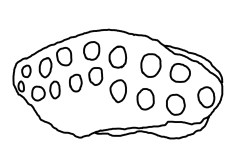
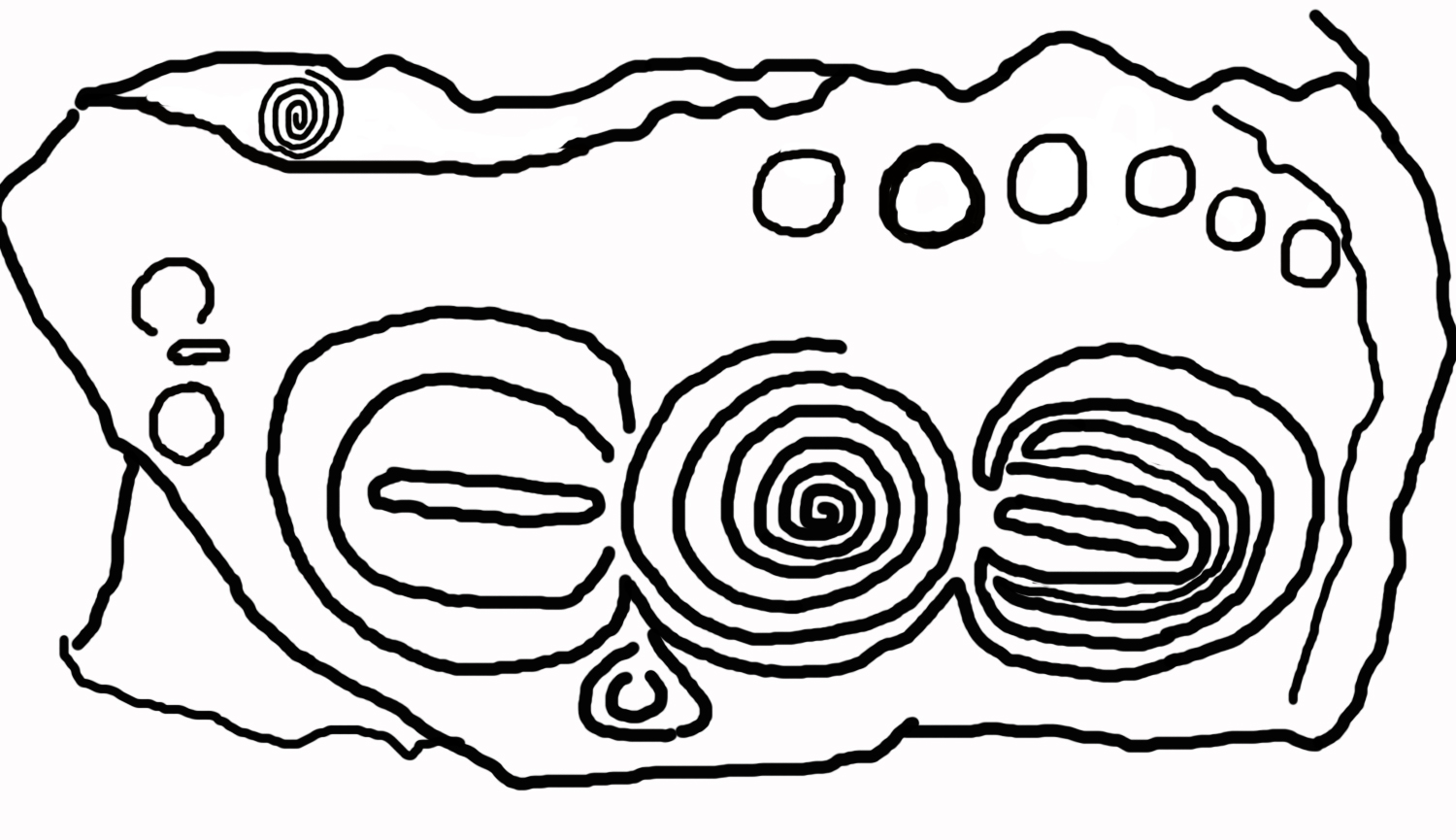
Knowth Kerbstone 42 Sketch

Knowth Kerbstone 42 Sketch

B.L. Freeborn (c) 2013, updated Sept. 2022

Neolithic art is something we do not spend too much time studying. We class it with ancient graffiti, decorative art, or a bit of bragging about the recent hunt. We do not really expect it to tell us anything in the way of communication of important ideas. If it does say anything, we assume they are simple messages from simple minded people and move on. An article by Dr. Philip Stooke in 1994, “Neolithic Lunar Maps at Knowth and Baltinglass, Ireland,” proposed that several works of art found in the Knowth Passage Mound, Ireland are images of the moon’s surface. Most of the art at Knowth and the nearby sites are an odd assortment of lines, swirls and dots. One stone simply depicts 16 circles. Then there is the other extreme. There is another stone so covered with markings it looks like a piece of overused doodle paper.

We are going to look at a few kerbstones found at Knowth, Ireland. These stones are some 5500 years old.

The first stone to be studied is the aforementioned simple 16 circle image drawn on Kerbstone 42 depicted above. It is one of the 127 kerbstones at Knowth.

Another author has proposed that these Neolithic artists counted their year in 16 months and therefore each circle is a month. It is suggested here the 16 circles simply represent the distance Earth travels in a day. ??? Yes. It travels 1.6 million miles on average in any given day.

Now it would be logical for you to scoff and say these artists did not measure in miles, nor were they even aware the Earth moves or even rotates. Since we believed until quite recently in our own history that the Sun circled the Earth we assume they were as simple minded as we are/were.

As far as measuring in miles, they left us another clue that they did measure in miles and perhaps we should hold up on the scoffing. That 16 is written as two pairs of 8 circles, the upper line and the lower line. 8 and 8 as in 88. We all remember that 88 x 60 = 5280 and that is how many feet are in a mile. There is a group of 6 in a neat array on the right side to remind us of 6 and 60 and the minutes in an hour.

Now would be a good time to declare, “That it is purely co-incidental!”

Before tossing the whole idea out as a sour apple we might note the left group forms 9 circles and the right group 7 circles. There are 2 lines of circles. 7, 9 and 2 ?? 792??   As in 7920 miles in the diameter of Earth?

Yet we might say the left group has 8 circles in a neat square array and the right group has 6 circles in a neat square array as in 8 6. The Sun’s diameter is 864 thousand miles.

But we have forgotten the one hanging out at the beginning and end. We could say we have a series 1 8 6 1 which looks remarkably like the diameter of Earth’s orbit at 186 million miles.

Now we discover a second way to determine 5280 feet. Note that the group of 8 times the group of 6 times one on each end for 11 equals 8 x 6 x 11 = 528.

There is an expected number still missing. The number 56 should appear in the message since this number consistently appears at ancient sites.

3200 is 56.56². The image has 16 circles. They are depicted in two lines. So we might say 2 x 16 gives us the 32.

Recall that the Great Pyramid was constructed only 750 years after these tombs and it displays celestial measurements encoded into its structure. Knowth is a large earthen mass with two narrow halls that emit light into the structure. The pyramids are similarly designed.

Perhaps you think this is too much knowledge for a stone age man to possess? The name of the place is Knowth which means “to know” and this only adds to the curiosity of it all. So, for a Neolithic doodle this one packs a powerful mathematical message. This artist has written in a language we can understand and yet we still do not trust our eyes.

Very shortly we will look at Kerbstone 52, a much more complex doodle and that will really leave us wondering.

Have a great day!

PREVIOUS POST        NEXT POST

Knowth Kerbstone 52: A Statement of Science

Knowth Kerbstone 52, sketch by BL Freeborn.

Knowth Kerbstone 52,sketch by BL Freeborn.

(c) 2013, updated Sept. 2022

Let us look at another doodle by a stone swinging Irishman – Kerbstone 52 from Knowth, Ireland.

The Knowth mound has a diameter 275 feet and has 127 kerbstones surrounding the base perimeter of approximately 866 feet. This circumference brings to mind the diameter of the Sun at 864,000 miles. Because we are discussing a circular mound the idea of pi comes to mind. 127 x pi equals 399. The diameter of the Moon is 2160 and that of the Sun is 864336 and this gives us the ratio of 1:400 regardless of the units used.

So, now we begin a study of the petroglyph found on Kerbstone 52 as sketched in the figure. Dr. Philip Stooke suggests in his article that this drawing is of the phases of the moon as it exhibits several images we can easily associate with its changing appearance. However, even he admitted that these symbols really have little in common with the actual observed appearance of the Moon throughout a month.

He noted that there are 29 phases depicted above and below the center up-down line. There are four circles marked T, three circles marked B, one up-side down crescent marked D, two left opening crescents or C’s marked L, 17 left opening C’s marked U that lie underneath in a straight line, followed by crescent R which is removed from the group and the cycle ends with the crescent marked M. A sum of these reveals there are indeed 29 symbols encircling the up-down line. There are two crescents below the circles in the middle. Not all sketches depict these two.

At this point most people conclude the artist was not very gifted or a lousy observer and they move on. However, we shall be a little more determined than most so that we might prove the translation of the previous stone was not wildly co-incidental.

Here we start by counting all the symbols. Because the one C is removed from the rest there is a tendency to get only 28. We see 28 x 2 = 56. This number 56 appears at Stonehenge. There are 56 Aubrey holes surrounding Stonehenge which are unexplained. It was the number found in the previous kerbstone study.

If the crescent marked R is placed with the 28 we obtain 1 plus 28 or 128 which is one more than the number of kerbstones. 128 x pi = 402 which reflects the ratio between the diameter of the Sun and Moon and the ratio of their distances from Earth, both of which is 400 to 1.

Also note the layout. At the center top is a circle below which are two C’s. On each side are two sets of 3 circles. Kerbstone 93 depicts something similar. The darker three suggests 3 craters. The center circle with C’s below suggest ‘issue forth’. Issue forth what? Below is a wave. The right 3 circles appear like latitude lines. So one might say at 33 is 3 craters from where the waves issued forth. Reinforcing this there is a wave like twirl on the left. To its left is crescent marked M. In another post the idea this means great is discussed. It reinforces the idea of not just a wave but a great wave. At the end of the wave is 3 more crescents (marked L) suggesting… ‘a great wave from the three craters.’

The up-down wave line has 16 cycles or 16 up and 16 down for 32. The square root of 32 is 5.65. Recall 90 degrees – 56.5 equals 33.5 which essentially explains the 33.

The crescent at R and the seventeen in a row can be taken as 117 or 171. The first is twice 58.5 recalling the distance earth travels in a year at 584 million miles. The second is twice 85.5 which recalls the diameter of the sun at 860,000 miles.

A simpler explanation is to add the 17 C’s to 16 waves and obtain a repeat of 33. Or we might say ‘from one came many craters.’

We look again at the image and see the top circles may also represent the Sun. We count 4 T circles plus 3 B circles and the 2 crescents below the circles. 4 3 2? The radius of the Sun is 432,000 miles or multiply by 2 and obtain 864, the diameter of the Sun at 864,000 miles.

At the center bottom is a prominent spiral symbol. This can be translated to mean turning, cycles, repetition, or the ecliptic. It appears prominently in Kerbstone 5 and there was interpreted as turn.

Next to this turn glyph is an unexplained series of connected symbols very similar to one found at Loughcrew. (See post.) Here we might add to that discussion by noting that here it seems to depict ‘fell,’ a zigzag and a crater. The zigzag has 3 points at the top and 2 below for 32. It has been noted 32 is the square of 5.65. So it could mean it ‘fell to/at 56.5 at the crater.’ This appears accurate if one takes the time to look at satellite images and note the latitude there!

The only really pertinent number missing is 792. The 7 is obvious with 7 circles as well as the 2 C’s below it but the 9 is allusive. If one counts the C’s on the left and right of the turn. There are 8 left and 9 right for 89. The square root of 7920 is 89. This is the diameter of Earth.

So, this is one very complicated mathematical message after all! But is it remotely possible these stone wielding cave men knew anything of science?

Recall that the Pyramids are considered to be some 4800 years old and that many people have found values which represent Earth and Solar System measurements designed into its structure. Knowth is some 500 to 700 years older than the pyramids which is a reasonable period of time to develop the engineering skills to step from building round monuments to monstrous pyramidal monuments.

PREVIOUS POST       NEXT POST

Translating Knowth Kerbstone 5

Kerbstone 5 from Knowth, Ireland

Kerbstone 5 from Knowth, Ireland

-B. L. Freeborn © 2013, updated Nov. 2018

Kerbstone K5 is simple, straightforward and powerful in its message. Reading the large image left to right we have a symbol for longitude or a line which hugs the planet in a U shape and runs vertically. (In this case, it is shown horizontally.) In the middle of this U is a bar or a pole and surely, longitude wraps around the planet beginning and ending at the pole.

Next, just to the lower right of this we have a small round circle within a circle. A comet on collision course with the planet? The inner circle is the eye and the surrounding circle is the coma. The artist attempts to depict by its placement an impact near the pole. The planet is turned by the impact as noted by the swirl image and we see in the final image that it is shaken and the lines of longitude are changed.

In the upper right corner are 6 circles. The fifth from the right is different from the others. So we have 5 and 6 for the 56 we expect to see.

On the left face of the stone is an image for longitude, pole and latitude; or for cup, pole and crater. The top face has the turn symbol again.

This stone is a picture of an event rather than a mathematical message. It reinforces the message we saw in the last post about Kerbstone 93.

This is all a part of  the mystery and the ultimate purpose for Knowth. It assures us that we will come to knowth the truth.

The last stone to be studied is the enigmatic kerbstone 52 from Newgrange and its exquisite art.

PREVIOUS POST                NEXT POST

A Simply Beautiful Mystery

Newgrange, Ireland. Kerbstone 52.

Newgrange, Ireland. Kerbstone 52.

-B. L. Freeborn © 2013 (updated Nov 2018)

Newgrange kerbstone 52 is a beautiful mathematical message as well as a depiction of an event. The left side of the stone depicts the number 56 twice as shown. This simple number, 56, has a way of appearing at all these ancient sites.  The right side has three bold ovals each containing three dots which creates the number 33.3. This number is also part of this mystery.

These three bold ovals contain two triangles (or arrows) each and three dots. Three ovals, 9 dots, and 6 arrows creates the number 396. The radius of the Earth is 3960 miles. Its diameter is then 7920 miles.

Notice the place marked in the sketch as magnetic north. The pattern depicted between the two ovals is what appears when a piece of paper is sprinkled with iron filings and a magnet is placed beneath it. So they indicate magnetic north by this realistic depiction. We may understand the two adjoining ovals to be the two hemispheres of the Earth shown joined at the pole. Note the bold dot directly below this point. We may speculate that an object moves towards earth. It draws closer and a coma or tail forms. They depict an impact at the pole as was suggested by art on other kerbstones.

This drawing however goes further. They are suggesting by the ornate pattern multiple impacts. Now we may interpret the 3 bold ovals as impact sites with multiple impacts within each site. The petal style then portrays impact ejecta that fanned out from the initial craters wrecking maximum havoc.

Or perhaps we should interpret it such that previously there was one Arctic Circle as shown in the bottom right which became two! – two places to measure from as in magnetic north and true north!

Impossible! Not a believer?

Delve into more posts and then decide.

PREVIOUS POST              NEXT POST

The Odd Little Purse in Olmec and Assyrian Art

Assyrian Relief with Winged Genius, Walters Art Museum, Wikimedia

Assyrian Relief with Winged Genius, Walters Art Museum, Wikimedia

File:La Venta Stele 19 (Delange).jpg

La Venta, Mexico, Olmec Monument 19, Photo by Audrey and George Delange, Wikimedia

B.L. Freeborn, February 2013

Once in a while it is nice to spot a co-incidence that leads us to new understanding. Illustrated here are two stone reliefs from two different hemispheres of the world. The Assyrian relief, (Ancient Iraq), on the left, is dated to 880 – 859 BC. The Olmec relief, (Ancient Mesoamerica), on the right, is dated to 1200 to 400 BC.

Notice these similarities between these detailed works of art. The giant carries in his hand a square purse. His hand is depicted with four fingers up. The Olmec man is holding a nearly identical purse with four fingers up as well.

The giant holds in his right hand a pine cone/egg shaped object. The Olmec man sits in an accentuated curved pose with feet outstretched to the rear in a manner which imitates the egg shape.

The giant is winged and strong. The feathered serpent wrapped around the man is equally fierce.

It is as if these two artists are using the exact same symbols to describe the same story. It might also be indisputable proof that these two cultures were in communication and contemporary to each other.

When used in Assyrian art it is said the purse holds magic dust. When depicted in Olmec art they postulate it contains herbs for getting high. Could it actually be a weight such as in a standard of measure? If it is, why would this become an important part of a story on two continents?

An actual purse has been found! See it here.

PREVIOUS POST        NEXT POST

More on the Purse Image Here

More on Purse Images at Göbeckli Tepe.

New England Stone Chamber – Many Questions

IMG_0061

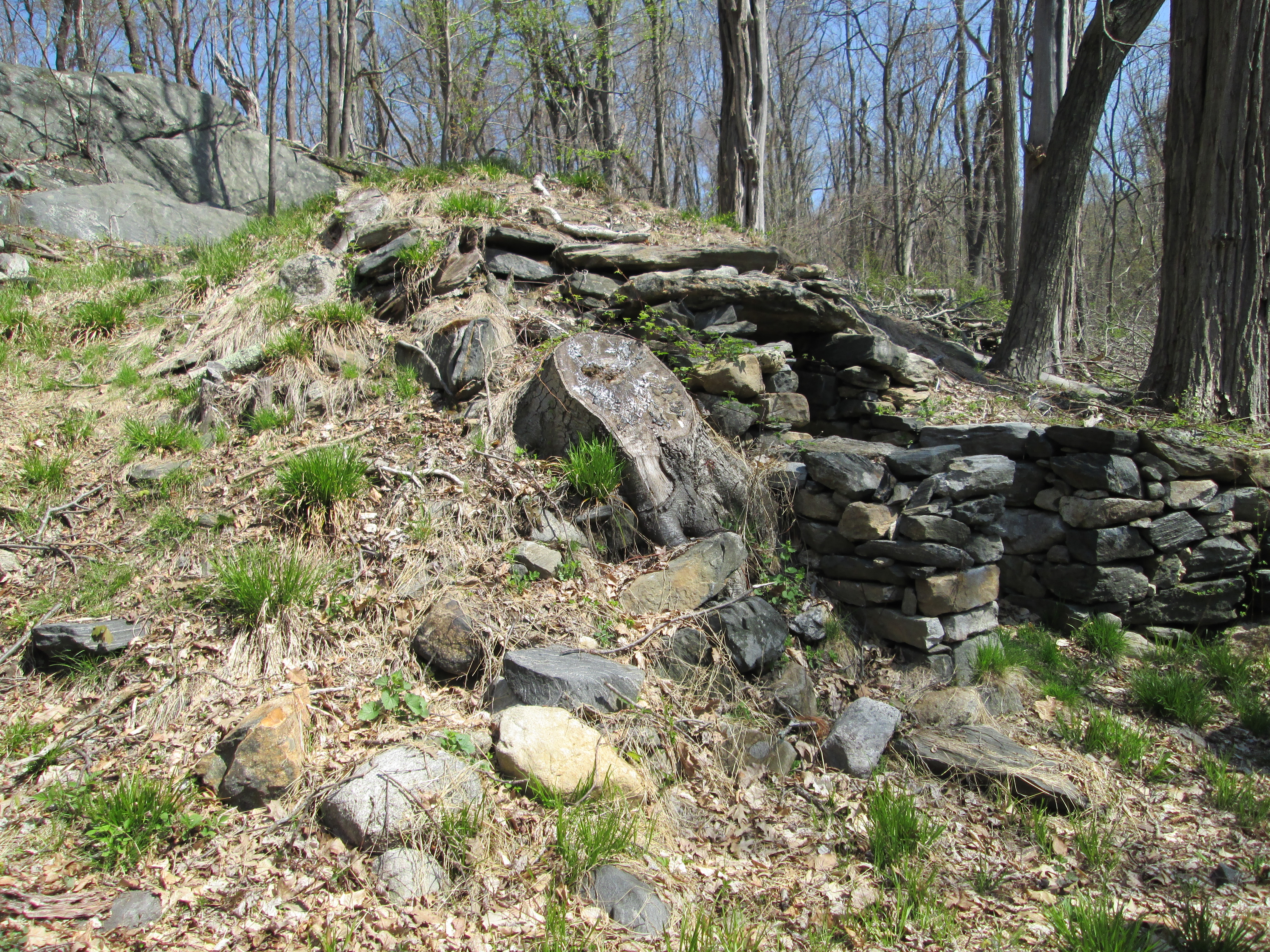
Exterior of Chamber (Entrance area rebuilt by owner.)

This is on private property so I cannot say where it is other than in the southern part of New York. The owner does not appreciate trespassers.

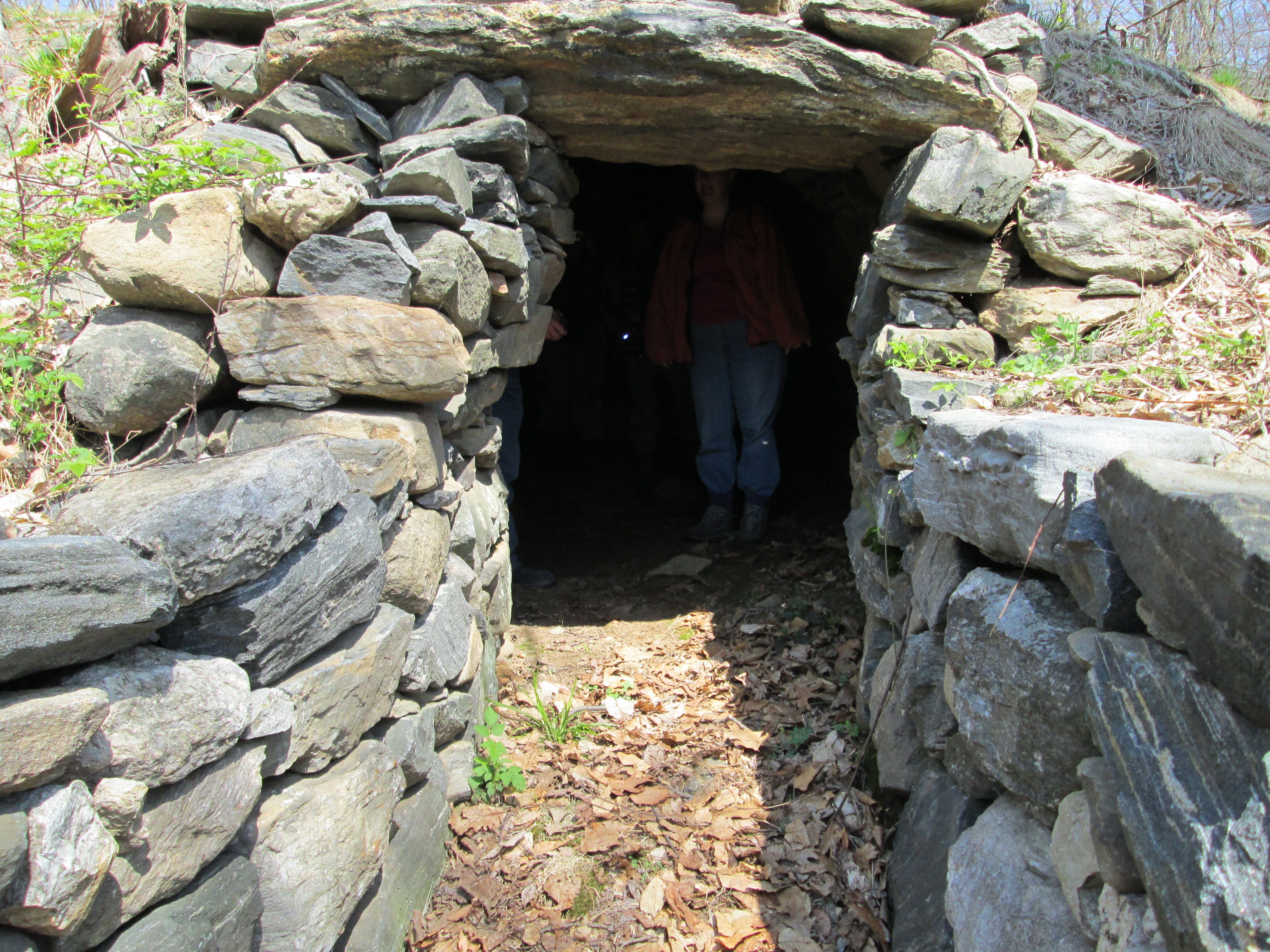
This sits in his backyard. The front part of the structure has been repaired by the owner but the interior is original. The exterior is deceiving. It is quite large on the inside. There is no evidence it has ever had a door.

Entrance - Interior tall enough for a person to stand.

Entrance – Interior tall enough for a person to stand.

IMG_0077

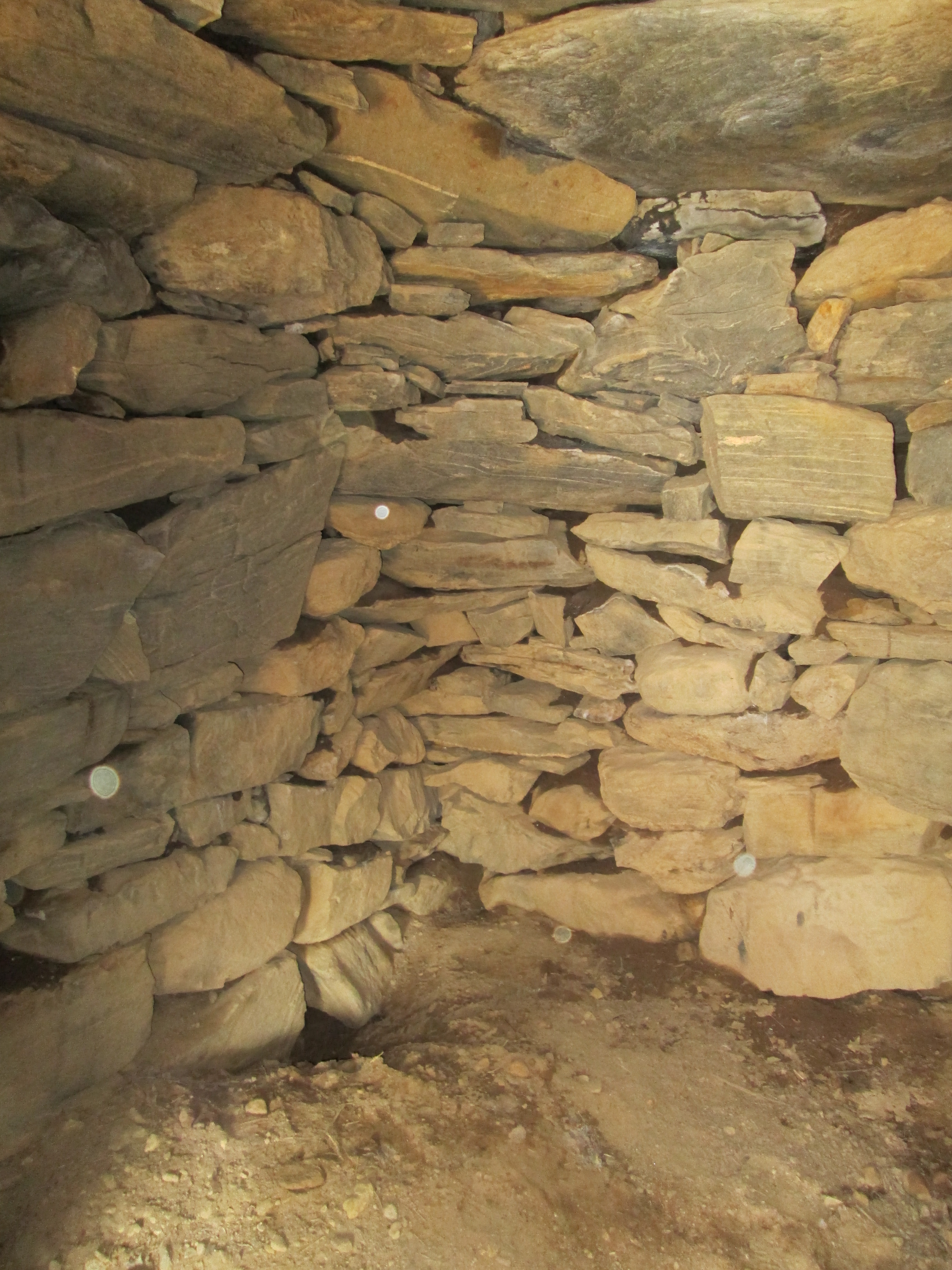
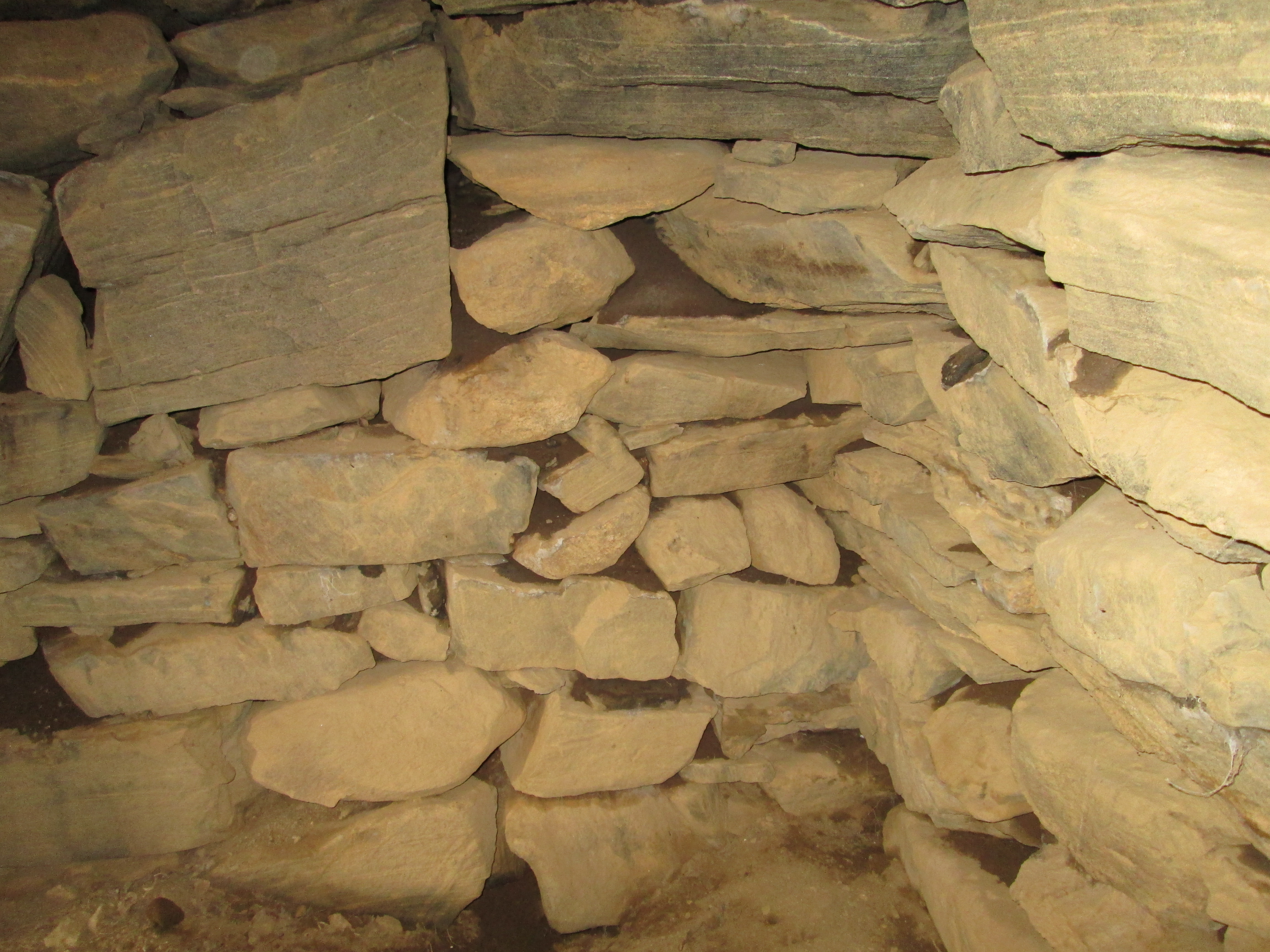
Interior rear corners corbel inward at the top.

Right rear corner also corbels inward.

Right rear corner also corbels inward.

Upper left rear corner corbelled inward.

Upper left rear corner corbelled inward.

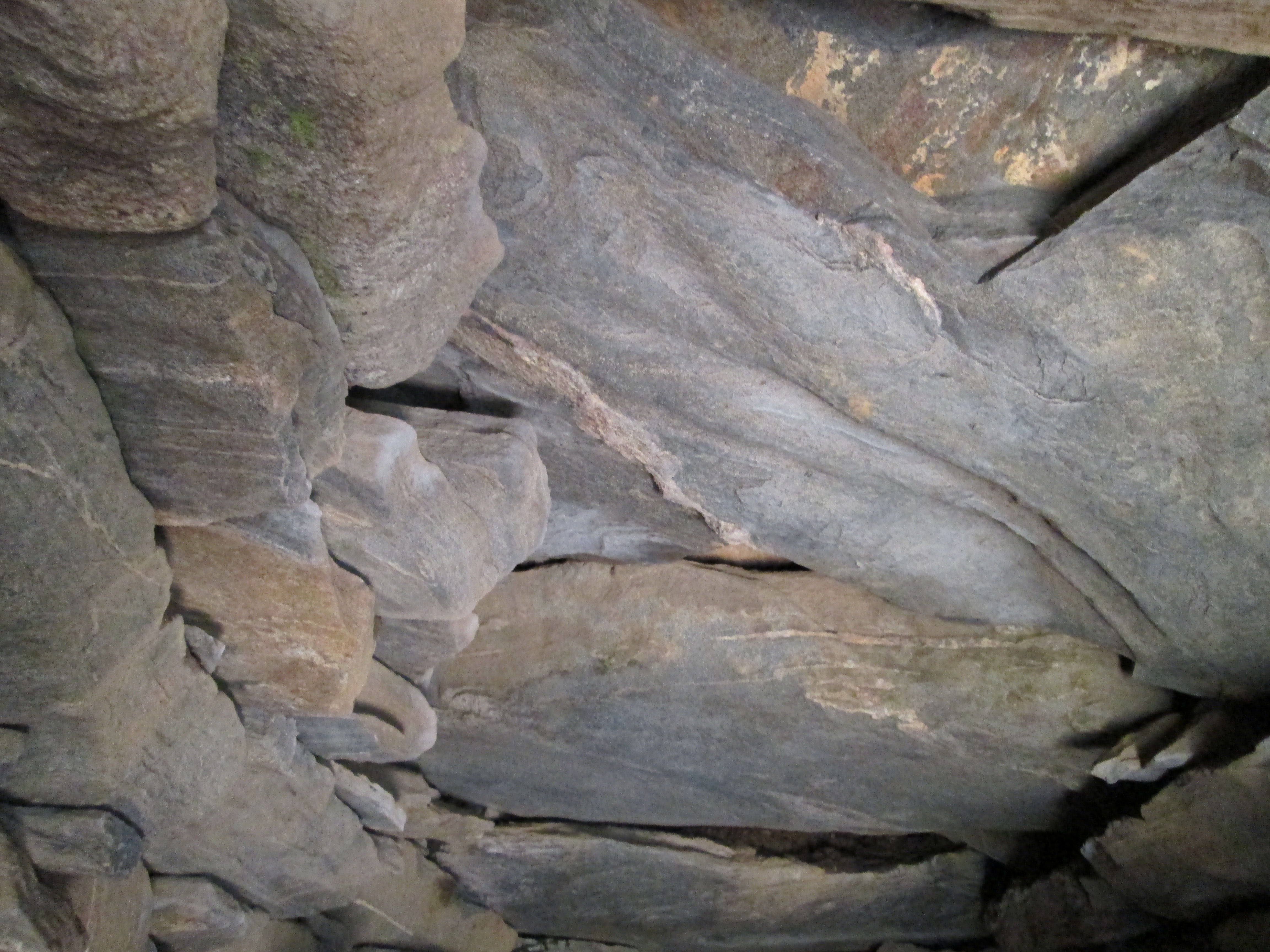
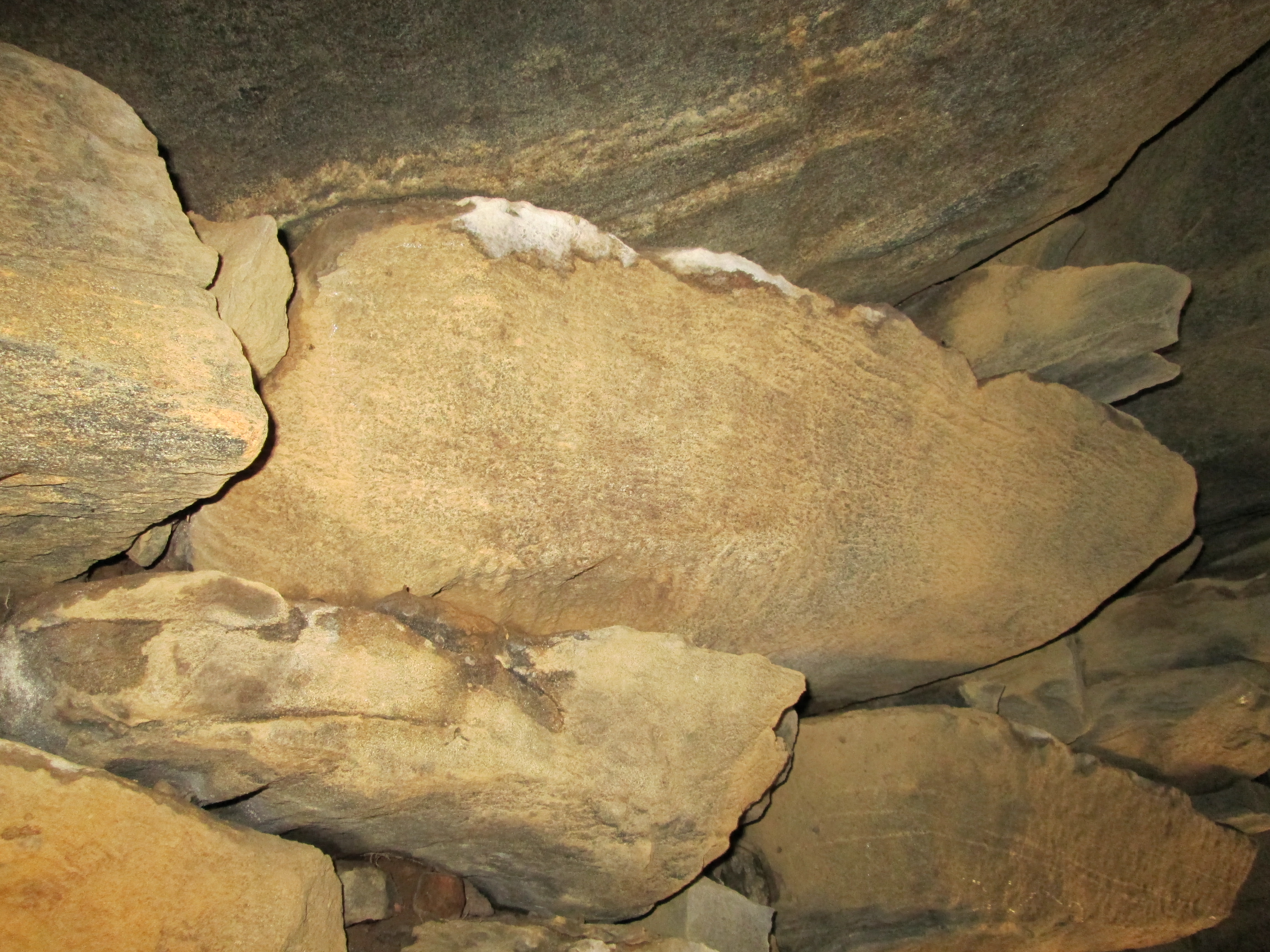
Roof stones.

Roof stones.

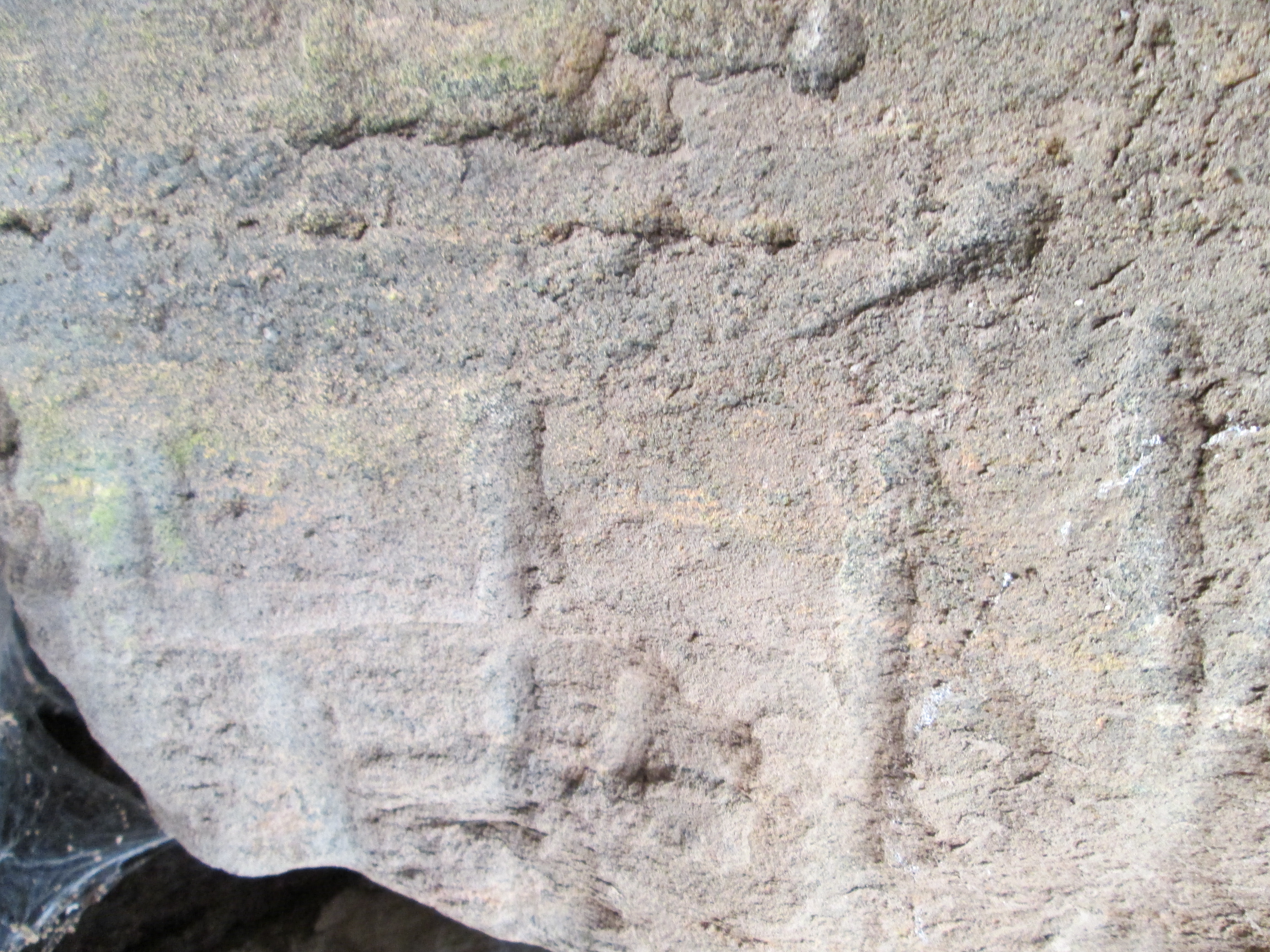
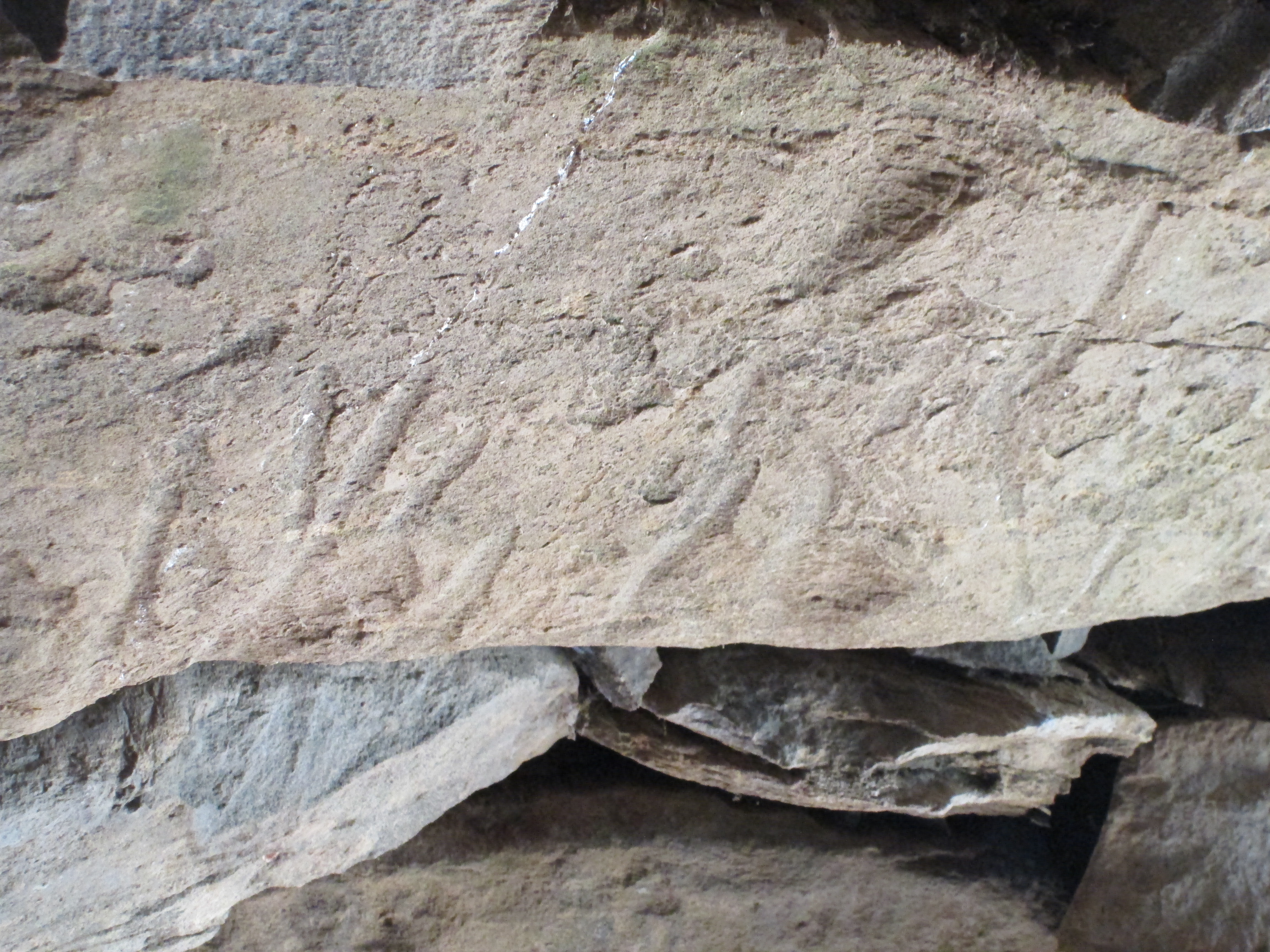
Tool marks? Graffiti? Or a message?

Tool marks? Graffiti? Or a message?

Wider view of marks.

Wider view of marks.

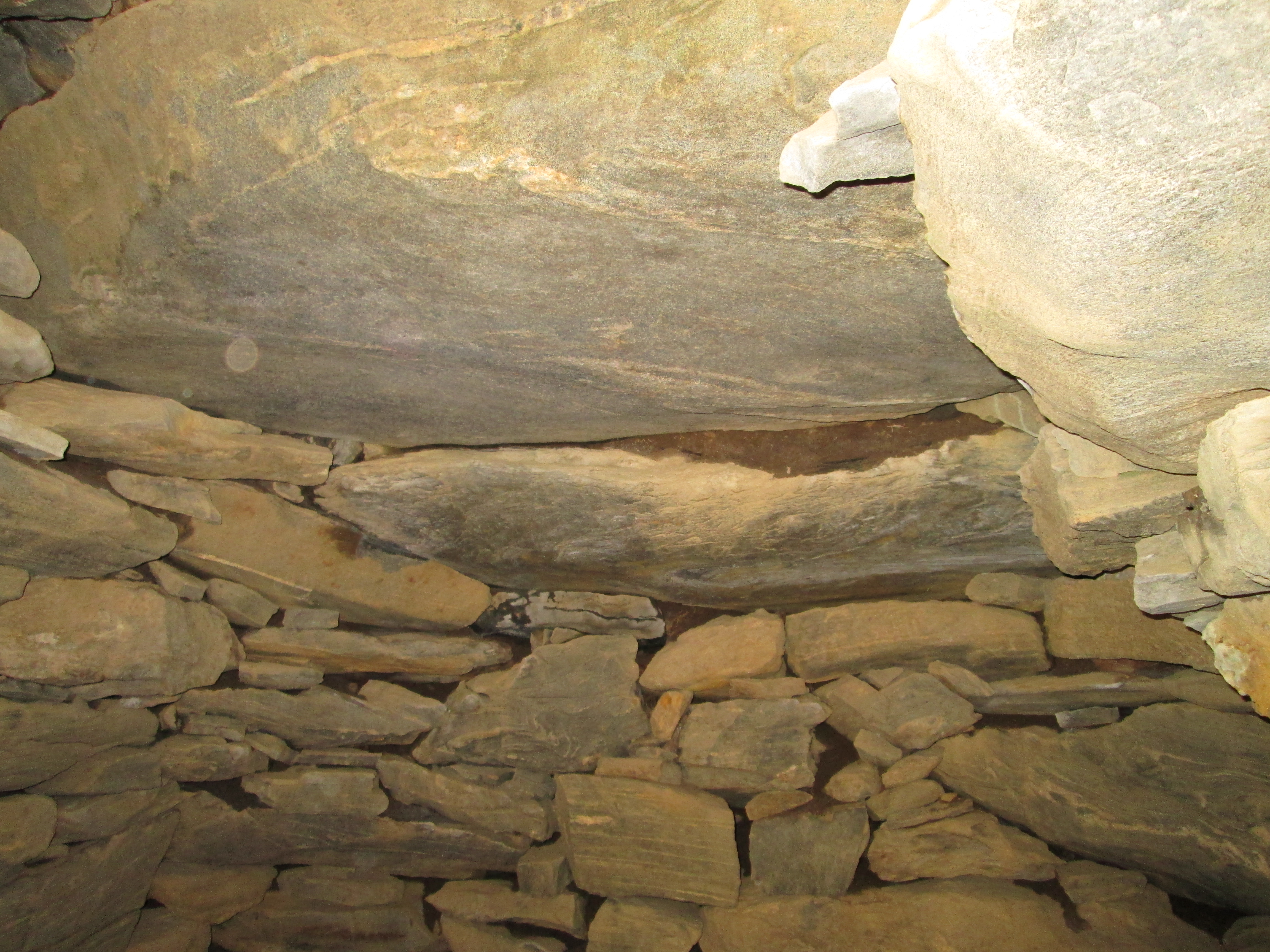
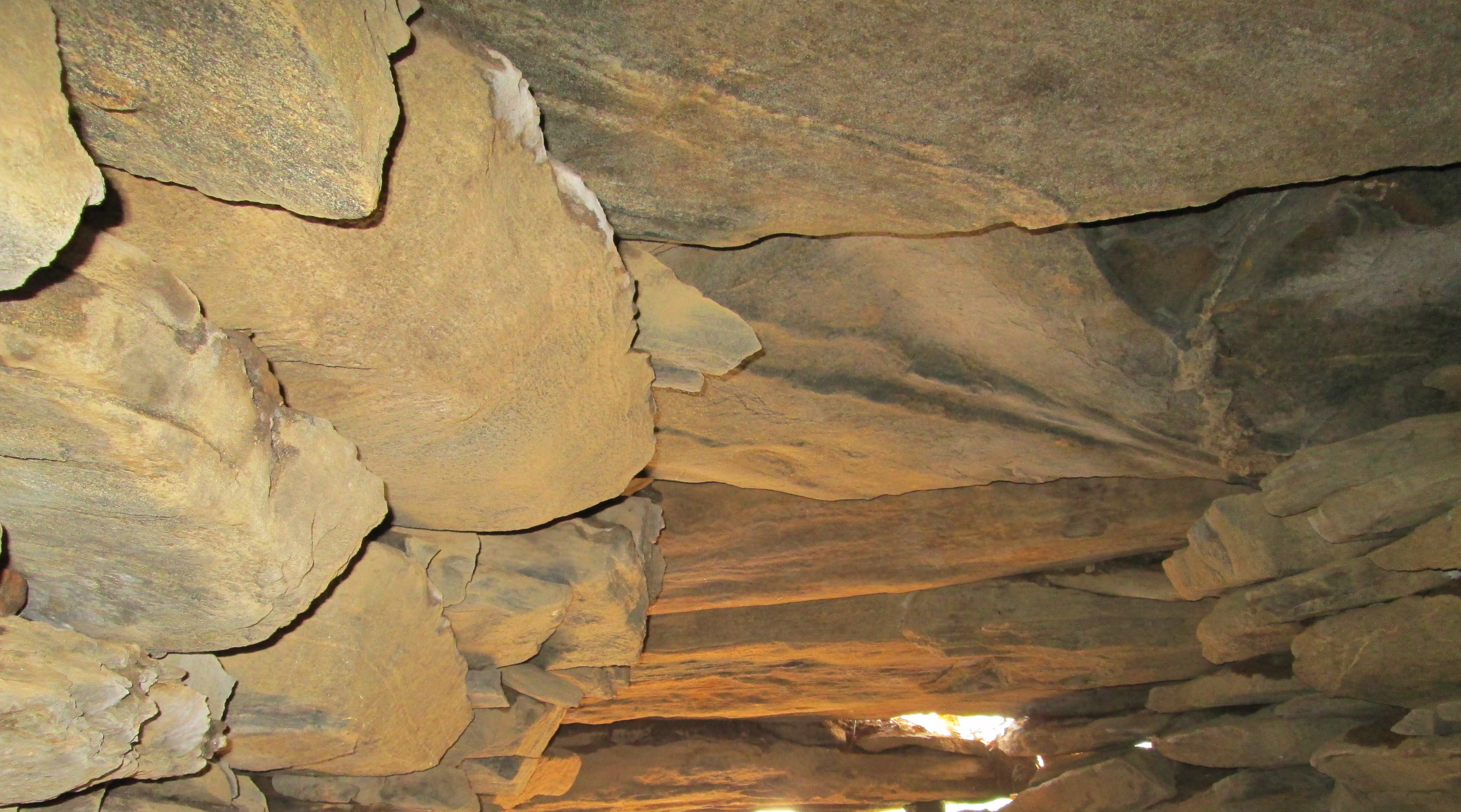
Ceiling and upper walls made of massive stones.

Ceiling and upper walls made of massive stones.

Looking towards the exit. Sunlight enters through the stones.

Looking towards the exit. Sunlight enters through the stones.

Is it a time portal? Root cellar? Ice house? Ancient Meditation chamber? Well…. This one sits remarkably close to a very old house in an area where there seems to be a chamber at every old house. Was a stone chamber found by the colonists and they thought it was such a great idea they all had one installed? Time may someday tell.

Someone suggested they might have been for brewing and storing beer. This would explain why they don’t appear on home inventories from the colonial period forward. !!

PREVIOUS POST             NEXT POST