New Hampshire Mystery Stone Photos

More photos to help you see the new Hampshire Mystery Stone. Click on the image to get a better view!

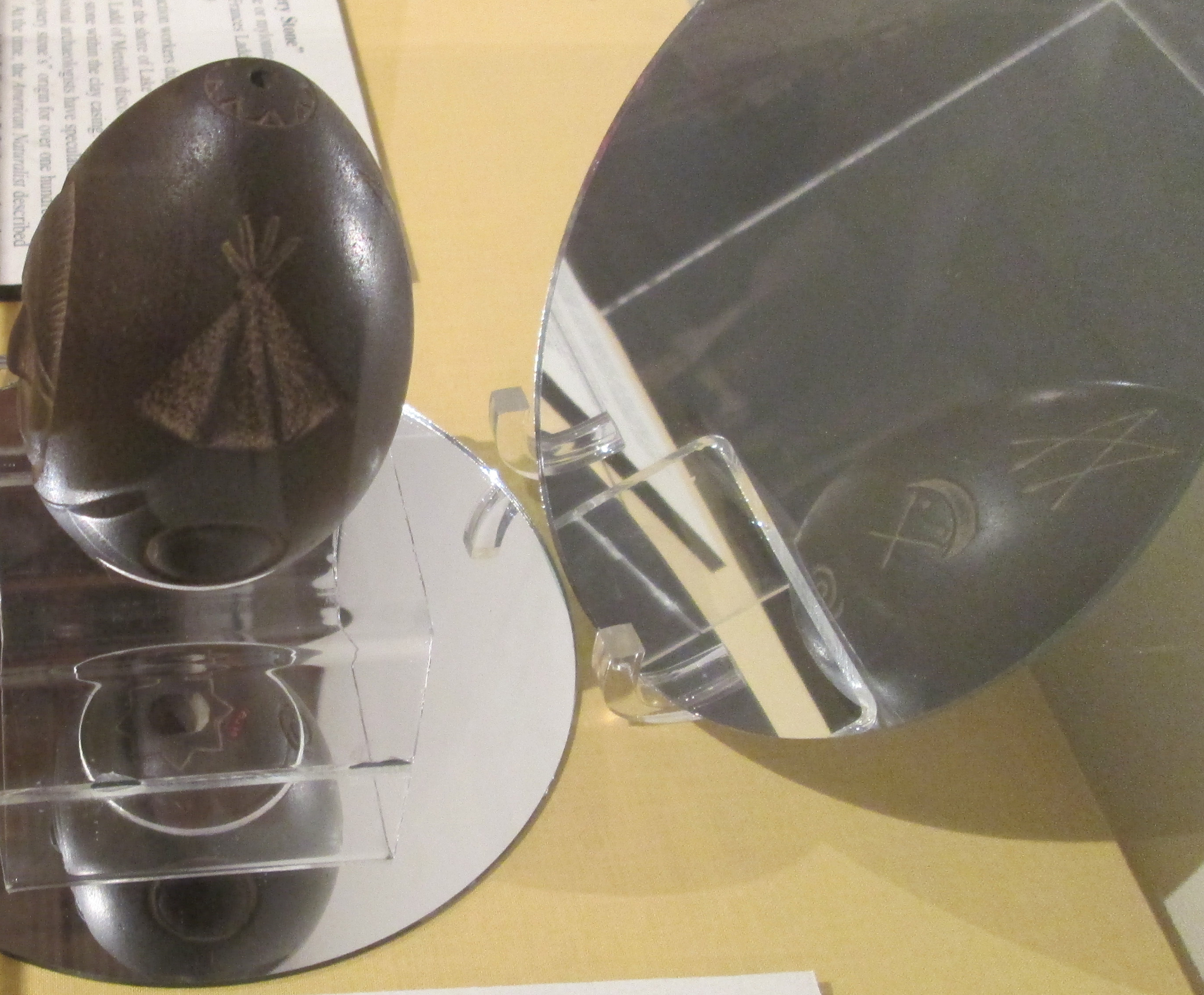
New Hampshire Mystery Stone: Using two mirrors the museum display allows more symbols to be viewed.

New Hampshire Mystery Stone: Using two mirrors the museum display allows more symbols to be viewed.

For those seeking more information on North American language and writing systems, “The Lenâpé and Their Legends: With the Complete Text and Symbols of the Walam Olum,” by Daniel Garrison Brinton, 1885 should be of interest. This book has been re-published beautifully by Bibliolife. (A sample page is at the bottom.)

The  Lenâpé, also known as the Delaware Indians, wrote in hieroglyphics as did many other tribes in North America. Unbeknownst to many, the Cherokee symbols used today did not originate after the Europeans arrival but was in use prior to their influence. Barry Fell documents in his book “America B.C.”, 1989 edition, the comparison of Micmac symbols to Egyptian Hieroglyphs, and symbols found in Iowa and Long Island to both Libyan and Egyptian. This book is packed with epigraphic documentation throughout America that demonstrates extensive interaction between Celts, Libyans, Egyptians, Chinese and other distant places with the Americas. Very little of the North American early written traditions have survived making this book an important record. The majority of their documents were inscribed on perishable mediums as is still done the world over today (including these very words!) which makes this beautiful little stone seem like an oddity. It is commonly believed that the written word was never used by native people. Yet, Brinton reports that letter writing was as common among these people as it is presently.

Evidence of interaction between these ancient cultures can be seen here. Retained in the words of the title “Walam Olum” are two important words. Brinton (pg. 104) explains the root word ‘wul’ means pleasurable sensation and so ‘wulit’ means well, good, handsome, ‘wuliken’ means it grows well and ‘walam’ is red ochre which they found very beautiful. The resemblance to the word ‘well’ is unmistakable.

‘Olum’ means score written on paper, bark or hide. In Modern English, ‘vellum’ means paper usually of a finer quality. This word comes to us from Old English ‘waelrûn’ meaning a song about death. (R and L are not always distinguished by native speakers in the same way Japanese cannot pronounce V’s.) The similarity is clearer in words such as ‘wail’, ‘wallow’ and ‘wailfyll’ or awful.

bottom side circle

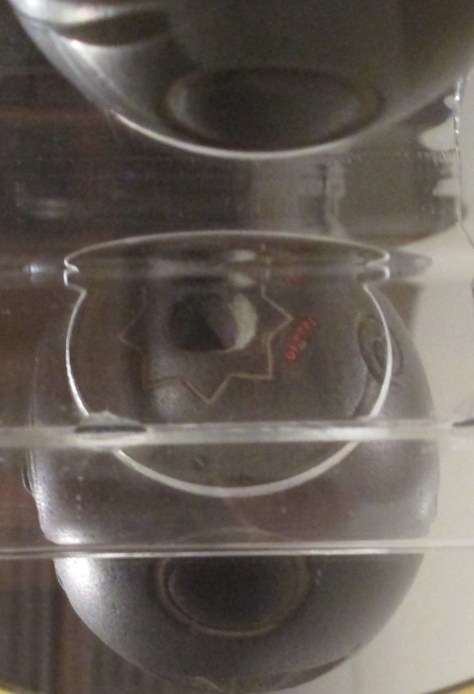
The bottom side of this small stone has a hole drilled into it which is both symbolic and functional. It allows the stone to be set on a stick for display and use during ceremonies.

bottom

As reflected in the lower mirror. A closer view of the bottom of the stone.

corn side

The perfect image of an ear of corn is shown. Corn has a long history of appearing in religious images. It can be found in Indonesian art as well as Assyrian art. We must not forget the Roslyn Chapel, Scotland! Its perfect rows demonstrate the idea of latitude.

corn leg circle side

Another shot of the corn side. Notice the side view of the face reveals the stone was rounded before the images were carved.

cornlegcircle

Yet another view of the corn side. The empty perfect circle is directly opposite on the far side from this circle with drowning figures.

face far

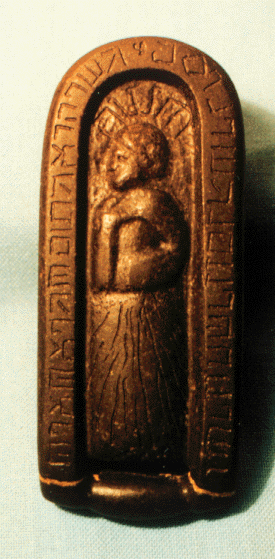
Front side of New Hampshire Mystery Stone: Are these eyes wide open? Are these eyes that are closed in contemplation? Is this a person who is bundled up warmly? Or….has this person drowned and now floats in water?

A page of the “Walam Olum” showing the hieroglyphs, the words of the story as they would be read or sung, and a translation by Brinton. He further understood each sign was traditionally accompanied by hand gestures.

 "The Lenâpé and Their Legends: With the Complete Text and Symbols of the Walam Olum," by Daniel Garrison Brinton, 1885.

“The Lenâpé and Their Legends: With the Complete Text and Symbols of the Walam Olum,” by Daniel Garrison Brinton, 1885.

Back to Previous Post

Ahead to Next Post on Noah’s Age

For further reading about this beautiful stone go…
Back to Full Post on New Hampshire Mystery Stone and see more photos.

MORE ON MYSTERY STONE

The Meaning of the Purse in Assyrian and Olmec Art

Copyright © 2014 by B.L. Freeborn

From time to time in the feedback section I receive on this blog it is evident that someone is searching for the answer to a particular question. A post I have written may come close to answering it and so they are referred here.

Assyrian Relief with Winged Genius, Walters Art Museum, Wikimedia

Assyrian Relief with Winged Genius, Walters Art Museum, Wikimedia

Last week someone was looking for the meaning of the purse in Assyrian art and so ended up at my post on the “Little Purse” which reveals an obvious link between the Assyrian and Olmec cultures. This is otherwise known as diffusionism.

So to answer the question directly, the purse indicates measurement in all forms. It is a square just as we see when we measure the globe in longitude and latitude. Each grid forms a square. We are further enlightened by the star on the wrist of the giant man. The pole star is central to measurement of the heavens. It is the point around which the heavens appear to turn which is emphasized in the Olmec version by the accented roundness of the man’s body.

It further indicates the measurement of weight. It hangs just as weights on a balance scale still do today.

Both men have one arm up and bent, and one arm down as we saw in the art of Ugarit and the statue related to Baal.

La Venta, Mexico, Olmec Monument 19, Photo by Audrey and George Delange, Wikimedia

La Venta, Mexico, Olmec Monument 19, Photo by Audrey and George Delange, Wikimedia

The giant holds a “pine cone” or the eye of a comet. This appears in the Olmec version as the ball with tail on the man’s shoulders behind his head. His body with the accented roundness of his shoulders and his clothes depict the round Earth complete with lines of latitude formed by the lines of his clothes. Indeed, the idea of a comet is again portrayed by this same round man within the serpent. He becomes the eye of a comet and the serpent is the coma.

The chest area forms a v which indicates a crater, or a broken Earth. This is doubly depicted. The curved headgear forms a crater as well. The crater was depicted in the Assyrian art as a cup held upon the hand of another giant. Both stories are depicting the details of a comet impact at the north pole, the place from which all  measurement is determined.

The arm bands of the Giant are broken indicating broken lines of latitude. His clothes depict longitude and latitude in the fringe that fans out or hangs straight. The double comet idea is further betrayed in this image by the two sword handles at his midriff.

This would be the story of Baal as we saw in the story of Newark Earthworks in Ohio. So we have a South American, North American and Middle East Version of the tale!

An actual ancient purse has been found! See it here.

The links will take the reader back to the pertinent posts.

Next up are new pictures of the Mystery Stone of New Hampshire This stone relates the Deluge Story which resulted from a double comet impact.

If you have a question not directly answered, post a comment.

Back to previous post – A Visual Tour of the Serpent Mound

Ahead to post – on Göbeckli Tepe post and the purses shown there.

Back to post – A Visual Tour of the Newark Earthworks

Ahead to more about the New Hampshire Mystery Stone

Great Serpent Mound of Ohio

Without commentary….. a video on the Great Serpent Mound Earthworks in Southern Ohio.

. . .

Back to PREVIOUS POST – A Visual Tour of Newark Earthworks

Back to POST on Newark Earthworks and Decalogue Stone debate in PDF.

Back to FIRST POST on Newark Earthworks and debate surrounding Decalogue Stone

A Visual Tour of Newark Earthworks

Without commentary….. a video on the Newark Earthworks including the Octagon, Observatory Circle, and Great Circle in Central Ohio.

.
.
.

Back to PREVIOUS POST on Newark Earthworks and Decalogue Stone debate in PDF.

Back to FIRST POST on Newark Earthworks and debate surrounding Decalogue Stone.

Forward to NEXT POST.  A video on Great Serpent Mound of Ohio

The Newark Decalogue Stone and Earthworks – Full Article PDF

Thank you for reading.

Here is the Newark Decalogue Stone and Earthworks: An Unraveling Mystery in PDF

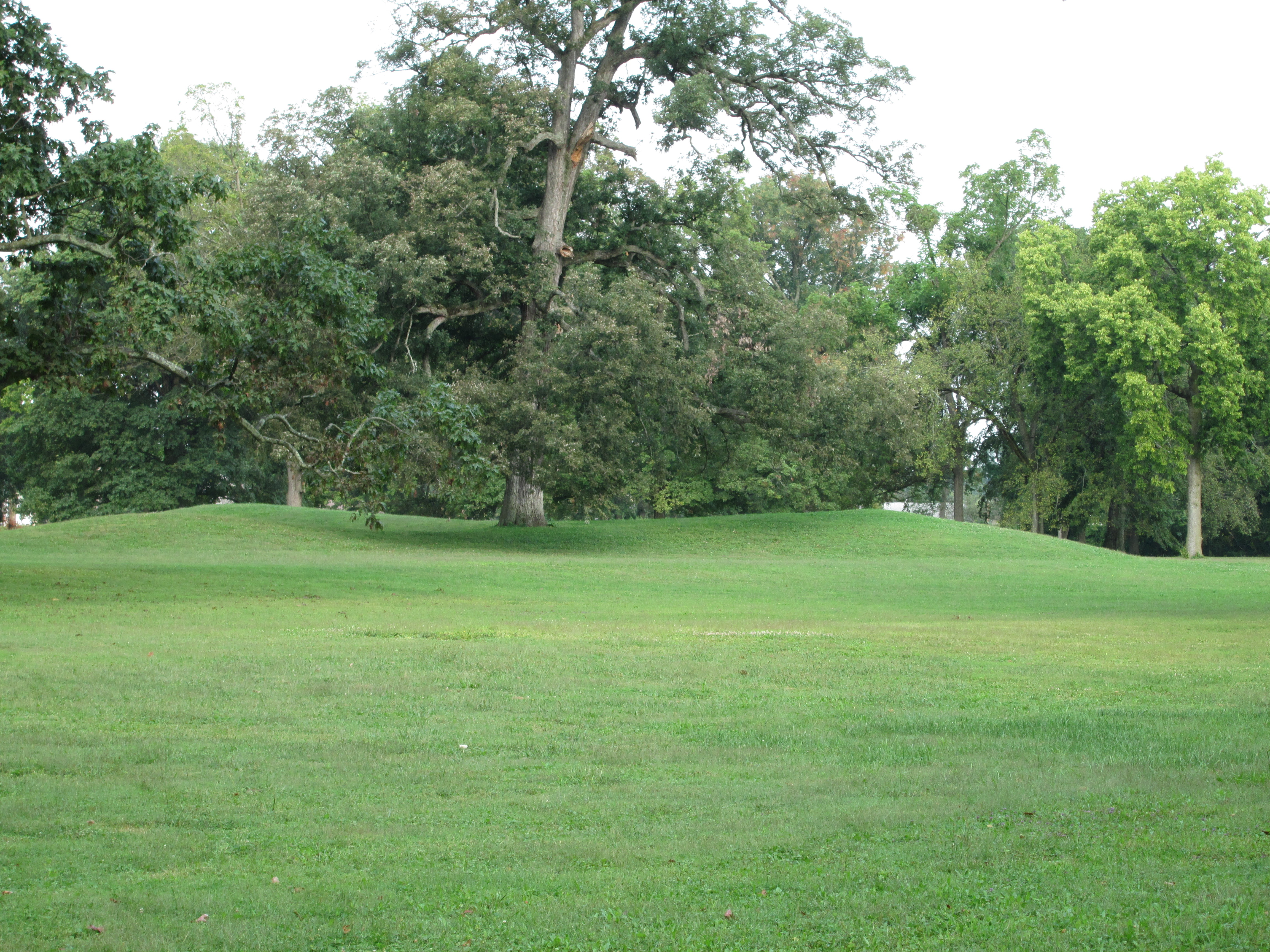
Group of Four Mounds called the Bird within the Great Circle at Newark, OH.

Group of Four Mounds called the Bird within the Great Circle at Newark, OH.

.

NEXT post Visual Tour of Newark Earthworks

Back to PREVIOUS POST

Back to TABLE OF CONTENTS for this article.

Back to Posts on Neolithic Art of Knowth, Ireland

Epilogue

By B.L. Freeborn © 2013

The best conclusion to a mystery is proof that the answer is unraveling but the end is not yet reached. Here we have silver medallions which were found in a mound in Scotland called Norrie’s Law located at Latitude: N 56.254847° and Longitude: W 2.954534°.  (56.254847 + .2954534 = 56.550) There was a large amount of silver, some Roman coins and some other elegant items such as very thick silver chains and crescent shaped articles similar to those found in Ohio mounds. This would indicate some of the “garbage” at both distant places is very similar.

Translation of Norrie's Law (Part I) by B.L. Freeborn. Photo by Johnbod, CC-BY-SA-3.0

Translation of Norrie’s Law (Part I) by B.L. Freeborn. Photo by Johnbod, CC-BY-SA-3.0

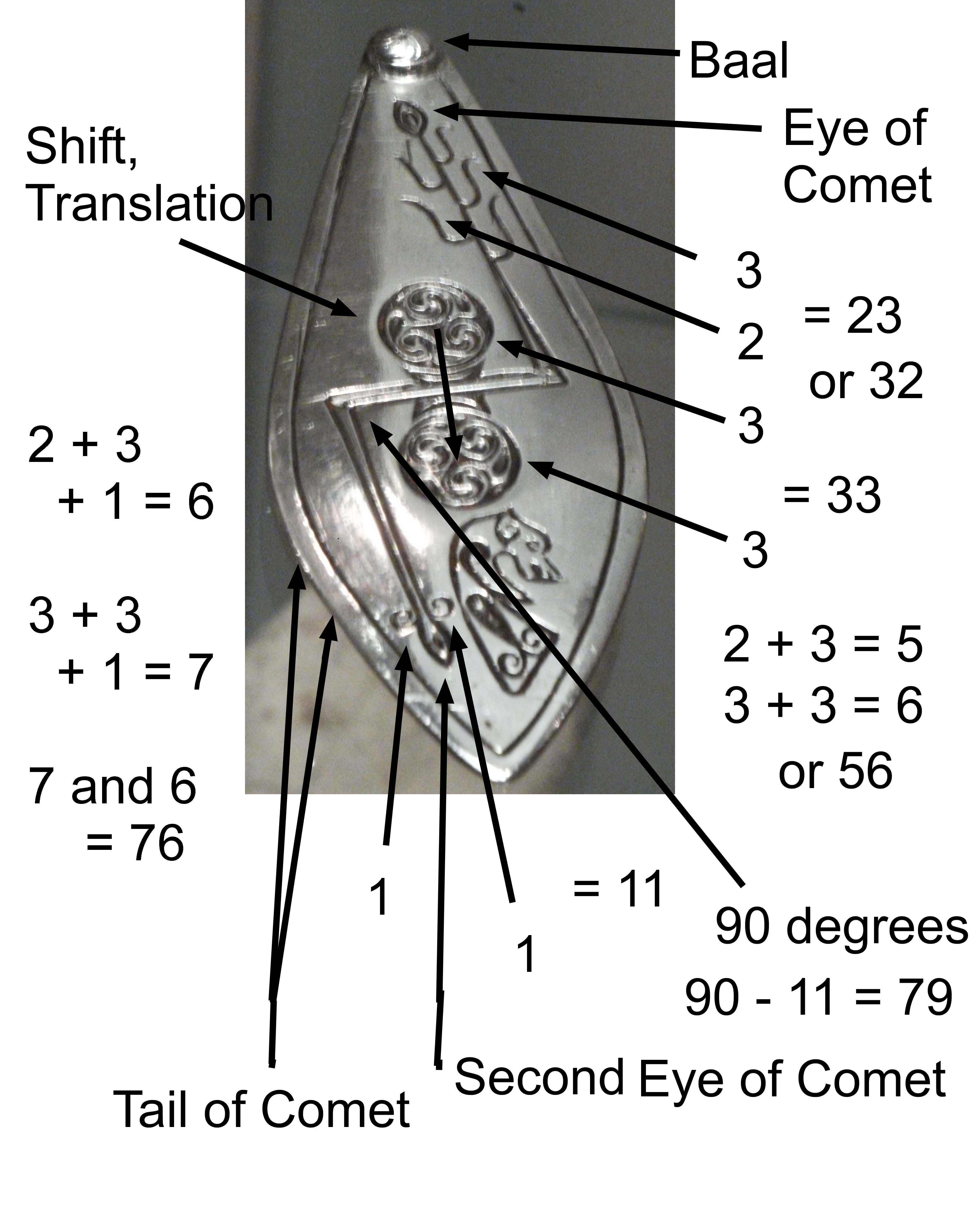
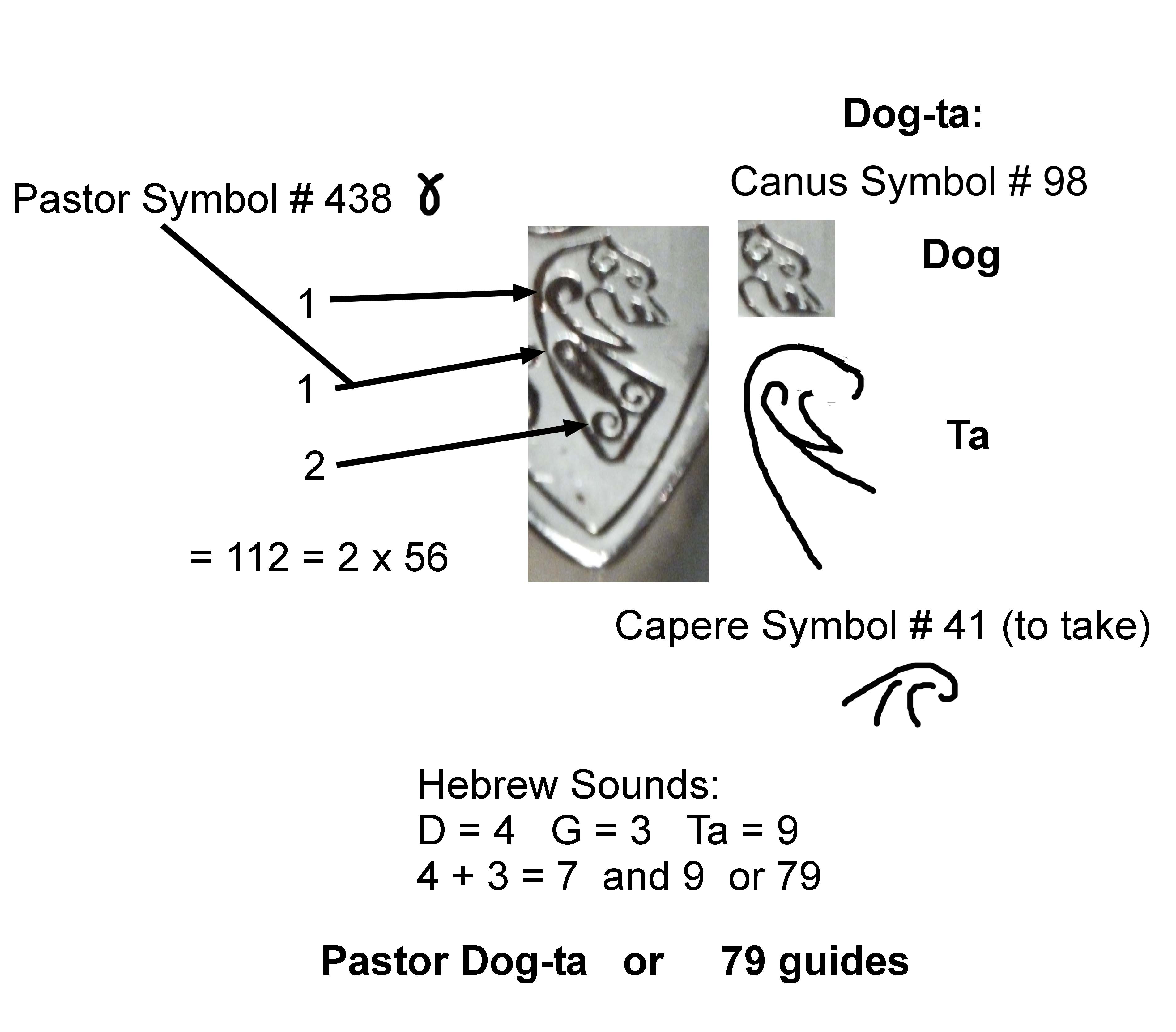
By studying the medallions we meet Baal again. We find the god Dagda spelled out in Luwian Hieroglyphs as Dog-ta or number 79 and the symbol for the Shepard. Thus, we may not as of yet understand how but we can presume 79 guided them. We also find numbers we saw at Newark earthworks and even more compelling we find numbers from the Weld-Blundell Prism. This prism is a cuneiform text which contains the Ancient King List from the Deluge forward. All this suggests the mounds were part of a much larger world culture.

Translation of Norrie's Law Medallion (Part II) by B.L. Freeborn (c) 2013.

Translation of Norrie’s Law Medallion (Part II) by B.L. Freeborn (c) 2013.

And so too in this previously untranslated Pictish Stele from Aberlemno, Scotland we find understanding and confirmation far beyond what we had hoped at the beginning. Prominently placed at the top is the Luwian Hieroglyph for Thunder. Its form reminds us of the Great Serpent Mound, Ohio with its 4 loops in one direction and 3 in the other which creates 43 and 2 x 43 is 86. But on this stone the eye is within one of the loops. Add this one eye to one loop in one direction and two in the other and we form the number 112 or 2 x 56.

Indeed, the stone even shows a Proto-Canaanite/Hebrew/Phoenician letter H at the bottom which has value 8. And to what does 8 refer? English creates a pun of the word eight. It is ate. Are they saying it ate the planet just as the Beltane-Newark story tells? But there is a dot punched into the upper line. Is it to be read 8 – 1 or 80 -1 = 79? Or does it mean the grid of measurement (longitude and latitude) was damaged? But on other stones 6 lines extend down from the H. This gives 8 + 6 = 86 for the Sun. There may be lines here as well but the weather takes from us what we would know. This H is called the “comb” in Pictish art descriptions.

Translation of Scottish Pictish Aberlemno Stone by B.L. Freeborn. Photo by D. Lloyd Original, Catfish Jim and the Soapdish. CC-BY-SA-3.0

Translation of Scottish Pictish Aberlemno Stone by B.L. Freeborn.
Photo by D. Lloyd Original, Catfish Jim and the Soapdish. CC-BY-SA-3.0

There is a circle with a handle that is called “the mirror” above the H. We have seen this image before and understand its meaning. The stele then speaks of a great comet that thundered into the planet leaving a wound in the Earth which is portrayed identically on the stele as in the Great Circle of Newark. Indeed, this same symbolism can be found in other places. It also appears in the Book of Kells from Ireland (See image in this post). We see the mirror and the H again clearly indicating a break in the box or grid.

The numbers 2311 and 33 are just as prominent here as on the medallion. The two and three reminds us of the layout at Newark with its reference to 23 and in reverse 32 for the Arctic Circle. Here we might sum the 2 and 3 to 5 while the 3 and 3 sum to 6 giving us familiar 56. The sum 6 reminds us further of the 6 OCD of translation of the circle-octagon into the circle-square of Newark. The concept of the translation is dominant in this image between the two identical circles showing a realistically layered planet with a core.  There is more to understand such as the riddle as to how 79 guides them.

A whole new way of reading history lays before us.

Back to PREVIOUS POST

Back to TABLE OF CONTENTS

Next post is pdf of entire article!

______________________

References and more information:

More information on Norrie’s Law Medallions:   http://canmore.rcahms.gov.uk/en/site/32527/details/norrie+s+law/

Image Norrie’s Law:  http://commons.wikimedia.org/wiki/File:Norrie%27s_LawDSCF6374.jpg

Image Aberlemno Roadside Stone:  http://en.wikipedia.org/wiki/File:Serpent_stone.JPG

Ohh… Let It Not be True

By B.L. Freeborn © 2013

Burks drawing of Newark Earthworks

Burks drawing of Newark Earthworks

The story Newark Earthworks relates is the historic tale of Beltane. We begin in the upper left of the layout with the circle, a comet Baal, which impacts with Earth represented by a square. The union of male and female occurs. The square rotates, shatters and a translation occurs. The story continues at the bottom right. The Earth is reformed with a scar. The Old Testament uses the symbolic number 6 for the length of this re-creation of the world. The Earth absorbs Baal represented by the bird within the Great Circle with its crescent as the crater. The Earth’s relationship with the Sun is represented by the square. Earth’s orbit is slightly oval. The square tells us this with its slightly out of square shape. We take our measurement of length from the Sun’s diameter. A mile is 1/864,000 of the Sun’s diameter. We take our measurement of time from the Sun. There are 86,400 seconds in a day. The square’s area echoes this value. The Earth travels about the Sun at 66,624 miles an hour as depicted by the angle of the Great Circle’s neck at 66.6 degrees.

Does the Decalogue Stone depict Baal and the Earth? By B.L. Freeborn, 2013.

Does the Decalogue Stone depict Baal and the Earth? By B.L. Freeborn, 2013.

This is the dreadful message of forgotten Beltane and the great religion of Baal. The Baalist’s left us a message in Ohio.

Front Face of Newark Decalogue Stone

Their minds were full of geometry, numbers and long ago calculated celestial values. They traveled the planet in their angst, their woe, over this event that destroyed all mankind. They were the last of the educated survivors of a prior civilization and their determination to preserve what mankind had attained scientifically prior to Baal’s destruction is at the root of our civilization today. This is an amazing story. It is the cosmology that we will rediscover because “the truth will out.” And once we understand it, the miracle and fortitude of life upon this planet will seem all the more wondrous. We can fancy that this debate over the Decalogue Stones will not die easily because some of the magic of the incantations written upon them call to us still today. We can hope that the prayers put into the mounds as they were built protect us still from the return of Baal. These Angle builders have new modern names: Luwian, Adena, Hopewell, Celts, Irish, Picts, English, Cherokee and many others. We have forgotten who they were. We are rediscovering what they preserved for us. Shamans of long ago teach us our forgotten worldwide heritage. They wove the message into the Earth for us to find. They created simple, straightforward images. This is a warning to value what is truly important and that we too can be knocked back into the stone age. This is our history. It recalls the day a great civilization ended and a scattered few survived to repopulate the world.Side view of Great Circle

But we began with the debate over the Newark Decalogue Stones by questioning whether they are fake and if they are Jewish. Now we wonder if they are Baalist? Or are they Anglo? Were they left by visiting engineers? Did they belong to the High Shamans of the people who built the earthworks who were educated in surveying and of Baalist belief? We have explored these issues. It is time for a conclusion. Here are three images to help one form an opinion. The image above lies hidden in the Decalogue Stone. The next is Squier’s detail of the Great Circle and the last is from NASA. Their art reveals they had an excellent understanding of what transpired. They spelled it out for us in every manner possible. Can we grasp the horror of it all?

NASA image of crater

NASA image of crater

Forward to NEXT POST

Back to PREVIOUS POST

Back to TABLE OF CONTENTS

Plain English Please

By B.L. Freeborn © 2013

Sketch of Decalogue Stone of Newark, Ohio. By B.L. Freeborn.

Sketch of Decalogue Stone of Newark, Ohio. By B.L. Freeborn.

The explanation of the Oval at the Newark Earthworks in Ohio is simple but of exceptional debate. We need to ask what elements in the Beltane story, Newark Earthworks and the Newark Decalogue have we left out? We have discussed the possibility that the oval was once filled seasonally with water. We have discussed how the Decalogue Stone appears to be a little ark. We might recall that the Oval is the shape of the egg at the Great Serpent Mound. In that respect, keeping with the story then Baal may be the serpent and the Oval would be another representation of the Earth since in fact the planet is just sightly oval not round. We have discussed the finding of meteoric iron and crescent shapes and the idea that the Great Circle shows a sideways impact of a comet into the Earth. Could the Oval be a further description? It would have been nice if they had just wrote it out in plain Old English so we would not have to guess. Ahhh, did they?

Recall the overall layout gave us the idea of 23 32 or “keg Baal.”  But 23 degrees 30′ is in fact the limit of the Arctic and Antarctic circles. The center of these two circles are the poles which relates back to the maypole.

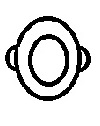
Newark Oval as drawn by D. WyrickWe might ask what else the Ancients tried to portray here. All three maps of the site, Burks’, Squier’s and Wyrick’s, depict the oval with a U shaped appendage to the west. There are also several strange paths with bump-outs to the west. Is it possible that this large oval and projections are letters or words? It is possible that the east side of the oval had a similar appendage as on the west that has worn away with time and creek flooding. This would make the Oval similar in concept to the Luwian Hieroglyph shown below. This glyph is unnamed but is associated with the sound “la.” 1

Luwian symbol #445.

Luwian symbol #445.

This form of writing called Luwian or Hittite Hieroglyphs is from the area of Hattusa in present day region of Anatola, Turkey and northern Syria. Evidence that this writing dates from third and early second millennia BC exists. There is no evidence of its use after 7th century BC per academia.2 Its use has been previously demonstrated at Loughcrew, Ireland3 which is believed by some to be much older than the 5500 year old Knowth Tomb, Ireland where several examples have been demonstrated.4 An example of Luwian Hieroglyphics will be shown at the conclusion of this series from a much later period.

Oval with Hieroglyphic Words notedIt would seem this symbol of a circle with two ears is not the only Hieroglyph to be found at Newark. Since Wyrick’s map is believed to be the most accurate, the Oval portion of his map is redrawn here for our study. A comparison of the simple geometric figures with Luwian Hieroglyphs produces a translation as we see in this image.5 Three words are written out. The main oval is Symbol number 445 with sound “la.” Attached at the bottom is the line pronounced “ra,” Symbol number 383. Off the side of Ra is a hump or Symbol number 209 or 210 and sound “i” or “ia” which gives the word: La- Ra- I.

The middle set of lines with the circle and dot is Scutella 402 (Latin for shield) pronounced “sa”. The line beneath is “ra,” Symbol number 383. This forms the word Sa-Ra.

The third word is a combination of the hump out “i” and “ra” to form I-Ra.

We need a translation of “Larai Sare Ira.” How fortunate! This is written in English, Old English that is! 6 7

Larai provides these possibilities: lær = empty; læran = to teach (to fill the mind of someone who is empty); lar = lore, history; lareow = teacher; leorian = to vanish, die, become empty; lyre = hurt, lure; and leger = lair, lying, grave.

Sa-Ra provides: sar = to sear, or sare = sore. And I-Ra could be irre or ierre which means fierce, angry or ire.

The sentence then becomes “Ire sore lair” or in modern terms “An angry sore, an emptiness.” This provides us with a meaning for the Oval. It represents the place where we might presume the event of Bael-teon occurred or where the comet they are referring to as Baal impacted.

Is this sore in southern Ohio? Is it the .8 mile crater that forms the hills into strange sheared plains? Would this event motivate people from half way around the world to seek it out? Not likely. The construction so close to the creek so the Oval can be filled with water suggests they are referring to a watery grave and to have drawn the attention of the ancient world it must have been a significantly larger impact. What event do we find described world-wide that everyone scoffs at?

Forward to NEXT POST

Back to PREVIOUS POST

Back to TABLE OF CONTENTS

___________________

References/ Footnotes:

  1. Freeborn, B.L., “Luwian Hieroglyph Reinterpretation,” 2013. See:  https://noahsage.com/2013/07/10/luwian-hieroglyph-reinterpretation/
  2. Wikipedia article: Anatolian Hieroglyphs. See: http://en.wikipedia.org/wiki/Anatolian_hieroglyphs
  3. Freeborn, B.L. “A Loughcrew Petroglyph Translation,” 2013. See:   https://noahsage.com/2013/07/05/a-loughcrew-neolithic-petroglyph-translation/
  4. Freeborn, B.L., “A Simple and Elegant Neolithic Oops,” 2013. See:  https://noahsage.com/2013/07/01/a-simple-and-elegant-neolithic-oops/
  5. Anders, Gunter, “Luwian Symbols.”  See: http://www.hethport.uni-wuerzburg.de/luwglyph/Signlist.pdf
  6. Hall, J.R. Clark , “A Concise Anglo-Saxon Dictionary.” Toronto: University of Toronto, 1894.
  7. “The American Heritage Dictionary of the English Language,” Boston: Houghton Mifflin Company, 1976.
  8. Gordon, Cyrus, “Forgotten Scripts,” New York: Dorset Press, 1987.

Thence Came Baal

By B.L. Freeborn © 2013, updated Nov. 2018

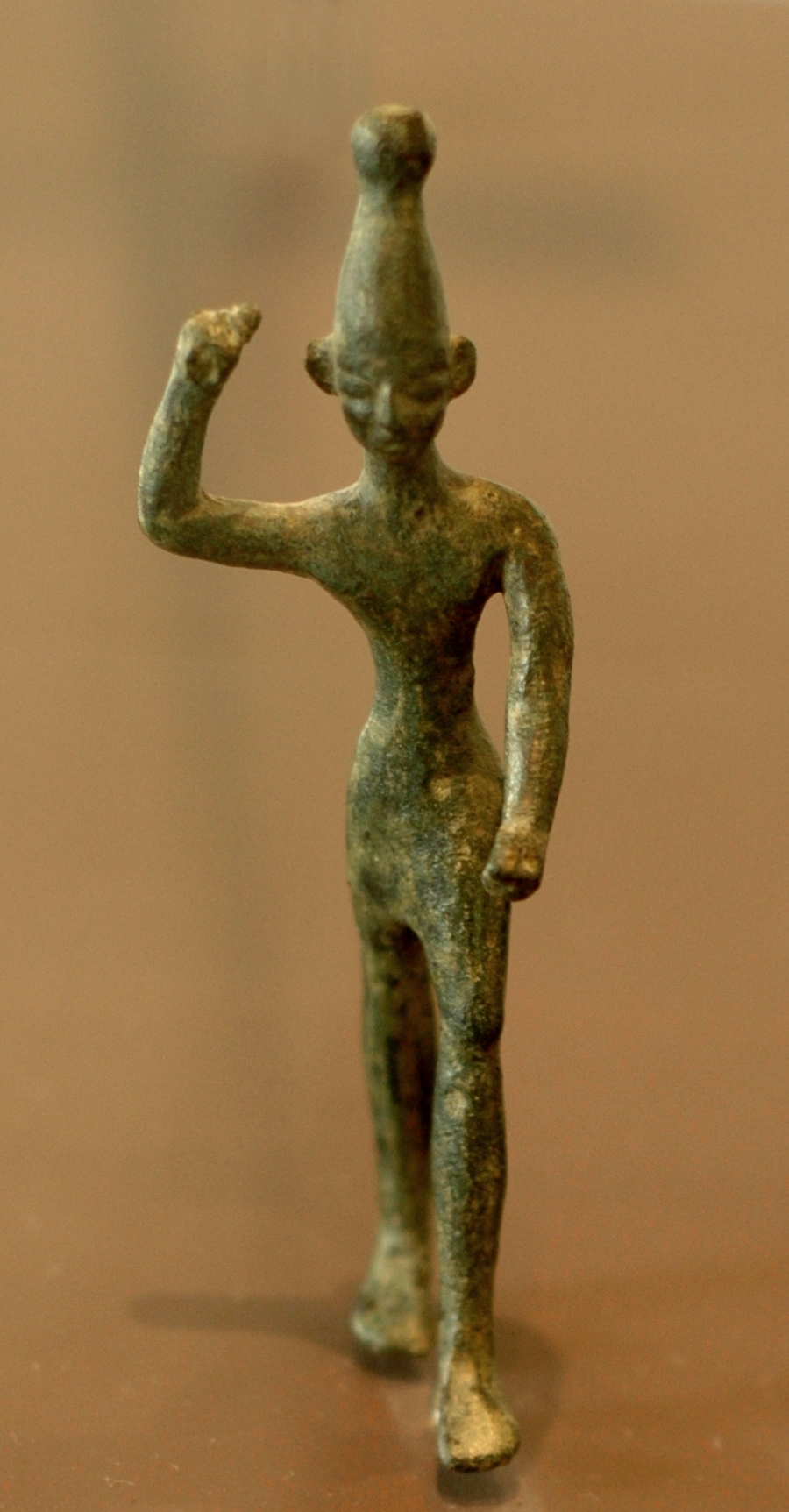
Baal, a Statute from Ugarit.14th to 12th BC. Louvre, Wikipedia,

Baal, a Statute from Ugarit.14th to 12th BC. Louvre, Wikipedia.

Beltane and Baal, are they related? It has already been proposed that they are. The scant information on Beltane suggests it involved building bonfires, the union of male and female, fertility, and the maypole. The maypole ceremony involves weaving long ribbons around a large pole held vertically. This idea is usually interpreted in the classic phallic manner. Yet, we might travel further in our understanding of the ancient world if we broaden our minds a bit. Can we not represent the north pole as a vertically held pole? Do not the lines of longitude project out from the pole in the same manner as the ribbons on the maypole? Certainly then, the object of weaving the lines about the pole is to remind us that lines of longitude and latitude are measured from this central point. This concept can be found not only in the Cuneiform records but it can also be found in Native American lore, just as the Noah story appears in both places. It is a relatively easy concept to understand but twice as easy to misunderstand if one has never been taught about longitude and latitude. It was simple then to relegate the maypole to a sanitized sexual symbol.

The word Beltane conjures up the image of a bell. While the word Baal brings to mind a ball which is reinforced by images such as we see in this Baal-Ugarit Statue. Yet these images converge if we picture that a fiery ball might appear as a bell and indeed, in Old English, a baelfire is a funerary pyre. What possible connection can there be between a maypole and a ball-fire? This is one facet of the story Newark might help answer.

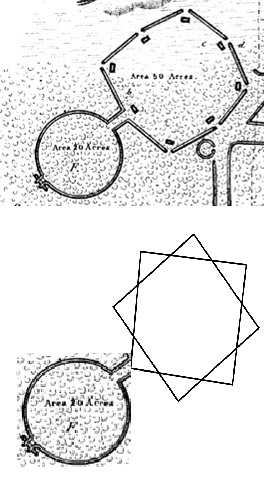
Circle and Octagon of Newark, Ohio Earthworks portrayed as a circle joining with a square.

Circle and Octagon of Newark, Ohio Earthworks portrayed as a circle joining with a square.

The pieces of Beltane we are left with is the concept of male, female and fertility. Since it is a spring festival we might assume these latter parts are all self-explanatory but we can take them another way as well. We look directly at Newark now and see that Baal, Bael, can be described by the circle which leaves the square as its counterpart. So then, in the circle-square we have the union of male and female which is indicated by the circle-octagon with the neck between them. Let us say the circle impacts with the square and causes it to rotate. There are two identical squares within the Octagon which are rotated. Let us say that the union is so abrupt and intense that the square breaks outwards. It is shattered and torn. The Old English word for torn is teon which is of course derived from the number ten and our fingers. Our ten fingers are used to tear apart. Hence, ten becomes teon. Now we have a better understanding of the word Beltane. It is Baal-teon which is then correctly illustrated here. Baal has impacted with the square which we may assume is Earth and it is torn apart. The image of Newark explains the effect of the impact is not only a rotation but a shattering. The images further relate a shift occurred which is portrayed to us by the translation of the two images across the plane equidistantly 6 diameters or 1.2 miles which echoes the statement “the earth was created in 6 days.

Circle and Octagon translate 6 OCD across plane to become circle and square. Drawing by B.L. Freeborn.

Circle and Octagon translate 6 OCD across plane to become circle and square. Drawing by B.L. Freeborn.

Right side of Newark Earthworks taken from Burks drawing.

Right side of Newark Earthworks taken from Burks drawing.

We can then postulate that the three images on the right indicate the condition of Earth after meeting Baal, its new relationship to the Sun, and an oval which we do not understand as of yet. The Great Circle as the Earth indicates the distance it travels in a year, the length of its day, and its velocity via the numbers 580, 1200 x 2, and 66.6. But we need to interpret the steeply formed neck, the bird, and the crescent in relation to the circle. The answer is supplied  by the artifacts which have been found: balls, crescents and meteoric iron. In fact, there is another clue supplied in an article by Romain.1 The Great Serpent Mound is built very near the Serpent Mound Impact Crater in southern Ohio. The .8 mile diameter crater was caused by a meteor impact between (we are told) 256 and 330 million years ago. All things considered it would seem then that the “bird” within the Great Circle is a meteor and the steeply formed neck is its impact site into the Earth. The crescent below the bird then is its crater driven deep into Earth. This suggests more than a passing understanding of the formation of craters such as the one found in southern Ohio.

Moving to the second of the earthworks on the right side we have a square. This exhibits measurements present in Earth’s orbit. The square as a symbol of measurement is found identically in Olmec art and Assyrian art.2 It is presented in Egyptian art and identically in Sumerian art. The square is the foundation of measurement. We can see this for ourselves on any map that shows longitude and latitude. The lines form squares.

This leaves us once again at the Oval where we remain perplexed for just a wee longer.

Forward to NEXT POST

Back to PREVIOUS POST

Back to TABLE OF CONTENTS

_______________

References/Footnotes:

  1. Romain, William F., Ph.D., LiDAR Views of the Serpent Mound Impact Crater, “Ohio Archaeological Council,” January 2012.  See: http://www.ohioarchaeology.org/joomla/index.php?option=com_content&task=view&id=361&Itemid=32
  2. Freeborn, B.L., “The Odd Little Purse in Olmec and Assyrian Art.”  See: https://noahsage.com/2013/02/17/the-odd-little-purse-in-olmec-and-assyrian-art/
  3. Baal Image: Wikipedia, Jastrow, PD.  http://en.wikipedia.org/wiki/File:Baal_Ugarit_Louvre_AO17330.jpg

What Fits Where?

By B.L. Freeborn © 2013

circle-octagon only

Circle and Octagon at Newark, Ohio from Squier -Davis drawing.

The most fascinating part of the Newark Earthworks is the Octagon and how very many things are going on inside it. It is mathematically a very busy place. In every respect this structure is a monument to mathematics and geometry.

It begins with a circle meeting an irregular octagon which is almost a distorted square. They join via a path or neck. Opposite this neck on the southwest side of the circle is an area dubbed the observation area due to its height and view it gives through this neck into the octagon. In addition, the circle has a slight ditch surrounding its exterior perimeter.

We have already noted that the square roots of 7.7 and 7.66 are 2.77 and 2.76. The outside distance of the neck is 270 – 274 feet on the north side and 278 to 281 feet on the south side. Assuming some form of creep is present the average of 270 and 281 is about 276 feet. The square of this value is 75900 feet or just shy of 76,000. The distance proposed between the two centers was 1540 or 2 x 770. The square root of 770 is 27.7. It would seem the original intention was to replicate the 770 in the neck as a multiple of its square root.

Hively/Horn, measuring from the middle top of the mounds, determined the neck measures 292 on the north and 296 on the south. The first number we saw as the distance from the Great Circle to Wright Square, 2920′, and twice this value is 584. The number 296 is the gematria value for Earth in Hebrew. The square root of 8.8 is 2.96. This 8.8 or 88 will appear again shortly. One final point, 292 x 296 = 86432 which reminds one of the diameter of the Sun at 864,337 miles and cannot even remotely be a coincidence.

The present distance across the throat at the base of the mounds measures somewhere in the range of 110 to 113.7 feet. Twice 56 is 112. Twice 56.5 is 113. This is a good indication of the original value.

The Observatory Circle at its southwestern extreme has an observation area. According to Hively the area was 170 feet long by 100 feet and 11 feet high in the year 1847. The number 170 is half of 340. Note that 90 degrees minus 34 is 56.

Octagon with 8 moundsThe octagon is composed of 8 long mounds that are separated at the corners. Within the Octagon there are 8 mounds, one at each break in the corners which seem to orbit within the Octagon. Recall that the earth is one of 8 planets orbiting the Sun. Wright Square also had 8 interior mounds. The eight sides plus the 8 inner mounds suggests the number 88. We have seen this number in the distance this Earthwork lies from The Great Serpent, 88.15 miles, and from Miamisburg Mound, 87.7 nautical miles. Each side averages in length from its mid-point 620 feet. Their sum is 4973 feet. This is a midpoint measurement. A measurement of the exterior perimeter is just over 5000 feet. The mounds measure on average 584 feet in length. The 8 interior mounds create an inner octagon. Measurement of the perimeter at the midpoints of the inner mounds measures 4400 feet.

The exterior circumference of 5000 x 88 = 440,000. This number, 440, appeared when the circumference of the earth in miles was divided by 56.5. It repeats in the perimeter of the inner mounds.Squares in the Newark octagon

The diameter of the Observatory Circle, or a fifth mile, is not restricted to the circle. It can be found twice in the Octagon. The diameter of the Great Circle can be found there as well. This is better explained by looking at the image above. Now we see the “circle inscribed in a square” and “the square inscribed in a circle.”  This is the beloved old world exercise explained earlier.

By way of the next image we can see that the two circumscribed squares have rotated with respect to each other. This will become important when we discuss the cosmology implied here.

Squares rotate

Hively and Horn show and Romain also proves that the diameter of a square 1056 feet (their OCD) is used to generate the shape of the octagon. The diameter of a 1056′ square is 1493′. By making an arc of radius 1493′ from each of the four corners as shown the four remaining corners of the octagon can be generated.

This does not create a regular octagon in a stop sign shape. Instead this creates a square with sides that are broken outwards at the midpoints which is also important in the cosmology implied here.

Building the Newark Octagon

The question as to how big this exterior square is remains. We can measure its dimensions as displayed in the earthwork but it needs to be confirmed. The diagonals are 1728 and 1717 feet. The sides measure roughly 1227, 1212, 1210, and 1213. (Hively) Compare this to a calculated diagonal of 1737 and side of 1228 feet. The largest side of the square is the end facing the circle. It is not an optical illusion that end is larger. The average length of each is then 1215 feet. This is 607′ per each of the 8 bars and 8 inner mounds. This might imply the relationship 6 x 88 = 5280 feet to the mile.

Largest Square within Newark OctagonThe two diameters 1728 and 1717 differ from the calculated 1737. The first differs by 9′ and the second by 20′. In other words, the most northern corner is pushed in considerably to create this number. The number 1717 repeats the 17 which appeared in the observation area. The number 1728 is 864 x 2.

Calculating the largest diameter at Newark Octagon All in all, a very pleasing geometric harmony is produced by continuously repeating the same numbers. The next image adds the largest square used and completes the Octagon.All the Squares within Newark Octagon

Forward to NEXT SECTION

Back to PREVIOUS SECTION

Back to TABLE OF CONTENTS

___________________________

References/Footnotes:

  1. Hively, Ray, and Horn, Robert, Geometry and Astronomy in Prehistoric Ohio, “Journal for the History of Astronomy, Archaeoastronomy,” Supplement, Vol. 13, p.S1; also Science History Publications, 1982.      See:   http://articles.adsabs.harvard.edu
  2. Romain, William F., Ph.D., Newark Earthwork Cosmology: This Island Earth, “Hopewell Archeology: The Newsletter of Hopewell Archeology in the Ohio River Valley,” Vol.6 (2), March 2005.   See:  http://www.nps.gov/mwac/hopewell/v6n2/one.htm
  3. Romain, William F., Ph.D., Design and Layout of the Newark Earthwork Complex, “Hopewell Archeology: The Newsletter of Hopewell Archeology in the Ohio River Valley,” Vol.6 (2), March 2005.  See:   http://www.nps.gov/mwac/hopewell/v6n2/two.htm