The Adena Tablets of Ancient Ohio – The Bainbridge and McKensie Mound Tablets

© 2014 B. L. Freeborn, updated Sept. 2022
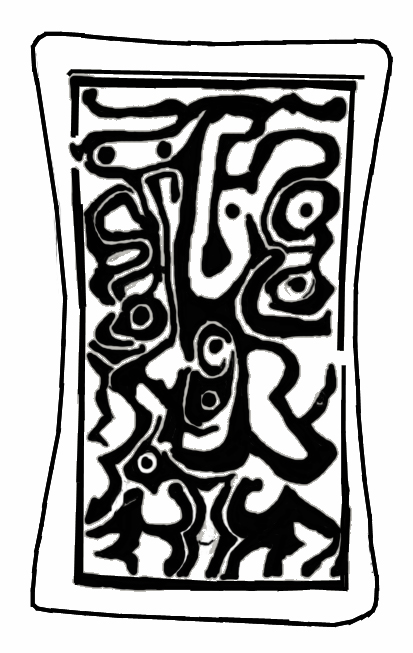
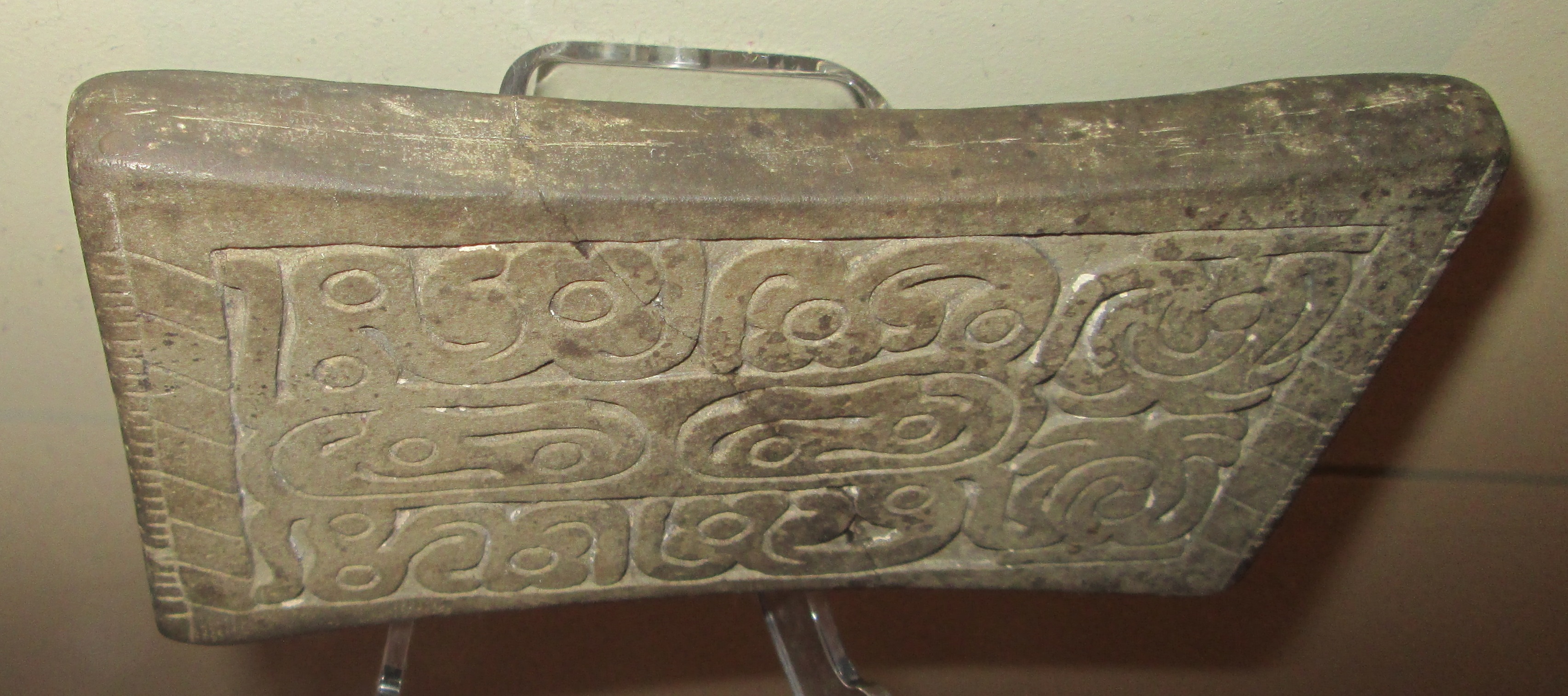
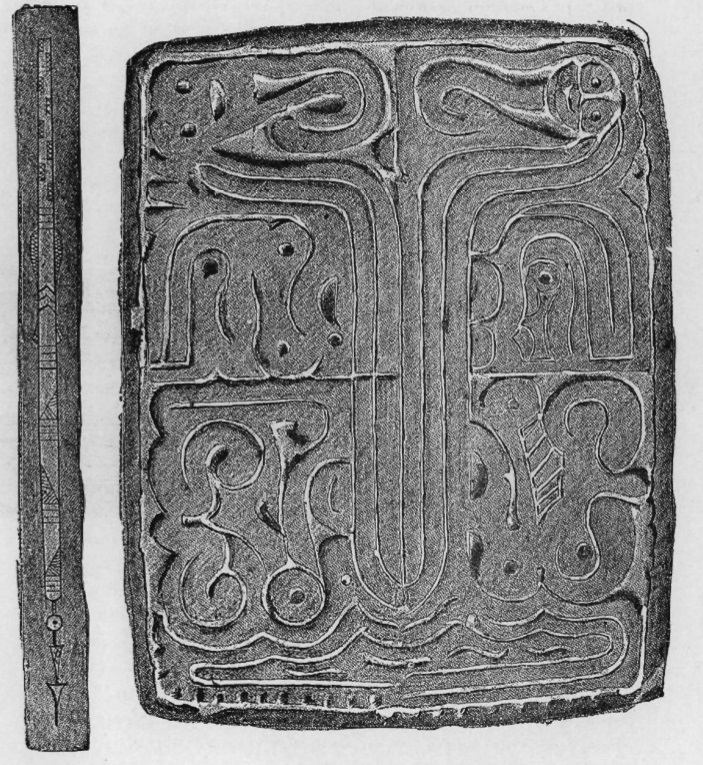
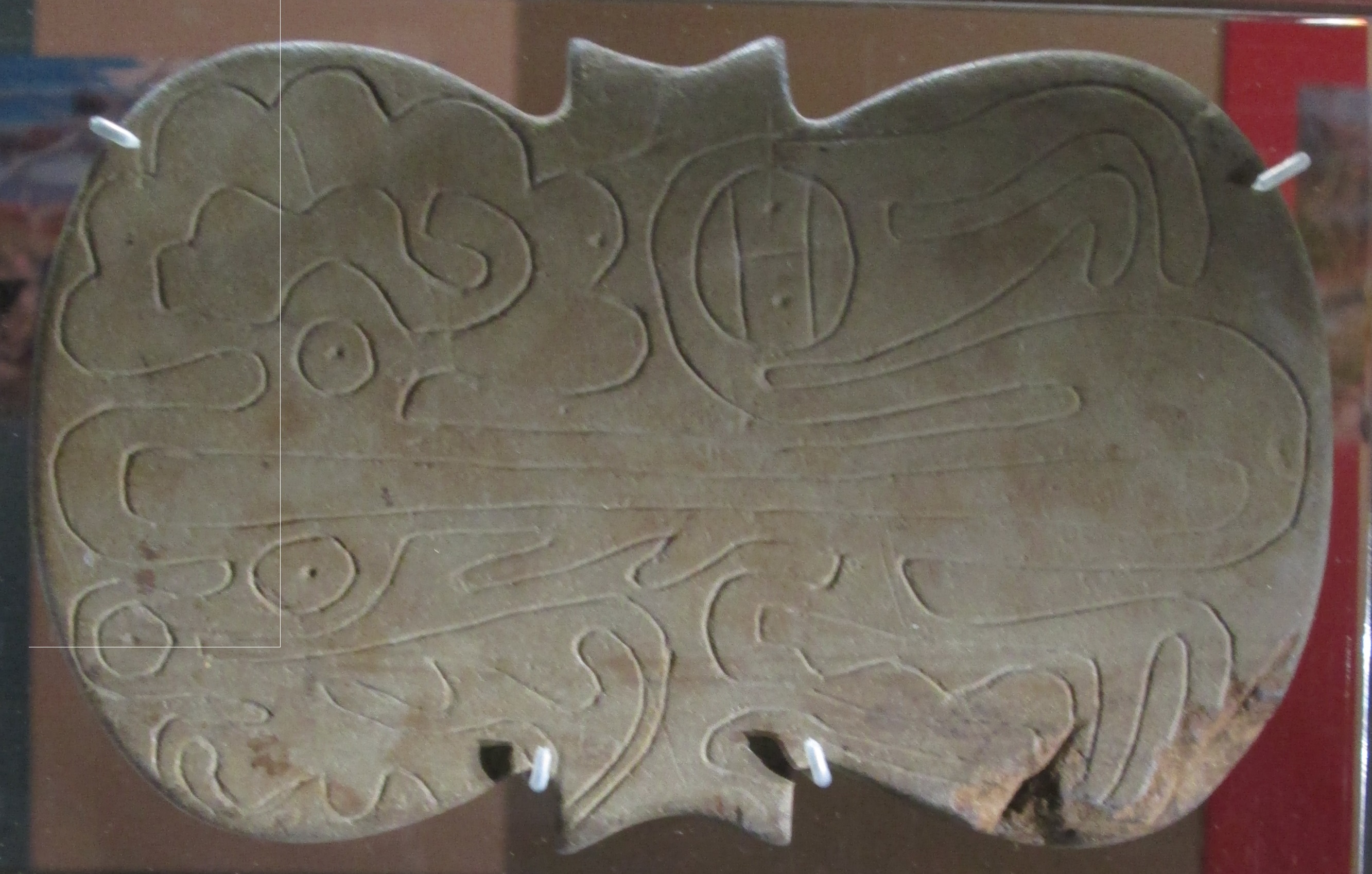
Bainbridge Tablet

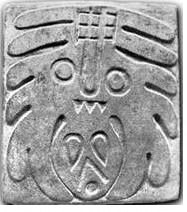
Sketch of Bainbridge Tablet after Caldwell photo.

The Bainbridge and McKensie Mound Tablets are both owned by Duncan Caldwell. View actual photos and read his analysis on line here. (Also see link below.)

The Bainbridge Tablet is from Ross County, Ohio and the McKensie Tablet is from Pike, County, Ohio. The latter was found in 1899. The Bainbridge is studied first here.

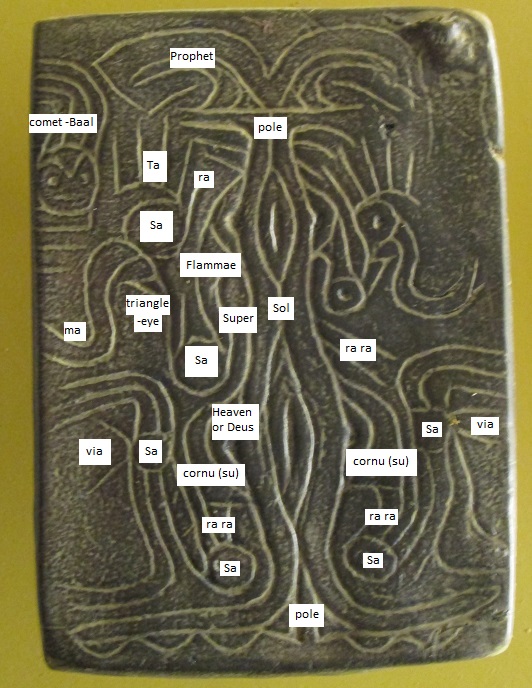
The Bainbridge is similar in design concept to the Cincinnati and Wilmington. It has sides bowed in as does the Cincinnati Tablet. All three have the feathers of the Prophet glyph giving us the correct orientation for reading it. The feathers were also present on the Lakin A Tablet. The Prophet glyph’s presence suggests the abstractness of the diagram is just a series of combined glyphs. With some effort the glyphs are identified as shown in the diagram below. It tells of a two eyed comet and the staff of guidance. It is where the ‘eye lays.’ The upended Pes/foot glyph on the right side gives us the idea of a base which is turned and the sound ‘ti.’ Two joined craters lie below it with the symbol for ‘ra’ between them forming the word ti-sa-ra-sa or tessarace which appeared in the Lakin A Tablet. A tessarace is the summit of a four sided pyramid. The north pole is the summit of a world divided into square tiles. The word can also be translated into Old English as ti-sa or tease, and ra-sa or raes which is a violent storm or a course. This suggests further meanings to the word tessarace. It describes a place that was harmed by a violent storm which is marked by a line.
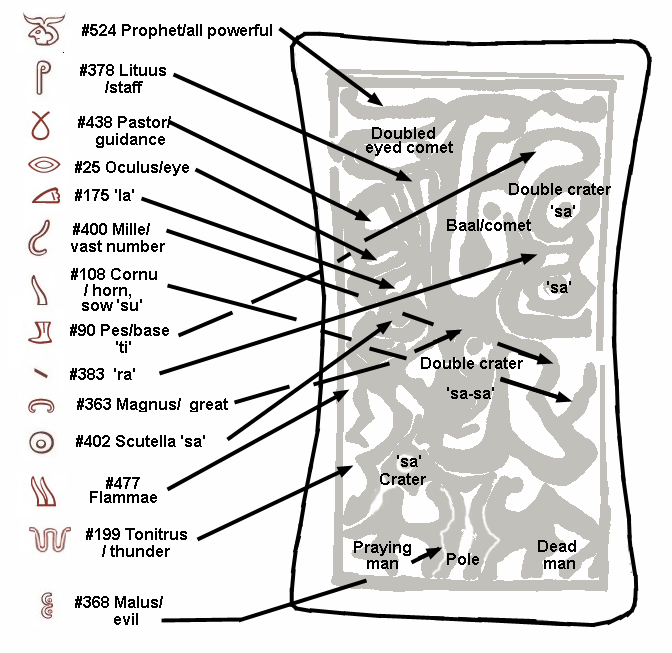
Glyph map of the Luwian/Hittite glyphs found on the Adena Tablet known as the Bainbridge from ancient Ohio glyph map

Glyph map of the Luwian/Hittite glyphs found on the Adena Tablet known as the Bainbridge from ancient Ohio.

Below this are two joined symbols. It describes ‘a vast number sown.’ In the center are two craters or ‘sa-sa’ suggesting the word ‘sess’ which means seat in Old English. The symbol for ‘great’ surrounds the highest of the two craters. On the left, three joined symbols suggest flaming-thunder-crater and below this is a praying man turned away from the center. To his back is the symbol for evil and in the center is the pole. The right side is a mirror image of the evil symbol. This symbol creates the legs of a man who is presumably dead since he seems decapitated. This would be appropriate since the message suggests the planet ‘lost its head’ or guiding north pole.

Numbers are indicated on the Bainbridge Tablet by the placement of the dots in the image.

Numbers are indicated on the Bainbridge Tablet by the placement of the dots in the image.

This message is not complete without imbedded numbers. The dots provide them. On the left are four dots. In the middle there are three and on the right are two for a sum of nine. So it can be said there are 7 on the left/center, 9 total, and 2 on the right which can be used to create the 792 seen on many tablets studied already. It refers to the diameter of the planet at 7920 miles. The center 3 and right 2 create 32 or the square of 5.65. If seen as 23 then it reminds us of the latitude at which the Arctic Circle ends. The number 432 can also be created and this reminds us of the radius of the Sun at 432 thousand miles.

The dimensions of the tablet provide more numbers: 2 7/8″ x 4 3/4″ x 2/3″ or 2.87″ x 4.72″ x .66″. The sum of the length and the width is the ever important number 7.6. The period of Halley’s Comet is 76 years. The width provides both 23 (from 2/3) and 66. The velocity of Earth is 66,600 mph.

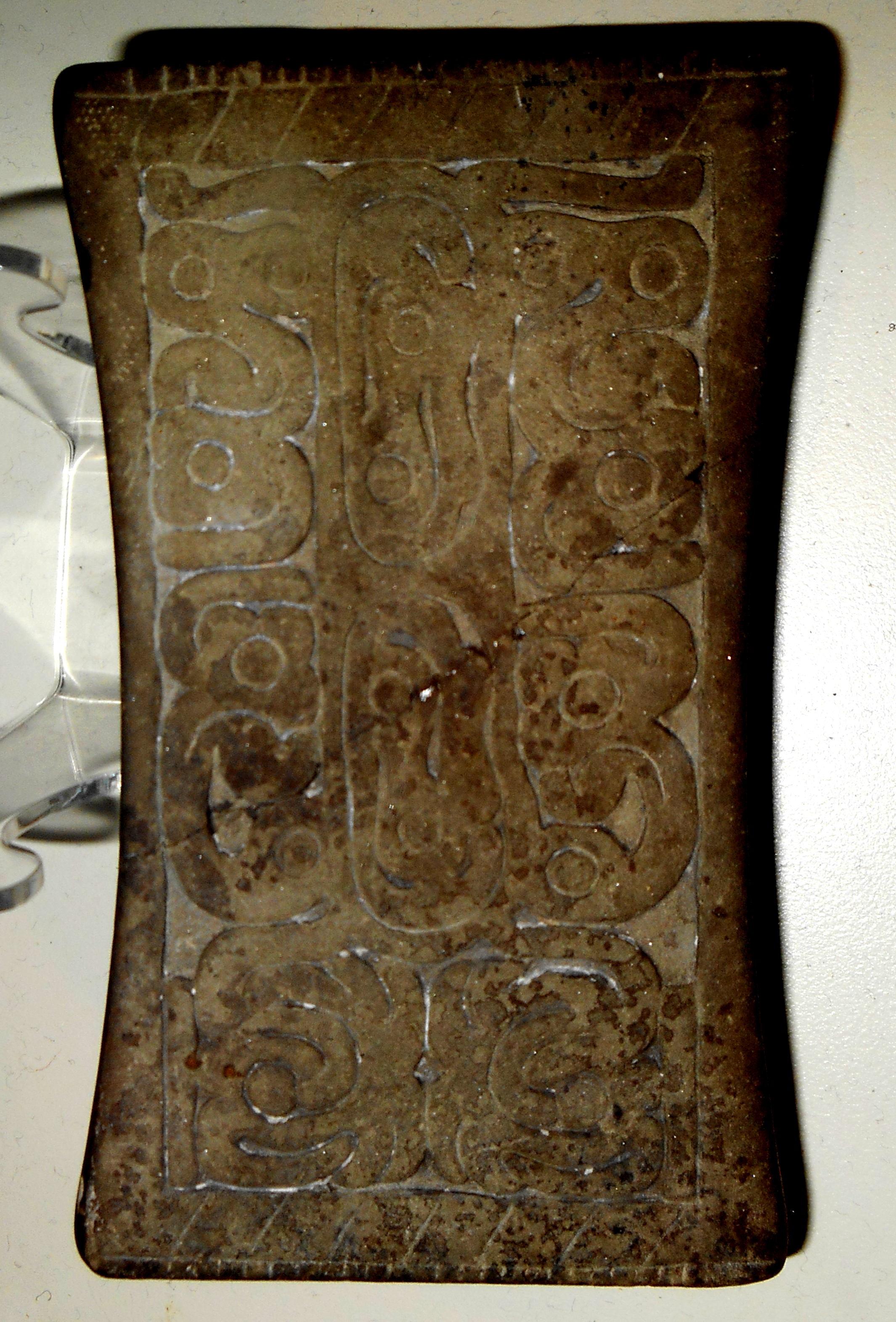
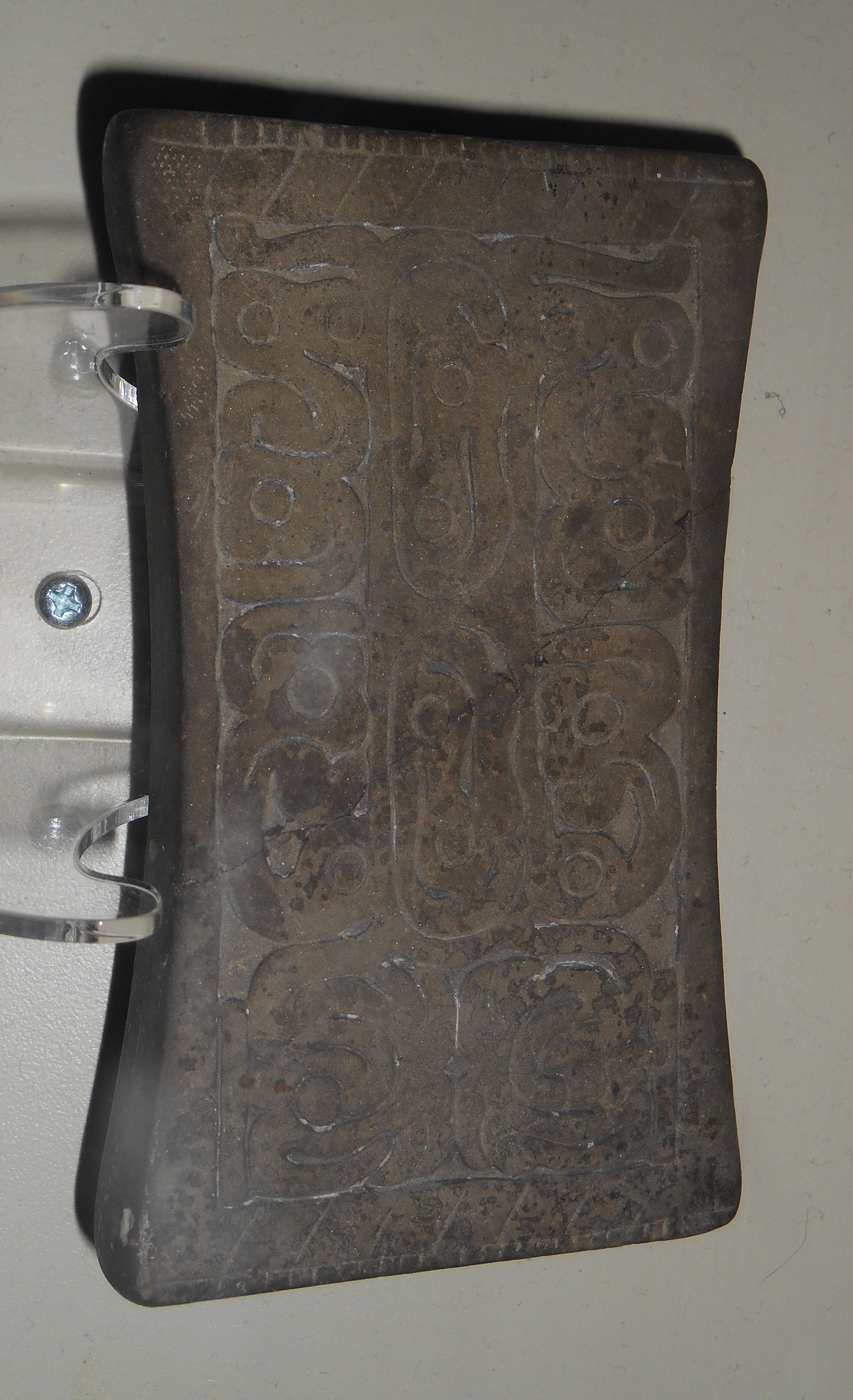
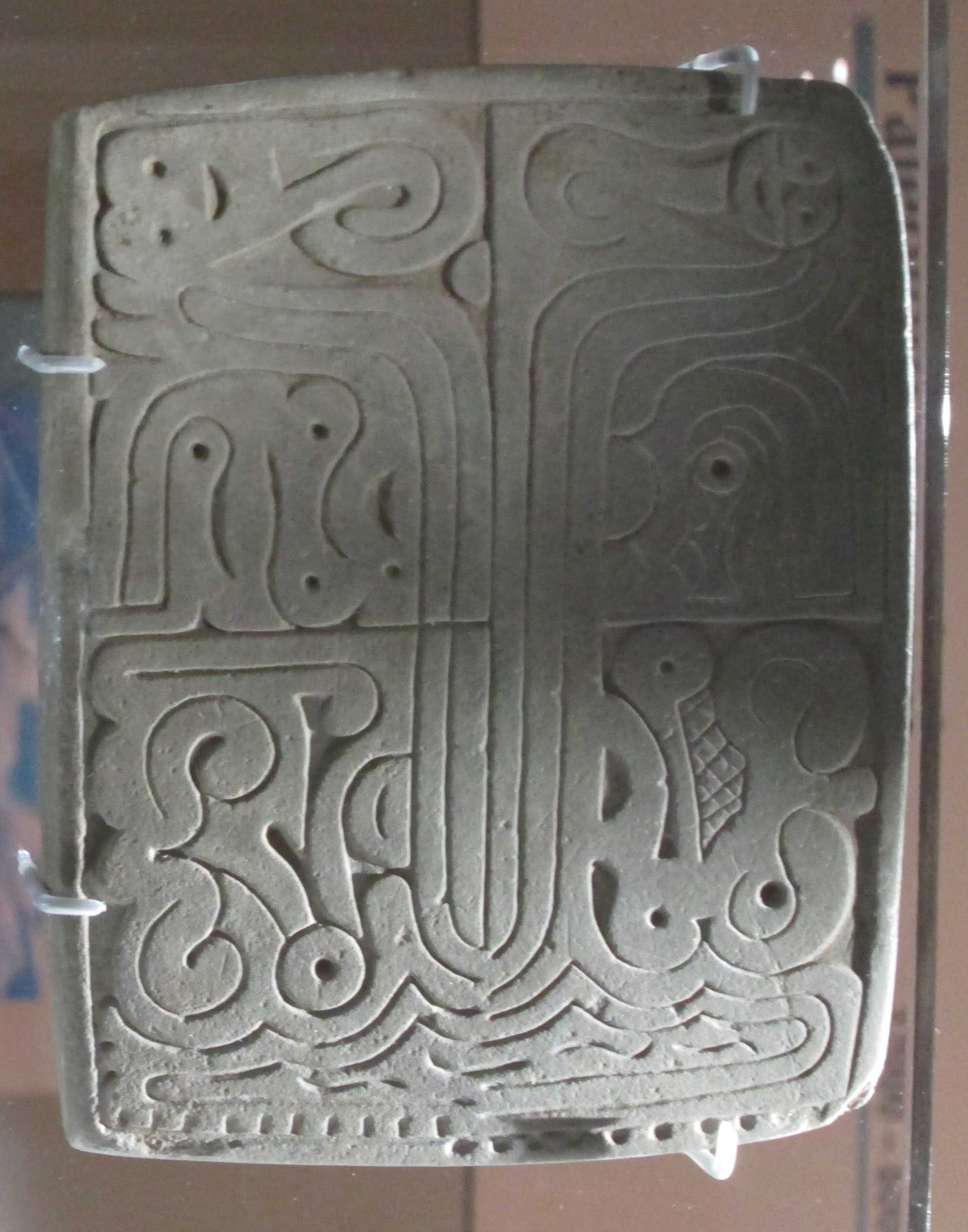
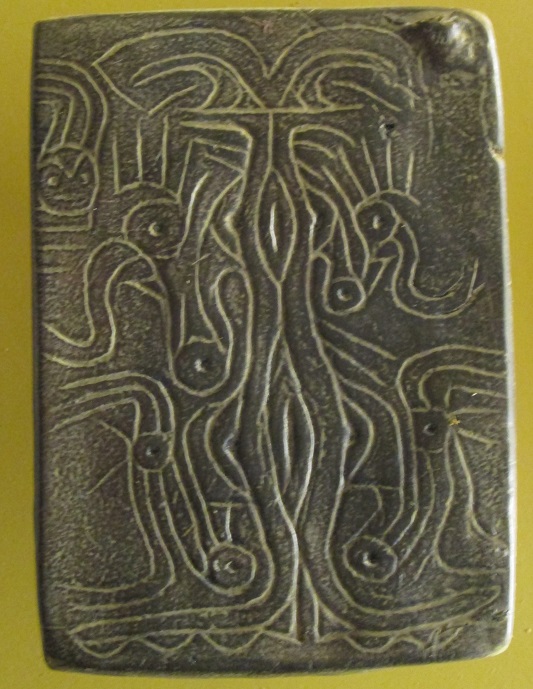
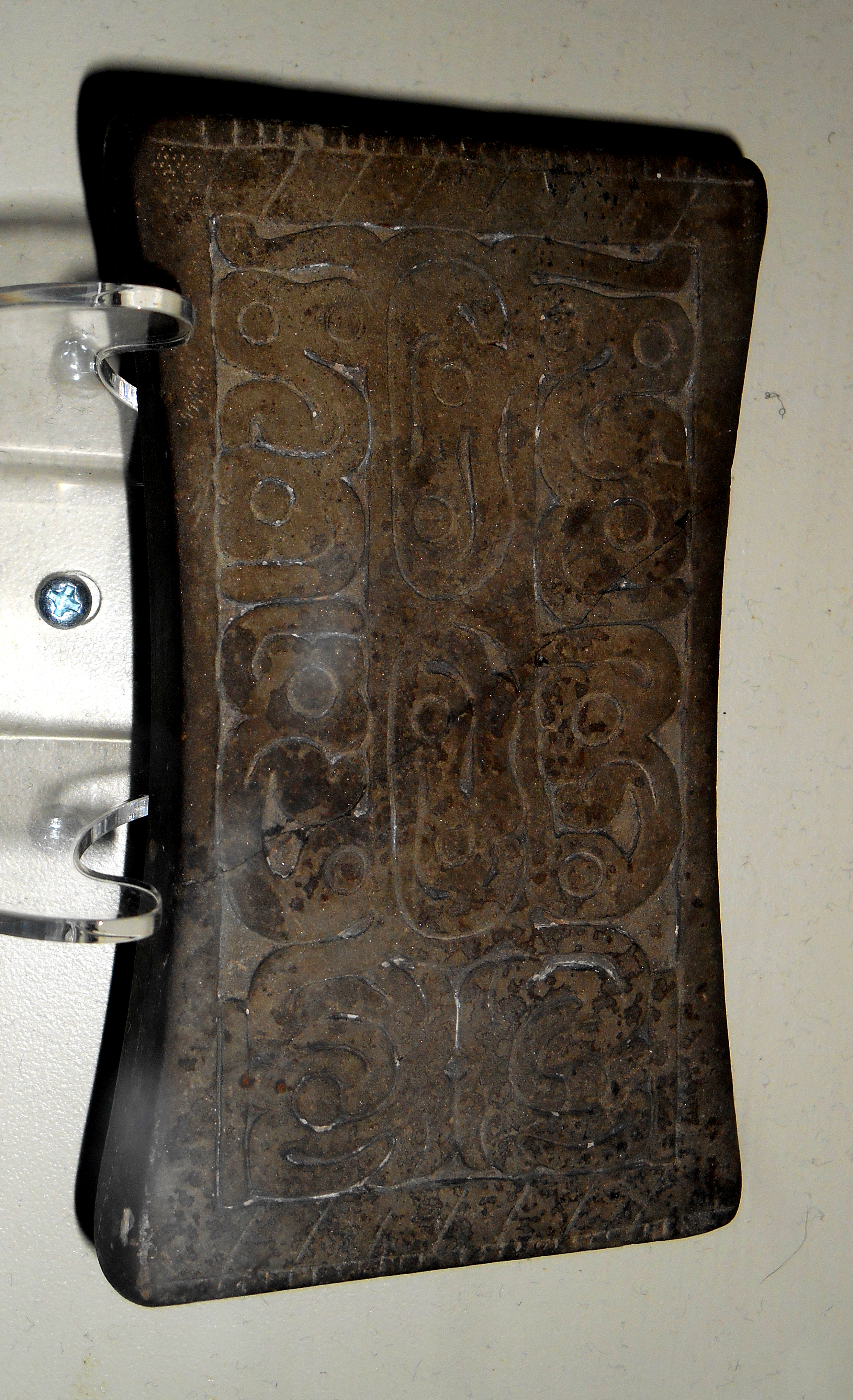
Turning now to the McKensie Tablet it is found it repeats the typical message.  Right side up can be determined by observing that two diamonds appear at the top of the Gaitskill Clay Tablet. One triangle begins the Metcalf Stone and diamonds are present on the Grave Creek Tablet. So the stone should be read as positioned in the image shown here.

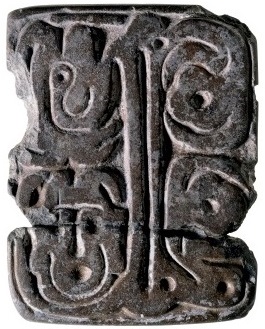
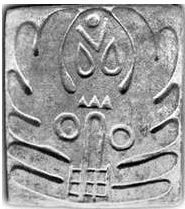
Mckenzie Mound sketch

The Adena tablet from ancient Ohio known as the Mckenzie Mound. The sketch is from a photo by Caldwell.

To the right is the circle with hash marks. Hash marks appeared on the Wilmington, and on the Gaitskill Stone Tablet. The Earth when divided by longitude and latitude appears to be overlain by such a grid. Another way to look at this circular glyph is that the hash marks are a separate glyph suggesting ‘ha or pa’ or the old words ‘heah and pea.’ Heah is high or a high power. The symbol also suggests an object such as corn which is composed of many pieces. Then the combination becomes a powerful comet of many pieces. The story then reads: ‘a powerful comet came to Earth.’

The left upper panels says literally ‘two eyes lay at the staff’ or two comets struck the north pole. Below this are two glyphs that suggest there are ‘ma’ which translates from Old English to ‘more.’ The two symbols suggest ‘there are more in heaven.’ Above this series of glyphs is the horn in 9 sections. The planet’s latitude is marked off in 90 degrees equator to pole. The bottom left corner suggests ‘sow’ but the rest of the corner is illegible.

Within the center is a Pastor symbol identical to the one seen on the Bainbridge Tablet just studied above. Next to it is a large ‘sa’ or crater. Above these two symbols is the symbol for heaven and below them is a wedge. This suggests the reading: ‘the crater from the heavenly comet guides.’
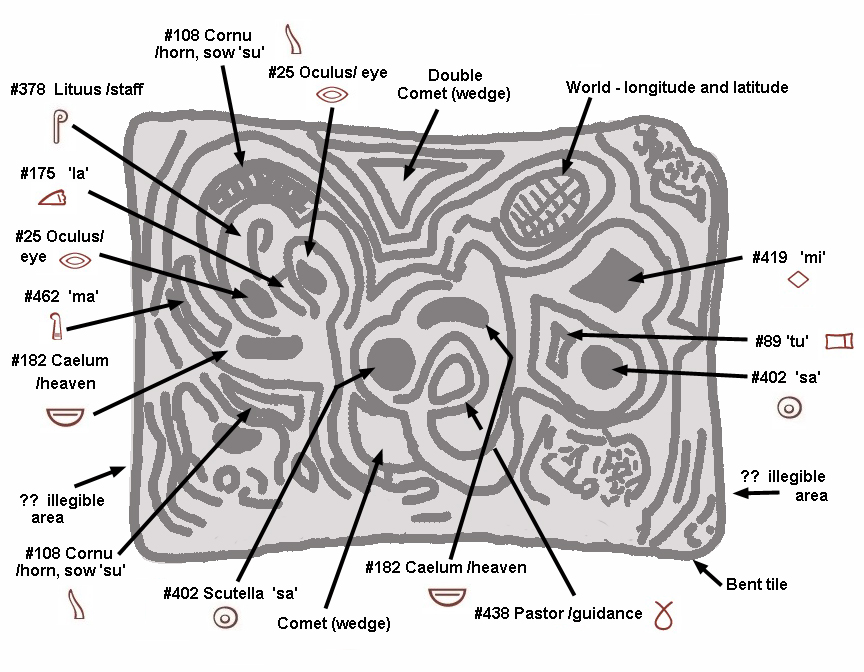
Mckenzie Tablet glyph map

The Adena Tablet from ancient Ohio known as the McKensie Tablet can be deciphered into Luwian/Hittite hieroglyphs from ancient Turkey.

The far right provides three glyphs: mi, tu and sa. The first suggests the Old English word ma for more or mighty, while the latter two are grouped together in the art suggesting tu-sa. The Old English word teosa meaning harm or the modern word tease is then formed. The phrase is then ‘a mighty harm.’

The overall layout of the stone suggests disorder in circular sweeping patterns. It imitates exactly what is observed in areas of comet collisions such as we see on the Moon’s surface. The Bainbridge Tablet also suggests disorder around circular crater marks. They may actually be attempts to depict the aftermath of such an impact with the planet just as the Berlin Tablet did.

If the McKensie Tablet is examined for numbers then several are found. The double triangle, center top, provides 2 triangles of 3 sides which is 23 or 32 = 5.65 squared. The center panel is grouped in such a way as to count out 1,1,2 as if to say 112 or twice 56. The right side gives 1 and 2 or 12. Some might say it gives 1,1, and 1 for 111. The square of this number is 12321. The left upper grouping gives 3 filled in figures and 3 carved out for 33. The overall measurements of the stone are 2.76″x 3.75″ x .394″. The square of the width is 7.6 recalling the period of Halley’s Comet. The sum of the length and width is 6.5. The sum 6.5 is 56 in reverse. The sum of all three measures is 6.90. The distance between two degrees of longitude at the equator is 69 miles.

The overall shape of both tablets is a tile with bent in sides. The story suggests the grid array of longitude – latitude shifted or perhaps twisted as the shape suggests. Most importantly, the two very round carved out circles suggest Two Balls or Bi-Baals. The pun ‘Holy Bible’ was noted in the Wilmington post.

The cumulative list of numbers from all tablets follows. Those in bold were also found on these tablets. 108, 111, 11111, 112, 12, 1212, 12321, 123454321, 14, 1414, 16, 17, 21, 212, 2121, 21212, 216, 2166, 222, 23, 23 32, 23.5, 24, 241, 2486, 26, 28, 3, 31, 32, 33, 333, 34, 3.8, 38, 4, 40, 43, 4.4, 44, 52, 54, 5.65, 56, 56.5, 56.5, 58, 6, 61, 64, 6.5, 65, 66, 66624, 67, 6.9, 7, 72, 76, 77, 777, 79, 792, 86, 8.8, 88, 9, 90, 912, 92, 93, 93.3, 7924 and 8642.

It can be concluded, despite the differences in the artist’s style, the message of the Bainbridge and McKensie Tablets is consistent with previously studied art. The Ramey Peet Tablet (next post) from Cahokia Mound indicates by repeating this now familiar message and style of numbering that this knowledge and iconography was not restricted to the areas of Georgia, Ohio, West Virginia and Egypt.

Back to the very beginning of series on Adena Tablets

Previous Post on Cincinnati Tablet

Posts on: Egyptian Art Comparison, Wilmington Tablet, Lakin A Tablet,

The Gaitskill Clay Tablet, Allen Tablet, Grave Creek, The Kiefer Tablet,

Wright, Lakin B and Meigs Tablets, Berlin Tablet, Gaitskill Stone Tablet,

The Low Tablet, The Waverly Tablet, Metcalf Stone, and pdf article on

Hudson Bay as a comet crater of recent origin.

Article by Duncan Caldwell at: https://www.researchgate.net/publication/277720624_A_New_Typological_Ordering_of_Adena_Tablets_Based_on_a_Deeper_Reading_of_the_McKensie_Tablet
The Adena Tablets of Ancient Ohio – The Cincinnati Tablet
© 2014 B. L. Freeborn, updated 2025

The Cincinnati Tablet is a beautiful work of art that has come to us through the centuries because of the wisdom of our ancient elders. They knew that in time we would forget the important message this tablet carefully depicts. The wise knew that if enough significant works of art were buried with them that long after their bones had turned to dust and their societies had vanished the mounds would attract the attention of future grave robbers. This predictable curiosity would drive them to dig and rediscover this important message left to us. It is as if the mounds were intended to function as valuable time capsules. Finding the pieces is the second to last step in the process. The last step is pondering and understanding them. We are presented with this important message. Can we read it?

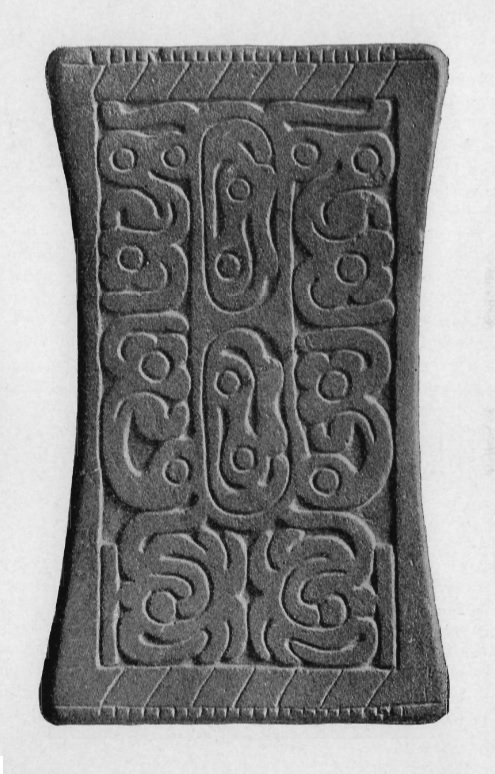
Cincinnati Tablet

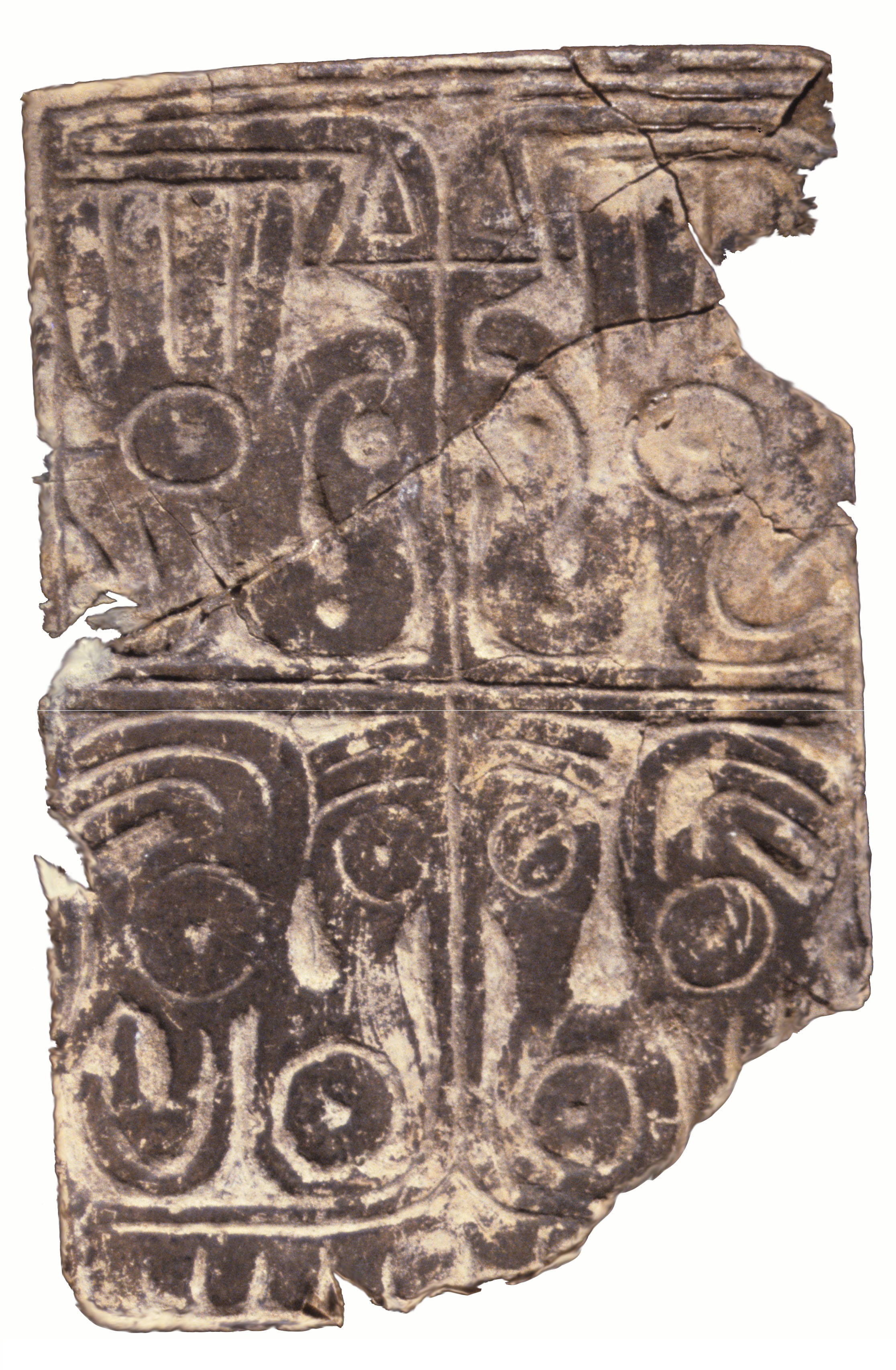
The Cincinnati Tablet from Skinner’s 1885 report.

This tablet was found in a mound not too distant from where it currently resides. It is displayed in the Cincinnati Museum Center at Union Station – poorly. It is not to be found with artifacts from the people of the area in the Natural History wing but in a dim lonely corner of the urban exhibits in the Cincinnati History Museum wing. The lighting is dismal. The location suggests it is to be forgotten. So indeed! Not understanding how beautifully this artist portrayed the ancient but still vitally important message, the curators have buried it in plain sight.

Comparing it to the Wilmington Tablet, it can be seen the basic layout is the same. The comet is the center piece with its two wings along the top. Within its center body are two nested comets. Each comet has one tail and two eyes. The flower images are seen in the Waverly Tablet and in studying that tablet it was suggested they have a dual meaning. They represent both people and flowers. They are ‘shot’ through the head. There are four flowers. At the bottom are mirrored comets once again. Between them is a dot in the negative. On each outer side there is a vertical bar. The two bars represent the two poles, true north and magnetic north, as we know it today.

Cincinnati Tablet

Cincinnati Tablet. Art from ancient Ohio as exhibited. Image darkened to add contrast.

Let us begin counting as done with other tablets. Prominently at the top 7 spaces are marked out (or 8 lines). At the bottom there are 6 spaces (or 7 lines). This creates the number 76 and as noted in previous posts, it suggests the period of Halley’s Comet which is 76 to 77 years. This confirms the topic is about comets. Combine the numbers as 77 and obtain another reference to the comet. Combine them as 86 and obtain a reference to the diameter of the Sun (864,000 miles). Combine them as 78 and obtain the diameter of Earth through the pole (7899 miles). Sum the 6, 7, 7 and 8 and obtain 28 or half of 56.

Even more eloquent, notice that there are actually 9 spaces at the top but only 7 within the hash marks and 2 outside. Create 792 easily from them and compare this to the diameter of the planet at 7920 miles. Similarly, count the bottom as 8, 6 and 2 or create 862 which reminds one of the diameter of the Sun.

Side view of Cincinnati Tablet

Side view of Cincinnati Tablet

The very edge of the top and bottom are scored with small marks. J. Ralston Skinner counted the marks and reported them in his 1885-1886 report on this stone. He noted 24 spaces/ 25 hash marks on the top and 23 spaces/ 24 hash marks on the bottom. The sum of these numbers is 96 and the average is 24. There are 24 hours in a day. The top has 23 spaces. There are 23.934 hours in a sidereal day. Combining 23 and 96 obtain 23.96 or very nearly this number.

Count out the dots. There are 16. The Earth travels 1.6 million miles in a day. There are 2 bars. The 2 and 16 combined creates 216. The diameter of the Moon is 2160 miles.

There are 8 dots in the upper third. There are 6 dots in the middle third. There are 4 dots in the center. There are 2 dots at the bottom. This creates the series 8642 or it refers to the diameter of the Sun at 864,336 miles.

The upper third has 3 dots left and right and 2 in the center. From the center out then is found 23. Reversing it is 32. The Arctic Circle ends at 23 degrees and 30 seconds. The tilt of the planet is this same value. The square of 5.65 is 32.

The center third provides 222. A square of sides 2222 has a diagonal equal to the constant pi (3.14) times 1000. The sum of 22 and 22 is 44. Divide the circumference of the planet by 44 and obtain 565 miles. Forty-four is found in the center bar as well. Count the 4 dots and notice there are 4 bump outs. Recall also a square with sides of 4 has a diagonal of 5.65.

Cincinnati Tablet Museum View. Image darkened for contrast.

Cincinnati Tablet Museum View. Image darkened for contrast.

The dots on each side number 6 which creates 66. The velocity of the planet is 66,600 miles per hour. In the center there are 4 dots. Below this is the one dot in the negative. This creates the number 5. Combine this with the 6 on each side and obtain 56 once again. Or count it out as 1 and 4 which reminds us of the fingers in the Gaitskill Clay Tablet. Combine them and create 14 and then recall there are 4 bumps in the center. 4 x 14 is 56.

The exterior dimensions of the stone and its shape provide numbers that appear familiar. It was measured in 1885 by Skinner to be 3.00″ x 5.00″ x 5/8 inch thick. The width of the narrow middle is 2.5 inches. The sum of these three numbers is 3 + 5 + .625 or 8.625 which recalls the diameter of the Sun. The diagonal of the piece is 5.831 inches. The distance Earth travels in a year is 584 million miles. The thickness expressed as 5/8 repeats this value. The circumference of the piece is 16. The Earth travels 1.6 million miles in a day. It is as if they used inches, also.

The curved portion on each side recalls the idea of a crater. They are 4.5 inches across and .25 inches deep. The area of the curve on each side is .563 inches. The ratio of the narrow width to the length is 2.5 to 5 or .5. The ratio of the width to the length is 3 to 5 or .6. The ratios are .5 and .6 or a reminder of 56 once again.

Cincinnati Tablet. Image before darkening for contrast.

Cincinnati Tablet. Image before darkening for contrast.

Overall, the tablet is extraordinary. It relates this ancient message to us with ease and symmetrical beauty. It tells us we did not crawl out of caves 10,000 years ago to create society as we know it. Indeed, it tells us great scientists once explored and measured the heavens. But the unimaginable happened.

Perhaps the Inch System of today was inherited from this distant prior time. The measure of length of a Hunab found at ancient Teotihuacan, Mexico is 41.66 inches. (1) Multiply this by the diameter of the Sun written as .864 and obtain a simple yard of 36 inches.

Yet to be reviewed are the mysterious (next in series) Bainbridge and McKensie Mound Tablets, the Ramey Peet Tablet from Cahokia Mound, the way too accurate Gridley Stone, the beautiful Ohio Adena Pipe now a Ohio State symbol, and the Hopewell Shaman – Bear. Many interesting posts are to come.

—–

(1) See Hugh Harleston, Jr. pg. 241-263 in “Mysteries of the Mexican Pyramids,” by Peter Tompkins, Harper & Row, Publishers, New York, 1976.

From Harleston, Hugh, Jr.  “A Mathematical Analysis of Teotihuacan.” Mexico City: XLI International Congress of Americanists. October 3, 1974.

———

Back to the very beginning of series on Adena Tablets

Previous Post on Egyptian Art Comparison

Posts on: Wilmington Tablet, Lakin A Tablet, The Gaitskill Clay Tablet,

Allen Tablet, Grave Creek, The Kiefer Tablet,

Wright, Lakin B and Meigs Tablets,

Berlin Tablet, Gaitskill Stone Tablet, The Low Tablet,

The Waverly Tablet,  Metcalf Stone,

and pdf article on

Hudson Bay as a comet crater of recent origin.

J. Ralston Skinner’s articles from 1886.

The Adena Tablets of Ancient Ohio – The Wilmington Tablet

© 2014 B. L. Freeborn

The Wilmington Tablet is only 5″ by 3.8″ by .6″ thick. It is made of sandstone and resides in the Ohio History Museum, Columbus, Ohio. This artist could not have been more clear in his depiction yet it is displayed on its side and usually is described as a phallic image.

Wilmington Tablet

Wilmington Tablet, Ohio History Museum, Columbus, Ohio shown in its correct orientation.

Baal and his twin self are depicted at the top with one tail on the right and twin tails on the left. Central to the image is a massive comet projecting towards Earth. It is so enormous it dwarfs the mountains depicted at the bottom. Recall all of northeastern Canada down to Ohio was once covered by ice mountains two miles high. The swirling shapes to each side of the comet depicts the destruction that followed the impact. Hidden in these swirls are Hittite/Luwian glyphs from the Anatolian region of Turkey. Within every part of this image there are many numbers.

This is the essential and important story this tile relates in a blatantly realistic fashion. What is it that keeps us from seeing this clear depiction of an enormous comet?

The remainder of the message is told through glyphs and numbers. We began with a one tailed Baal and a two tailed Baal, or a comet that split into two. One and two helps us recall there are 12 houses in the heavenly Zodiac. Continue counting by noticing it is actually divided into four panels. The planet can be said to have four quadrants. A square of 4 units to the side has a diagonal of 5.65 units. At the middle horizontal line count across the comet and find 6 lines above but only 5 lines below for 56. Reverse this and obtain 65 or nearly the velocity of the planet at 66624 mph. Similarly, count 6 dot holes on the right half and 7 on the left half for 67. Reverse the number and obtain 76. The period of Halley’s comet is 76 years. Count 9 holes on the upper half but only 3 on the lower half for 93. The average distance between Earth and the Sun is 93 million miles. There is 1 hole in the left lower square and 6 in the upper left for 16. The Earth travels 1.6 million miles in a day. Reverse the number and find 61. There are 60 minutes in an hour and a square of 61 units to the side has a diagonal of 86.3 which suggests the Sun’s diameter of 864 thousand miles. The right side has 3 holes above and 3 below for 33 which gives the maximum change in latitude caused by the impact.

Side view showing double headed arrow on Wilmington Tablet

Side view showing double headed arrow on Wilmington Tablet

The 2 holes in the upper left Baal are next to 3 small fingers on the edge for 23. The upper sweeps of the comet’s tail are composed of 3 on one side and 2 on the other for 32. The square of 5.65 is 32. Reverse the number and find 23. Recall the Arctic Circle ends at 23 degrees and 30′ or approximately 23 degrees and 32 minutes.

There is a half circle on the centerline at the top. The tail on that side is one strong piece between two which makes 112. Or count the strong tail line as 1, the half circle as 1 and the other side of the tail supplies the 2 for 112. Above the middle line there is 1 hole below 1 hollow half circle and opposite there are 2 half circles for 112. The bottom left panel gives 1 half circle, 1 dot and 2 loops for 112. Each and every 112 is twice 56.

On the right lower there are 3 dots and 1 half circle for 31. This is pi³. Continue the count from 3,1 and then 5 lines and 1 half circle for 3151 which is close but off. It should be 3141 which is pi at 3.1415.

Surrounding the piece on the narrow edge is an arrow with a doubled arrowhead which repeats the idea of a double comet. A circle with a dot in the center is in the mid-shaft suggesting the crater or the all seeing eye of the north pole. Then it ends with fletching. This end has hash marks that alternate to make 8 per side or 4 per side depending on how it is viewed. Divide the circumference of the planet in miles by 44 and obtain 565.5 miles.

Sketch of Wilmington Tablet

Sketch of Wilmington Tablet from J. Ralston Skinner’s 1885 article.

At the bottom of the piece there is fringe which wraps up the left side. There are 2 on the left, then 10, then 9 to the right. Summing the last two obtain 19. Multiply this by the 2 from the side and obtain 38 which is half 76 or the period of Halley’s Comet of 76 years.

Alternatively, begin with the 9 and affix the 12 to obtain 912 which is just under Earth’s minimum distance to the Sun of 9.14 million miles. If a simple sum of 9 and 12 is taken, find 21 which when multiplied by pi is a hair under 66. The velocity of Earth is 66624 mph.

The next few numbers are important because they are arrived at by using the Inch System of measurement. The dimensions of the piece in inches is 5″ x 3.8″ x .6″. The sum of the length and thickness is 5.6 which repeats 56 again. Twice 3.8 is 7.6 which recalls the period of Halley’s Comet. The sum of the 3.8 and .6 is 4.4. The circumference of the planet is 565.5 miles x 44. Sum 3.8 and 5 and obtain 8.8. A mile is 880 feet times 6.

Before moving on to the glyphs let us take note of all the numbers found on this piece and compare it to the numbers found on prior tablets. Here we found: 12, 16, 21, 23, 23 32, 31, 32, 3, 33, 3.8, 38, 4, 4.4, 44, 5.65, 56, 61, 65, 66, 67, 76, 8.8, 9, 93, 112, 912.

The cumulative list from previous tablets follows. Those in bold were also found on this tablet. 108, 111, 112, 1212, 12321, 14, 1414, 16, 17, 212, 2121, 21212, 2166, 222, 23, 23 32, 23.5, 24, 241, 2486, 26, 31, 32, 33, 333, 34, 40, 43, 44, 52, 54, 56, 56.5, 56.5, 58, 6, 64, 66, 66624, 7, 72, 76, 777, 79, 792, 86, 88, 9, 90, 92, 93.3, 7924 and 8642.

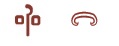
Glyphs for Malleus (hammer or disease), Calleum (heaven), Mille (vast number), and sound 'sa'

Glyphs for Malleus (hammer or disease), Caelum (heaven), Mille (vast number), and sound ‘sa’

Next the artwork is examined to see if any hieroglyphs can be found. Begin with the upper left Baal and find the Luwian/ Hittite symbols for Malleus, Caelum and Mille all joined. The first means a mallet or disease, the second means heaven, and the last which is doubled means a vast number. The image suggests then a disease from heaven in vast numbers or in modern terms: comets and meteorites.

Luwian/Hittite Glyphs

Luwian glyph for Deus (god), glyph number 502, Ala (wing of army), sound ‘i’, and sound ‘sa’

Opposite this we find another Baal which is described by glyphs Caelum #182 (heaven) and the right side is a variation on Deus #360 (god). This symbol is very close to glyph #502 which has no meaning attached to it. The tail repeats the Mille glyph suggesting again a vast number. This is easily translated as ‘gods came from heaven’ and is just another way of saying in modern terms many powerful comets came.

Prophet Symbol

Prophet Symbol

The sweeping tails of the central comet are the feathers on the head of the prophet glyph.

Wing symbol meaning troops - Ala 78

Wing symbol meaning troops – Ala 78

Beneath this in the upper right panel the idea is expounded upon. Glyph # 78 for ‘wing’ is an army wing or troops. It lies above a circle-dot. This suggests the two comets arrived with troops making craters.

Glyph for sound 'i'

Glyph for sound ‘i’


The upper left panel explains more. The first is the upright with the dot for sound ‘i’ found in glyph #209. The two connected circle-dots form two ‘sa’. This ‘sa-sa’ suggests repeated ‘s.’ This spells out i-s-s or the name of the Egyptian god Isis. But it also resembles two Anglo words, ice and sess. The first we understand and the second we hear in sis-ter. Sess is a seat. Ice-sess than implies an ice-seat and so we may hazard to guess that Isis is ‘ice-sess.’ These glyphs are followed by another circle-dot for another ‘sa’ such as we hear in ‘see.’ It is next to the glyph for Caelum or heaven which is connected to the comet or the central pole. Putting this together we have ‘the seat within the ice from which all heaven can be seen at the pole.’ This is the North Pole. A long distant ancestor tells us the meaning of a Goddess in a far distant land with symbols long forgotten and words we still use.

Luwian Glyphs for Halpa (help), sound 'hwi', Cornu (horn) or sound 'su', and sound 'sa'

Luwian Glyphs for Halpa (help), sound ‘hwi’, Cornu (horn) or sound ‘su’, and sound ‘sa’

In the lower left panel find the glyph for ‘hwi’ #329 in the two twirls. The original way the word why was spelled was hwy. So it asks very clearly, “Why?” The symbol for Halpa or help lies above it which reiterates the exclamation. Towards the pole is the symbol for ‘sa’ #402. Above this is symbol #108 Cornu meaning a horn with sound ‘su’ probably meaning ‘to sow.’ The sequence suggests “Help! Why! A comet sown”

Luwian Glyphs

Glyphs for Lituus (a staff), sound ‘ha’ or ‘pa’, and Malus (evil))

The bottom right panel gives us once again the ‘sa’ for ‘see’ with Lituus #378, a staff. Then there is cross hatching which suggests glyph #224 with sounds ‘pa’ or ‘ha.’ ‘Pa’ begins the words pole, power, and post. While ‘ha’ is the Anglo word ‘heah’ which we know as high. The reversed 3 towards the edge is glyph #368 Malus or evil. Putting this together we have ‘to the seeing staff of the pole on high came evil.’

The image on The Wilmington Tablet is composed of many Luwian Hieroglyphs which tell a story.

The image on The Wilmington Tablet is composed of many Luwian Hieroglyphs which tell a story.

This is the same message people on both sides of the world knew, understood, discussed and shared as revealed by their common knowledge of the subject, manner of depiction, and embedded numbers. They ask “Why! On high did this great evil come?”

This leaves the reader still wondering. Could it be? And where? Where is the evidence of this evil? But they tell us. Baal (Deus or god) struck at 56.5 as the Hebrew word for god, Yahweh, echos in its number gematria. Transcribing this word into numbers gives 5,6,5,10 or 56.5. Indeed, further still one must hear the word ‘why’ pronounced the original way ‘hwy’ in the word Yahweh when read left to right or backwards – hewhay.

But we need a second reference to find a location and this they provide. Recall in our prior number list (see Meigs Tablet and Kiefer Tablet) was the number 792 and this is the length of the diagonal of a square of sides 56. It also recalls the diameter of the Earth at 7920 miles. From the line of longitude of greatest displacement they traveled east 79.2 degrees and defined the zero longitude point at Greenwich, England at the same place it is today. This number of degrees was chosen to honor the diameter of the planet. So, reverse their journey! Travel back due west 79.2 degrees of longitude and find the home of Bi-Baal. The reader is encouraged to discover the place for himself. It is summed up by this pun: Holy Bible. Find the holy bible (hole lay bi-Baal) or the hole laid by two Baals.

More to learn about ourselves in upcoming posts.

Next post on Luwian Glyphs in Egyptian Art

Back to very first post on Adena Tablets

Previous Post on Lakin A Tablet

Posts on: The Gaitskill Clay Tablet, Allen Tablet, Grave Creek,

The Kiefer Tablet, Wright, Lakin B and Meigs Tablets,

Berlin Tablet, Gaitskill Stone Tablet,

The Low Tablet, The Waverly TabletMetcalf Stone,

and pdf article on

Hudson Bay as a comet crater of recent origin.

The Adena Tablets of Ancient Ohio – The Lakin A Tablet

© 2014 B. L. Freeborn, updated Sept. 2022

The Lakin A Tablet is actually from Point Pleasant, WV near Lakin. The tablet was found by Everette W. Schwartz.

It is just as abstract as the Gaitskill Clay but because we have deciphered that tablet this is easily read. It is a more fluid and evil looking version. Indeed, the message it relates is of a monster that came to Earth and he is shown in the upper left with an angry scowl. His mirror image has been worn away in the upper right.

The central pole has an ominous look and the two feathers of the Prophet symbol #524 are dominant at the top. Thus we have a pole that ‘could tell all.’ At the bottom a small pole protrudes from mountain peaks. There are three peaks on each side for 33. Similarly, counting the 2 feathers at the top first and then the 3 mountains, and then repeating the count in reverse we obtain 23 32 for the latitude of the Arctic Circle which surrounds the pole.

Lakin A at Grave Creek Mound, Art from ancient Ohio

Lakin A at Grave Creek Mound, Art from ancient Ohio

The power in the pole is contrasted by the orderly-disorder of the two mirrored panels. The multiple circles once again suggest a multitude of comet craters. The total count of circled dots is 8. The pole contains 6 slits. Combining these two numbers gives us 86 or a reminder of the diameter of the Sun at 864000 miles and the seconds in a day at 86400. Each side contains 4 circle-dots. Each group of slits contains 3. Combine these and obtain 43 which is another way they noted 86. Reverse the 43 and obtain 34. Recall 34 is twice 17 and that 90 – 34 is 56. The meaning of this important number we have yet to discuss but it has appeared on previously studied tablets. The 4 dots on each side creates 44. The two groups of 3 creates 33. All of these numbers we have seen before on other tablets.

Each group of slits can be counted as 3 or 1,2. This repeats lower giving us 33, 66 and 1212. These numbers we have seen before.

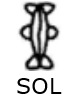
Symbol from Hittite Hieroglyphs called Sol or the Sun

Symbol from Hittite Hieroglyphs called Sol or the Sun

Projecting out of the center of the pole on the right side but not found on the left are two distinct lines that represent ‘ra’ in the Luwian Glyphs. The central pole is definitely Sol in the glyphs or symbol #191. This small depiction of the glyph from the Mnamon web page mimics closely the design used in the tablet. No sound is associated with this glyph. We shall take the leap that it is ‘po’ or ‘pa’ since these are the initial sounds in pole, post, and power. Combining ‘ra, ra’ and ‘pa’ two words come easily to mind. Ra as in ‘ray’ of the Sun and the name of the Egyptian Sun God is one such word. The second is rope.  Ropes have been historically used by surveyors. A rope is a unit of length of 66 feet or 792 inches which should look familiar to this tablet/number study. The idea that ‘ra rap’ (ray-rope) actually appears here is consistent with the idea that the pole is the seat of measure. (Note that the rope’s length in the English system of measure recalls both the velocity of the planet and its diameter.)

If the two sounds ra and pa are reversed, instead of obtaining rope we create ‘pair.’ In fact all navigation still to this day is based on a ‘pair’ of poles. The first pole is true north. The second pole is magnetic north. The suggested reading of these tablets is that they relate that the pole moved. Perhaps they had first hand knowledge of a shift of magnetic north away from true north and that the cause was a comet.

The hands of the Gaitskill Clay Tablet are here seen as eyes with eyebrows. They are the upper most circle-dot with 5 fingers. It might be fairer to say four of the lines are on the eyebrow and one projects straight off the circle-dot for a total of 5. Projecting from the lower side are 2 lines. This gives us 52 and 7. As in the Gaitskill Clay we note these represent days in a week and weeks in a year. If the brow is divided up into 1 and 4, we obtain both 14 and 241 which were found in the same position on the Gaitskill Clay and suggest numbers 56 and 58,000. The latter recalls Earth’s yearly orbit through the heavens of 584 million miles.

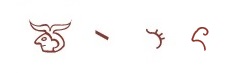
Glyphs for Prophet, ra, ta, and ma

Glyphs for Prophet, ‘ra’, ‘ta’, and ‘ma’ sounds

More glyphs in the Lakin A Tablet

Glyphs for Flame, Cornu or ‘su’, Via, Super, Heaven, and Deus or god

The circle-dot in the Luwian Glyphs represents the sound ‘sa’. The brow shape with the upward strokes is found in Glyph #172 and has sound ‘ta.’ ‘Ta-sa’ does not sound all that familiar yet it suggests the word ‘tease.’ In Anglo it was ‘teosu’ meaning harm. If the line off the circle which is not on the brow is interpreted, then we have ‘ra’. Pronouncing ta-sa-ra we have both the old and modern word tessera which is a tile (such as ceramic) or a grid square as found on a map, or as found in the object under examination! The upper circle-dot is connected to the next one and that provides the sound ‘sa’ again. What is tessera-sa? Tessarace. A tessarace is the summit of a four sided pyramid. The summit of the Earth once divided into mapped tiles is the North Pole.

On the left side of the lines joining the upper circles is a triangle. This appeared at the top of the Gaitskill Clay and is interpreted as a sword, or eye of Baal. The loop off the second circle that curls towards the pole is the symbol Super #70 which means above. Enclosed within the lines is Flammae (flame) symbol #477. The two curled tails off the eye-brow shape form the glyph #110 for ‘ma’. In Anglo ‘ma’ means ‘more.’ The half circles on the sides of the center pole also create the glyph #182 Caelum which means Heaven or #360 Deus which means god. These ideas complete the picture of a dangerous flaming comet above.

Luwian -Hittite Glyphs in Ohio art

Location of Luwian (Hittite) Glyphs from ancient Turkey imbedded in art of Lakin A Tablet from ancient Ohio

The bottom left circle-dot gives 23 32 in the same manner as the Clay Tablet. It also shows 222. The lowest circle shows 4 lines as does the one above it. Recall a square of sides of 4 has a diagonal of 5.65. Both of the mirrored lowest circles are positioned at the base of the pole as if to strike there. Pausing to examine this lower set for expressed words we find ‘ra-ra’ and ‘sa-sa.’ Ra-ra suggests the words rear (raer) or roar (rar) in Anglo. While ‘sa-sa’ repeats the idea of ‘sess’ or seat. The two V lines also represent the glyph Via #221 and means ‘path to.’ Above the lowest circle-dot is an enclosed shape that represents glyph Cornu #108 which has sound ‘su’ and means horn. In Anglo ‘su’ means sow, to plant. This is all consistent with reading the circle-dots as a progressive story.

Reading the four circles from top to bottom then we have a large ‘harm,’ a comet, with two long flowing tails above flying through the ‘tiles’ of ‘heaven.’ It has ‘more’ wings or troops traveling with it. It is a flaming danger from above. It draws near where it is clearly seen to have two tails. It ‘roars’ toward the ‘seat.’ Where they ‘sow’ themselves. They strike at the ‘ray rope,’ the pole in the mountains.

This is an extremely complicated story which we are able to translate because of the years of labor done to decipher the 14th to 13th century BC Hittite documents of the Anatolian regions of Turkey. The Lakin A Tablet and the other Adena Tablets tell an extraordinary story of our history in the not too distant past during the age when ice laid over Canada and Ohio. It is from a time when Ohio first became inhabitable and adventurers came to see for themselves and exclaim in angst that it was true. Their eyewitness accounts pass through the ages to us. We have ears to listen but can we hear?

That Europeans were coming and going from this continent (and vice versa) is evident by the shared language, symbolism and measuring system. That we cannot comprehend how they could have measured longitude, latitude, and planets so accurately is not their error in understanding but ours. They cannot be made to be just ‘cavemen in the stone age’ just because we are grossly ignorant. After all, they are relating that the Earth was struck by an enormous comet. If a large comet struck us today, Walmart would be empty forever in a few hours. We too would be fashioning hammers from stones and making every effort to remember the diameter of the Sun and the Earth and telling wild myths to future generations of men who walked on the moon.

Yet to be reviewed are the stunning Wilmington and Cincinnati Tablets, the mysterious Bainbridge, and McKenzie Mound Tablets, the Ramey Peet Tablet from Cahokia Mound, the way too accurate Gridley Stone, the beautiful Ohio Adena Pipe now a Ohio State symbol, and the Hopewell Shaman – Bear. Many interesting posts are to come.

Back to very first post on Adena Tablets

Previous Post on The Gaitskill Clay Tablet

Posts on: Allen Tablet, Grave Creek, The Kiefer Tablet,

Wright, Lakin B and Meigs Tablets, Berlin Tablet, Gaitskill Stone Tablet,

The Low Tablet, The Waverly Tablet Metcalf Stone

,and pdf article on

Hudson Bay as a comet crater of recent origin.

The Adena Tablets of Ancient Ohio – The Gaitskill Clay Tablet

© 2014 B. L. Freeborn

Art from ancient Ohio - Gaitskill Clay Tablet

Art from ancient Ohio – Gaitskill Clay Tablet

Art from ancient Ohio - Gaitskill Clay Tablet

Art from ancient Ohio – Gaitskill Clay Tablet. Clay copy.

Preserved from ancient Ohio is the Gaitskill Clay Tablet which gives us much to ponder. This stone has been described as having anthropomorphic and/or zoomorphic characteristics. Another author describes it as Avian with four world quarters. If we reflect on the open mouthed man who seemed to be crying ‘no’ in the Waverly Tablet and the angst of the Gaitskill Stone Tablet then it follows that what the artist is portraying is two hands held up as if to say, “Stop!” Above the hands appears two triangles which suggest this is another way of expressing the double eye of the comet Baal. Up and over on each side is the double tail of the comet. The two tails are similar in style to the feathers in the hat of the Prophet Glyph and the curved down feathers seen on the men in the Low Tablet. If the center line is taken as the pole then the reference to four quarters of the world is correct.

There are other details we might notice. In the lower quadrants notice the three lobed wings above the large circle that are like those in the Low Tablet. The Luwian Hieroglyph Symbol #78 Ala meaning ‘wing of army’ is similar. The wing of the Army of Baal would be the debris that preceded, followed and was created by the comet. The image shows multiple circles suggesting many craters of various sizes occurred.

Prophet Symbol

Prophet Symbol

Wing symbol meaning troops - Ala 78

Wing symbol meaning troops – Ala 78

In a prior post the name of the goddess Isis was discussed. It was suggested it means ‘ice-seat.’ At the base of the center pole on the tablet the lines fan out. Perhaps this symbolizes a mountain of ice or the mountain Isis at the seat of the North Pole. But the story these tablets relate is that the pole has a mirror image, a second location to which it moved. ‘Where?’ was the question asked by the Low and Waverly Tablets. Presumably the tablets answer the question. Perhaps this tablet will reveal the answer to us.

The quoted dimensions of the stone are 4.4″ x 2.95″ x .55″. The last number is .01 off from 56 suggesting this was the desired thickness. But these stones vary too much in thickness to be so exact so 4.4″ x 2.9″ x .6″ is a better way to describe it. The 4.4 we will see repeated in the stone and discussed later. The sum of these terms is 7.9 inches. The diagonal of the stone squared is 28 and twice this is 56.

The abstraction of the drawing is distracting to say the least. By counting the message becomes clearer. There are 8 large dot-circles. Of these, 6 are on the bottom. On the top there are 4 dots without outer circles and 2 remaining large circles. This gives us 8,6,4,2 which is a descending even series. When combined the familiar 86420 that is reminiscent of the diameter of the Sun at 864322 miles appears.

Those 6 bottom circles can be counted out as 3,3. The top circles as 12, 21 or perhaps it is 1212 or 2121. This all seems familiar and the abstraction begins to make sense. The fingers on each hand give 4 and 4 for 44. The thumb finger combination gives 1414 which we have seen before. Recall 4 x 14 is 56. The bottom fringe can be counted out as 5 upward nips and then the center plus the other side (assumed to be a mirror image) makes 6 for 56. This was found in the same manner on the center strip of the Low Tablet.

In the lower half the 3 wings to the left and 2 in the opposite direction makes 32 23. The 2, 3 pattern repeats in the two lower tails and the three circles. It repeats again on the left with two side tails and above it lies three lobes of the wing. Counting the 2 lower tails and the 2 side tails creates 22 which is half of 44.

In the top half move around the exterior of the hand and count 2 lower tails, 4 fingers, 1 thumb for 241. Also count 2 lower tails, 1 large circle, 2 dots for 212. The 5 fingers on the hands plus 2 tails creates 52 suggesting weeks in a year. The total sum is 7 for the days in a week.

The only number listed above that is new to our long list of numbers from the previous tablets is 44 but then again it is not so new. We already have 2486 suggesting the circumference of the Earth at 24881 miles and the very repetitive 56.5 listed. Divide the circumference of the planet by 565 and the term 44 appears.

Thus the abstraction is a rather clever way to relate numbers to a people who are both distant in place and time with no common language. It is clear from this list that these numbers and the story related involves the Earth and that someone had advanced scientific knowledge which they wished to share with someone of similar mind. That would be us.

The next tablet is equally abstract but rewarding to study.

Back to very first post on Adena Tablets

Previous Post on The Waverly Tablet

Posts on: Allen Tablet, Grave Creek, The Kiefer Tablet,

Wright, Lakin B and Meigs Tablets,

Berlin Tablet, Gaitskill Stone Tablet,

The Low Tablet, Metcalf Stone, and pdf article on

Hudson Bay as a comet crater of recent origin.

The Adena Tablets of Ancient Ohio – The Waverly Tablet

© 2014 B. L. Freeborn, updated Sept. 2022

Art from ancient Ohio - The Waverly Tablet

Art from ancient Ohio – The Waverly Tablet

The Waverly Tablet was created by an artist with a very skilled hand. The image is clear, sharp and symmetrical. It is located in the Cincinnati Art Museum.

The tablet displays the four panel style with the center bar which by now we understand immediately. In fact there is little about this tablet that the reader cannot discern for themselves. In the upper left Baal, the comet, appears in its two tailed form. The man seems to exclaim ‘oh’ or ‘no!’ upon seeing it. In this image his mouth forms the round empty crater. His face spells out wa-ur (where) just as in the Low Tablet. The pole is represented with a rounding at the top and bottom. The bottom gives a very definite negative shape like water waves or mountain peaks. I suggest it is the latter since the story relates to a prior era when great ice mountains laid over Ohio so heavily it was 800 feet lower in elevation and completely uninhabitable. It is also suggested by the name of the goddess Isis which was studied in Berlin Tablet post. There it was suggested Isis means ‘ice-sess’ or ‘ice-seat.’

On the right side there is disarray as two people ornately designed to double as flowers lie dead, shot through the head as if to say all was destroyed. The short bar at the top provides a sound. It appears to be symbol #383 or ‘ra’. The center bar is a form of ‘I’ and combining them we have the word ‘i-ra’ which remains unchanged through the centuries. It is ire or anger which is appropriate to the scene. Anger was clearly portrayed in the spider-like Gaitskill Tablet. ‘Ire’ also means to wander. So, it doubly suggests movement of the pole.

Numbers are supplied by punch marks and the four panel layout. We find 1, 4 provided by the layout and 4 x 14 = 56. In the top left panel there is 1 punch. The face panel provides 3, the upper right provides 2, and lower right provides 3 for a total of 9. This provides the 9 in 792. The two dots on the bar provide the 2. The remaining 7 are in the images. Hence, 792 is found.

On the left side between the upper-lower panels is a punch provided in the negative which allows 23 32 to be found on both halves. The short bar at the top provides 1, the bar 1 and the two dots complete 1,1,2. Each flower person provides 1,1,2 by using the dot, the head and then the two arms surrounding each head. If the bulb of the nose is counted as 1 then the left side provides 6 and the right side 5 for 56. The upper most center dot gives 1, the lower dot 1 and the sides of the bar gives 2 for 1,1,2 again or 2 x 56.

On the right side if the dots are counted left to right from top to bottom a group of 3 is found followed by 2. Reading from bottom to top there are 3 lines of 3 for 333. This number we have seen many times on the tablets. There are 9 distinct dots. If the nose and negative dot are added to the sum there are 11 or write this as 92. The latter suggests the distance Earth lies from the Sun. Or if you prefer 29 and this is half of 58. The distance Earth travels in a year is 584 million miles.

The Baal panel, upper left, seems to provide a line on the left which might have formed a dish or crater. This would have then given 1,1,2 as 1 crater, 1 eye, 2 tails.

The tablet measures 3 3/8 x 2 5/8 x 13/16 inches. The sum of the sides is 6 inches. The area of the face is then 8.86 sq. in. and a volume of 7.2 cubic inches. The product of 6 and 88 is 528. There are 5280 feet in a mile. The tenth mile appears at earthwork sites such as Newark. The diagonal calculates to 4.3 inches and twice this is 8.6.

These are all numbers we have seen before but their importance is contingent on the inch being in use by the artist. The ratio of the side lengths however eliminates units. The ratio is .777 which is significant.

Since this tablet portrays so many numbers it might be time to recall the number list and update it. The updated list includes: 108, 111, 112, 1212, 14, 16, 17, 212, 21212, 2166, 222, 23, 23 32, 23.5, 24, 241, 2486, 26, 31, 32, 33, 333, 34, 40, 43, 52, 54, 56, 56.5, 56.564, 58, 6, 66, 66624, 7, 72, 76, 777, 79, 792, 86, 88, 9, 90, 92, 93.3, 7924 and 8642. Now that they are getting easy to read let us try something a wee bit more complex.

Next post on Gaitskill Clay Tablet

———————-

See David Penny’s Article on these stones here.

————————

Back to very first post on Adena Tablets

Previous Post on The Low Tablet

Posts on: Allen Tablet, Grave Creek, The Kiefer Tablet,

Wright, Lakin B and Meigs Tablets, Berlin Tablet,

Gaitskill Stone Tablet , Metcalf Stone, and pdf article on

Hudson Bay as a comet crater of recent origin.

The Adena Tablets of Ancient Ohio – The Low Tablet

© 2014 B. L. Freeborn

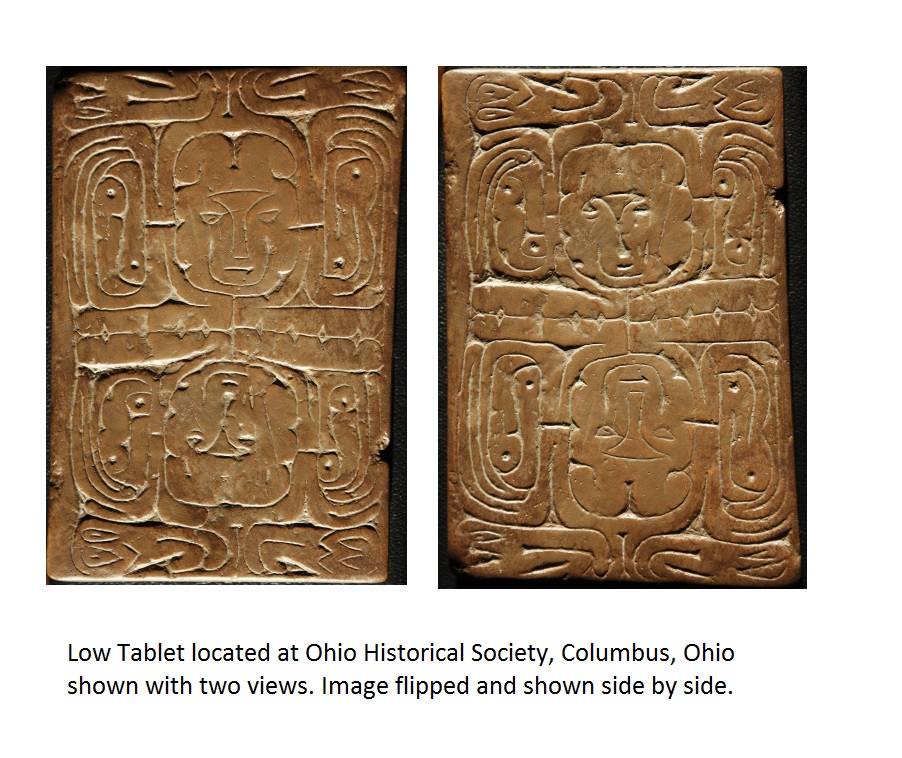
low tablet alternate

Low Tablet. Art from ancient Ohio.

The Low Tablet was found by Edward Low in Parkersburg, West Virginia and can be viewed at the Ohio Historical Society. Its message provides a important link in understanding the symbolism on other tablets.

Center stage and in mirror image is a man with a distinctive hat made of two side appendages. Most would call him a shaman or medicine man. He might be more appropriately called a Prophet. This is the name of the Luwian (La Angle) Hieroglyph from ancient Turkey (3000-2000 BC) that portrays the same concept – a man with a hat with two appendages which appear to be feathers in a flame shape- is #524 Propheta. The idea that great leaders on far sides of the planet wore feather hats is easily accepted. That they are depicted as adorned by -two- feathers in opposite directions is interesting.

Prophet Symbol

Prophet Symbol

We find as usual the symmetry in the design and the appearance of the two eyed, two tailed Baal portrayed in each corner which confirms the topic. On each side of the prophet’s head we find two comets lying in their nests or, more aptly described, craters. If we focus directly on the face of the prophet we see the nose-forehead is a sort of upright object. At the ear positions are short strong straight lines. Similar lines above and below the faces give the impression of the cardinal directions. The chin is etched in as an over accented cup and looking at the face again we see the nose is then the comet and the chin is its crater. The feathers upon the head are then the two tails of the comet which suggests why the Anatolian Luwian glyph for Prophet has just two feathers in his hat. The remembrance and discussion of a two tailed comet appears to have been worldwide. That the conversation spanned two hemispheres is evident by the similar symbols.

Symbols 'wa' and "Magnus'

Symbols ‘wa’ and “Magnus’

The face suggests with its nose pillar and two eyes, symbol #439 with sound ‘wa.’ The deep chin suggests Magnus or great, symbol #363 which has sound ‘ur.’ Sounding out this simple word creates wa-ur in which we cannot help but hear ‘where.’ For sure, this is just what the interpretation suggests. When we hear of two comets striking Earth, we immediately ask, “Where?” Presumably the image answers the question it asks.

Low Tablet shown twice

Ala 78

Ala 78

Wing (Ala) on Lowe Tablet

Wing Symbol (Ala) on Lowe Tablet

There is another important glyph here that appears on other tablets. Symbol #78 Ala meaning ‘wing of army’ is shown. The wing of the Army of Baal can be none other than meteorites and other smaller masses which accompanied the comet that changed the world. Each wing is formed by four bars. Each section has two end to end Baals, four bars in the wing and the center line creates 2,4,1 or 241 which reminds us of the 24 hours in a day, 24 hours of longitude and that 241 x 241 = 58081. This number 241 provided the layout for the insect shape of the Gaitskill Stone Tablet. The distance Earth travels in a year around the Sun is 584 million miles.

The center bar repeats the idea of two and within it is found the series of numbers marked by diamonds 1,4,1,4,1 which when multiplied by 4 is the number 56564. The number is also the square root of 2. ( 2 = 1.4142 x 1.4142) This reminds us that a square of side 4 units has a diagonal of 5.65 units. The number is obtained by multiplying 4 times this pattern 1.4141. The series also creates the sum 11.

The overall layout of the piece is 2 (Baal at the top), 3 (craters and face), 1, 3, 2. This gives again the 23 32 pattern about a central pole. The doubling of the face suggests two such places that are identical or that the pole moved. Perhaps this answers the question “Where?” The comet struck at the original pole which caused it to move.

The number 2 is portrayed everywhere. The meaning of Deus in Latin is god while the meaning of duo is two. The glyph which represents Deus in the Hieroglyphs is a circle divided in two. Two Baal, a symbol split in two, Deus meaning god and duo meaning two all suggests a strong relationship between them. Or perhaps we should use the word ‘bi’ instead for two and confirm there are Bi-Baal at the top and bottom of the image. Each Baal has two tails so that 2,2,2,2 is created top and bottom which sums to 8. The total sum is 16 and the distance Earth travels in a day is 1,600,000 miles.

Across the face portion there are 2 Baal, 1 line (at the ear), 2 eyes, 1 line, 2 Baal which makes 2,1,2,1,2 or exactly the pattern displayed by the Grave Creek Tablet. The sum of 2,1,2,1,2 is 8. Interestingly 21212 x pi is 66637. The velocity of Earth is 66624 mph. However, pi which equals 3.1415 is not represented, or perhaps it is! Those 2’s at the top created 2222. A square of sides 2222 has a diagonal equal to pi x 1000.

The center bar also provides 56. Counting diamonds left to right, count five and stop at the middle and then from the middle to the far side is six. The four dots on the top panel are complemented by four dots on the bottom panel which represent the number 44. Divide the circumference of Earth in miles by 44 and obtain 565.5 once again. The numbers then are consistent from tablet to tablet and were not randomly chosen which reinforces that they are intrinsic to understanding the message and the culture.

What else might these tablets tell us about ourselves and what is missing from the history books?

The Waverly Tablet has the same little man face so we study it next.

Back to very first post on Adena Tablets

Previous Post on The Gaitskill Stone Tablet

Posts on: Allen Tablet,  Grave Creek Tablet,  The Kiefer Tablet,

Wright, Lakin B and Meigs Tablets,  Berlin Tablet,

Metcalf Stone, and pdf article on

Hudson Bay as a comet crater of recent origin.

The Adena Tablets of Ancient Ohio – The Gaitskill Stone Tablet

© 2014 B. L. Freeborn, updated Sept. 2022

A stone tablet from ancient Kentucky. The Gaitskill Tablet.

A stone tablet from ancient Kentucky. The Gaitskill Tablet.

Gaitskill Stone Tablet

Gaitskill Stone Tablet shown upside down here so that the spider appears.

The Gaitskill Stone Tablet is assumed to be an image of a spider. The similarity to an insect is obvious with the legs and the large round abdomen. It was found in Mt. Sterling, Kentucky around 1920. It is dated to 500 BC to 200 AD.

Symbols 'wa' and "Magnus'

Symbols ‘wa’ and “Magnus’

209 i

Symbol for i.

In order to study it we have to turn it right side up and once we do we see some rather familiar features. The ‘wa’ (Luwian Symbol #439) is center bottom with its bold feature and two round circles. The loop in this glyph can also be interpreted as sound ‘i’ (glyph 209) and on each side of it are two ‘sa’ symbols or perhaps craters.

Ha or pa glyph #224.

Ha or pa glyph #224.

In previous posts it was suggested this is the north pole or polar axis from which all measures of longitude and latitude are taken today. Here depicted very clearly is just that. The pole stands atop a grid of hash marks 3 x 3 wide. This gives us 33 and 9. It also gives us 93.3. The hash mark symbol appears in the glyph repertoire as #224 with sound ‘ha’ or ‘pa’. Pa gives us the first syllable of both power and pole. Ha gives us ‘heah’ in Old English which means high. Both terms indicate importance and surely the seat of measurement is extremely important.

On top of the pole are three joined triangles which appear as scary teeth in one direction and a crown in reverse. This too appears in the Luwian glyph system as #231, Castrum, or ‘camp.’ This completes the message that this is the ‘home’ of the ‘po’ on ‘heah’. Despite sounding blatantly Anglo, it also sounds accurate.

Symbol Castrum means camp.

Symbol Castrum means camp.

Before moving on, the 33 we have seen before but the 93.3 is knew. It brings to mind that the average distance to the Sun is 93 million miles. It would be remiss not to note a few more numbers. Does the north pole not sit at 90 degrees north latitude? Is this pole not positioned on a grid? If we count out the two circles and three triangles to the crown there is a reappearance of the number 23 32. The Arctic Circle ends at 23 degrees 30 minutes. The two circles are once again suggesting two positions for the pole with its two circles on each side of the vertical. So we have one obviously where it belongs in the north but where are they saying the other was? Could the answer lie in the 3×3 grid?

But the image continues.

Once the image is rotated it loses its spider appearance but still has two faces. The upper face has angry eyebrows, two teardrops for eyes and a dot in the middle of the forehead as the Hindu’s wear. This reminds us of the Metcalf Stone with its initial symbol of a triangle. So here too we find the idea of one comet which split into two. If the expression is interpreted correctly, then it caused anger and weeping. The number 112 is easily found within this face again.

The overall exterior shape of this creature in stone has two straight bars on each side at the bottom. Above these are four flame or wing shapes. Two and four reminds us of the hours in a day. Topping this 24 pattern is the center round. If we begin with this center round as 1 and count around the image there are 12 wings. 1 and 12 once again appears and 112 = 2 x 56. If we begin at the bottom and count upwards then we find 2,4,1 or 241. The square of 241 is 58081 which is another number to add to our list which suggests the distance Earth travels in a year or 584 million miles. The hours in one day and hours of longitude around the earth is also 24!

If we begin at the center round and count in either direction then we form 1 and 4 to create 14, the number of days in a fortnight. At the bottom the four bars remind us that 14 x 4 = 56.

Symbol for flame.

Symbol for flame.

The last two things to be noted are the similarity to the Luwian glyphs for Flammae (flame) symbol #477 and Femina (woman) symbol #79 which is an oval. The eight exterior wings thus become flames around a central “woman” or place of origin. Taking this one step further, the straight lower bars taken across the figure become the glyph #384 in a shape similar to #388 which represents simply the number ‘two.’ In other words, the artist is describing a flaming comet which was really two.

This image utilizes so fully the hieroglyphs in use in Anatolia Turkey in 1200 BC that we must pause to consider the possibilities this creates:

  • The resemblance is purely coincidental.
  • It is from Turkey.
  • It was made in America by someone from Turkey.
  • It was made in America by someone taught /descended by someone from Turkey.
  • A third group of people created and inspired the art. They lived in Turkey in 1200 BC and Kentucky in 500 BC.
  • The symbols express a common language both continents shared.
  • North Americans traveled to Turkey and shared their language.
  • The Scottish Picts who used the symbols in 1200 AD and the Ancient Irish who used the symbols in 3000 BC were somehow related to both the Turkish of 1200 BC and the North American of 500 BC and 500 AD … and the Egyptians of 2500 BC.

Or…. there is really something that is missing from our history books.

We continue on by looking next at the Low Tablet

Back to very first post on Adena Tablets

Previous Post on The Berlin Tablet

Posts on: Allen Tablet, Grave Creek, The Kiefer Tablet,

Wright, Lakin B and Meigs TabletsMetcalf Stone, and pdf article on

Hudson Bay as a comet crater of recent origin.

The Adena Tablets of Ancient Ohio – The Berlin Tablet

© 2014 B. L. Freeborn

The Berlin Tablet of Ancient Ohio

The Berlin Tablet of Ancient Ohio

The Berlin Tablet is unique in its shape but not its message. We begin by comparing it to artwork found at Knowth, Ireland. Kerbstone 86 depicts a strong image and a familiar shape. This stone was studied in a prior post but here the symbolism repeats in a totally different place. If one were to draw a bold outline around each lobe of the Berlin Tablet the same strong U shape appears. The line through the middle of the kerbstone has a dot on each side. The line through the middle of the tablet has a dot on each side. The kerbstone is considered to be 5000 years old and sits half a world a way. Like the Odd Little Purse in Olmec and Assyrian Art there is an obvious connection here.

Symbols #439 'wa' and #363 'Magnus'

Symbols #439 ‘wa’ and #363 ‘Magnus’

This symbol in Luwian Hieroglyphs is #363 Magnus meaning ‘great’ with sound value ‘ur’. Exactly as in Kerbstone 86 it is doubled and so we have ‘great-great.’ Another way to look at the doubled symbol is to consider the one opening down as Magnus or great, and the opposite opening up as a crater. Then the statement is ‘great-crater.’ This is wholly consistent with the idea of comets.

Sketch of Kerbstone 86

Sketch of Kerbstone 86

Studying the image on the stone gives us once again something for the uninitiated. It looks like a bird with a very distorted eye next to a little tree. Here then is exactly what we saw in the remaining half of the Wright Tablet. The double tailed comet appears as the head. The odd eye is then a doubled eye within a comet which is flying towards a tree. This tree could be called the tree of life or the polar axis through Earth which is directed towards the Pole Star. So then we have a great-comet headed towards the great-tree.

Within the tree is a similar shape as we saw in the nest portion of the Wright Tablet. Here it has seven strong lobes on the exterior and two on the interior plus the handle. Closer inspection reveals a lobe in the middle which is inwards so the inner image is the series 1,1,2 or twice 56. The total number of lobes is 9 so divided to make 2 and 7 or the number 792 which we recognize as the diameter of the planet. The number 72 is significant in relation to the polestar since precession causes the direction to which the axis points to change over time at the rate of 1 degree per 72 years.

Just below this inner shape is a circle. It is none other than the ‘sa’ symbol that has been consistently found in the other tablets. Below it and acting as a mirror to it is another ‘sa’ circle across the central line or pole. It has been suggested that two ‘sa’ refers to the word ‘sess’ meaning ‘seat.’ Perhaps seeing them as ‘es’ makes it easier to hear. But if one listens carefully to ‘es-es’ not only can the Anglo word ‘sess’ be heard but it sounds remarkably like Isis. Taking this one step further, the first syllable of Isis sounds exactly like the Anglo word ‘ice.’ And then if the subject has not been taken too far we might hear ‘sess’ in the name of the King of Egypt ‘Ramses’. This word is spelled in Ancient Egyptian as ‘r-m-s-s’ making it entirely possible the last two s’s are pronounced ‘sess.’ Although, it appears we have strayed off topic it is pertinent to the discussion to note that the Anglo word for border or number is ‘rim.’ This then implies that in Old English the name Ramses pronounced as rim-sess means ‘number-seat’ and Isis is ‘ice-seat.’

The two circles that inspired the above and the bar create another hieroglyph (#439) with sound ‘wa’ which was also central to Kerbstone 86. The  meaning of ‘wa’ in Old English is woe. Pushed further to the left is another ‘sa’ circle so that once again we find 1 circle, 1 line, 2 circles for 112 or twice 56. The artist was thorough in expressing 112 for along the lower side of the bar are two jut outs that create 1,1 and then 2 circled circles.

What then is the rest of the distorted image? Spending time counting it seems futile for it is truly a mess and that is probably the full intention of the artist. But careful study reveals 2’s and 3’s and these numbers have been seen in the other tablets as 23 32 and 23.5. They imply the limit of the Arctic Circle. So then, the great comet strikes the polar tree, the sess, seat of all measurement. A great-crater forms. It was woeful as all was destroyed. The world is literally a mess. This is the same message as found in the New Hampshire Mystery Stone, the Newark Earthworks, and Aberlemno Stone of Scotland. They tell the story of a comet impact. They even allude to the correct shape of the Earth in the overall shape of the stone with the new pole north-south as we know it today.

Comments have been made in relation to these posts that this sort of an impact would have killed nearly all life on the planet and therefore it is impossible for these artists to be relating something so fantastic. But this is what the artist shows – devastation of unimaginable proportions. It does not require this artist to have lived through it. Indeed, mythological and actual history report that few life forms lived through the deluge as confirmed by the massive skeletal debris piles found on various continents. These events were witnessed and survived by a few people, perhaps those out of harm’s way on the far side of the world. They recorded it as strange images such as “The Venus of Willendorf.” Their children, spurned on by legends of their grandparents, later came to view the destruction and pay homage to vanished civilizations and life. Some remained behind to restart civilization on the American continents and others returned to their homelands having viewed the devastation firsthand.

Perhaps the Gaitskill Stone Tablet will prove this all wrong!! It’s cartoon-ish features are of a fearsome spider.

Back to very first post on Adena Tablets

Previous Post on The Wright, Lakin B and Meigs Tablets

Posts on: Allen Tablet, Grave Creek, The Kiefer Tablet,

Metcalf Stone, and pdf article on

Hudson Bay as a comet crater of recent origin.

The Adena Tablets of Ancient Ohio – The Kiefer Tablet

Kiefer Tablet: An Ancient Ohio Tablet

Art from Ancient Ohio: The Kiefer Tablet

© 2014 B. L. Freeborn

The Kiefer Tablet was found in Miami County, Ohio. Some people think it represents a bird’s tail and feet which is a change from the phallic stigma most ancient artwork suffers under.

This is an exercise in numbers and once again an opportunity to observe Luwian (La Ang-a) Hieroglyphics embedded in art half a world a way from where it should be found. The image is in the correct orientation to view this tablet. The Ohio History Museum displays it on its side. This is the lower portion and there is a very similar tablet that we will look at in the future that gives a good idea what else was inscribed on this sandstone piece.

Hwi

Hwi

On the left and right side are two designs described as feathers by some authors. They very well may be, but they also bear a strong resemblance to glyph #329 which has the sound ‘hwi.’ In this use the tail is pushed to the far side to allow it to look like a feather. Indeed, in the Grave Creek Tablet the words ‘seat, quarrel-seat, quarrel-seat’ were proposed and now we find ‘hwi’ which is easily translated to hwie or hwy in Old English. The modern spelling of the words: what, where, when and why places the w before the h. The original spellings placed the h before the w just as the glyph suggests. Now we have a double exclamation of ‘why, why’ and assuming both tablets relate to the same idea then whatever occurred at this ‘seat of quarrel’ was distressful.

Indeed, like a modern cartoon the image expresses a collision with clarity. The U shape appears to strike the lower shape and a ‘bang’ seems to emanate.

Although the above is conjecture the numbers are real. We begin taking note of numbers in this center shape. We can easily count 2 lines, 1 band, 2 lines and then it repeats. Or we can count it as 1, 1, 2 and then 2,1,1. Or if you prefer 1,1,2,1,1. Any way you please, we need to attach some meaning to at least one of these sets. The 212,212 sounds like the 21212 of the last tablet which suggested something that repeats. Multiplied by pi (3.1415) it is 66637. Multiply 212 by pi and it is exactly 666. The velocity of Earth is 66624 mph. The 112 is 2 x 56 which is a number often found in ancient art and sites. The 2,1,1 allows for someone to read it in reverse and obtain the same number or multiply by pi and obtain 663, a less accurate reminder of Earth’s velocity. Also possible is the sum of the two numbers which gives 333. This number was clearly expressed in the previously studied Grave Creek and Allen Tablets.

Next there is a whole series of numbers expressed around the bottom oval. They appear to start at the left and move around it. At the top left find the large black stripe as 1, then the exterior and interior triangles as 7 so 17. This is an important number to this message as well. Or perhaps it begins with the triangles and we find 3,4 or 4,3 triangles which gives us 34 which we saw on the previous tablets. It is also 2 x 17. We have seen 43 as well but it appeared as 2 x 43 or 86.

At the bottom find 12 black triangles and 12 white triangles. The sum 24 reminds us of the hours in a day, while 1212 is the reappearance of a repeating pattern. This pattern suggests 1 became 2 repeatedly.

On the right side there are 5 triangles and on the outside there are 4 so that we have 45 or 54 or maybe just plain 9. Twice 45 is 90 and twice 54 is 108. Both are significant. The number of degrees between north to east, east to south, etc. is 90. The distance between the Earth and the Moon is 108 Moon diameters.

Then it ends with 1 black area, 1 white and two triangles or 112 which is 2 x 56 again. This confirms it is to be read left to right as done here.

Considering the left side the triangles in white are 7 and on the right are 9. This creates 79. The sum of the bottom triangles is 24. Assembling these as 7,9,24 or 7924 reminds us of the diameter of this planet or 7920 miles. Summing them gives 7 + 9 + 24 or 40. A square of 40 to the side has 56.5 as a diagonal. The 56 reappears.

Other combinations can be argued but this gives us plenty to look at. In review then we have on this tablet 108, 112, 1212, 14, 17, 24, 333, 34, 40, 43, 54, 56, 56.5, 66624, 7, 79, 86, 9, 90, and 7924. This gives us a substantial list of numbers which is more than describing it as ‘feathers and a bird’s tail’ as some have done.

To keep a complete and updated list including the numbers previously found on tablets we have: 108, 112, 1212, 14, 17, 212, 21212, 23, 23 32, 23.5, 24, 26, 32, 33, 333, 34, 40, 43, 52, 54, 56, 56.5, 66, 66624, 7, 79, 86, 9, 90, 7924 and 8642.

This then leads us to look at the next tablet for a greater understanding of the Ancient Ohioan’s message, method of writing and their language.

Back to the very beginning post of the series on the Adena Tablets.

Next Post on Wright Tablet

Previous Post on Grave Creek Tablet

Posts on: Allen Tablet and Metcalf Stone, and pdf article on

Hudson Bay as a comet crater of recent origin.