The Adena Tablets of Ancient Ohio – Compared to Egyptian Art

© 2014 B. L. Freeborn, updated Sept. 2022

In previous posts a good many Hittite or Luwian Hieroglyphs from the Anatolian region of Turkey were pointed out in the ancient Ohio art of the Wilmington and Lakin A Tablets. The question remains as to whether this same style of incorporating glyphs into art can be found in ancient art from other regions such as Egypt?
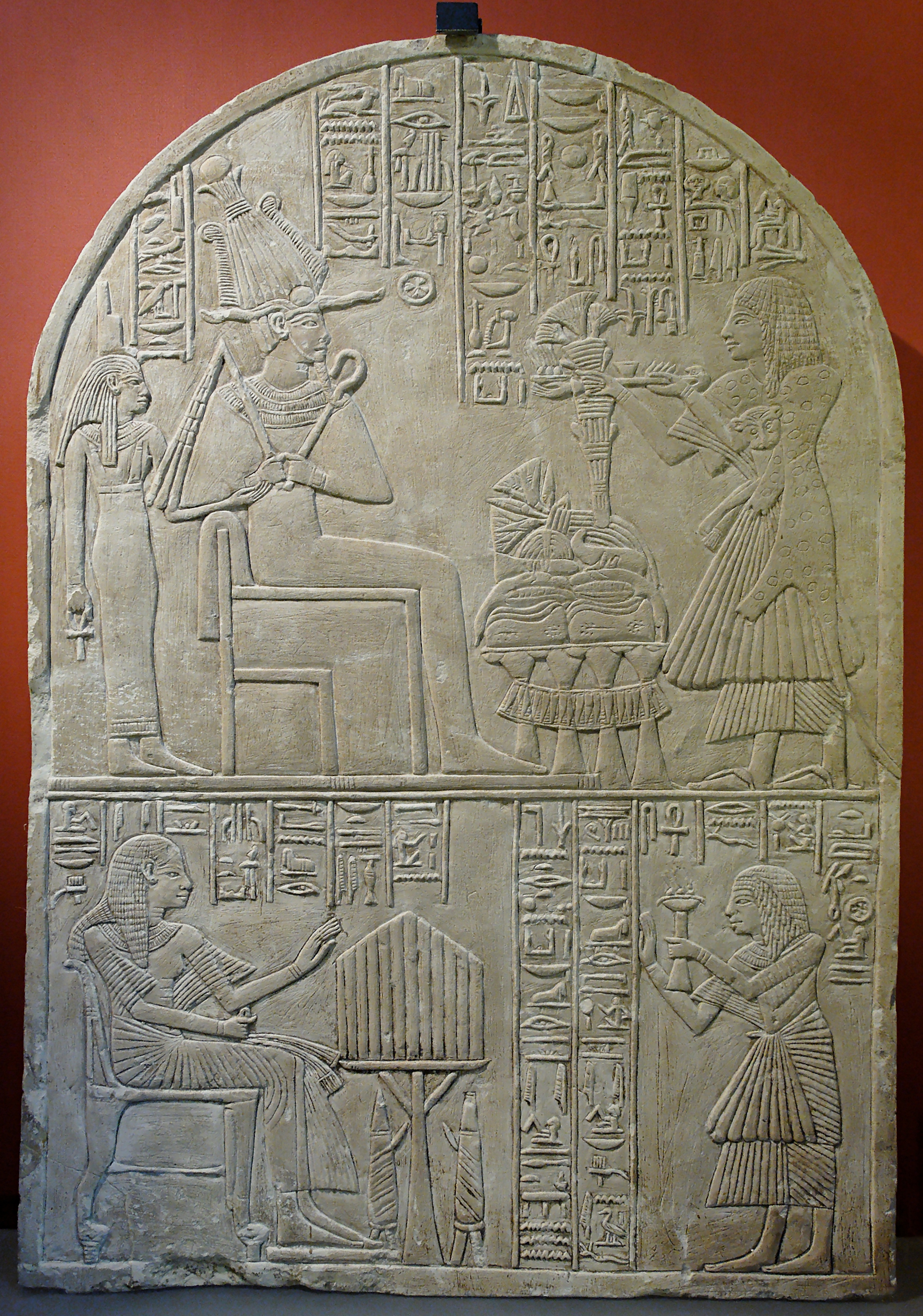
Iuny Stele

The Iuny Stele. An Egyptian funerary stone. Louvre. Dated to New Kingdom Period.

The Iuny Stele from Egypt is shown here. In particular the depiction of Osiris and Isis found in the upper left section of the stele is examined in this post. Begin by observing that Isis on the left holds the arm of Osiris with almost a disembodied arm and upturned hand. Osiris’ body is turned in the traditional pose of rotated at the waist. This exaggeration with the hands two fisted at the center imitates the symbol for the sound ‘hwi.’ This sound we have seen expressed in many of the Adena Tablets suggesting the Anglo word ‘hwy.’ The feet of Osiris supply another sound ‘ta.’ Combining these two sounds the word hwa-ta is formed. The modern spelling of this word is ‘what.’ The headdress supplies the answer to ‘what and why.’ Baal is the origin of the cause as the oval or glyph for Femina suggests. On each side of the headdress is the Magnus symbol ‘great.’ Along the sides are numerous lines. Numbers are typically indicated by lines in this glyph system. Two ways to think of the lines then are ‘numerous’ or the glyph for Ala/wings of an army.

The headdress illustrates the idea further. The lines are drawn upwards and banded together. Longitude is banded together at the North Pole. There are seven lines below the bands and six above it. This creates the number 76 which is easily associated with the period of Halley’s Comet reinforcing the idea the art is about a comet. So then, this can be read as a ‘great many comets struck the place where the lines of longitude gather at the North Pole.’ The four bands give one further number. A square with 4 units to a side has a diagonal of 5.65 units. This gives us that very important number seen repeatedly in the Adena art.

Other numbers can be easily found. The headdress of Isis is three steps. Latitude is a series of steps towards the pole. Her hair has three curls in front of her shoulder and eight curls behind. This creates the number 38 which is half 76 and repeats the reference to Halley’s comet.

Below Osiris’ headdress we find the symbol for Propheta depicted in very much the same manner as it was depicted on the Adena tablets. Between the two feathers is a second circular glyph also suggesting Baal or the origin. This second Baal completes the idea of ‘two comets.’ To the right is a circle glyph that represents the concept of rotate. The idea of rotation is expressed two other times in the image. Osiris always appears rotated at the waist and the appearance of the eye is rotated whereas the mouth and nose are portrayed correctly. The degree of rotation is indicated by the flail. Half the flail’s three vertical lines is broken into five sections or perhaps it should be seen as 33; 33.5 or some combination of this. This number was seen in the tablets. Recall 90 degrees (at the pole) minus 56.5 is 33.5. The idea of rotation was found on the New Hampshire Mystery Stone with the twirl symbol.

From the New Hampshire Mystery Stone - the idea of turning

New Hampshire Mystery Stone glyph

The face with its typical Egyptian turned eye and odd beard gives further information. The eye is the glyph Ocular/eye and comets are known to be composed of masses often called the eye. The beard suggests the letter ‘ra’ in the glyphs. Combining the sounds ‘i’ and ‘r’ we find both the old and new Anglo word ‘ire’ which means to wander, to be angry. The face itself is the glyph for Caput or head. It can also be interpreted as the glyph for Prae which means ‘before.’ The face then is relating that the ‘previous pole/head of the planet wandered.’

The collars give another number. Two segments on Isis’ collar and three segments of Osiris’ collar form the number 23. The arctic circle ends at latitude 23 degrees and 30 seconds. It forms a ‘collar around the head of the planet.’ It also forms the number 32 which is 5.65 squared.

Furthering the idea that the North Pole is the place to which is being referred is the flail and hook held at an angle by two fists. The pole is the place from which the angles of longitude are marked out. Two firm fists suggest two places are involved: the north pole and the magnetic pole. It also suggests the idea of both latitude and longitude which are measured from the north pole. This is reiterated by the embracing arm of Isis under Osiris’ arm. Furthermore, Isis’ hand is in the form of the glyph for Manus/power over the people. Certainly, standards of measure such as measurement from the pole hold power over the people. Another repetition of the idea of union is found in the Ankh within Isis’ hand. It is the union of two glyphs: Femina/origin and the Cross. The Ankh then refers to the place from which measurements begin. Repeating again this duality of two poles is the two feet of Isis but only one shown for Osiris. If the face of Osiris suggests the glyph for Prae or ‘before’ then they are relating that previously there was only one place of measurement and now there are two.

Glyph map of Iuny Stele

The images of Isis and Osiris on the Iuny Stele demonstrate the use of Luwian/Hittite Hieroglyphs. The glyphs used and the message is identical to that found on the Adena Tablets of ancient Ohio.

The throne itself provides more information. A blanket is laid over the back of the chair and this is typical in Egyptian art. The chair is composed of several symbols. These are Argentum /shining, silvery; throne; cubitum/measurement, and aedificium/structure. Altogether they describe the polar ice cap that once overlaid the North Pole as a shining white blanket from which measurements were taken providing structure.

The name Isis was discussed in previous posts and that it is depicted in the Adena tablets as Ice-sess. Sess in Anglo means ‘seat’ and is the root of the modern word sister. Mythology tells us Isis was Osiris’ sister. What then might the name Osiris mean? In Latin ‘os’ means opening or origin. Spelled as ‘aes’ it means food in Old English and is associated with the word mouth or once again the idea of an opening. Spelled as ‘ease’ it means a beaker or lipped vessel. Perhaps this is a reference to a crater. Spelled as ‘os’ it means god. Ire as noted above means to wander, to be angry. ‘Is’ in Anglo means ice. Osiris is then a compound of three words: os-ire-ice.  The word could then mean ‘an opening in the wandering ice.’ In other words it confirms the analysis above. The story related is the same as in the Adena Tablets which is summarized as follows: Two great comets with many others struck the pole and the pole wandered (ire) and rotated. Previously there was one place of measurement whereas now there are two. Longitude is referenced from this old pole where there is a crater.

The rotation of the pole from an engineering standpoint is discussed within this site here (pdf).

The origin of longitude measurement (the zero line lies at Greenwich today) is described by the Ankh. Hence, its prevalence in Egyptian art. We might understand further if the gematria of Ankh is examined using Hebrew equivalents. ‘A’ gives us 1, ‘n’ give 50, ‘k’ gives 20, and ‘h’ gives 8. The sum is 79. If the word is examined further the first two letters give 51 and the last two give 28. What lies at latitude 51 degrees 28 minutes and 40.12 seconds? And what is 79 degrees of longitude distant from it?

The importance of this word is not confined to Egypt. It is found boldly in our own language. Consider one important word: thank. Is this not ‘the-ankh’? Has its meaning been forgotten through time?

Next we continue with the fabulous Cincinnati Tablet.

Back to the very beginning of series on Adena Tablets

Previous Post on Wilmington Tablet

Posts on: Lakin A Tablet, The Gaitskill Clay Tablet,

Allen Tablet, Grave Creek, The Kiefer Tablet,

Wright, Lakin B and Meigs Tablets,

Berlin Tablet, Gaitskill Stone Tablet, The Low Tablet,

The Waverly Tablet, and Metcalf Stone,

and pdf article on

Hudson Bay as a comet crater of recent origin.
The Adena Tablets of Ancient Ohio – The Wilmington Tablet

© 2014 B. L. Freeborn

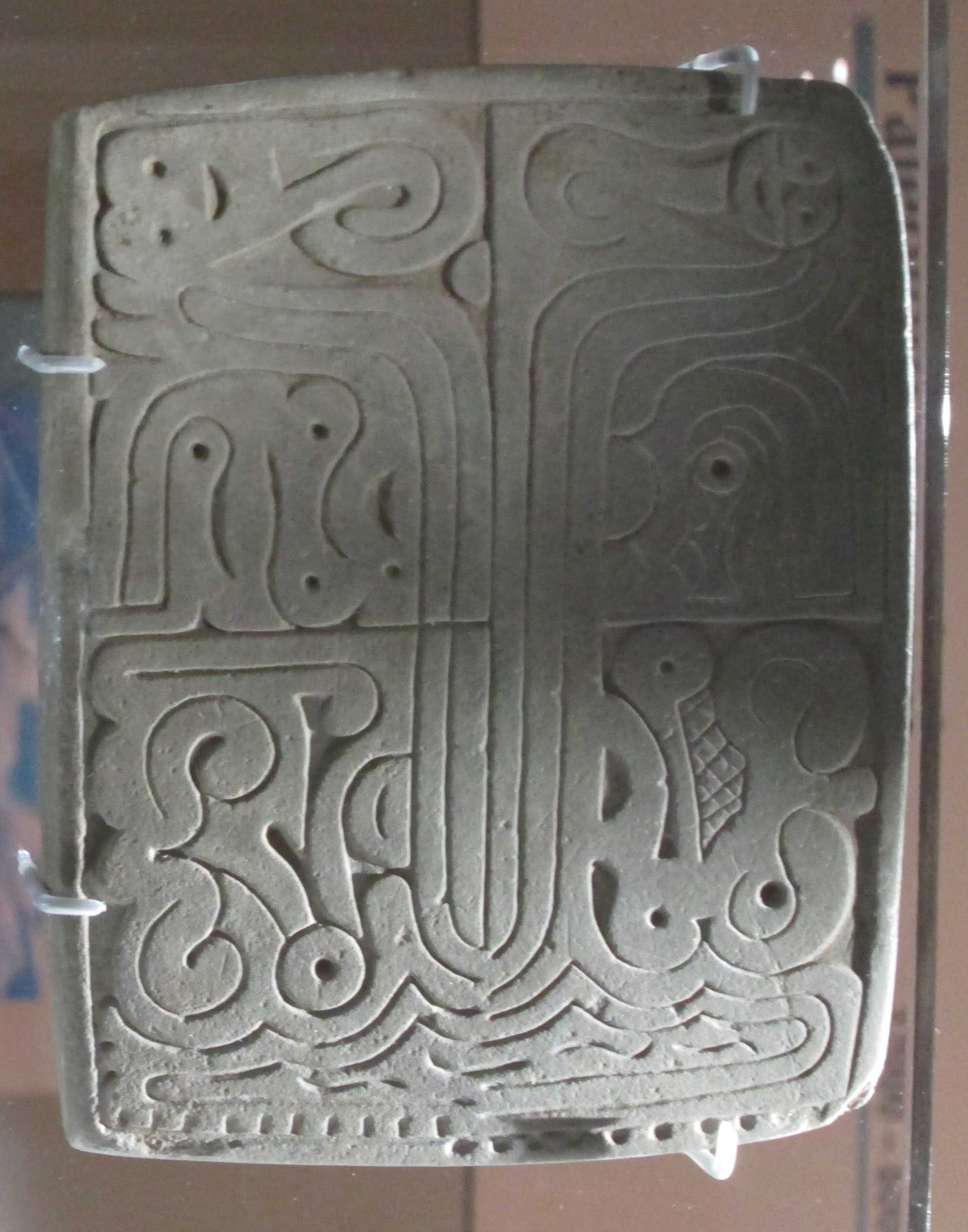
The Wilmington Tablet is only 5″ by 3.8″ by .6″ thick. It is made of sandstone and resides in the Ohio History Museum, Columbus, Ohio. This artist could not have been more clear in his depiction yet it is displayed on its side and usually is described as a phallic image.

Wilmington Tablet

Wilmington Tablet, Ohio History Museum, Columbus, Ohio shown in its correct orientation.

Baal and his twin self are depicted at the top with one tail on the right and twin tails on the left. Central to the image is a massive comet projecting towards Earth. It is so enormous it dwarfs the mountains depicted at the bottom. Recall all of northeastern Canada down to Ohio was once covered by ice mountains two miles high. The swirling shapes to each side of the comet depicts the destruction that followed the impact. Hidden in these swirls are Hittite/Luwian glyphs from the Anatolian region of Turkey. Within every part of this image there are many numbers.

This is the essential and important story this tile relates in a blatantly realistic fashion. What is it that keeps us from seeing this clear depiction of an enormous comet?

The remainder of the message is told through glyphs and numbers. We began with a one tailed Baal and a two tailed Baal, or a comet that split into two. One and two helps us recall there are 12 houses in the heavenly Zodiac. Continue counting by noticing it is actually divided into four panels. The planet can be said to have four quadrants. A square of 4 units to the side has a diagonal of 5.65 units. At the middle horizontal line count across the comet and find 6 lines above but only 5 lines below for 56. Reverse this and obtain 65 or nearly the velocity of the planet at 66624 mph. Similarly, count 6 dot holes on the right half and 7 on the left half for 67. Reverse the number and obtain 76. The period of Halley’s comet is 76 years. Count 9 holes on the upper half but only 3 on the lower half for 93. The average distance between Earth and the Sun is 93 million miles. There is 1 hole in the left lower square and 6 in the upper left for 16. The Earth travels 1.6 million miles in a day. Reverse the number and find 61. There are 60 minutes in an hour and a square of 61 units to the side has a diagonal of 86.3 which suggests the Sun’s diameter of 864 thousand miles. The right side has 3 holes above and 3 below for 33 which gives the maximum change in latitude caused by the impact.

Side view showing double headed arrow on Wilmington Tablet

Side view showing double headed arrow on Wilmington Tablet

The 2 holes in the upper left Baal are next to 3 small fingers on the edge for 23. The upper sweeps of the comet’s tail are composed of 3 on one side and 2 on the other for 32. The square of 5.65 is 32. Reverse the number and find 23. Recall the Arctic Circle ends at 23 degrees and 30′ or approximately 23 degrees and 32 minutes.

There is a half circle on the centerline at the top. The tail on that side is one strong piece between two which makes 112. Or count the strong tail line as 1, the half circle as 1 and the other side of the tail supplies the 2 for 112. Above the middle line there is 1 hole below 1 hollow half circle and opposite there are 2 half circles for 112. The bottom left panel gives 1 half circle, 1 dot and 2 loops for 112. Each and every 112 is twice 56.

On the right lower there are 3 dots and 1 half circle for 31. This is pi³. Continue the count from 3,1 and then 5 lines and 1 half circle for 3151 which is close but off. It should be 3141 which is pi at 3.1415.

Surrounding the piece on the narrow edge is an arrow with a doubled arrowhead which repeats the idea of a double comet. A circle with a dot in the center is in the mid-shaft suggesting the crater or the all seeing eye of the north pole. Then it ends with fletching. This end has hash marks that alternate to make 8 per side or 4 per side depending on how it is viewed. Divide the circumference of the planet in miles by 44 and obtain 565.5 miles.

Sketch of Wilmington Tablet

Sketch of Wilmington Tablet from J. Ralston Skinner’s 1885 article.

At the bottom of the piece there is fringe which wraps up the left side. There are 2 on the left, then 10, then 9 to the right. Summing the last two obtain 19. Multiply this by the 2 from the side and obtain 38 which is half 76 or the period of Halley’s Comet of 76 years.

Alternatively, begin with the 9 and affix the 12 to obtain 912 which is just under Earth’s minimum distance to the Sun of 9.14 million miles. If a simple sum of 9 and 12 is taken, find 21 which when multiplied by pi is a hair under 66. The velocity of Earth is 66624 mph.

The next few numbers are important because they are arrived at by using the Inch System of measurement. The dimensions of the piece in inches is 5″ x 3.8″ x .6″. The sum of the length and thickness is 5.6 which repeats 56 again. Twice 3.8 is 7.6 which recalls the period of Halley’s Comet. The sum of the 3.8 and .6 is 4.4. The circumference of the planet is 565.5 miles x 44. Sum 3.8 and 5 and obtain 8.8. A mile is 880 feet times 6.

Before moving on to the glyphs let us take note of all the numbers found on this piece and compare it to the numbers found on prior tablets. Here we found: 12, 16, 21, 23, 23 32, 31, 32, 3, 33, 3.8, 38, 4, 4.4, 44, 5.65, 56, 61, 65, 66, 67, 76, 8.8, 9, 93, 112, 912.

The cumulative list from previous tablets follows. Those in bold were also found on this tablet. 108, 111, 112, 1212, 12321, 14, 1414, 16, 17, 212, 2121, 21212, 2166, 222, 23, 23 32, 23.5, 24, 241, 2486, 26, 31, 32, 33, 333, 34, 40, 43, 44, 52, 54, 56, 56.5, 56.5, 58, 6, 64, 66, 66624, 7, 72, 76, 777, 79, 792, 86, 88, 9, 90, 92, 93.3, 7924 and 8642.

Glyphs for Malleus (hammer or disease), Calleum (heaven), Mille (vast number), and sound 'sa'

Glyphs for Malleus (hammer or disease), Caelum (heaven), Mille (vast number), and sound ‘sa’

Next the artwork is examined to see if any hieroglyphs can be found. Begin with the upper left Baal and find the Luwian/ Hittite symbols for Malleus, Caelum and Mille all joined. The first means a mallet or disease, the second means heaven, and the last which is doubled means a vast number. The image suggests then a disease from heaven in vast numbers or in modern terms: comets and meteorites.

Luwian/Hittite Glyphs

Luwian glyph for Deus (god), glyph number 502, Ala (wing of army), sound ‘i’, and sound ‘sa’

Opposite this we find another Baal which is described by glyphs Caelum #182 (heaven) and the right side is a variation on Deus #360 (god). This symbol is very close to glyph #502 which has no meaning attached to it. The tail repeats the Mille glyph suggesting again a vast number. This is easily translated as ‘gods came from heaven’ and is just another way of saying in modern terms many powerful comets came.

Prophet Symbol

Prophet Symbol

The sweeping tails of the central comet are the feathers on the head of the prophet glyph.

Wing symbol meaning troops - Ala 78

Wing symbol meaning troops – Ala 78

Beneath this in the upper right panel the idea is expounded upon. Glyph # 78 for ‘wing’ is an army wing or troops. It lies above a circle-dot. This suggests the two comets arrived with troops making craters.

Glyph for sound 'i'

Glyph for sound ‘i’


The upper left panel explains more. The first is the upright with the dot for sound ‘i’ found in glyph #209. The two connected circle-dots form two ‘sa’. This ‘sa-sa’ suggests repeated ‘s.’ This spells out i-s-s or the name of the Egyptian god Isis. But it also resembles two Anglo words, ice and sess. The first we understand and the second we hear in sis-ter. Sess is a seat. Ice-sess than implies an ice-seat and so we may hazard to guess that Isis is ‘ice-sess.’ These glyphs are followed by another circle-dot for another ‘sa’ such as we hear in ‘see.’ It is next to the glyph for Caelum or heaven which is connected to the comet or the central pole. Putting this together we have ‘the seat within the ice from which all heaven can be seen at the pole.’ This is the North Pole. A long distant ancestor tells us the meaning of a Goddess in a far distant land with symbols long forgotten and words we still use.

Luwian Glyphs for Halpa (help), sound 'hwi', Cornu (horn) or sound 'su', and sound 'sa'

Luwian Glyphs for Halpa (help), sound ‘hwi’, Cornu (horn) or sound ‘su’, and sound ‘sa’

In the lower left panel find the glyph for ‘hwi’ #329 in the two twirls. The original way the word why was spelled was hwy. So it asks very clearly, “Why?” The symbol for Halpa or help lies above it which reiterates the exclamation. Towards the pole is the symbol for ‘sa’ #402. Above this is symbol #108 Cornu meaning a horn with sound ‘su’ probably meaning ‘to sow.’ The sequence suggests “Help! Why! A comet sown”

Luwian Glyphs

Glyphs for Lituus (a staff), sound ‘ha’ or ‘pa’, and Malus (evil))

The bottom right panel gives us once again the ‘sa’ for ‘see’ with Lituus #378, a staff. Then there is cross hatching which suggests glyph #224 with sounds ‘pa’ or ‘ha.’ ‘Pa’ begins the words pole, power, and post. While ‘ha’ is the Anglo word ‘heah’ which we know as high. The reversed 3 towards the edge is glyph #368 Malus or evil. Putting this together we have ‘to the seeing staff of the pole on high came evil.’

The image on The Wilmington Tablet is composed of many Luwian Hieroglyphs which tell a story.

The image on The Wilmington Tablet is composed of many Luwian Hieroglyphs which tell a story.

This is the same message people on both sides of the world knew, understood, discussed and shared as revealed by their common knowledge of the subject, manner of depiction, and embedded numbers. They ask “Why! On high did this great evil come?”

This leaves the reader still wondering. Could it be? And where? Where is the evidence of this evil? But they tell us. Baal (Deus or god) struck at 56.5 as the Hebrew word for god, Yahweh, echos in its number gematria. Transcribing this word into numbers gives 5,6,5,10 or 56.5. Indeed, further still one must hear the word ‘why’ pronounced the original way ‘hwy’ in the word Yahweh when read left to right or backwards – hewhay.

But we need a second reference to find a location and this they provide. Recall in our prior number list (see Meigs Tablet and Kiefer Tablet) was the number 792 and this is the length of the diagonal of a square of sides 56. It also recalls the diameter of the Earth at 7920 miles. From the line of longitude of greatest displacement they traveled east 79.2 degrees and defined the zero longitude point at Greenwich, England at the same place it is today. This number of degrees was chosen to honor the diameter of the planet. So, reverse their journey! Travel back due west 79.2 degrees of longitude and find the home of Bi-Baal. The reader is encouraged to discover the place for himself. It is summed up by this pun: Holy Bible. Find the holy bible (hole lay bi-Baal) or the hole laid by two Baals.

More to learn about ourselves in upcoming posts.

Next post on Luwian Glyphs in Egyptian Art

Back to very first post on Adena Tablets

Previous Post on Lakin A Tablet

Posts on: The Gaitskill Clay Tablet, Allen Tablet, Grave Creek,

The Kiefer Tablet, Wright, Lakin B and Meigs Tablets,

Berlin Tablet, Gaitskill Stone Tablet,

The Low Tablet, The Waverly TabletMetcalf Stone,

and pdf article on

Hudson Bay as a comet crater of recent origin.

The Adena Tablets of Ancient Ohio – The Gaitskill Clay Tablet

© 2014 B. L. Freeborn

Art from ancient Ohio - Gaitskill Clay Tablet

Art from ancient Ohio – Gaitskill Clay Tablet

Art from ancient Ohio - Gaitskill Clay Tablet

Art from ancient Ohio – Gaitskill Clay Tablet. Clay copy.

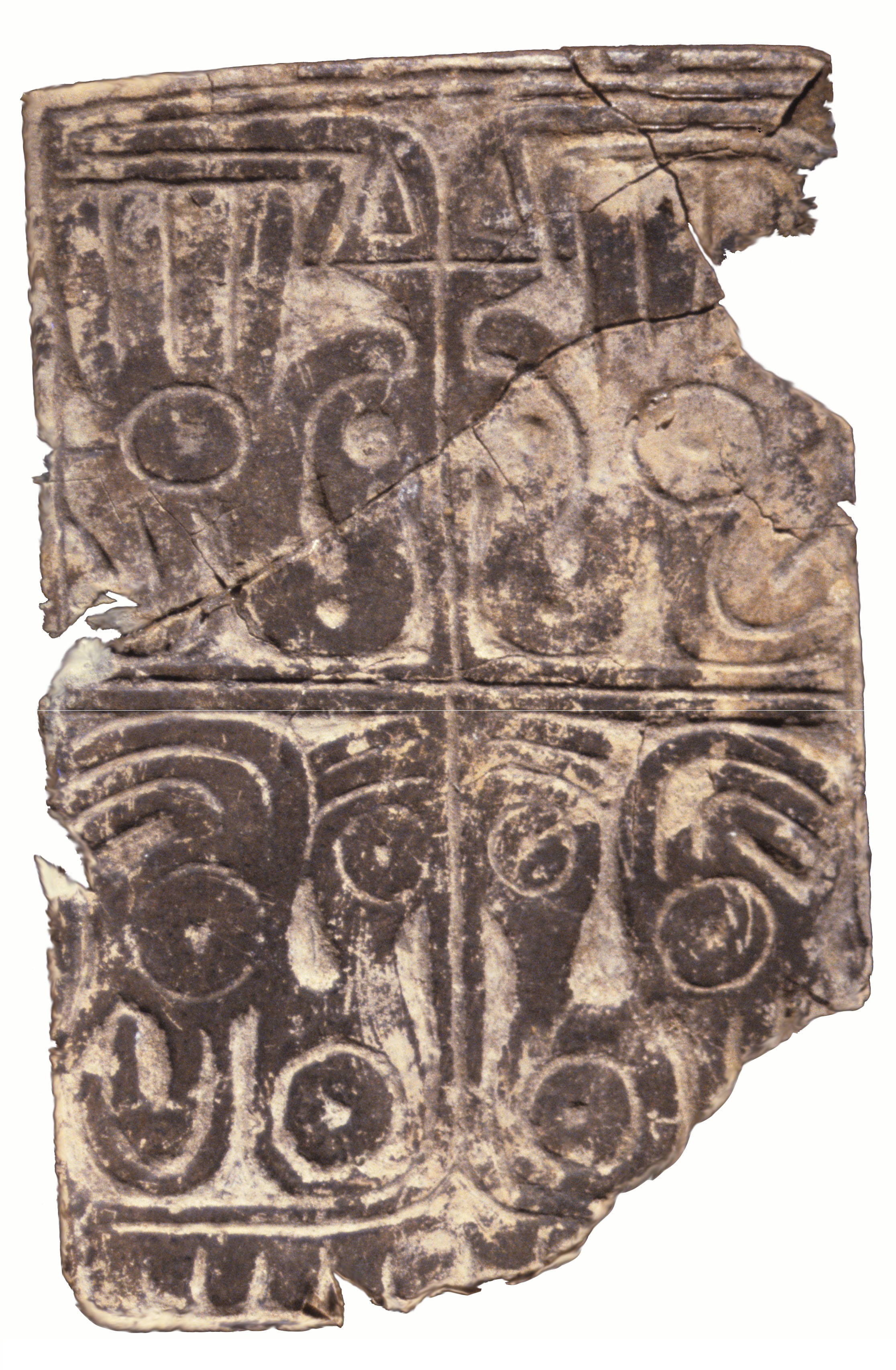
Preserved from ancient Ohio is the Gaitskill Clay Tablet which gives us much to ponder. This stone has been described as having anthropomorphic and/or zoomorphic characteristics. Another author describes it as Avian with four world quarters. If we reflect on the open mouthed man who seemed to be crying ‘no’ in the Waverly Tablet and the angst of the Gaitskill Stone Tablet then it follows that what the artist is portraying is two hands held up as if to say, “Stop!” Above the hands appears two triangles which suggest this is another way of expressing the double eye of the comet Baal. Up and over on each side is the double tail of the comet. The two tails are similar in style to the feathers in the hat of the Prophet Glyph and the curved down feathers seen on the men in the Low Tablet. If the center line is taken as the pole then the reference to four quarters of the world is correct.

There are other details we might notice. In the lower quadrants notice the three lobed wings above the large circle that are like those in the Low Tablet. The Luwian Hieroglyph Symbol #78 Ala meaning ‘wing of army’ is similar. The wing of the Army of Baal would be the debris that preceded, followed and was created by the comet. The image shows multiple circles suggesting many craters of various sizes occurred.

Prophet Symbol

Prophet Symbol

Wing symbol meaning troops - Ala 78

Wing symbol meaning troops – Ala 78

In a prior post the name of the goddess Isis was discussed. It was suggested it means ‘ice-seat.’ At the base of the center pole on the tablet the lines fan out. Perhaps this symbolizes a mountain of ice or the mountain Isis at the seat of the North Pole. But the story these tablets relate is that the pole has a mirror image, a second location to which it moved. ‘Where?’ was the question asked by the Low and Waverly Tablets. Presumably the tablets answer the question. Perhaps this tablet will reveal the answer to us.

The quoted dimensions of the stone are 4.4″ x 2.95″ x .55″. The last number is .01 off from 56 suggesting this was the desired thickness. But these stones vary too much in thickness to be so exact so 4.4″ x 2.9″ x .6″ is a better way to describe it. The 4.4 we will see repeated in the stone and discussed later. The sum of these terms is 7.9 inches. The diagonal of the stone squared is 28 and twice this is 56.

The abstraction of the drawing is distracting to say the least. By counting the message becomes clearer. There are 8 large dot-circles. Of these, 6 are on the bottom. On the top there are 4 dots without outer circles and 2 remaining large circles. This gives us 8,6,4,2 which is a descending even series. When combined the familiar 86420 that is reminiscent of the diameter of the Sun at 864322 miles appears.

Those 6 bottom circles can be counted out as 3,3. The top circles as 12, 21 or perhaps it is 1212 or 2121. This all seems familiar and the abstraction begins to make sense. The fingers on each hand give 4 and 4 for 44. The thumb finger combination gives 1414 which we have seen before. Recall 4 x 14 is 56. The bottom fringe can be counted out as 5 upward nips and then the center plus the other side (assumed to be a mirror image) makes 6 for 56. This was found in the same manner on the center strip of the Low Tablet.

In the lower half the 3 wings to the left and 2 in the opposite direction makes 32 23. The 2, 3 pattern repeats in the two lower tails and the three circles. It repeats again on the left with two side tails and above it lies three lobes of the wing. Counting the 2 lower tails and the 2 side tails creates 22 which is half of 44.

In the top half move around the exterior of the hand and count 2 lower tails, 4 fingers, 1 thumb for 241. Also count 2 lower tails, 1 large circle, 2 dots for 212. The 5 fingers on the hands plus 2 tails creates 52 suggesting weeks in a year. The total sum is 7 for the days in a week.

The only number listed above that is new to our long list of numbers from the previous tablets is 44 but then again it is not so new. We already have 2486 suggesting the circumference of the Earth at 24881 miles and the very repetitive 56.5 listed. Divide the circumference of the planet by 565 and the term 44 appears.

Thus the abstraction is a rather clever way to relate numbers to a people who are both distant in place and time with no common language. It is clear from this list that these numbers and the story related involves the Earth and that someone had advanced scientific knowledge which they wished to share with someone of similar mind. That would be us.

The next tablet is equally abstract but rewarding to study.

Back to very first post on Adena Tablets

Previous Post on The Waverly Tablet

Posts on: Allen Tablet, Grave Creek, The Kiefer Tablet,

Wright, Lakin B and Meigs Tablets,

Berlin Tablet, Gaitskill Stone Tablet,

The Low Tablet, Metcalf Stone, and pdf article on

Hudson Bay as a comet crater of recent origin.
The Adena Tablets of Ancient Ohio – The Waverly Tablet

© 2014 B. L. Freeborn, updated Sept. 2022

Art from ancient Ohio - The Waverly Tablet

Art from ancient Ohio – The Waverly Tablet

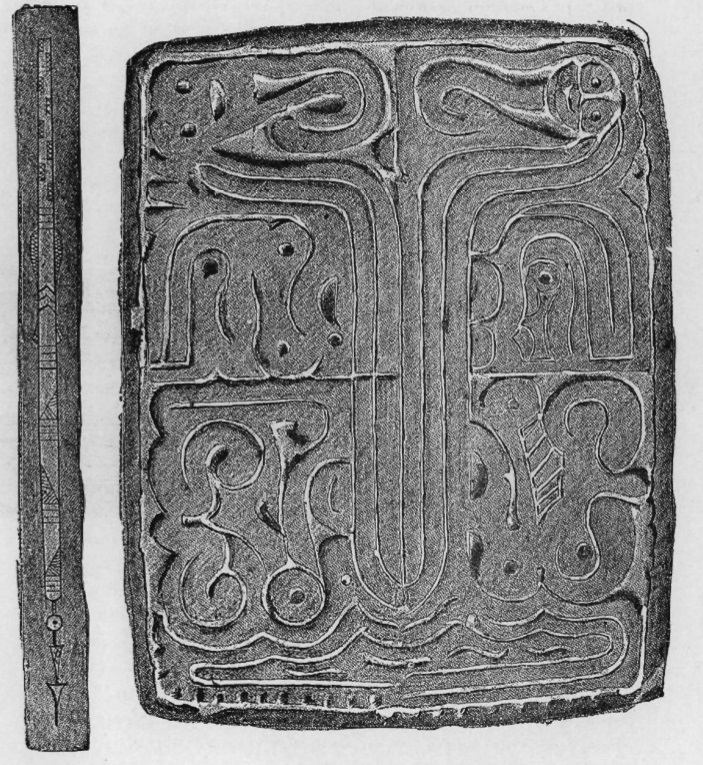
The Waverly Tablet was created by an artist with a very skilled hand. The image is clear, sharp and symmetrical. It is located in the Cincinnati Art Museum.

The tablet displays the four panel style with the center bar which by now we understand immediately. In fact there is little about this tablet that the reader cannot discern for themselves. In the upper left Baal, the comet, appears in its two tailed form. The man seems to exclaim ‘oh’ or ‘no!’ upon seeing it. In this image his mouth forms the round empty crater. His face spells out wa-ur (where) just as in the Low Tablet. The pole is represented with a rounding at the top and bottom. The bottom gives a very definite negative shape like water waves or mountain peaks. I suggest it is the latter since the story relates to a prior era when great ice mountains laid over Ohio so heavily it was 800 feet lower in elevation and completely uninhabitable. It is also suggested by the name of the goddess Isis which was studied in Berlin Tablet post. There it was suggested Isis means ‘ice-sess’ or ‘ice-seat.’

On the right side there is disarray as two people ornately designed to double as flowers lie dead, shot through the head as if to say all was destroyed. The short bar at the top provides a sound. It appears to be symbol #383 or ‘ra’. The center bar is a form of ‘I’ and combining them we have the word ‘i-ra’ which remains unchanged through the centuries. It is ire or anger which is appropriate to the scene. Anger was clearly portrayed in the spider-like Gaitskill Tablet. ‘Ire’ also means to wander. So, it doubly suggests movement of the pole.

Numbers are supplied by punch marks and the four panel layout. We find 1, 4 provided by the layout and 4 x 14 = 56. In the top left panel there is 1 punch. The face panel provides 3, the upper right provides 2, and lower right provides 3 for a total of 9. This provides the 9 in 792. The two dots on the bar provide the 2. The remaining 7 are in the images. Hence, 792 is found.

On the left side between the upper-lower panels is a punch provided in the negative which allows 23 32 to be found on both halves. The short bar at the top provides 1, the bar 1 and the two dots complete 1,1,2. Each flower person provides 1,1,2 by using the dot, the head and then the two arms surrounding each head. If the bulb of the nose is counted as 1 then the left side provides 6 and the right side 5 for 56. The upper most center dot gives 1, the lower dot 1 and the sides of the bar gives 2 for 1,1,2 again or 2 x 56.

On the right side if the dots are counted left to right from top to bottom a group of 3 is found followed by 2. Reading from bottom to top there are 3 lines of 3 for 333. This number we have seen many times on the tablets. There are 9 distinct dots. If the nose and negative dot are added to the sum there are 11 or write this as 92. The latter suggests the distance Earth lies from the Sun. Or if you prefer 29 and this is half of 58. The distance Earth travels in a year is 584 million miles.

The Baal panel, upper left, seems to provide a line on the left which might have formed a dish or crater. This would have then given 1,1,2 as 1 crater, 1 eye, 2 tails.

The tablet measures 3 3/8 x 2 5/8 x 13/16 inches. The sum of the sides is 6 inches. The area of the face is then 8.86 sq. in. and a volume of 7.2 cubic inches. The product of 6 and 88 is 528. There are 5280 feet in a mile. The tenth mile appears at earthwork sites such as Newark. The diagonal calculates to 4.3 inches and twice this is 8.6.

These are all numbers we have seen before but their importance is contingent on the inch being in use by the artist. The ratio of the side lengths however eliminates units. The ratio is .777 which is significant.

Since this tablet portrays so many numbers it might be time to recall the number list and update it. The updated list includes: 108, 111, 112, 1212, 14, 16, 17, 212, 21212, 2166, 222, 23, 23 32, 23.5, 24, 241, 2486, 26, 31, 32, 33, 333, 34, 40, 43, 52, 54, 56, 56.5, 56.564, 58, 6, 66, 66624, 7, 72, 76, 777, 79, 792, 86, 88, 9, 90, 92, 93.3, 7924 and 8642. Now that they are getting easy to read let us try something a wee bit more complex.

Next post on Gaitskill Clay Tablet

———————-

See David Penny’s Article on these stones here.

————————

Back to very first post on Adena Tablets

Previous Post on The Low Tablet

Posts on: Allen Tablet, Grave Creek, The Kiefer Tablet,

Wright, Lakin B and Meigs Tablets, Berlin Tablet,

Gaitskill Stone Tablet , Metcalf Stone, and pdf article on

Hudson Bay as a comet crater of recent origin.

The Adena Tablets of Ancient Ohio – The Low Tablet

© 2014 B. L. Freeborn

low tablet alternate

Low Tablet. Art from ancient Ohio.

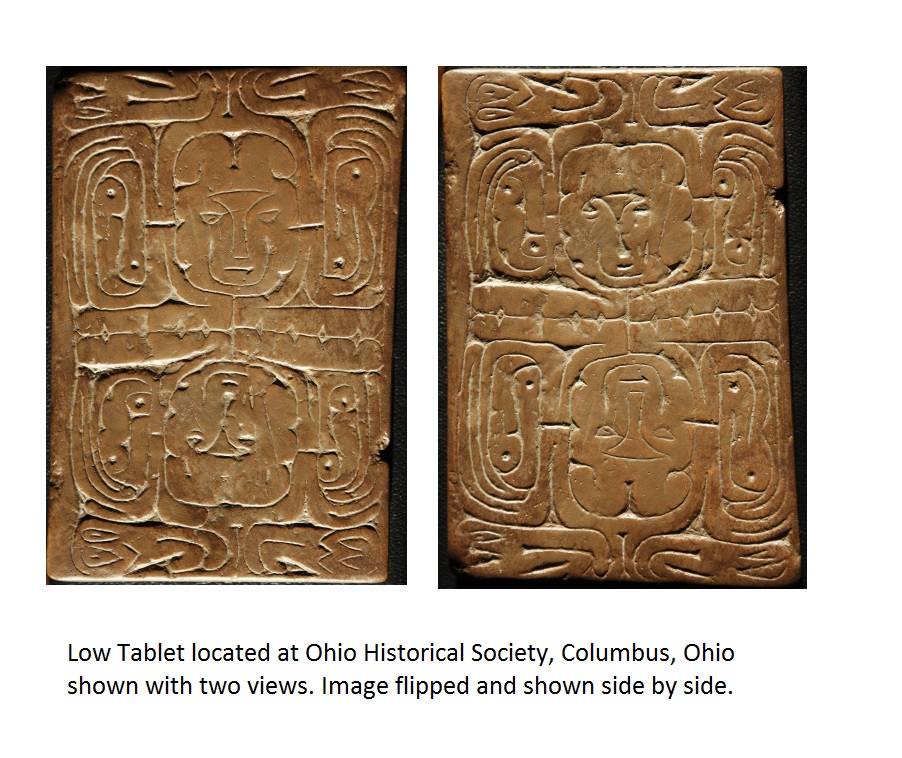
The Low Tablet was found by Edward Low in Parkersburg, West Virginia and can be viewed at the Ohio Historical Society. Its message provides a important link in understanding the symbolism on other tablets.

Center stage and in mirror image is a man with a distinctive hat made of two side appendages. Most would call him a shaman or medicine man. He might be more appropriately called a Prophet. This is the name of the Luwian (La Angle) Hieroglyph from ancient Turkey (3000-2000 BC) that portrays the same concept – a man with a hat with two appendages which appear to be feathers in a flame shape- is #524 Propheta. The idea that great leaders on far sides of the planet wore feather hats is easily accepted. That they are depicted as adorned by -two- feathers in opposite directions is interesting.

Prophet Symbol

Prophet Symbol

We find as usual the symmetry in the design and the appearance of the two eyed, two tailed Baal portrayed in each corner which confirms the topic. On each side of the prophet’s head we find two comets lying in their nests or, more aptly described, craters. If we focus directly on the face of the prophet we see the nose-forehead is a sort of upright object. At the ear positions are short strong straight lines. Similar lines above and below the faces give the impression of the cardinal directions. The chin is etched in as an over accented cup and looking at the face again we see the nose is then the comet and the chin is its crater. The feathers upon the head are then the two tails of the comet which suggests why the Anatolian Luwian glyph for Prophet has just two feathers in his hat. The remembrance and discussion of a two tailed comet appears to have been worldwide. That the conversation spanned two hemispheres is evident by the similar symbols.

Symbols 'wa' and "Magnus'

Symbols ‘wa’ and “Magnus’

The face suggests with its nose pillar and two eyes, symbol #439 with sound ‘wa.’ The deep chin suggests Magnus or great, symbol #363 which has sound ‘ur.’ Sounding out this simple word creates wa-ur in which we cannot help but hear ‘where.’ For sure, this is just what the interpretation suggests. When we hear of two comets striking Earth, we immediately ask, “Where?” Presumably the image answers the question it asks.

Low Tablet shown twice

Ala 78

Ala 78

Wing (Ala) on Lowe Tablet

Wing Symbol (Ala) on Lowe Tablet

There is another important glyph here that appears on other tablets. Symbol #78 Ala meaning ‘wing of army’ is shown. The wing of the Army of Baal can be none other than meteorites and other smaller masses which accompanied the comet that changed the world. Each wing is formed by four bars. Each section has two end to end Baals, four bars in the wing and the center line creates 2,4,1 or 241 which reminds us of the 24 hours in a day, 24 hours of longitude and that 241 x 241 = 58081. This number 241 provided the layout for the insect shape of the Gaitskill Stone Tablet. The distance Earth travels in a year around the Sun is 584 million miles.

The center bar repeats the idea of two and within it is found the series of numbers marked by diamonds 1,4,1,4,1 which when multiplied by 4 is the number 56564. The number is also the square root of 2. ( 2 = 1.4142 x 1.4142) This reminds us that a square of side 4 units has a diagonal of 5.65 units. The number is obtained by multiplying 4 times this pattern 1.4141. The series also creates the sum 11.

The overall layout of the piece is 2 (Baal at the top), 3 (craters and face), 1, 3, 2. This gives again the 23 32 pattern about a central pole. The doubling of the face suggests two such places that are identical or that the pole moved. Perhaps this answers the question “Where?” The comet struck at the original pole which caused it to move.

The number 2 is portrayed everywhere. The meaning of Deus in Latin is god while the meaning of duo is two. The glyph which represents Deus in the Hieroglyphs is a circle divided in two. Two Baal, a symbol split in two, Deus meaning god and duo meaning two all suggests a strong relationship between them. Or perhaps we should use the word ‘bi’ instead for two and confirm there are Bi-Baal at the top and bottom of the image. Each Baal has two tails so that 2,2,2,2 is created top and bottom which sums to 8. The total sum is 16 and the distance Earth travels in a day is 1,600,000 miles.

Across the face portion there are 2 Baal, 1 line (at the ear), 2 eyes, 1 line, 2 Baal which makes 2,1,2,1,2 or exactly the pattern displayed by the Grave Creek Tablet. The sum of 2,1,2,1,2 is 8. Interestingly 21212 x pi is 66637. The velocity of Earth is 66624 mph. However, pi which equals 3.1415 is not represented, or perhaps it is! Those 2’s at the top created 2222. A square of sides 2222 has a diagonal equal to pi x 1000.

The center bar also provides 56. Counting diamonds left to right, count five and stop at the middle and then from the middle to the far side is six. The four dots on the top panel are complemented by four dots on the bottom panel which represent the number 44. Divide the circumference of Earth in miles by 44 and obtain 565.5 once again. The numbers then are consistent from tablet to tablet and were not randomly chosen which reinforces that they are intrinsic to understanding the message and the culture.

What else might these tablets tell us about ourselves and what is missing from the history books?

The Waverly Tablet has the same little man face so we study it next.

Back to very first post on Adena Tablets

Previous Post on The Gaitskill Stone Tablet

Posts on: Allen Tablet,  Grave Creek Tablet,  The Kiefer Tablet,

Wright, Lakin B and Meigs Tablets,  Berlin Tablet,

Metcalf Stone, and pdf article on

Hudson Bay as a comet crater of recent origin.

The Adena Tablets of Ancient Ohio – The Gaitskill Stone Tablet

© 2014 B. L. Freeborn, updated Sept. 2022

A stone tablet from ancient Kentucky. The Gaitskill Tablet.

A stone tablet from ancient Kentucky. The Gaitskill Tablet.

Gaitskill Stone Tablet

Gaitskill Stone Tablet shown upside down here so that the spider appears.

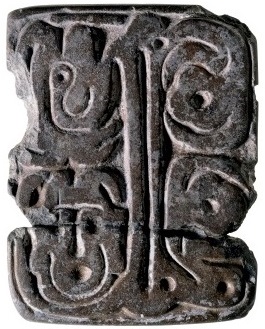
The Gaitskill Stone Tablet is assumed to be an image of a spider. The similarity to an insect is obvious with the legs and the large round abdomen. It was found in Mt. Sterling, Kentucky around 1920. It is dated to 500 BC to 200 AD.

Symbols 'wa' and "Magnus'

Symbols ‘wa’ and “Magnus’

209 i

Symbol for i.

In order to study it we have to turn it right side up and once we do we see some rather familiar features. The ‘wa’ (Luwian Symbol #439) is center bottom with its bold feature and two round circles. The loop in this glyph can also be interpreted as sound ‘i’ (glyph 209) and on each side of it are two ‘sa’ symbols or perhaps craters.

Ha or pa glyph #224.

Ha or pa glyph #224.

In previous posts it was suggested this is the north pole or polar axis from which all measures of longitude and latitude are taken today. Here depicted very clearly is just that. The pole stands atop a grid of hash marks 3 x 3 wide. This gives us 33 and 9. It also gives us 93.3. The hash mark symbol appears in the glyph repertoire as #224 with sound ‘ha’ or ‘pa’. Pa gives us the first syllable of both power and pole. Ha gives us ‘heah’ in Old English which means high. Both terms indicate importance and surely the seat of measurement is extremely important.

On top of the pole are three joined triangles which appear as scary teeth in one direction and a crown in reverse. This too appears in the Luwian glyph system as #231, Castrum, or ‘camp.’ This completes the message that this is the ‘home’ of the ‘po’ on ‘heah’. Despite sounding blatantly Anglo, it also sounds accurate.

Symbol Castrum means camp.

Symbol Castrum means camp.

Before moving on, the 33 we have seen before but the 93.3 is knew. It brings to mind that the average distance to the Sun is 93 million miles. It would be remiss not to note a few more numbers. Does the north pole not sit at 90 degrees north latitude? Is this pole not positioned on a grid? If we count out the two circles and three triangles to the crown there is a reappearance of the number 23 32. The Arctic Circle ends at 23 degrees 30 minutes. The two circles are once again suggesting two positions for the pole with its two circles on each side of the vertical. So we have one obviously where it belongs in the north but where are they saying the other was? Could the answer lie in the 3×3 grid?

But the image continues.

Once the image is rotated it loses its spider appearance but still has two faces. The upper face has angry eyebrows, two teardrops for eyes and a dot in the middle of the forehead as the Hindu’s wear. This reminds us of the Metcalf Stone with its initial symbol of a triangle. So here too we find the idea of one comet which split into two. If the expression is interpreted correctly, then it caused anger and weeping. The number 112 is easily found within this face again.

The overall exterior shape of this creature in stone has two straight bars on each side at the bottom. Above these are four flame or wing shapes. Two and four reminds us of the hours in a day. Topping this 24 pattern is the center round. If we begin with this center round as 1 and count around the image there are 12 wings. 1 and 12 once again appears and 112 = 2 x 56. If we begin at the bottom and count upwards then we find 2,4,1 or 241. The square of 241 is 58081 which is another number to add to our list which suggests the distance Earth travels in a year or 584 million miles. The hours in one day and hours of longitude around the earth is also 24!

If we begin at the center round and count in either direction then we form 1 and 4 to create 14, the number of days in a fortnight. At the bottom the four bars remind us that 14 x 4 = 56.

Symbol for flame.

Symbol for flame.

The last two things to be noted are the similarity to the Luwian glyphs for Flammae (flame) symbol #477 and Femina (woman) symbol #79 which is an oval. The eight exterior wings thus become flames around a central “woman” or place of origin. Taking this one step further, the straight lower bars taken across the figure become the glyph #384 in a shape similar to #388 which represents simply the number ‘two.’ In other words, the artist is describing a flaming comet which was really two.

This image utilizes so fully the hieroglyphs in use in Anatolia Turkey in 1200 BC that we must pause to consider the possibilities this creates:

  • The resemblance is purely coincidental.
  • It is from Turkey.
  • It was made in America by someone from Turkey.
  • It was made in America by someone taught /descended by someone from Turkey.
  • A third group of people created and inspired the art. They lived in Turkey in 1200 BC and Kentucky in 500 BC.
  • The symbols express a common language both continents shared.
  • North Americans traveled to Turkey and shared their language.
  • The Scottish Picts who used the symbols in 1200 AD and the Ancient Irish who used the symbols in 3000 BC were somehow related to both the Turkish of 1200 BC and the North American of 500 BC and 500 AD … and the Egyptians of 2500 BC.

Or…. there is really something that is missing from our history books.

We continue on by looking next at the Low Tablet

Back to very first post on Adena Tablets

Previous Post on The Berlin Tablet

Posts on: Allen Tablet, Grave Creek, The Kiefer Tablet,

Wright, Lakin B and Meigs TabletsMetcalf Stone, and pdf article on

Hudson Bay as a comet crater of recent origin.

The Adena Tablets of Ancient Ohio – The Grave Creek Tablet

© 2014 B. L. Freeborn

The Adena Tablet most similar in design to the Allen is the Grave Creek Tablet. The only existing drawings are from Henry R. Schoolcraft done in 1845 and a re-drawing done in 1851 by Eastman. It was found at the Grave Creek Mound which lies next to the Ohio River in West Virginia.

Grave Creek Tablet. after Eastman drawing and Schoolcraft 1851.

Grave Creek Tablet. after Eastman drawing and Schoolcraft 1851.

Once again we see the six circles aligned in two rows but this time there are details. Two squares are in the middle in alignment with two sets of vertical lines so that this design forms the center of the image. The exterior triangles are so placed to give the impression that if it was possible the stone would have been removed at these places so that it would have been six circles joined by the center bar. Additionally, the triangles in the upper/lower center are doubled so that there are four sets of two or 8 angles. There are six circles, four side angles and two inner squares. We might sum up the image by saying 8,6,4,2, or 8642, or at the very least a series of even numbers.

To go deeper into the meaning of this tablet we must interpret the symbols. This requires a translation of the most difficult type. The meaning and/or sounds associated with the symbols is unknown and so is the language of the people who made the symbols. However, we do have insight into the story that is being related by the stones if we accept the Metcalf Stone’s interpretation as accurate. But then again, Georgia is a long way from Ohio and there is no reason to think the artists were attempting to depict the same subject. More notably the resemblance to any other script does not mean the person who made the art was using it the way other persons have. With that caveat ….

Luwian Glyph: Sol #191.

Luwian Glyph: Sol #191.

This image is so strikingly similar to a Luwian Hieroglyph that it must be noted. These glyphs have been discussed in other posts and the point has been made that the word Luwian should actually be La Ang-a. The glyph is #191 and is called the Sun, or Sol in Latin. This is not the only glyph to be found on these tablets so its significance should be explored. Note that the diameter of the Sun is 864,322 and this is similar to the number 8642 above. The number of seconds in a day, 86400, is also similar.

Another glyph is clearly found and that is #402 Scutella meaning shield. This is simply the double concentric circle. Its sound is ‘sa.’ Could this be six sa or sores? The two diamonds in the center may be glyph #423. It is a small rhomboid and has the sound ‘ku.’ This then gives us the opportunity to sound out a few ancient (however improbable) words. So we have sa-sa, ku-sa-sa, ku-sa-sa. It has already been suggested that these are Luwian (or La Ang-a) words and a good source of La Ang-a might be an Anglo-Saxon dictionary. Thus these interesting words: sa-sa is ‘sess’ just like in sister which means ‘a seat.’ So a sister is a seat. (The ‘ter’ just means it is a noun.) We can also find the word ceac which means cauldron or vat. It is the root word of castle which comes from its variant ceas meaning quarrel. Either word ceac or ceas will do and in reality both are descriptive. It is ‘a cup or place of a quarrel’ which is reinforced by following it by a word which means seat (sa-sa or sess). So perhaps it reads sess, keas-sess, keas-sess. In modern terms it could be seat, quarrel-seat, quarrel-seat.

The Metcalf Stone supplies the answer to what a ‘quarrel-seat’ or ‘keas-sess’ might be. A comet crater is the seat of an impact or a quarrel between planet and comet. It also explains the association of cup to quarrel. We might also pause to note that the rhomboid had a ‘ku’ sound and both cup and quarrel preserve this sound.

This tablet does not reveal any details that confirm this in any way. What is very real though are the numbers clearly portrayed. Three circles and three circles creates 33. Six circles (concentric) and six more becomes 66. Two squares and three circles is 23 and its reverse is 32 for 23 32 as we saw in the last post. The pattern 2,1,2,1,2 as 21212 which can be looked at as something that repeats. Interestingly, 21212 x pi is 66637. Pi is used in circular measure such as measuring the velocity of Earth at 66624 mph.

Twenty-six is also dramatically formed by the circles and squares, and 2 x 26 is 52. The number 56 can be formed in the same manner as it was found on the Allen Tablet or 2 + 3 = 5 and 2 x 3 = 6.

This stone then gives us the following collection of numbers: 8642, 33, 66, 56, 23 32, 52 and 21212 which builds upon the prior list of 7, 33, 34, 23.5, 23 32 and 56.

To simplify, it has been previously found that the 33 and 34 relate to the same concept. The 23.5 and 23 32 as we saw in the prior post are equivalent. The 7 and 52 are also obviously interrelated as in days in a week and weeks in a year.

And here we must end, since this is a tablet which expects us to know the story to appreciate its message. We will look next at the bottom portion of a stone which still actually exists!!! and can be seen!!! The Kiefer Tablet is in the Ohio Historical Society Museum and we shall study it next.

Next Post on Kiefer Tablet

Previous Post on Allen Tablet

Beginning post and index on Adena Tablets:

Post on Metcalf Stone. Pdf article on

Hudson Bay as a comet crater of recent origin.

The Adena Tablets of Ancient Ohio – The Allen Tablet

© 2014 B. L. Freeborn

There are about a dozen small stones decorated with art that are called the Adena Tablets. They were found in various places throughout Ohio and in neighboring states. Sometimes they were found lying on the surface of the ground, but most often they were associated with mound sites. There are several persons who have published translations such as David W. Penny in the Mid-Continental Journal of Archaeology in 1980, J. Ralston Skinner in the Cincinnati Society of Natural History in 1885, (Note the time span.) and Duncan Caldwell in 1997 in Ohio Archaeologist.

A new way of reading them will be suggested here. So, we begin with the easiest only because it is so obscured by time there is virtually nothing left and ultimately we will be reading such beautiful art as the Ohio Adena Pipe, now a Ohio State symbol, and the Hopewell Shaman – Bear. Check out the links at Ohio History to see these items.

The Allen Tablet, Art from Ancient Ohio

The first reading is of the Allen Tablet as shown in the sketch. (No better image was found.) It is unclear if David Penny drew this or if he took it from Ellis H. Holmes’ 1944 article. Either way, all that can be seen is six circular blurbs. The original is long missing so there is no way to verify its design further. Penny reports it is made of sandstone. It is only 2″ wide and 3 ½” tall so it easily fit within the palm of a hand. These were often covered with red ocher and some suggest they were used in printing or laying on designs. Based on reading Lena Lenape Indian traditions, it is possible the red ocher was used to make them more beautiful and to make the designs leap out.

So, …. how is it this stone just happened to be 2″ by 3 ½” ? Of all the random sizes available how did the artist just happen to use measurements that fall so close to standard English inch sizes? We shall examine this topic closer in the future. Also note it was 3/4 of an inch thick and then observe the numbers as noted in the diagram that can be made from these dimensions: 7, 34 and 23.5.

From the art itself other numbers can be created just by counting the circular blurbs. Find: 23 32, and 56. The most obvious should be noted: three circles and three circles creates 33.

These are seemingly six random meaningless numbers, yet we see 34 + 56 = 90 and there are 90 degrees from the equator to the pole and 90 degrees in each quadrant of direction North to East, East to South, etc. Degrees are composed each of 60 minutes and 23.5 degrees can be written as 23 degrees 30 minutes which looks remarkably like the 23 32 obtained from counting blurbs. The Arctic Circle is defined by this latitude.

Seven we realize is the number of days in a week but there is no way these people also had seven day weeks or perhaps they did. Either way, seven is of great importance throughout a vast number of old world religions.

But we saw this 23 32 before in the Newark Earthworks. And we saw it in the Scottish Pict’s Aberlemno Stone. We also saw 56 in both of those and we found 34 there as well. Could this art lend credence to that strange tale related about the validity of the Newark Decalogue Stone?

Perhaps…. this is more Baalist artwork. But what does it all mean?

The mystery unravels further one stepping stone at a time.


Index to posts on Adena Stones and beginning post:

Metcalf Stone

Next post on Grave Creek Tablet, and pdf article on

Hudson Bay as a comet crater of recent origin.

The Metcalf Stone Gives Up Its Secret

Copyright © 2013 by B.L. Freeborn, updated Sept. 2022

Two views of the Metcalf Stone. (The peck mark on the center left bottom symbol does not appear in the right photo.)

An exciting new series of posts begins! New translations of ancient North American Stones …..

The Metcalf Stone is a unique and important discovery. It was found by Manfred Metcalf in 1967 at Fort Benning outside Columbus, Georgia. This eleven by eleven inch stone was part of a chimney foundation from a house built prior to 1889 eliminating the idea of a recent forgery. Several individuals believe the symbols are Linear A. But some symbols do not fit the script so it is, as of yet, unread. (See sketch below.)

There are twelve symbols on the stone composed of sixteen components. This is significant. Twelve indicates the number of months in the year and the number of signs in the zodiac. Sixteen reminds us that the Earth travels 1600,000 miles in any given day. Counting punch marks from far right to left moving upwards we find 1,1, and 3 which creates the number 113. This is 2 x 56.5. Or count them as 2, 3 or 3, 2. This 23 – 32 was significant at Newark and on the Aberlemno Stone from Scotland. Indeed, counting the placement of the symbols, there are four in the first column and three in the second giving us 43 which is half 86. The diameter of the sun is 864,000 miles. The remaining columns must be read left to right to give 1,1,3 or 113. This is 2 x 56.5 which is a reiteration of the 56.5 above. This number was seen in the Newark Decalogue Stone. Continuing along this line from left to right is 1 and 1 or 11. Returning, moving right to left, the remaining columns then count 3, 3, 4 symbols. This creates 33.4 which is significant as we saw in the Newark Earthworks and the Norrie’s Law medallion also from Scotland. This method of item counts with punches is identical to what was found on the 5,000 year old Knowth and Newgrange Kerb Stones from Ireland giving one a good idea of when and by whom these stone documents were inscribed.

Understanding the double triangle symbol.

Understanding the double triangle symbol.

Three of the symbols can be easily identified as mathematical symbols. Note the symbols for parallel lines, a bent angle and an angle. The bottom left symbol is very similar to the letter quo in Phoenician during the 7th to 1st century B.C. Prior to that in 1000 B.C. it was depicted as a circle with a stick out of its center to the bottom which is more stylized in a modern Q. Today, in engineering discussions, a ball on top of a stick is used to symbolize a structure and how it moves. This double triangle symbol was a Z in South Semitic scripts in 1000 B.C. The Phoenician symbol for Z in that time period looked more like a capital I. We can understand this symbol by seeing it as a rectangle that has twisted like a bag-twisty.

The left top symbol is not a triangle but a dagger or sword which is easily identified in other art from the pre-Christ era. The two symbols in the third column are animal skins. Archaeologists have wondered why copper ingots were cast in this shape. Here then we have an answer. Copper is cast in the shape of a skin in remembrance of the comet, composed of copper, which moved the skin of the Earth.

The symbol on the far right.

The symbol on the far right.

The most interesting symbol on the piece is on the right hand side made of the square and the downward stroke ending in a punch mark. Comparison with the constellation Ursa Minor quickly proves it is not exactly this star cluster. Comparison of the layout with a star map shows that the pole star from 4000 BC to 1800 BC, Thuban, is being indicated which gives us a reference for the time period to which the stone relates, was first written, or it is just a mirror image of Ursa Minor and so a simple reference to the pole star.

The translation is thus read from top left downwards in columns towards the right except for the bottom row which reads left to right for two symbols. So then, there is enough information to translate this stone as shown in the last diagram.

Ursa Minor. Wikipedia.

Ursa Minor. Wikipedia.

A comet came to Earth.

It struck at the pole.

It broke into two comets

and left craters.

The impact twisted the lines

of latitude (parallels).

It rotated the skin.

The angle of measurement

to Ursa Minor and

the pole star changed.

The Metcalf Stone translated.

The Metcalf Stone translated.

In the coming months the Ohio Tablets, Gridley Stone, Hopewell Shaman Statue, and Ohio Adena Pipe will be studied. They are fabulous ancient art each with an extraordinary message to tell.

PREVIOUS POST on Noah’s Age

NEXT POST IN SERIES- the Allen Tablet

Index to Adena Tablets:

Posts on:

Newberry Tablet, Batcreek Stone,

Grave Creek Stone, Hopewell Shaman Bear,

The Ohio Adena Pipe,  Bainbridge and McKensie Tablets,

Wilmington Tablet, Lakin A Tablet, The Gaitskill Clay Tablet,

Allen Tablet, Grave Creek, The Kiefer Tablet, Wright, Lakin B and Meigs Tablets,

Berlin Tablet, Gaitskill Stone Tablet, The Low Tablet,

The Waverly Tablet

Egyptian Art Comparison and the Cincinnati Tablet.

Ramey Peet Tablet, Gridley Stone, the Numbers

and more!

Posts on Newark Decalogue Stone and Earthworks

Posts on Aberlemno Stone

Posts on  Knowth Kerbstones, and pdf article on

Hudson Bay as a comet crater of recent origin.

The Ancient Secret Hidden in Noah’s Age

The meaning of Noah’s age can be understood by relating it to astronomy and the most important numbers related to Earth: its diameter, the distance it travels in a year and its distance from the Sun.

Darren Aronofsky’s new movie “Noah” will be released this month. One does not have to believe the story to wonder about it. Indeed, wondering about it includes questioning the age to which Noah lived. The image above solves the riddle but leaves us still in a state of disbelief.

If we accept the premise that the ages of Noah’s fathers gives us Earth related values, then we must ask how did they determine these values in the first place which have been calculated only recently by our finest scientists? This suggests there previously existed a society upon this planet which had achieved a high level of scientific achievement and someone was determined not to let this knowledge be lost. In fact, the story of Noah relates just such an idea, the demise of the world‘s entire civilization. In contemplating this mystery one should consider we still use the Sumerian’s system of time measurement and the forerunner to the Noah story existed in their society.

So then, we are forced to give up the absurd idea of giants and men living ten centuries and we must trade it for an even more fascinating mystery. Unless one has accurate knowledge of these values it is impossible to reveal the secrets of the Old Testament (or Torah). This then is how this secret has alluded us for so many centuries. What had originally been created to help keep the memories of the sages strong and accurate became a mystery to us. This also proves despite fervent use of the sword through the centuries to eradicate this knowledge, the pen is still mightier.

The mystery is not gone. It lays before us rich and deep. We need no boat large enough to contain all animals, nor the gravelly, steady voice of Russell Crowe to make it true. We need only appreciate the Earth and recognize that it is the only vessel large enough to carry all which lives around the Sun for a full year, year in and year out.

Back to Previous Post

Forward to Next Post – A Translation of an Ancient North American Stone