The Narragansett Inscription: A Translation with its Date of Dedication, Author and Inscriber

B.L. Freeborn © October 2022  – Updated April 2023            (PDF version here.)

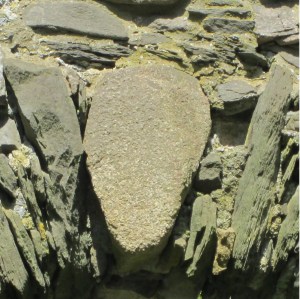
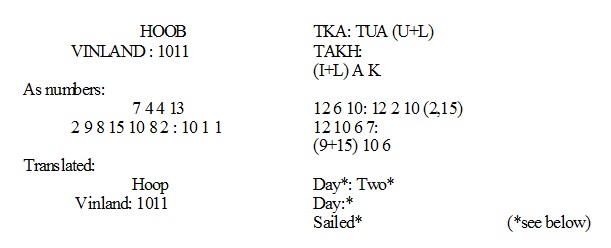
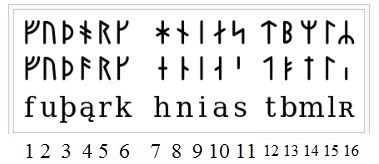
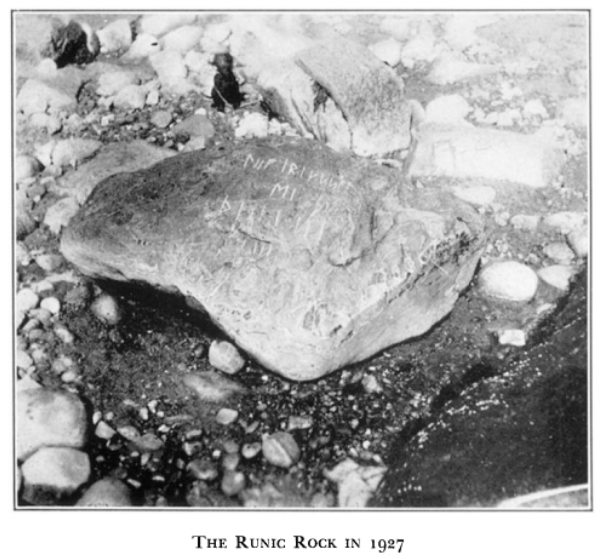
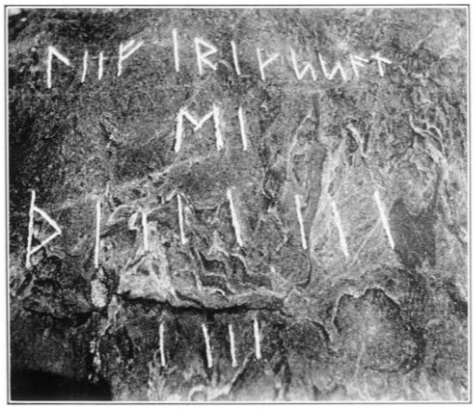
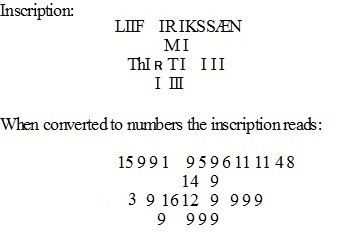
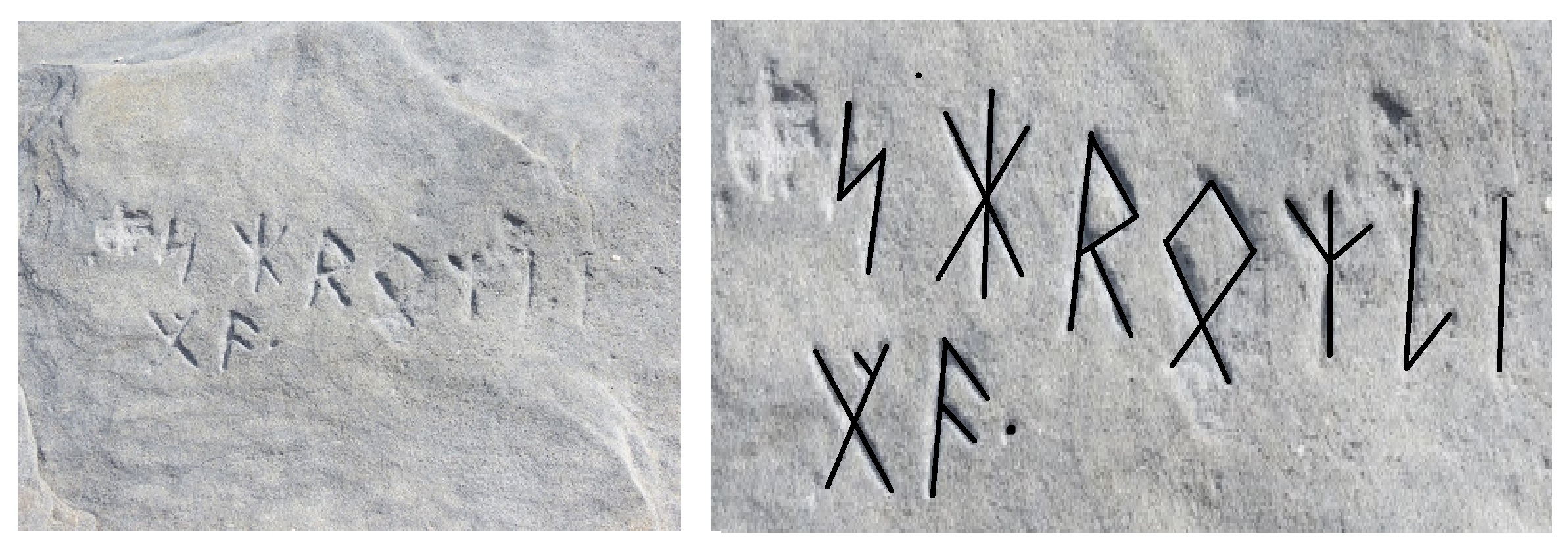
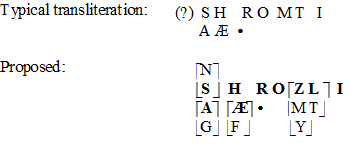
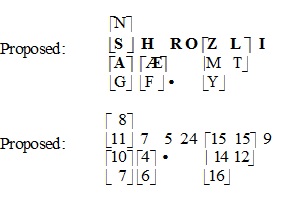
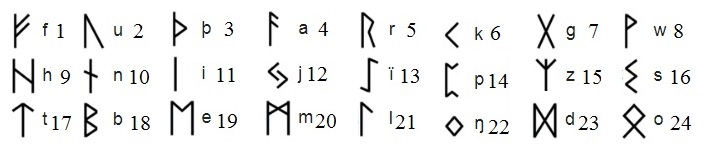
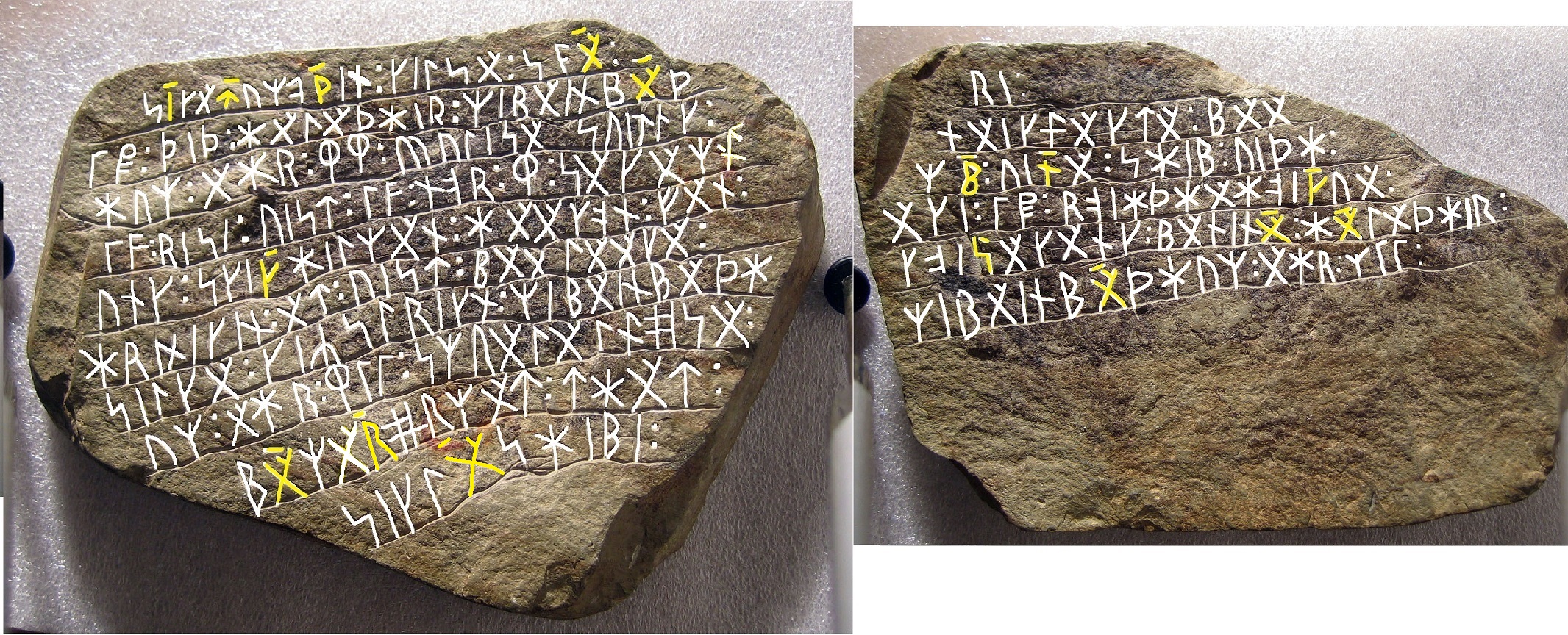
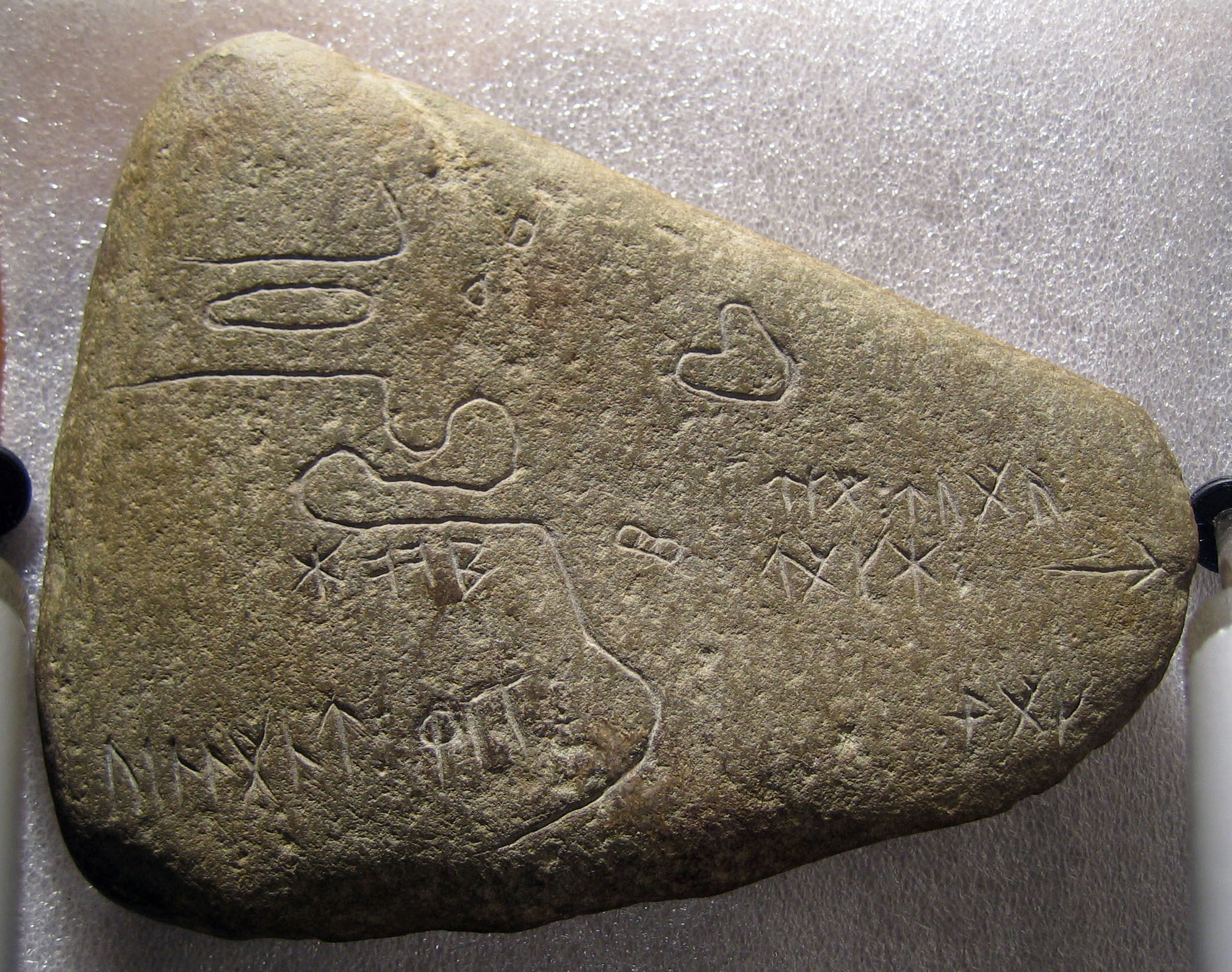
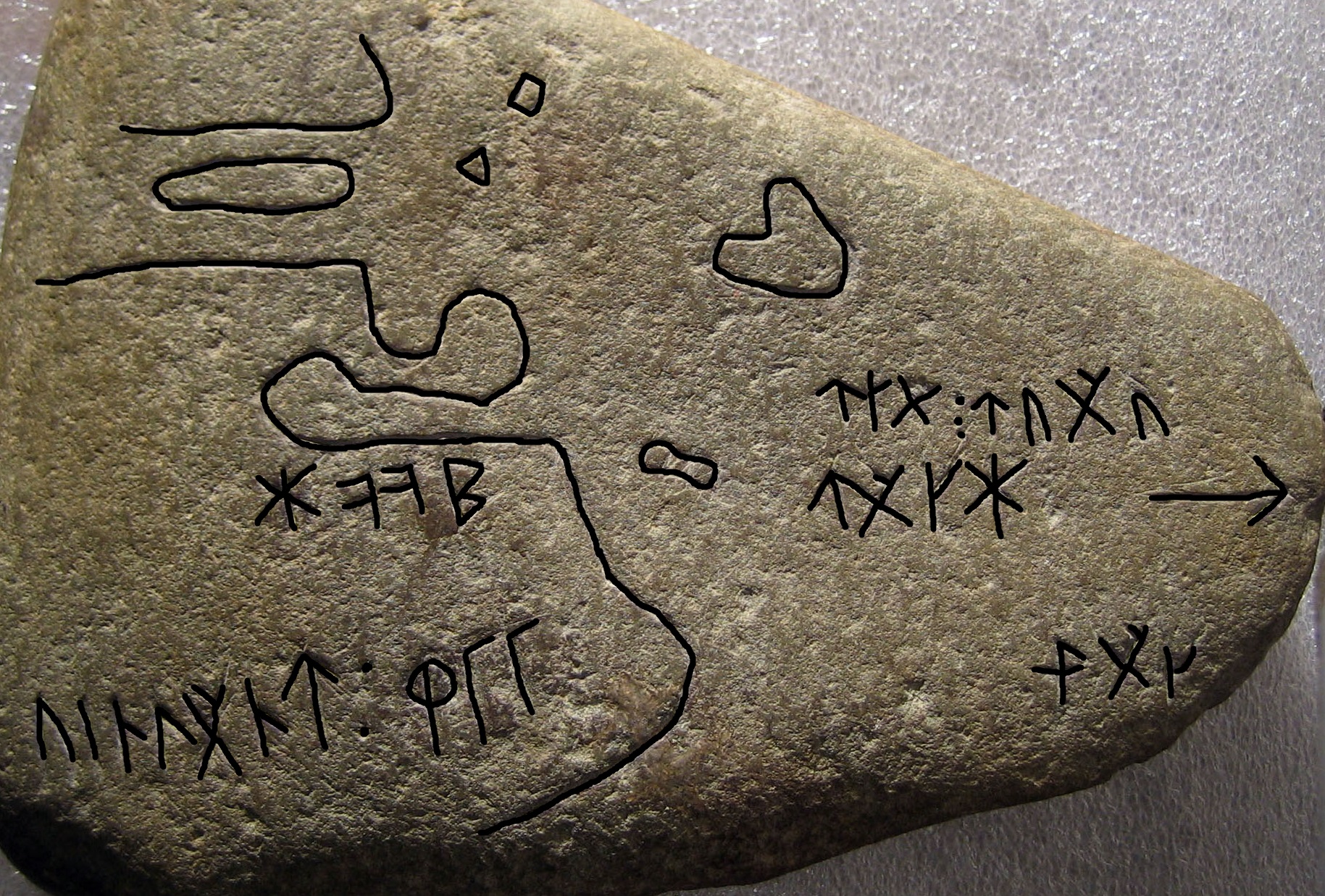
The Narragansett Runestone is the work of a genius. Besides the initial plain text reading, there are additional phrases, the date and even the correct location concealed in the text. This is a lot for nine symbols to convey. The proposed transliteration and subsequent translation of symbols imbedded in the rock once on the shores of Narragansett, Rhode Island are shown below. The proof that the correct symbols are used is very math heavy, so it is at the end for those who are interested. What enables the cipher is that the text is in three alphabets: Younger Futhark, Elder Futhark and Latin. The reader is directed to the charts on the last page for Futhark (runic) alphabets.

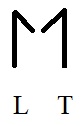
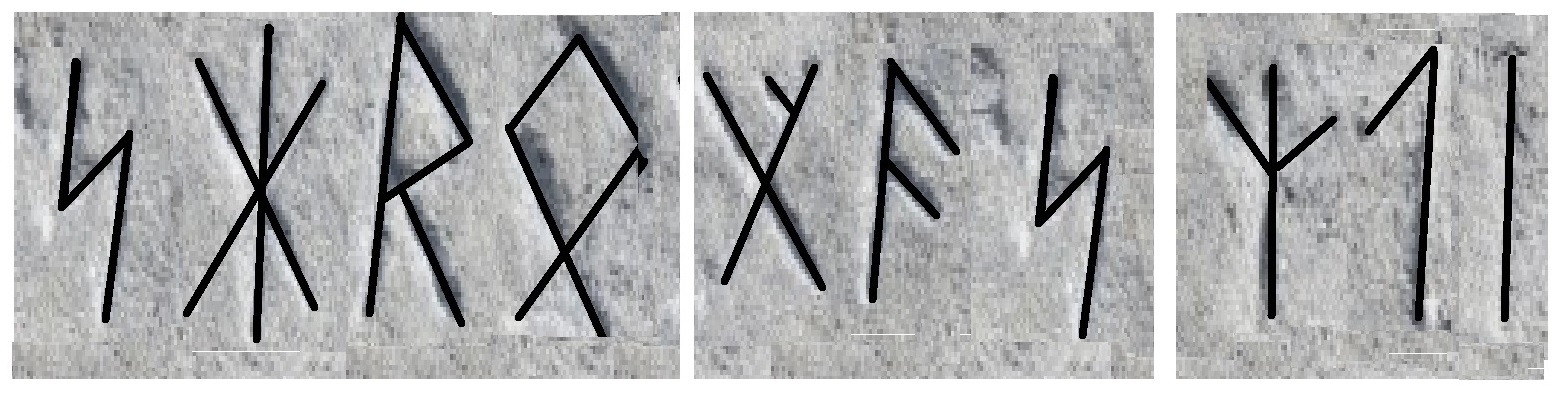
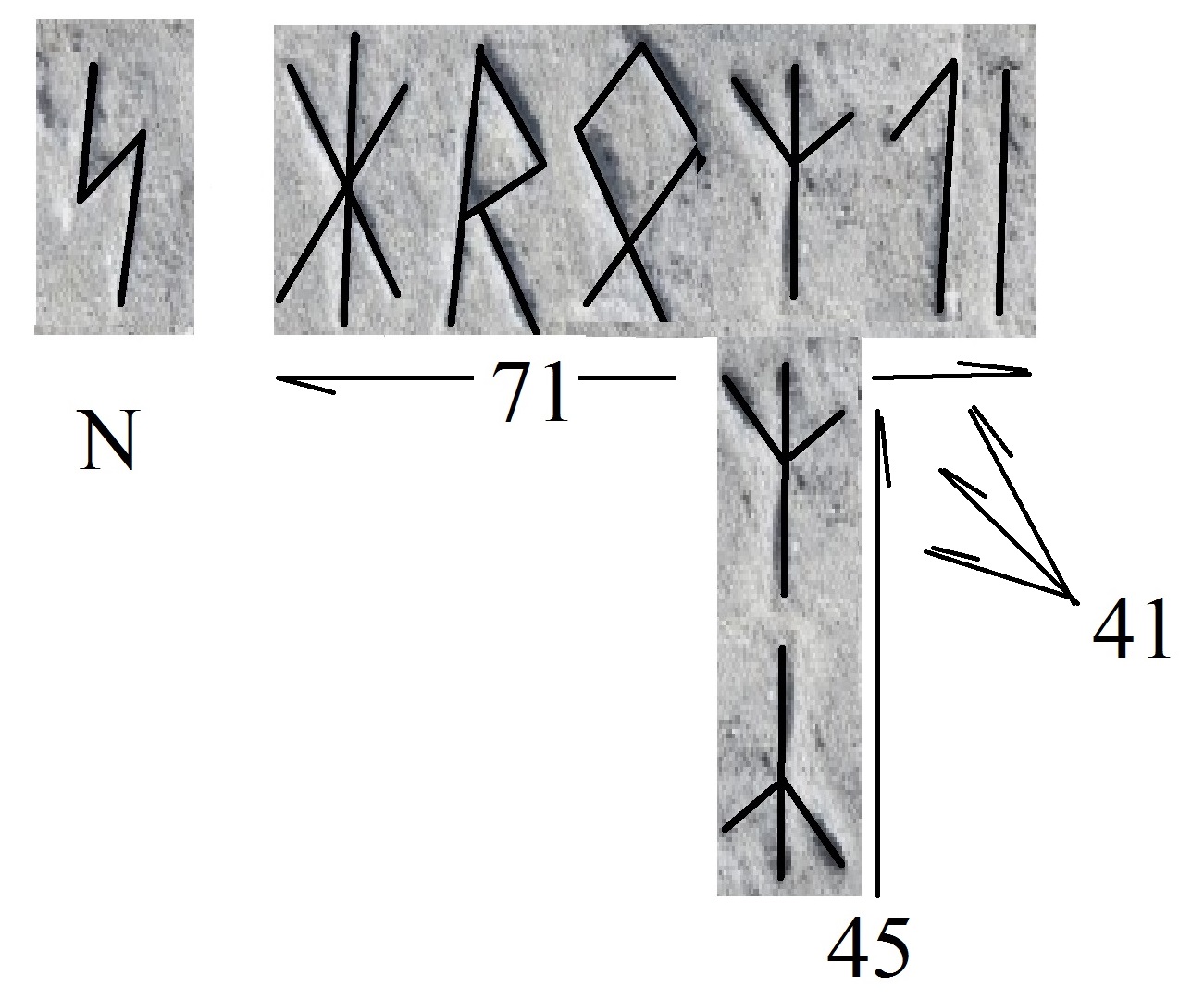
The extra letters appear after one notices several other possibilities are present. The S (in Futhark) can be seen as a backwards Latin N. The Æ symbol (in Futhark) can also be seen as a Latin F. The X can be seen as an A in Younger Futhark or a G in the Older. The T in the Younger Futhark is upside down. There is no reason to assume the adjoining M is not also upside down. If it is, it becomes a Y. There is also no reason to assume it is in the Younger Futhark, since the symbol appears in the Elder as does the S and O in the forms shown. This adds Z to its possible transliteration. Indeed, reading the pairs as shown provides AF, GA, FA, LT, TL, ZT, ZL, MT and MZ as easily readable. They suggest Af(ter), Go, Foe, Let, Tell, Set, Zeal, Meet and Maze.

We move on with reading the text. Find the runes: A H R. This is exactly how ‘year’ was written in both the Spirit Pond and Kensington runestones including the rune forms. This confirms these runes are part of or near the date. The date is found in the transliteration proof below.

Studying the inscription further leads to the correct plain text reading. Take the first letter as N and notice that the H looks like two arrowheads coming together. It is followed by RO which seems to reinforce the idea of an arrow. Take the hooked X as a G (in Elder Futhark) and now GÆN can be found. The letters forming ZT (set) were seen in the 5th and 6th runes. See the I erroneously as a T and now one has everything needed to interpret the inscription as:

……. N ……………… ARROW ……………. GAN ………………….. ZTT

⇒⇒ Narragansett.

Now in the transliteration find: ÆR HOM LI ………………..Our homes lies…

This suggests the location is also embedded. The longitude and latitude is also deciphered below.

Now find:

AS SHÆ RO YMZ ML TI I TL ROZY………As she row amaze mill tie eye – I tell Rozy.
AF HÆ RO YMZ ML TI I LT HR OM…..After he row amaze mill tie eye – I letter here OM.

As she rowed to the amazing mill tie eye, I tell Rosy.
After he rowed to the amazing mill tie eye, I letter here. OM.

DESIGNED BY O. M. – TOLD TO ROZY – AFTER THEIR AMAZING
JOURNEY TO THE MILL TIE EYE
AROUND YEAR 1157
NARRAGANSETT FOUNDED 1011
OUR HOME LIES ∙ 41.45̊ N 71.45̊W

O.M. is the person who designed and built the Newport Tower which was completed about this time. Rozy was his departed beloved. He is known as Bishop Henricus mentioned in the Vinland Map. It appears as if it is a couple, Hrom and Rozy, but it is Henricus missing his beloved. (This is confirmed by another source, the study of which will be published in the future.)

Transliteration Proof

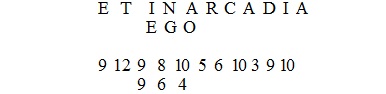
The gematria (number) associated with each rune is as found in that alphabet with the exception of the L which uses the value for L from the Younger Futhark. The correctness of the transliteration can be checked but it requires substitution to numbers and summing. Sums found should be typical numbers found in Baalist** encoded inscriptions. They are so noted with a ✓ check mark. The reader is directed to the paper Validating North American Runic Inscriptions (pdf) for further information on this topic since it is a new approach to deciphering runic inscriptions.

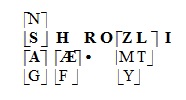
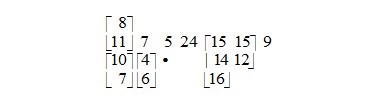
Below is the proposed transliteration which includes all three versions of the 5th rune and two provided by the 6th. This positioning at the 5th and 6th eliminates the possibility of the undecipherable rune (?) ever actually being present. If it was, these would shift to 6th and 7th positions. The 7 and 2 pattern provides a required number. (7 + 2 = 9) or 792.✓ The number 28 or its double 56 must be found. The 5th and 6th runes were just discussed. This provides 56.✓ Further still, 3 versions of the ‘M’ and 2 of the ‘L’ suggest 32 which is 5.65².✓ Look at it again and see there is a group of 3 double letters followed by a group of 2 or 32.✓

We have now found four numerical verifications of the stone’s validity. Others are easily found but number substitution is required to see them. (See chart of runes/numbers at end.)

In this case the dot is next to the [Æ, F]. Letter F has value 6. Notice the R of value 5 is just above so that 56 is found.✓

The 7 is followed by 5 and 24 which sum to 29 so that one finds 7, 29 ⇒⇒ 792.✓
The group of four numbers: 8,11,4,6 sum to 29 next to a 7 ⇒⇒ 792.✓
The sum of the five numbers in brackets is 15+14+16+15+12=72. This is followed by 9 or 72,9.✓

Running the sum across the top line (in bold) as written find 86.✓ (86400 seconds of longitude.)
The sum as typically transliterated (with M, T) is 82 which if read in reverse is 28 or half 56.✓
The sum of A Æ or 10, 4 is 14 which is half of 28.✓

This is a significant number of numerical verifications. The transliteration appears to be correct.

Finding the Date

Easter Tables were used in earlier times for determining when Sundays and Easter would fall. Each year has a Golden Number (GN) and Day Letter (DL). This can be used to confirm a date is read correctly. (See Easter Table here and Mongé,1967) There are two dates here. The first is the founding date of Narragansett. The second is the date the stone was designed.

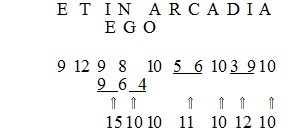
There is a 10 below the 11. The 7 and 4 sum to 11. The 4 and 6 sum to 10…..1011….1110. This appears to be a date. The Spirit Pond rune stones date themselves to the year 1011. Finding the Golden Number (GN) for both years may settle the matter. GN was commonly used at the time for determining Easter. The GN for 1110 is 9. Its Line # on the table is 18. The Day Letter (DL) is 2. The two is not found so 1110 is eliminated. ✗

The GN for year 1011 is 5. A five is immediately to the right of this group of numbers. More so, the Line # is 15 which appears twice (Z, L).✓ The DL is 7. To the left of the five is 7.✓ The implied date is year 1011.✓ Further confirmation for 1011 is found in the number of runes. There are 7 runes on the first line. Day letter = 7. ✓ There are 11 runes from the doubled runes. Year is 1011.✓ There are 15 runes in total. The Line # is 15.✓

We may conclude that 1011 is the date of the founding. The second date is much easier.

Note that by reading it in reverse I MT ROZY O ÆHR SRH; and H,R,F,AG,AN,NS ⇒ 7,6, 5,17,18,19.
⇒ I meet Rozy O / around year 1157.
Years 1156, 1157 and 1158 have GN 17, 18 and 19 respectively. Their day letters are 7,6 and 5 respectively. Note the 56, 56 and 76 which once again are important Baalist numbers. This is then the date this was designed.

The numbers can be played with for some time. Eventually even a novice solver will come to the conclusion there is no mysterious missing rune on the first line. In other rune riddles a missing letter is required to be guessed to solve the riddle. Here it is the opposite. The missing letter was only a ruse.

Finding the Location

It is possible to confirm the latitude and longitude if it is known.
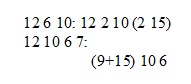
Recall the numbers are:

The full top line of the inscription provides N (7, 5, 24, 14, 12, 9) = N 71.

ZMT (15,14,12) = 41 and MLT (14,15,12) = 41.
ZMY (15,14,16) = 45 and must be used twice.

So that 41.45̊ N, 71.45̊ W is found which is correct with respect to the Greenwich Meridian. (Its apparent accuracy suggests they were using this meridian as opposed to other available meridians.) It is important to note – one must know beforehand the location to find it in the inscription. One cannot just read it out.

DESIGNED BY O. M. – TOLD TO ROZY – AFTER THEIR AMAZING
JOURNEY TO THE MILL TIE EYE
AROUND YEAR 1157
NARRAGANSETT FOUNDED 1011
OUR HOME LIES ∙ 41.45̊ N 71.45̊ W

From Wikipedia

Previous Post         Next Post

Similar Articles by the Same Author in PDF and Post:

*Easter Tables

** For numeric background see:

**Freeborn, B.L., Validating North American Runic Inscriptions, noahsage.com, November 2022. PDF only.

Freeborn, B.L., Ancient Riddles to Test Our Wits: The Secret Chamber, noahsage.com, January 2016. Post here.

Freeborn, B.L., Another Riddle in Stone from Canada, noahsage.com, August 2025. Post here.

Freeborn, B.L., Deciphering the Spirit Pond, Nomans Land and Narragansett Runic Inscriptions, noahsage.com, November 2022. Amulet post. Map stone postPDF only.

Freeborn, B.L., Et in Arcadia Ego – OUOSVAVV DM – Deciphered, noahsage.com, December 2022. Post here.

Freeborn, B.L., Kensington Rune Stone: A New Translation, noahsage.com, February 2023. Post here.

Freeborn, B.L., Rök runestone of Sweden, noahsage.com, April 2023. Post here.

Freeborn, B.L., Runic Riddles: Time Capsules, noahsage.com, December 2022. Post here.

Freeborn, B.L. The Long Debated Bourne Stone, noahsage.com, January 2023. Post here.

Freeborn, B.L., The Nomans Land – Leif Eriksson Inscription, noahsage.com, December 2022. Post here.

Freeborn, B.L., The Narragansett Inscription: A Translation with its Date of Dedication, Author and Inscriber, noahsage.com, October 2022. Post here.

Freeborn, B.L., The Newport Tower: Finding the Date of Dedication, its Designer and Builder, noahsage.com, October 2022. Post here.

Freeborn, B.L., The Wawa Stone and Its Viking Ship, noahsage.com, August 2025. Post here.

References

*Monge, Alf & O.G. Landsverk, Norse Medieval Cryptography in Runic Carvings, Norseman Press, Glendale, California, 1967.

Landsverk, O.G., Runic Records of the Norsemen in America, Erik J. Friis, Publisher, Rushford, MN, 1974.

Landsverk, O.G., Ancient Norse Messages, Norseman Press, Glendale, California, 1969.

Syversen, Earl, Norse Runic Inscriptions with Their Long-forgotten Cryptography, The Vine Hill Press, Sebastopol, California, 1979.

Derogatory article by Aslak Liestol of Alf Mongé’s work: http://collections.mnhs.org/MNHistoryMagazine/articles/41/v41i01p034-042.pdf  and…. Landsverk responded to these comments in Ancient Norse Messages pg. 126-129; and often in Runic Records of the Norsemen in America.


The Newport Tower: Finding the Year of Dedication, its Designer and Builder

B.L. Freeborn © October 30, 2022, Rewritten June 2025        (PDF version here.)

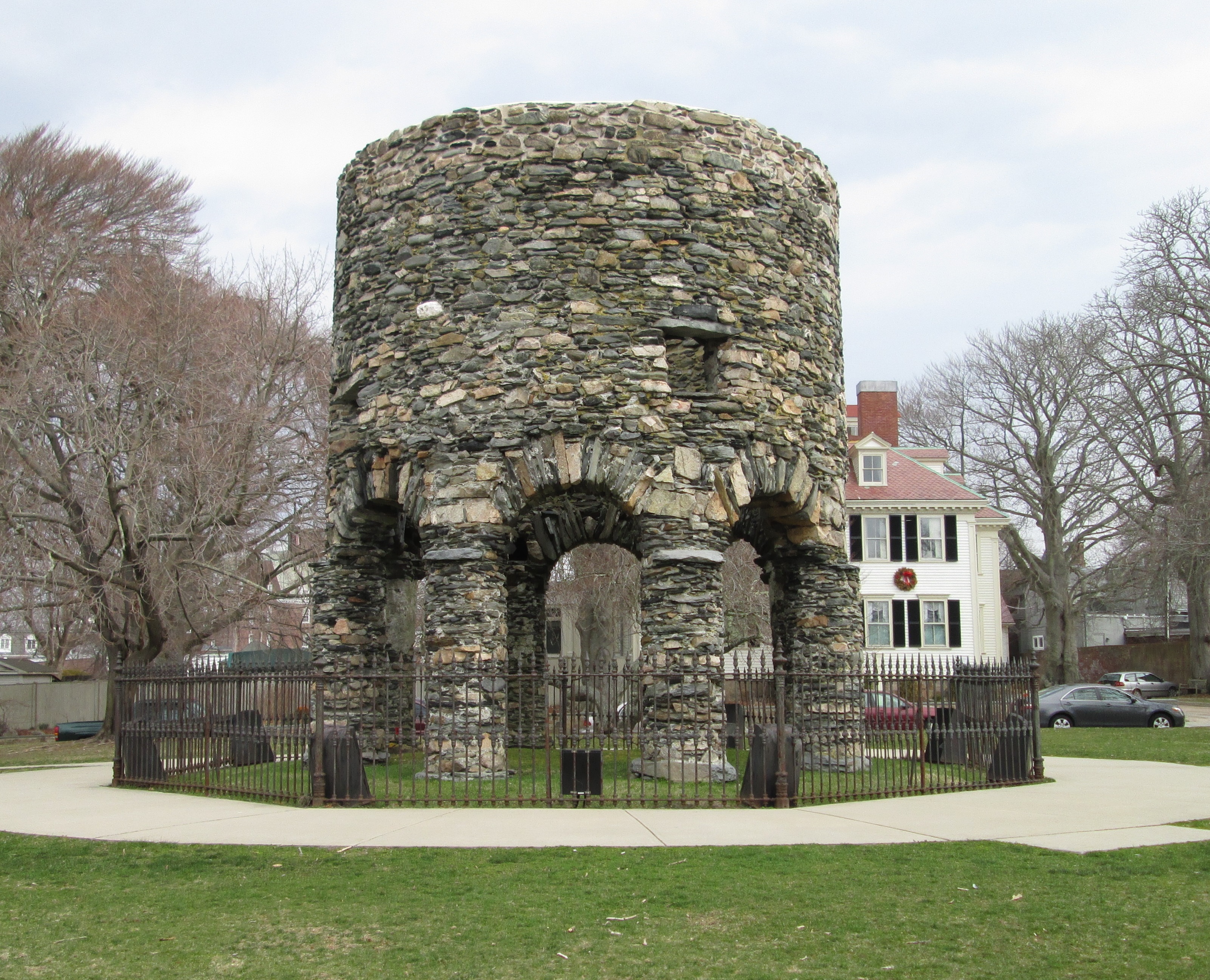
Who built the Newport Tower is a long standing question. It has been well proven by James Eagan that the tower is used for keeping time as the celestial bodies align with its numerous small windows. Eagan also noticed that certain letters formed with stones appear in the arches of the structure. Most notable and hard to miss is the >OI<. He found the Delta and P (shown as R). He also thought the h was a Greek η. From there he determined, probably correctly, it spells out Rode as in Rhode Island. His theory states John Dee had the tower built in 1583 in connection with a colonization attempt which failed.

The tower is shown on the “Woods Map 1635’ by William Woods a colonist in Providence, RI (Syverson, pg.32) The map notes it as Old Plymouth. This is the earliest known record and predates Benedict Arnold senior’s ownership. Evidently Arnold knew what it was and probably who built it, but because of the possibility of these prior claims resurfacing he referred to it as an old windmill knowing very well only a fool would believe that.

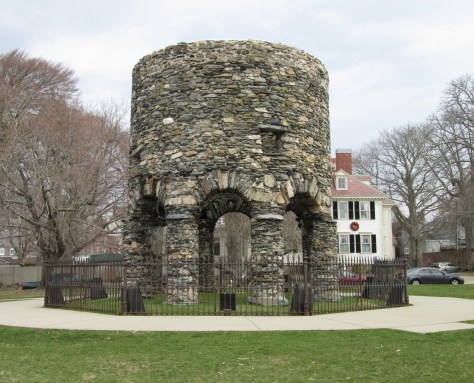
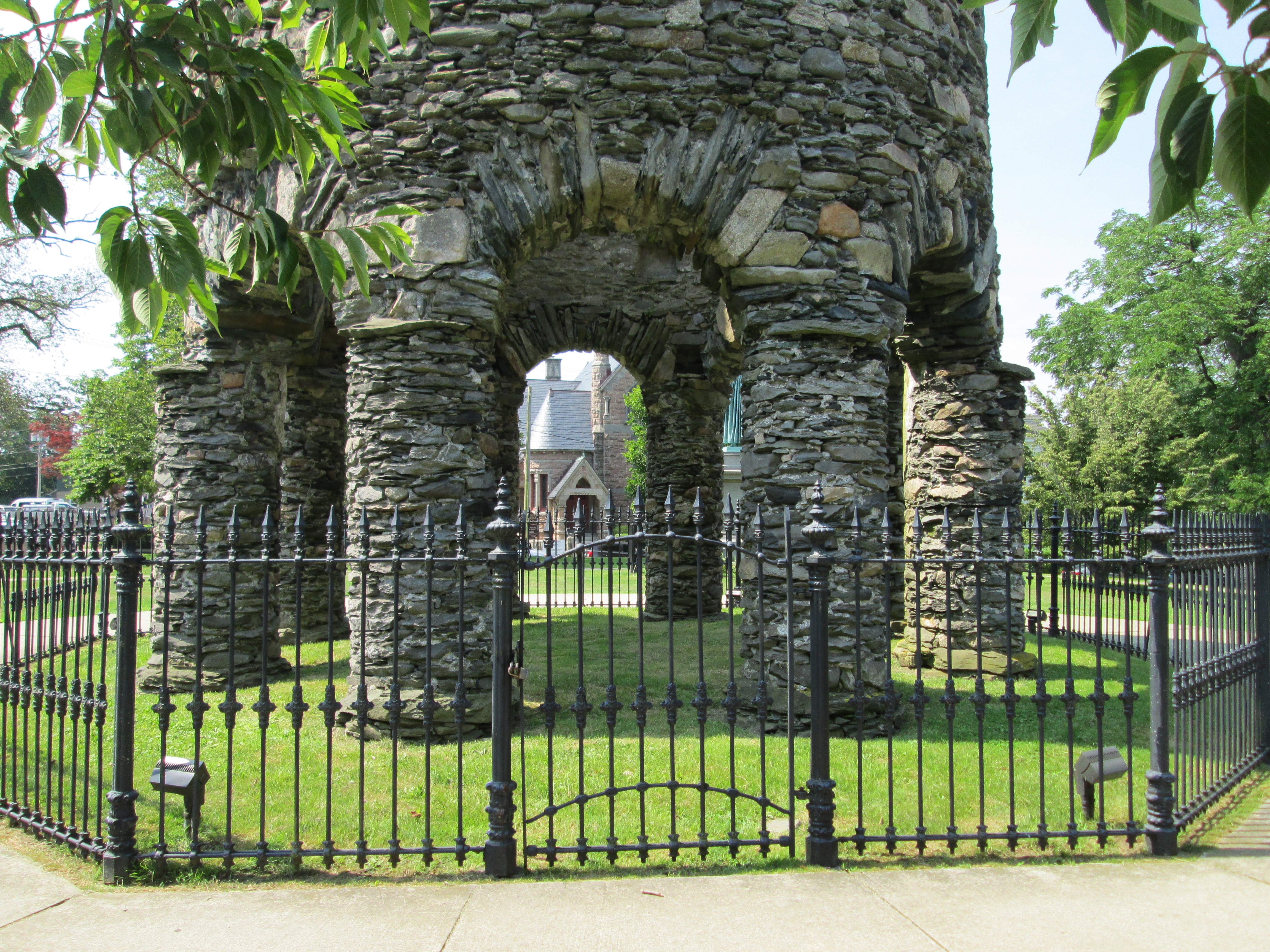
Newport Tower in 2023

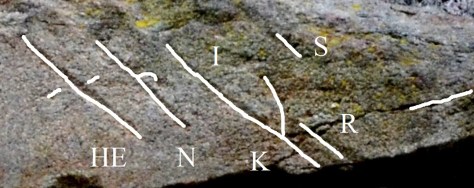
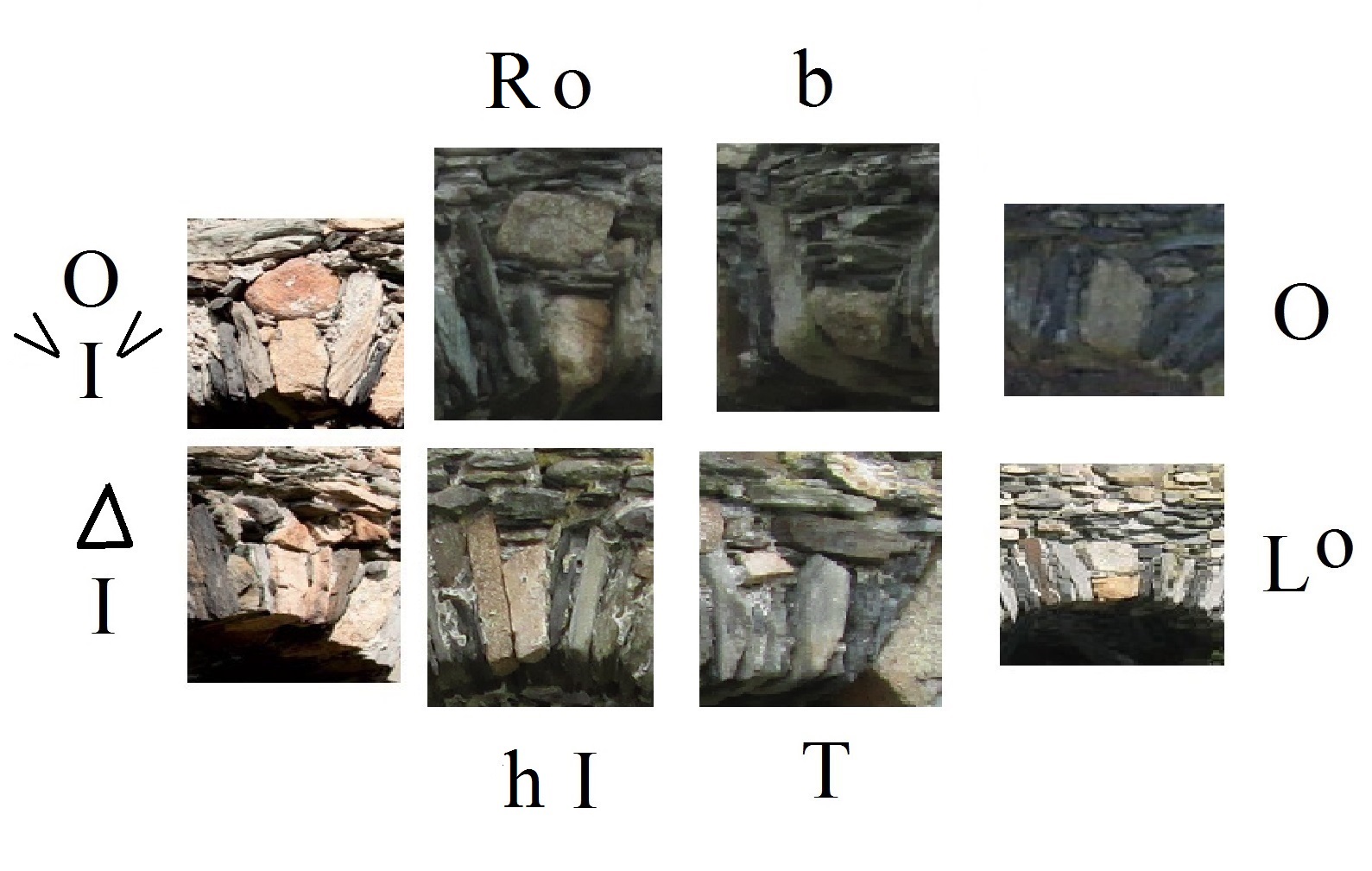
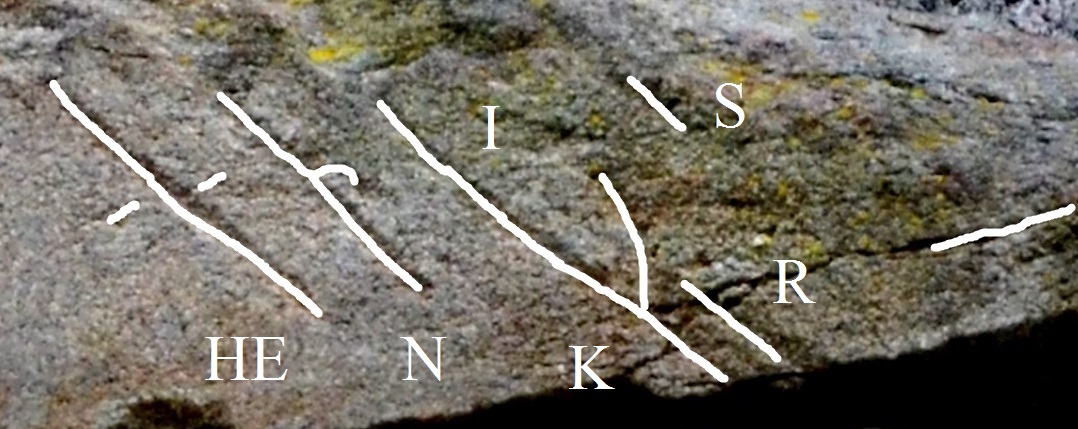
After studying Eagan’s discovery, the other letters shown above were identified. There are eight arches. Three of which have one letter displayed and five display two each. There is also a round stone on the interior opposite the >OI< stone which is on the northwest side. This makes fourteen altogether. To complicate the picture there is a runic inscription found over the southwest pillar (see images below). It was translated by Mongé (1967) and it reads Henricus 1116. This refers to Bishop Henricus from Greenland that was sent to Vinland. He is known as Bishop Eirik Gnupsson in Icelandic annals. Other theories as to the tower’s origin abound. The Henricus theory is at least supported by an inscription imbedded into the tower itself in the manner of a corner stone.

This paper is a study of the inscription and stone letters. It is also an addendum to Validating North American Runic Inscriptions (PDF). The translation is given here and the study with its numeric work follows. The aforementioned paper will be helpful in understanding it.

Translation

The round stone on a peg in the NW arch is as indicative of Baal as a cross is to Christ. (The >OI< stones.) Furthermore, it would seem the stone letters spell out Baal. This leads to studying the ‘inscription’ as if it is of Baalist origin and if so, certain numbers must be present. Validating North American Runic Inscriptions describes how certain numbers are embedded in Baalist inscriptions. One should recall that the Catholic Church went to great lengths to stamp out paganism in the time preceding, during and after Henricus’ tenure as Bishop. Apparently, Baal was central to that religion which is why there are so many references to it hidden in runic riddles. The dedication to Baal at Newport tower is unmistakable. The stone letters are repeated here:
Reading in a clockwise manner – b O O L T I h Δ I O >I< P/R O
These are transliterated as:           B A A L T I h D I A I R O

Note that the P in some scripts/languages is R. The O’s can be either O or A. Similarly, the I can be E. In Futhark runes B can be P.
Reading from the top clockwise find: RO, BAAL, TI, HI, HID, DI, O, >I<
Also find: HIT, I TOOL, O LO, BOR, ROB, POL, RODE or RHODE and OH.

The first line suggests: Row, Baal, Tie, die, high, hide, eye, two strikes at I.
The second adds: hit, I tool Rob, hole low, bore, pole; rod, red or road; and oh. We may conclude:

Baal at the high tie hit. It hit twice at the eye in rows.
The hole is low where it bored the eye of the pole.

“ROB” tooled (designed and built).
Rhode Island

The first two lines are typical Baalist statements. The words are easily found in the inscription. Rhode Island perhaps requires an explanation. RHODE appears to be a combined anagram for Rod (or Red) and Oh (meaning island). A rod is a measuring length of 16.5 feet. The clay on the shores of Rhode Island is notably red so it might also refer to red. This suggests the name, Rhode Island, is much older than cited by modern authorities. The name Rob, R.O.B. or B.O.R. is the name or initials of the designer. The H presumably represents his pseudonym, Henricus. (To be discussed further below.)

Then Comes Henricus

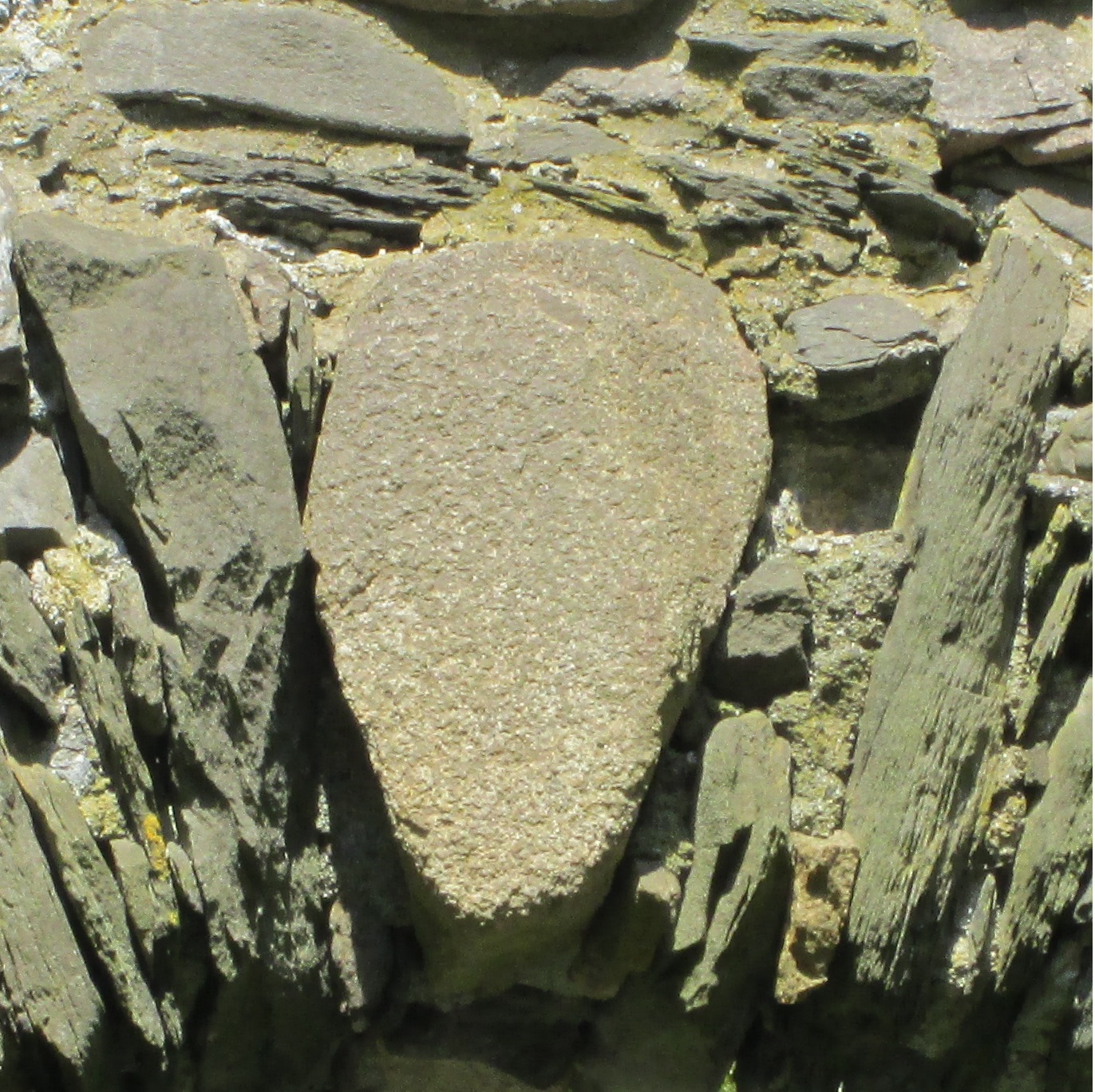
Above the southwest pillar of the tower is a runic inscription. Harek Williams examines it in a video with James Eagan and confirms it is human carved and nothing more. A much better source for proving it is an authentic runic carving is Alf Mongé. Why the latter? Harek Williams reads plain text runes from that period. He does not delve into runic puzzles or dated riddles. Alf Mongé was a cryptologist. He deciphered the deep scratch marks into runic letters and decoded them. He found it reads: Henricus 1116. This gives a lower limit to the age of the tower. Based on other runic inscriptions found along the east coast and the Narragansett inscription nearby this seems plausible.

The rapidity with which the tower is giving away to nature demands that it must be under constant care. This requires that, regardless of when it was built, it must have been periodically repaired. It has been nine hundred years since Bishop Henricus visited (circa 1116) as stated in the Vinland map legend. The Spirit Pond stones are dated to 1214-1217. (Freeborn, Deciphering.., 2022) They commemorate his visit. The Kensington Stone’s date is 1362. (Freeborn, Kensington.., 2023) It states the travelers came from Rhode Island. In 1525 Verazzanno explored the coast but did not mention the tower. In 1583 John Dee sent an expedition to the area. By the 1600’s it was settled by colonists and it came under the care of Benedict Arnold senior. This could mean it received periodic maintenance since the time of its construction, on or after 1116, until Arnold’s ownership five hundred years later.

The date and builder need not be total speculation. The aforementioned inlaid letters tell the story of Baal. If they were chosen in the manner of a runic riddle they may reveal more. Since Henricus was a master at runic riddles, and if this was built by him or in honor of him, then the symbols should contain further information. These riddles often contained a date.

As far as John Dee being the designer, that is possible as well. However, and it is a very big however, he was a devoted Christian and this tower is clearly a dedication to Baal. A study of Dee’s mathematics does not display the numbers so prevalent in Baalist inscriptions which suggests he is not the creator. The two religions are not mutually exclusive since Henricus was a Bishop of the church, but he lived at the point in time when paganism, through genocide, was actively being stamped out. To continue their religion and live, they were forced underground or in this case, off the European continent. It is possible he was of both beliefs.

After a mathematical study (which follows) of the letters’ number equivalents more information was derived. As seen, it was erected to commemorate the great story of Baal. It also commemorates Henricus’ visit in 1116 and suggests an erection date from 1153 to 1161. This is some thirty years after his supposed death. In keeping with his humor, or some might say his ego, he designed and oversaw the construction himself.

Designed and Built by O.M. – Dedicated 1161
To Honor Baal and Bishop Henricus’ visit in 1116
Rhode Island

Number Work and Proof of Transliteration

Certain numbers** appear when the letters in any Baalist inscription is converted to their numerical equivalent (gematria). The Newport Tower’s hidden letter/numbers are studied here. Numbers that are typically found are noted by a ✓ check mark. Simply put, if the numbers are not found, it is -not- a true Baalist inscription -or- the letters have been misinterpreted. Once the correct letters are proven via their gematria then the message about Baal can be read and also, possibly, who wrote it and when. The result of this study is as noted above.

The proposed transcription of symbols imbedded in the arches of the Newport Tower is shown below. The numbers are studied for repetitions and pertinent numbers.

Norse Runic Gematria

Sum from T and around to first A = 79. From the same A to L is 23. So that it is 79,23.✓
Total sum is 98 or 89 in reverse which reminds one 89 x 89 = 7921.✓
The sum from the Δ around again to the 7 is 89. ✓ The 79 is also imbedded in the text.✓
Even more notable the 9,3,9 sum to 21 so it becomes 7921.✓
The sum from the first A to first I is 51.✓ The sum from H to the right and around to L is 86.✓
The 28 appears twice which is half of 56.✓ The sum from B to the left around to the I (by H) is 56.✓
The sum from first I to the last O is 43. Twice 43 is 86.✓
The tower also spells out RHODI or Rhode. These letters have values: 5,7,4,3,9 = 28 and twice this is 56 ✓
Note the 12’s at T, ID, DI. Note the 13 at AI just following the 12.
Note the 14 at IR. Lastly, note 7 and 9 sum to 16.
By summing adjoining numbers find: 13,17, 19, 15, 19,12, 16, 12, 12, 13, 13, 14, 9, 17…
On either side of the 16 is a 12, then 12, 12, 13, 13, 14.

Years 1112,1113, 1114, 1115,1116 and 1117 are all implied by the series. These numbers coincide with the period of time Henricus was believed to be in Vinland. In dated runic riddles the Golden Number (GN), Day Letter (DL) and Line # are used to denote a year since every year has specific values that can be found in Easter Tables (a calendar device created in 525 AD). The main legend on the Vinland Map has the phrase: ‘anno p. ss. nrj.’. This uses a 1, 2, 3 sequence in the abbreviations. Since ‘anno’ means year, this is clearly a reference to ‘year 1123’ when Bishop Henricus was replaced by Bishop Arnold and his death was therefore presumed. As an example, if it implies Line #1, Golden Number (GN) 2 and Day Letter (DL) 3 then 1161 is indicated. In this instance, for year 1116, the values are Line #19, GN 14, and DL 3. There are two sums of value 19 with a 15 in between. The delta is the only letter in Greek. D has value 3 in Futhark. This 3 would be the DL. This then easily points to a date 1116. The date has additional merit as seen below. Without corroborating information as seen in the imbedded stone and Vinland map, other dates remain as possibilities.

Runic Inscription Study

Briefly, this is a summary of Mongé’s decipherment of the small stone imbedded above one of the pillars shown in the image above. It is a group of five runes and two are joined runes: (HE) N (IK) ʀ S or Henricus. There is an arrow to the right. The arrow is another feature common on Baalist inscriptions.** Using runic gematria, the year 1116 is found. The (HE) is 16. The S is 11. The ʀ is 16. The (IK) is 15. Reading in reverse find 1116. The repetition of the 16 and 15 help confirm the interpretation. It is worth reading Mongé’s study (Mongé, pgs 128-129).

The Structure Contributes

Round sun stone on interior.

The structure is set up to provide numbers as well. There are 8 pillars and 10 symbols that appear on five arches (two each). One symbol (the round sunstone) is in the inside and three arches have only one symbol for a total of 14 symbols. 4 x 14 = 56.✓
There are five arches with two symbols each or 10.
There are three with one each for 3. Total 13.
There is a single round stone on the interior. So 1. Then 1 and 13 ➟ 113 = 56.5 x 2.✓
There are 8 pillars and of course, 8 arches. A square of sides 5.656 has a diagonal of 8.✓
There are double symbols in 5 arches and single symbols in 3.
If the first arch with B is #1, then the arches with two symbols are found on: 3, 5, 6, 7,8. The ever present 3 is represented, then 56 and 7 x 8 is 56 again.✓ Similarly, if B is #1, then it is 1 symbol, then 1 symbol, then 2 symbols; or 112 which is twice 56.✓

One may again conclude after finding so many numbers typically found in Baalist documents that the transliteration is correct. The set of numbers is then 5,3,2,2,2,2,2,1,1,1 and 10. Let us view this another way. There are 3 arches with only 1 symbol. This is part of the story of Baal. There are 3 arcs.✓ The repeating 2’s emphasize that there were 2 Baals ✓.
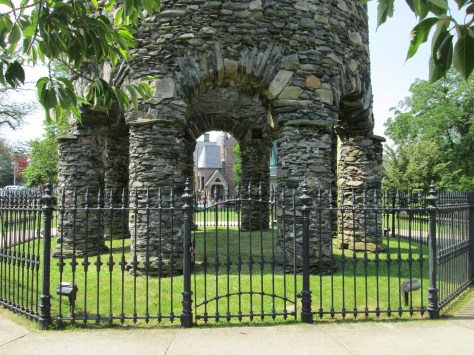
Also note the number 532 is easily found. This is the number of years in the Easter Table before the table starts to repeat. Its presence infers a date. The 1,2,3 suggests year 1161 as seen above. The more probable date of 1153 is also easily implied here. Of the eight arches 5 have two symbols and 3 have one for 53. There is one round stone on the inside and one on the outside between two pillars which implies the 11. The sum of the digits in 1153 is 10 which is the number of double symbols.✓ It is suggested that Henricus journeyed to Rhode Island a second time or began the structure in 1153, and the tower was completed on or before 1161. This accounts for some of the confusion in the Vinland Map that says, ‘He remained a long time summer and winter and later returned toward Greenland.’ He was presumed dead in 1123 but reappears thirty years later.

Newport Tower with OM on side. Round stone is O. Adjoining arches form M.

Who was the Builder?

Further information is here about Henricus. If the letter sequence is viewed using the Elder Futhark gematria we find:
18 4 4 21 17 9 11 23 11 4 11 5 24 …18
B  A A L  T H  I   D   I  A I R O… B ⇒… repeats..

It is believed Henricus died in 1123 because a new Bishop of Greenland was consecrated in 1124. Note that 1123 is emphasized in the sequence.

Find: I, DI, H 1123…… I die 1123 (as) Henricus.
I HID 1123 ……… I hid 1123.
I R O B …. or… B. O. R. or I Rob….

In other runic riddles such phrases are anagrams. Recall first that the O’s were also considered to be A’s and find in these letters – B A A L T H I D I A I R O the following:

I DI  REAL PA AT OH ………. I die. Real father at island. (OH = island)
I ROB LOT I AID HA ………. I rob (the) lot. I aid. Ha!
I HID A O ROB IT AL ………. I hid. I ring rob it all.
I A O I HID ROB LOT ………. I a ring. I hid. Rob lot.
I HI PA O RAID LOT ………. I high father (bishop). Ring raid lot.
I PA H I O RAID LOT ………. I Father H. I ring (that) raid lot.
IT A O ROB AL I HID ………. It a ring. Rob all. I hid.
I PA O HID AL AT RI ………. I father. Ring hid all at RI (Rhode Island).
RHODE IT AL I A PA ………. Rhode. It all I, a father.

This sounds like the confession of a thief who robbed and aided. Furthermore, it suggests he hid it at RI, which one might think refers to treasure. It is more likely it means he was using his ill gotten gains to ‘aid’ his fellow man and hiding those people at Rhode Island. What sort of people needed to be hidden in that era? And is there a thief known as Rob who stole from the rich and gave to the poor? Who then was Henricus? Who was Rob?

Perhaps a couple more phrases might help.

I O PA HID AL AT RI ………. I O. Father (who) hid all at RI. (Rhode Island)
I O R PA AL HAT I DI ………. I O . Are Father (of) all. Hate I die.
I O R PA AL HAT I DI ………. I O . Are pa. All hate I die.

The image of the side of the tower shows a round stone between two arches. (See above.) If the round stone is an O then might not the two arches represent an M? Who then was OM and was OM a king?

It just so happens that a king also died in 1123 and his name was Oystein Magnusson who co-ruled Norway with his brother Sigurd the Crusader. Sigurd was a warrior and killer. It is then possible it was Oystein who named Henricus (Erik) as Bishop to Greenland.

A study of the two kings’ relationship can be seen in the historical account of Snorri. They were not friends. The need arises for a new bishop in Greenland in 1123. It is Sigurd that names him since Oystein has died unexpectedly.

So then we might ask:
• Did King Oystein name himself as Bishop and travel to Rhode Island as Henricus?
• Was King Oystein spiriting his people away from the genocides in Norway and sending them to Rhode Island?
• Was he funding his enterprise by robbing?
• King Oystein was a fabulous architect and builder of ships, bridges and churches. Did he design the tower?
• Did he hide from his murderous brother and later return to Rhode Island to oversee the tower’s construction?

Perhaps if one looks closer at the Vinland map (yes… it’s been declared a fake…), one can find his initials OM there as well. (Hint: use two copies against a sunny window.) Did King Oystein also pen the map?


Conclusion

The Newport Tower’s embedded letters when converted to gematria reveal numbers typical of Baalist documents. Their transliteration and subsequent translation educate us in a long lost religion. That this tower displays these features severely narrows the field of possible builders. It also strongly suggests that the northern peoples, Norse and others, inhabited this region known as Rhode Island for some time and built an elegant edifice by the year 1161. Pagan / Baalist beliefs are apparent in the design of the structure. Regardless of who designed and built this Tower, it is a marvelous feat of time keeping / engineering.

This still leaves us plenty of mystery but the time period has narrowed to a window beginning in 1116 to around 1161. Furthermore, new evidence of the builder/architect is presented here pointing to a man who used the alias Henricus and who signed his work O.M.

Previous Post                     Next Post

Similar Articles by the Same Author in PDF and Post:

*Easter Tables

** For numeric background see:

**Freeborn, B.L., Validating North American Runic Inscriptions, noahsage.com, November 2022. PDF only.

Freeborn, B.L., Ancient Riddles to Test Our Wits: The Secret Chamber, noahsage.com, January 2016. Post here.

Freeborn, B.L., Another Riddle in Stone from Canada, noahsage.com, August 2025. Post here.

Freeborn, B.L., Deciphering the Spirit Pond, Nomans Land and Narragansett Runic Inscriptions, noahsage.com, November 2022. Amulet post. Map stone postPDF only.

Freeborn, B.L., Et in Arcadia Ego – OUOSVAVV DM – Deciphered, noahsage.com, December 2022. Post here.

Freeborn, B.L., Kensington Rune Stone: A New Translation, noahsage.com, February 2023. Post here.

Freeborn, B.L., Rök runestone of Sweden, noahsage.com, April 2023. Post here.

Freeborn, B.L., Runic Riddles: Time Capsules, noahsage.com, December 2022. Post here.

Freeborn, B.L. The Long Debated Bourne Stone, noahsage.com, January 2023. Post here.

Freeborn, B.L., The Nomans Land – Leif Eriksson Inscription, noahsage.com, December 2022. Post here.

Freeborn, B.L., The Narragansett Inscription: A Translation with its Date of Dedication, Author and Inscriber, noahsage.com, October 2022. Post here.

Freeborn, B.L., The Newport Tower: Finding the Date of Dedication, its Designer and Builder, noahsage.com, October 2022. Post here.

Freeborn, B.L., The Wawa Stone and Its Viking Ship, noahsage.com, August 2025. Post here.

References

Creedon, Marc, Runologist Henrik Williams Examines the Newport Tower, Youtube, April 2015.

Eagan, James Alan, Elizabethan America: The John Dee Tower of 1583/ A Renaissance horologium in Newport, Rhode Island, Cosmopolite Press, Newport, Rhode Island, 2011.

*Monge, Alf & O.G. Landsverk, Norse Medieval Cryptography in Runic Carvings, Norseman Press, Glendale, California, 1967.

Syversen, Earl, Norse Runic Inscriptions with Their Long-forgotten Cryptography, The Vine Hill Press, Sebastopol, California, 1979.

Derogatory article by Aslak Liestol of Alf Mongé’s work: http://collections.mnhs.org/MNHistoryMagazine/articles/41/v41i01p034-042.pdf  and….

…Landsverk responded to these comments in Ancient Norse Messages pg. 126-129; and often in Runic Records of the Norsemen in America.
ET IN ARCADIA EGO – OUOSVAVV DM – Deciphered

B.L. Freeborn © December 2022        (PDF version here.)

Shugborough_inscription From Wikipedia

The Shugborough Inscription is a sequence of letters ‘OUOSVAVV’ on the first line and ‘DM’ spaced far apart on the second line. It is on a monument built between 1748 and1756 commissioned by Thomas Anson. Above it is a relief by sculptor Peter Scheemakers which is a variation of the Poussin painting Et in Arcadia ego. The famous painting by Nicolas Poussin displays this inscription on a tomb. It translates from Latin as ‘I am also in Arcadia.’ This inscription has eleven letters on top and three on bottom. The Poussin painting was done in 1637-1638. He did an earlier version in 1627. Previous to this, Guercino painted a similar but different version in 1618-1622. The original inspiration is a poem by Roman poet Virgil known as Ecologues. In this poem from 40 BC the inscription on the tomb of Daphnis is described. The tomb is in ‘Arcades.’ Daphnis was a shepherd in ancient Greek mythology.

From Wikipedia

Although the number of shepherds changes from two to three as the work progresses they all include a tomb. At some point in time the full phrase ‘Et in Arcadia ego’ was developed. The fact that Anson invokes this phrase and adds several elements to it suggests there is more to it besides his still undeciphered cipher some 270 years later.

It would seem he saw something in Et in Arcadia ego that others had not and added the lower inscription as a clue to revealing what is in the original phrase which is most definitely a cipher as well.

Indeed, his efforts resulted in creating a perplexing mystery. The solution to Anson’s ‘OUOSVAVV’ and to the riddle concealed in Et in Arcadia ego follow.

Part I: OUOSVAVV DM

Image Details

Before solving it, note what the image gives us:
• A woman on the left stands tall but looks down.
• The sky is tumultuous. On the upper coffin is a round wreath.
• Her right arm is bent and rests on her hip. It forms an arc.
• There are 3 shepherds each of whom has a staff. One leans to the left by the woman. The other two lean to the right. Two of the staffs seem to join at the bottom in a very large V.
• Two of the shepherds gesture at the inscription. Their thumbs are out creating V’s. It is said they are pointing at the N and R but in fact they frame the letter A.
• The third shepherd rests his arm on the tomb with 3 fingers together. This also appears in the Poussin version.
• Their arms form two arcs. The Poussin uses a shadow to depict a third arm /arc.
• While the other three look at the inscription, the shepherd on the left looks directly at the observer with a smile on his face.

Is he laughing because this is a riddle? With those images in mind, the solutions move forward.

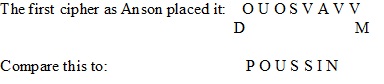
Cipher #1: O U O S V A V V – D M

For background purposes:
Many alphabets have numerical equivalents for their letters called gematria. Hebrew, Greek and Futhork are three which have gematria. Hebrew and Greek gematria are still in use today. Then to complicate matters, just slightly, do not forget there are also Roman Numerals which are letters as well. The solution requires the Hebrew gematria – first.

  • O is 70. A is 1.    U is Vav or 6.    S is S or 60.
  • D is D or 4.   M is M or 40. 
  • V is Vav or 6, but then again it is also a 5 as in a Roman V.

If the line is read as DO then the word ‘do’ is found which refers to Poussin. He ‘did’ it. If the D replaces the O then the word DUO can be spelled. An S follows. Perhaps he meant a DUO of S’s. Missing S found.✓

If the A is replaced by it’s value or 1 or Roman numeral I. Then the I is found.✓

There is no N. However, there is an M just below. In Hebrew gematria M has value 40 and N has value 50. There are two V’s where there should be an N. Two Roman V’s equals 10 and 40 + 10 = 50 ⇒ N. Missing N found. ✓

The first letter is O and as stated previously it has value 70. The P in Hebrew has value 80. Once again add two V’s or 10 and find 70 + 10 = 80 ⇒ P. ✓

The last two letters now spell NM which sounds remarkably like ‘name.’

The inscription then simply reads: DO POUSSIN NaMe. – – One mystery solved. ✓

By creating this exercise, Anson has shown us several clues to resolve the riddle in the original inscription. Note that it required two numeric systems to solve it (Hint #1) and more importantly, fixed the value of the O’s at 70 (Hint #2).

We must pause for a moment for a bit of seemingly irrelevant information. In drafting, when drawing an image of an object, two versions are often shown: the plan view – as if one is looking down; and the side view – as if one is looking at the side. Now – in your minds eye – look at the O’ and U’s as if they are plan and side views of an object. This will be called Anson’s Big Hint.

These -3- letters are followed by an S. Recall S often represents the word South. This idea will repeat later.

Cipher #1 Numbers

This requires numbers for a while…distasteful to many… lovely to others.

  • Yahweh or יהוה or 565 10 can be seen in the last four letters. (If A replaced with I.) The V is 5 and then VI is 6. Then V. Two V’s is 10. Or see it this way. In the fifth and sixth position from the left is V and I. This is 5th and 6th then 5 and 6 or 56.

Fully substituting now for the phrase but using only Hebrew gematria it equates to:

70 6 70 60 6 1 6 6
     4 40

  • Find 76 twice at the start. And it repeats again with 70 60.
  • If the last four are seen as Roman numerals 5 1 5 5 = 16 and 60. Together 16+60 = 76.
  • The pattern of the layout is 2 letters and 8 letters or 28. The product of 4 (on line two) and 70 is 280.
  • The 4 repeats in the 40. They sum to 44.
  • The top line sum is 225 and 4 x 225 is 900.
  • The sum from 60 right becomes 79. The remaining numbers sum to 190. See this as a series 79,190…..or…. 7919.
  • There are four 6’s or 24.

Let’s give some of these meaning.
• The period of Halley’s comet is 76 years.
• There are 24 hours in a day and 24 hours of longitude mark the planet.
• Each hour has 60 minutes.
• The number of seconds of longitude is 86400. This is also the number of seconds in a day. Half of this is 432,000 or 432 for short. Reverse this number and find 234.
• The 900 reminds one the pole lies at 90̊.
• The diameter of the planet is 7920 miles.
• The 28 is repeated twice so it must be important. Indeed, a 40 is present and a square of sides 40 has a diagonal of 56.56 which is a number similar to that just seen above.

All but two of the numbers reference time and/or longitude. One reference is to God and the other is to a comet.

How many of these numbers will repeat in that first phrase ET IN ARCADIA – EGO?

Cipher #2 ET IN ARCADIA EGO

To continue, we convert these lines to their numeric equivalent in Hebrew.

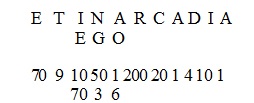
  • Each line begins with 79. (70+9) and (70+3+6). T to A (9+10+50+10) is also 79 and it is followed by 200. This is 79200.
  • Sum of top line (376) minus second line (79) is 297. A jumbled 792.
  • IN (10+50) provides 60.
  • NA (50+1) provides 51.
  • I to R (10+50+10+200) provides 270.
  • N and O (50+6) provides 56. The number of letters on the first line is 11 and on the second is 3 so together as 113 it is twice 56.5.
  • From C to A (20+1+4+10+1) is 36.

This much shorter list gives us 51, 36, 376 and 270 that are new.

  • There are 360̊ in a circle.
  • Due west is at 270̊.
  • The Greenwich Meridian is at latitude 51.51̊.
  • 3 76 should be seen as 3 and 76. We have seen the 3 in the Big Hint OUO.

Evidently then, these numbers do relate to longitude and latitude.

The following important note is made. Normally E should equal 1 and A should equal 70. If this arrangement is chosen, nothing is found. Anson did the same manipulation in his riddle. ‘O’ normally has value 6 but he changed it to 70.

The original phrase Virgil used in his poem was only ‘Arcades.’ Someone in turn added the ET IN and EGO with the latter on the second line and changed ‘Arcades’ to ‘Arcadia.’ Presumably this was done in the same manner we say American for someone from America. The endings are just a change in suffix.

Let’s make it worse. After all, Hint #1 suggests two gematrias may be in play here. Having tried Latin and found nothing, the next one attempted was Futhork. This alphabet is used primarily only by the most northern peoples. This inscription is very reminiscent of their style of runic riddles except in Latin letters. Since positioning is of great importance to runic riddles, it is likely the E was aligned under or almost under the I when this was first written. Furthermore, since it is in Latin and Hebrew gematria provides numbers of interest, it is likely the writer was extremely well educated. So, we proceed by using the Younger Futhork. (E and I share value 9. See chart at end.)

This seems random except the 5 and 6 follow each other. So we begin there:

  • RC is 56.
  • NGO is 864.
  • Sum from R to end is 43.
  • Sum of phrase ‘In Arcadia’ is 70. There are two 9’s one above the other and to the left is (9+12) or 21 so…70, 9,21 or… 7921.
    The letters IN provide 98 which reminds one 89 x 89 = 7920.
  • Sum from first I to last I is 60.
  • Sum from first I to R is 32. Sum of ADIA is 32.
  • Sum from first I to D is 51.
  • Sum from C to last I is 28.
  • Sum of A above O is 14.
  • 9+9 = 18.
  • Sum of the top line is 91 and of the second is 19. Note 91 in reverse is 19.

A few of these are new but actually repeat the same ideas.

  • 14 is half of 28 which is half of 56.
  • 32 is 5.65 x 5.65.
  • There are 180̊ degrees of latitude.
  • There are 19 lines in the Easter table. (See below.)

Evidently, it is far from random! Indeed, it can be summed as follows to find something else of great interest.

When was ‘he’ in Arcadia

This is a date. All the runic riddles, as shown by Alf Mongé (1967), are dated via the Easter Tables. This form of calendar was invented in 525 AD by Dionysius Exiguus but was in use in other forms since 390 AD. In the Easter Tables (used to place Easter – a moveable holiday) each year is identified by three numbers: Line #, Golden Number (GN) and Day Letter (DL). There are 19 lines for 532 years and then the calendar recycles. Each line represents 28 years by GN and DL. Each DL tells what day of the week the year started. (The period of years during which these runic riddles were being written is covered by the appended chart.)

‘Vinland: 1011’ As seen Spirit Pond Map Stone

Above we see how a year date is implied by the riddle master. The date should appear twice. Once literally and once at least by confirmation with Line #, GN and DL. One must proceed somewhat by trial and error. Notice the 15. If this is a Line #, it begins with year 1000. Numbers 1010, 1011 and 1012 are present. The first, 1010 has GN 4, DL 1 which is indicated by the 4 next to the 15. Year 1011 and year 1012 are indicated by GN’s 5 and 6 which appear just above them. They have DL’s 7 and 5,6 (leap year) respectively. The DL’s for 1012 are just above. There is no 7 or sum to 7. This gives a span of years from 1010 to 1012 which is very significant. The Spirit Pond runestone SP-3 from Maine dates itself to 1010 and 1011. Also part of the same collection, the amulet stone clearly states Vin 1010; and the Map Stone states Vinland 1011. It can be said then there is support for this interpretation. But it gets better….

Who Wrote It

We know Virgil wrote the original phrase ‘Arcades’ about the year 40 BC. The age of Rome and widespread Paganism. We know Poussin and Guercino both immortalized it around 1630 in its present form. The era of the Pilgrams and witch trials. The above dating suggests that before or in the year 1010 ‘someone’ added the Et In /Ego to the phrase. The era when northern kings of Norway, Denmark and Sweden chose Christianity and began to oppress Paganism earnestly. Anson added his own two lines to those words around 1750. The age when freedom of religion was beginning to take shape. Who then added those three words during the era of Pagan oppression in the north?

Fortunately, many of these encrypted riddles do include the name of the author. Often it is concealed in the telestic/acrostic lines. These are the end letters running down or up the left and right sides of the inscription. In this case EE/AO reveals nothing. Now one should check the letters from both ends as noted by the word count for each line. In this case there are three words on the first line and one on the second. The third letters in, on the first line, are I and D. The first letters on the second are E and O. This is IE from the left and DO from the right.

The letters tell us two things. Anson also found this since he repeated the same ‘DO’ in his riddle. The name of the writer is then IE. But, this is a problem. It is not a name but the Latin phrase ‘ie.’ which is still in use. It essentially means ‘to restate’ or ‘as stated.’ The name then is obvious. ??? It turns out EGO is a male name of Swedish/ Danish/ Norwegian origin. But the text also uses the word ET which means in Latin ‘and.’ Interestingly, another name is also apparent at the same point in the inscription: IN and below it GE – Inge. So it reads:

INGE ET EGO DO – IN ARCADIA – 1010 – 1012

Inge and Ego wrote this – who were in Arcadia in 1010 to 1012

Another mystery appears. Where was Arcadia of the myths and was it a real place in 1010?

Conceal and Anagram

It has become blatantly obvious something else is concealed here. As it happens often in these riddles when an acrostic or telestic requires a letter in a certain position something will be misspelled or words will be compressed together. Let us look at it again. Perhaps if the D is used twice and EGO becomes AGO then it reads:

ET IN ARC / A D / D I / A AGO

Now note: ET spells ‘eat’and AD means ‘fire’ in Old English. It means ‘hell’ in Russian. DI can be taken to mean ‘die’ and ago means ‘in the past.’ Now the phrase becomes: Eat in arc, fire, die, A – a long time ago.

It was eaten in an arc. By fire died A – a long time ago.

The letter framed by the shepherds hands was A. This then is a tomb in memory of ‘A.’ Sound strange? It is about to get even stranger.

We have just assumed the word spacing was compressed. What if this contains anagrams? What words do we see? Die, eat, go, roc(k), net, near, gore, dare, tear, gear, care, gone, ran. And then there is that Big Hint Anson gave…cup or was it a can?

Perhaps this says: ET I I CANADA GORE

No? We can be relatively certain this is the intended meaning by looking at the gematria in Hebrew:

ET I I CANADA       70 9 10 10 20 1 50 1 4 1

GORE                        3 6 200 70

These are found: 7920, 40, 60, 51, 51, 56, 77, 141 and 36, 270, 279. All of which were seen above. But again we have compressed CANADA into one word. Should it be CAN 141? Or CAN AD A? Either way, the whole thing becomes strange. Were Ego and Inge actually in Canada in 1010? Was it even called Canada then?

Virgil used the word ‘Arcades’ and it was where ‘Daphnis’ the shepherd was from. In Latin: ‘arc’ is arc, ‘cade’ is fall, ‘ad’ is to, and ‘caed’ is kill (the root of cadaver). It ends in S. Together it is: arc-fall to death-S. Whereas, Daphnis is not quite so obvious. It is four words together as well: hid-pan-I-S or hid-pan-eye-S. The ending ‘nis’ is remarkably close to ‘N is S’ and English ‘ness’ seen in other runic riddles. A study of many of the names Virgil used are like this. Perhaps the common theme here is Paganism.

It was eaten in an arc. By fire died A – a long time ago.

Inge and Ego wrote this – who were in Canada in 1010 to 1012

Remember – history is written by the victor.

The remainder of the secret is now easy to grasp, if the mind is willing.

Image at Virgil’s Tomb is reminiscent of Ragnarok.

Previous Post          Next Post

From Wikipedia

Similar Articles by the Same Author

*Easter Tables

** For numeric background see:

**Freeborn, B.L., Validating North American Runic Inscriptions, noahsage.com, November 2022. PDF only.

Freeborn, B.L., Ancient Riddles to Test Our Wits: The Secret Chamber, noahsage.com, January 2016. Post here.

Freeborn, B.L., Another Riddle in Stone from Canada, noahsage.com, August 2025. Post here.

Freeborn, B.L., Deciphering the Spirit Pond, Nomans Land and Narragansett Runic Inscriptions, noahsage.com, November 2022. Amulet post. Map stone postPDF only.

Freeborn, B.L., Et in Arcadia Ego – OUOSVAVV DM – Deciphered, noahsage.com, December 2022. Post here.

Freeborn, B.L., Kensington Rune Stone: A New Translation, noahsage.com, February 2023. Post here.

Freeborn, B.L., Rök runestone of Sweden, noahsage.com, April 2023. Post here.

Freeborn, B.L., Runic Riddles: Time Capsules, noahsage.com, December 2022. Post here.

Freeborn, B.L. The Long Debated Bourne Stone, noahsage.com, January 2023. Post here.

Freeborn, B.L., The Nomans Land – Leif Eriksson Inscription, noahsage.com, December 2022. Post here.

Freeborn, B.L., The Narragansett Inscription: A Translation with its Date of Dedication, Author and Inscriber, noahsage.com, October 2022. Post here.

Freeborn, B.L., The Newport Tower: Finding the Date of Dedication, its Designer and Builder, noahsage.com, October 2022. Post here.

Freeborn, B.L., The Wawa Stone and Its Viking Ship, noahsage.com, August 2025. Post here.

References

Gordon, Cyrus, Riddles in History, Crown Publishers, Inc. New York, 1974.

Landsverk, O.G., Runic Records of the Norsemen in America, Erik J. Friis, Publisher, Rushford, MN, 1974.

Mongé, Alf & O.G. Landsverk, Norse Medieval Cryptography in Runic Carvings, Norseman Press, Glendale, California, 1967.

Derogatory article by Aslak Liestol of Alf Mongé’s work: http://collections.mnhs.org/MNHistoryMagazine/articles/41/v41i01p034-042.pdf  and….

…Landsverk responded to these comments in Ancient Norse Messages pg. 126-129; and often in Runic Records of the Norsemen in America.
Wikipedia articles on: Guercino ‘Et in Arcadia Ego’ ; Virgil ; Poussin ‘Et in Arcadia Ego’ ; Shugborough Inscription ; and many others.

Previous Post          Next Post

Runic Riddles: Time Capsules

B.L. Freeborn © December 2022               (PDF version here.)

Runic riddles are riddles written in runes. Runes are alphabets that were in use in northern Europe, Britain and other northern areas. They were used for centuries but died out and banned with the coming of Christianity.

There are a certain group of inscriptions from this period that are either difficult to interpret, very short, have unexplained symbols, use bindrunes (letters stuck together), and/ or are unusual for some reason. Here is an example from Norway (Lomen No. 2; Norges Inscrifter Med De Yngre Runer, Vol.1, Pg. 216) deemed to be a magic incantation. It is simply a riddle. The solution is at the end of the post.

These unusual ones are where the riddles hide. Primarily they were created for amusement, in the same manner as crosswords are today. Besides providing unique puzzles for people to solve, they often contained phrases and ‘secret messages’ that we find strange or incomprehensible today. They are little windows into a bygone era before the cleansing of facts by ‘modern’ teachers, internet myths, and the Catholic church. The latter worked especially hard via genocide and threats to stamp out Paganism. Throw the Black death into the picture which killed half the population of these areas and it is not surprising that the information these riddles reveal seems …. surprising to say the least.

Sadly, the numbers of inscriptions still in existence are declining with each passing year. They were once abundant. Many now only exist in photos. The few remaining tell us something of importance.

Many preserve the concepts of Baal and Paganism. This religion can be traced back 12000 years. The remaining practitioners faced with the power of the Catholic Church found a way to preserve some hints of it in these riddles. Others tell us of extraordinary journeys. They reveal an important part of our lost knowledge.

The following posts bring a few of these riddles to you. Others are available as pdfs at the bottom of the posts.

Hopefully, they are both enjoyable and educational to you.

Solution:

This is called a magic formula – ISTIL form. The number of duplicated runes varies. This one uses triplicates and to match the three makes bindrunes of the six initial runes. The transliteration of the three bindrunes and duplicated runes is RT UÆ KN III SSS TTT III LLL. This is an anagram for ‘stlis’ in Latin which means ‘quarrel’ or ’cause’ and/or ‘tellus’ meaning Earth or region. This implies a ‘global difficulty.’

The three bindrunes and the triplicates suggest 3. This is equal to Th (or D) rune. Simplify and add the Th:    Th    R T U Æ K N    I S T I L. As numbers this is: 3   5 12 2 4 6 8     9 11 12 9 15.

The group ISTIL has four notable values. 9,11,12 sum to 32✓; then 9,15 sum to 24✓; then 12,9,15 sum to 36✓; and the total is 56.✓ All of these numbers are important. (For checked ✓ number meanings see below**. See next table for rune/number equivalents.)

The first group containing the bindrunes has no meaningful sums except for the total with the 3 (Th) included which is 40. A square of sides 40 has 56.56 as a diagonal. This repeats the ISTIL sum. The group does have the significant series 4 6 8 which in reverse is 864.✓

From Wikipedia

There are several elements of the riddle missing. The author and year are often stated and the number 792 (always present) is missing. This is long enough to contain both. Mongé derived the name KanutR from the first six runes. His solution is different than what is presented here. (Landsverk, Ancient…, pg. 127-138) However, by inspection the name Thorniut is found. (The Æ includes the sound O. Also, the I rune can be an E.) The only letter missing is an I and a K is left over. There are two I’s in the last group, so this implies letter sharing. If the K shifts to the last group notice this list of small abbreviated words can be formed: KIL (kill); I TIL (I tell); I LIS (I lies); S (south); I TI LI S (I tie lie South). When taken altogether the following is suggested:

I Thorniut tell. The I tie lies South where it was killed in the global upheaval.

This is a typical Baalist statement, including the name of the author, but the number 792 is still missing so the solution is incomplete. If Thorniut is converted to numbers as given (without the I) one finds: 3 4 5 8 2 12. Now the following sums are noted: 3,4 sums to 7; then 4,5 sums to 9; then 3,4,5,8 sums to 20 so that we now have 7920.✓

The year would complete the picture. Some indication of the year and three other numbers is sought: the Golden Number (GN), the Day Letter (DL) and the Line #. These numbers are used to find dates on the Perpetual Easter Table (here). A complete discussion of this is found in any of Landsverk’s books listed below.

The letters as bindrunes were anagrammed for a reason so returning to those runes/numbers we have: 5 12 2 4 6 8. These can somewhat change order since there is no way to tell which rune of the bindrune should go first ie. 12 5 4 2 8 6 etc. Note the 1224 looks like a year and in fact, Line # 4 in the attached chart begins with that year. The 4 is present in the series. But year 1224 has GN 9 which is not present in this group. Since 3 is prominently noted by the triplicates, if taken to mean GN 3 then on this 4th line, year 1237 is indicated. It has day letter 4. The sum of this series of numbers is 37 confirming the date.

Other dates for similar reasons can be found. But after much searching 1237 seemed to have the most in its favor. Mongé dated this to 3 March 1199 using just the 3’s. There is good reason to accept his date except that all versions of Istil riddles repeating 3 times would then imply the same date. The reader is free to search for other plausible dates using the attached Easter Table.

I Thorniut tell in the year 1237. The I tie lies South where it was killed in the global upheaval.

Earlier Riddle Posts      Next Post

Similar Articles by the Same Author in PDF and Post:

*Easter Tables

** For numeric background see:

**Freeborn, B.L., Validating North American Runic Inscriptions, noahsage.com, November 2022. PDF only.

Freeborn, B.L., Ancient Riddles to Test Our Wits: The Secret Chamber, noahsage.com, January 2016. Post here.

Freeborn, B.L., Another Riddle in Stone from Canada, noahsage.com, August 2025. Post here.

Freeborn, B.L., Deciphering the Spirit Pond, Nomans Land and Narragansett Runic Inscriptions, noahsage.com, November 2022. Amulet post. Map stone postPDF only.

Freeborn, B.L., Et in Arcadia Ego – OUOSVAVV DM – Deciphered, noahsage.com, December 2022. Post here.

Freeborn, B.L., Kensington Rune Stone: A New Translation, noahsage.com, February 2023. Post here.

Freeborn, B.L., Rök runestone of Sweden, noahsage.com, April 2023. Post here.

Freeborn, B.L., Runic Riddles: Time Capsules, noahsage.com, December 2022. Post here.

Freeborn, B.L. The Long Debated Bourne Stone, noahsage.com, January 2023. Post here.

Freeborn, B.L., The Nomans Land – Leif Eriksson Inscription, noahsage.com, December 2022. Post here.

Freeborn, B.L., The Narragansett Inscription: A Translation with its Date of Dedication, Author and Inscriber, noahsage.com, October 2022. Post here.

Freeborn, B.L., The Newport Tower: Finding the Date of Dedication, its Designer and Builder, noahsage.com, October 2022. Post here.

Freeborn, B.L., The Wawa Stone and Its Viking Ship, noahsage.com, August 2025. Post here.

Book References:

Landsverk, O.G., Runic Records of the Norsemen in America, Erik J. Friis, Publisher, Rushford, MN, 1974.

Landsverk, O.G., Ancient Norse Messages, Norseman Press, Glendale, California, 1969.

Mongé, Alf & O.G. Landsverk, Norse Medieval Cryptography in Runic Carvings, Norseman Press, Glendale, California, 1967.

Syversen, Earl, Norse Runic Inscriptions: with their Long-forgotten Cryptography, The Vine Hill Press, Sebastopol, California, 1979.

Derogatory article by Aslak Liestol of Alf Mongé’s work: http://collections.mnhs.org/MNHistoryMagazine/articles/41/v41i01p034-042.pdf  and….

…Landsverk responded to these comments in Ancient Norse Messages pg. 126-129; and often in Runic Records of the Norsemen in America.
Hidden Messages from the Ancients

© 2019 B. L. Freeborn

Here is a short riddle…


את הארוט
סעו נאטטירו פניסו אנו וו את
טסאלפמיס סאדוך ראוא דאטארך רו
פניראדיסנוך,
ווה פנול טי כווט וט כארב טי
,אנו וו את טסום טלוכיוויד.

??????

Use this key:

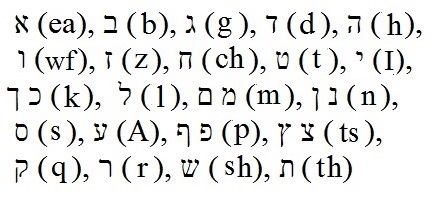
Key to the Hebrew Letters and the Latin Letter that will serve to substitute for it in this study due to font issues.

Using the above key to the Hebrew letters find:

Torah The
the of one using written was
or created ever codes simplest
considering,
it break to took it long how
.difficult most the of one,

Then read them right to left:

The Torah
was written using one of the
simplest codes ever created or,
considering
how long it took to break it,
one of the most difficult.

Apply this same method to this verse from the Torah. (Word order already reversed.)

Deuteronomy Verse 25:14:

לך יהיה לא
בביתך
איפה
איפה
גדולה
וקטנה

Change into Latin letters:

ea-l  h-i-h-i  k-l

c-th-i-b-b

h-p-i-ea

h-p-i-ea

h-l-wf-d-g

h-n-t-q-wf

Into Old English using linked words (letters):

Eall! Hie! Hie! Cyll!
Cuthe-thy-yb-beeb
Haep-pie-ea
Haep-pie-ea
Hleow-wod-dag
Hnat-taque-quo

From Old English to modern:

All! Hy! Hy! It killed!
Clearly then around about it was stranded in tides
It happened as the powerful worms were at the source
At the hollow mound it was senseless as the daggers
collided and changed the direction of its tack as it was leveled

Using the same method:

-Deuteronomy 28:1

גויי כל על

l-a   l-k   i-i-wf-g

Laeg loc eage-iew-wag

The lay and look at the eye was revealed and a wall

Using the same method:

-Deuteronomy 34:6

מול מואב בארץ

ts-r-ea-b   b-ea-wf-m   l-wf-m

Tos-seare-rab beuf-wom loma

It tossed, seared and raved above as it was bent where it looms

And these are some of the numerous other gems:

“Gaze on it all and how it was essentially horrible.”   -Numbers 6:4

“It quelled the living with stones that were abundant
It billowed forth thus as it ebbed at the gorges
in the lands with wasting heat.”    -Numbers 22: 38

“The battles on the living were woeful omens and flames that married.”    -Numbers 22: 41.

Last post —   Back to the first post on this topic


The Indo-European Language in Summary

© 2019 B. L. Freeborn

It was suggested previously that the alphabet as preserved in the Hebrew Script represents the original Indo-European Language and that each letter represents a sound, number and idea.

David Sacks, author of the excellent work on the alphabet “Letter Perfect: The Marvelous History of out Alphabet from A to Z”, would not approve of anything written here. He relates that the letters were created to describe objects such as houses, sticks, monkeys, mouths and eyes etc.

What has been proposed in these posts and reiterated below is the idea the alphabet was developed to describe physical principles such as continuity, points, and negation. This is the vocabulary of scientists. Their need to relate their discoveries and preserve the history of the apocalypse drove the development of this sound/number/symbol system and resulted in a language that spread from one scientific mind to the next until it was well….. pretty much known world-wide. We find it in its most basic form in Anglo-Saxon (Old English) and in its advanced and far distant forms in such places as Japan and Canada.

From Anglo-Saxon: toss and name (meaning ‘to take possession’);

compare from Japanese: tsunami  (meaning ‘a wave that tosses and takes’).

From Anglo-Saxon: ness (headland), top and pock;

compare to the name in the native language of Hudson Bay:  Nastopoka Arc.

Here is a summary of the significant ideas of the Indo-European Language:

‘a’ source, ‘b’ to be bisected, ‘g’ action, rotation,

‘d’ a division or state,‘h’ on high, ‘wf’ ongoing,

‘z’ to sever, severeness, ‘ch’ to change,

‘t’ a place of union, linear action, ‘I’ the eye or center,

‘k’ the impact crater and its properties,

‘L’ to lie where it fell, to lay out, to be in a line,

‘m’ more, might, measure of, ‘n’ negation, to reverse in direction yet continue,

‘s’ continuous state of being, unbroken, ‘A’ assigned, custom law,

‘p’ power in the small or great, ‘ts’ to harm by tossing, teasing, twisting, action that harms,

‘q’ magnetic pole and force,

‘r’ behavior of an explosion,

‘sh’ becoming infinitely small or transparent, ephemeral

and ‘th’ denotes importance and order of events.

Key to the Hebrew Letters and the Latin Letter that will serve to substitute for it in this study due to font issues.

Before this topic is concluded, let us use the above to look at a few interesting words.

Last postNext post

Back to the first post on this topic

Another Secret Hidden in the Hebrew Alphabet

© 2019 B. L. Freeborn

It was suggested previously that the alphabet as preserved in the Hebrew Script represents the original Indo-European Language and that each letter represents a sound, number and idea.

In the last posts ea, b, g; d, h, wf, z, ch, t; I k, L; m, n, s; A, p, ts; q, r, sh and th were examined.

Consider that the sounds may have been assigned to the numbers to preserve a specific message. Then each time the alphabet was read certain words were spoken.

Does a-b-g-d-h-u-z-ch-t-i-k-l-m-n-s-a-p-ts-q-r-sh-th say something?

It is suggested that it did originally tell a specific story. This is why the letters k, l, m, n have maintained their order as they were transferred into various alphabets. The meaning of the words as they are found in this series was stated at the end of each post. All the words are gathered together below in order.

Does it say….

It ebbed as it was done in a big way. It wandered as it was divided and somehow it was driven away. The warriors chattered at the tie. Increasingly it was killed and lamed. Yet men survived. The story repeated as it put it here and tossed it. It tossed the magnetic pole into a quern as it rushed the sheath.

ea-b or aeb = ebb;

b-g or beg = to do, care for, used today in the phrase “that is very big of you”;

g-d or gad (wandering in lack)

d-h or dah = division, partial

h-wf or hu = how, hwy = why

wf-z or fys = feeze, drive away

z-ch or secg = ‘sedge’, reed, sword, warrior

Key to the Hebrew Letters and the Latin Letter that will serve to substitute for it in this study due to font issues.

ch-t or ‘chette’ = chatter from raescettan = crackle, creak;

t-i or tieg = to tie, bind;

i-k or iec = increase;

k-l or cyll = skin, kill

l-m or lama = cripple, lay;

m-n or man = mankind, force, troop;

n-s or nes = escape, survive

s-A or seg = say, story;

A-p or apa = repeat, manifest;

p-ts or put-toss.

ts-q or toss – cue;

q-r or cweorn = quern; queer = unusual state

r-sh or raesc = shower, raesc = vibrate, quiver;

sh-th or sceath = sheath, covering.

Last postNext post

Back to the beginning of this series

Indo-European: In the Simplest Terms

© 2019 B. L. Freeborn

It was suggested previously that the alphabet as preserved in the Hebrew Script represents the original Indo-European Language and that each letter represents a sound, number and idea.

In the last posts ea, b, g; d, h, wf; z, ch, t; I, k, L; m, n, s; A, p and ts were studied. In this post the last of the letters: q, r, sh and th are examined.

They represent numbers 100, 200, 300 and 400 respectively. The Hebrew Letters are as seen in the image below.

The ‘q’ sound represents the number 100. When pronounced as ‘cue or queue’ it reveals itself. It suggests what happens next or lining up. The word quintessence means the fifth essence or element. The other elements are air, fire, earth, and water. What element exists that is not listed here? Magnetism and it has the ability to make things cue up.

Consider that it suggests the idea: magnetic pole and force.

The next letter ‘r’ has value 200. We find it used in such common words as rush, roar, ray, rage and rake. As before in its related terms 20 and 2 we have a doubling here. It repeats the idea that two comets raged and raked or exploded as they struck.

Consider it suggests the idea: behavior of an explosion.

The next letter provides the sound ‘sh’. It has value 300. We see it used in such words as shim, shimmer, show, shoe, and shy.

Consider that it suggests the idea: becoming infinitely small or transparent, ephemeral.

The last letter provides the sound ‘th’. It has value 400. Numerically this an extraordinary number. It is the ratio between the distances of the Moon and Earth; and Sun and Earth; and their diameters. As a sound, it must be one of the most frequently used in modern English. It is essentially ‘the’ and found in this, that, then, there, thus, thing etc. At one time there was even a second form of the word spelled ‘tha’ which meant then, at that time. We use it to give words importance. Get the book not a book.

Consider that it suggests the idea: denotes importance and order of events.

Key to the Hebrew Letters and the Latin Letter that will serve to substitute for it in this study due to font issues.

From Anglo-Saxon note these examples using these letters:

cwys = bruise, cwec = quicken, cwel = quell;

ra = ran, robbery, ryhe = blanket, rec = to govern;

shy = shoe, foundation, scyg = to shoe, sceaw = show;

theg = to serve, thy = thy, the, after, theb = thief, thaw = thaw.

Note the meaning of the words as they are found in series as provided by the alphabet. Continuing where we left off:

ts-q or toss – cue;

q-r or cweorn = quern, queer = unusual state;

r-sh or raesc = shower, raesc = vibrate, quiver;

sh-th or sceath = sheath, covering.

Before we had these significant ideas: ‘a’ source, ‘b’ to be bisected, ‘g’ action, rotation, ‘d’ a division or state,‘h’ on high, ‘wf’ ongoing, ‘z’ to sever, severeness, ‘ch’ to change, ‘t’ a place of union, linear action, ‘I’ the eye or center, ‘k’ the impact crater and its properties, ‘L’ to lie where it fell, to lay out, to be in a line, ‘m’ more, might, measure of, ‘n’ negation, to reverse in direction yet continue, ‘s’ continuous state of being, unbroken, ‘A’ assigned, custom law, ‘p’ power in the small or great, and ‘ts’ to harm by tossing, teasing, twisting, action that harms. Each is represented by a short sound.

Now we have these ideas: ‘q’ magnetic pole and force, ‘r’ behavior of an explosion, ‘sh’ becoming infinitely small or transparent, ephemeral and ‘th’ denotes importance and order of events.

Last postNext post

In the Indo-European Language: Letters Hold the Power

© 2019 B. L. Freeborn

It was suggested previously that the alphabet as preserved in the Hebrew Script represents the original Indo-European Language and that each letter represents a sound, number and idea.

In the last posts ea, b, g; d, h, wf; z, ch, t; i, k, L; m, n and s were studied. In this post A, p, and ts are examined.

They represent numbers 70, 80 and 90 respectively. The Hebrew Letters are as seen in the image below.

It is suggested the ‘long A’ sound represents the number seventy. This number is of importance when measuring longitude. The distance between each degree is 69.2 miles at the equator. From the pole down it creates a wedge shape which is reflected in both the Latin and Hebrew letter form. Notably in Anglo-Saxon ae meant law, custom.

Consider that it suggests the idea: assigned, custom, law.

The next letter ‘p’ has value 80. We find it used in such common words as point, place, plane and power.

Consider it suggests the idea: power in the small or great.

The next letter provides the sound ‘ts’. It has value 90. Numerically this is an important number. The pole lies at 90 degrees and this is the place where the story of Baal plays out. The comet struck here at the tessarace. (A tessarace is the summit of a tetrahedron or four-sided figure with top and bottom like the Great Pyramid.)

Consider that it suggests the idea: to harm by tossing, teasing, twisting, action that harms.

Key to the Hebrew Letters and the Latin Letter that will serve to substitute for it in this study due to font issues.

From Anglo-Saxon note these examples using these letters:

At = at, awa = world without end, aetys = present, attest, al = fire, burning;

pa = father, pohha = pocket, pawa = peacock;

teosu = harm, injure, tosaw = strew, scatter.

Note the meaning of the words as they are found in the series as provided by the alphabet’s order. Continuing where we left off:

s-A or seg = say, story;

A-p or apa = repeat, manifest;

p-ts or put-toss.

Before we had these significant ideas: ‘a’ source, ‘b’ to be bisected, ‘g’ action, rotation, ‘d’ a division or state,‘h’ on high, ‘wf’ ongoing, ‘z’ to sever, severeness, ‘ch’ to change, ‘t’ a place of union, linear action, ‘I’ the eye or center, ‘k’ the impact crater and its properties, ‘L’ to lie where it fell, to lay out, to be in a line, ‘m’ more, might, measure of, ‘n’ negation, to reverse in direction yet continue, and ‘s’ continuous state of being, unbroken. Each is represented by a short sound.

Now we have these ideas: ‘A’ assigned, custom law, ‘p’ power in the small or great, and ‘ts’ to harm by tossing, teasing, twisting, action that harms.

Last postNext post

Back to first post on this topic

Indo-European as a Language is Laid Out

© 2019 B. L. Freeborn

It was suggested previously that the alphabet as preserved in the Hebrew Script represents the original Indo-European Language and that each letter represents a sound, number and idea.

In the last posts ea, b, g; d, h, wf; z, ch and t were studied. In this post I, k and L are examined.

They represent numbers 10, 20 and 30 respectively. The Hebrew Letters are as seen in the image below. Now the numbers count out the tens.

It is suggested the ‘I’ or ‘y’ sound represents the number ten. Each time a number is multiplied by ten it moves one place to the left and a zero or place holder is added to the right if no other digit (1, 2, 3…) is used. Similarly, division by ten moves the number to the right. Essentially, this is the number all the other numbers are centered around.

Consider that it suggests the idea: the eye or center.

The next letter ‘K’ has value 20. It is twice 10. The double is important here. Recall that it has been suggested this language was invented to transmit the ideas of the Baalists. Central to this is the idea that two comets struck the planet simultaneously. That idea is embodied in this number. The Latin K takes the form of the Phoenician letter for ‘ea.’ Turn it on its side and the idea of a sharp object impacting with a surface is depicted. In the Hebrew forms we see perhaps a precipitous cliff and crater.

Consider it suggests the idea: the impact crater and its properties. We find it used in such common words as crater, cave, cause and collide.

The next letter provides the sound ‘L’. It has value 30. Thirty correlates well with the idea of measurement. Thirty feet is 360 inches. The circle is measured in 360 degrees. A double hour of longitude is 30 degrees etc.  All of which suggest the ordering of things. We find it in such common words as to lie, to lay, land and line.

Consider that it suggests the idea: to lie where it fell, to lay out, to be in a line.

Key to the Hebrew Letters and the Latin Letter that will serve to substitute for it in this study due to font issues.

From Anglo-Saxon note these examples using these letters:

eage = eye, iu = geo, formerly, yb = ymbe = around, at, upon;

caeg = key, essence, caeg = object or place, ceahhe = dawn;

lea = piece of ground, lieg = to lie, at rest, leg = lieg = flame.

Note the meaning of the words as they are found in the series as provided by the alphabet’s order. Continuing where we left off:

t-i or tieg = to tie, bind;

i-k or iec = increase;

k-l or cyll = skin, kill.

Before we had these significant ideas: ‘a’ source, ‘b’ to be bisected, ‘g’ action, rotation, ‘d’ a division or state,‘h’ on high, ‘wf’ ongoing, ‘z’ to sever, severeness, ‘ch’ to change, and ‘t’ a place of union, linear action. Each is represented by a short sound.

Now we have these ideas: ‘I’ the eye or center, ‘k’ the impact crater and its properties, and ‘L’ to lie where it fell, to lay out, to be in a line.

Last postNext post

Back to first post on this topic