Ancient Riddles to Test Our Wits: Crespi’s Warrior

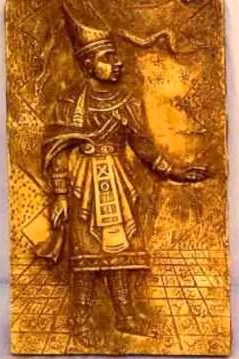
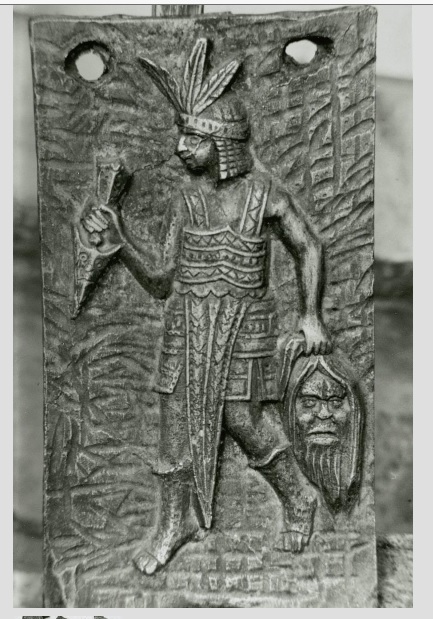
Carved Plate from Crespi Collection

Carved Plate from Crespi Collection

© 2016 B. L. Freeborn (updated Dec. 2018)

In this piece from the Crespi Collection find the words in italic:

The hoary ancient head of Earth was left low

as the two holes pressed through.

The sword struck near the foot of the tile foundation.

It walked and made a two footed foundation,

one magnetic and the other true.

The dagger of Baal with its two craters lies at the rightful pole.

It is the angle that parts longitude.

The pole wavered and split,

the collar dropped to the eye.

The new youthful Earth was thus clothed.

_________

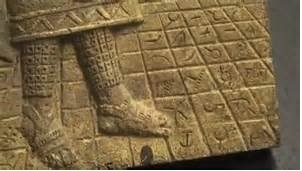
Compare this art to the Narmer Palette from Egypt, c. 3100 BC as displayed at the Royal Ontario Museum:

Narmer Palette, Egypt, c. 3100 BC - Royal Ontario Museum

Narmer Palette, Egypt, c. 3100 BC – Royal Ontario Museum

__________________

Read about Father Crespi and see more art:

“The Crespi Ancient Artifact Collection of Cuenca Ecuador”

Back to Beginning of posts on Newberry Tablet

Back to Beginning of posts on Adena Art

The next riddle is here!

The Newberry Tablet Reveals….

© 2015 B. L. Freeborn, Sept. 2022

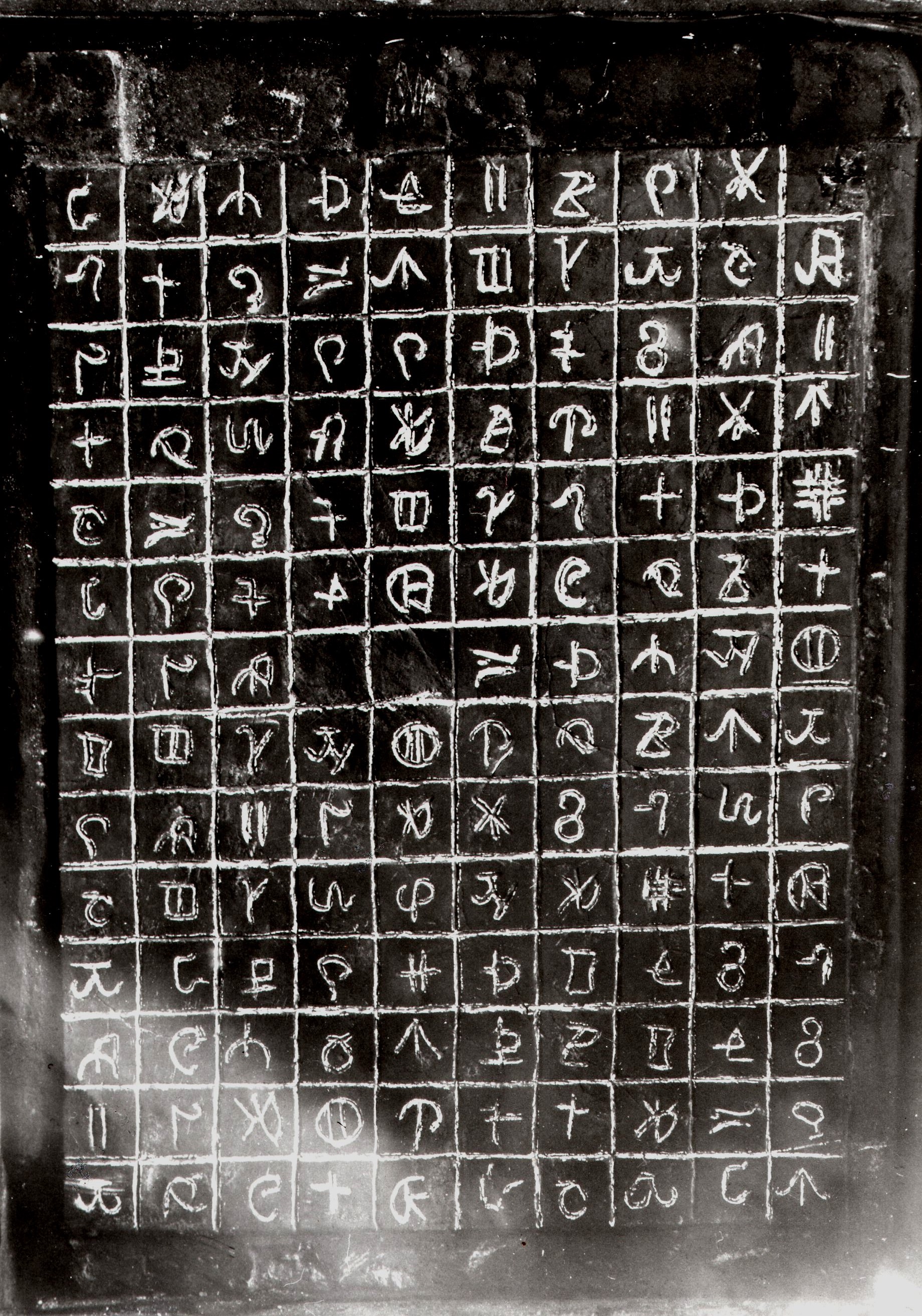
Smithsonian Photo of Newberry Tablet, compliments of Roger Jewell

Smithsonian Photo of Newberry Tablet, compliments of Roger Jewell

To the first post on the tablet – To the previous post on the tablet.

In the last posts we looked at the overall layout of the Newberry Tablet and many symbols. The list has grown and the reading is completed here.

The symbol identification thus far has suggested the topic of the tablet is a double comet collision and its crater was to be a point of reference for future measurements. The remaining symbols should support this story.

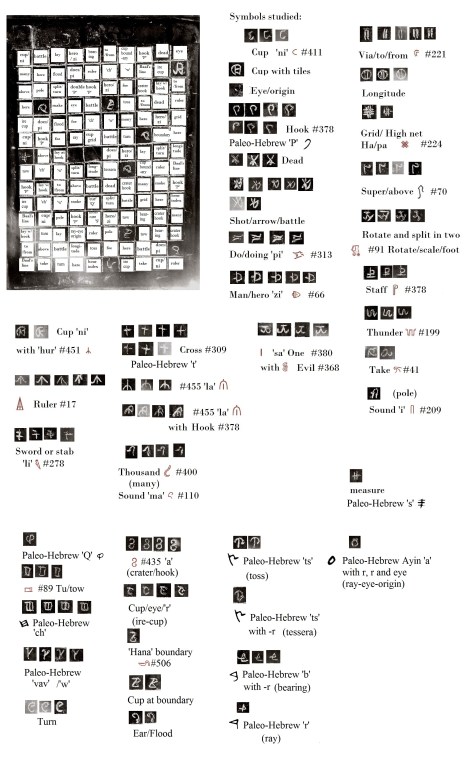
The last of the study comprises 15 symbols. The remaining symbols are left for the reader to identify. There is one symbol that resembles the ‘Q’ of the Paleo-Hebrew alphabet. It is suggested it represents cue or to line up, or quay, the place where ships line up. Since cows walk in a line and the Old English word for cow, spelled cu, is very similar; the symbol perhaps means to line up and/or skin, an important by product of cows.

The symbol similar to a rectangle is found in the Luwian symbol list #89 and has sound value ‘tu.’ This is very similar to the word tow and is so noted.

The symbol that is a square divided in half is always followed by the symbol that looks like a ‘Y’. Both symbols are extremely similar to the ‘ch’ and ‘vav’ of the Paleo-Hebrew Alphabet. Substituting the sounds ‘ch’ and ‘w’ into the table find the word ‘chew’ repeated four times. This word is also an original Old English word.

The circle with a hook on top is found in the Luwian Glyph list at #435 with sound ‘a’ and is noted in the table as crater/hook.

The symbol that looks like a large curling ‘e’ most likely means ‘turn’ since the Adena Tablets and the New Hampshire Mystery Stone included this idea. It is so noted in the image.

The symbol that is the cup with a dot in the middle and a small stroke at the top is translated by understanding that in Luwian Hieroglyphs the small stroke added to another symbol is an ‘r’. This gives us an eye-r-cup or perhaps ‘ire cup’ and is so noted in the table.

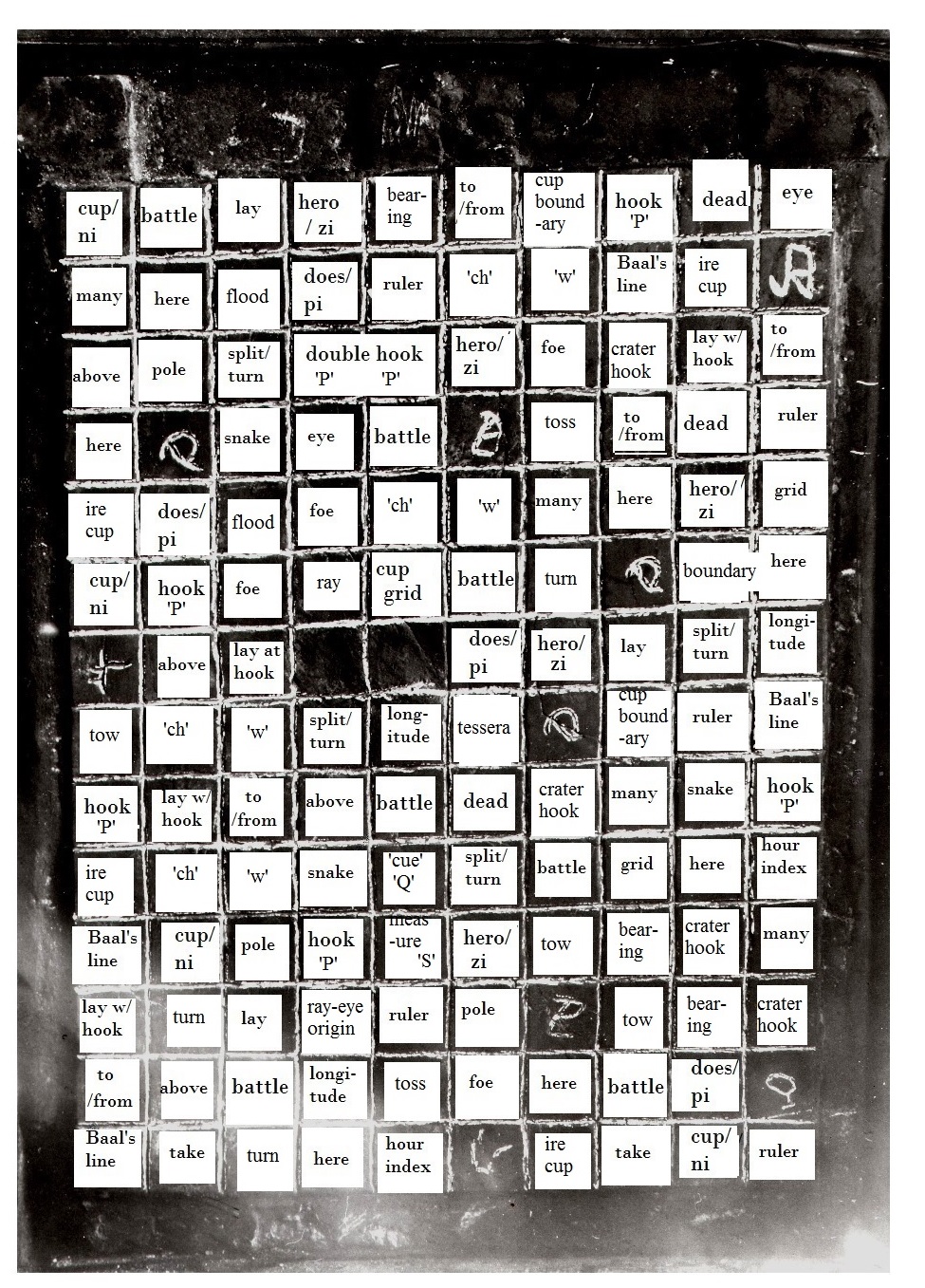
Newberry symbols replaced with proposed meanings. See images below and text for more information.

It took some time to identify the symbol first row, fourth from the right and the symbol in the sixth row second from the right as being related to each other. The latter is found in the Luwian glyph list at #506. It is also found in Assyrian art and Olmec art described in a previous post as the odd little purse. The glyph list notes it as having sound ‘hana.’ In Old English this word means boundary stone. The symbol in the first row combines it with a ‘cup’ so that the distorted ‘B’ shape is created. They are noted in the chart as boundary and cup/boundary.

The symbol in the second row third from the left is similar to a reversed ‘e’ with an extra mark below it. In fact it appears to be an ear. In Old English the word ‘ear’ besides meaning ear means wave or flood. The association no doubt arises because of the whirlpool design of the ear. It is noted as ‘flood’ in the table.

Since many of the symbols are similar to Paleo-Hebrew perhaps the cup that is upside down and upon an upstroke is the letter ‘ts’. The words ‘toss’ or ‘tease’ is essentially defined by this sound. The similar symbol that combines the former symbol with a short stroke is then ‘ts’ and ‘r’ and is actually closer to the Paleo-Hebrew ‘ts’. This then sounds out the word ts-r or tesserae and is so noted in the table. This word means a small square tile.

The hook or staff studied in previous posts can now be associated with Paleo-Hebrew ‘P’ which begins such words as pea, power, pole, and point. The ‘P’ has been added to the table.

The symbol in the first row fifth from the left that appears to be a triangular ‘e’ with a large side stroke reminds one of the Paleo-Hebrew ‘B’ with the Luwian ‘r’ added. This gives the word b-r which suggests the word bear as in direction and it is noted in the table as bearing.

The Newberry Tablet's translation.

The Newberry Tablet’s translation.

The triangle with the stem suggests the Paleo-Hebrew ‘R’. It might have a side stroke as seen in the ‘bearing’ symbol. It is noted in the chart as ‘ray.’

The last symbol identified here is the circle with the two side strokes like antennae and the dot in the middle. The Paleo-Hebrew letter Ayin or ‘A’ is a circle. The dot supplies eye or sound ‘i’ and the two strokes give two r’s. So then we have r for ray, an eye, and a-r. The latter suggests the Old English word ‘or’ which means origin. It is noted in the table as ray-eye-origin.

So then, the table provides short readable sentences. The first line perhaps reads: The battle at the cup where lays the noble bearing is the to/from boundary. The cup is the dead pole and the eye.

Continue to line two and read: Many here caused the flood. It was the powerful ruler that was chewed. It is Baal’s line at the angry wandering cup …(unknown term).

In other words they say: There was a comet impact. It is the crater at magnetic north. Here is the reference boundary for longitude. The crater is the former north pole and the eye of the comet.

Many comets here caused a flood. It was the north pole that was destroyed. It is the longitude of the double comet’s (Baal’s) crater that….

The remainder of the table can be studied at one’s leisure.

Enjoy your New Year! Happy Holidays!

On to more riddles!!

Newberry Tablet and its Ancient Links to Europe

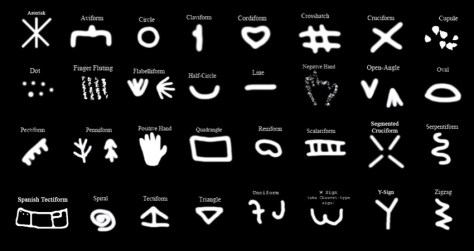
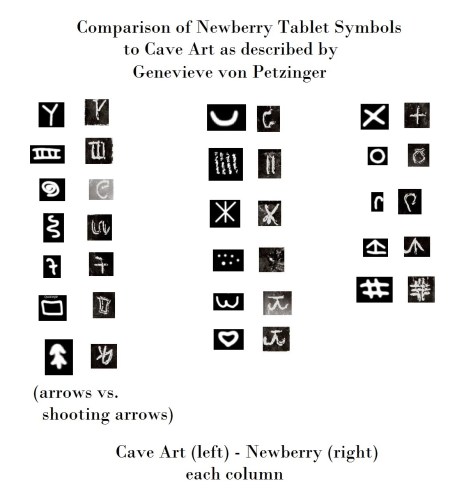
The reader may find this short talk on cave drawing to be of interest. The symbols that are compiled and presented by Genevieve von Petzinger in the video are compared below to the symbols found on the Newberry Tablet and to the Paleo-Hebrew script from some 3000 years ago. (Symbols as depicted at oocities.org.)

“Written language, the hallmark of human civilization, didn’t just suddenly appear one day. Thousands of years before the first fully developed writing systems, our ancestors scrawled geometric signs across the walls of the caves they sheltered in. Paleoanthropologist, rock art researcher and TED Senior Fellow Genevieve von Petzinger has studied and codified these ancient markings in caves across Europe. The uniformity of her findings suggest that graphic communication, and the ability to preserve and transmit messages beyond a single moment in time, may be much older than we think.” -Ted Talks


Cave art as found by Genevieve von Petzinger

Cave art as found by Genevieve von Petzinger

Newberry symbols compared to cave art.

Newberry symbols compared to cave art.


Comparison of cave art to Paleo-Hebrew script circa 8th century BC.

Comparison of cave art to Paleo-Hebrew script circa 8th century BC.

On to last post on Newberry Tablet.

The Message of the Newberry Tablet – Part 3

© 2015 B. L. Freeborn

Smithsonian Photo of Newberry Tablet, compliments of Roger Jewell

Smithsonian Photo of Newberry Tablet, compliments of Roger Jewell

To the first post on the tablet – To the previous post on the tablet.

In the last posts we looked at the overall layout of the Newberry Tablet and a few symbols.

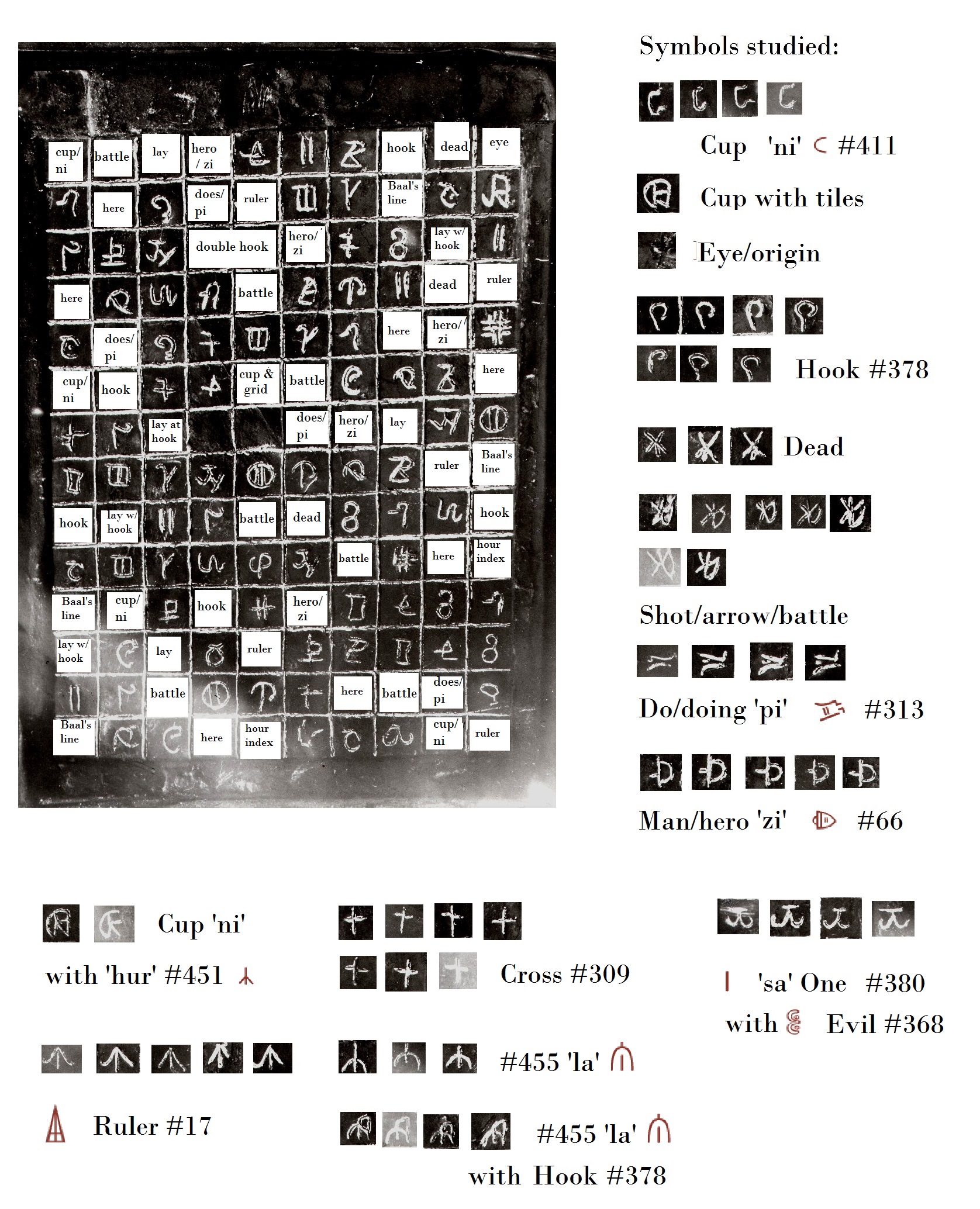
In this post six symbols are studied: the glyphs found at the bottom corners, the cross, the symbol at 1, 3 and the similar symbol at 3,9. The last symbol to be studied combines the cup symbol found in the upper left corner with what looks like a bird foot print and is found at 10,10. There are two of the latter. The second is found at 14,5. It combines the idea of the cup with sound ‘ni’ with glyph #451 with sound ‘hur.’ This sounds remarkably like the word ‘hour’ and if the craters in Hudson Bay were used as the start line for longitude then the ‘hours’ of Earth’s rotation are marked off from this place. We should recall that the word ‘ni’ means ‘here, now, and/or upon us’ and is today spelled ‘nigh.’

This idea is repeated in the bottom left corner. There is a double loop with a line on top of it. It is a combination of glyphs #368 and #380 from the Luwian Glyph list. The double loop was determined to mean ‘evil’ which a double crater would certainly represent. This symbol would then repeat the idea of the line of longitude index point. It is used four times in the table.

Again the idea is reinforced by the symbol in the bottom right corner which is found in the glyph list at #17 and represents the ruler. This glyph is repeated five times in the table. So then the four corners, which should define the topic of the tablet, are: a cup (crater), an eye, a line at evil and the ruler.

The last three symbols are the cross which is used seven times and is found in the glyph list at #309. It likely represents the idea of ‘a place’ or ‘an intersection.’ The other two symbols are the upside down trident at 1, 3 and the related symbol that puts a hook on top of the glyph. The first symbol is #455 and has sound ‘la’ or we might say in both modern and old English it is the word ‘lay.’ The similar symbol combines this with the hook glyph #378. So, it expresses the idea of ‘laid with the hook’ or ‘at/by’.

The table is filling in!

The study will continue in the next post.

The Newberry Tablet's decipherment continues in this image as six more glyphs are filled in.

The Newberry Tablet’s decipherment continues in this image as six more glyphs are filled in.


The Message of the Newberry Tablet – Part I

© 2015 B. L. Freeborn, updated Sept. 2022

Smithsonian Photo of Newberry Tablet, compliments of Roger Jewell

Smithsonian Photo of Newberry Tablet, compliments of Roger Jewell

From the previous post:  The Newberry Tablet’s authenticity, like all inscribed artifacts found in North America, is much debated. The best place to see it as it exists today is to watch Scott Wolter’s episode in “America Unearthed.” Virtually destroyed, there are few pictures of it in existence. The best pictures are in Roger Jewell’s book, “Ancient Mines of Kitchi Gummi” which is a well thought out explanation of the copper mines in the Lake Superior area and worth reading.

We continue: The images here are compliments of Roger Jewell.

In the last post the overall number layout of the tablet was discussed and now it is time to look at some of the symbols. They may be viewed as letters by some and hieroglyphs by others. Barry Fell viewed them as letters from the Cypriot Alphabet and translated it accordingly. The two letters that led him to think it was of that alphabet are seen (counting from left, top)  in box 1,9 (next to the dot) and 13,3. Beyond these two there is little resemblance. These two symbols repeat in the array but we begin not with them but the symbols in the first box that looks like a C since it would seem the topic should be announced first.

This C symbol repeats three times at 6,1; 11,2 and 14,9 (or 1,2 from the bottom corner). For a total of four times.

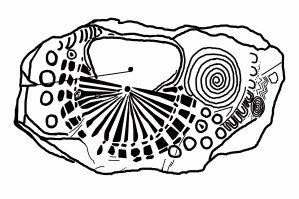
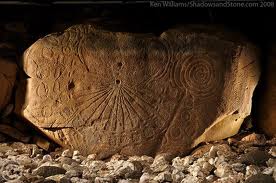
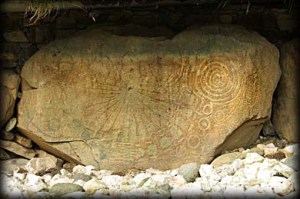
Sketch of Kerbstone 86

Sketch of Kerbstone 86

Perhaps its shape gives a clue to its meaning. It is a cup. It is the shape of the center of Stonehenge’s main uprights. The first sound of cup is K and this sound in Hebrew is denoted by a C shape. The word cup is repeated in the word copper which was mined heavily in the region where this tablet was found. This C shape is the symbol for ‘great’ with sound ‘ur’ from Luwian Hieroglyphs (see number 363). It was repeated four times on Kerbstone 86 at ancient Knowth in Ireland. The word ‘origin’ begins with this ‘ur’ sound and the Old English word ‘or’ means ore. Does the cup indicate the origin of copper ore?

Previously Hudson Bay has been discussed and geographically this tablet is from Michigan rather close to the bay with its three large cup shapes in a vertical row that begin at 56.5 N and 79.2 W.

What then is in box 5,6? (column 5, row 6). The symbols should be consistent with the suggested meaning. The cup shape repeats with a double box in it. This repeats the idea of emptiness at 5,6 as depicted by the table with its two empty squares. In row 5, column 6 is a Y. This suggests this is a split. Opposed to the cup in the far corner is a dot, or an eye, or the repeating of the idea of ‘here it begins’ at 1,1 if read from the right. Things tend to fan out or Y out from an eye.

This is a good beginning. The longitude of Hudson Bay at 79.2 is measured from England where lies Stonehenge with its large ‘cup’ configured monoliths and more recently discovered identical CUP inscription. (See this well written paper.) And what’s more! The diameter of Earth is 7920 miles. Coincidence!?

More to follow……… on the message of the Newberry Tablet.

Study of symbols of Newberry Tablet

Study of symbols of Newberry Tablet

Back to the very beginning of series on Adena Tablets

Previous Post on the  Newberry Tablet

Posts on:  Batcreek Stone, Shaman Stone,

 Adena Pipe, Numbers and their Meaning,

Ramey Peet Tablet, Gridley Stone

McKensie and Bainbridge Tablets, Cincinnati Tablet,

Egyptian Art Comparison, Wilmington Tablet, Lakin A Tablet,

The Gaitskill Clay Tablet, Allen Tablet, Grave Creek,

The Kiefer Tablet, Wright, Lakin B and Meigs Tablets,

Berlin Tablet, Gaitskill Stone Tablet, The Low Tablet,

The Waverly Tablet, Metcalf Stone, and pdf article on

Hudson Bay as a comet crater of recent origin!!!!

See also Luwian Symbols by: Gunter Anders at http://www.hethport.uni-wuerzburg.de/luwglyph/Signlist.pdf

The Newberry Tablet – A New Way to Read It

© 2015 B. L. Freeborn, September 2022
Newberry Tablet, photo Smithsonian

Newberry Tablet, photo Smithsonian

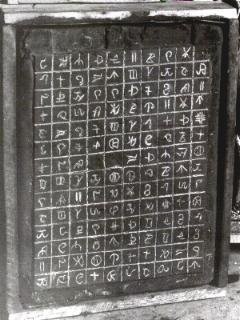
The Newberry Tablet’s authenticity, like all inscribed artifacts found in North America, is much debated. The best place to see it as it exists today is to watch Scott Wolter’s episode in America Unearthed. Virtually destroyed, there are few pictures of it in existence. The best pictures are in Roger Jewell’s book, “Ancient Mines of Kitchi Gummi” which is a well thought out explanation of the copper mines in the Lake Superior area and worth reading.

The Tablet was translated by Barry Fell as ‘how to obtain omens using birdseed’ and is available in Betty Sodders’, “Michigan Prehistory Mysteries.”

The translation done here of this tablet begins with looking at the square grid as essential to its meaning. The Earth is divided by longitude and latitude in a grid like manner. This then gives a starting point for translation. The numbers revealed by the grid are the same as those found in studying the Adena Tablets. It is highly unlikely a modern trickster would have known to incorporate these same numbers and this suggests the Tablet was authentic.

In the coming weeks the meaning of the 138 (twice 69) symbols will be explored but for now ….. the numbers reveal a great deal!
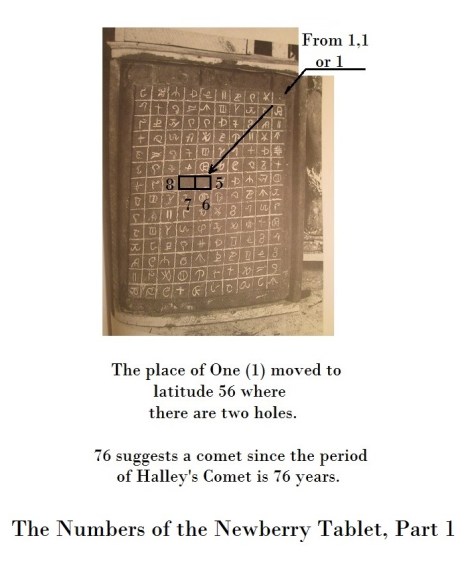
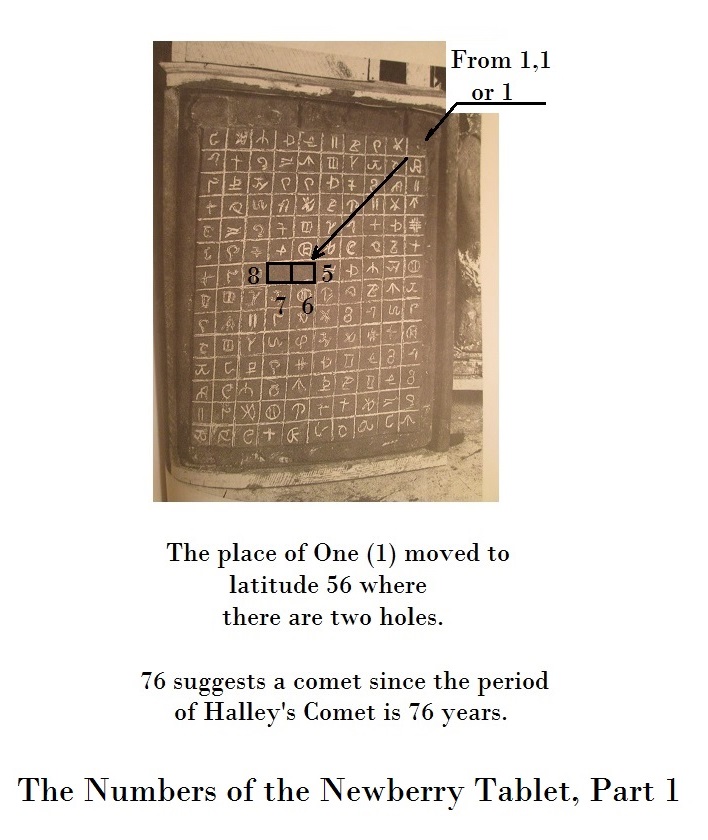
Translation of Newberry Tablet, Part IThe tablet is a 10 x 14 grid. Here in the first image, notice that the upper right corner only has a dot or an eye. There are two empty boxes in the middle. Counting from the left and then right obtain 5,6 for the right box. Count it again as if the box is translated left 5 spaces and down 6 spaces so that 56 is obtained again. In this case, if the dot is at 1,1 it has translated to 5,6.

Do the same for the left box and it is 4,7. Recall 4 x 7 = 28 or half of 56. Also as the seventh box down and the 8th up or 7 x 8 is 56.

Other numbers can be found depending on how one counts such as 7,8; 6,7; 7,6; 4,6; 6, 4; 7,8 and 7,7. In this grouping notice 76 and 77 both appear and the return period of Halley’s comet is 76 to 77 years. Combining the two ideas it suggests the pole moved to latitude 56 because of a comet. This interpretation will be supported by further study of the symbols.
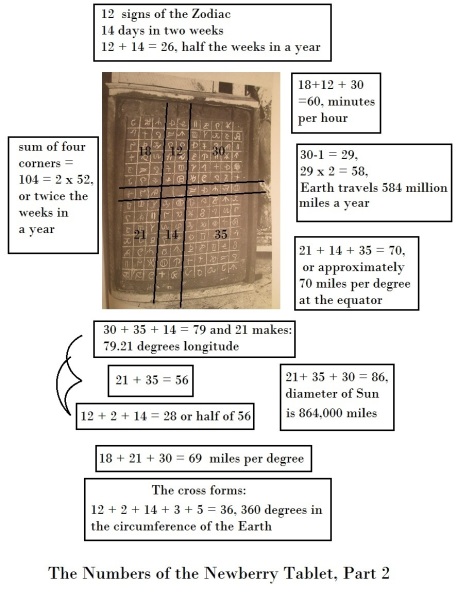
Translation of Newberry Tablet, Part 2

The next number study reveals the grid can be divided by the central boxes into sections. The number of boxes in each section are indicated and sums of these numbers reveal Earth related values. The three most plausible numbers from this study are found in the cross, top and bottom. The cross has 36 boxes which suggests the 360 degrees of longitude, 360 seconds in a degree of measure, and 360 seconds in an hour.

The top has 60 boxes suggesting the 60 minutes in a degree of latitude and longitude. The bottom has 70 boxes suggesting the 69.2 miles per degree of longitude at the equator.

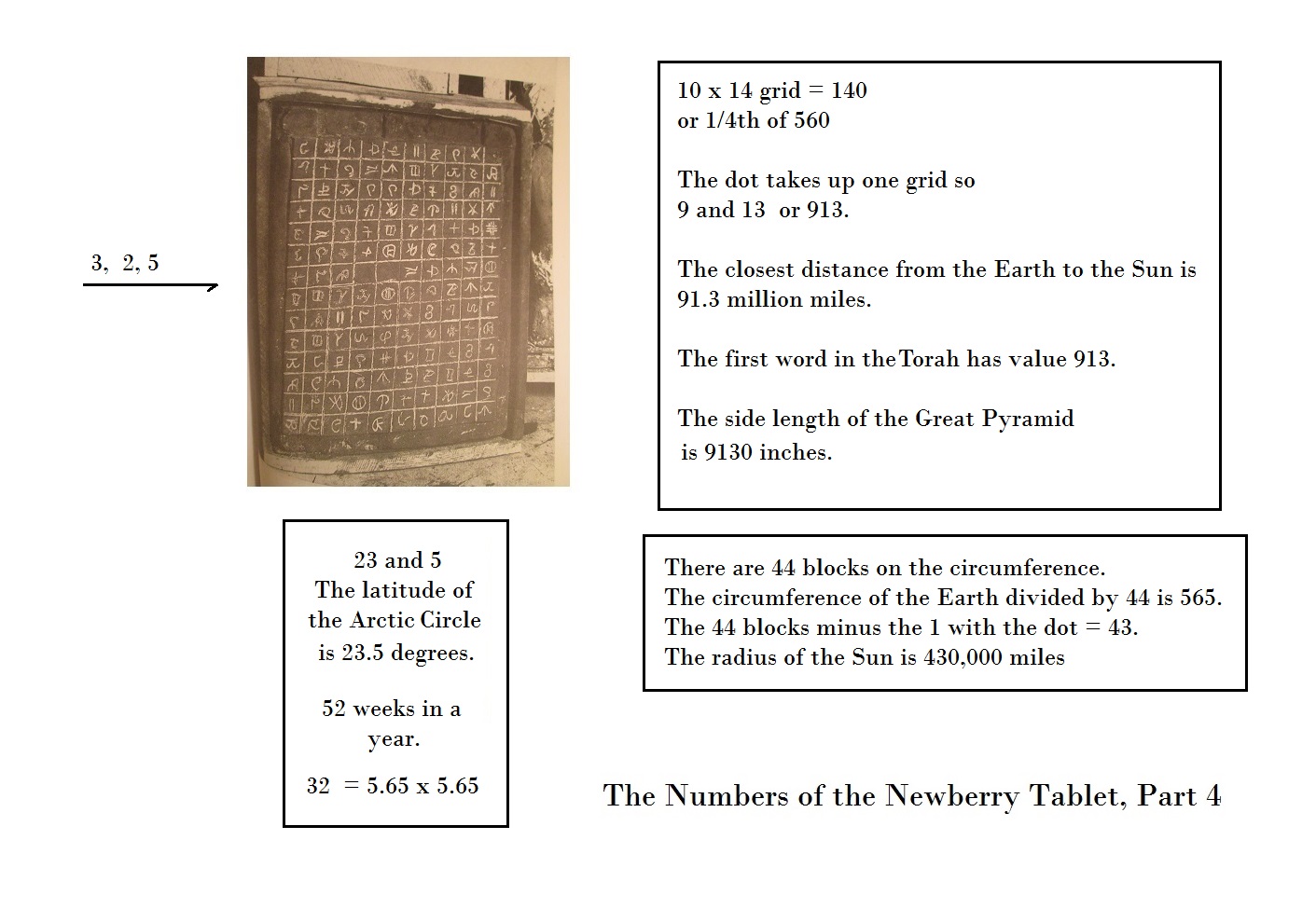
Read the line with two empty squares as 3,2,5 and find 32 or 23.5. The first is 5.65 squared and the second suggests the arctic circle which lies at (90-23.5 =) 66.5 degrees.

The other number arrangements are left for your consideration
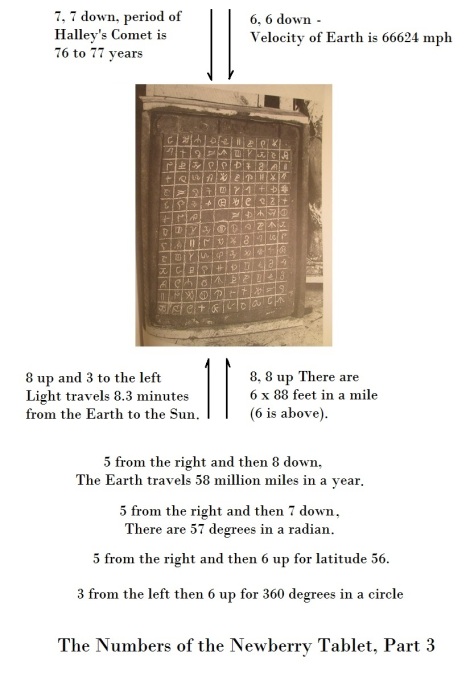
Translation of Newberry Tablet, Part 3The third and last figures both reveal Earth related values and that the positioning vertically in the grid of the empty boxes was intentional.
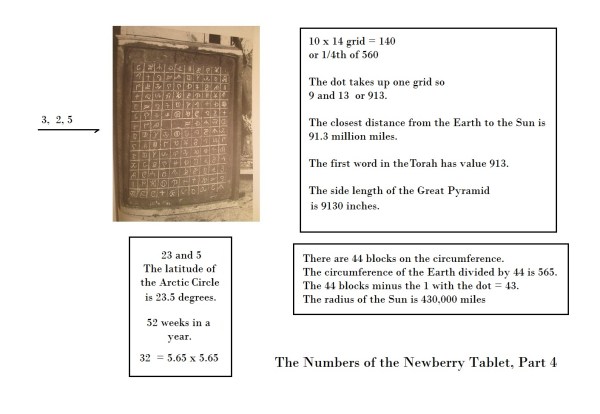
Translation of Newberry Tablet, Part 4Finally, note the overall 10 by 14 grid. Recall the square root of 2 is 1.414 and that 14 x 10 assembled as 1410 resembles this number.

The story this tablet reveals continues in coming posts. Next up then is the beginning study of the symbols.

Back to the very beginning of series on Adena Tablets

Previous Post on the Batcreek Stone

Posts on:  Shaman Stone,

 Adena Pipe, Numbers and their Meaning, Ramey Peet Tablet, Gridley Stone

McKensie and Bainbridge Tablets, Cincinnati Tablet,

Egyptian Art Comparison, Wilmington Tablet, Lakin A Tablet,

The Gaitskill Clay Tablet, Allen Tablet, Grave Creek,

The Kiefer Tablet, Wright, Lakin B and Meigs Tablets,

Berlin Tablet, Gaitskill Stone Tablet, The Low Tablet,

The Waverly Tablet, Metcalf Stone, and pdf article on

Hudson Bay as a comet crater of recent origin.

The Adena Tablets – The Grave Creek Stone

Smithsonian photo of Grave Creek Stone from McCulloch's site

Smithsonian photo of Grave Creek Stone from McCulloch’s site

© 2015 B. L. Freeborn, updated May 2025

The Grave Creek Stone was found in the Grave Creek Mound close to the Ohio River in West Virginia. Translations have been done, one in jest, but none seem satisfying. An excellent place to review the controversy surrounding the stone is at J. Huston McCulloch’s site linked here. The original Smithsonian photo of the stone and Schoolcraft’s art are from his site and his efforts are greatly appreciated.

Seth Eastman drawing of stone from Schoolcraft's 1850 book.

Seth Eastman drawing of stone from Schoolcraft’s 1850 book.

There are several ideas that have been consistently overlooked in translating the stone. The lines on the stone are always assumed to be guides for writing such as ruled school paper. Since most persons attempting to translate this stone read and write English which is presented horizontally it has never occurred to anyone they are not guide lines and represent something else. Perhaps they represent lines of longitude and the stone should be rotated to be read in a vertical manner.

Grave Creek Mound, Moundsville, W. Virginia

Grave Creek Mound, Moundsville, W. Virginia

The Grave Creek Mound is shown here and a similar mound below Dayton is also shown. It is found in  Miamisburg.

Miamisburg Mound

Miamisburg Mound, Miamisburg, Ohio


Comparison with other art from Ireland and Georgia

Comparison with other art from Ireland and Georgia

The decipherment of the stone resolves itself quickly as seen here when it is compared to Kerbstone 86 from the ancient ruins in Knowth, Ireland (3000 BC) and when compared to the Metcalf stone from Georgia. The Metcalf Stone began this series. The kerbstone was studied in a prior posting as well. The comparison shows the symbols from the kerbstone are located in the middle line if the stone is rotated and read in a vertical manner. The top is confirmed by comparison to the Metcalf stone as shown in the image. The two symbols at the bottom of the columns are out of alignment intentionally. One indicates 3 and the other 2 for 32 or the square of 5.65 is where the misalignment lies.

Numbers of Grave Creek Stone, Par II

grave creek sketch mod 2bAlthough it is believed these glyphs are letters, it is more likely they are simple small pictures that tell the same story as the Metcalf and as depicted on the Mystery Stone from New Hampshire. It is the same story depicted on the other Adena Tablets. Several of the glyphs appear to be forerunners to Phoenician letters including the symbols interpreted here as numbers at the bottom of the middle row.

grave creek readingIt is as if this is all to commemorate a separation of the North Pole from Magnetic North.

The stone is then translated as shown and reads:

The two eyes lie at 79 degrees and 56.5 degrees in the lake.

The object struck the pole at the top and pushed it down.

The pole was stricken by two arrows and craters.

It was split and shaken.

The one place of the mountain became a great valley.

It measured the heavens.

The numbers’ order rotated.

Arisen is a pole and it is the foot for measurement of angles.

Measure also from the stricken pole place.

………………

The last stone in this translation series will be the Newberry Tablet. The numbers are easy. Yes, same old, same old numbers! Imagine that!

__________________

Much more Information at:

J. Huston McCulloch’s site

http://economics.sbs.ohio-state.edu/jhm/arch/grvcrk.html

___________________

Back to the very beginning of series on Adena Tablets

Previous Post on the Bat Creek Stone

Posts on:  Shaman Stone, Adena Pipe,

Numbers and their Meaning, Ramey Peet Tablet, Gridley Stone

McKensie and Bainbridge Tablets, Cincinnati Tablet,

Egyptian Art Comparison, Wilmington Tablet, Lakin A Tablet,

The Gaitskill Clay Tablet, Allen Tablet, Grave Creek,

The Kiefer Tablet, Wright, Lakin B and Meigs Tablets,

Berlin Tablet, Gaitskill Stone Tablet, The Low Tablet,

The Waverly Tablet, Metcalf Stone, and pdf article on

Hudson Bay as a comet crater of recent origin.

The Bat Creek Stone – Translated – Not So Plain and Simple

Bat Creek Stone - photo by Scott Wolter

Bat Creek Stone – photo by Scott Wolter

© 2015 B. L. Freeborn, Updated Sept. 2022

The Bat Creek Stone was found in a mound with a skeleton in Loudon County, Tennessee in 1889 during a dig by the Smithsonian Bureau of Ethnology. Because it appears to have Phoenician or Paleo-Hebrew letters it has been dubbed a fraud. Arguing in favor of its validity is J. Huston McCulloch who describes the controversy at the site noted below and linked here. Scott Wolter also argues in its favor. It is also described at Wikipedia under the Bat Creek Inscription.

No satisfying, controversy resolving translation has been made. The following may not put the matter to rest either but it is new and unique! All other attempted translations have failed to note this is an extraordinary number riddle. The numbers are found by recalling that letters originally had number equivalents and not separate symbols as we have today. Using the Hebrew gematria or number/letter system the values appear as noted below and the riddle of the numbers is solved. In turn this confirms that the correct letters are identified in the translation.

The two lines and dot in the upper left were not shown in a detailed sketch of the stone done in 1890. Scott Wolter successfully demonstrates in his show America Unearthed that they were not part of the original inscription.

The Translation

The letters used to translate this inscription are from oocities.org and were in use in 800 BC by the Phoenicians. Note that the L and P are more in the modern Latin Alphabet style and a reversed E which is an H in Phoenician also appears.  So, there are intentionally two alphabets in use in this inscription. It is typical of highly educated people still to this day to insert some Latin phrase into their argument for emphasis and so we see it is also done here. The L and P are further confirmed and identified in this manner. (See note to reader below about using P as R.)

The language is not Hebrew but Anglo or Old English as has been noted in other Adena Tablets from the nearby Ohio area. This does not mean it is a fraud but that there is a major part of history that has not yet been recovered.  The impossible idea that this stone is -valid- because it is in English/Anglo written in Phoenician letters is an idea that will be expounded upon in further posts. The reader should understand that academics tell us English (Anglo) originated 1300 years after this alphabet was in use or 500 AD.  (See Sator Rotas post.)

The stone is read – left to right.  (The letter ‘u’ has sounds: u, v, o, w.)

Note most importantly, that the S letter is a line with hatch marks such as used in latitude. It is suggested here it means South and/or latitude. Also note it is directly under the letter I. This suggests a further word or two depending on pronunciation: is and ice. Both apply here.

It translates as follows (see image below):

 AN HIL UP S  IS

……………or filling in a bit:

AN HILl UP South Is Ice

…….or……

An Hill of Ice that was up is now South

……. or…..

The ice mountain of  An that was north is now south.

Presumably this is the goddess An spoken of in ancient texts and in modern terms is magnetic north.

The Latin Style letters (E,L,P) and numbers provide:  ‘E’ LaP  and  PaL ‘E’

……or…….

the ‘Ae’ lap is at the pole source

…… or…..

The first lap begins at the magnetic source and pole.

Recall that in Hebrew gematria the sound for ‘a’ has a one value. There is no value and letter for ‘e’ so here the ‘E’ is given the value 1 or as spoken it is ‘a’ or ‘an’ meaning one. Combining these ideas then this phrase suggests that the One original pole is at this ‘lap’ or latitude/longitude position. We recognize two poles today: magnetic north and true north. This leads to the final idea and most important part of the riddle.

By solving the number riddle (see below) this critical line can be added:

It lies at 56 degrees 30 minutes and 79 degrees.

(This is the location of southeast Hudson Bay in the arc and close to old magnetic north which is moving northwards.)

Relationship to Sator-Rotas

satar rotasThe reader should note that the Bat Creek Stone is still easily translated (in words but not numbers) if the P is actually an R. The wording changes to ‘or’ = origin, and ‘ro’ = row, order. The witty riddler cleverly hides another word in the letter’s confusion. This is the word ‘pr’ and ‘rp’. The first suggests pair and the latter reap or rape.

A raping pair is the origin of order.

But there is more to this confusing letter! The H looked suspiciously like an E and if this is combined with the r-p duo then the words e-p-r and e-r-p, or appear and a-rope are created. They suggest that:

The raping pair appeared and provide the one rope.

This interpretation recalls the riddle of the Sator-Rotas Square. The inner ring of that puzzle is formed by the repeating letters E, P, E, R, E… or, P, E, R, E … which now look suspiciously familiar. The words ‘ro’ ,’or’, ‘op’, and ‘po’ are notable in that puzzle as well as ‘en’ and ‘ne’. Notice the clever reversal of the N to create the Hebrew letter a.

The Number Riddle

The number riddle is solved by substituting the Hebrew number equivalents for each letter and by noting the left and right half separated by the dot should be equal. This resolves any confusion about identifying the letters and how the ‘p’ was determined over the other possible letters ‘q’ and ‘r’. If the ‘i’ (letter directly left of the ‘L’) is considered to be an angle sign then the left half reads 56 (angle) 30 = 86. This 56 degrees 30 minutes is the latitude of Hudson Bay. (Hudson Bay is where magnetic north has moved from). The 86 is the diameter of the Sun or 864000 miles. It is reminds us of 86400 seconds of longitude. The forty of 864000 is present if the numbers (1 50 5 10 30 6 80) are read as 56 40 86. Adding further support to this idea, recall that a square of sides of 40 has a diagonal of 56.5. The 56 degrees 30 minutes can be written as 56.5 degrees. The reference to the sun also suggests they are talking about latitude since the sun is used to measure latitude.

If the ‘i’ is given its 10 value then the sum of all the terms on the upper line left side is 96.

The sum of the main line is then 182. Add the 60 given by the lower ‘s’ as 182.60 and double. This is 365.2 or the number of days in a year.

Counting the letters left of the dot find 5 and right find 2. There are 52 weeks in a year. There are 7 letters in this main line. There are 7 days in a 52 week year.

The total number of symbols is ten. The word ten is associated with tien (fork tines) and teon (torn) in Anglo /Old English. This idea and use of the word ten appeared in the Sator Rotas.

Observe further that the 5, 7 and 2 can be assembled to create 57.2. The number of degrees in a radian (used in spherical calculations such as astronomy and navigation) is 57.29.

Notice further that the sum of 56 + 30 = 86  on the left plus the 86 on the right is equal to 172. The bottom number is 60. Subtract 172-60 and obtain 112 or twice 56 again. Also note that the total sum on the left, 96, plus the 60 beneath is 156 and this repeats 56.

Note also this manner of counting: The main line is 5 symbols then a dot for 6 making 56. Count from the right 2 and a dot for 3 and find 23 again. The count can be continued right to left. The 23 is followed by 5 for 23.5. This 23.5 is the latitude of the Arctic Circle which surrounds the north pole!

This same manner of counting can be applied to the letter I which is the up down triangle. Count the angles, 3, and the line segments, 4. Find 34 and this distance in degrees from the pole is 56 degrees.

Indeed, we must consider that that pesky P was meant to be an R so that P as 80 and R as 200 gives 280 or half of 560!

But note two last important values ….

The numeric value of Yahweh is 5,6,5,10.

And a triangle of sides 56 has a diagonal of 79.2.

Enough is enough! There are probably more!

Conclusion

So, whoever the hoaxer was that inscribed this stone, we know for a fact they were darned good at math riddles and knew gematria. That narrows the field of who dunits down a bit. The original author of this riddle was educated in two alphabets: Phoenician and Latin. He/she also knew that R and P can be confused and took full advantage of it. The Phoenician letter style used was in use east of the Atlantic in 800 BC. The Latin letters evolved from Etruscan about 700 BC. Letter P was used as an R in the original alphabet. It evolved into a P as used today a few centuries later. This gives an upper limit to the age of the  stone as 2700 years. The lower limit depends on when Paleo-Hebrew / Phoenician fell out of use on the west side of the Atlantic and when the last time this stone was copied to remember the wit and wisdom of the saying.

Next the Grave Creek Stone is examined. It too has a fascinating translation.

__________

http://en.wikipedia.org/wiki/Bat_Creek_inscription

http://economics.sbs.ohio-state.edu/jhm/arch/batcrk.html

___________________

Updated May 2021 to remove two scratch marks from translation.

Back to the very beginning of series on Adena Tablets

Previous Post on the Shaman Stone

Posts on: Adena Pipe, Numbers and their Meaning, Ramey Peet Tablet, Gridley Stone

McKensie and Bainbridge Tablets, Cincinnati Tablet,

Egyptian Art Comparison, Wilmington Tablet, Lakin A Tablet,

The Gaitskill Clay Tablet, Allen Tablet, Grave Creek,

The Kiefer Tablet, Wright, Lakin B and Meigs Tablets,

Berlin Tablet, Gaitskill Stone Tablet, The Low Tablet,

The Waverly Tablet, Metcalf Stone, and pdf article on

Hudson Bay as a comet crater of recent origin.

(updated Nov. 2018)

The Ohio Adena Pipe – Art from Ancient Ohio

The Adena Effigy Pipe from Ancient Ohio

The Adena Effigy Pipe from Ancient Ohio

The Ohio effigy pipe is from Chillicothe in southern Ohio. It is attributed to the period 800BC to 1 AD. It is part of the Ohio Historical Society’s Collection in Columbus, Ohio.

The classic explanations are available at the Society’s page. (here) As part of this study we only need notice that some parts of the man’s depiction are symbolic rather than realistic. Compare his features to the men on the Ramey Pete Tablet (see below) and notice the unique hair style may be an attempt by the artist to make what had been symbolic into reality. In Luwian/Hittite Glyphs this symbol means a cubit or measurement.

Hittite/Luwian Glyph for cubitum/measure

Hittite/Luwian Glyph for cubitum/measure

Further symbolism is found in the loincloth. It depicts a snake and we may assume the snake overlays a ‘pole.’ This then symbolizes the comet that struck the North Pole. The feathered bustle is clearly a wing and the wing in Hittite/Luwian glyphs means army. Ironically, a wing in English, both old and new, means troops or a portion of an army.

Without need for much explanation notice the arrow carved on the chest points upwards towards the gaping open mouth like it’s pointing out ‘a crater.’

The two earrings represent the two craters of Baal. The mouthpiece, the functional part of the pipe, also suggests the crater on the crown of the Earth. Indeed, this cupped mouthpiece as crater has further symbolism if the two L hairpieces are considered to be symbols about measure. It suggests there is a crater and two poles. There are definitely two poles. If we are to believe this story there is at least one if not two craters also.

Ramey Peet Tablet from Cahokia Mound, obverse

Ramey Peet Tablet from Cahokia Mound, obverse

Numerically, the mouth with the two ears makes three and the eyes make two. This gives the 23,32 which suggests the Arctic Circle. The bustle has 10 feathers. Next to the bustle neatly placed are the two hands. Counting fingers as well as feathers find: 1, 4, 10,4,1 or 141 and 141. This recalls the value of the square root of 2 at 1.414. The sum of 141 and 141 is 282 and this is half of 564.

This then completes the essential knowledge of Baal and it is beautifully woven into the art of this functional object. Similarly lifelike and even more symbolic is the Ohio Shaman Bear Statue found in Newark, Ohio which is the topic of the next post.

See more at:

http://www.ohiohistorycentral.org/w/Adena_Pipe?rec=1278

http://ohsweb.ohiohistory.org/gallery2/main.php?g2_view=core.DownloadItem&g2_itemId=1266

Back to the very beginning of series on Adena Tablets

Previous Post on the Numbers and their Meaning

Posts on: Ramey Peet Tablet, Gridley Stone

McKensie and Bainbridge Tablets, Cincinnati Tablet,

Egyptian Art Comparison, Wilmington Tablet, Lakin A Tablet,

The Gaitskill Clay Tablet, Allen Tablet, Grave Creek,

The Kiefer Tablet, Wright, Lakin B and Meigs Tablets,

Berlin Tablet, Gaitskill Stone Tablet, The Low Tablet,

The Waverly Tablet, Metcalf Stone, and pdf article on

Hudson Bay as a comet crater of recent origin.

The Adena Tablets of Ancient Ohio – The Gridley Stone

Drawing of Gridley Stone which was found in a Mound in Cincinnati, Ohio

Drawing of Gridley Stone which was found in a Mound in Cincinnati, Ohio

This is the only image of the Gridley Stone in existence and J. Ralston Skinner’s report is the only documentation remaining as to its size. Entrusted in the late 1880’s to The Cincinnati Society of Natural History by C. P. Gridley it has been lost or tossed. We might easily speculate that this was essential to maintaining the prevailing dogma of the time (almost identical to today’s). It might be added that it is essential to certain parties today that the existence of Anglo/Celtic influence and descendants not come to light because then they would no longer own the entire ancient history of the continent and so also any archeological and anthropological discoveries.

It might also have disappeared because the stone just does not appear to be that fantastically important. However, it is. Its drab shape hides so very much. In fact, its mathematical proportions are ingenious and confirm an Anglo presence in this continent long ago.

The words of Mr. Skinner penned some 130 years ago amply describe the topic. The following are excerpts from the “Cincinnati Society of Natural History,” pages 51-55.

THE IDENTIFICATION OF THE BRITISH INCH AS THE UNIT OF MEASURE OF THE MOUND BUILDERS OF THE OHIO VALLEY.

Paper Contributed by J. RALSTON SKINNER, Dec. 1, 1885.

Very fortunate conditions seem to make the identification of the unit of measure of the Mound Builders of the Ohio valley both simple and easy of demonstration. One may go further, and say certain of demonstration, because certainty rests upon but two matters of fact, which on examination will probably be pronounced established. The first of these facts is this : That the measures of a great number of these mounds in the river valleys, and on the river terraces of the State of Ohio, as reported by E. G. Squier and E. H. Davis in their great and now somewhat famous work, “Ancient Monuments of the Mississippi Valley,” published by the Smithsonian Institution in the year 1848, are to be relied on. It is but fair to say that they are reliable;. . . .The second of these facts is as follows : The key to this matter is a stone measure now in possession of The Cincinnati Society of Natural History. This stone was found in and dug out of the Sixth and Mound street mound in the City of Cincinnati at the time of its removal, by Mr. C. P. Gridley, now of the City of Springfield, Ohio. He deposited it in the collection of The Western Academy of Natural Sciences, where it was labeled as contributed by him; the original label being now on the stone. The collection of The Western Academy of Natural Sciences, this stone being part of it, passed into the possession of the present society. . . . . The elliptical mound in which this stone was found is the same in which was recovered the ” Gest Tablet” (Known as the Cincinnati tablet today.) as to which so much has been said and written.

. . .

It happened fortunately, that Mr. R. B. Moore, a member of The Cincinnati Society of Natural History, and former President thereof, became interested in the various discoveries set forth in the works of the writer as to the origin and ancient use of the British measures; as also in the suggestion of their use in the construction of the Mound Builder remains. Having his attention turned that way, it occurred to him to take the measure of the Gridley stone, the outlines of which are here given:

Caption to Gridley Stone image as it appears in Skinner's article.

Caption to Gridley Stone image as it appears in Skinner’s article. Copy repeated below for reading ease.

Caption reads:

Around the curve from the shoulder of the stone above B in direction of the arrows to E is 12 standard inches. The right line face between these is 9 standard inches. The stone is the half of the ellipse and drawn twice, reversing it. The figure is reduced one-half size from the exact facsimile. The edge of the stone on diameter is beveled, and right line CF is 9 inches also. From E to D to fill the space of the worn point is 11/50 of an inch. The measure of the curve was made December 21, 1882, by use of a strip of firm paper, and referred to a standard rule.

. . . .

The fact that this unit of measure so fits in this exceedingly curious mode of making, showing and preserving a standard of measure is proof of the general intention of the contriver. Couple this fact with another, viz., that the mound in which it was found was an elliptical one “about 440 feet in circumference” a peculiar division of 5280 feet, (for 5280/12 = 440) used much in Mound structure. (An English mile consists of 5280 feet.)

End of excerpt.

On page 237 of the report the thickness of the piece is noted to be 4 /12 or .33 inches thick. The size of the stone is then 9 exact inches along the straight edge. Twelve along the curve and .33 inches thick. This gives us several numbers immediately: 9, 12 and .33. Part of Mr. Skinner’s paper deals with the numerical relationships that can be developed. More have been found and are listed below. These three numbers can be used to find the following:

9 + 12 = 21 …………reverse 21 and find 12

12 – 9 = 3 ………..  it is .33 inches thick

9 + 12 x .33 = 7 ………..Days in a week.

(9 + 12) /.33 = 63.6363………..a repeating decimal which in reverse reads 3636.36

………………………………………….Multiply 63.6363… by pi and obtain 200.

9 x 12 x .33 = 36 ………….Inches in a yard.

9 x 12 = 108 …………….The average distance from the Earth to the Moon is 108 Moon diameters.

12 x .33 = 4  and  9 x .33 = 3

The ratio of 9 to 12 is 3/4 and 12 to 9 is 4/3. This gives the 34 and 43 found in other tablets and art in this series.

9 + 12 – .33 = 20.67 Multiply this by 9 and find 186. …………The diameter of Earth’s orbit is 186 million miles.

Instead multiply this 20.67 by 12 and find 248. ……………..The circumference of the planet is 24880 miles.

Assemble them as 912 and obtain the closest distance Earth travels to the Sun or 91.2 million miles.

Assemble them as 129 and note that a square of sides 912 has a diagonal of 1290.

Since one half of the stone’s exterior measures 12 the entire circumference of the ellipse measures 24 plus the distance across the beveled edges. The worn point is noted to measure 11/50″ or .22 inches. Assuming this distance times four is required to complete the circumference, the total becomes 24.88 inches. Compare this to the circumference of the Earth at 24880 miles.

There are other numbers to be found. The following measures were found by scaling the image:

The length from the tip to the furthest end of the round end is 9.12 inches which repeats the 9 and 12 and this repeats the idea of the closest distance Earth travels around the Sun.

The length of oval made of two halves is 9.36″ (scaled). This suggests the average distance from Earth to the Sun. The width across the image is 5.53″ (scaled). This is so close to 5.6 that it is likely this is what this length should measure. The mound in which this was found was 440 feet in diameter. The circumference of the planet divided by 440 is 56.5 miles. The difference between the dimensions 9.36 and 5.53 is 3.83 or one half of 7.66. If the value 5.53 is corrected to 5.6 the difference doubled is 7.52. More likely the values should be, based on significant digits, 9.4 and 5.6 which gives a doubled difference of 7.6. The period of Halley’s Comet is 76 years.

The long axis of the ellipse scales to 9.73″ and the short axis to 4.80″. This is twice 4.88 x twice 2.40. The latter suggests the hours in a day. The difference between the two is 2.48 and this suggests the circumference of Earth. The product of the two is twice 5.85. The distance Earth travels in a year in its elliptical orbit is 584 million miles.

Consider the symbolism contained in the half ellipse. Does it represent half of Earth’s elliptical orbit? Or does it represent a crater? Does the full ellipse represent the eye of the comet Baal or does it represent Earth’s full orbit? Does the wedge shape represent a shard that struck Earth? Or was it made just to record accurately 9″ and 12″? One measure is random coincidence. The Wilmington Stone measures 5″ by 3.8″. The Cincinnati Tablet measured in 1885 by Skinner is 3.00″ x 5.00″ x 5/8 inch thick. The width of the narrow middle is 2.5 inches. The evidence cannot be overcome. There is no coincidence. Units of measure in common with ancient England implies trade and commerce with ancient Ohioans. The austere stone provided too much proof of this common heritage. And so, it had to go.

The beautiful Ohio Adena Pipe now a Ohio State symbol is up after the list of numbers arrived at during this study is examined. After that, we have yet to explore the Hopewell Shaman – Bear and translate the Grave Creek Stone. Many interesting posts are to come.

Back to the very beginning of series on Adena Tablets

Previous Post on the Ramey Peet Tablet

Posts on: McKensie and Bainbridge Tablets, Cincinnati Tablet,

Egyptian Art Comparison, Wilmington Tablet, Lakin A Tablet,

The Gaitskill Clay Tablet, Allen Tablet, Grave Creek,

The Kiefer Tablet, Wright, Lakin B and Meigs Tablets,

Berlin Tablet, Gaitskill Stone Tablet, The Low Tablet,

The Waverly Tablet, Metcalf Stone, and pdf article on

Hudson Bay as a comet crater of recent origin.