Ancient Riddles to Test Our Wits: The Mammoth at the Top of the World

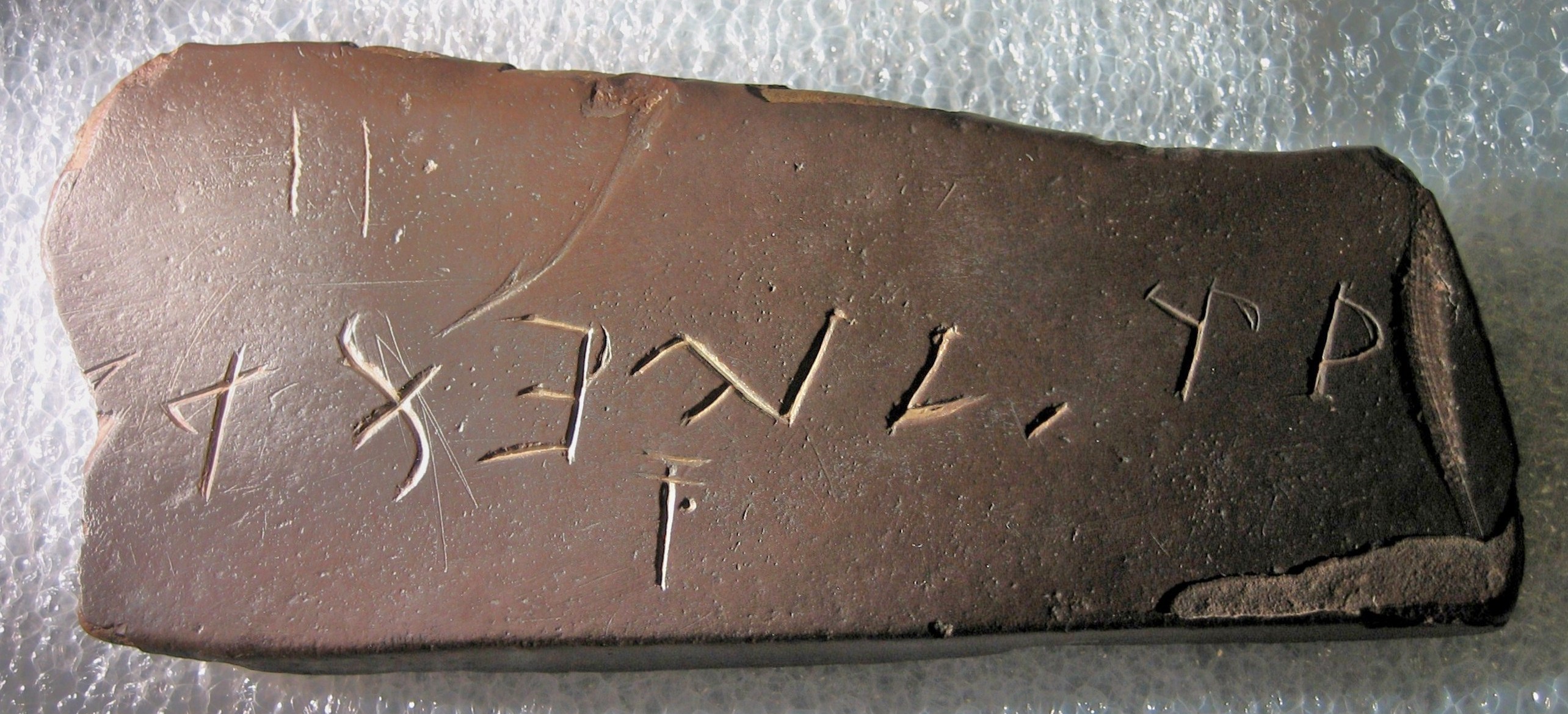
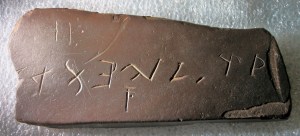
Elephant Tablet found during construction of Cuenca Airport, Ecuador

Elephant Tablet found during construction of Cuenca Airport, Ecuador

© 2016 B. L. Freeborn, Updated August 2022

This piece from the Crespi Collection was found during construction of the Airport in Cuenca, Ecuador. By identifying the letters as Paleo-Hebrew (Phoenician) circa 200 to 100 BC and Hebrew Letters as derived by J. Huston McCulloch in his study of the Newark Decalogue Stone from Ohio, the Elephant Tablet is translated. The language used to aid with the translation is Anglo-Saxon. A study of the stele when read in Boustrophedon style (back and forth) provides these words: bad, death, beat, cave or pole, dwell, lame, bucket, An, dish, change, origin, peck, cave or pole, eye, Baal, and area.

So perhaps they suggest…

The back of the mammoths was broken –

It was a bad death. It beat at the pole. There is a bucket where An dwelt. It is a dish where it changed (?) the origin (?). It pecked at the pole at the eye. Baal was there.

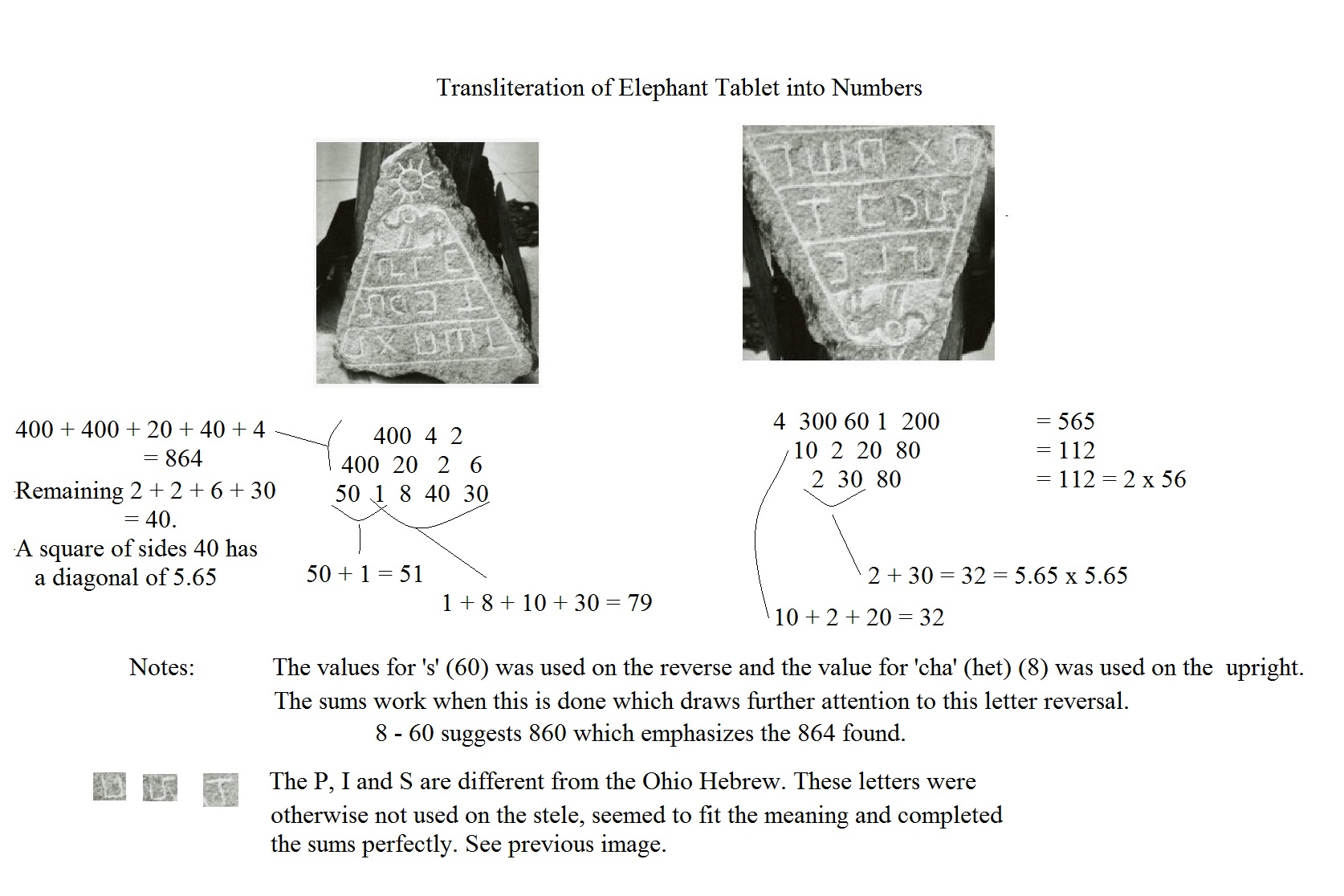
The letters can be converted to numbers as shown in the next image and the sums as shown can be found:

This number study reveals the all important 565. The numbers that comprise the word Yahweh by way of gematria are 565 10.

The number 79 was found and one can also easily find 792 or 7920 by using the 20 and 2 in the line above. The diameter of Earth is 7920 miles.

The 864 refers to the number of seconds in a day and to the seconds of longitude of the Earth or 86,400.

The 51 created by the letters AN then remains. There is this interesting fact. Cuenca sits nearly on the equator. By traveling 79 degrees longitude to the east and 51.51 degrees north of it one finds London and Greenwich, England the prime meridian. ??!!! ??

There is at least one other 56.5 that can be found. Because the letter noted as ‘sa’ or ‘a bucket’ is a pictogram the stele is composed of eleven letters and three pictures or 113 which is 2 x 56.5.

The most important idea here is that these numbers have been imbedded in ancient documents for millennia which lends credence to the Ohio Hebrew being valid and thence, the Newark Stones.

Continues in the next post with a comparison to other elephant stones ……………

____________________

See full article on the alphabet by J. Huston McCulloch at:

http://www.econ.ohio-state.edu/jhm/arch/decalog.html

Paleo-Hebrew at oocities.org

______

Back to Newberry Tablet beginning or its  conclusion.

Hudson Bay as a Comet Crater

© 2016 B. L. Freeborn

This is an excerpt from the full article: “A Planet Most Miraculous: The Mechanic’s of Earth’s Rotating Crust.”

Hudson Bay showing the arcs of the bay.

Hudson Bay showing the arcs of the bay.

It is possible to draw four large round circles in Hudson Bay. The largest scales to a diameter of 400 miles. The second largest scales to 230 miles. Hudson Bay is very shallow. Yet it was once compressed down 900 feet deeper than it is by the mass of the former ice sheet. The large appendage to the bay in the south is extremely shallow. References differ on the bay’s depth from 111 feet deep in the east to 768 to the northwest. Variations aside, this is a very shallow body of water when the size of it is considered.

This causes a problem if one wants to prove these are large craters. They are just not deep enough to be craters of this diametrical proportion. For example, Barringer Crater, Arizona is 4000 feet wide and 570 feet deep. Look at the other contraindications. Besides its shallowness, there is no impact ejecta. There may be central uplift in the bay as islands but for the size of it, and the age as required to have brought about the end of the “ice age”, there is no deep basin. There is no high well delineated edge as can be seen in the Pingualuit crater which is supposed to be vastly old by comparison. It does not seem possible that this is a crater. Yet it can be argued that it is.

Delving a bit further, it is known that there is a “large region of below-average gravity” in the area. The anomaly has not been explained. Suggested theories include the weight of the Laurentide Ice Sheet has influenced the area. Another theory suggests that convection in the underlying mantle may be a contributing factor. The 230 mile diameter arc to the southeast is known as the Nastapoka Arc of the bay. The geologists’ consensus explanation calls it an “arcuate boundary of tectonic origin.” In other words they think that millions of years ago the Earth folded in a perfect arc. Another theory, less popular, allows a Precambrian extraterrestrial impact. However, geologists do not feel there is any credible evidence for such an impact crater. There is no evidence from regional magnetic, Bouguer gravity, or geologic studies. That statement directly contradicts the “large region of below-average gravity” with which the paragraph started. (Wikipedia)

Hudson Bay crater formation, 14,000 years BP.

Formation of a crater within the two mile thick ice sheet that once overlaid Canada which resulted in Hudson Bay.

So, how does one explain Hudson Bay is a very recent comet crater 1000 miles by 300 to 400 miles across? Once again, let us just look at what we have. We have a nearly perfect arc in an area that is on average 330 feet deep. This same area was once overlain by an ice sheet two miles thick in certain parts. Two miles thick is 10,560 feet of hard frozen, compacted, heavy ice. This means that if we took a cross section of Hudson Bay when the ice sheet was there and scooped a crater out of it that only dips into the ground 330 feet, the crater was theoretically 10,890 feet deep with little imagination.  The bottom of the crater only remains then as the Nastapoka Arc which implies the upper rim, now long melted, was substantially larger in diameter. The ejecta was simply ice, and billions of tons of it which was spewed as far as Siberia to engulf herds of grazing mammoths. It was thrown as far as Scandinavia to leave glaciers there. There was no dust cloud that enveloped the Earth for decades, because water does not create dust. It creates rain. The elongated shape from the northwest to southeast then is either the sideways impact of a comet striking the surface at an angle or the successive impact of several portions of one comet. A sideways impact will add more torque to the reaction of the Earth and aid in turning the outer layers of the planet. The enumerable other craters that dot the northern latitudes may have occurred at the same time or during later events which totally negates their vast ages.

Successive crater formation as comet strikes Ice Sheet (future bay area) and blast material ricochets to form other impact sites.

Successive crater formation as comet strikes Ice Sheet (future bay area) and blast material ricochet to form other impact sites.

The picture becomes clearer when we comprehend the velocity with which these mammoth projectiles struck the planet. They could not just strike and stick like an arrow in a target. They shattered on impact and bounced in very much the same manner as a stone skips across a lake, except in this case their velocity was unimaginably high. We see directly below Hudson Bay the five great lakes and upon close inspection we see several sections of each lake exhibit the same round cut out pattern as the Nastapoka Arc of Hudson Bay. Once impacting and forming the Great Lakes the debris shattered even further.  A rebound impact could not entirely expend the comets’ energy. The debris kept moving albeit at a slower yet still extremely high velocity. It fanned out to the west, southwest, south, east and southeast blanketing and smashing millions of square miles. The impacting debris formed what are called Carolina Bays. The name originates from the thousands of long elliptical, shallow structures that appear throughout the Carolinas. As Kelly and Dachille explained in 1953, they were formed by massive melting icebergs. In other words, they were debris from the shattered ice cap.

Overlapping polar circles creates a vesica shape where the thickest ice on the planet is found.

Overlapping polar circles creates a vesica shape where the thickest ice on the planet is found.

Indeed, almost the entire old polar ice cap was displaced from the bitter cold of the Arctic Circle. The ice that was outside the first circle was now -outside of the arctic circle- and prone to melting. We call these areas glaciers and their melting is what we call the ‘End of the Ice Age.’ It is proposed that the glaciers extended into Ohio, not because the weather patterns had changed allowing the Earth to cool but because this area was within the Arctic Circle when the ice formed. During this same period of time, half of Antarctica was dry land and ice free because it was outside the Antarctic Circle. The Earth had gone through a long period of stability and created these extremely large and thick ice layers at the then poles within the first circle. The sea level had dropped and man had happily moved out onto the vast plains left behind by the receding ocean. It was safe. It was beautiful and they were blessed, for a long while.

Continue reading …..full article posted here.

Possible remnants of the comet are seen in the next post.

See the Ancient Map of Hudson Bay in the Previous post

Ancient Riddles to Test Our Wits: Crespi’s Warrior

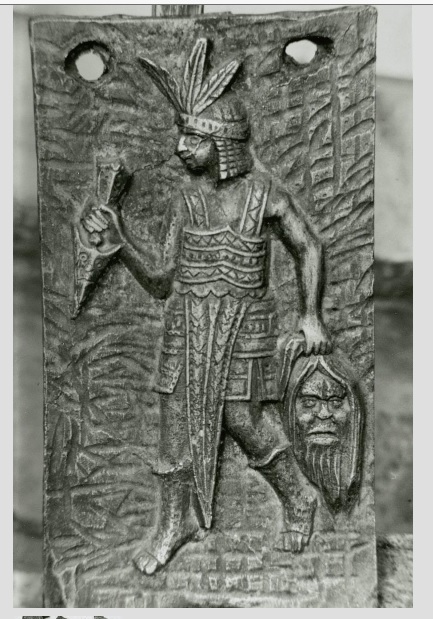
Carved Plate from Crespi Collection

Carved Plate from Crespi Collection

© 2016 B. L. Freeborn (updated Dec. 2018)

In this piece from the Crespi Collection find the words in italic:

The hoary ancient head of Earth was left low

as the two holes pressed through.

The sword struck near the foot of the tile foundation.

It walked and made a two footed foundation,

one magnetic and the other true.

The dagger of Baal with its two craters lies at the rightful pole.

It is the angle that parts longitude.

The pole wavered and split,

the collar dropped to the eye.

The new youthful Earth was thus clothed.

_________

Compare this art to the Narmer Palette from Egypt, c. 3100 BC as displayed at the Royal Ontario Museum:

Narmer Palette, Egypt, c. 3100 BC - Royal Ontario Museum

Narmer Palette, Egypt, c. 3100 BC – Royal Ontario Museum

__________________

Read about Father Crespi and see more art:

“The Crespi Ancient Artifact Collection of Cuenca Ecuador”

Back to Beginning of posts on Newberry Tablet

Back to Beginning of posts on Adena Art

The next riddle is here!

The Newberry Tablet Reveals….

© 2015 B. L. Freeborn, Sept. 2022

Smithsonian Photo of Newberry Tablet, compliments of Roger Jewell

Smithsonian Photo of Newberry Tablet, compliments of Roger Jewell

To the first post on the tablet – To the previous post on the tablet.

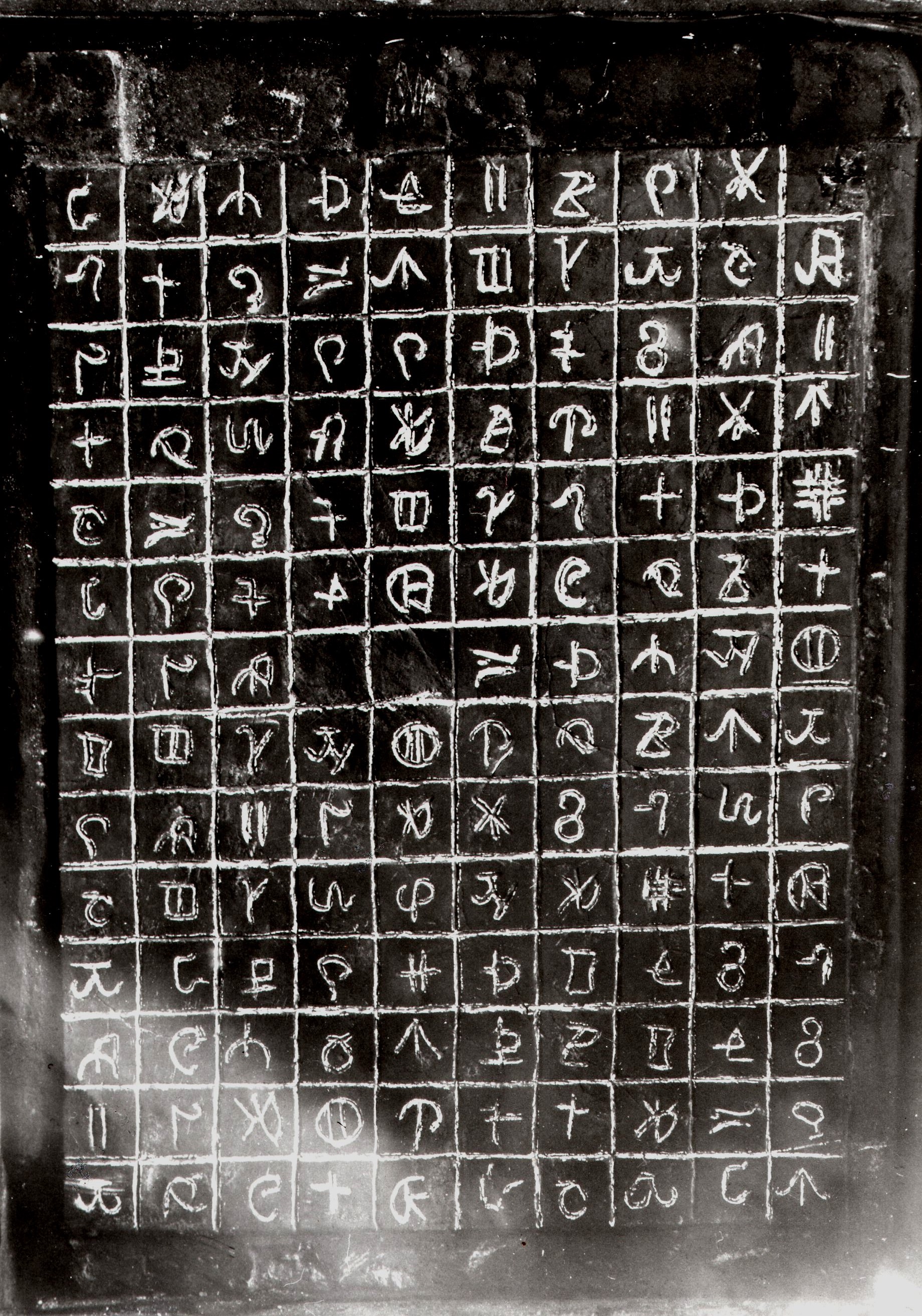
In the last posts we looked at the overall layout of the Newberry Tablet and many symbols. The list has grown and the reading is completed here.

The symbol identification thus far has suggested the topic of the tablet is a double comet collision and its crater was to be a point of reference for future measurements. The remaining symbols should support this story.

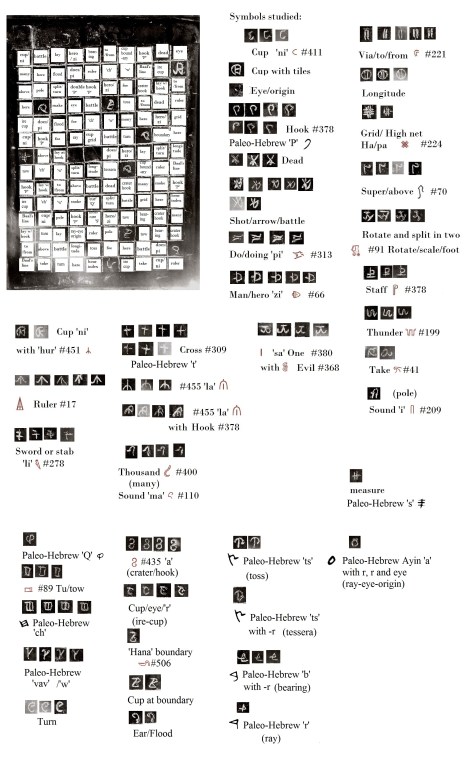
The last of the study comprises 15 symbols. The remaining symbols are left for the reader to identify. There is one symbol that resembles the ‘Q’ of the Paleo-Hebrew alphabet. It is suggested it represents cue or to line up, or quay, the place where ships line up. Since cows walk in a line and the Old English word for cow, spelled cu, is very similar; the symbol perhaps means to line up and/or skin, an important by product of cows.

The symbol similar to a rectangle is found in the Luwian symbol list #89 and has sound value ‘tu.’ This is very similar to the word tow and is so noted.

The symbol that is a square divided in half is always followed by the symbol that looks like a ‘Y’. Both symbols are extremely similar to the ‘ch’ and ‘vav’ of the Paleo-Hebrew Alphabet. Substituting the sounds ‘ch’ and ‘w’ into the table find the word ‘chew’ repeated four times. This word is also an original Old English word.

The circle with a hook on top is found in the Luwian Glyph list at #435 with sound ‘a’ and is noted in the table as crater/hook.

The symbol that looks like a large curling ‘e’ most likely means ‘turn’ since the Adena Tablets and the New Hampshire Mystery Stone included this idea. It is so noted in the image.

The symbol that is the cup with a dot in the middle and a small stroke at the top is translated by understanding that in Luwian Hieroglyphs the small stroke added to another symbol is an ‘r’. This gives us an eye-r-cup or perhaps ‘ire cup’ and is so noted in the table.

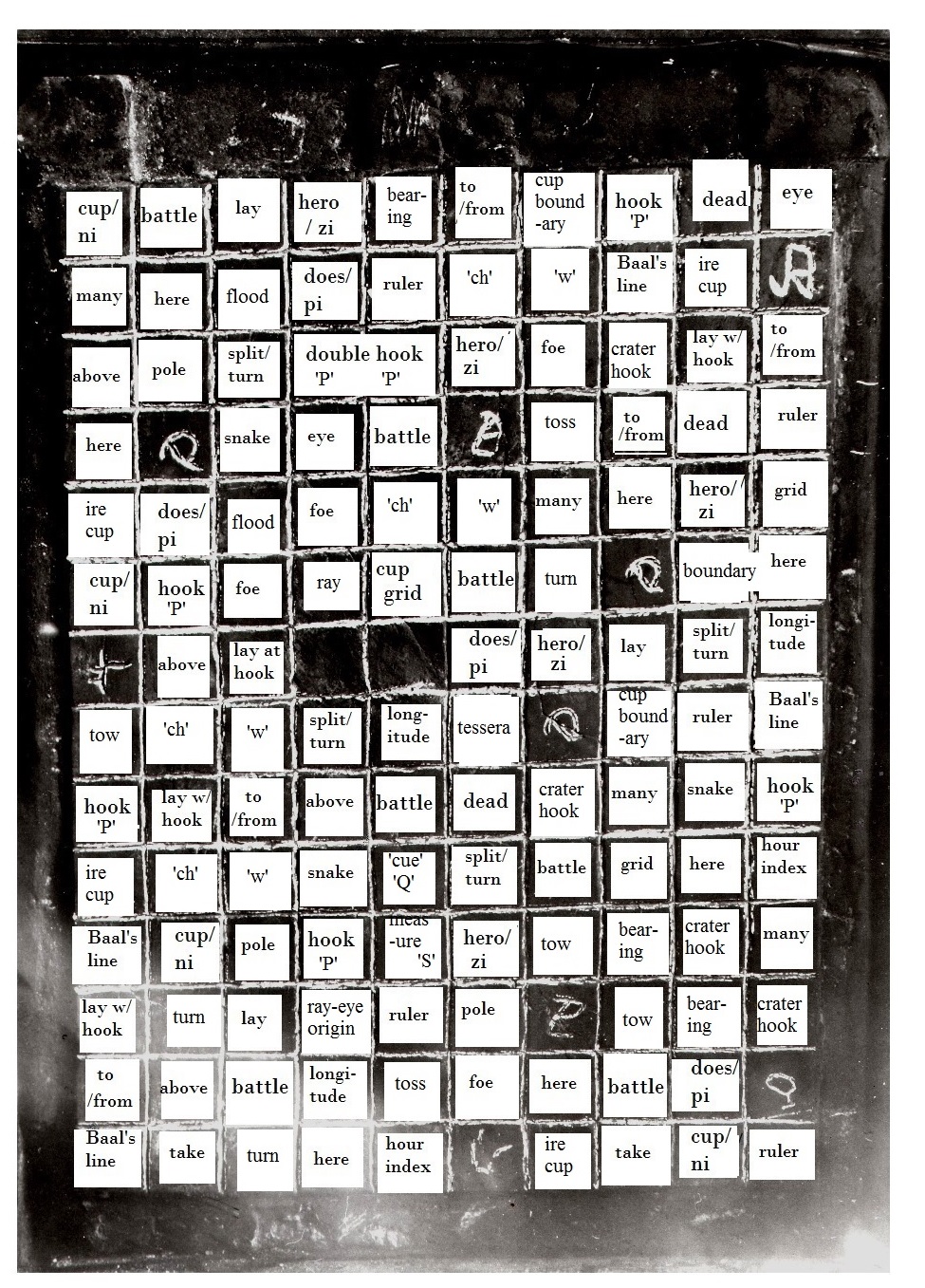
Newberry symbols replaced with proposed meanings. See images below and text for more information.

It took some time to identify the symbol first row, fourth from the right and the symbol in the sixth row second from the right as being related to each other. The latter is found in the Luwian glyph list at #506. It is also found in Assyrian art and Olmec art described in a previous post as the odd little purse. The glyph list notes it as having sound ‘hana.’ In Old English this word means boundary stone. The symbol in the first row combines it with a ‘cup’ so that the distorted ‘B’ shape is created. They are noted in the chart as boundary and cup/boundary.

The symbol in the second row third from the left is similar to a reversed ‘e’ with an extra mark below it. In fact it appears to be an ear. In Old English the word ‘ear’ besides meaning ear means wave or flood. The association no doubt arises because of the whirlpool design of the ear. It is noted as ‘flood’ in the table.

Since many of the symbols are similar to Paleo-Hebrew perhaps the cup that is upside down and upon an upstroke is the letter ‘ts’. The words ‘toss’ or ‘tease’ is essentially defined by this sound. The similar symbol that combines the former symbol with a short stroke is then ‘ts’ and ‘r’ and is actually closer to the Paleo-Hebrew ‘ts’. This then sounds out the word ts-r or tesserae and is so noted in the table. This word means a small square tile.

The hook or staff studied in previous posts can now be associated with Paleo-Hebrew ‘P’ which begins such words as pea, power, pole, and point. The ‘P’ has been added to the table.

The symbol in the first row fifth from the left that appears to be a triangular ‘e’ with a large side stroke reminds one of the Paleo-Hebrew ‘B’ with the Luwian ‘r’ added. This gives the word b-r which suggests the word bear as in direction and it is noted in the table as bearing.

The Newberry Tablet's translation.

The Newberry Tablet’s translation.

The triangle with the stem suggests the Paleo-Hebrew ‘R’. It might have a side stroke as seen in the ‘bearing’ symbol. It is noted in the chart as ‘ray.’

The last symbol identified here is the circle with the two side strokes like antennae and the dot in the middle. The Paleo-Hebrew letter Ayin or ‘A’ is a circle. The dot supplies eye or sound ‘i’ and the two strokes give two r’s. So then we have r for ray, an eye, and a-r. The latter suggests the Old English word ‘or’ which means origin. It is noted in the table as ray-eye-origin.

So then, the table provides short readable sentences. The first line perhaps reads: The battle at the cup where lays the noble bearing is the to/from boundary. The cup is the dead pole and the eye.

Continue to line two and read: Many here caused the flood. It was the powerful ruler that was chewed. It is Baal’s line at the angry wandering cup …(unknown term).

In other words they say: There was a comet impact. It is the crater at magnetic north. Here is the reference boundary for longitude. The crater is the former north pole and the eye of the comet.

Many comets here caused a flood. It was the north pole that was destroyed. It is the longitude of the double comet’s (Baal’s) crater that….

The remainder of the table can be studied at one’s leisure.

Enjoy your New Year! Happy Holidays!

On to more riddles!!

The Message of the Newbery Tablet – Part 4

© 2015 B. L. Freeborn, updated Sept. 2022

Smithsonian Photo of Newberry Tablet, compliments of Roger Jewell

Smithsonian Photo of Newberry Tablet, compliments of Roger Jewell

To the first post on the tablet – To the previous post on the tablet.

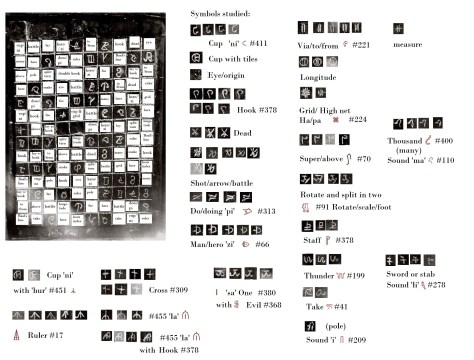
In the last posts we looked at the overall layout of the Newberry Tablet and many symbols. The list has grown and we push to completion of this project by looking at twelve symbols in this post.

The symbol identification thus far has suggested the topic of the tablet is a double comet collision and its crater as a point of reference for measurements. Hopefully the remaining symbols support and complete the story. Note the parallel line symbol in the first row and the cross hatching symbol that ends the fifth. Note the circle with two lines through it that ends the seventh. These suggest that the double comet arcs of Hudson Bay are to represent a reference point for longitude and latitude. Signs associated with this concept are studied here as well as another two groups of signs.

The second and third groups require an understanding of the symbols as pictographs that would have meaning even today. The first symbol in the third row down uses an upstroke to elevate a cup symbol. Next to it is a symbol that can be described as a P on a line. Perhaps the upstroke means above or heavenly, and the horizontal line simply represents – on the surface of the Earth. With these ideas the study continues.

We begin with the parallel lines in the first line and suggest it means to/from which is found in the glyph list at #221 except they used curved lines. Keep in mind that the two parallel lines may simply mean two or equal distance. They may also suggest lines of measure.

The circle with the set of parallel lines continues the idea and perhaps means specifically either longitude and latitude or both and/or the measurement of such.

Similar to this is the two lines with the horizontal mark found in the center of the fourth line from the bottom which suggests either two or perhaps measure and is so noted below.

The cross hatching symbol suggests a grid or the longitude/latitude net of the Earth.

Although not identical the symbol compared to the Luwian glyph meaning ‘above’ is similar to the symbol found at 3,1. Compare it to the symbols for ‘ma’ #110 and ‘thousand’ #400 and the second symbol from the table found at 2,1. (See diagram below.) The word ‘ma’ in Old English means ‘more.’

Interestingly, Luwian glyph #91 is said to mean rotate/scale/foot. It is compared to the glyph found in the third row, third position and is shown below. It appears to be two shoes and a hook suggesting rotation. Note they are located at grid positions 3,3; 8,4; 10,6 and most notably 7,9. The 33 and 79 stand out immediately as the 33 degree latitude change of the pole and the diameter of the Earth at 7920 miles. The location of Hudson Bay is just west of the 79 degrees. But the other two numbers even in reverse are not of much importance. However! If one counts their position from the opposing corner (bottom right) then the two positions 7,7 and 5,6 are counted out. The latitude of Hudson Bay is 56 and the return period of Halley’s Comet is 76 to 77 years. This then correlates well with the proposed topic of the tablet and to the idea of scale, rotation and foot as found in the Luwian glyph #91.

The staff is found in glyph #378. The associated symbol was used three times on the tablet and suggests a staff stuck in the ground. The symbol is found at 3,2; 11,3; and 12,6. The symbol next to the bottom P appears to be a slanted version so it may also be the same symbol but is not so noted here.

Glyph #199 is said to mean ‘thunder’ and is very close to the symbol found at 4,3.

Glyph #41 means ‘take’ and is close to the symbol in the table at 14,2 and mirrored at 14,8.

Glyph #209  with sound ‘i’ appears to be the same as shown in the table and is taken to mean pole or eye. It is found notably at position 4,4. The circumference of the planet divided by 44 is 565 miles.

The reader should examine this ‘i’ symbol closely and note there is a small horizontal stroke on the left upstroke. This may not be accidental. In the Luwian glyph system of writing this small stroke represents the sound ‘r’ and if the two sounds are combined we arrive at the word ‘ire’ which means today what it did in Old English except previously it additionally meant to wander. So this adds that now the ‘eye’ has ‘wandered angrily.’

Lastly, the symbol that looks like a backwards F is taken to be a sword or knife that stabs the ground and the idea repeats in the glyphs as seen in #278.

For your reference the Luwian Glyph list can be found linked here:

The associated words have been filled in and the tablet’s ideas are unfolding  in this very complicated riddle and blending of ideas with Earth related numbers.

The next post compares this script to cave art found in Europe.  The last of the symbols that can be identified in the Newberry Tablet are found when the decipherment continues.

Newberry Tablet decipherment continues here.

.

The Message of the Newberry Tablet – Part 3

© 2015 B. L. Freeborn

Smithsonian Photo of Newberry Tablet, compliments of Roger Jewell

Smithsonian Photo of Newberry Tablet, compliments of Roger Jewell

To the first post on the tablet – To the previous post on the tablet.

In the last posts we looked at the overall layout of the Newberry Tablet and a few symbols.

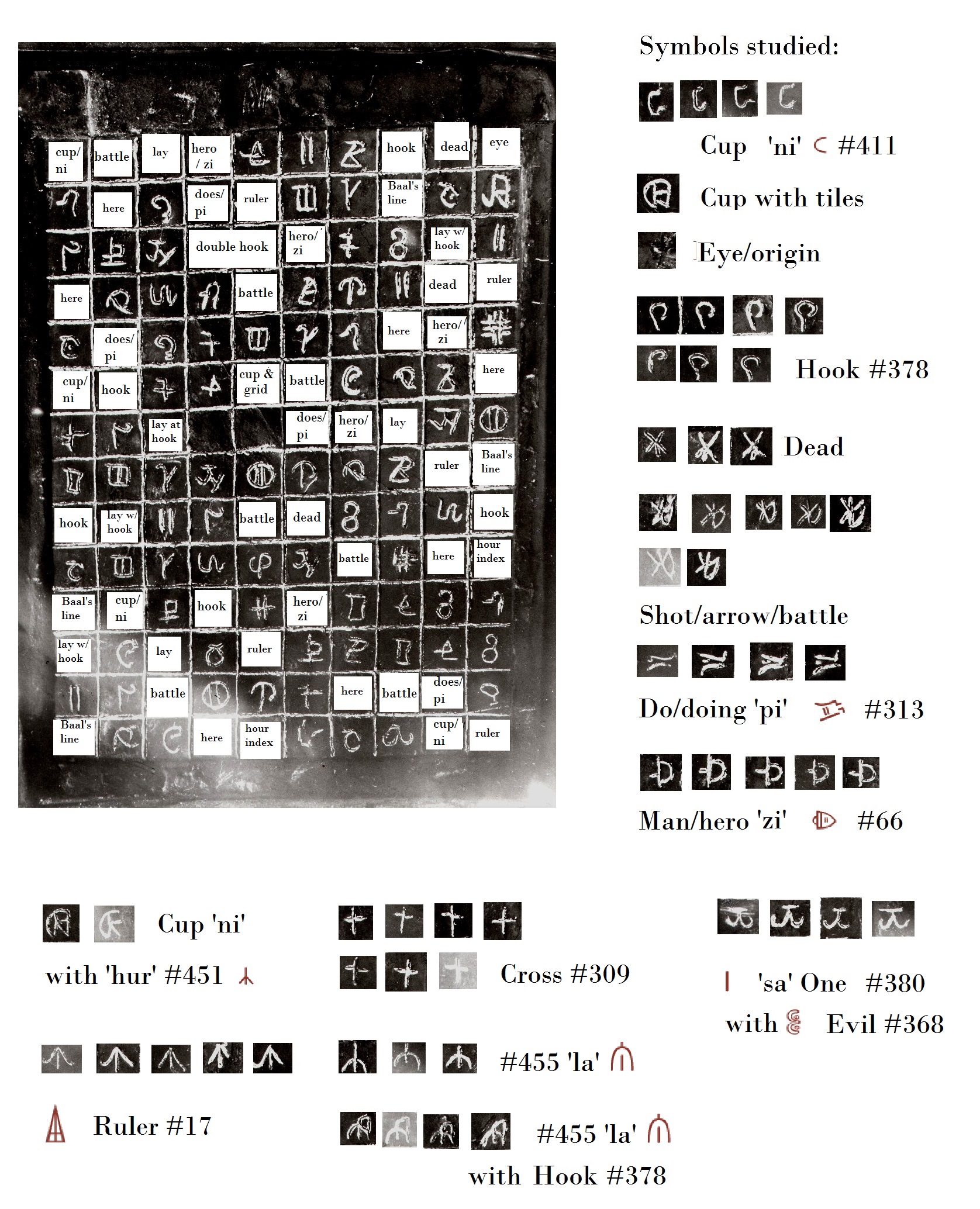
In this post six symbols are studied: the glyphs found at the bottom corners, the cross, the symbol at 1, 3 and the similar symbol at 3,9. The last symbol to be studied combines the cup symbol found in the upper left corner with what looks like a bird foot print and is found at 10,10. There are two of the latter. The second is found at 14,5. It combines the idea of the cup with sound ‘ni’ with glyph #451 with sound ‘hur.’ This sounds remarkably like the word ‘hour’ and if the craters in Hudson Bay were used as the start line for longitude then the ‘hours’ of Earth’s rotation are marked off from this place. We should recall that the word ‘ni’ means ‘here, now, and/or upon us’ and is today spelled ‘nigh.’

This idea is repeated in the bottom left corner. There is a double loop with a line on top of it. It is a combination of glyphs #368 and #380 from the Luwian Glyph list. The double loop was determined to mean ‘evil’ which a double crater would certainly represent. This symbol would then repeat the idea of the line of longitude index point. It is used four times in the table.

Again the idea is reinforced by the symbol in the bottom right corner which is found in the glyph list at #17 and represents the ruler. This glyph is repeated five times in the table. So then the four corners, which should define the topic of the tablet, are: a cup (crater), an eye, a line at evil and the ruler.

The last three symbols are the cross which is used seven times and is found in the glyph list at #309. It likely represents the idea of ‘a place’ or ‘an intersection.’ The other two symbols are the upside down trident at 1, 3 and the related symbol that puts a hook on top of the glyph. The first symbol is #455 and has sound ‘la’ or we might say in both modern and old English it is the word ‘lay.’ The similar symbol combines this with the hook glyph #378. So, it expresses the idea of ‘laid with the hook’ or ‘at/by’.

The table is filling in!

The study will continue in the next post.

The Newberry Tablet's decipherment continues in this image as six more glyphs are filled in.

The Newberry Tablet’s decipherment continues in this image as six more glyphs are filled in.


The Newberry Tablet – A New Way to Read It

© 2015 B. L. Freeborn, September 2022

Newberry Tablet, photo Smithsonian

Newberry Tablet, photo Smithsonian

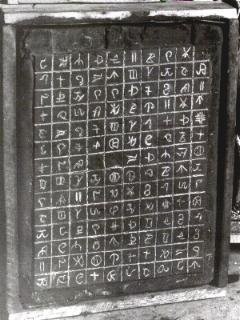
The Newberry Tablet’s authenticity, like all inscribed artifacts found in North America, is much debated. The best place to see it as it exists today is to watch Scott Wolter’s episode in America Unearthed. Virtually destroyed, there are few pictures of it in existence. The best pictures are in Roger Jewell’s book, “Ancient Mines of Kitchi Gummi” which is a well thought out explanation of the copper mines in the Lake Superior area and worth reading.

The Tablet was translated by Barry Fell as ‘how to obtain omens using birdseed’ and is available in Betty Sodders’, “Michigan Prehistory Mysteries.”

The translation done here of this tablet begins with looking at the square grid as essential to its meaning. The Earth is divided by longitude and latitude in a grid like manner. This then gives a starting point for translation. The numbers revealed by the grid are the same as those found in studying the Adena Tablets. It is highly unlikely a modern trickster would have known to incorporate these same numbers and this suggests the Tablet was authentic.

In the coming weeks the meaning of the 138 (twice 69) symbols will be explored but for now ….. the numbers reveal a great deal!

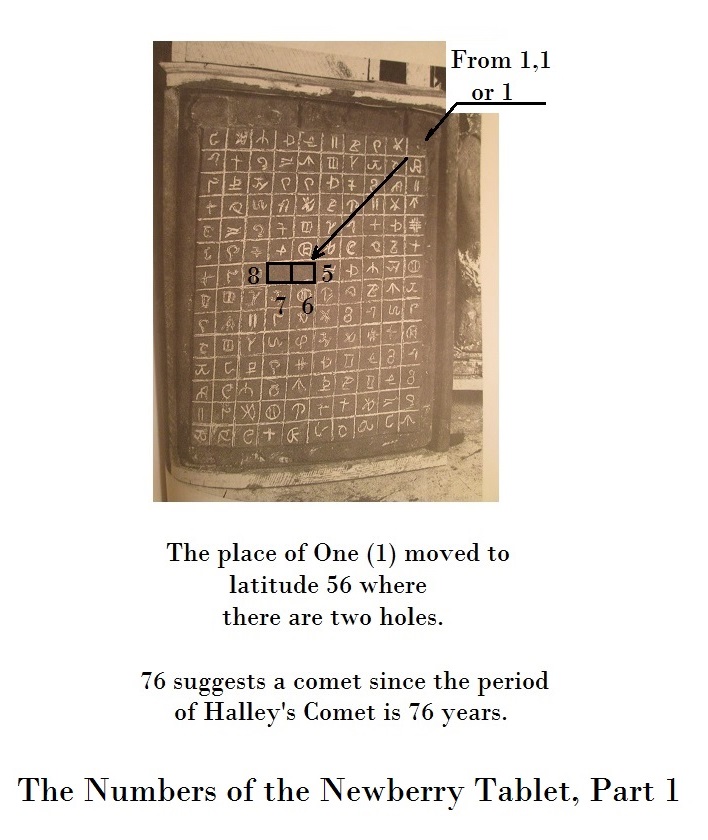
Translation of Newberry Tablet, Part IThe tablet is a 10 x 14 grid. Here in the first image, notice that the upper right corner only has a dot or an eye. There are two empty boxes in the middle. Counting from the left and then right obtain 5,6 for the right box. Count it again as if the box is translated left 5 spaces and down 6 spaces so that 56 is obtained again. In this case, if the dot is at 1,1 it has translated to 5,6.

Do the same for the left box and it is 4,7. Recall 4 x 7 = 28 or half of 56. Also as the seventh box down and the 8th up or 7 x 8 is 56.

Other numbers can be found depending on how one counts such as 7,8; 6,7; 7,6; 4,6; 6, 4; 7,8 and 7,7. In this grouping notice 76 and 77 both appear and the return period of Halley’s comet is 76 to 77 years. Combining the two ideas it suggests the pole moved to latitude 56 because of a comet. This interpretation will be supported by further study of the symbols.

Translation of Newberry Tablet, Part 2

The next number study reveals the grid can be divided by the central boxes into sections. The number of boxes in each section are indicated and sums of these numbers reveal Earth related values. The three most plausible numbers from this study are found in the cross, top and bottom. The cross has 36 boxes which suggests the 360 degrees of longitude, 360 seconds in a degree of measure, and 360 seconds in an hour.

The top has 60 boxes suggesting the 60 minutes in a degree of latitude and longitude. The bottom has 70 boxes suggesting the 69.2 miles per degree of longitude at the equator.

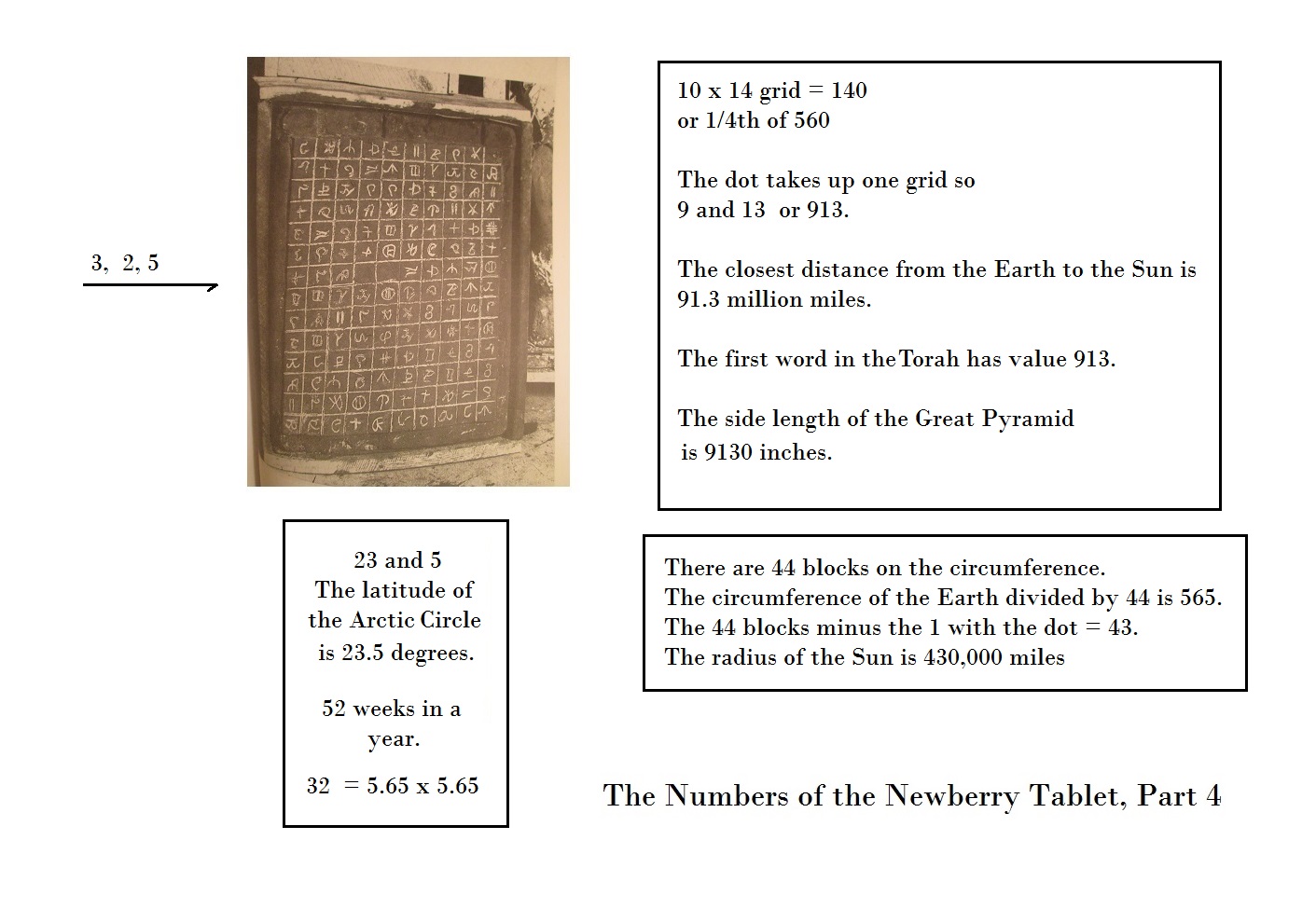
Read the line with two empty squares as 3,2,5 and find 32 or 23.5. The first is 5.65 squared and the second suggests the arctic circle which lies at (90-23.5 =) 66.5 degrees.

The other number arrangements are left for your consideration

Translation of Newberry Tablet, Part 3The third and last figures both reveal Earth related values and that the positioning vertically in the grid of the empty boxes was intentional.

Translation of Newberry Tablet, Part 4Finally, note the overall 10 by 14 grid. Recall the square root of 2 is 1.414 and that 14 x 10 assembled as 1410 resembles this number.

The story this tablet reveals continues in coming posts. Next up then is the beginning study of the symbols.

Back to the very beginning of series on Adena Tablets

Previous Post on the Batcreek Stone

Posts on:  Shaman Stone,

 Adena Pipe, Numbers and their Meaning, Ramey Peet Tablet, Gridley Stone

McKensie and Bainbridge Tablets, Cincinnati Tablet,

Egyptian Art Comparison, Wilmington Tablet, Lakin A Tablet,

The Gaitskill Clay Tablet, Allen Tablet, Grave Creek,

The Kiefer Tablet, Wright, Lakin B and Meigs Tablets,

Berlin Tablet, Gaitskill Stone Tablet, The Low Tablet,

The Waverly Tablet, Metcalf Stone, and pdf article on

Hudson Bay as a comet crater of recent origin.

The Bat Creek Stone – Translated – Not So Plain and Simple

Bat Creek Stone - photo by Scott Wolter

Bat Creek Stone – photo by Scott Wolter

© 2015 B. L. Freeborn, Updated Sept. 2022

The Bat Creek Stone was found in a mound with a skeleton in Loudon County, Tennessee in 1889 during a dig by the Smithsonian Bureau of Ethnology. Because it appears to have Phoenician or Paleo-Hebrew letters it has been dubbed a fraud. Arguing in favor of its validity is J. Huston McCulloch who describes the controversy at the site noted below and linked here. Scott Wolter also argues in its favor. It is also described at Wikipedia under the Bat Creek Inscription.

No satisfying, controversy resolving translation has been made. The following may not put the matter to rest either but it is new and unique! All other attempted translations have failed to note this is an extraordinary number riddle. The numbers are found by recalling that letters originally had number equivalents and not separate symbols as we have today. Using the Hebrew gematria or number/letter system the values appear as noted below and the riddle of the numbers is solved. In turn this confirms that the correct letters are identified in the translation.

The two lines and dot in the upper left were not shown in a detailed sketch of the stone done in 1890. Scott Wolter successfully demonstrates in his show America Unearthed that they were not part of the original inscription.

The Translation

The letters used to translate this inscription are from oocities.org and were in use in 800 BC by the Phoenicians. Note that the L and P are more in the modern Latin Alphabet style and a reversed E which is an H in Phoenician also appears.  So, there are intentionally two alphabets in use in this inscription. It is typical of highly educated people still to this day to insert some Latin phrase into their argument for emphasis and so we see it is also done here. The L and P are further confirmed and identified in this manner. (See note to reader below about using P as R.)

The language is not Hebrew but Anglo or Old English as has been noted in other Adena Tablets from the nearby Ohio area. This does not mean it is a fraud but that there is a major part of history that has not yet been recovered.  The impossible idea that this stone is -valid- because it is in English/Anglo written in Phoenician letters is an idea that will be expounded upon in further posts. The reader should understand that academics tell us English (Anglo) originated 1300 years after this alphabet was in use or 500 AD.  (See Sator Rotas post.)

The stone is read – left to right.  (The letter ‘u’ has sounds: u, v, o, w.)

Note most importantly, that the S letter is a line with hatch marks such as used in latitude. It is suggested here it means South and/or latitude. Also note it is directly under the letter I. This suggests a further word or two depending on pronunciation: is and ice. Both apply here.

It translates as follows (see image below):

 AN HIL UP S  IS

……………or filling in a bit:

AN HILl UP South Is Ice

…….or……

An Hill of Ice that was up is now South

……. or…..

The ice mountain of  An that was north is now south.

Presumably this is the goddess An spoken of in ancient texts and in modern terms is magnetic north.

The Latin Style letters (E,L,P) and numbers provide:  ‘E’ LaP  and  PaL ‘E’

……or…….

the ‘Ae’ lap is at the pole source

…… or…..

The first lap begins at the magnetic source and pole.

Recall that in Hebrew gematria the sound for ‘a’ has a one value. There is no value and letter for ‘e’ so here the ‘E’ is given the value 1 or as spoken it is ‘a’ or ‘an’ meaning one. Combining these ideas then this phrase suggests that the One original pole is at this ‘lap’ or latitude/longitude position. We recognize two poles today: magnetic north and true north. This leads to the final idea and most important part of the riddle.

By solving the number riddle (see below) this critical line can be added:

It lies at 56 degrees 30 minutes and 79 degrees.

(This is the location of southeast Hudson Bay in the arc and close to old magnetic north which is moving northwards.)

Relationship to Sator-Rotas
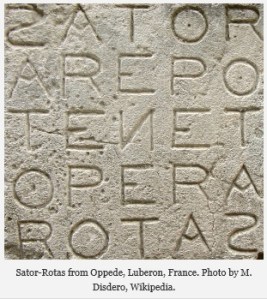
satar rotasThe reader should note that the Bat Creek Stone is still easily translated (in words but not numbers) if the P is actually an R. The wording changes to ‘or’ = origin, and ‘ro’ = row, order. The witty riddler cleverly hides another word in the letter’s confusion. This is the word ‘pr’ and ‘rp’. The first suggests pair and the latter reap or rape.

A raping pair is the origin of order.

But there is more to this confusing letter! The H looked suspiciously like an E and if this is combined with the r-p duo then the words e-p-r and e-r-p, or appear and a-rope are created. They suggest that:

The raping pair appeared and provide the one rope.

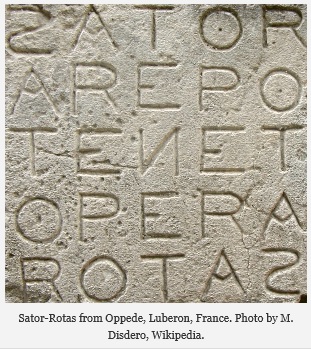
This interpretation recalls the riddle of the Sator-Rotas Square. The inner ring of that puzzle is formed by the repeating letters E, P, E, R, E… or, P, E, R, E … which now look suspiciously familiar. The words ‘ro’ ,’or’, ‘op’, and ‘po’ are notable in that puzzle as well as ‘en’ and ‘ne’. Notice the clever reversal of the N to create the Hebrew letter a.

The Number Riddle

The number riddle is solved by substituting the Hebrew number equivalents for each letter and by noting the left and right half separated by the dot should be equal. This resolves any confusion about identifying the letters and how the ‘p’ was determined over the other possible letters ‘q’ and ‘r’. If the ‘i’ (letter directly left of the ‘L’) is considered to be an angle sign then the left half reads 56 (angle) 30 = 86. This 56 degrees 30 minutes is the latitude of Hudson Bay. (Hudson Bay is where magnetic north has moved from). The 86 is the diameter of the Sun or 864000 miles. It is reminds us of 86400 seconds of longitude. The forty of 864000 is present if the numbers (1 50 5 10 30 6 80) are read as 56 40 86. Adding further support to this idea, recall that a square of sides of 40 has a diagonal of 56.5. The 56 degrees 30 minutes can be written as 56.5 degrees. The reference to the sun also suggests they are talking about latitude since the sun is used to measure latitude.

If the ‘i’ is given its 10 value then the sum of all the terms on the upper line left side is 96.

The sum of the main line is then 182. Add the 60 given by the lower ‘s’ as 182.60 and double. This is 365.2 or the number of days in a year.

Counting the letters left of the dot find 5 and right find 2. There are 52 weeks in a year. There are 7 letters in this main line. There are 7 days in a 52 week year.

The total number of symbols is ten. The word ten is associated with tien (fork tines) and teon (torn) in Anglo /Old English. This idea and use of the word ten appeared in the Sator Rotas.

Observe further that the 5, 7 and 2 can be assembled to create 57.2. The number of degrees in a radian (used in spherical calculations such as astronomy and navigation) is 57.29.

Notice further that the sum of 56 + 30 = 86  on the left plus the 86 on the right is equal to 172. The bottom number is 60. Subtract 172-60 and obtain 112 or twice 56 again. Also note that the total sum on the left, 96, plus the 60 beneath is 156 and this repeats 56.

Note also this manner of counting: The main line is 5 symbols then a dot for 6 making 56. Count from the right 2 and a dot for 3 and find 23 again. The count can be continued right to left. The 23 is followed by 5 for 23.5. This 23.5 is the latitude of the Arctic Circle which surrounds the north pole!

This same manner of counting can be applied to the letter I which is the up down triangle. Count the angles, 3, and the line segments, 4. Find 34 and this distance in degrees from the pole is 56 degrees.

Indeed, we must consider that that pesky P was meant to be an R so that P as 80 and R as 200 gives 280 or half of 560!

But note two last important values ….

The numeric value of Yahweh is 5,6,5,10.

And a triangle of sides 56 has a diagonal of 79.2.

Enough is enough! There are probably more!

Conclusion

So, whoever the hoaxer was that inscribed this stone, we know for a fact they were darned good at math riddles and knew gematria. That narrows the field of who dunits down a bit. The original author of this riddle was educated in two alphabets: Phoenician and Latin. He/she also knew that R and P can be confused and took full advantage of it. The Phoenician letter style used was in use east of the Atlantic in 800 BC. The Latin letters evolved from Etruscan about 700 BC. Letter P was used as an R in the original alphabet. It evolved into a P as used today a few centuries later. This gives an upper limit to the age of the  stone as 2700 years. The lower limit depends on when Paleo-Hebrew / Phoenician fell out of use on the west side of the Atlantic and when the last time this stone was copied to remember the wit and wisdom of the saying.

Next the Grave Creek Stone is examined. It too has a fascinating translation.

__________

http://en.wikipedia.org/wiki/Bat_Creek_inscription

http://economics.sbs.ohio-state.edu/jhm/arch/batcrk.html

___________________

Updated May 2021 to remove two scratch marks from translation.

Back to the very beginning of series on Adena Tablets

Previous Post on the Shaman Stone

Posts on: Adena Pipe, Numbers and their Meaning, Ramey Peet Tablet, Gridley Stone

McKensie and Bainbridge Tablets, Cincinnati Tablet,

Egyptian Art Comparison, Wilmington Tablet, Lakin A Tablet,

The Gaitskill Clay Tablet, Allen Tablet, Grave Creek,

The Kiefer Tablet, Wright, Lakin B and Meigs Tablets,

Berlin Tablet, Gaitskill Stone Tablet, The Low Tablet,

The Waverly Tablet, Metcalf Stone, and pdf article on

Hudson Bay as a comet crater of recent origin.

(updated Nov. 2018)
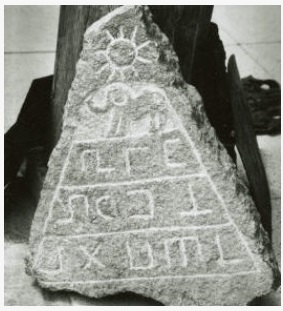
The Hopewell Shaman Bear

© 2015 B. L. Freeborn

Ohio Shaman Bear - Art from ancient Ohio found in Newark Earthworks

Ohio Shaman Bear – Art from ancient Ohio found in Newark Earthworks

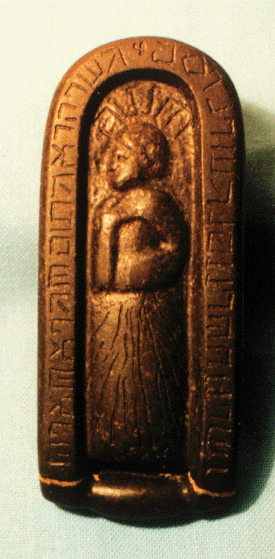
The Hopewell Shaman Bear is located in the Ohio History Museum in Columbus, Ohio. This magnificent piece of art was found in Newark, Ohio in the extensive earthworks there. The Newark Decalogue Stone was found seven miles south under a massive stone mound. The Newark Stone is inscribed with a form of Jewish letters and considered to be a fraud by academics. A full description and discussion about this stone can be found in the paper – Newark Decalogue Stone and Earthworks: An Unraveling Mystery or at this post. The Newark Stone is so unlike the Shaman Bear that it is easy to accept the academics’ viewpoint. However, despite their apparent and obvious differences they depict a similar story. The Newark Stone was found in a stone carved case that forms a rock shape when closed. Both statues are carved stones. Both are about the same size.

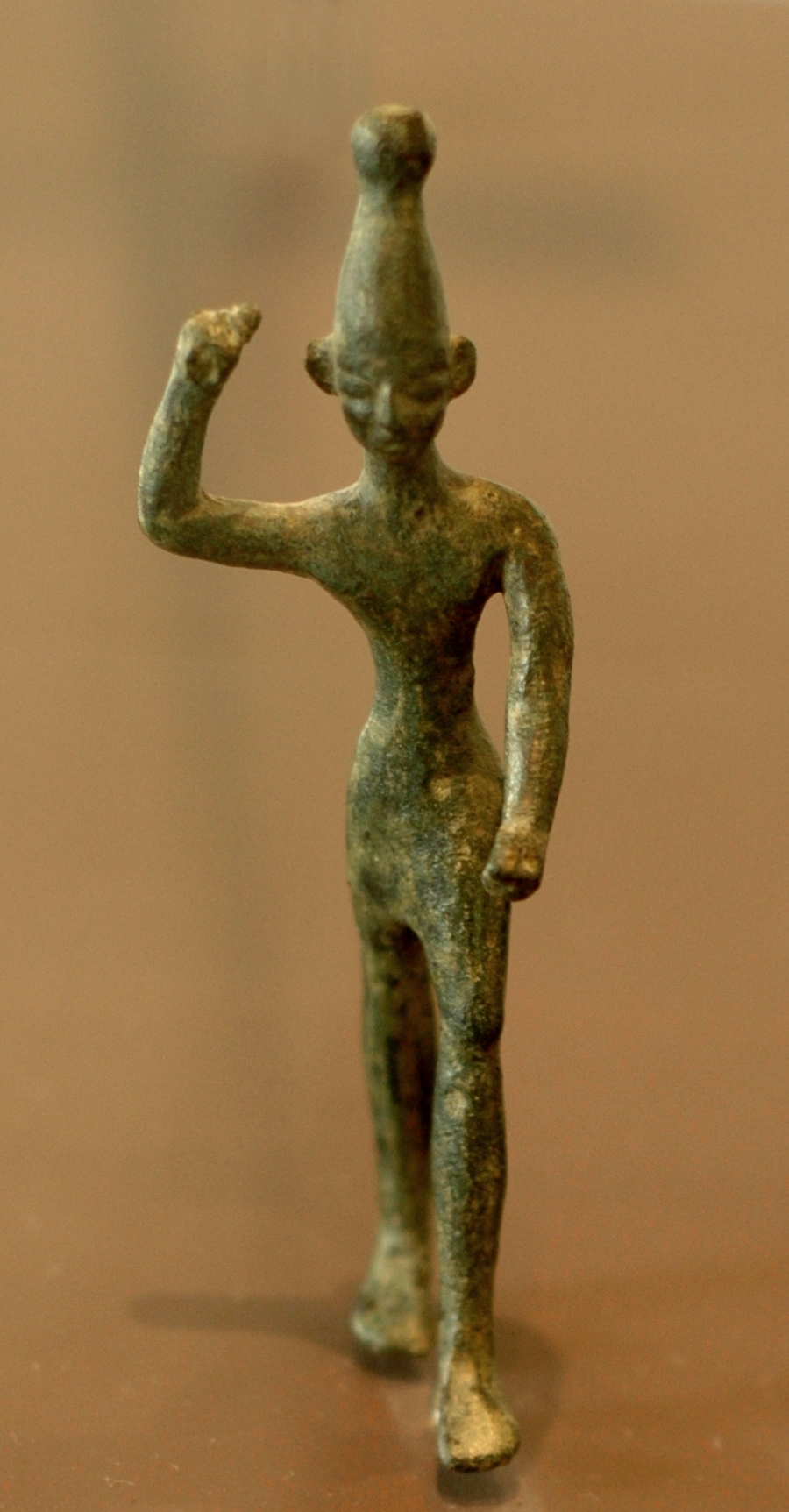
Both have one arm bent at the waist and the second arm pointed up. Compare the arm positions to the statue from Ugarit that is said to describe Baal. It has one hand pointed up at the hat which is a round ball with a conical tail.

Baal, a Statute from Ugarit.14th to 12th BC. Louvre, Wikipedia,

Baal, a Statute from Ugarit.14th to 12th BC. Louvre, Wikipedia,

Front Face of Newark Decalogue Stone

Front Face of Newark Decalogue Stone

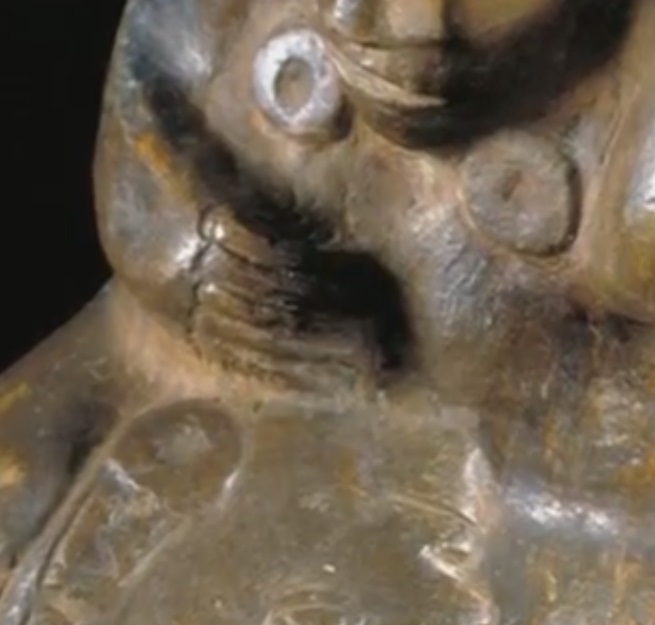
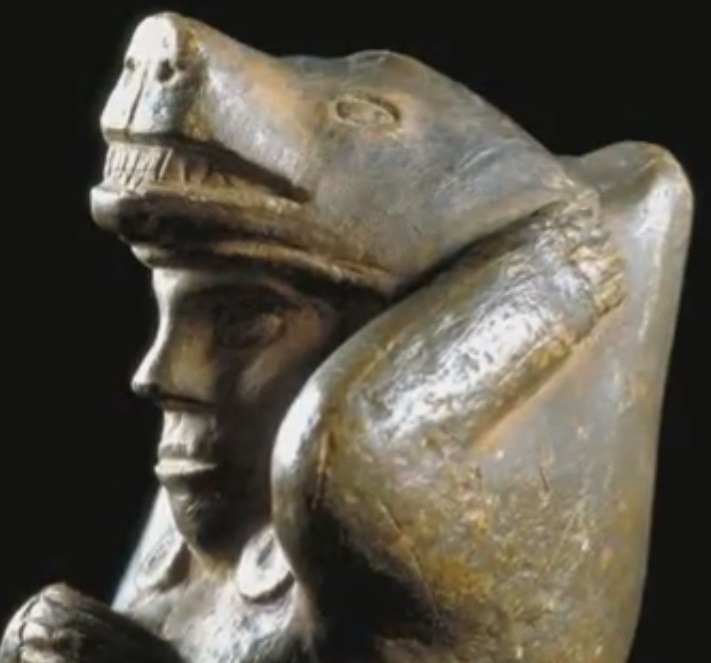
Concentrating now on the Shaman Stone we find it has three heads. One is upside down in the lap of the man with the hair splayed downwards. The sitting man is wearing a bear head creating a double head. So we find one head below and two above or it can be said one becomes two. The caul of the bear covers the man and keeps him from being bare. It is suggested that the stone is referring to the old North Pole with its caul of ice that is thought of as the Laurentide Ice Sheet. From it bearings were taken. Hence, we find three forms of the word bear is depicted by this stone: bear- animal, bare – uncovered, and bear – direction. The head in the lap depicts the head (of the Earth) forced down. It lies on a lap which makes a pun of the man’s lap to indicate that it lies on an important lap of longitude. Notice the ear of this upside down head is not quite right. There is a little comet for the ear with a u – cup shape above it almost in the hairline. The hair becomes the meteorites following the comet. This idea is seen in the Ugarit Statue with the cone below the round ball. The legs of the man become arms for the upside down man who is exclaiming as we saw in other Adena stones. Men crying out in horror is part of the story.

Close up of head in lap showing comet and crater.

Close up of head in lap showing comet and crater.

The small comet is directed towards the man’s hand. His fingers clearly depict the numbers 2 and 3. The other hand has 5 straight fingers The Arctic Circle ends at 23.5 degrees. The sitting man has two bold round earrings. These are the double comet craters of Baal indicated on the other tablets.

The statue is designed to sit with a 90 degree -or so- posture, yet since the feet are bent out at an angle there is a tendency to think they should be dropped down at a 90 degree angle. In other words the angle is bent or turned as the other stones studied in previous posts have depicted.

Right hand shows two and three with fingers.

Right hand shows two and three with fingers.

Looking for other numbers, note the right hand as 23 can also be 32 and this gives the square of 5.65. There are 5 eyes, 3 ears (2 bear and 1 human), 3 round donut comet craters, and the toes are 3 on each side making 33. The approximate angle between the pole positions is 33 to 35 degrees. The 5 and 3 suggests 53 and 5.3 is the square root of 28 which is half of 56.

Left hand showing five fingers.

Left hand showing five fingers.

The words that form the meaningful puns -lap and bear- are Old English words which may not really be indicated but considering the Anglo words found in the Adena Tablets previously, there is probably no coincidence.

Apparently the three statues have more in common then first thought. They all describe Baal and its collision with Earth. This collision changed the position of the pole and bared it of its caul. It was beheaded and at the lap it lies.

Shaman Bear

Shaman Bear

The next adventure into the minds of the ancients continues with the Bat Creek Stone.

Back to the very beginning of series on Adena Tablets

Previous Post on the Adena Pipe

Posts on: Numbers and their Meaning, Ramey Peet Tablet, Gridley Stone

McKensie and Bainbridge Tablets, Cincinnati Tablet,

Egyptian Art Comparison, Wilmington Tablet, Lakin A Tablet,

The Gaitskill Clay Tablet, Allen Tablet, Grave Creek,

The Kiefer Tablet, Wright, Lakin B and Meigs Tablets,

Berlin Tablet, Gaitskill Stone Tablet, The Low Tablet,

The Waverly Tablet, Metcalf Stone, and pdf article on

Hudson Bay as a comet crater of recent origin.

(updated Nov. 2018)

The Ohio Adena Pipe – Art from Ancient Ohio

The Adena Effigy Pipe from Ancient Ohio

The Adena Effigy Pipe from Ancient Ohio

The Ohio effigy pipe is from Chillicothe in southern Ohio. It is attributed to the period 800BC to 1 AD. It is part of the Ohio Historical Society’s Collection in Columbus, Ohio.

The classic explanations are available at the Society’s page. (here) As part of this study we only need notice that some parts of the man’s depiction are symbolic rather than realistic. Compare his features to the men on the Ramey Pete Tablet (see below) and notice the unique hair style may be an attempt by the artist to make what had been symbolic into reality. In Luwian/Hittite Glyphs this symbol means a cubit or measurement.

Hittite/Luwian Glyph for cubitum/measure

Hittite/Luwian Glyph for cubitum/measure

Further symbolism is found in the loincloth. It depicts a snake and we may assume the snake overlays a ‘pole.’ This then symbolizes the comet that struck the North Pole. The feathered bustle is clearly a wing and the wing in Hittite/Luwian glyphs means army. Ironically, a wing in English, both old and new, means troops or a portion of an army.

Without need for much explanation notice the arrow carved on the chest points upwards towards the gaping open mouth like it’s pointing out ‘a crater.’

The two earrings represent the two craters of Baal. The mouthpiece, the functional part of the pipe, also suggests the crater on the crown of the Earth. Indeed, this cupped mouthpiece as crater has further symbolism if the two L hairpieces are considered to be symbols about measure. It suggests there is a crater and two poles. There are definitely two poles. If we are to believe this story there is at least one if not two craters also.

Ramey Peet Tablet from Cahokia Mound, obverse

Ramey Peet Tablet from Cahokia Mound, obverse

Numerically, the mouth with the two ears makes three and the eyes make two. This gives the 23,32 which suggests the Arctic Circle. The bustle has 10 feathers. Next to the bustle neatly placed are the two hands. Counting fingers as well as feathers find: 1, 4, 10,4,1 or 141 and 141. This recalls the value of the square root of 2 at 1.414. The sum of 141 and 141 is 282 and this is half of 564.

This then completes the essential knowledge of Baal and it is beautifully woven into the art of this functional object. Similarly lifelike and even more symbolic is the Ohio Shaman Bear Statue found in Newark, Ohio which is the topic of the next post.

See more at:

http://www.ohiohistorycentral.org/w/Adena_Pipe?rec=1278

http://ohsweb.ohiohistory.org/gallery2/main.php?g2_view=core.DownloadItem&g2_itemId=1266

Back to the very beginning of series on Adena Tablets

Previous Post on the Numbers and their Meaning

Posts on: Ramey Peet Tablet, Gridley Stone

McKensie and Bainbridge Tablets, Cincinnati Tablet,

Egyptian Art Comparison, Wilmington Tablet, Lakin A Tablet,

The Gaitskill Clay Tablet, Allen Tablet, Grave Creek,

The Kiefer Tablet, Wright, Lakin B and Meigs Tablets,

Berlin Tablet, Gaitskill Stone Tablet, The Low Tablet,

The Waverly Tablet, Metcalf Stone, and pdf article on

Hudson Bay as a comet crater of recent origin.