The Message of the Newberry Tablet – Part I

© 2015 B. L. Freeborn, updated Sept. 2022

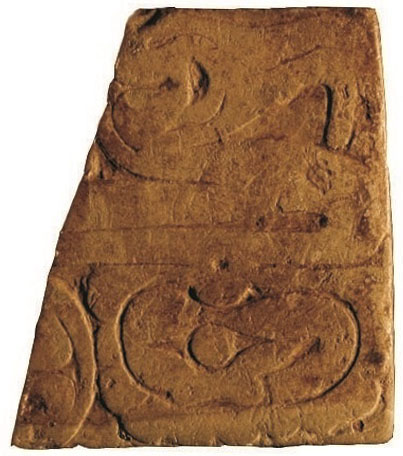
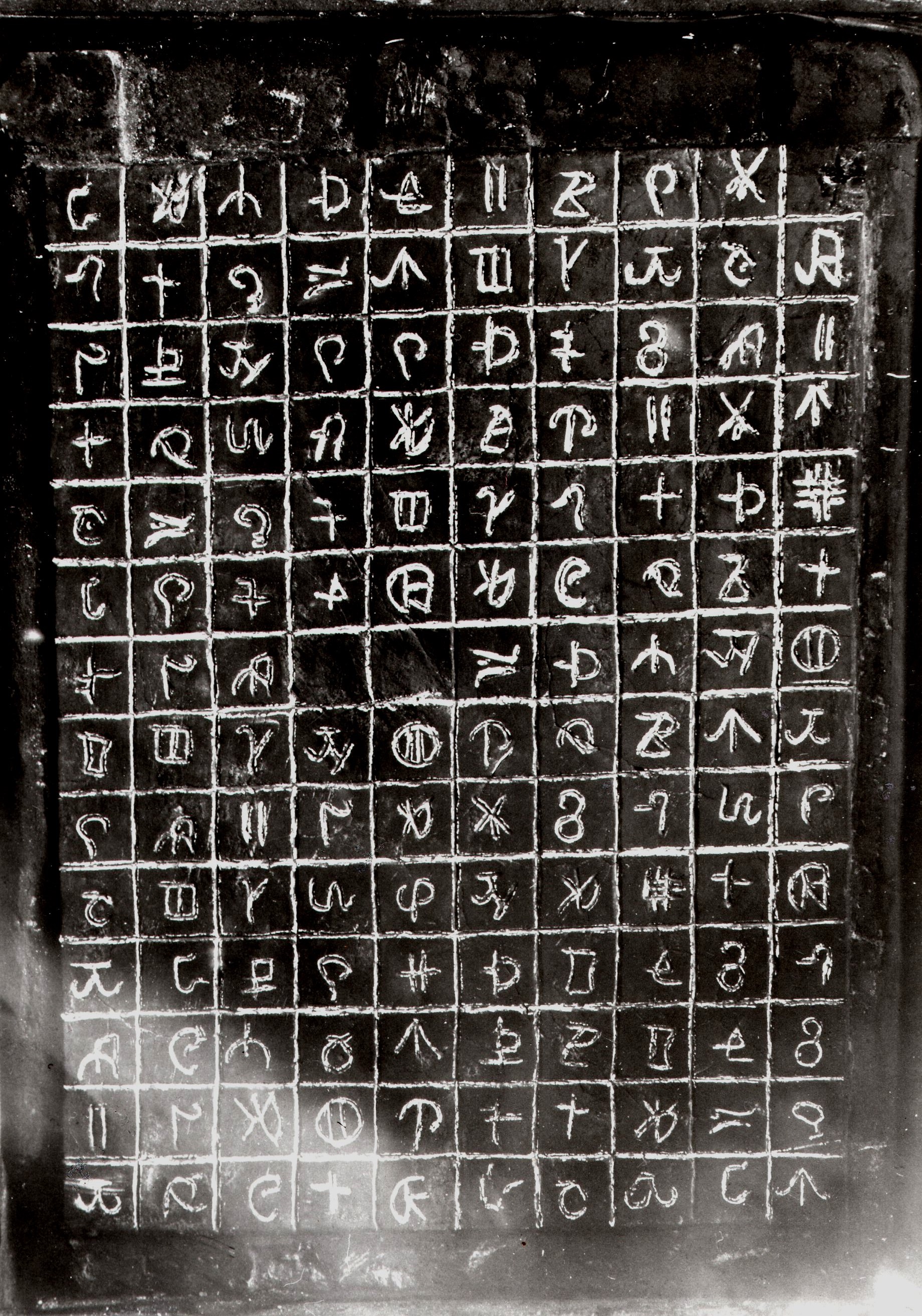
Smithsonian Photo of Newberry Tablet, compliments of Roger Jewell

Smithsonian Photo of Newberry Tablet, compliments of Roger Jewell

From the previous post:  The Newberry Tablet’s authenticity, like all inscribed artifacts found in North America, is much debated. The best place to see it as it exists today is to watch Scott Wolter’s episode in “America Unearthed.” Virtually destroyed, there are few pictures of it in existence. The best pictures are in Roger Jewell’s book, “Ancient Mines of Kitchi Gummi” which is a well thought out explanation of the copper mines in the Lake Superior area and worth reading.

We continue: The images here are compliments of Roger Jewell.

In the last post the overall number layout of the tablet was discussed and now it is time to look at some of the symbols. They may be viewed as letters by some and hieroglyphs by others. Barry Fell viewed them as letters from the Cypriot Alphabet and translated it accordingly. The two letters that led him to think it was of that alphabet are seen (counting from left, top)  in box 1,9 (next to the dot) and 13,3. Beyond these two there is little resemblance. These two symbols repeat in the array but we begin not with them but the symbols in the first box that looks like a C since it would seem the topic should be announced first.

This C symbol repeats three times at 6,1; 11,2 and 14,9 (or 1,2 from the bottom corner). For a total of four times.

Sketch of Kerbstone 86

Sketch of Kerbstone 86

Perhaps its shape gives a clue to its meaning. It is a cup. It is the shape of the center of Stonehenge’s main uprights. The first sound of cup is K and this sound in Hebrew is denoted by a C shape. The word cup is repeated in the word copper which was mined heavily in the region where this tablet was found. This C shape is the symbol for ‘great’ with sound ‘ur’ from Luwian Hieroglyphs (see number 363). It was repeated four times on Kerbstone 86 at ancient Knowth in Ireland. The word ‘origin’ begins with this ‘ur’ sound and the Old English word ‘or’ means ore. Does the cup indicate the origin of copper ore?

Previously Hudson Bay has been discussed and geographically this tablet is from Michigan rather close to the bay with its three large cup shapes in a vertical row that begin at 56.5 N and 79.2 W.

What then is in box 5,6? (column 5, row 6). The symbols should be consistent with the suggested meaning. The cup shape repeats with a double box in it. This repeats the idea of emptiness at 5,6 as depicted by the table with its two empty squares. In row 5, column 6 is a Y. This suggests this is a split. Opposed to the cup in the far corner is a dot, or an eye, or the repeating of the idea of ‘here it begins’ at 1,1 if read from the right. Things tend to fan out or Y out from an eye.

This is a good beginning. The longitude of Hudson Bay at 79.2 is measured from England where lies Stonehenge with its large ‘cup’ configured monoliths and more recently discovered identical CUP inscription. (See this well written paper.) And what’s more! The diameter of Earth is 7920 miles. Coincidence!?

More to follow……… on the message of the Newberry Tablet.

Study of symbols of Newberry Tablet

Study of symbols of Newberry Tablet

Back to the very beginning of series on Adena Tablets

Previous Post on the  Newberry Tablet

Posts on:  Batcreek Stone, Shaman Stone,

 Adena Pipe, Numbers and their Meaning,

Ramey Peet Tablet, Gridley Stone

McKensie and Bainbridge Tablets, Cincinnati Tablet,

Egyptian Art Comparison, Wilmington Tablet, Lakin A Tablet,

The Gaitskill Clay Tablet, Allen Tablet, Grave Creek,

The Kiefer Tablet, Wright, Lakin B and Meigs Tablets,

Berlin Tablet, Gaitskill Stone Tablet, The Low Tablet,

The Waverly Tablet, Metcalf Stone, and pdf article on

Hudson Bay as a comet crater of recent origin!!!!

See also Luwian Symbols by: Gunter Anders at http://www.hethport.uni-wuerzburg.de/luwglyph/Signlist.pdf

The Adena Tablets of Ancient Ohio – The Wright, Lakin B and Meigs Tablets

© 2014 B. L. Freeborn

Art from Ancient Ohio- The Wright Tablet

Art from Ancient Kentucky- The Wright Tablet

A portion of the Wright Tablet is shown. It was found in Montgomery County, Kentucky and it appears so dramatically different from the other three tablets previously studied that they seem unrelated. Hence, other authors have described them as different in style and content. In due course we shall see that the difference is a result of artistic choice and the message is the same.

This tablet when viewed on its side as shown, looks deceptively like a bird with a vertical eye, beak, neck, and body. It also seems to be positioned above its nest. The deception is probably intentional to mislead the uninitiated. The initiate would see that the egg in the nest looks remarkably like an eye. The eye is surrounded by something that has a tail. In fact a comet also has an eye, is surrounded by matter and has a tail.

Caelum Glyph - Heaven

Caelum Glyph – Heaven

The bird head has a similar feature and the beak forms two tails. Indeed, this vertical eye looks remarkably like the Luwian Hieroglyph Caelum, symbol # 182, which means heaven. It has no associated sound. A comet can be described as a bird from heaven.

209 i

Glyph 209 for sound i

The line in the middle was represented in the Grave Creek Tablet as the center area with two rhomboids. We can see it as symbol #209 which has sound ‘i’. Attached to the bar is a circle with a dot in it which we associated previously with ‘sa’ from symbol #402 Scutella meaning shield. Sa-i or i-sa can be created by these two sounds. Eventually we will find both are appropriate. The first suggests ‘see’ and the second ‘ice.’

The first impression is that this tablet is devoid of numbers in contrast to the Kiefer Tablet. However, the ‘sa’ circle provides us with 1, the bar’s black hollow area is 1, and the two sides of the bar creates 2 or 112 appears once again. The bird’s head also provides 112. The area to the left of the vertical eye is shaped to create a dot, the eye forms 1 and the tail forms 2. The nest area also provides 112. The eye is 1, the tail is 1 and there are two lobes on the loop surrounding the eye. There appears to be twelve lobes on the exterior of the nest but the right edge is too worn to confirm this. If it is 12 then the ‘sa’ provides 1 and the 12 completes the number to create 112. Counting dots and circles across the image gives 1,1,1. Including the bird eye in the count gives 1,1,2. Recall 112 is 2 x 56.

This bird head symbol is identifiable in the Meigs County Tablet and Lakin B Tablet. The Lakin B Tablet is a photo from Ohio Archaeologist and the image on the right is from David Penny’s report. (See below.) The location of the Meigs tablet is unknown. The Lakin Tablet is part of The Everette W. Schwartz Family Collection. Both tablets consist of an eight panel layout except the Meigs squeezes in the double central image which will be dominant in the Cincinnati Tablet (future post). However, the artist preserved the 2 x 4 layout. The number 2,4,8 is apparent here and what is 248 but a reminder of the circumference of the planet at 24868 miles. Taking this one step further, by squeezing in the two extra panels the Meigs records the series 2,4,8,6 which makes the comparison stronger. Or it can be said it records 8,6,4,2 as was noted in the Grave Creek Tablet and it relates to the diameter of the Sun at 864,336 miles. There is no suggestion here that the artist or society was able to measure the planet or the Sun just that they were taught the numbers and their importance in the very same way the average person is today.

Lakin B on left and Meigs Tablet on right.

Lakin B on left and Meigs Tablet on right.

The Lakin B Tablet is actually from Point Pleasant, WV near Lakin. The tablet was found by Everette W. Schwartz. What is apparent is that the Lakin B appears to be instructional as if someone created the tablet to explain an event and we can almost hear s/he speaking to us. The Meigs (from Meigs County, Ohio) tablet upon close inspection seems to relate the same story but slightly more stylized and with hash marks in the bottom left indicating numbers were inherent to the story. If the image is accurate the number 792 is easily counted out. Counting the full set as 9 and then counting left to right to the largest mark is 7 leaving 2. The Kiefer Tablet noted 79-24 and which reminds one of the diameter of the planet.

Examination of the bottom left of the Lakin B reveals scallops on the figure that appear to count out nine with two on one side of the figure and seven on the bottom which may also create 792. Or indeed, there is no reason to exclude the number 279 which also relates to astronomical measures. The distance to the asteroid belt which lies beyond Mars and encircles the four inner planets is 2.79 Astronomical Units (ie. 2.79 Earth to Sun distances). Taking this useful set of numbers one step further, they also make 29.7 which is the longest period in days between full Moons and is the diameter of the Earth in reverse.

A good idea as to what story these tablets relate might be found by reviewing the easily read Metcalf Stone.

Next we follow the bird head and it takes us to the Berlin tablet.

Back to very first post on Adena Tablets

Next post on the Berlin Tablet

Previous Post on The Kiefer Tablet
Posts on: Allen Tablet, Grave Creek, and Metcalf Stone, and pdf article on

Hudson Bay as a comet crater of recent origin.

Plain English Please

By B.L. Freeborn © 2013

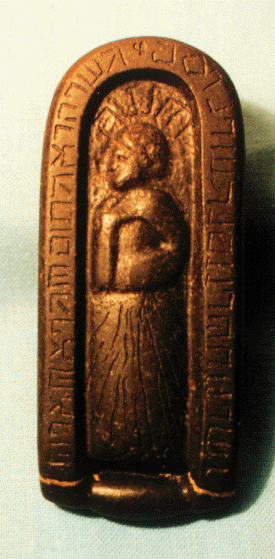
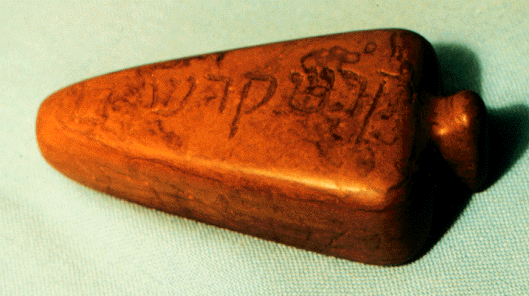
Sketch of Decalogue Stone of Newark, Ohio. By B.L. Freeborn.

Sketch of Decalogue Stone of Newark, Ohio. By B.L. Freeborn.

The explanation of the Oval at the Newark Earthworks in Ohio is simple but of exceptional debate. We need to ask what elements in the Beltane story, Newark Earthworks and the Newark Decalogue have we left out? We have discussed the possibility that the oval was once filled seasonally with water. We have discussed how the Decalogue Stone appears to be a little ark. We might recall that the Oval is the shape of the egg at the Great Serpent Mound. In that respect, keeping with the story then Baal may be the serpent and the Oval would be another representation of the Earth since in fact the planet is just sightly oval not round. We have discussed the finding of meteoric iron and crescent shapes and the idea that the Great Circle shows a sideways impact of a comet into the Earth. Could the Oval be a further description? It would have been nice if they had just wrote it out in plain Old English so we would not have to guess. Ahhh, did they?

Recall the overall layout gave us the idea of 23 32 or “keg Baal.”  But 23 degrees 30′ is in fact the limit of the Arctic and Antarctic circles. The center of these two circles are the poles which relates back to the maypole.

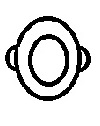
Newark Oval as drawn by D. WyrickWe might ask what else the Ancients tried to portray here. All three maps of the site, Burks’, Squier’s and Wyrick’s, depict the oval with a U shaped appendage to the west. There are also several strange paths with bump-outs to the west. Is it possible that this large oval and projections are letters or words? It is possible that the east side of the oval had a similar appendage as on the west that has worn away with time and creek flooding. This would make the Oval similar in concept to the Luwian Hieroglyph shown below. This glyph is unnamed but is associated with the sound “la.” 1

Luwian symbol #445.

Luwian symbol #445.

This form of writing called Luwian or Hittite Hieroglyphs is from the area of Hattusa in present day region of Anatola, Turkey and northern Syria. Evidence that this writing dates from third and early second millennia BC exists. There is no evidence of its use after 7th century BC per academia.2 Its use has been previously demonstrated at Loughcrew, Ireland3 which is believed by some to be much older than the 5500 year old Knowth Tomb, Ireland where several examples have been demonstrated.4 An example of Luwian Hieroglyphics will be shown at the conclusion of this series from a much later period.

Oval with Hieroglyphic Words notedIt would seem this symbol of a circle with two ears is not the only Hieroglyph to be found at Newark. Since Wyrick’s map is believed to be the most accurate, the Oval portion of his map is redrawn here for our study. A comparison of the simple geometric figures with Luwian Hieroglyphs produces a translation as we see in this image.5 Three words are written out. The main oval is Symbol number 445 with sound “la.” Attached at the bottom is the line pronounced “ra,” Symbol number 383. Off the side of Ra is a hump or Symbol number 209 or 210 and sound “i” or “ia” which gives the word: La- Ra- I.

The middle set of lines with the circle and dot is Scutella 402 (Latin for shield) pronounced “sa”. The line beneath is “ra,” Symbol number 383. This forms the word Sa-Ra.

The third word is a combination of the hump out “i” and “ra” to form I-Ra.

We need a translation of “Larai Sare Ira.” How fortunate! This is written in English, Old English that is! 6 7

Larai provides these possibilities: lær = empty; læran = to teach (to fill the mind of someone who is empty); lar = lore, history; lareow = teacher; leorian = to vanish, die, become empty; lyre = hurt, lure; and leger = lair, lying, grave.

Sa-Ra provides: sar = to sear, or sare = sore. And I-Ra could be irre or ierre which means fierce, angry or ire.

The sentence then becomes “Ire sore lair” or in modern terms “An angry sore, an emptiness.” This provides us with a meaning for the Oval. It represents the place where we might presume the event of Bael-teon occurred or where the comet they are referring to as Baal impacted.

Is this sore in southern Ohio? Is it the .8 mile crater that forms the hills into strange sheared plains? Would this event motivate people from half way around the world to seek it out? Not likely. The construction so close to the creek so the Oval can be filled with water suggests they are referring to a watery grave and to have drawn the attention of the ancient world it must have been a significantly larger impact. What event do we find described world-wide that everyone scoffs at?

Forward to NEXT POST

Back to PREVIOUS POST

Back to TABLE OF CONTENTS

___________________

References/ Footnotes:

  1. Freeborn, B.L., “Luwian Hieroglyph Reinterpretation,” 2013. See:  https://noahsage.com/2013/07/10/luwian-hieroglyph-reinterpretation/
  2. Wikipedia article: Anatolian Hieroglyphs. See: http://en.wikipedia.org/wiki/Anatolian_hieroglyphs
  3. Freeborn, B.L. “A Loughcrew Petroglyph Translation,” 2013. See:   https://noahsage.com/2013/07/05/a-loughcrew-neolithic-petroglyph-translation/
  4. Freeborn, B.L., “A Simple and Elegant Neolithic Oops,” 2013. See:  https://noahsage.com/2013/07/01/a-simple-and-elegant-neolithic-oops/
  5. Anders, Gunter, “Luwian Symbols.”  See: http://www.hethport.uni-wuerzburg.de/luwglyph/Signlist.pdf
  6. Hall, J.R. Clark , “A Concise Anglo-Saxon Dictionary.” Toronto: University of Toronto, 1894.
  7. “The American Heritage Dictionary of the English Language,” Boston: Houghton Mifflin Company, 1976.
  8. Gordon, Cyrus, “Forgotten Scripts,” New York: Dorset Press, 1987.

Newark Decalogue Stone and Earthworks: An Unraveling Mystery

The following twenty-five posts were a pleasure to write and even more so to share with you. 

Newark Decalogue Stone and Earthworks: An Unraveling Mystery  … Full document as pdf.

B.L. Freeborn   © July 2013

“As a rule, innovation is welcome only when it is confined to surface details and does not modify the structure as a whole.” – Cyrus Gordon

Table of Contents

  1. Lepper’s One-Way Leap into Oh-Oh

    Front Face of Newark Decalogue Stone

    Front Face of Newark Decalogue Stone

  2. The Remains according to Romain

    Keystone found near Octagon in Newark, Ohio

    Keystone found near Octagon in Newark, Ohio

  3. Ohh… Let It Not be True

    Newark Earthworks, Link to James Q. Jacobs Site and Photos.

    Newark Earthworks, Link to James Q. Jacobs Site and Photos.

BACK TO PREVIOUS POST

See another example of Ohio Hebrew here.

Luwian Hieroglyph Reinterpretation

Luwian Hieroglyph

Luwian Hieroglyph

Luwian Hieroglyphs are otherwise known as Hittite Hieroglyphs. The name Luwian comes from the three glyphs shown in the image. This is how they referred to themselves. The first glyph is unidentified. The sound La is associated with it. The second glyph is for mountain. It has the associated sound Wa. The third is also unidentified but has the sound A. Hence, the name is La-wa-a.

Sometimes the sound attached to the glyph is not used but the name of the glyph is used as in a rebus. In other words, it is also possible they referred to themselves by the identity of the glyphs.

The following revisions for these symbols are suggested.

The first glyph: La or ley is still an appropriate sound to be attached to it. It is the root word of to lay, to lie and line. Perhaps it is an image of the place where ‘the two holes are” as it depicts. It suggests a specific place for perhaps the primary line of longitude. (Which is now in Greenwich, England but was not always.)

The second glyph: It is likely this refers to the mountain of ice that once overlaid the magnetic pole when it was at Hudson Bay. The two bumps repeat the idea of the the two holes seen in the first glyph and that form the bay. It may also suggest a set of dividers which is a tool used in navigation and engineering to transfer measures. The symbol shows an angle. Its name could then be the root of the word angle. Perhaps angle was once pronounced an-gal which reinforces the idea that the mountain was galled. The sound wa is still appropriate since Hittite is an Indo-European language and wa means woe. The word angst has the root word ang and also means woe.

The third glyph is associated with the sound a. It probably shows a knife, sword or dagger.

The symbols might be translated to mean “the measurers of angles and lines with respect to the galls from the daggers” and their name to La Ang-a as opposed to Luwian. It is not a big leap to their modern name. This begins to explain the origin of the name Angle or English which is poorly understood today.

This is too brief to give a real explanation. The next series of posts, although they seem unrelated at first, will eventually lead back to this very subject of Luwian or should we say Lay-Ang-a.

___________________

See Luwian Symbols by: Gunter Anders at http://www.hethport.uni-wuerzburg.de/luwglyph/Signlist.pdf

PREVIOUS POST         NEXT POST

NEWARK EARTHWORKS AND DECALOGUE STONE POSTS

(updated Nov. 2018)

A Simple and Elegant Neolithic Oops

– B.L. Freeborn (c) 2013, updated Sept. 2022

Sketch of Kerbstone 86

Sketch of Kerbstone 86

There is an oops in this drawing that reveals all. You won’t see it right off in its simple symmetric shape of four crescents, a line and two dots but here is the thing. If you examine image after image of art from Knowth, Dowth, Loughcrew and Newgrange you will see abstract shapes of swirls, curves, zigzags, crescents etc. but you will never see anything that looks specifically like a distinct letter. A crescent does but it is not distinct enough for one to point at a specific alphabet and say ahah! that is from Ancient ….. It is as though these artists did not have a written language and that is why symbols that appear to be letters or hieroglyphs are absent. There seems to be an overwhelming agreement these ancient builders were illiterate. Yet it is a simple idea that no letters were used in their art because these monuments were built for the eons and people (like us) who would not speak their specific language but who might speak – the one universal language.

So the oops is the letter dead center in the image. A line with a dot on each side according to the eminent Dr. Cyrus Gordon is part of the Hittite (now called Luwian) Hieroglyphic system and it is the letter “wa.” It does not mean this is the Luwian language but if it is “wa” then it confirms these people spoke an Indo-European language just as we would expect. We will come back to this.

Shall we read this mathematical message to us sent across time?

As before, we immediately count 4 C’s in a square shape and draw the conclusion we must square four!  Or 4² + 4² = 5.65².   And there we have the incredibly important and secret number 56 that is central to the deep mystery and appears at Stonehenge (see post) and is incorporated into the Giza Pyramid.

The C shape looks like the Hebrew K so we shall equate it to 20. What then might we equate the “wa” to? In Hebrew gematria the “wa” sound is often indicated by the ‘vav’ which equals 6. This gives us 4 C’s at 20 + 6 or 86. And this is the incredibly important value of the Sun with its diameter in miles at 864,000.

Can there be any other mathematical secrets in this figure?

Let us read it as we did others. 2 C, 1 wa, 2 C equates to 212. ????

But perhaps they meant us to add the 21 and 12 to get 33. Does 33 mean anything special? As a matter of fact it does. It is one of the often repeated numbers.

So let us go one step further. If they had an alphabet, then what language did they speak?

Missing Stone at Cairn F, Loughcrew, Ireland. After Brennan, After Du Noyer.

Missing Stone at Cairn F, Loughcrew, Ireland. After Brennan, After Du Noyer.

Perhaps the answer to that has been stolen from us. Martin Brennan records in his book the inscription on a stone which was removed from Loughcrew, Ireland. This is a mountain site which is much older than Knowth and Newgrange. I repeat the symbols here with the warning that they have been reproduced in succession and errors may have crept in.

This then suggests these people did have a written language distinct from the art. Since we would like to think we are quick of wit, let us try to solve the present riddle at hand. We have 2 C’s, a “wa”, and 2 C’s.

Since this decipherment into words is novel we shall do it thrice:

Try One:

C is the initial sound in crescent, comet, cup and cave and its shape repeats the idea of each word’s meaning. This suggests it has sound value K. So let us stick with it and pronounce the word.  CCwaCC or KwaK.

I am told that at one time all the letters in words were pronounced. So when we read light as lite it is incorrect. The gh in light was once pronounced. This suggests the c and k of quick were both pronounced. Because Knowth is on an island once solidly joined to Britain and Germany by land, and in close proximity regardless, it is not too far a cry to suggest this is one of two English words: quake or quick. The latter has the double c preserved and both preserve the k-wa sound. And if you think about it, they say the same thing. In Old English, according to J.R. Clark Hall, quake and quick are spelled cwac and cwic respectively. And he reminds us that it means “living, trembling”, and “living, alive.”  From Indo-European roots it is found as gwei which is the root of both English “quick” and German “Kwi(k)waz” also meaning alive.  (Old languages did not always differentiate between g and k.) In support of this interpretation, quick and quake are both appropriate to the diagram itself once the over all meaning of the site is understood.

This then suggests once again the impossible, just as an analysis of the Sator-Rotas revealed, and that is, that the English language did not begin around 500 AD as we are educated. For these sites are older than the pyramids. It helps piece together a past for the English language that might just pre-date High German. Is this possible? Time will tell.

Try Two:

As above we have CCwaCC. The Old English word ceac meaning vessel can be represented by the two letters CC. In Old English ‘wa’ is the word “woe, a sorrow.” It is also the root word of water. The -ter suffix changes the word into a noun. Hence, the word can also represent water. So this translation suggests there were two vessels, woe, two vessels. The image reinforces this translation.

Try Three:

We look once again at the Luwian and find that the large bold C symbol is the hieroglyph for the word meaning “great.” So then our image reads great, great, wa, great, great. The hieroglyph is associated with the sound ur. Ur was a very great city of the past. Perhaps this is why the linguists have happened upon the association. In Old English we note that ur can mean our, ore or origin. So then, the image takes on the meaning origin-woe. To understand this better we note that sometimes the hieroglyphs did not represent a sound but the object itself. In this case it could mean great, great woe. So we have “the origin of the great woe.” And if this woe was water then perhaps they are explaining the origin of the great flood itself.

So in total we have “the origin of the great woe” that was quick and a quake. It speaks of a great sorrow, a quake, a tragedy, a great woe and great vessels. It speaks of the deluge and perhaps the Day the Pole Moved.

Many more mysteries to unravel…..

Thank you for reading!

See more of fantastic Knowth and Dowth at this link:

http://www.knowth.com


(1) Cyrus H. Gordon, “Forgotten Scripts.” NY: Dorset Press, 1968. See pg. 98.

(2) Martin Brennan, “The Stones of Time.” Rochester, Vermont: Inner Traditions International, 1994. See pg. 165.

(3) J.R. Clark Hall , “A Concise Anglo-Saxon Dictionary.”  Toronto: University of Toronto, 1894.

(4) “The American Heritage Dictionary of the English Language,” Boston: Houghton Mifflin Company, 1976. See Indo-European Roots, pg. 1519.

PREVIOUS POST                NEXT POST

A Loughcrew Neolithic Petroglyph Translation

-B.L. Freeborn (c) 2013, updated Nov. 2018

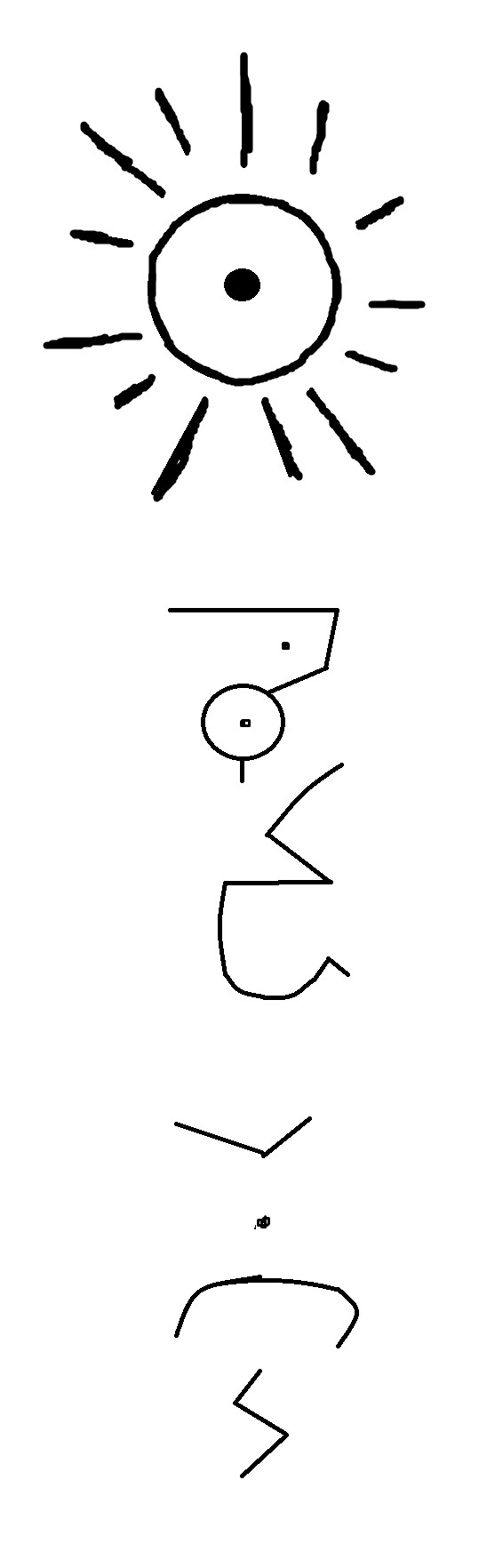
There was a petroglyph etched into a stone at Loughcrew recorded by George De Noyer and found in Martin Brennan’s book, “The Stones of Time.” The stone itself has been removed from the site. A translation shall be attempted here.

Missing Stone at Cairn F, Loughcrew, Ireland. After Brennan, After Du Noyer.

Missing Stone at Cairn F, Loughcrew, Ireland. After Brennan, After Du Noyer.

Note there are six symbols and a dot acting as either a word divider or sentence divider. There are too few symbols to be individual letters unless this is only one or two words. In studying Kerbstone 86 from Knowth the appearance of the letter “wa” and hieroglyph for “great” from the Hittite/Luwian Heiroglyph system was noted. The symbol for great appears in this image as well. It is the face down C second from the bottom.

Symbol One: The sun is the most prominent image at the top and since the Loughcrew site is built to capture and measure light we assume this message is then directly related to the site and/or the sun. Another possibility exists that this is a compound symbol and should be seen as a circle and dot surrounded by rays. The circle and dot is SCUTELLA 402 (Latin for shield) pronounced “sa”. The word “sa” in Old English means bucket.

The next two symbols are what might be called hieroglyphic cursive. Each is composed of three signs joined together.

Symbol two: The top part is very close to the hieroglyph SUPER 70 (Latin for above) with no sound identified. The circle and dot is SCUTELLA 402 (Latin for shield) pronounced “sa”. The small tail is “ra” 383. So we have ABOVE-sara.

Symbol three: This is also composed of three symbols. The first symbol is the same as symbol six: a zigzag of three lines. This is similar to SOLIUM 299 (throne) pronounced “i.” The cup shape is similar to CAELUM 182 (heaven) sign and to OCCIDENS 379 (west). The heaven symbol is a closed half circle with a horizontal line within while the west symbol is the same as here except with an upright staff in it. The last symbol is “ra.” So the word is  i, …….., ra.

Symbol four: There is no sign in Luwian that is similar to this. However, it appears on Kerbstone 93 (see post) and it seems to imply what it would today: to include, they, or this.

Symbol five: Is the MAGNUS 363 meaning great and sound “ur.”

Symbol six: Is the same as the first part of three. SOLIUM 299 (throne) and sound “i.”

In summary the six words are then: Sun or bucket, above-sara, i ……. ra, they, great, i. This needs a bit of work before we can equate it to modern words.

We could take the word SUN at face value or we could say from “the bucket it spread.” The dual meaning together suggests from the explosion like the Sun it spread.

Looking at Above-sara note that sara could be either sare meaning sore or sar spelled today as sear meaning dry. Both are related terms. The word asear means to dry out. So we shall leave it as “above was seared.”

The third symbol contains the i,……,ra. The middle syllable should be related to heaven and direction in some manner and the idea of a year fits. Old English for year is gear. Similarly there is the word gore and “gar” meaning spear. Both gore and gar reinforce the idea of an explosion. Surprisingly there is a word in Old English that is i,gar,ra and it is egor. Egor means flood, deluge. So this third symbol might very well mean flood.

The forth symbol we have temporarily equated to “they” or “this.” The fifth symbol was directly from Luwian as “great” which leaves us only to interpret the last symbol which from Luwian is Solium “throne” or the sound “i.” We might understand this symbol better if we realize that the “throne” or “ruler” determined the standard of measure (the length of the inch, mile, meter). The symbol then is a surveyor’s chain which is long and folds. If we look back to “egor” it reconfirms the idea of a measure of water or flood.

Putting it all together we have: Explosion, seared above, floods. They are great in measure.

This seems to be a serious lamentation rather than a weather report which might give us some insight as to why Loughcrew was built so high above the surrounding area and why they might have been studying the movement of the Sun. All in all, it is consistent with and confirms the findings presented in other posts.

This translation suggests that English was a written language some 4000 years earlier than than believed today. But then again for hundreds of years we were taught the world began in 4004 BC!

As mysteries unravel others appear…………
———————————————————————————–

(1) Cyrus H. Gordon, “Forgotten Scripts.” NY: Dorset Press, 1968. See pg. 98.

(2) Martin Brennan, “The Stones of Time.” Rochester, Vermont: Inner Traditions International, 1994. See pg. 165.

(3) J.R. Clark Hall , “A Concise Anglo-Saxon Dictionary.”  Toronto: University of Toronto, 1894.

(4) “The American Heritage Dictionary of the English Language,” Boston: Houghton Mifflin Company, 1976.

(5) Luwian Symbols by: Gunter Anders at http://www.hethport.uni-wuerzburg.de/luwglyph/Signlist.pdf

Previous Post    Next Post

Re-writing English History while Solving the Sator-Rotas, Part I

-B.L.Freeborn, (c) Oct. 2012 -last updated Sept. 2022

The “Sator Rotas” to an archaeologist is a trivial, long worn out mystery. To any fifth grader it is a quick puzzle. After the fifth grader explains it to the archaeologist then it becomes an out-of-place artifact.

File:Rotas square from Cirencester.jpg

Sator-Rotas from Cirencester, Wikipedia.

Let us first discover what is known and believed about this grid before we look at the way an un-influenced mind would perceive it.

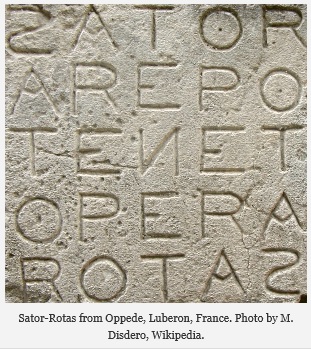
It is a five by five grid of letters that has been found in several places spanning both time and distance. The oldest is dated to 79 AD from Pompeii. The clear representation pictured below is from Oppede, France. A number of them have been found in England. Others have been found throughout Europe and one has been found in Syria. It is assumed it is in Latin. It is thought to be a secretive sign between Christians but others consider it magical. There are others who think it is a Jewish puzzle.

Before we throw the current translation out, let us reiterate it:

From Wikipedia we have………

“Sator Sower, planter; founder, progenitor (usually divine); originator

Arepo (arrepo) (I) creep/move stealthily towards, also trust, or likely an invented proper name. Its similarity with arrepo, from ad repo, ‘I creep towards’, may be coincidental

Tenet holds, keeps; comprehends; possesses; masters; preserves

Opera work, care; aid, service, (an) effort/trouble

Rotas (rota) wheel, rotate; (roto) (I) whirl around, revolve rotate; used in the Vulgate Psalms as a synonym for whirlwind and in Ezekiel as plain old wheels.”

They continue with …

“One likely translation is “The farmer Arepo has [as] works wheels [a plough]”; that is, the farmer uses his plough as his form of work. Although not a significant sentence, it is grammatical; it can be read up and down, backwards and forwards. C. W. Ceram also reads the square boustrophedon (in alternating directions). But since word order is very free in Latin, the translation is the same.”

Now let’s think about this….. They have been found in England. They have been found in Italy – Pompeii, Portugal, France, and Syria. So is it logical to conclude it is written in Latin? Probably. However – let us pause to think like a modern fifth grader who speaks the language spoken in England at this current time which is conveniently – this one.

What would a fifth grader see?

I suspect he/she could make a rather large list of words very similar to the list compiled below. The first two words any fifth grader is likely to identify are TEN and NET. Surely, the word ten appears four times and when read in the opposite direction they spell net. The four “nets” create a picture which forms a net spread out from the central N.

These are in fact two very revealing words which will lead us forward – momentarily. Our fifth graders would also spot the words SAT and ARE very quickly. A very bright child might find the word OPERA and then OPERATOR. We would not expect them to find TOR since it is not commonly used today but they would see the commonly used English word TENET. They might go on to find POT, OPEN and AT. They of course would not realize that they are finding Modern English words in a puzzle written many years before the creation of the language they speak. Unless!!!! There is something we do not understand about English.

This has led us off topic but it is a necessary deviation. The history of the English language must be checked. Is it possible this is written in modern English or even Old English?

No.

Or that is what we must infer from references such as the quote below from Wikipedia: English Language which does not conflict with other references on the subject. (Reference notes are found in Wikipedia article.)

“Historically, English originated from the fusion of closely related dialects, now collectively termed Old English, which were brought to the eastern coast of Great Britain by Germanic (Anglo-Saxons) settlers by the 5th century – with the word English being derived from the name of the Angles, and ultimately from their ancestral region of Angeln (in what is now Schleswig-Holstein).[12] A significant number of English words are constructed based on roots from Latin, because Latin in some form was the lingua franca of the Christian Church and of European intellectual life.[13] The language was further influenced by the Old Norse language due to Viking invasions in the 8th and 9th centuries.

The Norman conquest of England in the 11th century gave rise to heavy borrowings from Norman-French, and vocabulary and spelling conventions began to give the appearance of a close relationship with Romance languages[14][15] to what had then become Middle English. The Great Vowel Shift that began in the south of England in the 15th century is one of the historical events that mark the emergence of Modern English from Middle English.”

So, according to this English, even as Old English, was a dialect developed 400 years too late.

Darn!!! And it works so well in English if you look at the gematria. Like, the four tens actually are made of four 10’s!

Well, they do! Look…..

Using the Hebrew sounds for these letters, not a modern gematria for English letters and not translating them to Greek or Roman gematrias we substitute according to this:

A = 70

E = 1

R = 200

S =  60

T = 9

P = 80

N = 50 but if it considered to be a Hebrew Alef then = 1

let O =  6

S    A    T    O    R                        60      70       9       6    200

A    R   E    P     O                       70    200        1     80        6

T    E   N    E     T                         9         1     50       1        9

O    P   E    R     A                          6       80      1   200      70

R    O   T    A     S                     200         6       9     70      60

By this replacement, using the sounds provided by the Hebrew letters, we observe that indeed the tens create ten. There are four of them around a central 50.

The four tens sum to 40. This is a significant number. A square of sides of 40 has a diagonal of 56.56 which is a number often pointed out as important in these posts.  Or they might see it as a very Biblical number as in “Moses wandered for 40 years and it rained for 40 days and 40 nights.”

When the 40 is added to the 50 it sums to 90. Furthermore, each ten is at 90 degrees to the other which is true if the longitude and latitude of the planet is called a “net” and the four cardinal directions are then at 90 degrees to each other just as shown.

In other words: North, South, East and West are at 90 degrees to each other and each is depicted by the word NET fanning out from the center.

We take this idea one step further. Each degree of longitude and latitude is made of 60 minutes and each of those minutes of 60 seconds. Note that each 9 + 1 or ten when added to the central 50 creates 60. There are four 9’s on the exterior of the net and 4 x 9 = 36 which then suggests the number of minutes in a degree or 360.

Not convinced?
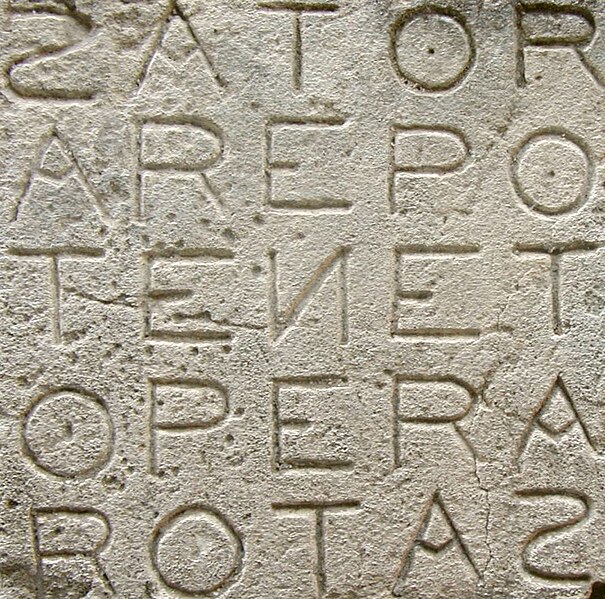
File:Sator Square at Oppède.jpg

Sator-Rotas from Oppede, France, Wikipedia

Hmmm. In this image of the Sator Rotas from France the N is reversed which calls attention to it. The Hebrew Alef and the letter N are very similar. This letter in Hebrew has the value 1. Now if the central  letter is allowed both values, both 50 and 1, then their sum is 51 and 51 degrees is the latitude of Greenwich, England from which longitude is measured today. It is in the  center of both the puzzle and the Net created by longitude and latitude numbered from Greenwich.

If the letters surrounding the center (REPEREPE) are summed, the number 564 is obtained.  This is significant. The value ‘560’ was discussed in the prior post about the Hebrew alphabet. 40, 56, and 79 are the three most important numbers in this secret system. The 40 we have touched upon. The 79 appears as the word AT and might be said to refer to the diameter of the Earth at 7920 miles. It most certainly refers to something the ancients kept as an ultimate secret. Indeed, the word AT is very appropriate. The 56 appears in the sum of the letters REPEREPE (564) surrounding the middle. It is often found in secret writings as 565 or 56.5. If the center is allowed to be 1 then the 565 appears quite nicely. This also repeats in the RPNPR diagonal. 560 + 50 or 56.50?! But that can also be said to be 610 which repeats the 60’s.

Is this all that is hidden here?

No, it is a very plush garden of numerical facts. Notice that our ten’s reveal something else. The closest distance Earth comes to the sun is considered to be 91.4 million miles. Our 9 + 1 + 50 can be re-written as 91.50 miles. Not too bad for a bit of graffiti!

The circumference of the Sun is 2.72 million miles. Ra is the Sun God of the Egyptians. R = 200 and A = 70 …..Ra.  RA appears four times.

More? Yes!

I would be disappointed if the diameter of the Sun was not easily found and there….summing the exterior letters we find it equals 860. The diameter of the Sun is 864,000 miles plus a few.

Here then is another point. Hebrew does not have the letter O so the value for ‘v’, which also serves for letters w and u, was used as 6. There is some logic to using 7 for the O. Seven is the value for the letter ‘z’  in Hebrew. Z is the first letter in zero and zero was originally called ‘cipher.’ If the value 7 is used then the exterior sum is 864 and that perfectly reflects the diameter of the Sun. What is more, ATO would then sum to 86 which would repeat it.

This then is no simple rhyme about farmers with fabricated names tilling soil. It is in fact a dire message.

To obtain this message we must take a daring step. We will declare the establishment, quite respectfully of course, in grave error. For this is a grave matter and an even deadlier message. We will accept that this is not written in Modern English but will allow it to be plain OLD ENGLISH. Why Old English and not French, German or Russian? 10 !!! How is it said in French – dix, in Spanish – diaz, in German – zehn, in Russian – desyat, in Hebrew – yod, in Latin!!! – decem, and in English both old and new – ten!!! So, English it is!

We think these willy nilly old timers knew nothing of longitude and latitude. Maybe that is an incorrect perception as well! We have already seen the 60’s. We even found 610 in one diagonal. The sum of the opposing diagonal SRNRS is 570. What is 570 and why is it pertinent to longitude and latitude? The value of a radian is 57.29 degrees. Radians are used in circular measure. That is important in longitude and latitude, and other matters involving the circular movement of objects.

Shall we explore further? Shall we look at what has become an eerily out-of-place artifact? Is this evidence of time travel or evidence that we just do not understand something?

So, we diligently continue………………………..

We find these words in this little 25 letter grid.

In bold-italics is the Old English Spelling as provided by “The Student’s Dictionary of Anglo-Saxon,” by Henry Sweet, Oxford at the Clarendon Press, 1896. A few spellings are provided by “The American Heritage Dictionary of the English Language,” Houghton Mifflin Company, 1976. The Modern English equivalent is then provided. ME denotes Middle English, OF – Old French, and bold-italic – Old English.

From the Sator Rotas we read:

a = a, meaning ………always

ar = ar = meaning……….brass, copper, counting device, ær = early

aras = arise??? aries, arisan = rise, arasian = explore, detect

are = ar = aer = early, reverence, before

as = as ME = alswa = as

asa = assay ME = assai OF = ascian

aten = ateon = to draw out

at, ato, ate = æt = origin, ate

= Ea, one supreme god, æ = divine law

ene = ane = one time, ænne = anne = one

era = ar = brass, copper, counting device, ær = early

net = nett = net, mesh

open = open

opera = opera = work, drama

= apperen ME = appear

aparian =  to take in the act

operator = operator

opor = ? opportune

opo = oppose, against- pose, pose from post

or = or = before, beginning, origin

oro = ora = bank, shore

ot = ut = out, oth = until

per = aparian = take in the act, see doing = appear = peer

po = fa = foe (if P is soft) = fæh

po = pawa = pea = pea, pee, poor, pour, pore

po = River Po in Italy

po = pohhe = pouch, purse

por = poren ME = pour = to stream forth

por = porus = pore = passage, porr = leek (vegetable), see ‘po’

pot = pott = pot

potenet = potent ME, Scottish = power

ra = Ra (god), ray, ra = to raid

rasa = ræs = attack, running rush

= race = course

= ræsc = shower of rain

rep = repan = to reap, rip = reap, rap = rope, riepan = to spoil, rape

repe = ripan = to reap, ripien = to ripen = repeat

ro = reow = row, order

rope = rap = rope

rot = rot = hrot

rota = rotare = wheel

rotas = rotates ????

rotare = rotare = wheel

roten = rote = repeat,  rotian = rotung = decay

sa = seah = see, sa = bucket

sara = sare = sore, sorrow, sarian = to be painful, sad

sat = sæt = ambush, lair

sator = sætere = robber

satoro = satori = Buddhist enlightenment

tare = taru = tear

tas = teoso = injury, tæsan = to tease (wool)

ten = teon = draw, drag, make, tien = ten

tenet = belief, tan  = twig, tænen = of twigs

to = to

top = topp = summit

tor = torr = tor, rock

torot = tarot = Italian 14th century game, plural of Torah

This is a substantial list of Old English words. What is very odd is that the Sator words are closer to modern English than Old English. From this we might easily conclude that the historian’s have misunderstood something. This simple out-of-place artifact suggests Old English was spoken as a distinct language some 500 years before it was supposedly invented.

Perhaps our understanding can be improved by looking at the numbers. They have not all been sought out. This and a more proper translation is the topic of the next post.

We shall let this mystery rest for a few days before we study the numbers.

Post as a full article

         PREVIOUS POST               NEXT SECTION
Re-writing English History while Solving the Sator-Rotas, Part II

– B. L. Freeborn (c) Oct. 2012 -last updated Sept. 2022

We have been discussing the Sator-Rotas and how it changes our understanding of the English language.

Curiosity piqued? Must we toss out all the history books?

Link to full article.

Perhaps our understanding can be improved by looking at the numbers. They have not all been sought out.

Let us continue…Alas, there are many numbers. If you dread them more than the pox skip to the bottom.

We repeat for ease of study…

Sator-Rotas

Numbers:

A = 70

E = 1

R = 200

S = 60

T = 9

P = 80

N = 50 but if it considered to be a Hebrew Alef then = 1

O =   6

Center number is both 1 (Hebrew Alef = 1) and N = 50 which sums to 51….. 51

S    A    T    O    R           60      70       9          6    200

A    R    E    P    O           70    200       1        80        6

T    E    N    E    T              9         1      50/1    1        9

O    P    E    R    A              6       80      1      200      70

R    O    T    A    S          200         6      9        70      60

Significant numbers are on the right side.

T, E = 9 + 1= 10

4 x ten = 4 x 10 = 40

10 x 4 = 40 and……………………………..40² + 40² = 56.56²

56 refers to their secret

Corner letters are S = 60…………………………. 60

Minutes in an hour

2 x 60 = 120…………………………………………    12

Signs of the Zodiac

R = 200 and 2 R’s = 400……………………….. 400

Ratio of Diameter of Moon/Sun

Four T’s of 9 = 4 x 9 = 36…………………….. 3600

Seconds in an hour

Four A’s of 70 = 4 x 70 = 280 and 280 x 2 = 560

Refers to their secret

Four O’s 4 x 6 = 24…………………………………..   24

Hours in a day

A T = 70 + 9 = 79…………………………………….7920

Diameter of Earth

A R E = 70 + 200 + 1 = 271……………………..   271

Circumference of Sun

RA in four places = 200 + 70 = 270…………….  270

Circumference of Sun

ENE (in middle) 1 + 50 + 1 = 52……………….     52

Weeks in a year

PR (in two corners) = 80 + 200 = 280, 280 x 2 = 560……

Their secret

PO in four places = 80 + 6 = 86……………………  86

Gematria of Elohim and Diameter of the Sun

OPO in two places = 6 + 80 + 6 = 92……………  92

Distance of Earth to Sun

Two corners of RSAA 200 + 70 + 70 + 60 = 400

Ratio of distance Earth to Moon / Earth to Sun

Two corners of OPOR = 6 + 80 + 6 + 200 = 292 times 2 = 584

Circumference of Earth’s orbit around the Sun

All four corners = RRSS = 200 + 200 + 60 + 60 = 520…  52

Weeks in a year

Center ring of 8 letters:

REPEREPE = 200 + 1 + 80 + 1 + 200 + 1 + 80 + 1 = 564 +

(center as  1) + 1  = 565………….. 565

Their secret about the reaper.

Sum of 16 exterior letters: SATOROTASATOROTA

60+70+9+6+200+6+9+70+60+70+9+6+200+6+9+70 = 860……860

Diameter of the Sun

Sum of first / last row: SATOR = 345……………………………………………. 345

345 x 2 = 690 or 69………………..  69

345 = 18.57²

345² + 345² = 238,050

345 = Gematria Value of Moses,

69 = approximate distance between two degrees of longitude,

18.57 = diameter of Earth’s orbit,

238000 distance between Earth and Moon

Sum of second /fourth row: AREPO = 357……357² + 357² = 254,900

Distance between Earth and Moon

Sum of middle row: TENET = 70………..(if  N = 50)……………………… 70

Approximate distance between two degrees of longitude

Sum of entire square = 345 + 357 + 70 + 357 + 345 = 1474

1474 = 79.2 x 18.6

Diameter of Earth x diameter of Earth’s orbit.

Let O’s = zero = 0 then…

Sum is = 1450, 1450 x 4 = 5800 or 58…………………………….. 58

Gematria of Noah and circumference of Earth’s orbit

16 exterior letters…………………. 16

Earth moves 1.6 million miles per day

Diagonal SRNRS sums to 570

Number of degrees in one radian is 57.29

And who is the author of this ancient puzzle? Whose secret message was this?

English is the modern way of saying Engle, Anglo, or Angle. And how does one determine latitude? Do we not take a measurement in degrees off the Sun? Do we not measure its angle? Perhaps we should call the Sun – Ra and measure its rays? We can deduce that the puzzle is the work of: an Anglo, who knew Hebrew numbers and letters, the Latin Alphabet, and key astronomical values. The author was also initiated into the secrets of the Anglos, Egyptians and the Hebrews.

And so we come to understand the very beginnings of the English language. We now know a little more about who spoke it, when they spoke it, and where the word Anglo for English comes from. We can also date the use of Greenwich as the zero longitude line to the early days of the Christian era or before.

A new understanding is revealed so neatly by a little puzzle!

PREVIOUS POST                       NEXT POST