The Newport Tower: Finding the Year of Dedication, its Designer and Builder

B.L. Freeborn © October 30, 2022, Rewritten June 2025        (PDF version here.)

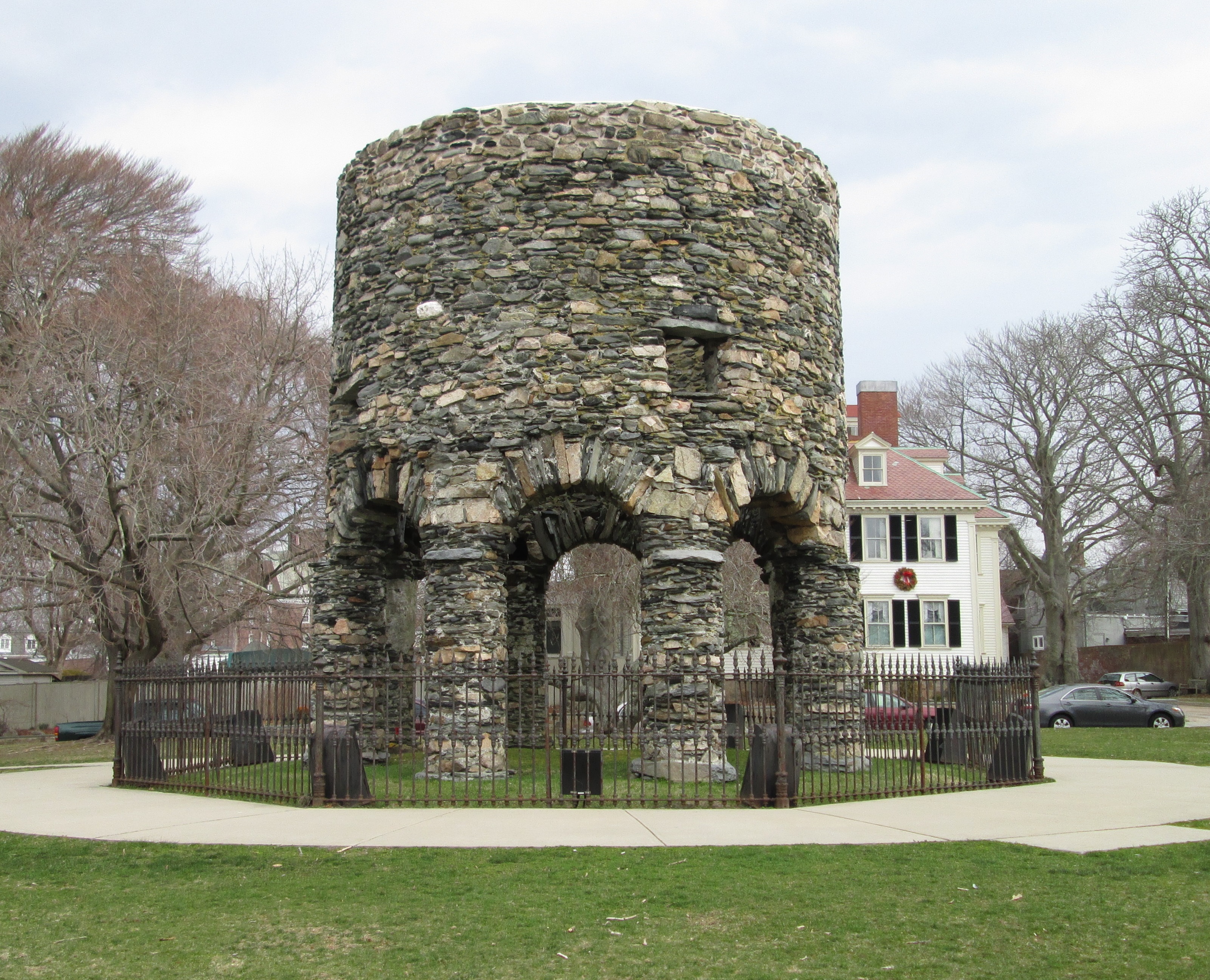
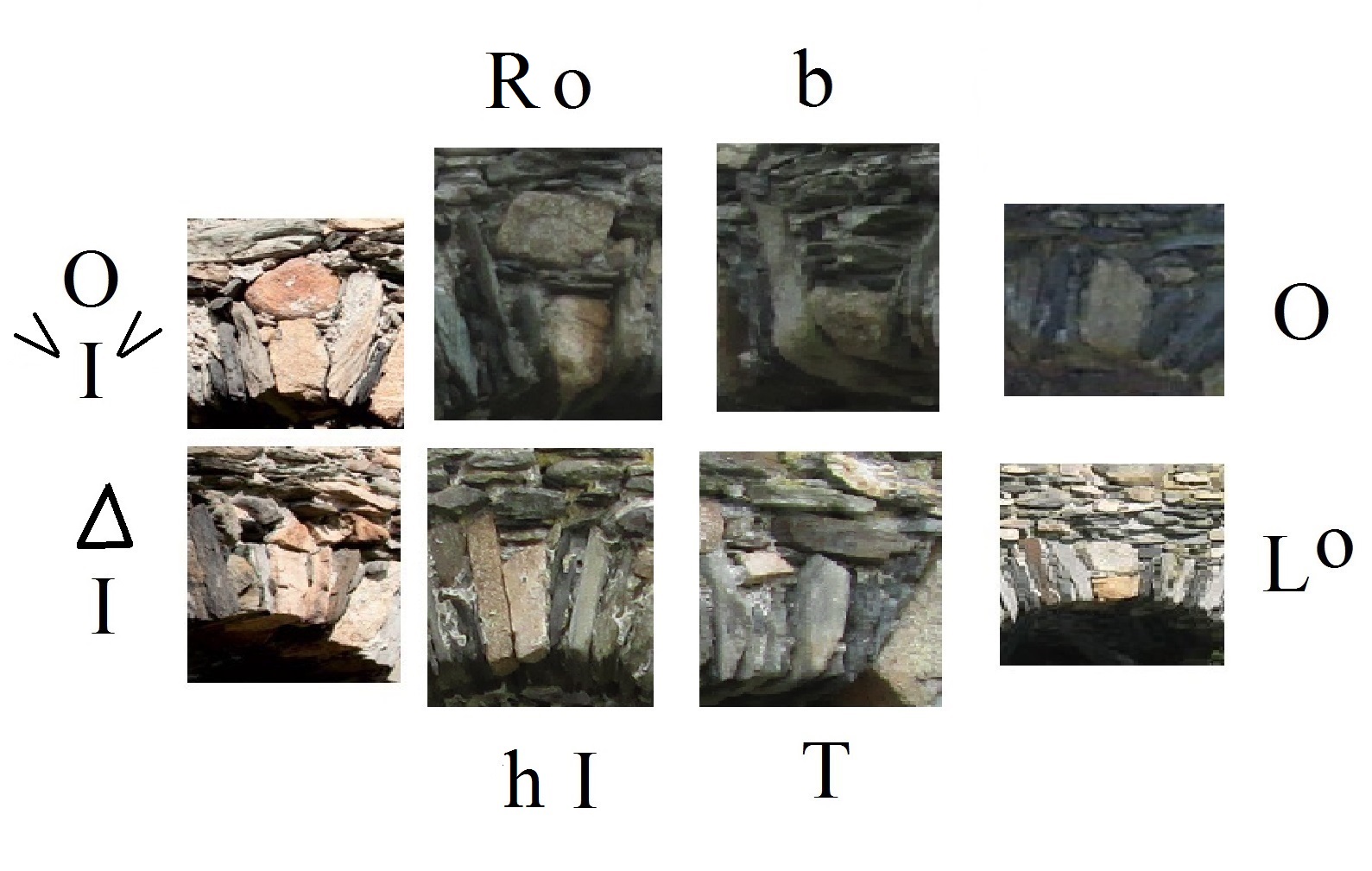
Who built the Newport Tower is a long standing question. It has been well proven by James Eagan that the tower is used for keeping time as the celestial bodies align with its numerous small windows. Eagan also noticed that certain letters formed with stones appear in the arches of the structure. Most notable and hard to miss is the >OI<. He found the Delta and P (shown as R). He also thought the h was a Greek η. From there he determined, probably correctly, it spells out Rode as in Rhode Island. His theory states John Dee had the tower built in 1583 in connection with a colonization attempt which failed.

The tower is shown on the “Woods Map 1635’ by William Woods a colonist in Providence, RI (Syverson, pg.32) The map notes it as Old Plymouth. This is the earliest known record and predates Benedict Arnold senior’s ownership. Evidently Arnold knew what it was and probably who built it, but because of the possibility of these prior claims resurfacing he referred to it as an old windmill knowing very well only a fool would believe that.

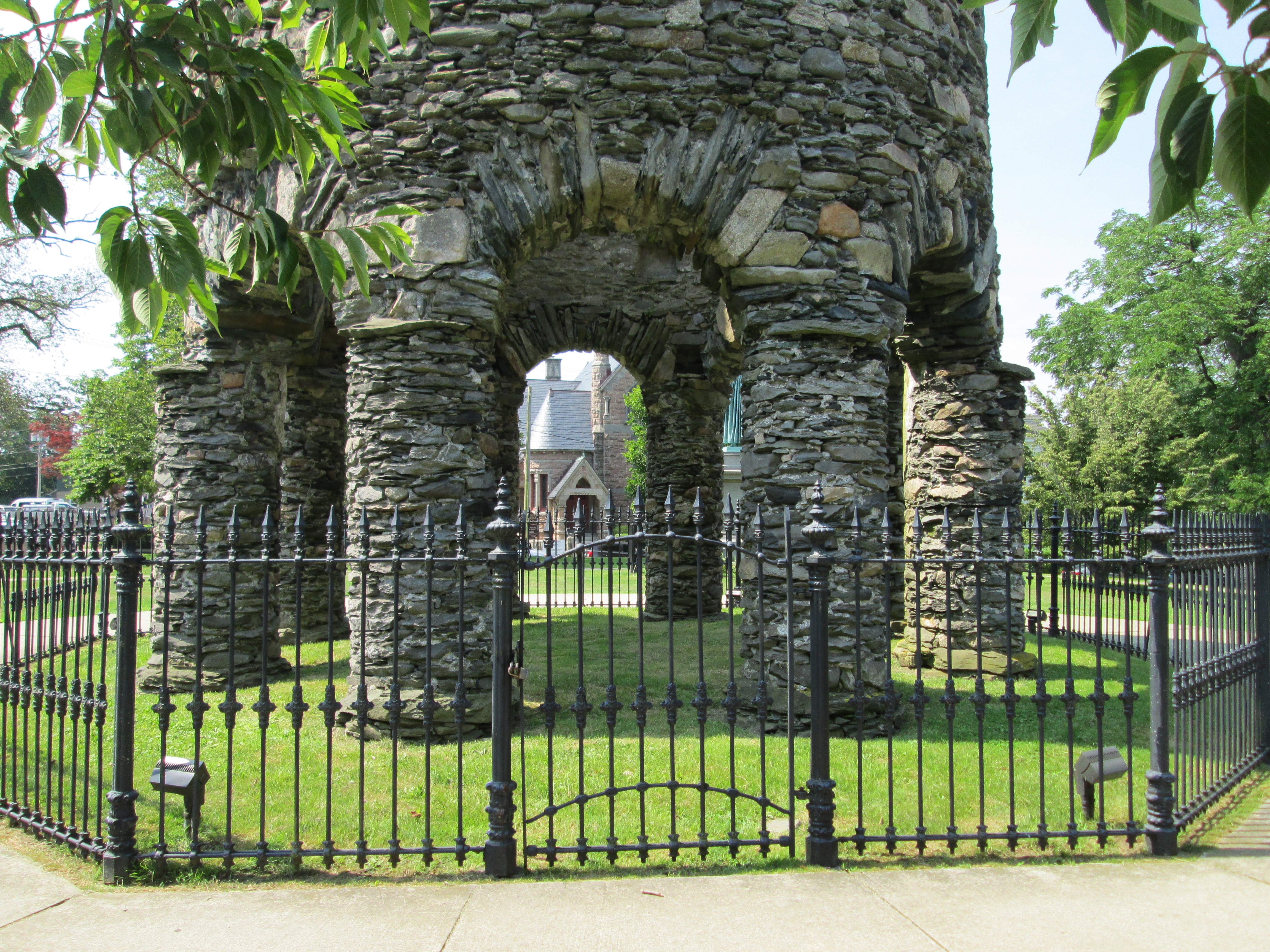
Newport Tower in 2023

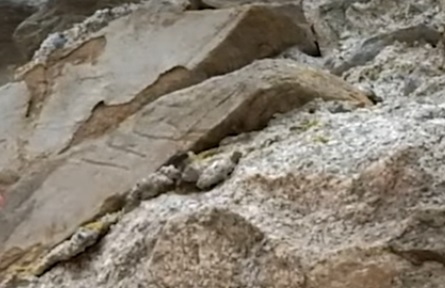
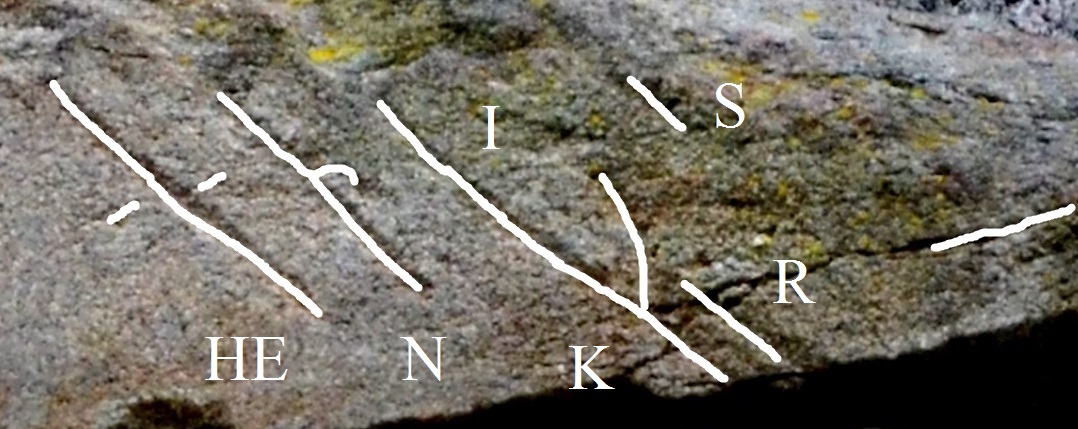
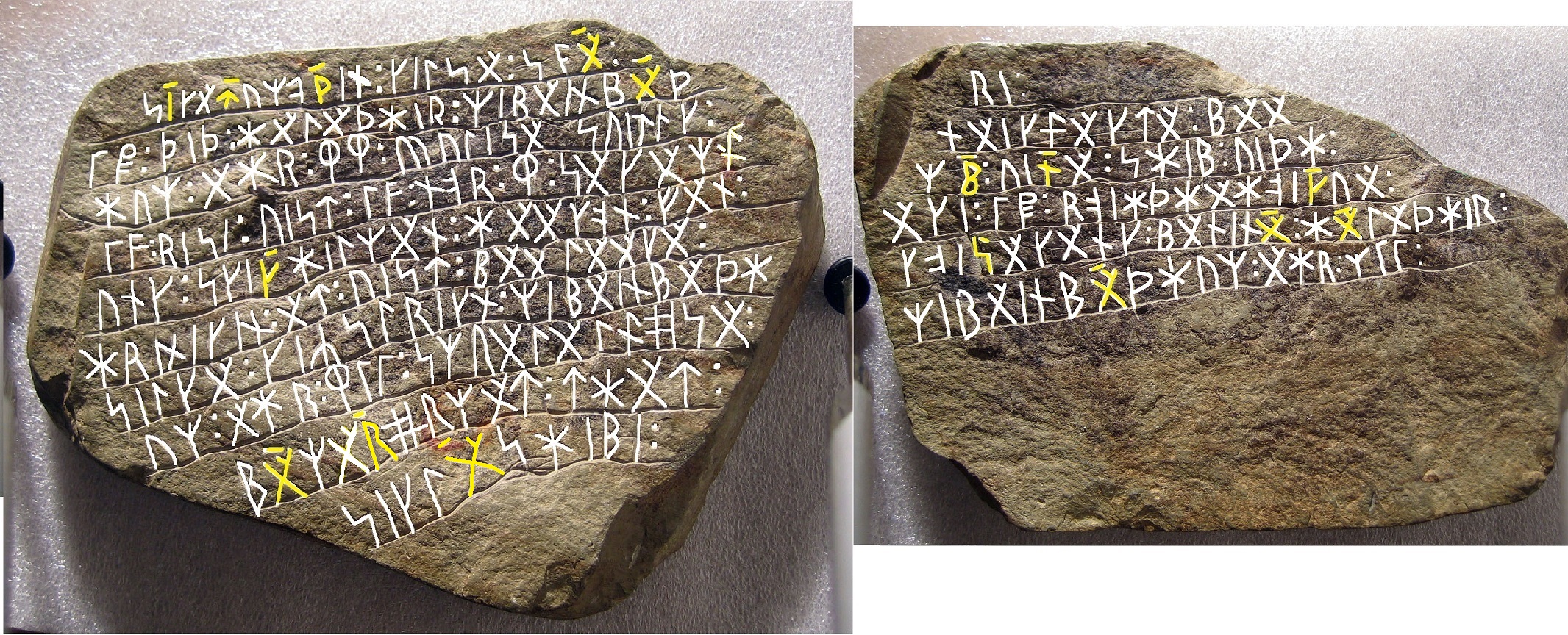
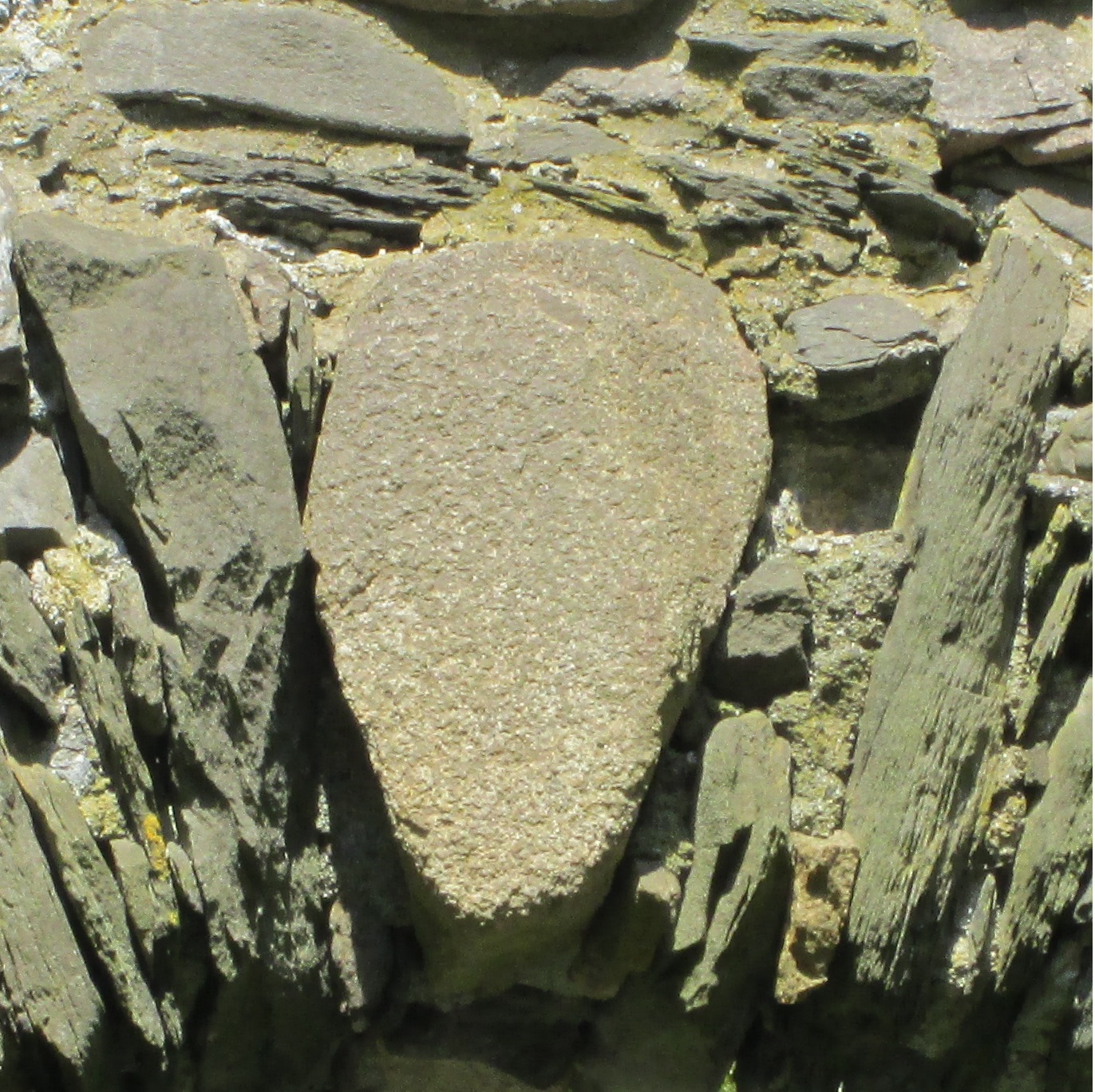
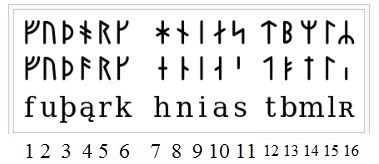
After studying Eagan’s discovery, the other letters shown above were identified. There are eight arches. Three of which have one letter displayed and five display two each. There is also a round stone on the interior opposite the >OI< stone which is on the northwest side. This makes fourteen altogether. To complicate the picture there is a runic inscription found over the southwest pillar (see images below). It was translated by Mongé (1967) and it reads Henricus 1116. This refers to Bishop Henricus from Greenland that was sent to Vinland. He is known as Bishop Eirik Gnupsson in Icelandic annals. Other theories as to the tower’s origin abound. The Henricus theory is at least supported by an inscription imbedded into the tower itself in the manner of a corner stone.

This paper is a study of the inscription and stone letters. It is also an addendum to Validating North American Runic Inscriptions (PDF). The translation is given here and the study with its numeric work follows. The aforementioned paper will be helpful in understanding it.

Translation

The round stone on a peg in the NW arch is as indicative of Baal as a cross is to Christ. (The >OI< stones.) Furthermore, it would seem the stone letters spell out Baal. This leads to studying the ‘inscription’ as if it is of Baalist origin and if so, certain numbers must be present. Validating North American Runic Inscriptions describes how certain numbers are embedded in Baalist inscriptions. One should recall that the Catholic Church went to great lengths to stamp out paganism in the time preceding, during and after Henricus’ tenure as Bishop. Apparently, Baal was central to that religion which is why there are so many references to it hidden in runic riddles. The dedication to Baal at Newport tower is unmistakable. The stone letters are repeated here:
Reading in a clockwise manner – b O O L T I h Δ I O >I< P/R O
These are transliterated as:           B A A L T I h D I A I R O

Note that the P in some scripts/languages is R. The O’s can be either O or A. Similarly, the I can be E. In Futhark runes B can be P.
Reading from the top clockwise find: RO, BAAL, TI, HI, HID, DI, O, >I<
Also find: HIT, I TOOL, O LO, BOR, ROB, POL, RODE or RHODE and OH.

The first line suggests: Row, Baal, Tie, die, high, hide, eye, two strikes at I.
The second adds: hit, I tool Rob, hole low, bore, pole; rod, red or road; and oh. We may conclude:

Baal at the high tie hit. It hit twice at the eye in rows.
The hole is low where it bored the eye of the pole.

“ROB” tooled (designed and built).
Rhode Island

The first two lines are typical Baalist statements. The words are easily found in the inscription. Rhode Island perhaps requires an explanation. RHODE appears to be a combined anagram for Rod (or Red) and Oh (meaning island). A rod is a measuring length of 16.5 feet. The clay on the shores of Rhode Island is notably red so it might also refer to red. This suggests the name, Rhode Island, is much older than cited by modern authorities. The name Rob, R.O.B. or B.O.R. is the name or initials of the designer. The H presumably represents his pseudonym, Henricus. (To be discussed further below.)

Then Comes Henricus

Above the southwest pillar of the tower is a runic inscription. Harek Williams examines it in a video with James Eagan and confirms it is human carved and nothing more. A much better source for proving it is an authentic runic carving is Alf Mongé. Why the latter? Harek Williams reads plain text runes from that period. He does not delve into runic puzzles or dated riddles. Alf Mongé was a cryptologist. He deciphered the deep scratch marks into runic letters and decoded them. He found it reads: Henricus 1116. This gives a lower limit to the age of the tower. Based on other runic inscriptions found along the east coast and the Narragansett inscription nearby this seems plausible.

The rapidity with which the tower is giving away to nature demands that it must be under constant care. This requires that, regardless of when it was built, it must have been periodically repaired. It has been nine hundred years since Bishop Henricus visited (circa 1116) as stated in the Vinland map legend. The Spirit Pond stones are dated to 1214-1217. (Freeborn, Deciphering.., 2022) They commemorate his visit. The Kensington Stone’s date is 1362. (Freeborn, Kensington.., 2023) It states the travelers came from Rhode Island. In 1525 Verazzanno explored the coast but did not mention the tower. In 1583 John Dee sent an expedition to the area. By the 1600’s it was settled by colonists and it came under the care of Benedict Arnold senior. This could mean it received periodic maintenance since the time of its construction, on or after 1116, until Arnold’s ownership five hundred years later.

The date and builder need not be total speculation. The aforementioned inlaid letters tell the story of Baal. If they were chosen in the manner of a runic riddle they may reveal more. Since Henricus was a master at runic riddles, and if this was built by him or in honor of him, then the symbols should contain further information. These riddles often contained a date.

As far as John Dee being the designer, that is possible as well. However, and it is a very big however, he was a devoted Christian and this tower is clearly a dedication to Baal. A study of Dee’s mathematics does not display the numbers so prevalent in Baalist inscriptions which suggests he is not the creator. The two religions are not mutually exclusive since Henricus was a Bishop of the church, but he lived at the point in time when paganism, through genocide, was actively being stamped out. To continue their religion and live, they were forced underground or in this case, off the European continent. It is possible he was of both beliefs.

After a mathematical study (which follows) of the letters’ number equivalents more information was derived. As seen, it was erected to commemorate the great story of Baal. It also commemorates Henricus’ visit in 1116 and suggests an erection date from 1153 to 1161. This is some thirty years after his supposed death. In keeping with his humor, or some might say his ego, he designed and oversaw the construction himself.

Designed and Built by O.M. – Dedicated 1161
To Honor Baal and Bishop Henricus’ visit in 1116
Rhode Island

Number Work and Proof of Transliteration

Certain numbers** appear when the letters in any Baalist inscription is converted to their numerical equivalent (gematria). The Newport Tower’s hidden letter/numbers are studied here. Numbers that are typically found are noted by a ✓ check mark. Simply put, if the numbers are not found, it is -not- a true Baalist inscription -or- the letters have been misinterpreted. Once the correct letters are proven via their gematria then the message about Baal can be read and also, possibly, who wrote it and when. The result of this study is as noted above.

The proposed transcription of symbols imbedded in the arches of the Newport Tower is shown below. The numbers are studied for repetitions and pertinent numbers.

Norse Runic Gematria

Sum from T and around to first A = 79. From the same A to L is 23. So that it is 79,23.✓
Total sum is 98 or 89 in reverse which reminds one 89 x 89 = 7921.✓
The sum from the Δ around again to the 7 is 89. ✓ The 79 is also imbedded in the text.✓
Even more notable the 9,3,9 sum to 21 so it becomes 7921.✓
The sum from the first A to first I is 51.✓ The sum from H to the right and around to L is 86.✓
The 28 appears twice which is half of 56.✓ The sum from B to the left around to the I (by H) is 56.✓
The sum from first I to the last O is 43. Twice 43 is 86.✓
The tower also spells out RHODI or Rhode. These letters have values: 5,7,4,3,9 = 28 and twice this is 56 ✓
Note the 12’s at T, ID, DI. Note the 13 at AI just following the 12.
Note the 14 at IR. Lastly, note 7 and 9 sum to 16.
By summing adjoining numbers find: 13,17, 19, 15, 19,12, 16, 12, 12, 13, 13, 14, 9, 17…
On either side of the 16 is a 12, then 12, 12, 13, 13, 14.

Years 1112,1113, 1114, 1115,1116 and 1117 are all implied by the series. These numbers coincide with the period of time Henricus was believed to be in Vinland. In dated runic riddles the Golden Number (GN), Day Letter (DL) and Line # are used to denote a year since every year has specific values that can be found in Easter Tables (a calendar device created in 525 AD). The main legend on the Vinland Map has the phrase: ‘anno p. ss. nrj.’. This uses a 1, 2, 3 sequence in the abbreviations. Since ‘anno’ means year, this is clearly a reference to ‘year 1123’ when Bishop Henricus was replaced by Bishop Arnold and his death was therefore presumed. As an example, if it implies Line #1, Golden Number (GN) 2 and Day Letter (DL) 3 then 1161 is indicated. In this instance, for year 1116, the values are Line #19, GN 14, and DL 3. There are two sums of value 19 with a 15 in between. The delta is the only letter in Greek. D has value 3 in Futhark. This 3 would be the DL. This then easily points to a date 1116. The date has additional merit as seen below. Without corroborating information as seen in the imbedded stone and Vinland map, other dates remain as possibilities.

Runic Inscription Study

Briefly, this is a summary of Mongé’s decipherment of the small stone imbedded above one of the pillars shown in the image above. It is a group of five runes and two are joined runes: (HE) N (IK) ʀ S or Henricus. There is an arrow to the right. The arrow is another feature common on Baalist inscriptions.** Using runic gematria, the year 1116 is found. The (HE) is 16. The S is 11. The ʀ is 16. The (IK) is 15. Reading in reverse find 1116. The repetition of the 16 and 15 help confirm the interpretation. It is worth reading Mongé’s study (Mongé, pgs 128-129).

The Structure Contributes

Round sun stone on interior.

The structure is set up to provide numbers as well. There are 8 pillars and 10 symbols that appear on five arches (two each). One symbol (the round sunstone) is in the inside and three arches have only one symbol for a total of 14 symbols. 4 x 14 = 56.✓
There are five arches with two symbols each or 10.
There are three with one each for 3. Total 13.
There is a single round stone on the interior. So 1. Then 1 and 13 ➟ 113 = 56.5 x 2.✓
There are 8 pillars and of course, 8 arches. A square of sides 5.656 has a diagonal of 8.✓
There are double symbols in 5 arches and single symbols in 3.
If the first arch with B is #1, then the arches with two symbols are found on: 3, 5, 6, 7,8. The ever present 3 is represented, then 56 and 7 x 8 is 56 again.✓ Similarly, if B is #1, then it is 1 symbol, then 1 symbol, then 2 symbols; or 112 which is twice 56.✓

One may again conclude after finding so many numbers typically found in Baalist documents that the transliteration is correct. The set of numbers is then 5,3,2,2,2,2,2,1,1,1 and 10. Let us view this another way. There are 3 arches with only 1 symbol. This is part of the story of Baal. There are 3 arcs.✓ The repeating 2’s emphasize that there were 2 Baals ✓.
Also note the number 532 is easily found. This is the number of years in the Easter Table before the table starts to repeat. Its presence infers a date. The 1,2,3 suggests year 1161 as seen above. The more probable date of 1153 is also easily implied here. Of the eight arches 5 have two symbols and 3 have one for 53. There is one round stone on the inside and one on the outside between two pillars which implies the 11. The sum of the digits in 1153 is 10 which is the number of double symbols.✓ It is suggested that Henricus journeyed to Rhode Island a second time or began the structure in 1153, and the tower was completed on or before 1161. This accounts for some of the confusion in the Vinland Map that says, ‘He remained a long time summer and winter and later returned toward Greenland.’ He was presumed dead in 1123 but reappears thirty years later.

Newport Tower with OM on side. Round stone is O. Adjoining arches form M.

Who was the Builder?

Further information is here about Henricus. If the letter sequence is viewed using the Elder Futhark gematria we find:
18 4 4 21 17 9 11 23 11 4 11 5 24 …18
B  A A L  T H  I   D   I  A I R O… B ⇒… repeats..

It is believed Henricus died in 1123 because a new Bishop of Greenland was consecrated in 1124. Note that 1123 is emphasized in the sequence.

Find: I, DI, H 1123…… I die 1123 (as) Henricus.
I HID 1123 ……… I hid 1123.
I R O B …. or… B. O. R. or I Rob….

In other runic riddles such phrases are anagrams. Recall first that the O’s were also considered to be A’s and find in these letters – B A A L T H I D I A I R O the following:

I DI  REAL PA AT OH ………. I die. Real father at island. (OH = island)
I ROB LOT I AID HA ………. I rob (the) lot. I aid. Ha!
I HID A O ROB IT AL ………. I hid. I ring rob it all.
I A O I HID ROB LOT ………. I a ring. I hid. Rob lot.
I HI PA O RAID LOT ………. I high father (bishop). Ring raid lot.
I PA H I O RAID LOT ………. I Father H. I ring (that) raid lot.
IT A O ROB AL I HID ………. It a ring. Rob all. I hid.
I PA O HID AL AT RI ………. I father. Ring hid all at RI (Rhode Island).
RHODE IT AL I A PA ………. Rhode. It all I, a father.

This sounds like the confession of a thief who robbed and aided. Furthermore, it suggests he hid it at RI, which one might think refers to treasure. It is more likely it means he was using his ill gotten gains to ‘aid’ his fellow man and hiding those people at Rhode Island. What sort of people needed to be hidden in that era? And is there a thief known as Rob who stole from the rich and gave to the poor? Who then was Henricus? Who was Rob?

Perhaps a couple more phrases might help.

I O PA HID AL AT RI ………. I O. Father (who) hid all at RI. (Rhode Island)
I O R PA AL HAT I DI ………. I O . Are Father (of) all. Hate I die.
I O R PA AL HAT I DI ………. I O . Are pa. All hate I die.

The image of the side of the tower shows a round stone between two arches. (See above.) If the round stone is an O then might not the two arches represent an M? Who then was OM and was OM a king?

It just so happens that a king also died in 1123 and his name was Oystein Magnusson who co-ruled Norway with his brother Sigurd the Crusader. Sigurd was a warrior and killer. It is then possible it was Oystein who named Henricus (Erik) as Bishop to Greenland.

A study of the two kings’ relationship can be seen in the historical account of Snorri. They were not friends. The need arises for a new bishop in Greenland in 1123. It is Sigurd that names him since Oystein has died unexpectedly.

So then we might ask:
• Did King Oystein name himself as Bishop and travel to Rhode Island as Henricus?
• Was King Oystein spiriting his people away from the genocides in Norway and sending them to Rhode Island?
• Was he funding his enterprise by robbing?
• King Oystein was a fabulous architect and builder of ships, bridges and churches. Did he design the tower?
• Did he hide from his murderous brother and later return to Rhode Island to oversee the tower’s construction?

Perhaps if one looks closer at the Vinland map (yes… it’s been declared a fake…), one can find his initials OM there as well. (Hint: use two copies against a sunny window.) Did King Oystein also pen the map?


Conclusion

The Newport Tower’s embedded letters when converted to gematria reveal numbers typical of Baalist documents. Their transliteration and subsequent translation educate us in a long lost religion. That this tower displays these features severely narrows the field of possible builders. It also strongly suggests that the northern peoples, Norse and others, inhabited this region known as Rhode Island for some time and built an elegant edifice by the year 1161. Pagan / Baalist beliefs are apparent in the design of the structure. Regardless of who designed and built this Tower, it is a marvelous feat of time keeping / engineering.

This still leaves us plenty of mystery but the time period has narrowed to a window beginning in 1116 to around 1161. Furthermore, new evidence of the builder/architect is presented here pointing to a man who used the alias Henricus and who signed his work O.M.

Previous Post                     Next Post

Similar Articles by the Same Author in PDF and Post:

*Easter Tables

** For numeric background see:

**Freeborn, B.L., Validating North American Runic Inscriptions, noahsage.com, November 2022. PDF only.

Freeborn, B.L., Ancient Riddles to Test Our Wits: The Secret Chamber, noahsage.com, January 2016. Post here.

Freeborn, B.L., Another Riddle in Stone from Canada, noahsage.com, August 2025. Post here.

Freeborn, B.L., Deciphering the Spirit Pond, Nomans Land and Narragansett Runic Inscriptions, noahsage.com, November 2022. Amulet post. Map stone postPDF only.

Freeborn, B.L., Et in Arcadia Ego – OUOSVAVV DM – Deciphered, noahsage.com, December 2022. Post here.

Freeborn, B.L., Kensington Rune Stone: A New Translation, noahsage.com, February 2023. Post here.

Freeborn, B.L., Rök runestone of Sweden, noahsage.com, April 2023. Post here.

Freeborn, B.L., Runic Riddles: Time Capsules, noahsage.com, December 2022. Post here.

Freeborn, B.L. The Long Debated Bourne Stone, noahsage.com, January 2023. Post here.

Freeborn, B.L., The Nomans Land – Leif Eriksson Inscription, noahsage.com, December 2022. Post here.

Freeborn, B.L., The Narragansett Inscription: A Translation with its Date of Dedication, Author and Inscriber, noahsage.com, October 2022. Post here.

Freeborn, B.L., The Newport Tower: Finding the Date of Dedication, its Designer and Builder, noahsage.com, October 2022. Post here.

Freeborn, B.L., The Wawa Stone and Its Viking Ship, noahsage.com, August 2025. Post here.

References

Creedon, Marc, Runologist Henrik Williams Examines the Newport Tower, Youtube, April 2015.

Eagan, James Alan, Elizabethan America: The John Dee Tower of 1583/ A Renaissance horologium in Newport, Rhode Island, Cosmopolite Press, Newport, Rhode Island, 2011.

*Monge, Alf & O.G. Landsverk, Norse Medieval Cryptography in Runic Carvings, Norseman Press, Glendale, California, 1967.

Syversen, Earl, Norse Runic Inscriptions with Their Long-forgotten Cryptography, The Vine Hill Press, Sebastopol, California, 1979.

Derogatory article by Aslak Liestol of Alf Mongé’s work: http://collections.mnhs.org/MNHistoryMagazine/articles/41/v41i01p034-042.pdf  and….

…Landsverk responded to these comments in Ancient Norse Messages pg. 126-129; and often in Runic Records of the Norsemen in America.

ET IN ARCADIA EGO – OUOSVAVV DM – Deciphered

B.L. Freeborn © December 2022        (PDF version here.)

Shugborough_inscription From Wikipedia

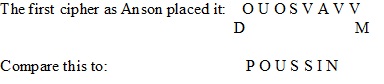
The Shugborough Inscription is a sequence of letters ‘OUOSVAVV’ on the first line and ‘DM’ spaced far apart on the second line. It is on a monument built between 1748 and1756 commissioned by Thomas Anson. Above it is a relief by sculptor Peter Scheemakers which is a variation of the Poussin painting Et in Arcadia ego. The famous painting by Nicolas Poussin displays this inscription on a tomb. It translates from Latin as ‘I am also in Arcadia.’ This inscription has eleven letters on top and three on bottom. The Poussin painting was done in 1637-1638. He did an earlier version in 1627. Previous to this, Guercino painted a similar but different version in 1618-1622. The original inspiration is a poem by Roman poet Virgil known as Ecologues. In this poem from 40 BC the inscription on the tomb of Daphnis is described. The tomb is in ‘Arcades.’ Daphnis was a shepherd in ancient Greek mythology.

From Wikipedia

Although the number of shepherds changes from two to three as the work progresses they all include a tomb. At some point in time the full phrase ‘Et in Arcadia ego’ was developed. The fact that Anson invokes this phrase and adds several elements to it suggests there is more to it besides his still undeciphered cipher some 270 years later.

It would seem he saw something in Et in Arcadia ego that others had not and added the lower inscription as a clue to revealing what is in the original phrase which is most definitely a cipher as well.

Indeed, his efforts resulted in creating a perplexing mystery. The solution to Anson’s ‘OUOSVAVV’ and to the riddle concealed in Et in Arcadia ego follow.

Part I: OUOSVAVV DM

Image Details

Before solving it, note what the image gives us:
• A woman on the left stands tall but looks down.
• The sky is tumultuous. On the upper coffin is a round wreath.
• Her right arm is bent and rests on her hip. It forms an arc.
• There are 3 shepherds each of whom has a staff. One leans to the left by the woman. The other two lean to the right. Two of the staffs seem to join at the bottom in a very large V.
• Two of the shepherds gesture at the inscription. Their thumbs are out creating V’s. It is said they are pointing at the N and R but in fact they frame the letter A.
• The third shepherd rests his arm on the tomb with 3 fingers together. This also appears in the Poussin version.
• Their arms form two arcs. The Poussin uses a shadow to depict a third arm /arc.
• While the other three look at the inscription, the shepherd on the left looks directly at the observer with a smile on his face.

Is he laughing because this is a riddle? With those images in mind, the solutions move forward.

Cipher #1: O U O S V A V V – D M

For background purposes:
Many alphabets have numerical equivalents for their letters called gematria. Hebrew, Greek and Futhork are three which have gematria. Hebrew and Greek gematria are still in use today. Then to complicate matters, just slightly, do not forget there are also Roman Numerals which are letters as well. The solution requires the Hebrew gematria – first.

  • O is 70. A is 1.    U is Vav or 6.    S is S or 60.
  • D is D or 4.   M is M or 40. 
  • V is Vav or 6, but then again it is also a 5 as in a Roman V.

If the line is read as DO then the word ‘do’ is found which refers to Poussin. He ‘did’ it. If the D replaces the O then the word DUO can be spelled. An S follows. Perhaps he meant a DUO of S’s. Missing S found.✓

If the A is replaced by it’s value or 1 or Roman numeral I. Then the I is found.✓

There is no N. However, there is an M just below. In Hebrew gematria M has value 40 and N has value 50. There are two V’s where there should be an N. Two Roman V’s equals 10 and 40 + 10 = 50 ⇒ N. Missing N found. ✓

The first letter is O and as stated previously it has value 70. The P in Hebrew has value 80. Once again add two V’s or 10 and find 70 + 10 = 80 ⇒ P. ✓

The last two letters now spell NM which sounds remarkably like ‘name.’

The inscription then simply reads: DO POUSSIN NaMe. – – One mystery solved. ✓

By creating this exercise, Anson has shown us several clues to resolve the riddle in the original inscription. Note that it required two numeric systems to solve it (Hint #1) and more importantly, fixed the value of the O’s at 70 (Hint #2).

We must pause for a moment for a bit of seemingly irrelevant information. In drafting, when drawing an image of an object, two versions are often shown: the plan view – as if one is looking down; and the side view – as if one is looking at the side. Now – in your minds eye – look at the O’ and U’s as if they are plan and side views of an object. This will be called Anson’s Big Hint.

These -3- letters are followed by an S. Recall S often represents the word South. This idea will repeat later.

Cipher #1 Numbers

This requires numbers for a while…distasteful to many… lovely to others.

  • Yahweh or יהוה or 565 10 can be seen in the last four letters. (If A replaced with I.) The V is 5 and then VI is 6. Then V. Two V’s is 10. Or see it this way. In the fifth and sixth position from the left is V and I. This is 5th and 6th then 5 and 6 or 56.

Fully substituting now for the phrase but using only Hebrew gematria it equates to:

70 6 70 60 6 1 6 6
     4 40

  • Find 76 twice at the start. And it repeats again with 70 60.
  • If the last four are seen as Roman numerals 5 1 5 5 = 16 and 60. Together 16+60 = 76.
  • The pattern of the layout is 2 letters and 8 letters or 28. The product of 4 (on line two) and 70 is 280.
  • The 4 repeats in the 40. They sum to 44.
  • The top line sum is 225 and 4 x 225 is 900.
  • The sum from 60 right becomes 79. The remaining numbers sum to 190. See this as a series 79,190…..or…. 7919.
  • There are four 6’s or 24.

Let’s give some of these meaning.
• The period of Halley’s comet is 76 years.
• There are 24 hours in a day and 24 hours of longitude mark the planet.
• Each hour has 60 minutes.
• The number of seconds of longitude is 86400. This is also the number of seconds in a day. Half of this is 432,000 or 432 for short. Reverse this number and find 234.
• The 900 reminds one the pole lies at 90̊.
• The diameter of the planet is 7920 miles.
• The 28 is repeated twice so it must be important. Indeed, a 40 is present and a square of sides 40 has a diagonal of 56.56 which is a number similar to that just seen above.

All but two of the numbers reference time and/or longitude. One reference is to God and the other is to a comet.

How many of these numbers will repeat in that first phrase ET IN ARCADIA – EGO?

Cipher #2 ET IN ARCADIA EGO

To continue, we convert these lines to their numeric equivalent in Hebrew.

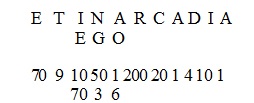
  • Each line begins with 79. (70+9) and (70+3+6). T to A (9+10+50+10) is also 79 and it is followed by 200. This is 79200.
  • Sum of top line (376) minus second line (79) is 297. A jumbled 792.
  • IN (10+50) provides 60.
  • NA (50+1) provides 51.
  • I to R (10+50+10+200) provides 270.
  • N and O (50+6) provides 56. The number of letters on the first line is 11 and on the second is 3 so together as 113 it is twice 56.5.
  • From C to A (20+1+4+10+1) is 36.

This much shorter list gives us 51, 36, 376 and 270 that are new.

  • There are 360̊ in a circle.
  • Due west is at 270̊.
  • The Greenwich Meridian is at latitude 51.51̊.
  • 3 76 should be seen as 3 and 76. We have seen the 3 in the Big Hint OUO.

Evidently then, these numbers do relate to longitude and latitude.

The following important note is made. Normally E should equal 1 and A should equal 70. If this arrangement is chosen, nothing is found. Anson did the same manipulation in his riddle. ‘O’ normally has value 6 but he changed it to 70.

The original phrase Virgil used in his poem was only ‘Arcades.’ Someone in turn added the ET IN and EGO with the latter on the second line and changed ‘Arcades’ to ‘Arcadia.’ Presumably this was done in the same manner we say American for someone from America. The endings are just a change in suffix.

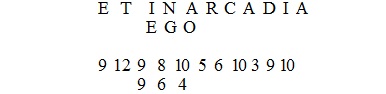
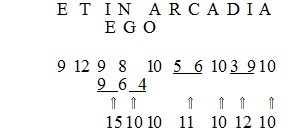
Let’s make it worse. After all, Hint #1 suggests two gematrias may be in play here. Having tried Latin and found nothing, the next one attempted was Futhork. This alphabet is used primarily only by the most northern peoples. This inscription is very reminiscent of their style of runic riddles except in Latin letters. Since positioning is of great importance to runic riddles, it is likely the E was aligned under or almost under the I when this was first written. Furthermore, since it is in Latin and Hebrew gematria provides numbers of interest, it is likely the writer was extremely well educated. So, we proceed by using the Younger Futhork. (E and I share value 9. See chart at end.)

This seems random except the 5 and 6 follow each other. So we begin there:

  • RC is 56.
  • NGO is 864.
  • Sum from R to end is 43.
  • Sum of phrase ‘In Arcadia’ is 70. There are two 9’s one above the other and to the left is (9+12) or 21 so…70, 9,21 or… 7921.
    The letters IN provide 98 which reminds one 89 x 89 = 7920.
  • Sum from first I to last I is 60.
  • Sum from first I to R is 32. Sum of ADIA is 32.
  • Sum from first I to D is 51.
  • Sum from C to last I is 28.
  • Sum of A above O is 14.
  • 9+9 = 18.
  • Sum of the top line is 91 and of the second is 19. Note 91 in reverse is 19.

A few of these are new but actually repeat the same ideas.

  • 14 is half of 28 which is half of 56.
  • 32 is 5.65 x 5.65.
  • There are 180̊ degrees of latitude.
  • There are 19 lines in the Easter table. (See below.)

Evidently, it is far from random! Indeed, it can be summed as follows to find something else of great interest.

When was ‘he’ in Arcadia

This is a date. All the runic riddles, as shown by Alf Mongé (1967), are dated via the Easter Tables. This form of calendar was invented in 525 AD by Dionysius Exiguus but was in use in other forms since 390 AD. In the Easter Tables (used to place Easter – a moveable holiday) each year is identified by three numbers: Line #, Golden Number (GN) and Day Letter (DL). There are 19 lines for 532 years and then the calendar recycles. Each line represents 28 years by GN and DL. Each DL tells what day of the week the year started. (The period of years during which these runic riddles were being written is covered by the appended chart.)

‘Vinland: 1011’ As seen Spirit Pond Map Stone

Above we see how a year date is implied by the riddle master. The date should appear twice. Once literally and once at least by confirmation with Line #, GN and DL. One must proceed somewhat by trial and error. Notice the 15. If this is a Line #, it begins with year 1000. Numbers 1010, 1011 and 1012 are present. The first, 1010 has GN 4, DL 1 which is indicated by the 4 next to the 15. Year 1011 and year 1012 are indicated by GN’s 5 and 6 which appear just above them. They have DL’s 7 and 5,6 (leap year) respectively. The DL’s for 1012 are just above. There is no 7 or sum to 7. This gives a span of years from 1010 to 1012 which is very significant. The Spirit Pond runestone SP-3 from Maine dates itself to 1010 and 1011. Also part of the same collection, the amulet stone clearly states Vin 1010; and the Map Stone states Vinland 1011. It can be said then there is support for this interpretation. But it gets better….

Who Wrote It

We know Virgil wrote the original phrase ‘Arcades’ about the year 40 BC. The age of Rome and widespread Paganism. We know Poussin and Guercino both immortalized it around 1630 in its present form. The era of the Pilgrams and witch trials. The above dating suggests that before or in the year 1010 ‘someone’ added the Et In /Ego to the phrase. The era when northern kings of Norway, Denmark and Sweden chose Christianity and began to oppress Paganism earnestly. Anson added his own two lines to those words around 1750. The age when freedom of religion was beginning to take shape. Who then added those three words during the era of Pagan oppression in the north?

Fortunately, many of these encrypted riddles do include the name of the author. Often it is concealed in the telestic/acrostic lines. These are the end letters running down or up the left and right sides of the inscription. In this case EE/AO reveals nothing. Now one should check the letters from both ends as noted by the word count for each line. In this case there are three words on the first line and one on the second. The third letters in, on the first line, are I and D. The first letters on the second are E and O. This is IE from the left and DO from the right.

The letters tell us two things. Anson also found this since he repeated the same ‘DO’ in his riddle. The name of the writer is then IE. But, this is a problem. It is not a name but the Latin phrase ‘ie.’ which is still in use. It essentially means ‘to restate’ or ‘as stated.’ The name then is obvious. ??? It turns out EGO is a male name of Swedish/ Danish/ Norwegian origin. But the text also uses the word ET which means in Latin ‘and.’ Interestingly, another name is also apparent at the same point in the inscription: IN and below it GE – Inge. So it reads:

INGE ET EGO DO – IN ARCADIA – 1010 – 1012

Inge and Ego wrote this – who were in Arcadia in 1010 to 1012

Another mystery appears. Where was Arcadia of the myths and was it a real place in 1010?

Conceal and Anagram

It has become blatantly obvious something else is concealed here. As it happens often in these riddles when an acrostic or telestic requires a letter in a certain position something will be misspelled or words will be compressed together. Let us look at it again. Perhaps if the D is used twice and EGO becomes AGO then it reads:

ET IN ARC / A D / D I / A AGO

Now note: ET spells ‘eat’and AD means ‘fire’ in Old English. It means ‘hell’ in Russian. DI can be taken to mean ‘die’ and ago means ‘in the past.’ Now the phrase becomes: Eat in arc, fire, die, A – a long time ago.

It was eaten in an arc. By fire died A – a long time ago.

The letter framed by the shepherds hands was A. This then is a tomb in memory of ‘A.’ Sound strange? It is about to get even stranger.

We have just assumed the word spacing was compressed. What if this contains anagrams? What words do we see? Die, eat, go, roc(k), net, near, gore, dare, tear, gear, care, gone, ran. And then there is that Big Hint Anson gave…cup or was it a can?

Perhaps this says: ET I I CANADA GORE

No? We can be relatively certain this is the intended meaning by looking at the gematria in Hebrew:

ET I I CANADA       70 9 10 10 20 1 50 1 4 1

GORE                        3 6 200 70

These are found: 7920, 40, 60, 51, 51, 56, 77, 141 and 36, 270, 279. All of which were seen above. But again we have compressed CANADA into one word. Should it be CAN 141? Or CAN AD A? Either way, the whole thing becomes strange. Were Ego and Inge actually in Canada in 1010? Was it even called Canada then?

Virgil used the word ‘Arcades’ and it was where ‘Daphnis’ the shepherd was from. In Latin: ‘arc’ is arc, ‘cade’ is fall, ‘ad’ is to, and ‘caed’ is kill (the root of cadaver). It ends in S. Together it is: arc-fall to death-S. Whereas, Daphnis is not quite so obvious. It is four words together as well: hid-pan-I-S or hid-pan-eye-S. The ending ‘nis’ is remarkably close to ‘N is S’ and English ‘ness’ seen in other runic riddles. A study of many of the names Virgil used are like this. Perhaps the common theme here is Paganism.

It was eaten in an arc. By fire died A – a long time ago.

Inge and Ego wrote this – who were in Canada in 1010 to 1012

Remember – history is written by the victor.

The remainder of the secret is now easy to grasp, if the mind is willing.

Image at Virgil’s Tomb is reminiscent of Ragnarok.

Previous Post          Next Post

From Wikipedia

Similar Articles by the Same Author

*Easter Tables

** For numeric background see:

**Freeborn, B.L., Validating North American Runic Inscriptions, noahsage.com, November 2022. PDF only.

Freeborn, B.L., Ancient Riddles to Test Our Wits: The Secret Chamber, noahsage.com, January 2016. Post here.

Freeborn, B.L., Another Riddle in Stone from Canada, noahsage.com, August 2025. Post here.

Freeborn, B.L., Deciphering the Spirit Pond, Nomans Land and Narragansett Runic Inscriptions, noahsage.com, November 2022. Amulet post. Map stone postPDF only.

Freeborn, B.L., Et in Arcadia Ego – OUOSVAVV DM – Deciphered, noahsage.com, December 2022. Post here.

Freeborn, B.L., Kensington Rune Stone: A New Translation, noahsage.com, February 2023. Post here.

Freeborn, B.L., Rök runestone of Sweden, noahsage.com, April 2023. Post here.

Freeborn, B.L., Runic Riddles: Time Capsules, noahsage.com, December 2022. Post here.

Freeborn, B.L. The Long Debated Bourne Stone, noahsage.com, January 2023. Post here.

Freeborn, B.L., The Nomans Land – Leif Eriksson Inscription, noahsage.com, December 2022. Post here.

Freeborn, B.L., The Narragansett Inscription: A Translation with its Date of Dedication, Author and Inscriber, noahsage.com, October 2022. Post here.

Freeborn, B.L., The Newport Tower: Finding the Date of Dedication, its Designer and Builder, noahsage.com, October 2022. Post here.

Freeborn, B.L., The Wawa Stone and Its Viking Ship, noahsage.com, August 2025. Post here.

References

Gordon, Cyrus, Riddles in History, Crown Publishers, Inc. New York, 1974.

Landsverk, O.G., Runic Records of the Norsemen in America, Erik J. Friis, Publisher, Rushford, MN, 1974.

Mongé, Alf & O.G. Landsverk, Norse Medieval Cryptography in Runic Carvings, Norseman Press, Glendale, California, 1967.

Derogatory article by Aslak Liestol of Alf Mongé’s work: http://collections.mnhs.org/MNHistoryMagazine/articles/41/v41i01p034-042.pdf  and….

…Landsverk responded to these comments in Ancient Norse Messages pg. 126-129; and often in Runic Records of the Norsemen in America.
Wikipedia articles on: Guercino ‘Et in Arcadia Ego’ ; Virgil ; Poussin ‘Et in Arcadia Ego’ ; Shugborough Inscription ; and many others.

Previous Post          Next Post

Ancient Riddles to Test Our Wits: The Secret Chamber

© 2016 B. L. Freeborn (updated Feb. 2023, June 2025)

This stone with a Latin inscription was found in rural New York.

This stone with a Latin inscription was found in rural New York.

Another ancient riddle presents itself in stone. This one is also from rural New York. The very readable words ‘In camera’  are still used today. It is a legal term in Latin for behind closed doors or in secret. What secret does this stone hold?

Roman numerals were in common use until the 11th century when they began to be replaced by Arabic style. They persisted into the 15th century and in some instances are still used today. The numbers read:  XLV = 45, XXX = 30, LXXV = 75, and LIII = 53.

Obverse side of stone with a Latin inscription found in rural New York.

Obverse side of stone with a Latin inscription found in rural New York. Numbers read 45 30 and 75 53.

What then do the numbers mean? Hint. Notice 30 + 45 = 75. When does 45 equal 75?

Perhaps in true ‘Da Vinci Code’ style the words In Camera are an anagram or in an entirely different language?

Find the words in italics on the front face:

Baal struck the center of the rule that governs the world.

The eye marks the angle that divides.

The smoking rocks struck deep into the mountain of ice

and the water flowed.

The numbers read:

XLV = 45, XXX = 30,

LXXV = 75, and LIII = 53.

Notice 30 + 45 = 75. When does 45 equal 75? And what of the other numbers?

  • 45 minutes equals .75 hours.
  • .53 radians equals 30 degrees.
  • 45 and 30 as 4530 is 79 radians.
  • The sum of 75, 53 and 30 is 158 or twice 79.
  • The sum of all four numbers is 203. There are 360 degrees in a circle. 203 / 360 = .564.

Notice that if the numbers in the top line are adjusted to be 4.5 and 3.0 then:

  • Sum 75 to 4.5 and find 79.5 and then sum 53 to 3.0 and find 56.0.

The hidden numbers then are 79, 79, 79.5, 56, .564.

The association with time, degrees and radians suggests measures of longitude and latitude.

What lies at 79 degrees West and 56 degrees North?

———-

Perhaps the two V’s are lined up for a reason. They point downwards between the A and M of Cam in ‘In camera.’ The word ‘am’ in Old English means ‘reed’ suggesting a measuring stick. The word ‘cam’ suggests came. The picture has a ruler on an index which reinforces the previous idea. Are the two V’s double daggers or twin comets? Does it say” in – came -arrows”? Is the octopus actually a smoking crater in a mountain of ice?  In Old English ‘Amier’ means destroyed.

Notice these other words: LIN or Line, MAC or make, LAER or lair, and there are three X’s in a row.

Is the phrase ‘IN CAMERA’ an anagram for:

  • Can I mare … meaning …’round eye sea’?
  • Mark lie in A …?
  • I name Carl … meaning… ‘I, Carl, wrote this’
  • N. America?

– – – – –

Perhaps we can conclude:

Carl wrote this in  America.

In the North lies the Eye Can Sea where in a line are three marks

 from the double comet.

They struck at the pinnacle, at the measuring point.

The three are the lairs in camera.

Similar Runic posts begin here.

Previous Post  ……. Next Post

Ancient Riddles to Test Our Wits: New York Baal Stone

The Baal Stone from upstate New York written in Phoenician script circa 800 BC

The Baal Stone from upstate New York written in Phoenician script circa 800 BC

© 2016 B. L. Freeborn

Another ancient riddle presents itself in this stone (about 12″ wide) written in Phoenician Letters circa 800 BC which was found in rural New York.

Is this the Eye of Baal in the center of the stone?

Is it a comet that splits into two parts?

Or is it the Phoenician letter T?

In the image below, the stone is translated using Anglo-Saxon. It reads: “There is the eye of power. It is here at the quay that divides.”

If it is read using the T as a tie then it reads: “It burnt a pit out of the net and it is eaten quite large at the stop for the tie.”

Translation of the New York Baal Stone with 800 BC Phoenician Letters and Anglo-Saxon

Translation of the New York Baal Stone with 800 BC Phoenician Letters and Anglo-Saxon

Previous Post

Ahead to Next Post

Hudson Bay as a Comet Crater

© 2016 B. L. Freeborn

This is an excerpt from the full article: “A Planet Most Miraculous: The Mechanic’s of Earth’s Rotating Crust.”

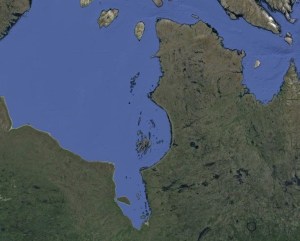
Hudson Bay showing the arcs of the bay.

Hudson Bay showing the arcs of the bay.

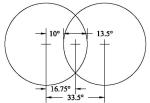
It is possible to draw four large round circles in Hudson Bay. The largest scales to a diameter of 400 miles. The second largest scales to 230 miles. Hudson Bay is very shallow. Yet it was once compressed down 900 feet deeper than it is by the mass of the former ice sheet. The large appendage to the bay in the south is extremely shallow. References differ on the bay’s depth from 111 feet deep in the east to 768 to the northwest. Variations aside, this is a very shallow body of water when the size of it is considered.

This causes a problem if one wants to prove these are large craters. They are just not deep enough to be craters of this diametrical proportion. For example, Barringer Crater, Arizona is 4000 feet wide and 570 feet deep. Look at the other contraindications. Besides its shallowness, there is no impact ejecta. There may be central uplift in the bay as islands but for the size of it, and the age as required to have brought about the end of the “ice age”, there is no deep basin. There is no high well delineated edge as can be seen in the Pingualuit crater which is supposed to be vastly old by comparison. It does not seem possible that this is a crater. Yet it can be argued that it is.

Delving a bit further, it is known that there is a “large region of below-average gravity” in the area. The anomaly has not been explained. Suggested theories include the weight of the Laurentide Ice Sheet has influenced the area. Another theory suggests that convection in the underlying mantle may be a contributing factor. The 230 mile diameter arc to the southeast is known as the Nastapoka Arc of the bay. The geologists’ consensus explanation calls it an “arcuate boundary of tectonic origin.” In other words they think that millions of years ago the Earth folded in a perfect arc. Another theory, less popular, allows a Precambrian extraterrestrial impact. However, geologists do not feel there is any credible evidence for such an impact crater. There is no evidence from regional magnetic, Bouguer gravity, or geologic studies. That statement directly contradicts the “large region of below-average gravity” with which the paragraph started. (Wikipedia)

Hudson Bay crater formation, 14,000 years BP.

Formation of a crater within the two mile thick ice sheet that once overlaid Canada which resulted in Hudson Bay.

So, how does one explain Hudson Bay is a very recent comet crater 1000 miles by 300 to 400 miles across? Once again, let us just look at what we have. We have a nearly perfect arc in an area that is on average 330 feet deep. This same area was once overlain by an ice sheet two miles thick in certain parts. Two miles thick is 10,560 feet of hard frozen, compacted, heavy ice. This means that if we took a cross section of Hudson Bay when the ice sheet was there and scooped a crater out of it that only dips into the ground 330 feet, the crater was theoretically 10,890 feet deep with little imagination.  The bottom of the crater only remains then as the Nastapoka Arc which implies the upper rim, now long melted, was substantially larger in diameter. The ejecta was simply ice, and billions of tons of it which was spewed as far as Siberia to engulf herds of grazing mammoths. It was thrown as far as Scandinavia to leave glaciers there. There was no dust cloud that enveloped the Earth for decades, because water does not create dust. It creates rain. The elongated shape from the northwest to southeast then is either the sideways impact of a comet striking the surface at an angle or the successive impact of several portions of one comet. A sideways impact will add more torque to the reaction of the Earth and aid in turning the outer layers of the planet. The enumerable other craters that dot the northern latitudes may have occurred at the same time or during later events which totally negates their vast ages.

Successive crater formation as comet strikes Ice Sheet (future bay area) and blast material ricochets to form other impact sites.

Successive crater formation as comet strikes Ice Sheet (future bay area) and blast material ricochet to form other impact sites.

The picture becomes clearer when we comprehend the velocity with which these mammoth projectiles struck the planet. They could not just strike and stick like an arrow in a target. They shattered on impact and bounced in very much the same manner as a stone skips across a lake, except in this case their velocity was unimaginably high. We see directly below Hudson Bay the five great lakes and upon close inspection we see several sections of each lake exhibit the same round cut out pattern as the Nastapoka Arc of Hudson Bay. Once impacting and forming the Great Lakes the debris shattered even further.  A rebound impact could not entirely expend the comets’ energy. The debris kept moving albeit at a slower yet still extremely high velocity. It fanned out to the west, southwest, south, east and southeast blanketing and smashing millions of square miles. The impacting debris formed what are called Carolina Bays. The name originates from the thousands of long elliptical, shallow structures that appear throughout the Carolinas. As Kelly and Dachille explained in 1953, they were formed by massive melting icebergs. In other words, they were debris from the shattered ice cap.

Overlapping polar circles creates a vesica shape where the thickest ice on the planet is found.

Overlapping polar circles creates a vesica shape where the thickest ice on the planet is found.

Indeed, almost the entire old polar ice cap was displaced from the bitter cold of the Arctic Circle. The ice that was outside the first circle was now -outside of the arctic circle- and prone to melting. We call these areas glaciers and their melting is what we call the ‘End of the Ice Age.’ It is proposed that the glaciers extended into Ohio, not because the weather patterns had changed allowing the Earth to cool but because this area was within the Arctic Circle when the ice formed. During this same period of time, half of Antarctica was dry land and ice free because it was outside the Antarctic Circle. The Earth had gone through a long period of stability and created these extremely large and thick ice layers at the then poles within the first circle. The sea level had dropped and man had happily moved out onto the vast plains left behind by the receding ocean. It was safe. It was beautiful and they were blessed, for a long while.

Continue reading …..full article posted here.

Possible remnants of the comet are seen in the next post.

See the Ancient Map of Hudson Bay in the Previous post

Ancient Map of Hudson Bay

Knowth Kerbstone 15. Sketch by B.L. Freeborn.

Knowth Kerbstone 15. Sketch by B.L. Freeborn.

© 2016 B. L. Freeborn

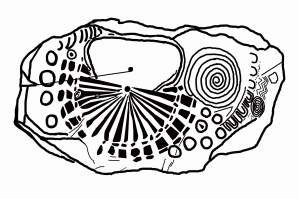
How cool would it be if a map from when the glaciers still covered Canada existed? It would show the Laurentide Ice Sheet and the lake that would eventually become Hudson Bay. Would it look just like this 5000 year old artwork from Knowth, Ireland known as Kerbstone 15?

The map shows the North Pole and its rays fanning out. The symbol on the right suggests the inscription tells of the world turning.

The line from the center towards the notch-out on the left is a line drawn from its center (magnetic north for the time period) towards Knowth, Ireland.

The monument of Knowth when seen from the air shows a small round mound overlapping the main structure or a comet impacting the planet.

See more at:

http://www.knowth.com/knowth-kerbstone15.htm

http://www.megalithicireland.com/Knowth.htm

Knowth Kerbston 15. Photo by Ken Williams.

Knowth Kerbston 15. Photo by Ken Williams.

Knowth Kerbstone 15. Photo by Megalithic Ireland.

Knowth Kerbstone 15. Photo by Megalithic Ireland.

Next Post
Previous Post

Newberry Tablet and its Ancient Links to Europe

The reader may find this short talk on cave drawing to be of interest. The symbols that are compiled and presented by Genevieve von Petzinger in the video are compared below to the symbols found on the Newberry Tablet and to the Paleo-Hebrew script from some 3000 years ago. (Symbols as depicted at oocities.org.)

“Written language, the hallmark of human civilization, didn’t just suddenly appear one day. Thousands of years before the first fully developed writing systems, our ancestors scrawled geometric signs across the walls of the caves they sheltered in. Paleoanthropologist, rock art researcher and TED Senior Fellow Genevieve von Petzinger has studied and codified these ancient markings in caves across Europe. The uniformity of her findings suggest that graphic communication, and the ability to preserve and transmit messages beyond a single moment in time, may be much older than we think.” -Ted Talks


Cave art as found by Genevieve von Petzinger

Cave art as found by Genevieve von Petzinger

Newberry symbols compared to cave art.

Newberry symbols compared to cave art.


Comparison of cave art to Paleo-Hebrew script circa 8th century BC.

Comparison of cave art to Paleo-Hebrew script circa 8th century BC.

On to last post on Newberry Tablet.

The Message of the Newbery Tablet – Part 4

© 2015 B. L. Freeborn, updated Sept. 2022

Smithsonian Photo of Newberry Tablet, compliments of Roger Jewell

Smithsonian Photo of Newberry Tablet, compliments of Roger Jewell

To the first post on the tablet – To the previous post on the tablet.

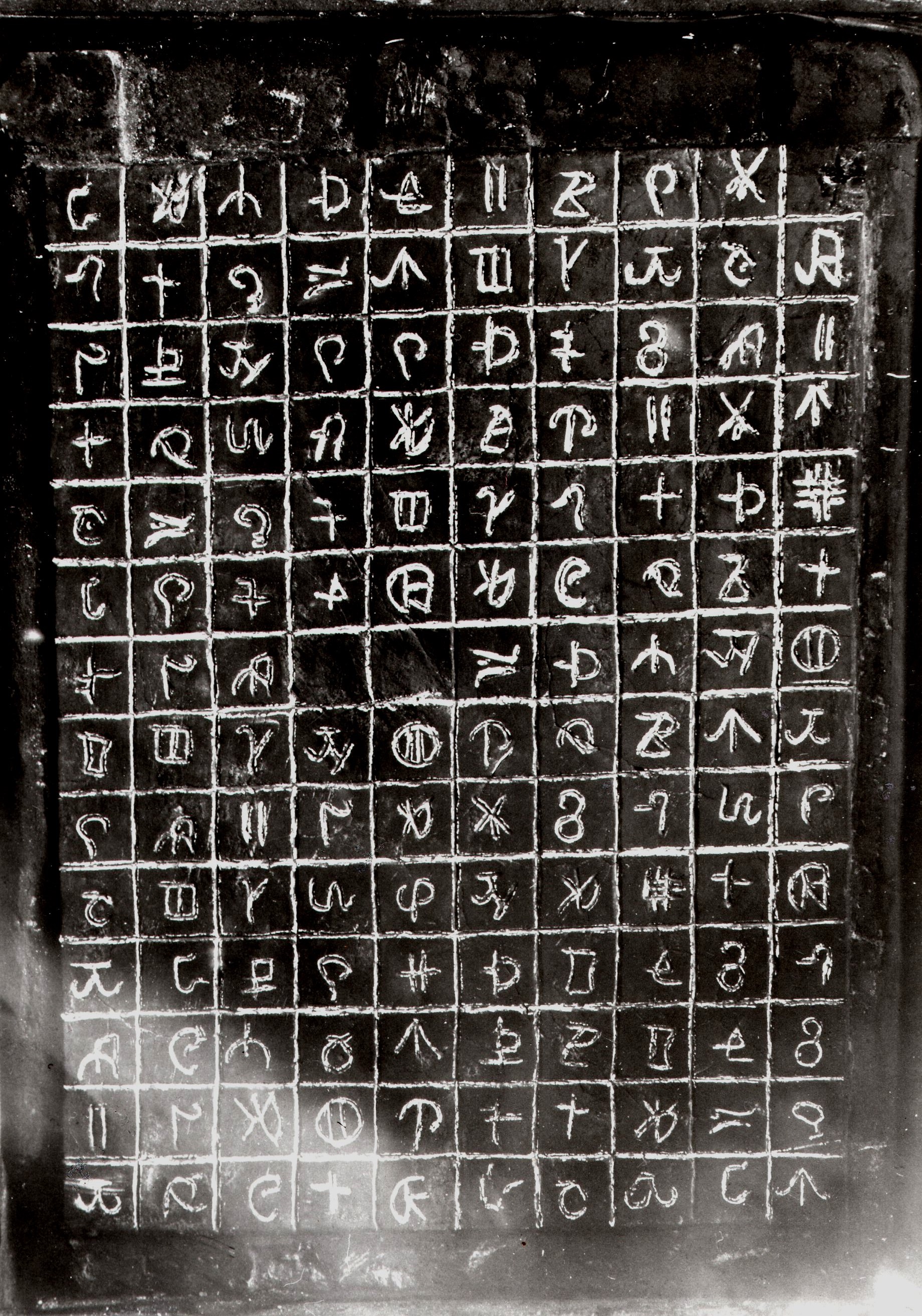
In the last posts we looked at the overall layout of the Newberry Tablet and many symbols. The list has grown and we push to completion of this project by looking at twelve symbols in this post.

The symbol identification thus far has suggested the topic of the tablet is a double comet collision and its crater as a point of reference for measurements. Hopefully the remaining symbols support and complete the story. Note the parallel line symbol in the first row and the cross hatching symbol that ends the fifth. Note the circle with two lines through it that ends the seventh. These suggest that the double comet arcs of Hudson Bay are to represent a reference point for longitude and latitude. Signs associated with this concept are studied here as well as another two groups of signs.

The second and third groups require an understanding of the symbols as pictographs that would have meaning even today. The first symbol in the third row down uses an upstroke to elevate a cup symbol. Next to it is a symbol that can be described as a P on a line. Perhaps the upstroke means above or heavenly, and the horizontal line simply represents – on the surface of the Earth. With these ideas the study continues.

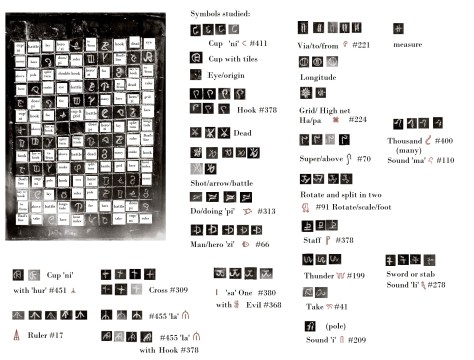
We begin with the parallel lines in the first line and suggest it means to/from which is found in the glyph list at #221 except they used curved lines. Keep in mind that the two parallel lines may simply mean two or equal distance. They may also suggest lines of measure.

The circle with the set of parallel lines continues the idea and perhaps means specifically either longitude and latitude or both and/or the measurement of such.

Similar to this is the two lines with the horizontal mark found in the center of the fourth line from the bottom which suggests either two or perhaps measure and is so noted below.

The cross hatching symbol suggests a grid or the longitude/latitude net of the Earth.

Although not identical the symbol compared to the Luwian glyph meaning ‘above’ is similar to the symbol found at 3,1. Compare it to the symbols for ‘ma’ #110 and ‘thousand’ #400 and the second symbol from the table found at 2,1. (See diagram below.) The word ‘ma’ in Old English means ‘more.’

Interestingly, Luwian glyph #91 is said to mean rotate/scale/foot. It is compared to the glyph found in the third row, third position and is shown below. It appears to be two shoes and a hook suggesting rotation. Note they are located at grid positions 3,3; 8,4; 10,6 and most notably 7,9. The 33 and 79 stand out immediately as the 33 degree latitude change of the pole and the diameter of the Earth at 7920 miles. The location of Hudson Bay is just west of the 79 degrees. But the other two numbers even in reverse are not of much importance. However! If one counts their position from the opposing corner (bottom right) then the two positions 7,7 and 5,6 are counted out. The latitude of Hudson Bay is 56 and the return period of Halley’s Comet is 76 to 77 years. This then correlates well with the proposed topic of the tablet and to the idea of scale, rotation and foot as found in the Luwian glyph #91.

The staff is found in glyph #378. The associated symbol was used three times on the tablet and suggests a staff stuck in the ground. The symbol is found at 3,2; 11,3; and 12,6. The symbol next to the bottom P appears to be a slanted version so it may also be the same symbol but is not so noted here.

Glyph #199 is said to mean ‘thunder’ and is very close to the symbol found at 4,3.

Glyph #41 means ‘take’ and is close to the symbol in the table at 14,2 and mirrored at 14,8.

Glyph #209  with sound ‘i’ appears to be the same as shown in the table and is taken to mean pole or eye. It is found notably at position 4,4. The circumference of the planet divided by 44 is 565 miles.

The reader should examine this ‘i’ symbol closely and note there is a small horizontal stroke on the left upstroke. This may not be accidental. In the Luwian glyph system of writing this small stroke represents the sound ‘r’ and if the two sounds are combined we arrive at the word ‘ire’ which means today what it did in Old English except previously it additionally meant to wander. So this adds that now the ‘eye’ has ‘wandered angrily.’

Lastly, the symbol that looks like a backwards F is taken to be a sword or knife that stabs the ground and the idea repeats in the glyphs as seen in #278.

For your reference the Luwian Glyph list can be found linked here:

The associated words have been filled in and the tablet’s ideas are unfolding  in this very complicated riddle and blending of ideas with Earth related numbers.

The next post compares this script to cave art found in Europe.  The last of the symbols that can be identified in the Newberry Tablet are found when the decipherment continues.

Newberry Tablet decipherment continues here.

.

The Message of the Newberry Tablet – Part 3

© 2015 B. L. Freeborn

Smithsonian Photo of Newberry Tablet, compliments of Roger Jewell

Smithsonian Photo of Newberry Tablet, compliments of Roger Jewell

To the first post on the tablet – To the previous post on the tablet.

In the last posts we looked at the overall layout of the Newberry Tablet and a few symbols.

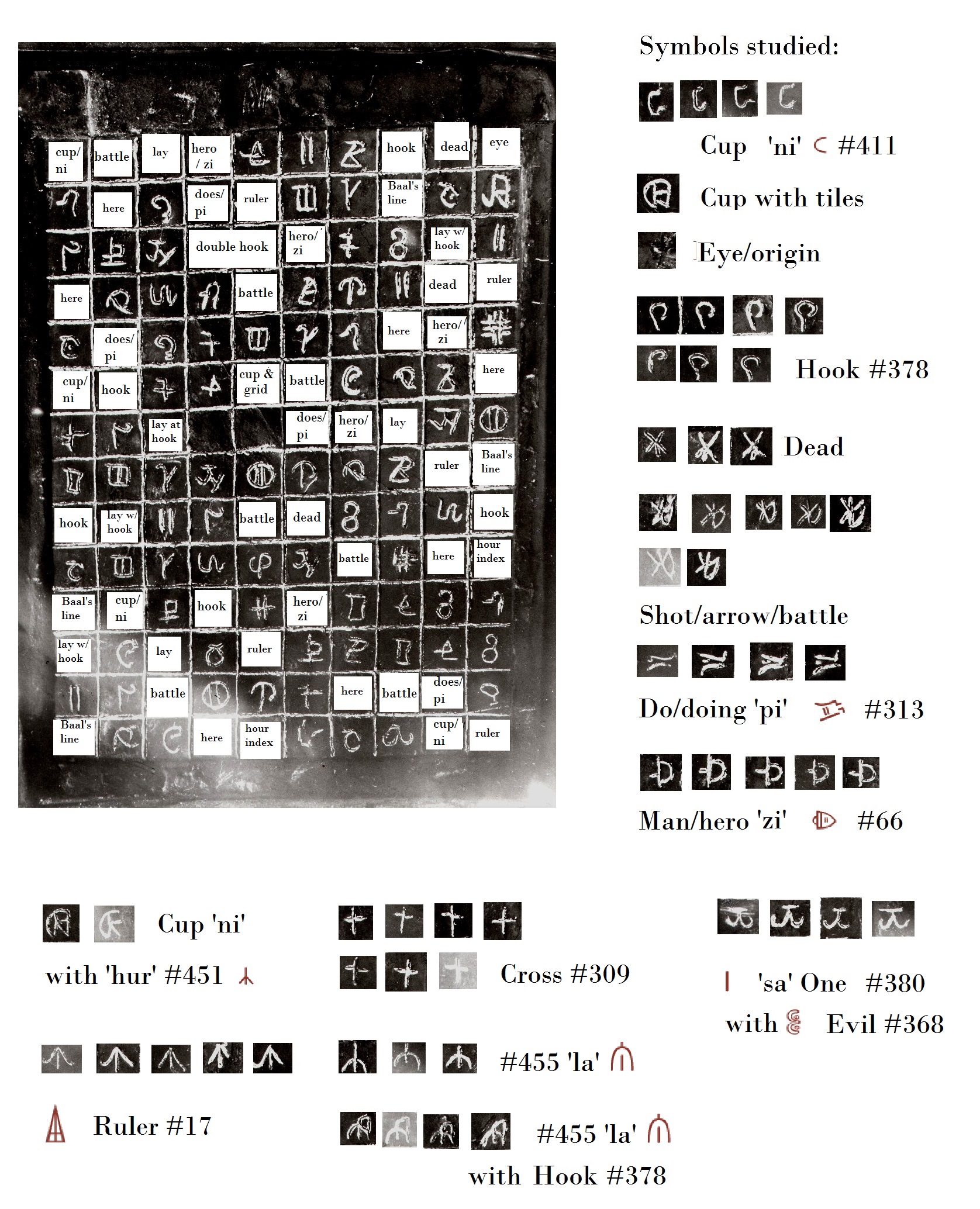
In this post six symbols are studied: the glyphs found at the bottom corners, the cross, the symbol at 1, 3 and the similar symbol at 3,9. The last symbol to be studied combines the cup symbol found in the upper left corner with what looks like a bird foot print and is found at 10,10. There are two of the latter. The second is found at 14,5. It combines the idea of the cup with sound ‘ni’ with glyph #451 with sound ‘hur.’ This sounds remarkably like the word ‘hour’ and if the craters in Hudson Bay were used as the start line for longitude then the ‘hours’ of Earth’s rotation are marked off from this place. We should recall that the word ‘ni’ means ‘here, now, and/or upon us’ and is today spelled ‘nigh.’

This idea is repeated in the bottom left corner. There is a double loop with a line on top of it. It is a combination of glyphs #368 and #380 from the Luwian Glyph list. The double loop was determined to mean ‘evil’ which a double crater would certainly represent. This symbol would then repeat the idea of the line of longitude index point. It is used four times in the table.

Again the idea is reinforced by the symbol in the bottom right corner which is found in the glyph list at #17 and represents the ruler. This glyph is repeated five times in the table. So then the four corners, which should define the topic of the tablet, are: a cup (crater), an eye, a line at evil and the ruler.

The last three symbols are the cross which is used seven times and is found in the glyph list at #309. It likely represents the idea of ‘a place’ or ‘an intersection.’ The other two symbols are the upside down trident at 1, 3 and the related symbol that puts a hook on top of the glyph. The first symbol is #455 and has sound ‘la’ or we might say in both modern and old English it is the word ‘lay.’ The similar symbol combines this with the hook glyph #378. So, it expresses the idea of ‘laid with the hook’ or ‘at/by’.

The table is filling in!

The study will continue in the next post.

The Newberry Tablet's decipherment continues in this image as six more glyphs are filled in.

The Newberry Tablet’s decipherment continues in this image as six more glyphs are filled in.


The Message of the Newberry Tablet – Part 2

© 2015 B. L. Freeborn, updated September 2022

Smithsonian Photo of Newberry Tablet, compliments of Roger Jewell

Smithsonian Photo of Newberry Tablet, compliments of Roger Jewell

To see the first post on the tablet – To see the previous post on the tablet.

In the last posts we looked at the overall layout of the Newberry Tablet and a few symbols.

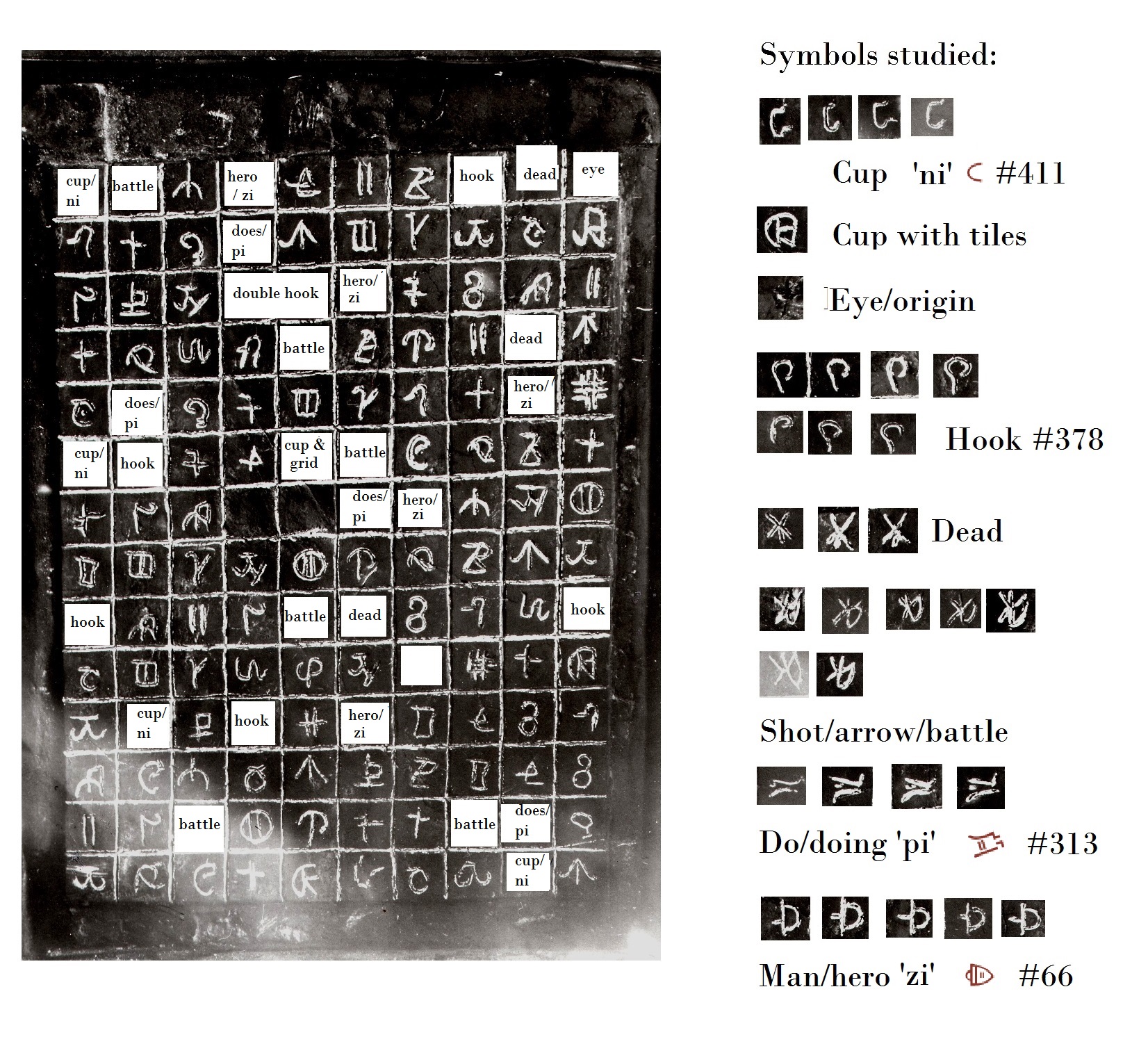
In this post four symbols are studied. We begin with the hook or staff symbol because it involves the least argument as to its meaning. Whether or not a particular sound is associated with it cannot be determined. It is found in the Luwian Glyph list at #378. It appears 7 times on the tablet. Notice the double staves in the third row just above the two blank spaces which imply its importance. They are in positions: 3,4 and 3, 5.  Count within this line from both directions and find a stave at 4,7 and the second at 5,6. Recall 4 x 7 is 28 or half 56. The other totally suggests 56.

The other staves are located at: 1,8; 6,2; 9,1; 9,10; and 11,4.

One of the next two symbols of interest is found at 1, 9 and it is an X with an extra down stroke and the other is at 1,2 which is an X with an extra upstroke and side stroke. These symbols are not found in the glyph list. Barry Fell thought they were Cypriot Letters for vowels i, a, and e but it takes little effort to confirm that few other letters are found in that script. If it is compared to prior Adena Tablets studied such as the Waverly and Cincinnati the idea of a dead man is suggested then by the first symbol. This leads to the idea the second is also a man. Perhaps he is doing something that was common then such as shooting an arrow. So for our purposes here, the first represents death and the second shooting, shot, arrow or battle. This death symbol is used three times at: 1,9; 4,9; 9,6. The battle symbol is used seven times at: 1,2; 4,5; 6,6; 9,5; 10,7; 13,3; 13,8. Indeed, they follow each other in line 9 as if to say ‘shot dead.’

The next symbol studied (at 2, 4) is distinct and impossible to find anywhere repeated except in the Luwian Glyph list at #313. Although not a perfect match every element of the symbol is represented in the glyph. It is said to mean the verb ‘does’ with sound ‘pi.’ It is used four times in the tablet at positions: 2,4; 5,2; 7,6; and 13,9.

The last symbol is at 1,4 and looks like the head of a shovel or a D with a side bar. It also appears in the glyph list at #66 and is said to mean men or hero with sound ‘zi.’ It appears five times at: 1,4; 3,6; 5,9; 7,7; and 11,6.

In Luwian Hieroglyphs the glyphs can take on the sound or the meaning of the object as in a rebus. Theses glyphs are also called Hittite and were used heavily between the 14th to 13th centuries BC and fell into disuse by 7th century BC. Decipherment of the glyphs did not begin until the early 1900’s with most work being done since 1930 and the language associated with them was confirmed in 1973 to be Luwian not Hittite. The Newberry Tablet was discovered in 1896 with three figurines that weighed close to 1000 lbs. See Betty Sodders “Michigan Prehistory Mysteries.”

More symbols to follow!

Identification of Newberry Tablet symbols.

Identification of Newberry Tablet symbols.

On to the next post on the tablet.