The Adena Tablets of Ancient Ohio – The Kiefer Tablet

Kiefer Tablet: An Ancient Ohio Tablet

Art from Ancient Ohio: The Kiefer Tablet

© 2014 B. L. Freeborn

The Kiefer Tablet was found in Miami County, Ohio. Some people think it represents a bird’s tail and feet which is a change from the phallic stigma most ancient artwork suffers under.

This is an exercise in numbers and once again an opportunity to observe Luwian (La Ang-a) Hieroglyphics embedded in art half a world a way from where it should be found. The image is in the correct orientation to view this tablet. The Ohio History Museum displays it on its side. This is the lower portion and there is a very similar tablet that we will look at in the future that gives a good idea what else was inscribed on this sandstone piece.

Hwi

Hwi

On the left and right side are two designs described as feathers by some authors. They very well may be, but they also bear a strong resemblance to glyph #329 which has the sound ‘hwi.’ In this use the tail is pushed to the far side to allow it to look like a feather. Indeed, in the Grave Creek Tablet the words ‘seat, quarrel-seat, quarrel-seat’ were proposed and now we find ‘hwi’ which is easily translated to hwie or hwy in Old English. The modern spelling of the words: what, where, when and why places the w before the h. The original spellings placed the h before the w just as the glyph suggests. Now we have a double exclamation of ‘why, why’ and assuming both tablets relate to the same idea then whatever occurred at this ‘seat of quarrel’ was distressful.

Indeed, like a modern cartoon the image expresses a collision with clarity. The U shape appears to strike the lower shape and a ‘bang’ seems to emanate.

Although the above is conjecture the numbers are real. We begin taking note of numbers in this center shape. We can easily count 2 lines, 1 band, 2 lines and then it repeats. Or we can count it as 1, 1, 2 and then 2,1,1. Or if you prefer 1,1,2,1,1. Any way you please, we need to attach some meaning to at least one of these sets. The 212,212 sounds like the 21212 of the last tablet which suggested something that repeats. Multiplied by pi (3.1415) it is 66637. Multiply 212 by pi and it is exactly 666. The velocity of Earth is 66624 mph. The 112 is 2 x 56 which is a number often found in ancient art and sites. The 2,1,1 allows for someone to read it in reverse and obtain the same number or multiply by pi and obtain 663, a less accurate reminder of Earth’s velocity. Also possible is the sum of the two numbers which gives 333. This number was clearly expressed in the previously studied Grave Creek and Allen Tablets.

Next there is a whole series of numbers expressed around the bottom oval. They appear to start at the left and move around it. At the top left find the large black stripe as 1, then the exterior and interior triangles as 7 so 17. This is an important number to this message as well. Or perhaps it begins with the triangles and we find 3,4 or 4,3 triangles which gives us 34 which we saw on the previous tablets. It is also 2 x 17. We have seen 43 as well but it appeared as 2 x 43 or 86.

At the bottom find 12 black triangles and 12 white triangles. The sum 24 reminds us of the hours in a day, while 1212 is the reappearance of a repeating pattern. This pattern suggests 1 became 2 repeatedly.

On the right side there are 5 triangles and on the outside there are 4 so that we have 45 or 54 or maybe just plain 9. Twice 45 is 90 and twice 54 is 108. Both are significant. The number of degrees between north to east, east to south, etc. is 90. The distance between the Earth and the Moon is 108 Moon diameters.

Then it ends with 1 black area, 1 white and two triangles or 112 which is 2 x 56 again. This confirms it is to be read left to right as done here.

Considering the left side the triangles in white are 7 and on the right are 9. This creates 79. The sum of the bottom triangles is 24. Assembling these as 7,9,24 or 7924 reminds us of the diameter of this planet or 7920 miles. Summing them gives 7 + 9 + 24 or 40. A square of 40 to the side has 56.5 as a diagonal. The 56 reappears.

Other combinations can be argued but this gives us plenty to look at. In review then we have on this tablet 108, 112, 1212, 14, 17, 24, 333, 34, 40, 43, 54, 56, 56.5, 66624, 7, 79, 86, 9, 90, and 7924. This gives us a substantial list of numbers which is more than describing it as ‘feathers and a bird’s tail’ as some have done.

To keep a complete and updated list including the numbers previously found on tablets we have: 108, 112, 1212, 14, 17, 212, 21212, 23, 23 32, 23.5, 24, 26, 32, 33, 333, 34, 40, 43, 52, 54, 56, 56.5, 66, 66624, 7, 79, 86, 9, 90, 7924 and 8642.

This then leads us to look at the next tablet for a greater understanding of the Ancient Ohioan’s message, method of writing and their language.

Back to the very beginning post of the series on the Adena Tablets.

Next Post on Wright Tablet

Previous Post on Grave Creek Tablet

Posts on: Allen Tablet and Metcalf Stone, and pdf article on

Hudson Bay as a comet crater of recent origin.

The Adena Tablets of Ancient Ohio – The Allen Tablet

© 2014 B. L. Freeborn

There are about a dozen small stones decorated with art that are called the Adena Tablets. They were found in various places throughout Ohio and in neighboring states. Sometimes they were found lying on the surface of the ground, but most often they were associated with mound sites. There are several persons who have published translations such as David W. Penny in the Mid-Continental Journal of Archaeology in 1980, J. Ralston Skinner in the Cincinnati Society of Natural History in 1885, (Note the time span.) and Duncan Caldwell in 1997 in Ohio Archaeologist.

A new way of reading them will be suggested here. So, we begin with the easiest only because it is so obscured by time there is virtually nothing left and ultimately we will be reading such beautiful art as the Ohio Adena Pipe, now a Ohio State symbol, and the Hopewell Shaman – Bear. Check out the links at Ohio History to see these items.

The Allen Tablet, Art from Ancient Ohio

The first reading is of the Allen Tablet as shown in the sketch. (No better image was found.) It is unclear if David Penny drew this or if he took it from Ellis H. Holmes’ 1944 article. Either way, all that can be seen is six circular blurbs. The original is long missing so there is no way to verify its design further. Penny reports it is made of sandstone. It is only 2″ wide and 3 ½” tall so it easily fit within the palm of a hand. These were often covered with red ocher and some suggest they were used in printing or laying on designs. Based on reading Lena Lenape Indian traditions, it is possible the red ocher was used to make them more beautiful and to make the designs leap out.

So, …. how is it this stone just happened to be 2″ by 3 ½” ? Of all the random sizes available how did the artist just happen to use measurements that fall so close to standard English inch sizes? We shall examine this topic closer in the future. Also note it was 3/4 of an inch thick and then observe the numbers as noted in the diagram that can be made from these dimensions: 7, 34 and 23.5.

From the art itself other numbers can be created just by counting the circular blurbs. Find: 23 32, and 56. The most obvious should be noted: three circles and three circles creates 33.

These are seemingly six random meaningless numbers, yet we see 34 + 56 = 90 and there are 90 degrees from the equator to the pole and 90 degrees in each quadrant of direction North to East, East to South, etc. Degrees are composed each of 60 minutes and 23.5 degrees can be written as 23 degrees 30 minutes which looks remarkably like the 23 32 obtained from counting blurbs. The Arctic Circle is defined by this latitude.

Seven we realize is the number of days in a week but there is no way these people also had seven day weeks or perhaps they did. Either way, seven is of great importance throughout a vast number of old world religions.

But we saw this 23 32 before in the Newark Earthworks. And we saw it in the Scottish Pict’s Aberlemno Stone. We also saw 56 in both of those and we found 34 there as well. Could this art lend credence to that strange tale related about the validity of the Newark Decalogue Stone?

Perhaps…. this is more Baalist artwork. But what does it all mean?

The mystery unravels further one stepping stone at a time.


Index to posts on Adena Stones and beginning post:

Metcalf Stone

Next post on Grave Creek Tablet, and pdf article on

Hudson Bay as a comet crater of recent origin.

The Ancient Secret Hidden in Noah’s Age

The meaning of Noah’s age can be understood by relating it to astronomy and the most important numbers related to Earth: its diameter, the distance it travels in a year and its distance from the Sun.

Darren Aronofsky’s new movie “Noah” will be released this month. One does not have to believe the story to wonder about it. Indeed, wondering about it includes questioning the age to which Noah lived. The image above solves the riddle but leaves us still in a state of disbelief.

If we accept the premise that the ages of Noah’s fathers gives us Earth related values, then we must ask how did they determine these values in the first place which have been calculated only recently by our finest scientists? This suggests there previously existed a society upon this planet which had achieved a high level of scientific achievement and someone was determined not to let this knowledge be lost. In fact, the story of Noah relates just such an idea, the demise of the world‘s entire civilization. In contemplating this mystery one should consider we still use the Sumerian’s system of time measurement and the forerunner to the Noah story existed in their society.

So then, we are forced to give up the absurd idea of giants and men living ten centuries and we must trade it for an even more fascinating mystery. Unless one has accurate knowledge of these values it is impossible to reveal the secrets of the Old Testament (or Torah). This then is how this secret has alluded us for so many centuries. What had originally been created to help keep the memories of the sages strong and accurate became a mystery to us. This also proves despite fervent use of the sword through the centuries to eradicate this knowledge, the pen is still mightier.

The mystery is not gone. It lays before us rich and deep. We need no boat large enough to contain all animals, nor the gravelly, steady voice of Russell Crowe to make it true. We need only appreciate the Earth and recognize that it is the only vessel large enough to carry all which lives around the Sun for a full year, year in and year out.

Back to Previous Post

Forward to Next Post – A Translation of an Ancient North American Stone

New Hampshire Mystery Stone Photos

More photos to help you see the new Hampshire Mystery Stone. Click on the image to get a better view!

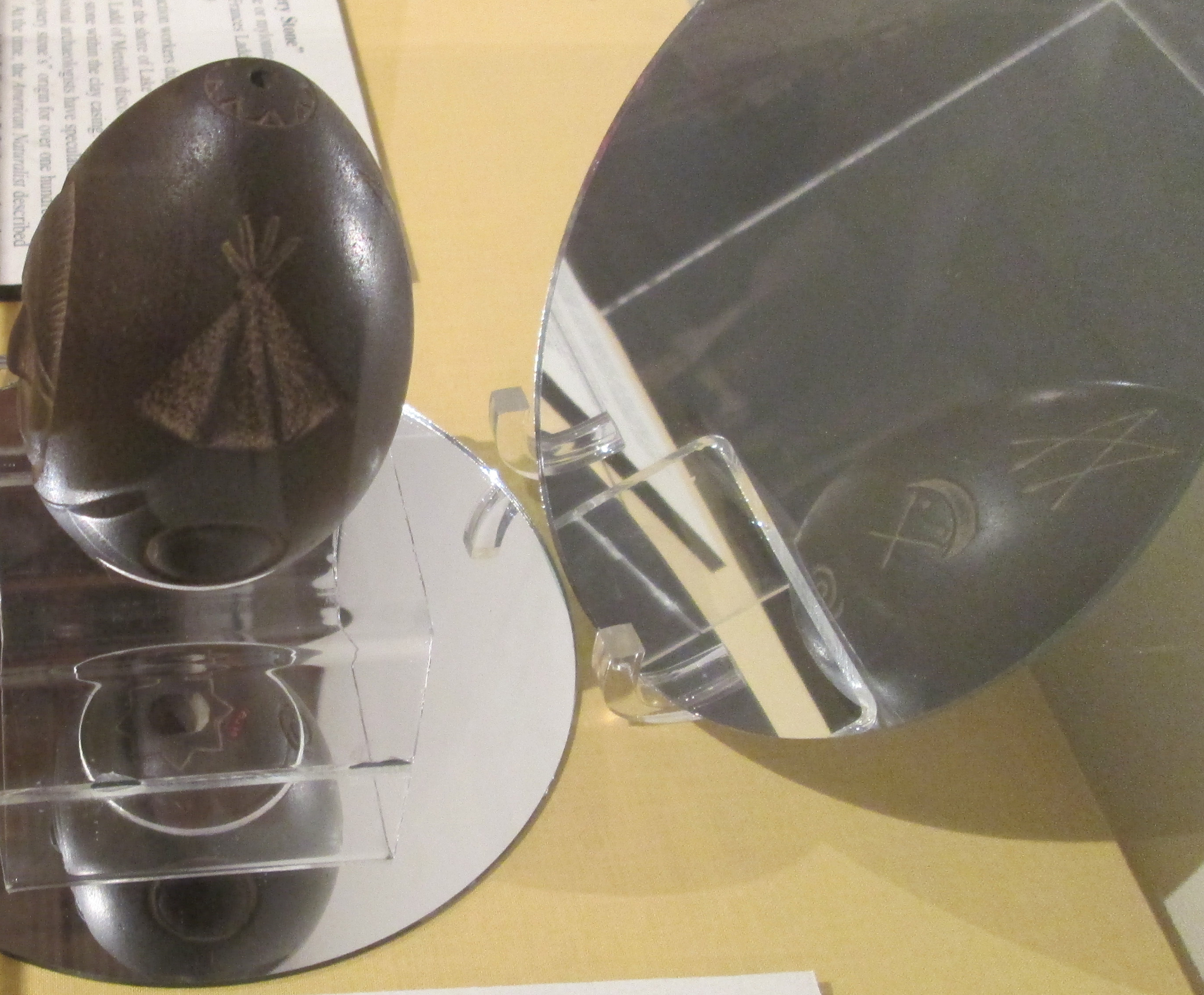
New Hampshire Mystery Stone: Using two mirrors the museum display allows more symbols to be viewed.

New Hampshire Mystery Stone: Using two mirrors the museum display allows more symbols to be viewed.

For those seeking more information on North American language and writing systems, “The Lenâpé and Their Legends: With the Complete Text and Symbols of the Walam Olum,” by Daniel Garrison Brinton, 1885 should be of interest. This book has been re-published beautifully by Bibliolife. (A sample page is at the bottom.)

The  Lenâpé, also known as the Delaware Indians, wrote in hieroglyphics as did many other tribes in North America. Unbeknownst to many, the Cherokee symbols used today did not originate after the Europeans arrival but was in use prior to their influence. Barry Fell documents in his book “America B.C.”, 1989 edition, the comparison of Micmac symbols to Egyptian Hieroglyphs, and symbols found in Iowa and Long Island to both Libyan and Egyptian. This book is packed with epigraphic documentation throughout America that demonstrates extensive interaction between Celts, Libyans, Egyptians, Chinese and other distant places with the Americas. Very little of the North American early written traditions have survived making this book an important record. The majority of their documents were inscribed on perishable mediums as is still done the world over today (including these very words!) which makes this beautiful little stone seem like an oddity. It is commonly believed that the written word was never used by native people. Yet, Brinton reports that letter writing was as common among these people as it is presently.

Evidence of interaction between these ancient cultures can be seen here. Retained in the words of the title “Walam Olum” are two important words. Brinton (pg. 104) explains the root word ‘wul’ means pleasurable sensation and so ‘wulit’ means well, good, handsome, ‘wuliken’ means it grows well and ‘walam’ is red ochre which they found very beautiful. The resemblance to the word ‘well’ is unmistakable.

‘Olum’ means score written on paper, bark or hide. In Modern English, ‘vellum’ means paper usually of a finer quality. This word comes to us from Old English ‘waelrûn’ meaning a song about death. (R and L are not always distinguished by native speakers in the same way Japanese cannot pronounce V’s.) The similarity is clearer in words such as ‘wail’, ‘wallow’ and ‘wailfyll’ or awful.

bottom side circle

The bottom side of this small stone has a hole drilled into it which is both symbolic and functional. It allows the stone to be set on a stick for display and use during ceremonies.

bottom

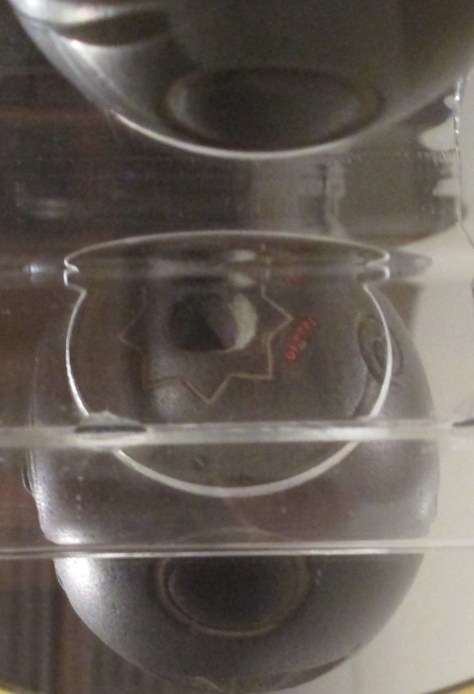
As reflected in the lower mirror. A closer view of the bottom of the stone.

corn side

The perfect image of an ear of corn is shown. Corn has a long history of appearing in religious images. It can be found in Indonesian art as well as Assyrian art. We must not forget the Roslyn Chapel, Scotland! Its perfect rows demonstrate the idea of latitude.

corn leg circle side

Another shot of the corn side. Notice the side view of the face reveals the stone was rounded before the images were carved.

cornlegcircle

Yet another view of the corn side. The empty perfect circle is directly opposite on the far side from this circle with drowning figures.

face far

Front side of New Hampshire Mystery Stone: Are these eyes wide open? Are these eyes that are closed in contemplation? Is this a person who is bundled up warmly? Or….has this person drowned and now floats in water?

A page of the “Walam Olum” showing the hieroglyphs, the words of the story as they would be read or sung, and a translation by Brinton. He further understood each sign was traditionally accompanied by hand gestures.

 "The Lenâpé and Their Legends: With the Complete Text and Symbols of the Walam Olum," by Daniel Garrison Brinton, 1885.

“The Lenâpé and Their Legends: With the Complete Text and Symbols of the Walam Olum,” by Daniel Garrison Brinton, 1885.

Back to Previous Post

Ahead to Next Post on Noah’s Age

For further reading about this beautiful stone go…
Back to Full Post on New Hampshire Mystery Stone and see more photos.

MORE ON MYSTERY STONE

The Meaning of the Purse in Assyrian and Olmec Art

Copyright © 2014 by B.L. Freeborn

From time to time in the feedback section I receive on this blog it is evident that someone is searching for the answer to a particular question. A post I have written may come close to answering it and so they are referred here.

Assyrian Relief with Winged Genius, Walters Art Museum, Wikimedia

Assyrian Relief with Winged Genius, Walters Art Museum, Wikimedia

Last week someone was looking for the meaning of the purse in Assyrian art and so ended up at my post on the “Little Purse” which reveals an obvious link between the Assyrian and Olmec cultures. This is otherwise known as diffusionism.

So to answer the question directly, the purse indicates measurement in all forms. It is a square just as we see when we measure the globe in longitude and latitude. Each grid forms a square. We are further enlightened by the star on the wrist of the giant man. The pole star is central to measurement of the heavens. It is the point around which the heavens appear to turn which is emphasized in the Olmec version by the accented roundness of the man’s body.

It further indicates the measurement of weight. It hangs just as weights on a balance scale still do today.

Both men have one arm up and bent, and one arm down as we saw in the art of Ugarit and the statue related to Baal.

La Venta, Mexico, Olmec Monument 19, Photo by Audrey and George Delange, Wikimedia

La Venta, Mexico, Olmec Monument 19, Photo by Audrey and George Delange, Wikimedia

The giant holds a “pine cone” or the eye of a comet. This appears in the Olmec version as the ball with tail on the man’s shoulders behind his head. His body with the accented roundness of his shoulders and his clothes depict the round Earth complete with lines of latitude formed by the lines of his clothes. Indeed, the idea of a comet is again portrayed by this same round man within the serpent. He becomes the eye of a comet and the serpent is the coma.

The chest area forms a v which indicates a crater, or a broken Earth. This is doubly depicted. The curved headgear forms a crater as well. The crater was depicted in the Assyrian art as a cup held upon the hand of another giant. Both stories are depicting the details of a comet impact at the north pole, the place from which all  measurement is determined.

The arm bands of the Giant are broken indicating broken lines of latitude. His clothes depict longitude and latitude in the fringe that fans out or hangs straight. The double comet idea is further betrayed in this image by the two sword handles at his midriff.

This would be the story of Baal as we saw in the story of Newark Earthworks in Ohio. So we have a South American, North American and Middle East Version of the tale!

An actual ancient purse has been found! See it here.

The links will take the reader back to the pertinent posts.

Next up are new pictures of the Mystery Stone of New Hampshire This stone relates the Deluge Story which resulted from a double comet impact.

If you have a question not directly answered, post a comment.

Back to previous post – A Visual Tour of the Serpent Mound

Ahead to post – on Göbeckli Tepe post and the purses shown there.

Back to post – A Visual Tour of the Newark Earthworks

Ahead to more about the New Hampshire Mystery Stone

Great Serpent Mound of Ohio

Without commentary….. a video on the Great Serpent Mound Earthworks in Southern Ohio.

. . .

Back to PREVIOUS POST – A Visual Tour of Newark Earthworks

Back to POST on Newark Earthworks and Decalogue Stone debate in PDF.

Back to FIRST POST on Newark Earthworks and debate surrounding Decalogue Stone

The Newark Decalogue Stone and Earthworks – Full Article PDF

Thank you for reading.

Here is the Newark Decalogue Stone and Earthworks: An Unraveling Mystery in PDF

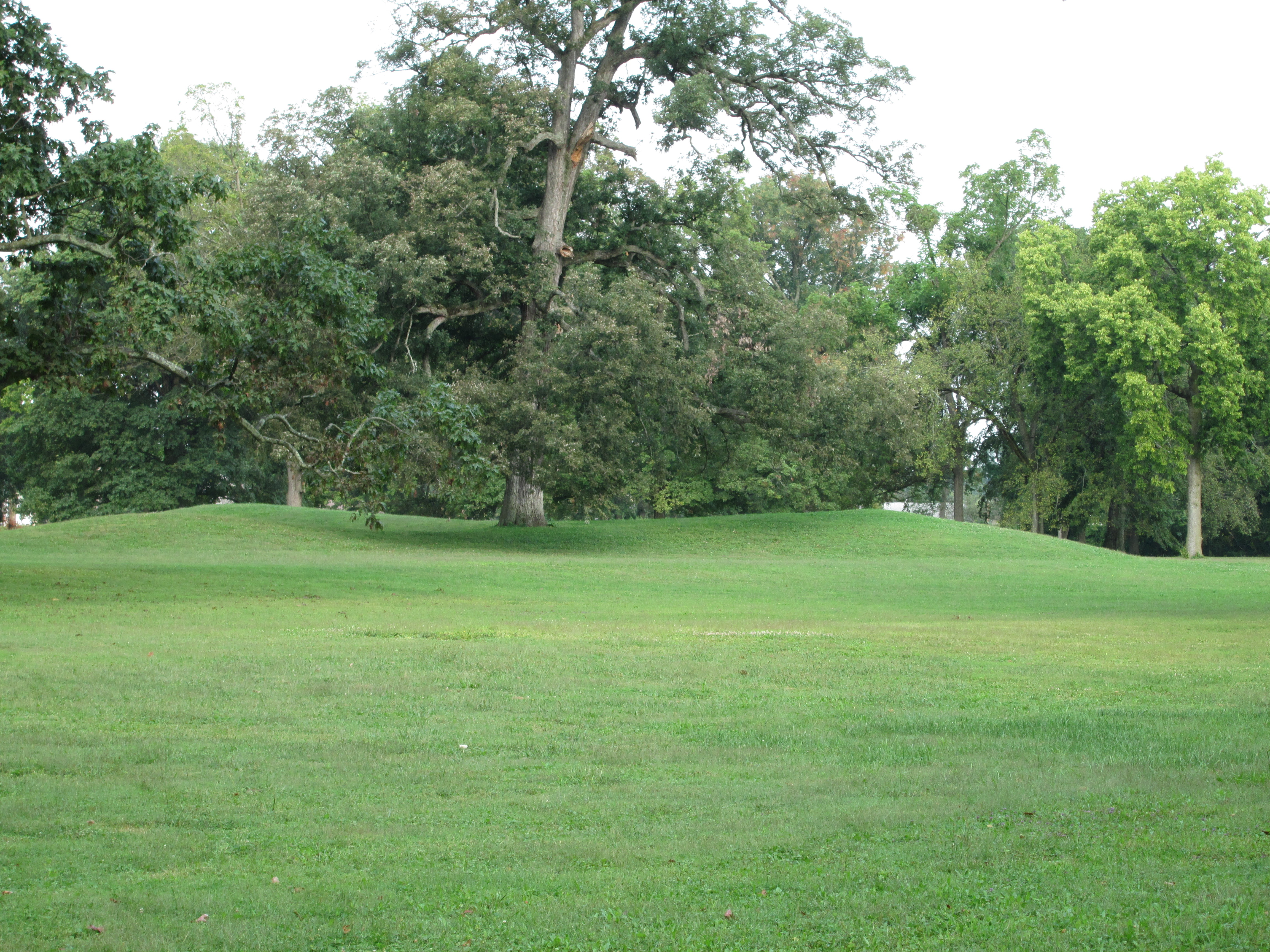
Group of Four Mounds called the Bird within the Great Circle at Newark, OH.

Group of Four Mounds called the Bird within the Great Circle at Newark, OH.

.

NEXT post Visual Tour of Newark Earthworks

Back to PREVIOUS POST

Back to TABLE OF CONTENTS for this article.

Back to Posts on Neolithic Art of Knowth, Ireland

Thence Came Baal

By B.L. Freeborn © 2013, updated Nov. 2018

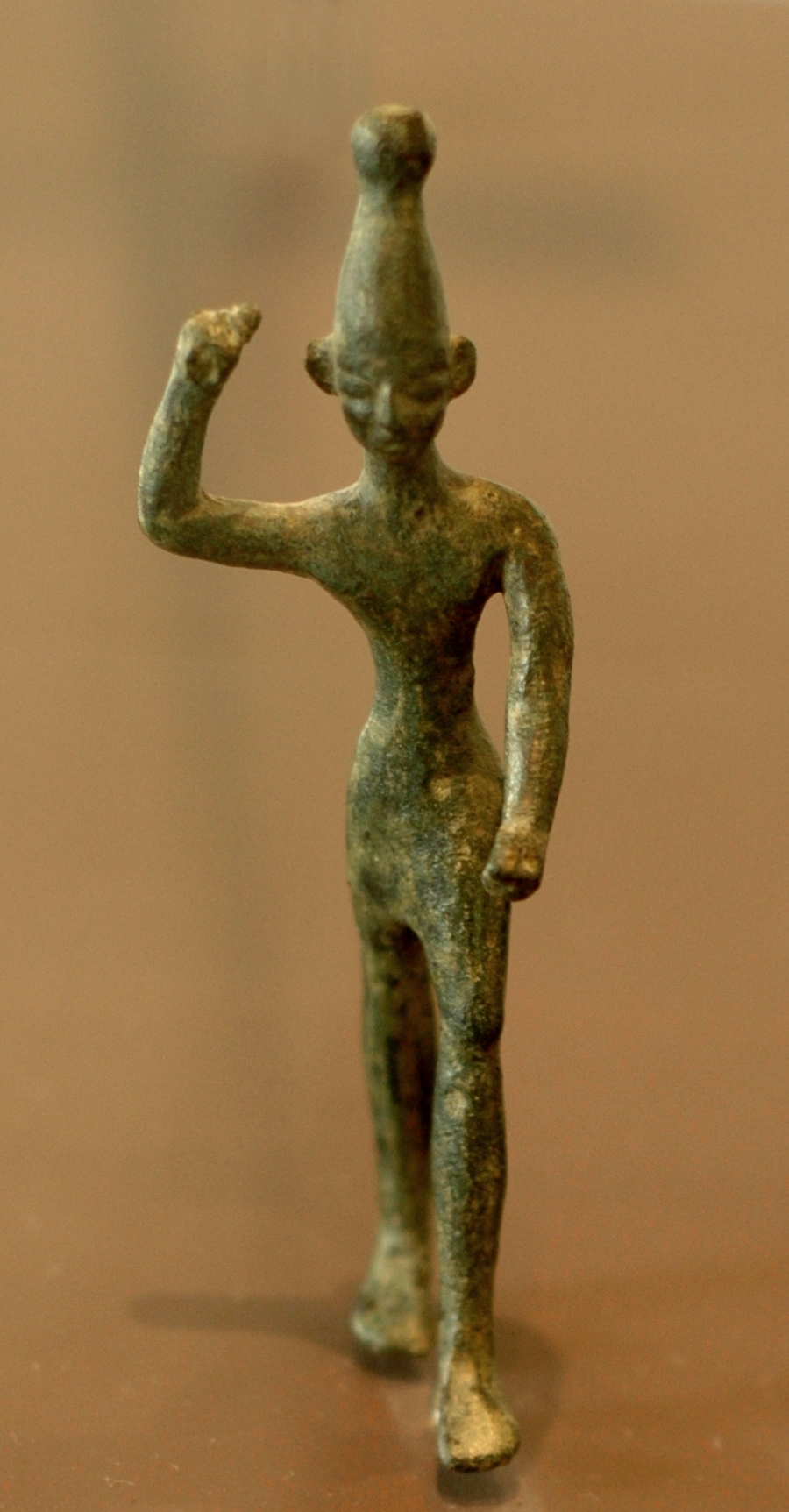
Baal, a Statute from Ugarit.14th to 12th BC. Louvre, Wikipedia,

Baal, a Statute from Ugarit.14th to 12th BC. Louvre, Wikipedia.

Beltane and Baal, are they related? It has already been proposed that they are. The scant information on Beltane suggests it involved building bonfires, the union of male and female, fertility, and the maypole. The maypole ceremony involves weaving long ribbons around a large pole held vertically. This idea is usually interpreted in the classic phallic manner. Yet, we might travel further in our understanding of the ancient world if we broaden our minds a bit. Can we not represent the north pole as a vertically held pole? Do not the lines of longitude project out from the pole in the same manner as the ribbons on the maypole? Certainly then, the object of weaving the lines about the pole is to remind us that lines of longitude and latitude are measured from this central point. This concept can be found not only in the Cuneiform records but it can also be found in Native American lore, just as the Noah story appears in both places. It is a relatively easy concept to understand but twice as easy to misunderstand if one has never been taught about longitude and latitude. It was simple then to relegate the maypole to a sanitized sexual symbol.

The word Beltane conjures up the image of a bell. While the word Baal brings to mind a ball which is reinforced by images such as we see in this Baal-Ugarit Statue. Yet these images converge if we picture that a fiery ball might appear as a bell and indeed, in Old English, a baelfire is a funerary pyre. What possible connection can there be between a maypole and a ball-fire? This is one facet of the story Newark might help answer.

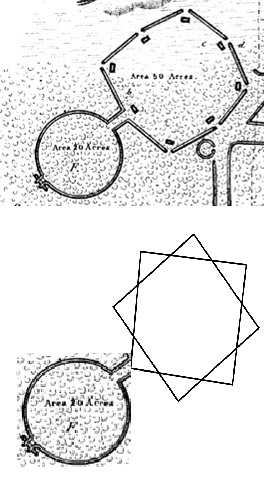
Circle and Octagon of Newark, Ohio Earthworks portrayed as a circle joining with a square.

Circle and Octagon of Newark, Ohio Earthworks portrayed as a circle joining with a square.

The pieces of Beltane we are left with is the concept of male, female and fertility. Since it is a spring festival we might assume these latter parts are all self-explanatory but we can take them another way as well. We look directly at Newark now and see that Baal, Bael, can be described by the circle which leaves the square as its counterpart. So then, in the circle-square we have the union of male and female which is indicated by the circle-octagon with the neck between them. Let us say the circle impacts with the square and causes it to rotate. There are two identical squares within the Octagon which are rotated. Let us say that the union is so abrupt and intense that the square breaks outwards. It is shattered and torn. The Old English word for torn is teon which is of course derived from the number ten and our fingers. Our ten fingers are used to tear apart. Hence, ten becomes teon. Now we have a better understanding of the word Beltane. It is Baal-teon which is then correctly illustrated here. Baal has impacted with the square which we may assume is Earth and it is torn apart. The image of Newark explains the effect of the impact is not only a rotation but a shattering. The images further relate a shift occurred which is portrayed to us by the translation of the two images across the plane equidistantly 6 diameters or 1.2 miles which echoes the statement “the earth was created in 6 days.

Circle and Octagon translate 6 OCD across plane to become circle and square. Drawing by B.L. Freeborn.

Circle and Octagon translate 6 OCD across plane to become circle and square. Drawing by B.L. Freeborn.

Right side of Newark Earthworks taken from Burks drawing.

Right side of Newark Earthworks taken from Burks drawing.

We can then postulate that the three images on the right indicate the condition of Earth after meeting Baal, its new relationship to the Sun, and an oval which we do not understand as of yet. The Great Circle as the Earth indicates the distance it travels in a year, the length of its day, and its velocity via the numbers 580, 1200 x 2, and 66.6. But we need to interpret the steeply formed neck, the bird, and the crescent in relation to the circle. The answer is supplied  by the artifacts which have been found: balls, crescents and meteoric iron. In fact, there is another clue supplied in an article by Romain.1 The Great Serpent Mound is built very near the Serpent Mound Impact Crater in southern Ohio. The .8 mile diameter crater was caused by a meteor impact between (we are told) 256 and 330 million years ago. All things considered it would seem then that the “bird” within the Great Circle is a meteor and the steeply formed neck is its impact site into the Earth. The crescent below the bird then is its crater driven deep into Earth. This suggests more than a passing understanding of the formation of craters such as the one found in southern Ohio.

Moving to the second of the earthworks on the right side we have a square. This exhibits measurements present in Earth’s orbit. The square as a symbol of measurement is found identically in Olmec art and Assyrian art.2 It is presented in Egyptian art and identically in Sumerian art. The square is the foundation of measurement. We can see this for ourselves on any map that shows longitude and latitude. The lines form squares.

This leaves us once again at the Oval where we remain perplexed for just a wee longer.

Forward to NEXT POST

Back to PREVIOUS POST

Back to TABLE OF CONTENTS

_______________

References/Footnotes:

  1. Romain, William F., Ph.D., LiDAR Views of the Serpent Mound Impact Crater, “Ohio Archaeological Council,” January 2012.  See: http://www.ohioarchaeology.org/joomla/index.php?option=com_content&task=view&id=361&Itemid=32
  2. Freeborn, B.L., “The Odd Little Purse in Olmec and Assyrian Art.”  See: https://noahsage.com/2013/02/17/the-odd-little-purse-in-olmec-and-assyrian-art/
  3. Baal Image: Wikipedia, Jastrow, PD.  http://en.wikipedia.org/wiki/File:Baal_Ugarit_Louvre_AO17330.jpg

The New Debate Begins

By B.L. Freeborn © 2013

Stone bowl found with Decalogue Stone.

Stone bowl found with Decalogue Stone.

The old debate revolved around the authenticity of the Decalogue Stone, the Keystone, the Johnson-Bradner Stone and the little teacup size stone bowl. The new debate will be much more fierce. The presence of the little bowl from a specific point in time has much to say in the argument. When excavating at Qumran bowls of this nature were found and they are used to date sites to no later than 200 AD. Their original use was for ritual bathing before prayer. This concurs with the date given for construction of Newark Earthworks from 250 – 500 AD. Whether we like it or not, these objects are from the appropriate period which weighs heavily for their validity not only as being real but a true component of the Newark Earthworks. Discarding them because they just don’t fit our picture is grossly negligent science.

But as Feder points out there is little if any other surviving evidence that people from the Old World were in Ohio except for these random few objects and…..the artifacts hundreds of feet in diameter. Despite the cohesive numbering system, the identical nature of structures supposedly built thousands of years apart on different continents, which just happened to be aligned by longitude and latitude to sites a half a world away, despite all this, we are told that tribal people got up one day and said lets dig a ditch in the shape of a circle because …. we are inspired by….? by what?

Coincidences are explained away far too easily. We are told the early North Americans could not have understood latitude and longitude thousands of years before we did. The very, very early neolithic Englander had just mastered stone tools. Therefore, we take the stance they could not understand it either. These assumptions are then used as proof that they are not aligned. Period. Despite numerical evidence to the contrary this is the assumption we are asked to accept!

More difficult to understand about all these sites, and especially Newark where we have evidence that not one but perhaps three of these phylactery sets existed, is despite the obvious Jewish connection, there is no knowledge of any such connection in the Jewish Rabbinical sources. Further still, there is no acknowledgment that words such as mentioned above (Yahweh, Noah, Moses, Elohim) have any relationship to celestial measures as noted. Which in the end proves only that if the Decalogue Stone and Key Stone have been in Ohio for two thousand years they were not the property of a person of Jewish belief. But this statement contradicts the Johnson-Bradner stone’s presence in the skull. Finding it there suggests the person was ceremonially laid to rest with the stone in the correct position upon the forehead as a believer would use it.

There are other elements to this whole story we have let drop out of the argument. There were quartz balls found. Round pyrite balls have been found at other sites. The case of the Decalogue Stone when closed forms a rounded stone. Recently beneath Teotihuacan balls were found. From the Jewish Old Testament comes stories of execution of large numbers of Baalists. There is a celebration called Beltane that existed in early Irish culture the meaning of which is reduced to a fertility ceremony today. We have also discussed the resemblance of the Decalogue’s man in profile to a Ugaritic statue. And have we forgotten in our haste to return to status quo the idea that the site spells out via gematria 23 32 or Keg Baal?

Could Baal be a comet that left a crater like a keg? Let us follow this last idea and tell the story of Baal using Newark as an illustration and see how the debate proceeds from there.

Forward to NEXT POST

Back to PREVIOUS POST

Back to TABLE OF CONTENTS

_________________________

References:

  1. Alrutz, Robert W., “Newark Holy Stones: The History of an Archaeological Tragedy,” Coshocton, Ohio: The Johnson-Humrickhouse Museum, 2010.
  2. Rochelle Altman, “First,…recognize that it’s a penny”: Report on the “Newark” Ritual Artifacts.”  See:    http://www.bibleinterp.com/articles/Altman_Newark.shtml

Diameters, Radii and Other Great Numbers

By B.L. Freeborn © 2013

This study of Newark Earthworks and the Decalogue has created a significant list of numbers. Before we look at the cosmology we need to review the Great Circle and then apply some meaning to this growing list of numbers.

Side view of Great Circle. Newark, Ohio.

The Great Circle can fit entirely inside the Octagon. Its exterior dimension averages 1200 feet (measured with Daftlogic.com). Its shape is not perfectly round which may have been on purpose or a result of creep as described previously. The ditches surrounding its circular shape and neck were very deep. Within its middle is a shape called a bird mound which appears to be composed of four joined ovals. Its span is 200 feet. On the side opposing the neck is a crescent moon shape. Meteoric iron and crescent shapes have been found among recovered artifacts. This is what Feder would call legitimate garbage.

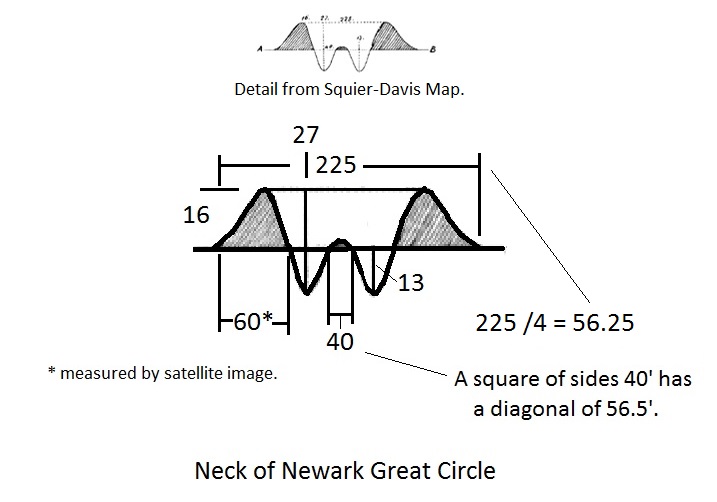
The Great Circle is essentially a series of numbers stated via the radii. A review of the diagram reveals the numbers: 528, 560, 580, 1056, 1200 and 600. The 528 we recognize as a tenth mile. The 1056 is a fifth mile and Hively’s OCD. The 1200 reminds us of the twelve houses in the Zodiac at 30 degrees per house. 600 reminds us of the seconds in an hour and minutes in a degree of latitude. The 560 is the essential part of the mystery. Which leaves only the 580 to explain from this list. Similarly, a study of the neck reveals the numbers 56.25 and 56.5. The neck opening was on an azimuth of 66.6 degrees which also needs to be explained. This brings us to the point of finding meaning for all the remaining numbers.

Detail of Neck of Newark Great CircleThe four inner most mounds of the Octagon are a good place to begin understanding the numbers. We can see in the next diagram these four mounds are so placed as to give us a reminder of the mile’s length and two dimensions that are key to understanding the whole layout. 914 and 945 sum to 1859 which we saw in the Wright Square and the East Fork side dimensions. These two numbers, 91,400,000 and 94,500,000 miles are quoted today by NASA as the closest and furthest distance of Earth to the Sun. The diameter created across Earth’s orbit at these two extremes is 186,000,000 miles. Wright Square had 8 inner mounds inside 1 square or put another way these two numbers, 1 square and 8 mounds, create 18. Further still this 1859 is another form of Millon’s 187′. The 1859 is usually seen rounded up to 1860 or stated as 186.

Octagon Inner MoundsThe largest diameter of the Octagon was 1728 feet or 2 x 864. This number, or its simpler form 86, was found in the square foot area of East Fork, the thickness of the Decalogue Stone, the value of the gematria of Elohim, the diameter of the two great circles at Thornborough in England, the area of Wright Square, the multiplication of the lengths of the sides of the neck of the Octagon-Circle and two times the azimuth angle between Wright Square and the Great Circle. We also find it today in the measurement of time, 86400 seconds in a day, and most importantly, it represents the diameter of the Sun at 864,337 miles (NASA). This is the value calculated by multiplying the 292′ and 296′ of the neck of the Octagon-Circle or 86432.

There were 256 letters on the Decalogue Stone or 16 x 16 letters. The distance Earth travels in any given day is roughly 1600,000 miles. It travels this distance at 66,624 miles and hour. This is the angle Hively could not explain at the Great Circle, 66.6 . It is used in our numbering system still today as shown in the East Fork work. Eight increments of 66 reminds us of 8 furlongs of 660′ equals a mile.

The Great Circle displays a radius of 580. In other places it appeared as 584. This value was found in the width of the Decalogue Stone as 2.9″, the gematria of Noah as 58, the distance between Wright Square and the Great Circle as 2920′, as 584 in the arc of the oil lamp at East Fork, as 292′ in the throat of the Octagon-Circle, as the average length of the side mounds of the Octagon, and as a reminder in the 50-80-50 triangle. If the Earth continues to travel about the Sun at 66,624 miles per hour every day then each and every year it travels 584,000,000 miles. This is the circumference of Earth’s orbit.

Romain discovered the multiple 7 OCD. Seven multiplies with the azimuth angle, 52.2 degrees, of the Octagon to give us the days in a year. The numbers 76, 760, 77, 770, 2.72, 2.77 suggest such important numbers as the return period of Halley’s Comet.

The number 56 and its variants 56.5, 560 and its other form 32, appears at such distant sites as the much debated 56 Aubrey Holes at Stonehenge. It appears in the gematria of Yahweh and Baal. We found it at Thornborough in the radius 320′. Its appearance at Newark occurs repeatedly. We find it today preserved in our measurement of the acre as 43,560 feet. We will discover it in a few other places before we are done here.

And the last number that we found in the gematria of Moses, 345, was the half of 69. Its other versions are 69.18 and 69.2 and  it is often rounded up to 70. These were not observed as frequently in Newark. This is the distance between lines of longitude at the equator.

The diameter of the Earth represented by 79 and 792 was found at Newark. Each and every time the number 528 is used it also refers to 792. Using cubits of 18″ or 1½ feet, means 528 cubits is 792 feet. It was found in the distance in miles between Grave Creek Mound and Geller Hill. This was the same distance Thornborough lies from Lincoln Cathedral. Twice 792 is 1584. This is the distance Romain used between the Octagon-Circle. This number is always present yet often quite hidden. In Stonehenge it appears as its square root 89 and at Thornborough it was the difference in lengths between the two sides. On the Decalogue Stone it was the two unidentified symbols front and back that sum to 79. At East Fork it appeared boldly as the length of the base. At Newark, although reconstructed too often to confirm, it seems to have been the length of each of the 8 inner mounds of the Octagon.

All in all a masterful blending of these important numbers appears at each and every one of these ancient sites. The proof that they are all interrelated is apparent. There is no question that the Decalogue Stone and the gematria of the Torah are equally related. This then leads us to the important question as to how simple people with no “pertinent garbage” could have measured these celestial values of immense size.

Just when we should be upon a solution the problem grows exponentially! We have arrived back at the debate with even more things to debate!

Forward to NEXT POST

Back to PREVIOUS POST

Back to TABLE OF CONTENTS

______________________

References

  1. Freeborn, B.L., “The Deep Mystery: The Day the Pole Moved,” Tiw & Elddir, 2013.
  2. Hively, Ray, and Horn, Robert, Geometry and Astronomy in Prehistoric Ohio, “Journal for the History of Astronomy, Archaeoastronomy,” Supplement, Vol. 13, p.S1; also Science History Publications, 1982.      See:   http://articles.adsabs.harvard.edu
  3. Romain, William F., Ph.D., Newark Earthwork Cosmology: This Island Earth, “Hopewell Archeology: The Newsletter of Hopewell Archeology in the Ohio River Valley,” Vol.6 (2), March 2005.   See:  http://www.nps.gov/mwac/hopewell/v6n2/one.htm
  4. Romain, William F., Ph.D., Design and Layout of the Newark Earthwork Complex, “Hopewell Archeology: The Newsletter of Hopewell Archeology in the Ohio River Valley,” Vol.6 (2), March 2005.  See:   http://www.nps.gov/mwac/hopewell/v6n2/two.htm