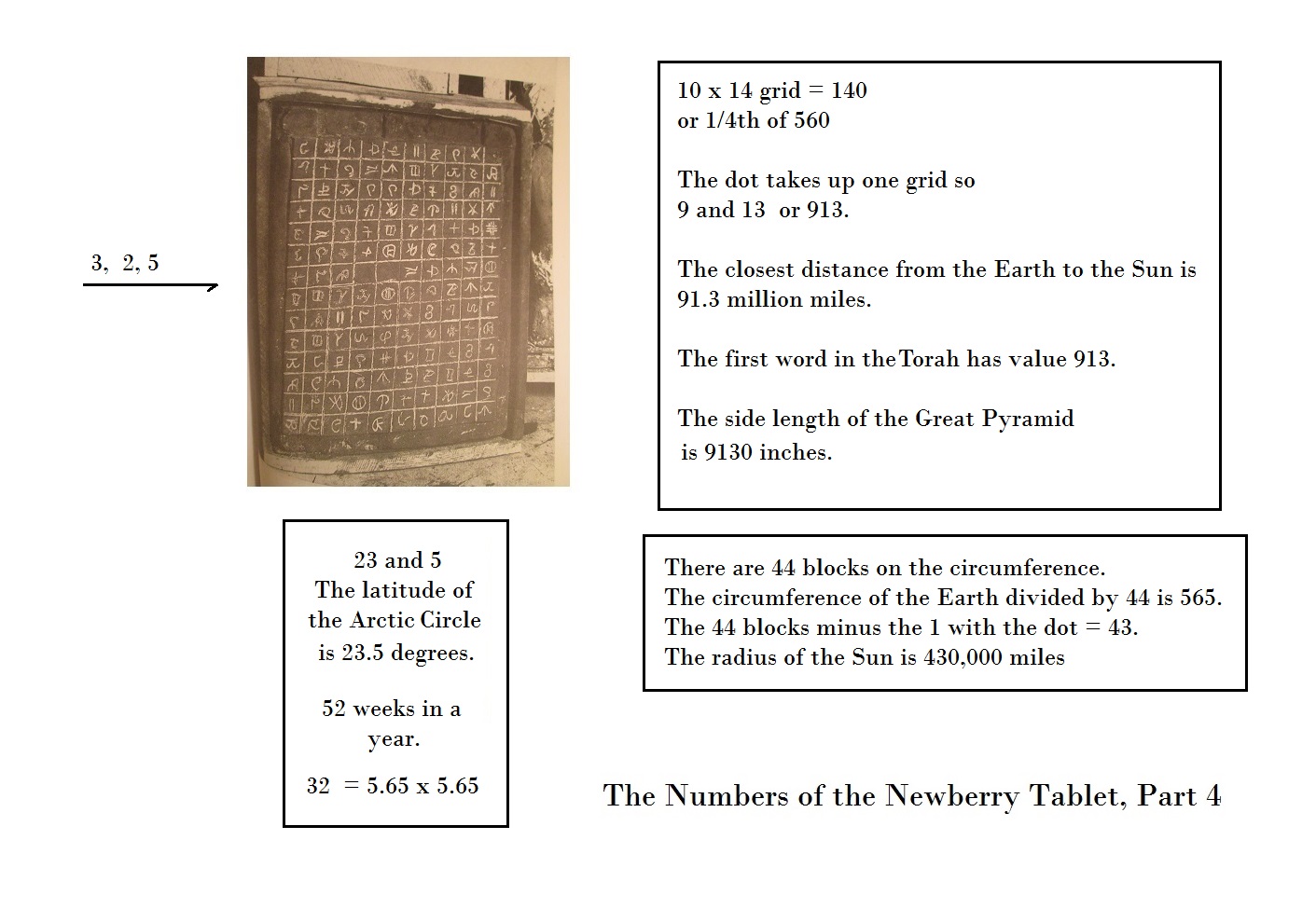
The Bat Creek Stone – Translated – Not So Plain and Simple

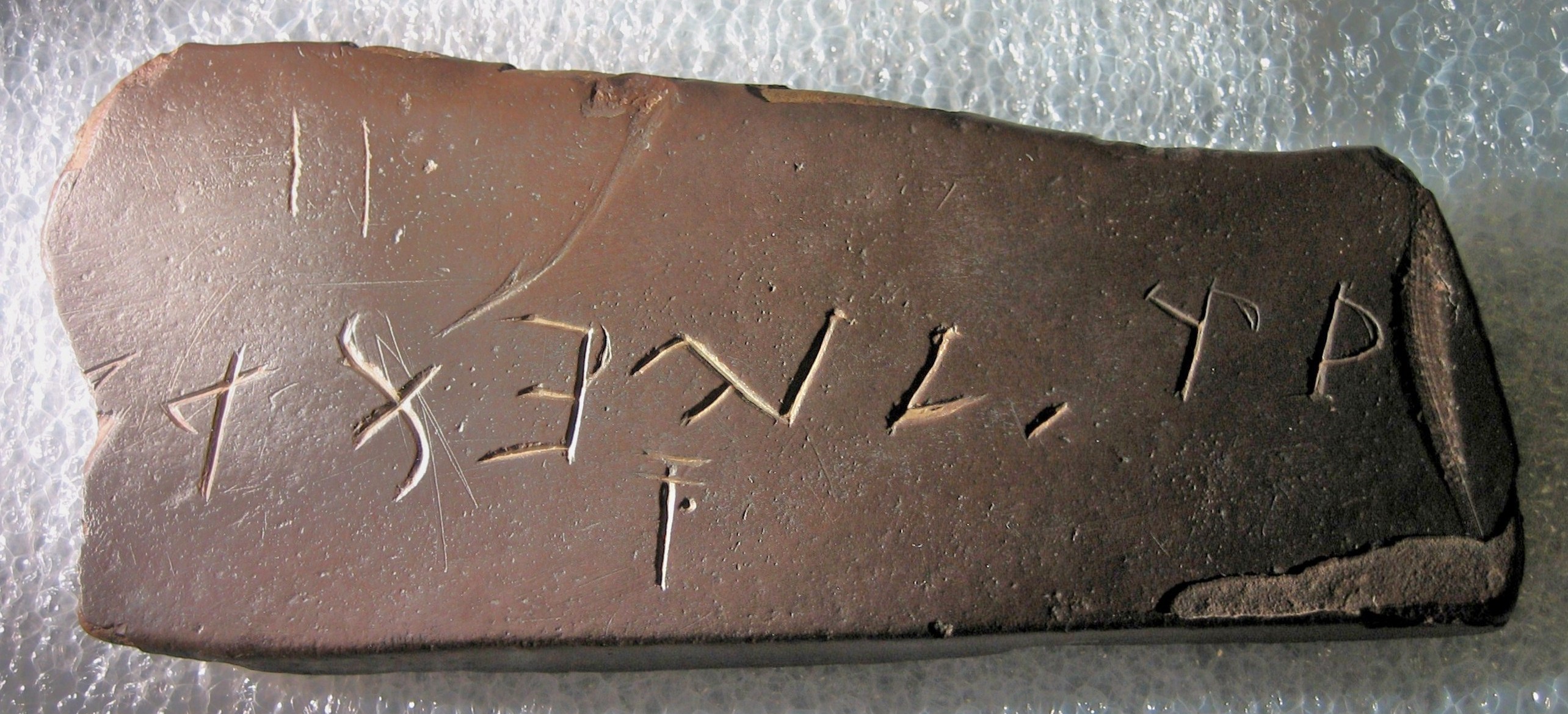
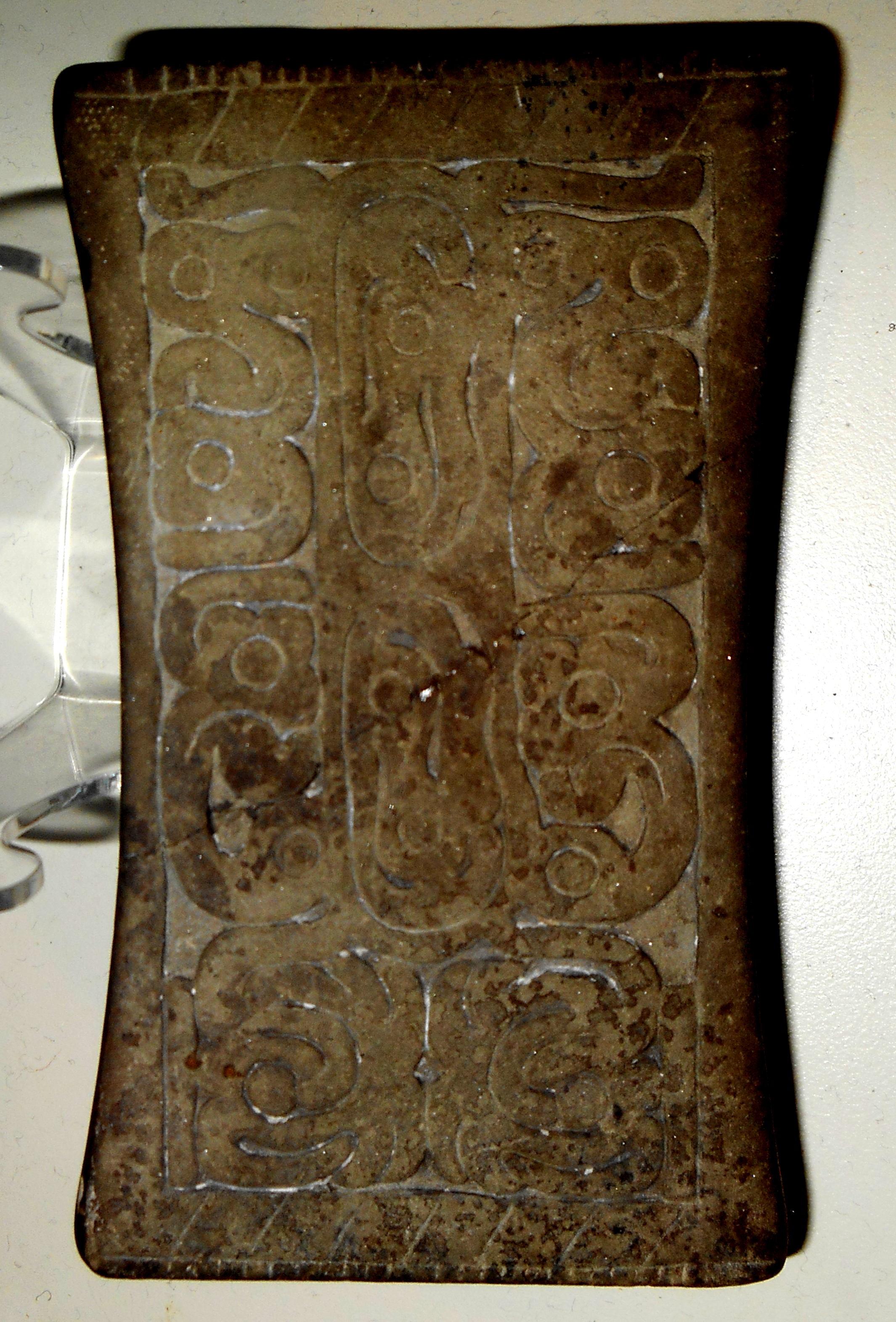
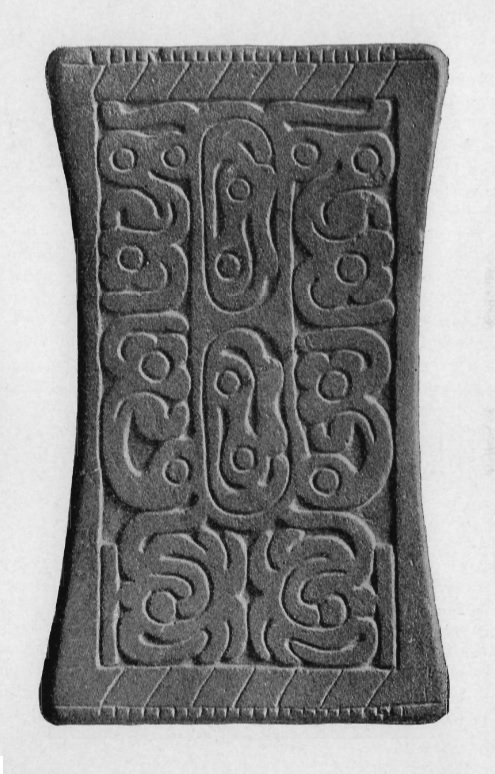
Bat Creek Stone - photo by Scott Wolter

Bat Creek Stone – photo by Scott Wolter

© 2015 B. L. Freeborn, Updated Sept. 2022

The Bat Creek Stone was found in a mound with a skeleton in Loudon County, Tennessee in 1889 during a dig by the Smithsonian Bureau of Ethnology. Because it appears to have Phoenician or Paleo-Hebrew letters it has been dubbed a fraud. Arguing in favor of its validity is J. Huston McCulloch who describes the controversy at the site noted below and linked here. Scott Wolter also argues in its favor. It is also described at Wikipedia under the Bat Creek Inscription.

No satisfying, controversy resolving translation has been made. The following may not put the matter to rest either but it is new and unique! All other attempted translations have failed to note this is an extraordinary number riddle. The numbers are found by recalling that letters originally had number equivalents and not separate symbols as we have today. Using the Hebrew gematria or number/letter system the values appear as noted below and the riddle of the numbers is solved. In turn this confirms that the correct letters are identified in the translation.

The two lines and dot in the upper left were not shown in a detailed sketch of the stone done in 1890. Scott Wolter successfully demonstrates in his show America Unearthed that they were not part of the original inscription.

The Translation

The letters used to translate this inscription are from oocities.org and were in use in 800 BC by the Phoenicians. Note that the L and P are more in the modern Latin Alphabet style and a reversed E which is an H in Phoenician also appears.  So, there are intentionally two alphabets in use in this inscription. It is typical of highly educated people still to this day to insert some Latin phrase into their argument for emphasis and so we see it is also done here. The L and P are further confirmed and identified in this manner. (See note to reader below about using P as R.)

The language is not Hebrew but Anglo or Old English as has been noted in other Adena Tablets from the nearby Ohio area. This does not mean it is a fraud but that there is a major part of history that has not yet been recovered.  The impossible idea that this stone is -valid- because it is in English/Anglo written in Phoenician letters is an idea that will be expounded upon in further posts. The reader should understand that academics tell us English (Anglo) originated 1300 years after this alphabet was in use or 500 AD.  (See Sator Rotas post.)

The stone is read – left to right.  (The letter ‘u’ has sounds: u, v, o, w.)

Note most importantly, that the S letter is a line with hatch marks such as used in latitude. It is suggested here it means South and/or latitude. Also note it is directly under the letter I. This suggests a further word or two depending on pronunciation: is and ice. Both apply here.

It translates as follows (see image below):

 AN HIL UP S  IS

……………or filling in a bit:

AN HILl UP South Is Ice

…….or……

An Hill of Ice that was up is now South

……. or…..

The ice mountain of  An that was north is now south.

Presumably this is the goddess An spoken of in ancient texts and in modern terms is magnetic north.

The Latin Style letters (E,L,P) and numbers provide:  ‘E’ LaP  and  PaL ‘E’

……or…….

the ‘Ae’ lap is at the pole source

…… or…..

The first lap begins at the magnetic source and pole.

Recall that in Hebrew gematria the sound for ‘a’ has a one value. There is no value and letter for ‘e’ so here the ‘E’ is given the value 1 or as spoken it is ‘a’ or ‘an’ meaning one. Combining these ideas then this phrase suggests that the One original pole is at this ‘lap’ or latitude/longitude position. We recognize two poles today: magnetic north and true north. This leads to the final idea and most important part of the riddle.

By solving the number riddle (see below) this critical line can be added:

It lies at 56 degrees 30 minutes and 79 degrees.

(This is the location of southeast Hudson Bay in the arc and close to old magnetic north which is moving northwards.)

Relationship to Sator-Rotas

satar rotasThe reader should note that the Bat Creek Stone is still easily translated (in words but not numbers) if the P is actually an R. The wording changes to ‘or’ = origin, and ‘ro’ = row, order. The witty riddler cleverly hides another word in the letter’s confusion. This is the word ‘pr’ and ‘rp’. The first suggests pair and the latter reap or rape.

A raping pair is the origin of order.

But there is more to this confusing letter! The H looked suspiciously like an E and if this is combined with the r-p duo then the words e-p-r and e-r-p, or appear and a-rope are created. They suggest that:

The raping pair appeared and provide the one rope.

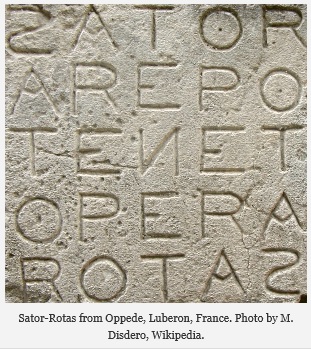
This interpretation recalls the riddle of the Sator-Rotas Square. The inner ring of that puzzle is formed by the repeating letters E, P, E, R, E… or, P, E, R, E … which now look suspiciously familiar. The words ‘ro’ ,’or’, ‘op’, and ‘po’ are notable in that puzzle as well as ‘en’ and ‘ne’. Notice the clever reversal of the N to create the Hebrew letter a.

The Number Riddle

The number riddle is solved by substituting the Hebrew number equivalents for each letter and by noting the left and right half separated by the dot should be equal. This resolves any confusion about identifying the letters and how the ‘p’ was determined over the other possible letters ‘q’ and ‘r’. If the ‘i’ (letter directly left of the ‘L’) is considered to be an angle sign then the left half reads 56 (angle) 30 = 86. This 56 degrees 30 minutes is the latitude of Hudson Bay. (Hudson Bay is where magnetic north has moved from). The 86 is the diameter of the Sun or 864000 miles. It is reminds us of 86400 seconds of longitude. The forty of 864000 is present if the numbers (1 50 5 10 30 6 80) are read as 56 40 86. Adding further support to this idea, recall that a square of sides of 40 has a diagonal of 56.5. The 56 degrees 30 minutes can be written as 56.5 degrees. The reference to the sun also suggests they are talking about latitude since the sun is used to measure latitude.

If the ‘i’ is given its 10 value then the sum of all the terms on the upper line left side is 96.

The sum of the main line is then 182. Add the 60 given by the lower ‘s’ as 182.60 and double. This is 365.2 or the number of days in a year.

Counting the letters left of the dot find 5 and right find 2. There are 52 weeks in a year. There are 7 letters in this main line. There are 7 days in a 52 week year.

The total number of symbols is ten. The word ten is associated with tien (fork tines) and teon (torn) in Anglo /Old English. This idea and use of the word ten appeared in the Sator Rotas.

Observe further that the 5, 7 and 2 can be assembled to create 57.2. The number of degrees in a radian (used in spherical calculations such as astronomy and navigation) is 57.29.

Notice further that the sum of 56 + 30 = 86  on the left plus the 86 on the right is equal to 172. The bottom number is 60. Subtract 172-60 and obtain 112 or twice 56 again. Also note that the total sum on the left, 96, plus the 60 beneath is 156 and this repeats 56.

Note also this manner of counting: The main line is 5 symbols then a dot for 6 making 56. Count from the right 2 and a dot for 3 and find 23 again. The count can be continued right to left. The 23 is followed by 5 for 23.5. This 23.5 is the latitude of the Arctic Circle which surrounds the north pole!

This same manner of counting can be applied to the letter I which is the up down triangle. Count the angles, 3, and the line segments, 4. Find 34 and this distance in degrees from the pole is 56 degrees.

Indeed, we must consider that that pesky P was meant to be an R so that P as 80 and R as 200 gives 280 or half of 560!

But note two last important values ….

The numeric value of Yahweh is 5,6,5,10.

And a triangle of sides 56 has a diagonal of 79.2.

Enough is enough! There are probably more!

Conclusion

So, whoever the hoaxer was that inscribed this stone, we know for a fact they were darned good at math riddles and knew gematria. That narrows the field of who dunits down a bit. The original author of this riddle was educated in two alphabets: Phoenician and Latin. He/she also knew that R and P can be confused and took full advantage of it. The Phoenician letter style used was in use east of the Atlantic in 800 BC. The Latin letters evolved from Etruscan about 700 BC. Letter P was used as an R in the original alphabet. It evolved into a P as used today a few centuries later. This gives an upper limit to the age of the  stone as 2700 years. The lower limit depends on when Paleo-Hebrew / Phoenician fell out of use on the west side of the Atlantic and when the last time this stone was copied to remember the wit and wisdom of the saying.

Next the Grave Creek Stone is examined. It too has a fascinating translation.

__________

http://en.wikipedia.org/wiki/Bat_Creek_inscription

http://economics.sbs.ohio-state.edu/jhm/arch/batcrk.html

___________________

Updated May 2021 to remove two scratch marks from translation.

Back to the very beginning of series on Adena Tablets

Previous Post on the Shaman Stone

Posts on: Adena Pipe, Numbers and their Meaning, Ramey Peet Tablet, Gridley Stone

McKensie and Bainbridge Tablets, Cincinnati Tablet,

Egyptian Art Comparison, Wilmington Tablet, Lakin A Tablet,

The Gaitskill Clay Tablet, Allen Tablet, Grave Creek,

The Kiefer Tablet, Wright, Lakin B and Meigs Tablets,

Berlin Tablet, Gaitskill Stone Tablet, The Low Tablet,

The Waverly Tablet, Metcalf Stone, and pdf article on

Hudson Bay as a comet crater of recent origin.
(updated Nov. 2018)

The Hopewell Shaman Bear

© 2015 B. L. Freeborn

Ohio Shaman Bear - Art from ancient Ohio found in Newark Earthworks

Ohio Shaman Bear – Art from ancient Ohio found in Newark Earthworks

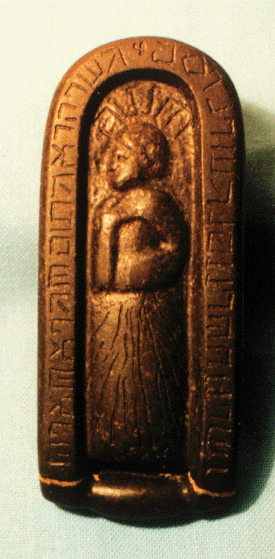
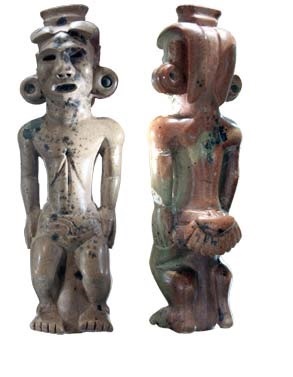
The Hopewell Shaman Bear is located in the Ohio History Museum in Columbus, Ohio. This magnificent piece of art was found in Newark, Ohio in the extensive earthworks there. The Newark Decalogue Stone was found seven miles south under a massive stone mound. The Newark Stone is inscribed with a form of Jewish letters and considered to be a fraud by academics. A full description and discussion about this stone can be found in the paper – Newark Decalogue Stone and Earthworks: An Unraveling Mystery or at this post. The Newark Stone is so unlike the Shaman Bear that it is easy to accept the academics’ viewpoint. However, despite their apparent and obvious differences they depict a similar story. The Newark Stone was found in a stone carved case that forms a rock shape when closed. Both statues are carved stones. Both are about the same size.

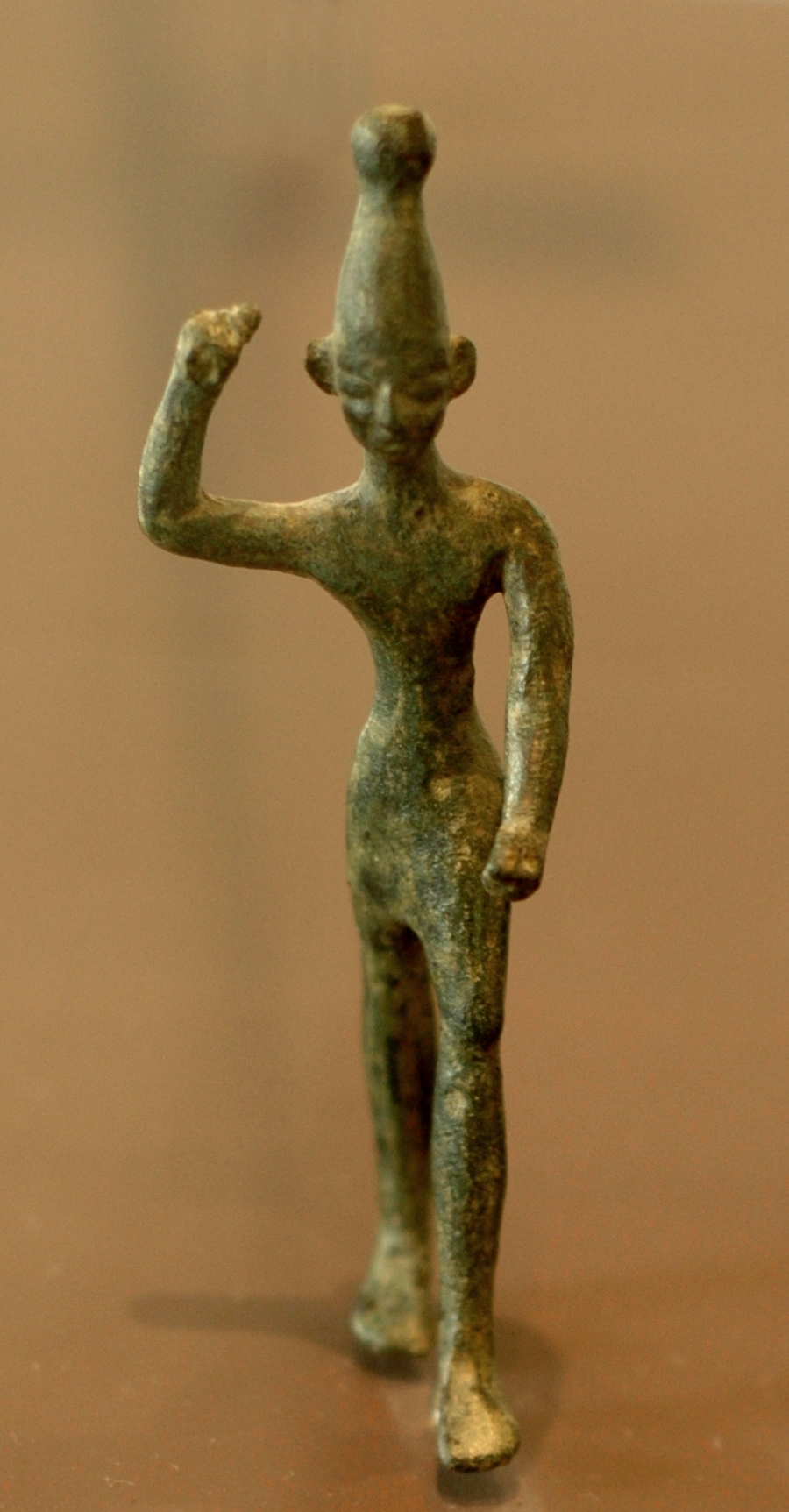
Both have one arm bent at the waist and the second arm pointed up. Compare the arm positions to the statue from Ugarit that is said to describe Baal. It has one hand pointed up at the hat which is a round ball with a conical tail.

Baal, a Statute from Ugarit.14th to 12th BC. Louvre, Wikipedia,

Baal, a Statute from Ugarit.14th to 12th BC. Louvre, Wikipedia,

Front Face of Newark Decalogue Stone

Front Face of Newark Decalogue Stone

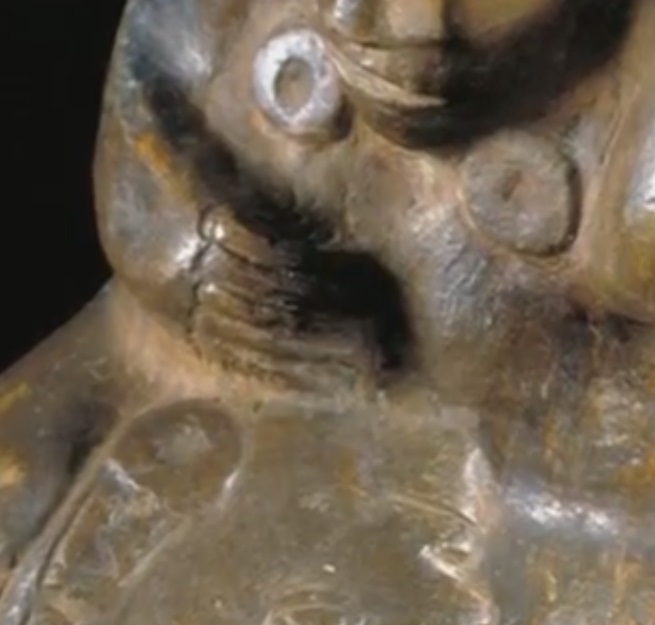
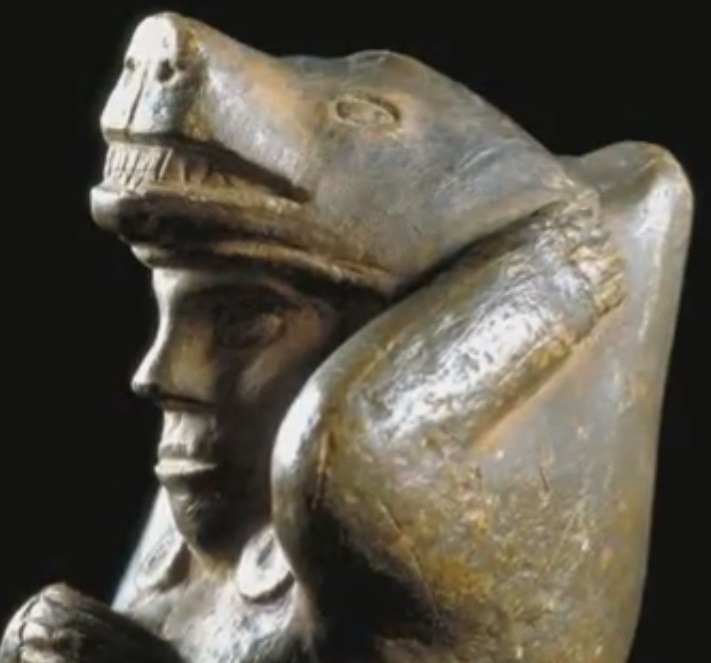
Concentrating now on the Shaman Stone we find it has three heads. One is upside down in the lap of the man with the hair splayed downwards. The sitting man is wearing a bear head creating a double head. So we find one head below and two above or it can be said one becomes two. The caul of the bear covers the man and keeps him from being bare. It is suggested that the stone is referring to the old North Pole with its caul of ice that is thought of as the Laurentide Ice Sheet. From it bearings were taken. Hence, we find three forms of the word bear is depicted by this stone: bear- animal, bare – uncovered, and bear – direction. The head in the lap depicts the head (of the Earth) forced down. It lies on a lap which makes a pun of the man’s lap to indicate that it lies on an important lap of longitude. Notice the ear of this upside down head is not quite right. There is a little comet for the ear with a u – cup shape above it almost in the hairline. The hair becomes the meteorites following the comet. This idea is seen in the Ugarit Statue with the cone below the round ball. The legs of the man become arms for the upside down man who is exclaiming as we saw in other Adena stones. Men crying out in horror is part of the story.

Close up of head in lap showing comet and crater.

Close up of head in lap showing comet and crater.

The small comet is directed towards the man’s hand. His fingers clearly depict the numbers 2 and 3. The other hand has 5 straight fingers The Arctic Circle ends at 23.5 degrees. The sitting man has two bold round earrings. These are the double comet craters of Baal indicated on the other tablets.

The statue is designed to sit with a 90 degree -or so- posture, yet since the feet are bent out at an angle there is a tendency to think they should be dropped down at a 90 degree angle. In other words the angle is bent or turned as the other stones studied in previous posts have depicted.

Right hand shows two and three with fingers.

Right hand shows two and three with fingers.

Looking for other numbers, note the right hand as 23 can also be 32 and this gives the square of 5.65. There are 5 eyes, 3 ears (2 bear and 1 human), 3 round donut comet craters, and the toes are 3 on each side making 33. The approximate angle between the pole positions is 33 to 35 degrees. The 5 and 3 suggests 53 and 5.3 is the square root of 28 which is half of 56.

Left hand showing five fingers.

Left hand showing five fingers.

The words that form the meaningful puns -lap and bear- are Old English words which may not really be indicated but considering the Anglo words found in the Adena Tablets previously, there is probably no coincidence.

Apparently the three statues have more in common then first thought. They all describe Baal and its collision with Earth. This collision changed the position of the pole and bared it of its caul. It was beheaded and at the lap it lies.

Shaman Bear

Shaman Bear

The next adventure into the minds of the ancients continues with the Bat Creek Stone.

Back to the very beginning of series on Adena Tablets

Previous Post on the Adena Pipe

Posts on: Numbers and their Meaning, Ramey Peet Tablet, Gridley Stone

McKensie and Bainbridge Tablets, Cincinnati Tablet,

Egyptian Art Comparison, Wilmington Tablet, Lakin A Tablet,

The Gaitskill Clay Tablet, Allen Tablet, Grave Creek,

The Kiefer Tablet, Wright, Lakin B and Meigs Tablets,

Berlin Tablet, Gaitskill Stone Tablet, The Low Tablet,

The Waverly Tablet, Metcalf Stone, and pdf article on

Hudson Bay as a comet crater of recent origin.
(updated Nov. 2018)

The Ohio Adena Pipe – Art from Ancient Ohio

The Adena Effigy Pipe from Ancient Ohio

The Adena Effigy Pipe from Ancient Ohio

The Ohio effigy pipe is from Chillicothe in southern Ohio. It is attributed to the period 800BC to 1 AD. It is part of the Ohio Historical Society’s Collection in Columbus, Ohio.

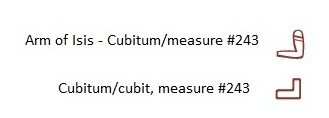
The classic explanations are available at the Society’s page. (here) As part of this study we only need notice that some parts of the man’s depiction are symbolic rather than realistic. Compare his features to the men on the Ramey Pete Tablet (see below) and notice the unique hair style may be an attempt by the artist to make what had been symbolic into reality. In Luwian/Hittite Glyphs this symbol means a cubit or measurement.

Hittite/Luwian Glyph for cubitum/measure

Hittite/Luwian Glyph for cubitum/measure

Further symbolism is found in the loincloth. It depicts a snake and we may assume the snake overlays a ‘pole.’ This then symbolizes the comet that struck the North Pole. The feathered bustle is clearly a wing and the wing in Hittite/Luwian glyphs means army. Ironically, a wing in English, both old and new, means troops or a portion of an army.

Without need for much explanation notice the arrow carved on the chest points upwards towards the gaping open mouth like it’s pointing out ‘a crater.’

The two earrings represent the two craters of Baal. The mouthpiece, the functional part of the pipe, also suggests the crater on the crown of the Earth. Indeed, this cupped mouthpiece as crater has further symbolism if the two L hairpieces are considered to be symbols about measure. It suggests there is a crater and two poles. There are definitely two poles. If we are to believe this story there is at least one if not two craters also.

Ramey Peet Tablet from Cahokia Mound, obverse

Ramey Peet Tablet from Cahokia Mound, obverse

Numerically, the mouth with the two ears makes three and the eyes make two. This gives the 23,32 which suggests the Arctic Circle. The bustle has 10 feathers. Next to the bustle neatly placed are the two hands. Counting fingers as well as feathers find: 1, 4, 10,4,1 or 141 and 141. This recalls the value of the square root of 2 at 1.414. The sum of 141 and 141 is 282 and this is half of 564.

This then completes the essential knowledge of Baal and it is beautifully woven into the art of this functional object. Similarly lifelike and even more symbolic is the Ohio Shaman Bear Statue found in Newark, Ohio which is the topic of the next post.

See more at:

http://www.ohiohistorycentral.org/w/Adena_Pipe?rec=1278

http://ohsweb.ohiohistory.org/gallery2/main.php?g2_view=core.DownloadItem&g2_itemId=1266

Back to the very beginning of series on Adena Tablets

Previous Post on the Numbers and their Meaning

Posts on: Ramey Peet Tablet, Gridley Stone

McKensie and Bainbridge Tablets, Cincinnati Tablet,

Egyptian Art Comparison, Wilmington Tablet, Lakin A Tablet,

The Gaitskill Clay Tablet, Allen Tablet, Grave Creek,

The Kiefer Tablet, Wright, Lakin B and Meigs Tablets,

Berlin Tablet, Gaitskill Stone Tablet, The Low Tablet,

The Waverly Tablet, Metcalf Stone, and pdf article on

Hudson Bay as a comet crater of recent origin.

The Adena Tablets of Ancient Ohio – The Numbers

© 2014 B. L. Freeborn, updated Sept. 2022

Scattered throughout the previous posts on ancient art have been numbers. The compiled list is:

108, 111, 11111, 112, 12, 1212, 12321, 123454321, 14, 1414, 16, 17, 21, 212, 2121, 21212, 216, 2166, 222, 23, 23 32, 23.5, 24, 241, 2486, 26, 28, 3, 31, 32, 33, 333, 34, 3.8, 38, 4, 40, 43, 4.4, 44, 52, 54, 5.65, 56, 56.5, 565, 58, 6, 61, 64, 6.5, 65, 66, 66624, 67, 6.9, 7, 72, 76, 77, 777, 79, 792, 7924, 86, 8642, 8.8, 88, 9, 90, 912, 92, 93, 93.3.

This is a substantial list. To make understanding it easier they are grouped by the first digit and explained below.

All the numbers can be related back to values associated with the planet or the solar system. They were either defined, calculated, or determined by measurement. The 12 Houses of the Zodiac or 12 months of the year are defined. Numbers such as 108 are calculated. It is the distance from the Earth to the Moon divided by the diameter of the Moon, or it is how many ‘moons fit’ between the Earth and Moon. The original values must be determined by direct measurement. Someone had to have the mathematical skills and tools to make an accurate determination that the diameter of the Moon is 2160 miles. This person did not necessarily have to live in ancient Ohio or even in that time period. The values could have been passed down to them just as they are to us today through education and sharing.

The question becomes how far distant in the past were they first measured? The story told by the tablets suggests people were well able to measure longitude, latitude, and determine celestial values long before the comet impact. Neither the artists nor the population needed to know how to obtain the values just as the average person today cannot calculate them. That these concepts and measurement units have existed for eons of human history becomes apparent when one learns they are simply not as arbitrary as the length of some man’s foot 3000 years ago. Indeed, they were chosen with extraordinary care so that the repetitiveness and harmony of the numbers is revealed when the Mile System is used for measurement in the sciences.

To illustrate how the numbers of the mile system repeat, a few examples follow. The diameter of the planet is 7920 miles. The number of protons in Gold is 79. The length of a surveyor’s chain is 792 inches long or 66 feet. A furlong is 7920 inches or 660 feet. The velocity of Earth is 66,624 mph. A Sumerian inch was .66 inches long. A mile is 5280 feet or 660 x 8 feet long (8 furlongs). Noah’s age was 950 years. Divide this by 12 and obtain 79.17.

The ratio of the distance from the Earth to Sun: Earth to Moon is 400. The last letter in the Hebrew Alphabet is Tau or ‘th’ with value 400. By –definition- there are 86400 seconds in a day and equally be definition, there are 86400 seconds of longitude in the measurement of Earth. The diameter of the Sun is approximately 864,000 miles. Using those same seconds 1000 of them are required for light to travel the distance equivalent to Earth’s orbital diameter. This nominal value cannot be coincidental. Each of those miles marking out the Sun’s diameter is 5280 feet. The diameter of this planet can be obtained by multiplying 5280 by 1.5 or 7920 miles. Conversely it can be said there are 109 Earth diameters in the diameter of the Sun which brings us back to the distance between the Earth and Moon. The average distance can be said to be 109 moons. The Earth travels 1,599,000 miles or essentially 1,600,000 miles in a day and there are 16 cups in a gallon. There are 16 ounces in a pound. Oxygen’s molecular weight is 15.99.

Consider further the mile of 5280 feet. There are 12 Houses in the Zodiac. 5280 feet / 12 is 440. There are 1584,000 seconds in 440 degrees. Compare this number to the distance Earth travels in a day given above. The circumference of the planet divided by 440 is 565 miles. Furthermore, the area of an acre appears arbitrary until it is examined. An acre is 44,000 -440 square feet or 43560 square feet. Observe this 43560 is composed of two values. Twice 43 suggests 86 or it repeats the diameter of the Sun. The 56 is the value just discussed related to the circumference of Earth.

If the year is divided into 7 day weeks there are 52.14 weeks in a year. If we think of this number in terms of degrees and convert it to degrees and minutes we obtain 52 and 8.4 minutes. Compare this to 5280 feet in a mile. Indeed, the Astronomical Unit (AU) or what is considered scientifically to be the average distance between the Earth and Sun is 92,956,050 miles. (NASA) The mile is 88 x 60 feet. Divide the AU by 88 and obtain 1056,318 or 2 x 528,160. In other words, the AU is approximately 5280 x 88 x 2 x 1000 miles. And the mile is 5280 = 88 x 60 feet. Working the values in reverse 5280 x 88 x 2 x 1000 gives an Ancient AU of 929280,000 which for all intents and purposes is the same as the modern value except it is easier to remember with its repetition of 92.

This whole repetitive process can be continued ad nauseam. In other words, a lot of thought went into choosing the length of an inch, foot, and mile and the number of seconds in a day in order to make this system synchronize with the Solar System.

Let us take a moment to look at the metric system. The diameter of the planet is 12,742 km. There are 86400 seconds in a day. The diameter of the Sun is approximately 1,390,570 km. The circumference of the planet is 40,000 km. The Earth travels 2,534,400 km in a day. The AU is 148,729,680 km. Nothing repetitive appears.

Interestingly, the metric system uses nautical miles to calculate longitude and latitude. There are 60 nautical miles per each degree of longitude at the equator. There are 6076 feet in a nautical mile. The length of a nautical foot is 13.8 inches. This is twice 6.9 inches. There are 69.17 statute miles between degrees of longitude at the equator.  There are 21600 nautical miles in the Earth’s circumference which sounds remarkably like the Moon’s diameter of 2160 statute miles.

The numbers as found in the tablets…….

108……….. The distance in moons from the Earth to the Moon. The radius of the Moon is 1080 miles.

…………….. The distance in Suns from the Earth to the Sun. The radius of the Sun is 1080 miles x 400.

111, 11111 ……….A suggestion of infinity and the power of 1. Multiply 11 x 11 and obtain 121. Multiply 11111 x 11111 and obtain 123454321. The longitude of Barringer Crater, Arizona is 111.

112………… Twice 56.

12 ………Houses in the Zodiac. Months in a year.

1212 ……….Times pi is 3807 or half of 76. There are 76 years in the period of Halley’s Comet.

12321, and 123454321 ………See 111 above.

14……….. 4 x 14 is 56.

1414 ……… The square root of 2 is 1.414. The diagonal of any square is this number times its side length.

16 ………..The distance Earth travels in a day is 1.6 million miles. The number of cups in a gallon.

17 ………Twice 17 is 34.

21, 212, 2121, 21212…….. Multiply by pi and obtain the velocity of the planet at 666,24 mph.

216, 2166 ………..The diameter of the Moon is 2160 miles.  Years in an ecliptic House of the Zodiac (30 degrees) is 2160.

222…….. A square of sides 2222 has a diagonal of pi x 1000.

23, 23 32, 23.5 ……….The Arctic Circle ends at 23.5 degrees or 23 degrees 30 minutes. This is also the angle of tilt of the planet. The angle varies from 23.5 to 24.5 degrees over 40,000 years.

24 …………..Hours in a day. Was this chosen to coincide with the average tilt of the planet?

241 ……….The square of 241 is 58081. The Earth travels 584 million miles in a year.

2486 …….. Circumference of Earth is 24880 miles.

26 ……….Twice 26 is 52. There are 52 weeks in a year.

28 ……….Twice 28 is 56.

31 ……….The cube of pi is 31.

32 ………The square of 5.65 is 32.

3, 33, 333, 34 ………….. The latitude change of the old pole.

34………….. Twice 17 is 34. The maximum difference between the magnetic pole and true north after the pole was displaced.

3.8, 38 …………….. Twice 38 is 76 or the period of Halley’s comet.

4, 40 …………….A square of sides of 4 (or 40) has a diagonal of 5.65 (or 56.5) units.

43 ………….The radius of the Sun is 432,000 miles.

4.4, 44 …………. The circumference of Earth divided by 44 is 565.5 miles.

52……..The number of 7 day weeks in a year.

54………… Twice 27. The distance to the asteroid belt beyond Mars is 2.77 AU (Astronomical Units). Twice 54 is 108. See 108 above. The latitude of England and Denmark. The circumference of a circle of diameter 17.

5.65, 56, 56.5 ……..Latitude of Hudson Bay and mouth of St. Lawrence seaway.

58…………… The Earth’s orbital circumference is 584 million miles.

6, 61 ………….Time and distance are both measured 60 minutes to the hour and 60 seconds to the minute. The solar system is interestingly enough 60 AU wide!

64 ………….Four cubed is 64. The diagonal of a square of 4 units is 5.65. Twice 32 is 64. 5.65 squared is 32.

6.5, 65 ………….The value 56 reversed. Latitude of Hudson Bay.

66, 66624 …………The velocity of Earth is 66624 mph.

67 ………..The velocity of light 671 million mph.

6.9 ……….The distance between two degrees of longitude at the equator is 69.17 miles.

7 ………..Days in a week.

72 ……….The number of years for the north pole to precess one degree.

76, 77 ………The period of Halley’s Comet.

777 ………The square of 27.9 or the approximate distance to Neptune is 2790 million miles. The distance to the asteroid belt is 2.79 AU. 777 squared is the number of seconds in 7 days or 604800.

79, 792, 7924 ………Diameter of Earth varies from 7899 to 7927 miles.

86, 8642 ………Diameter of the Sun is 864,200 miles roughly or exactly 864336 miles.

8.8, 88 ………… There are 88 x 600 feet in a mile. The square root of 7920 is 88.99. The square root of 7900 is 88.88.

9, 90 ………..There are 90 degrees from the equator to the pole. There are 90 degrees in a quarter of the circumference of Earth. The longitude of Cahokia Mounds is 90 degrees 3 minutes. Minimum and average distances between Earth to the Sun is 91.4 million miles.

92, 93, 93.3 …………The average distance between Earth and Sun is 93 million miles.

Without a doubt someone with skill measured these celestial and earthly values long ago and diligently through time they were preserved. The values and measures as they come down to us give testament to a prior technical civilization. Surely, this is the reason these values are preserved over and over in ancient art. The numbers serve a phenomenally important purpose and tell a good portion of the story of the tablets.

The beautiful Ohio Adena Pipe now a Ohio State symbol is up next. After that, we have yet to explore the Hopewell Shaman – Bear and translate the Grave Creek Stone. Many interesting posts are to come.

Back to the very beginning of series on Adena Tablets

Previous Post on the Gridley Stone

Posts on: Ramey Peet Tablet, McKensie and Bainbridge Tablets, Cincinnati Tablet,

Egyptian Art Comparison, Wilmington Tablet, Lakin A Tablet,

The Gaitskill Clay Tablet, Allen Tablet, Grave Creek,

The Kiefer Tablet, Wright, Lakin B and Meigs Tablets,

Berlin Tablet, Gaitskill Stone Tablet, The Low Tablet,

The Waverly Tablet, Metcalf Stone, and pdf article on

Hudson Bay as a comet crater of recent origin.

The Adena Tablets of Ancient Ohio – The Gridley Stone

Drawing of Gridley Stone which was found in a Mound in Cincinnati, Ohio

Drawing of Gridley Stone which was found in a Mound in Cincinnati, Ohio

This is the only image of the Gridley Stone in existence and J. Ralston Skinner’s report is the only documentation remaining as to its size. Entrusted in the late 1880’s to The Cincinnati Society of Natural History by C. P. Gridley it has been lost or tossed. We might easily speculate that this was essential to maintaining the prevailing dogma of the time (almost identical to today’s). It might be added that it is essential to certain parties today that the existence of Anglo/Celtic influence and descendants not come to light because then they would no longer own the entire ancient history of the continent and so also any archeological and anthropological discoveries.

It might also have disappeared because the stone just does not appear to be that fantastically important. However, it is. Its drab shape hides so very much. In fact, its mathematical proportions are ingenious and confirm an Anglo presence in this continent long ago.

The words of Mr. Skinner penned some 130 years ago amply describe the topic. The following are excerpts from the “Cincinnati Society of Natural History,” pages 51-55.

THE IDENTIFICATION OF THE BRITISH INCH AS THE UNIT OF MEASURE OF THE MOUND BUILDERS OF THE OHIO VALLEY.

Paper Contributed by J. RALSTON SKINNER, Dec. 1, 1885.

Very fortunate conditions seem to make the identification of the unit of measure of the Mound Builders of the Ohio valley both simple and easy of demonstration. One may go further, and say certain of demonstration, because certainty rests upon but two matters of fact, which on examination will probably be pronounced established. The first of these facts is this : That the measures of a great number of these mounds in the river valleys, and on the river terraces of the State of Ohio, as reported by E. G. Squier and E. H. Davis in their great and now somewhat famous work, “Ancient Monuments of the Mississippi Valley,” published by the Smithsonian Institution in the year 1848, are to be relied on. It is but fair to say that they are reliable;. . . .The second of these facts is as follows : The key to this matter is a stone measure now in possession of The Cincinnati Society of Natural History. This stone was found in and dug out of the Sixth and Mound street mound in the City of Cincinnati at the time of its removal, by Mr. C. P. Gridley, now of the City of Springfield, Ohio. He deposited it in the collection of The Western Academy of Natural Sciences, where it was labeled as contributed by him; the original label being now on the stone. The collection of The Western Academy of Natural Sciences, this stone being part of it, passed into the possession of the present society. . . . . The elliptical mound in which this stone was found is the same in which was recovered the ” Gest Tablet” (Known as the Cincinnati tablet today.) as to which so much has been said and written.

. . .

It happened fortunately, that Mr. R. B. Moore, a member of The Cincinnati Society of Natural History, and former President thereof, became interested in the various discoveries set forth in the works of the writer as to the origin and ancient use of the British measures; as also in the suggestion of their use in the construction of the Mound Builder remains. Having his attention turned that way, it occurred to him to take the measure of the Gridley stone, the outlines of which are here given:

Caption to Gridley Stone image as it appears in Skinner's article.

Caption to Gridley Stone image as it appears in Skinner’s article. Copy repeated below for reading ease.

Caption reads:

Around the curve from the shoulder of the stone above B in direction of the arrows to E is 12 standard inches. The right line face between these is 9 standard inches. The stone is the half of the ellipse and drawn twice, reversing it. The figure is reduced one-half size from the exact facsimile. The edge of the stone on diameter is beveled, and right line CF is 9 inches also. From E to D to fill the space of the worn point is 11/50 of an inch. The measure of the curve was made December 21, 1882, by use of a strip of firm paper, and referred to a standard rule.

. . . .

The fact that this unit of measure so fits in this exceedingly curious mode of making, showing and preserving a standard of measure is proof of the general intention of the contriver. Couple this fact with another, viz., that the mound in which it was found was an elliptical one “about 440 feet in circumference” a peculiar division of 5280 feet, (for 5280/12 = 440) used much in Mound structure. (An English mile consists of 5280 feet.)

End of excerpt.

On page 237 of the report the thickness of the piece is noted to be 4 /12 or .33 inches thick. The size of the stone is then 9 exact inches along the straight edge. Twelve along the curve and .33 inches thick. This gives us several numbers immediately: 9, 12 and .33. Part of Mr. Skinner’s paper deals with the numerical relationships that can be developed. More have been found and are listed below. These three numbers can be used to find the following:

9 + 12 = 21 …………reverse 21 and find 12

12 – 9 = 3 ………..  it is .33 inches thick

9 + 12 x .33 = 7 ………..Days in a week.

(9 + 12) /.33 = 63.6363………..a repeating decimal which in reverse reads 3636.36

………………………………………….Multiply 63.6363… by pi and obtain 200.

9 x 12 x .33 = 36 ………….Inches in a yard.

9 x 12 = 108 …………….The average distance from the Earth to the Moon is 108 Moon diameters.

12 x .33 = 4  and  9 x .33 = 3

The ratio of 9 to 12 is 3/4 and 12 to 9 is 4/3. This gives the 34 and 43 found in other tablets and art in this series.

9 + 12 – .33 = 20.67 Multiply this by 9 and find 186. …………The diameter of Earth’s orbit is 186 million miles.

Instead multiply this 20.67 by 12 and find 248. ……………..The circumference of the planet is 24880 miles.

Assemble them as 912 and obtain the closest distance Earth travels to the Sun or 91.2 million miles.

Assemble them as 129 and note that a square of sides 912 has a diagonal of 1290.

Since one half of the stone’s exterior measures 12 the entire circumference of the ellipse measures 24 plus the distance across the beveled edges. The worn point is noted to measure 11/50″ or .22 inches. Assuming this distance times four is required to complete the circumference, the total becomes 24.88 inches. Compare this to the circumference of the Earth at 24880 miles.

There are other numbers to be found. The following measures were found by scaling the image:

The length from the tip to the furthest end of the round end is 9.12 inches which repeats the 9 and 12 and this repeats the idea of the closest distance Earth travels around the Sun.

The length of oval made of two halves is 9.36″ (scaled). This suggests the average distance from Earth to the Sun. The width across the image is 5.53″ (scaled). This is so close to 5.6 that it is likely this is what this length should measure. The mound in which this was found was 440 feet in diameter. The circumference of the planet divided by 440 is 56.5 miles. The difference between the dimensions 9.36 and 5.53 is 3.83 or one half of 7.66. If the value 5.53 is corrected to 5.6 the difference doubled is 7.52. More likely the values should be, based on significant digits, 9.4 and 5.6 which gives a doubled difference of 7.6. The period of Halley’s Comet is 76 years.

The long axis of the ellipse scales to 9.73″ and the short axis to 4.80″. This is twice 4.88 x twice 2.40. The latter suggests the hours in a day. The difference between the two is 2.48 and this suggests the circumference of Earth. The product of the two is twice 5.85. The distance Earth travels in a year in its elliptical orbit is 584 million miles.

Consider the symbolism contained in the half ellipse. Does it represent half of Earth’s elliptical orbit? Or does it represent a crater? Does the full ellipse represent the eye of the comet Baal or does it represent Earth’s full orbit? Does the wedge shape represent a shard that struck Earth? Or was it made just to record accurately 9″ and 12″? One measure is random coincidence. The Wilmington Stone measures 5″ by 3.8″. The Cincinnati Tablet measured in 1885 by Skinner is 3.00″ x 5.00″ x 5/8 inch thick. The width of the narrow middle is 2.5 inches. The evidence cannot be overcome. There is no coincidence. Units of measure in common with ancient England implies trade and commerce with ancient Ohioans. The austere stone provided too much proof of this common heritage. And so, it had to go.

The beautiful Ohio Adena Pipe now a Ohio State symbol is up after the list of numbers arrived at during this study is examined. After that, we have yet to explore the Hopewell Shaman – Bear and translate the Grave Creek Stone. Many interesting posts are to come.

Back to the very beginning of series on Adena Tablets

Previous Post on the Ramey Peet Tablet

Posts on: McKensie and Bainbridge Tablets, Cincinnati Tablet,

Egyptian Art Comparison, Wilmington Tablet, Lakin A Tablet,

The Gaitskill Clay Tablet, Allen Tablet, Grave Creek,

The Kiefer Tablet, Wright, Lakin B and Meigs Tablets,

Berlin Tablet, Gaitskill Stone Tablet, The Low Tablet,

The Waverly Tablet, Metcalf Stone, and pdf article on

Hudson Bay as a comet crater of recent origin.

The Adena Tablets of Ancient Ohio – The Ramey Peet Tablet

© 2014 B. L. Freeborn

The Ramey Peet Tablet is from Mound 18 at the Cahokia Mound Site in Collinsville, Illinois very near St. Louis. Comparing and analyzing this tablet as has been done with the Ohio Tablets does not disappoint. It is generally assumed that only half the tablet has been found. However, the first thing that should be noted is that as presented the tablet forms a cup shape and that in and of itself indicates the topic. The shape suggests this is about a great event which involved a crater despite the fact that to a casual observer the front face appears to depict two chanting men and the obverse two woodpeckers. So, we shall look closer and discover not only two comets and lots of numbers but some rather familiar Luwian/Hittite Hieroglyphs from ancient Turkey.

Ramey Peet Tablet found at Cahokia Mounds, Illinois

Ramey Peet Tablet found at Cahokia Mounds, Illinois

Ramey Peet Tablet from Cahokia Mound, obverse

Ramey Peet Tablet from Cahokia Mound, obverse

The woodpecker side positioned as shown can be described as two panels divided by a center bar with cross pieces. In other words there is a ‘T’ here. The ‘T’ is found in Egyptian art as the lower portion of the Ankh in the hand of Isis. (See Iuny Stele)

At the top of each half of the woodpecker side are crater shapes just below the T side bars. Emanating from or pointing towards the center are the tear drop shapes surrounding the ‘sa’ symbol often seen on the Ohio Tablets. This can be interpreted as before. It reads two comets struck the center of the pole and/or that two comets divided from one larger comet. Each of these figures overlap what appears to be double (comet) tails. On the right side there seems to be a hook shape around the tail implying once again as seen on other tablets the symbol for a hook or staff. The left side shows the twirl symbol seen on the New Hampshire Mystery Stone suggesting something turned.

Combined the symbols relate the identical story as deciphered before. A great comet broke into two parts and after striking the pole the staff/pole was turned.

From the New Hampshire Mystery Stone

From the New Hampshire Mystery Stone

Notice the numbers indicated on the center bar. It is divided into 6 portions but only one contains a dot. There are 5 without dots out of 6 portions or the number 56 appears again. Notice on the left panel there are 4 bars beneath the cross bar but only 3 on the right side for 43 or 34. The sum of 34 and 56 is 90. There are 90 degrees from the pole to the equator. The 43 reminds us the radius of the Sun is 432,000 miles.

Overall, this side is a simple statement of the basic numbers and narration. The obverse side is a bit more challenging but as seen in the examination of the Egyptian Iuny Stele these distorted faces are composed of numbers and glyphs making the fellows look rather unique.

An overall description of the second side would be two men chanting with a ‘T’ shape dividing the image. Beginning with this T notice it is divided into three sections at the top with a center knot. There are four sections in the vertical portion. This gives us three familiar numbers immediately: 33, 34 and 43. The first two refer to the change in the lay of the pole and the latter to the radius of the Sun. Count the sections with dots and without. There are 5 with dots and 6 without. The number 56 is easily created. Count the dots on the vertical and then the crossbar, and find 2 then 3. The numbers 23 or 32 can be created or the latitude at which the Arctic Circle ends. The ‘T’ then represents the north pole and the large dot-knot at the top suggests a large crater.

Luwian/Hittite Hieroglyphs from ancient Turkey

Luwian/Hittite Hieroglyphs from ancient Turkey

Notice there are dots in the faces as well. Each man has two circles at the forehead and those circles have tails. Instead of viewing them as headdress ornaments perhaps they should be viewed as a statement that ‘two objects struck at the crown of the head.’ The image once again describes a comet striking the planet on the ‘crown of its head.’ Each man wears a large circular earring beneath his ear. This recalls something present on the McKensie Tablet. The whorls within the average ear are an orderly disarray of circles around the central canal and that is a good description of the McKensie Tablet. The placement of the large circle below the ear suggests that circular disorder radiated out from the central crater. Hence, we might recall that the Egyptian Iuny Stele also made use of the ear. In that instance it is carved with great care and skill to accurately portray an ear yet the eye is shown from the wrong angle. This striking difference must be intentional. The ear in the Egyptian art suggests radiating disorder from a central eye. The symbolism reveals a common theme. Taking it one step further, in Old English the word ‘ear’ means wave.

By counting dots find there are three upon each man so that there are 3 and 3 or 33 repeating the angle of rotation. Each man’s dots can be counted as 1 and 2 for 12. The number of houses in the heavenly Zodiac is 12. Count them as two ear dots and four forehead dots for the 24 hours in a day. There are 5 dots on the bar. There are 6 dots on the men. The 56 reappears. There are 3 dots on the top bar. There are 8 dots below the bar. The number 38 is formed which is half of 76. This number is the period of years of Halley’s Comet.

The hats demonstrate more numbers. The left side has three sections. The right has two. Create 32 and 23 again. The dots with tails differ. The left side shows one tail and the right shows two tails. The Wilmington showed a two tailed comet on one side and only one tail on the opposing side. So then the statement a ‘comet split into two’ is suggested by this image as well. Now those odd strong lips have meaning. The two comets created two craters.

The nose is interesting. It is bold and is making a statement in a notably Old English way. The word ‘nose’ derives from the word ‘ness’ which means prominence, headlands. It is the most prominent feature on the face, hence the association. The image, by exaggerating the nose, makes it clear that it is part of the story. A mountain can be called a ness. The image suggests the crater lies near the ‘ness.’ The north pole or headlands was once overlain by mountains of ice.

Notice that the eye is portrayed in the Egyptian manner and in this full on view rather than sideways it is the glyph for ‘eye.’ The image with its large nose, accented crater mouth and sideways eye tells us the eye (of the comet) is near the crater and ness/mountain.

Hittite/Luwian Glyoh for cubitum/measure

Hittite/Luwian Glyoh for cubitum/measure

Another glyph is clearly present. The Iuny Stele used symbol #243 in both forms to indicate Cubit/measure. This is the distinct shape the hair of these men forms. Each ‘head measures’ and this is a true statement. The north pole and the magnetic pole acting as heads of the planet are both used to measure.

The study is completed by counting. The odd formation of the neck gives 2 nubs. The projections on the face give 3 if the nose is not counted and 4 if it is. This gives us the familiar 23, 32, 24, and 43.

The last number to be found is on the right head. He has four portions to his hair. It appears the man on the left has one or none. The hair is divided to make a count just as was done in the Iuny Stele. Recall that a square of 4 unit sides has a diagonal of 5.65 units. Similarly, 1 and 4 as 14 make 56 since 4 x 14 = 56.

Like the previous tablets, this one tells the same important story to initiates. To all others, it is just two men chanting and woodpeckers. The famous statement ‘they have eyes to see but do not see’ is now understood.

The Gridley Stone is up next. It is also a half circle shape and what it reveals is exactly why it has come up missing.

Back to the very beginning of series on Adena Tablets

Previous Post on McKensie and Bainbridge Tablets

Posts on: Cincinnati Tablet, Egyptian Art Comparison,

Wilmington Tablet, Lakin A Tablet, The Gaitskill Clay Tablet,

Allen Tablet, Grave Creek Tablet, The Kiefer Tablet,

Wright, Lakin B and Meigs Tablets, Berlin Tablet,

Gaitskill Stone Tablet, The Low Tablet, The Waverly Tablet,

Metcalf Stone, and pdf article on

Hudson Bay as a comet crater of recent origin.

——————————————

Further Information on the Ramey Peet Tablet:

The link to the museum site with a great deal of information is here:

http://cahokiamounds.org/explore/archaeology/bird-man-peet-tablets

Vince Barrows has written extensively on the mounds and his work with many diverse links can be found here: http://www.bibliotecapleyades.net/arqueologia/monks_mound03.htm

The Adena Tablets of Ancient Ohio – The Bainbridge and McKensie Mound Tablets

© 2014 B. L. Freeborn, updated Sept. 2022

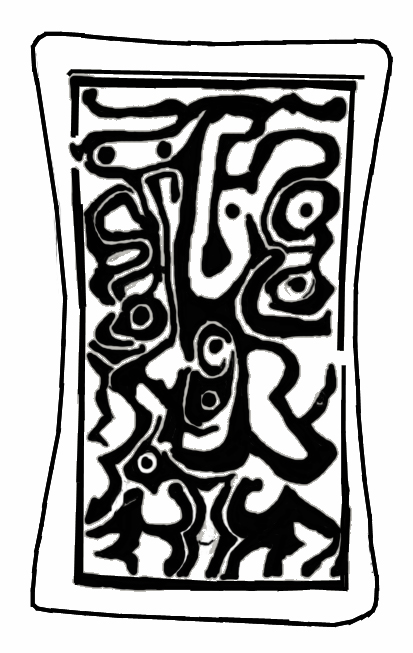
Bainbridge Tablet

Sketch of Bainbridge Tablet after Caldwell photo.

The Bainbridge and McKensie Mound Tablets are both owned by Duncan Caldwell. View actual photos and read his analysis on line here. (Also see link below.)

The Bainbridge Tablet is from Ross County, Ohio and the McKensie Tablet is from Pike, County, Ohio. The latter was found in 1899. The Bainbridge is studied first here.

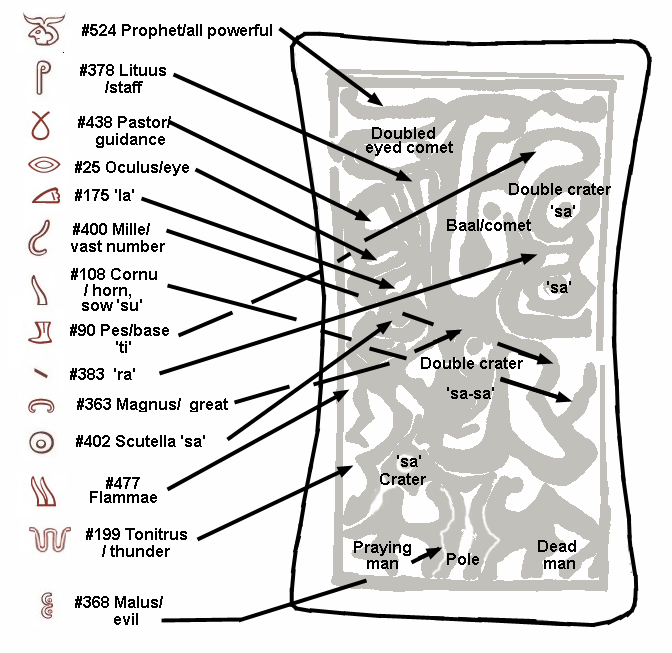
The Bainbridge is similar in design concept to the Cincinnati and Wilmington. It has sides bowed in as does the Cincinnati Tablet. All three have the feathers of the Prophet glyph giving us the correct orientation for reading it. The feathers were also present on the Lakin A Tablet. The Prophet glyph’s presence suggests the abstractness of the diagram is just a series of combined glyphs. With some effort the glyphs are identified as shown in the diagram below. It tells of a two eyed comet and the staff of guidance. It is where the ‘eye lays.’ The upended Pes/foot glyph on the right side gives us the idea of a base which is turned and the sound ‘ti.’ Two joined craters lie below it with the symbol for ‘ra’ between them forming the word ti-sa-ra-sa or tessarace which appeared in the Lakin A Tablet. A tessarace is the summit of a four sided pyramid. The north pole is the summit of a world divided into square tiles. The word can also be translated into Old English as ti-sa or tease, and ra-sa or raes which is a violent storm or a course. This suggests further meanings to the word tessarace. It describes a place that was harmed by a violent storm which is marked by a line.

Glyph map of the Luwian/Hittite glyphs found on the Adena Tablet known as the Bainbridge from ancient Ohio glyph map

Glyph map of the Luwian/Hittite glyphs found on the Adena Tablet known as the Bainbridge from ancient Ohio.

Below this are two joined symbols. It describes ‘a vast number sown.’ In the center are two craters or ‘sa-sa’ suggesting the word ‘sess’ which means seat in Old English. The symbol for ‘great’ surrounds the highest of the two craters. On the left, three joined symbols suggest flaming-thunder-crater and below this is a praying man turned away from the center. To his back is the symbol for evil and in the center is the pole. The right side is a mirror image of the evil symbol. This symbol creates the legs of a man who is presumably dead since he seems decapitated. This would be appropriate since the message suggests the planet ‘lost its head’ or guiding north pole.

Numbers are indicated on the Bainbridge Tablet by the placement of the dots in the image.

Numbers are indicated on the Bainbridge Tablet by the placement of the dots in the image.

This message is not complete without imbedded numbers. The dots provide them. On the left are four dots. In the middle there are three and on the right are two for a sum of nine. So it can be said there are 7 on the left/center, 9 total, and 2 on the right which can be used to create the 792 seen on many tablets studied already. It refers to the diameter of the planet at 7920 miles. The center 3 and right 2 create 32 or the square of 5.65. If seen as 23 then it reminds us of the latitude at which the Arctic Circle ends. The number 432 can also be created and this reminds us of the radius of the Sun at 432 thousand miles.

The dimensions of the tablet provide more numbers: 2 7/8″ x 4 3/4″ x 2/3″ or 2.87″ x 4.72″ x .66″. The sum of the length and the width is the ever important number 7.6. The period of Halley’s Comet is 76 years. The width provides both 23 (from 2/3) and 66. The velocity of Earth is 66,600 mph.

Turning now to the McKensie Tablet it is found it repeats the typical message.  Right side up can be determined by observing that two diamonds appear at the top of the Gaitskill Clay Tablet. One triangle begins the Metcalf Stone and diamonds are present on the Grave Creek Tablet. So the stone should be read as positioned in the image shown here.

Mckenzie Mound sketch

The Adena tablet from ancient Ohio known as the Mckenzie Mound. The sketch is from a photo by Caldwell.

To the right is the circle with hash marks. Hash marks appeared on the Wilmington, and on the Gaitskill Stone Tablet. The Earth when divided by longitude and latitude appears to be overlain by such a grid. Another way to look at this circular glyph is that the hash marks are a separate glyph suggesting ‘ha or pa’ or the old words ‘heah and pea.’ Heah is high or a high power. The symbol also suggests an object such as corn which is composed of many pieces. Then the combination becomes a powerful comet of many pieces. The story then reads: ‘a powerful comet came to Earth.’

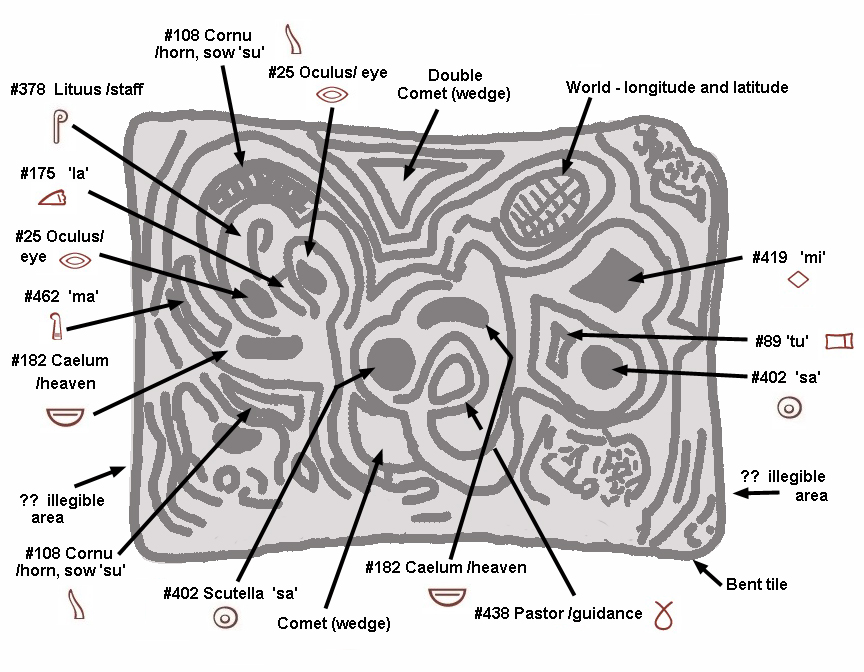
The left upper panels says literally ‘two eyes lay at the staff’ or two comets struck the north pole. Below this are two glyphs that suggest there are ‘ma’ which translates from Old English to ‘more.’ The two symbols suggest ‘there are more in heaven.’ Above this series of glyphs is the horn in 9 sections. The planet’s latitude is marked off in 90 degrees equator to pole. The bottom left corner suggests ‘sow’ but the rest of the corner is illegible.

Within the center is a Pastor symbol identical to the one seen on the Bainbridge Tablet just studied above. Next to it is a large ‘sa’ or crater. Above these two symbols is the symbol for heaven and below them is a wedge. This suggests the reading: ‘the crater from the heavenly comet guides.’

Mckenzie Tablet glyph map

The Adena Tablet from ancient Ohio known as the McKensie Tablet can be deciphered into Luwian/Hittite hieroglyphs from ancient Turkey.

The far right provides three glyphs: mi, tu and sa. The first suggests the Old English word ma for more or mighty, while the latter two are grouped together in the art suggesting tu-sa. The Old English word teosa meaning harm or the modern word tease is then formed. The phrase is then ‘a mighty harm.’

The overall layout of the stone suggests disorder in circular sweeping patterns. It imitates exactly what is observed in areas of comet collisions such as we see on the Moon’s surface. The Bainbridge Tablet also suggests disorder around circular crater marks. They may actually be attempts to depict the aftermath of such an impact with the planet just as the Berlin Tablet did.

If the McKensie Tablet is examined for numbers then several are found. The double triangle, center top, provides 2 triangles of 3 sides which is 23 or 32 = 5.65 squared. The center panel is grouped in such a way as to count out 1,1,2 as if to say 112 or twice 56. The right side gives 1 and 2 or 12. Some might say it gives 1,1, and 1 for 111. The square of this number is 12321. The left upper grouping gives 3 filled in figures and 3 carved out for 33. The overall measurements of the stone are 2.76″x 3.75″ x .394″. The square of the width is 7.6 recalling the period of Halley’s Comet. The sum of the length and width is 6.5. The sum 6.5 is 56 in reverse. The sum of all three measures is 6.90. The distance between two degrees of longitude at the equator is 69 miles.

The overall shape of both tablets is a tile with bent in sides. The story suggests the grid array of longitude – latitude shifted or perhaps twisted as the shape suggests. Most importantly, the two very round carved out circles suggest Two Balls or Bi-Baals. The pun ‘Holy Bible’ was noted in the Wilmington post.

The cumulative list of numbers from all tablets follows. Those in bold were also found on these tablets. 108, 111, 11111, 112, 12, 1212, 12321, 123454321, 14, 1414, 16, 17, 21, 212, 2121, 21212, 216, 2166, 222, 23, 23 32, 23.5, 24, 241, 2486, 26, 28, 3, 31, 32, 33, 333, 34, 3.8, 38, 4, 40, 43, 4.4, 44, 52, 54, 5.65, 56, 56.5, 56.5, 58, 6, 61, 64, 6.5, 65, 66, 66624, 67, 6.9, 7, 72, 76, 77, 777, 79, 792, 86, 8.8, 88, 9, 90, 912, 92, 93, 93.3, 7924 and 8642.

It can be concluded, despite the differences in the artist’s style, the message of the Bainbridge and McKensie Tablets is consistent with previously studied art. The Ramey Peet Tablet (next post) from Cahokia Mound indicates by repeating this now familiar message and style of numbering that this knowledge and iconography was not restricted to the areas of Georgia, Ohio, West Virginia and Egypt.

Back to the very beginning of series on Adena Tablets

Previous Post on Cincinnati Tablet

Posts on: Egyptian Art Comparison, Wilmington Tablet, Lakin A Tablet,

The Gaitskill Clay Tablet, Allen Tablet, Grave Creek, The Kiefer Tablet,

Wright, Lakin B and Meigs Tablets, Berlin Tablet, Gaitskill Stone Tablet,

The Low Tablet, The Waverly Tablet, Metcalf Stone, and pdf article on

Hudson Bay as a comet crater of recent origin.

Article by Duncan Caldwell at: https://www.researchgate.net/publication/277720624_A_New_Typological_Ordering_of_Adena_Tablets_Based_on_a_Deeper_Reading_of_the_McKensie_Tablet

The Adena Tablets of Ancient Ohio – The Cincinnati Tablet

© 2014 B. L. Freeborn, updated 2025

The Cincinnati Tablet is a beautiful work of art that has come to us through the centuries because of the wisdom of our ancient elders. They knew that in time we would forget the important message this tablet carefully depicts. The wise knew that if enough significant works of art were buried with them that long after their bones had turned to dust and their societies had vanished the mounds would attract the attention of future grave robbers. This predictable curiosity would drive them to dig and rediscover this important message left to us. It is as if the mounds were intended to function as valuable time capsules. Finding the pieces is the second to last step in the process. The last step is pondering and understanding them. We are presented with this important message. Can we read it?

Cincinnati Tablet

The Cincinnati Tablet from Skinner’s 1885 report.

This tablet was found in a mound not too distant from where it currently resides. It is displayed in the Cincinnati Museum Center at Union Station – poorly. It is not to be found with artifacts from the people of the area in the Natural History wing but in a dim lonely corner of the urban exhibits in the Cincinnati History Museum wing. The lighting is dismal. The location suggests it is to be forgotten. So indeed! Not understanding how beautifully this artist portrayed the ancient but still vitally important message, the curators have buried it in plain sight.

Comparing it to the Wilmington Tablet, it can be seen the basic layout is the same. The comet is the center piece with its two wings along the top. Within its center body are two nested comets. Each comet has one tail and two eyes. The flower images are seen in the Waverly Tablet and in studying that tablet it was suggested they have a dual meaning. They represent both people and flowers. They are ‘shot’ through the head. There are four flowers. At the bottom are mirrored comets once again. Between them is a dot in the negative. On each outer side there is a vertical bar. The two bars represent the two poles, true north and magnetic north, as we know it today.

Cincinnati Tablet

Cincinnati Tablet. Art from ancient Ohio as exhibited. Image darkened to add contrast.

Let us begin counting as done with other tablets. Prominently at the top 7 spaces are marked out (or 8 lines). At the bottom there are 6 spaces (or 7 lines). This creates the number 76 and as noted in previous posts, it suggests the period of Halley’s Comet which is 76 to 77 years. This confirms the topic is about comets. Combine the numbers as 77 and obtain another reference to the comet. Combine them as 86 and obtain a reference to the diameter of the Sun (864,000 miles). Combine them as 78 and obtain the diameter of Earth through the pole (7899 miles). Sum the 6, 7, 7 and 8 and obtain 28 or half of 56.

Even more eloquent, notice that there are actually 9 spaces at the top but only 7 within the hash marks and 2 outside. Create 792 easily from them and compare this to the diameter of the planet at 7920 miles. Similarly, count the bottom as 8, 6 and 2 or create 862 which reminds one of the diameter of the Sun.

Side view of Cincinnati Tablet

Side view of Cincinnati Tablet

The very edge of the top and bottom are scored with small marks. J. Ralston Skinner counted the marks and reported them in his 1885-1886 report on this stone. He noted 24 spaces/ 25 hash marks on the top and 23 spaces/ 24 hash marks on the bottom. The sum of these numbers is 96 and the average is 24. There are 24 hours in a day. The top has 23 spaces. There are 23.934 hours in a sidereal day. Combining 23 and 96 obtain 23.96 or very nearly this number.

Count out the dots. There are 16. The Earth travels 1.6 million miles in a day. There are 2 bars. The 2 and 16 combined creates 216. The diameter of the Moon is 2160 miles.

There are 8 dots in the upper third. There are 6 dots in the middle third. There are 4 dots in the center. There are 2 dots at the bottom. This creates the series 8642 or it refers to the diameter of the Sun at 864,336 miles.

The upper third has 3 dots left and right and 2 in the center. From the center out then is found 23. Reversing it is 32. The Arctic Circle ends at 23 degrees and 30 seconds. The tilt of the planet is this same value. The square of 5.65 is 32.

The center third provides 222. A square of sides 2222 has a diagonal equal to the constant pi (3.14) times 1000. The sum of 22 and 22 is 44. Divide the circumference of the planet by 44 and obtain 565 miles. Forty-four is found in the center bar as well. Count the 4 dots and notice there are 4 bump outs. Recall also a square with sides of 4 has a diagonal of 5.65.

Cincinnati Tablet Museum View. Image darkened for contrast.

Cincinnati Tablet Museum View. Image darkened for contrast.

The dots on each side number 6 which creates 66. The velocity of the planet is 66,600 miles per hour. In the center there are 4 dots. Below this is the one dot in the negative. This creates the number 5. Combine this with the 6 on each side and obtain 56 once again. Or count it out as 1 and 4 which reminds us of the fingers in the Gaitskill Clay Tablet. Combine them and create 14 and then recall there are 4 bumps in the center. 4 x 14 is 56.

The exterior dimensions of the stone and its shape provide numbers that appear familiar. It was measured in 1885 by Skinner to be 3.00″ x 5.00″ x 5/8 inch thick. The width of the narrow middle is 2.5 inches. The sum of these three numbers is 3 + 5 + .625 or 8.625 which recalls the diameter of the Sun. The diagonal of the piece is 5.831 inches. The distance Earth travels in a year is 584 million miles. The thickness expressed as 5/8 repeats this value. The circumference of the piece is 16. The Earth travels 1.6 million miles in a day. It is as if they used inches, also.

The curved portion on each side recalls the idea of a crater. They are 4.5 inches across and .25 inches deep. The area of the curve on each side is .563 inches. The ratio of the narrow width to the length is 2.5 to 5 or .5. The ratio of the width to the length is 3 to 5 or .6. The ratios are .5 and .6 or a reminder of 56 once again.

Cincinnati Tablet. Image before darkening for contrast.

Cincinnati Tablet. Image before darkening for contrast.

Overall, the tablet is extraordinary. It relates this ancient message to us with ease and symmetrical beauty. It tells us we did not crawl out of caves 10,000 years ago to create society as we know it. Indeed, it tells us great scientists once explored and measured the heavens. But the unimaginable happened.

Perhaps the Inch System of today was inherited from this distant prior time. The measure of length of a Hunab found at ancient Teotihuacan, Mexico is 41.66 inches. (1) Multiply this by the diameter of the Sun written as .864 and obtain a simple yard of 36 inches.

Yet to be reviewed are the mysterious (next in series) Bainbridge and McKensie Mound Tablets, the Ramey Peet Tablet from Cahokia Mound, the way too accurate Gridley Stone, the beautiful Ohio Adena Pipe now a Ohio State symbol, and the Hopewell Shaman – Bear. Many interesting posts are to come.

—–

(1) See Hugh Harleston, Jr. pg. 241-263 in “Mysteries of the Mexican Pyramids,” by Peter Tompkins, Harper & Row, Publishers, New York, 1976.

From Harleston, Hugh, Jr.  “A Mathematical Analysis of Teotihuacan.” Mexico City: XLI International Congress of Americanists. October 3, 1974.

———

Back to the very beginning of series on Adena Tablets

Previous Post on Egyptian Art Comparison

Posts on: Wilmington Tablet, Lakin A Tablet, The Gaitskill Clay Tablet,

Allen Tablet, Grave Creek, The Kiefer Tablet,

Wright, Lakin B and Meigs Tablets,

Berlin Tablet, Gaitskill Stone Tablet, The Low Tablet,

The Waverly Tablet,  Metcalf Stone,

and pdf article on

Hudson Bay as a comet crater of recent origin.

J. Ralston Skinner’s articles from 1886.

The Adena Tablets of Ancient Ohio – Compared to Egyptian Art

© 2014 B. L. Freeborn, updated Sept. 2022

In previous posts a good many Hittite or Luwian Hieroglyphs from the Anatolian region of Turkey were pointed out in the ancient Ohio art of the Wilmington and Lakin A Tablets. The question remains as to whether this same style of incorporating glyphs into art can be found in ancient art from other regions such as Egypt?

Iuny Stele

The Iuny Stele. An Egyptian funerary stone. Louvre. Dated to New Kingdom Period.

The Iuny Stele from Egypt is shown here. In particular the depiction of Osiris and Isis found in the upper left section of the stele is examined in this post. Begin by observing that Isis on the left holds the arm of Osiris with almost a disembodied arm and upturned hand. Osiris’ body is turned in the traditional pose of rotated at the waist. This exaggeration with the hands two fisted at the center imitates the symbol for the sound ‘hwi.’ This sound we have seen expressed in many of the Adena Tablets suggesting the Anglo word ‘hwy.’ The feet of Osiris supply another sound ‘ta.’ Combining these two sounds the word hwa-ta is formed. The modern spelling of this word is ‘what.’ The headdress supplies the answer to ‘what and why.’ Baal is the origin of the cause as the oval or glyph for Femina suggests. On each side of the headdress is the Magnus symbol ‘great.’ Along the sides are numerous lines. Numbers are typically indicated by lines in this glyph system. Two ways to think of the lines then are ‘numerous’ or the glyph for Ala/wings of an army.

The headdress illustrates the idea further. The lines are drawn upwards and banded together. Longitude is banded together at the North Pole. There are seven lines below the bands and six above it. This creates the number 76 which is easily associated with the period of Halley’s Comet reinforcing the idea the art is about a comet. So then, this can be read as a ‘great many comets struck the place where the lines of longitude gather at the North Pole.’ The four bands give one further number. A square with 4 units to a side has a diagonal of 5.65 units. This gives us that very important number seen repeatedly in the Adena art.
Other numbers can be easily found. The headdress of Isis is three steps. Latitude is a series of steps towards the pole. Her hair has three curls in front of her shoulder and eight curls behind. This creates the number 38 which is half 76 and repeats the reference to Halley’s comet.

Below Osiris’ headdress we find the symbol for Propheta depicted in very much the same manner as it was depicted on the Adena tablets. Between the two feathers is a second circular glyph also suggesting Baal or the origin. This second Baal completes the idea of ‘two comets.’ To the right is a circle glyph that represents the concept of rotate. The idea of rotation is expressed two other times in the image. Osiris always appears rotated at the waist and the appearance of the eye is rotated whereas the mouth and nose are portrayed correctly. The degree of rotation is indicated by the flail. Half the flail’s three vertical lines is broken into five sections or perhaps it should be seen as 33; 33.5 or some combination of this. This number was seen in the tablets. Recall 90 degrees (at the pole) minus 56.5 is 33.5. The idea of rotation was found on the New Hampshire Mystery Stone with the twirl symbol.

From the New Hampshire Mystery Stone - the idea of turning

New Hampshire Mystery Stone glyph

The face with its typical Egyptian turned eye and odd beard gives further information. The eye is the glyph Ocular/eye and comets are known to be composed of masses often called the eye. The beard suggests the letter ‘ra’ in the glyphs. Combining the sounds ‘i’ and ‘r’ we find both the old and new Anglo word ‘ire’ which means to wander, to be angry. The face itself is the glyph for Caput or head. It can also be interpreted as the glyph for Prae which means ‘before.’ The face then is relating that the ‘previous pole/head of the planet wandered.’

The collars give another number. Two segments on Isis’ collar and three segments of Osiris’ collar form the number 23. The arctic circle ends at latitude 23 degrees and 30 seconds. It forms a ‘collar around the head of the planet.’ It also forms the number 32 which is 5.65 squared.
Furthering the idea that the North Pole is the place to which is being referred is the flail and hook held at an angle by two fists. The pole is the place from which the angles of longitude are marked out. Two firm fists suggest two places are involved: the north pole and the magnetic pole. It also suggests the idea of both latitude and longitude which are measured from the north pole. This is reiterated by the embracing arm of Isis under Osiris’ arm. Furthermore, Isis’ hand is in the form of the glyph for Manus/power over the people. Certainly, standards of measure such as measurement from the pole hold power over the people. Another repetition of the idea of union is found in the Ankh within Isis’ hand. It is the union of two glyphs: Femina/origin and the Cross. The Ankh then refers to the place from which measurements begin. Repeating again this duality of two poles is the two feet of Isis but only one shown for Osiris. If the face of Osiris suggests the glyph for Prae or ‘before’ then they are relating that previously there was only one place of measurement and now there are two.

Glyph map of Iuny Stele

The images of Isis and Osiris on the Iuny Stele demonstrate the use of Luwian/Hittite Hieroglyphs. The glyphs used and the message is identical to that found on the Adena Tablets of ancient Ohio.

The throne itself provides more information. A blanket is laid over the back of the chair and this is typical in Egyptian art. The chair is composed of several symbols. These are Argentum /shining, silvery; throne; cubitum/measurement, and aedificium/structure. Altogether they describe the polar ice cap that once overlaid the North Pole as a shining white blanket from which measurements were taken providing structure.

The name Isis was discussed in previous posts and that it is depicted in the Adena tablets as Ice-sess. Sess in Anglo means ‘seat’ and is the root of the modern word sister. Mythology tells us Isis was Osiris’ sister. What then might the name Osiris mean? In Latin ‘os’ means opening or origin. Spelled as ‘aes’ it means food in Old English and is associated with the word mouth or once again the idea of an opening. Spelled as ‘ease’ it means a beaker or lipped vessel. Perhaps this is a reference to a crater. Spelled as ‘os’ it means god. Ire as noted above means to wander, to be angry. ‘Is’ in Anglo means ice. Osiris is then a compound of three words: os-ire-ice.  The word could then mean ‘an opening in the wandering ice.’ In other words it confirms the analysis above. The story related is the same as in the Adena Tablets which is summarized as follows: Two great comets with many others struck the pole and the pole wandered (ire) and rotated. Previously there was one place of measurement whereas now there are two. Longitude is referenced from this old pole where there is a crater.

The rotation of the pole from an engineering standpoint is discussed within this site here (pdf).

The origin of longitude measurement (the zero line lies at Greenwich today) is described by the Ankh. Hence, its prevalence in Egyptian art. We might understand further if the gematria of Ankh is examined using Hebrew equivalents. ‘A’ gives us 1, ‘n’ give 50, ‘k’ gives 20, and ‘h’ gives 8. The sum is 79. If the word is examined further the first two letters give 51 and the last two give 28. What lies at latitude 51 degrees 28 minutes and 40.12 seconds? And what is 79 degrees of longitude distant from it?

The importance of this word is not confined to Egypt. It is found boldly in our own language. Consider one important word: thank. Is this not ‘the-ankh’? Has its meaning been forgotten through time?

Next we continue with the fabulous Cincinnati Tablet.

Back to the very beginning of series on Adena Tablets

Previous Post on Wilmington Tablet

Posts on: Lakin A Tablet, The Gaitskill Clay Tablet,

Allen Tablet, Grave Creek, The Kiefer Tablet,

Wright, Lakin B and Meigs Tablets,

Berlin Tablet, Gaitskill Stone Tablet, The Low Tablet,

The Waverly Tablet, and Metcalf Stone,

and pdf article on

Hudson Bay as a comet crater of recent origin.

The Adena Tablets of Ancient Ohio – The Wilmington Tablet

© 2014 B. L. Freeborn

The Wilmington Tablet is only 5″ by 3.8″ by .6″ thick. It is made of sandstone and resides in the Ohio History Museum, Columbus, Ohio. This artist could not have been more clear in his depiction yet it is displayed on its side and usually is described as a phallic image.

Wilmington Tablet

Wilmington Tablet, Ohio History Museum, Columbus, Ohio shown in its correct orientation.

Baal and his twin self are depicted at the top with one tail on the right and twin tails on the left. Central to the image is a massive comet projecting towards Earth. It is so enormous it dwarfs the mountains depicted at the bottom. Recall all of northeastern Canada down to Ohio was once covered by ice mountains two miles high. The swirling shapes to each side of the comet depicts the destruction that followed the impact. Hidden in these swirls are Hittite/Luwian glyphs from the Anatolian region of Turkey. Within every part of this image there are many numbers.

This is the essential and important story this tile relates in a blatantly realistic fashion. What is it that keeps us from seeing this clear depiction of an enormous comet?

The remainder of the message is told through glyphs and numbers. We began with a one tailed Baal and a two tailed Baal, or a comet that split into two. One and two helps us recall there are 12 houses in the heavenly Zodiac. Continue counting by noticing it is actually divided into four panels. The planet can be said to have four quadrants. A square of 4 units to the side has a diagonal of 5.65 units. At the middle horizontal line count across the comet and find 6 lines above but only 5 lines below for 56. Reverse this and obtain 65 or nearly the velocity of the planet at 66624 mph. Similarly, count 6 dot holes on the right half and 7 on the left half for 67. Reverse the number and obtain 76. The period of Halley’s comet is 76 years. Count 9 holes on the upper half but only 3 on the lower half for 93. The average distance between Earth and the Sun is 93 million miles. There is 1 hole in the left lower square and 6 in the upper left for 16. The Earth travels 1.6 million miles in a day. Reverse the number and find 61. There are 60 minutes in an hour and a square of 61 units to the side has a diagonal of 86.3 which suggests the Sun’s diameter of 864 thousand miles. The right side has 3 holes above and 3 below for 33 which gives the maximum change in latitude caused by the impact.

Side view showing double headed arrow on Wilmington Tablet

Side view showing double headed arrow on Wilmington Tablet

The 2 holes in the upper left Baal are next to 3 small fingers on the edge for 23. The upper sweeps of the comet’s tail are composed of 3 on one side and 2 on the other for 32. The square of 5.65 is 32. Reverse the number and find 23. Recall the Arctic Circle ends at 23 degrees and 30′ or approximately 23 degrees and 32 minutes.

There is a half circle on the centerline at the top. The tail on that side is one strong piece between two which makes 112. Or count the strong tail line as 1, the half circle as 1 and the other side of the tail supplies the 2 for 112. Above the middle line there is 1 hole below 1 hollow half circle and opposite there are 2 half circles for 112. The bottom left panel gives 1 half circle, 1 dot and 2 loops for 112. Each and every 112 is twice 56.

On the right lower there are 3 dots and 1 half circle for 31. This is pi³. Continue the count from 3,1 and then 5 lines and 1 half circle for 3151 which is close but off. It should be 3141 which is pi at 3.1415.

Surrounding the piece on the narrow edge is an arrow with a doubled arrowhead which repeats the idea of a double comet. A circle with a dot in the center is in the mid-shaft suggesting the crater or the all seeing eye of the north pole. Then it ends with fletching. This end has hash marks that alternate to make 8 per side or 4 per side depending on how it is viewed. Divide the circumference of the planet in miles by 44 and obtain 565.5 miles.

Sketch of Wilmington Tablet

Sketch of Wilmington Tablet from J. Ralston Skinner’s 1885 article.

At the bottom of the piece there is fringe which wraps up the left side. There are 2 on the left, then 10, then 9 to the right. Summing the last two obtain 19. Multiply this by the 2 from the side and obtain 38 which is half 76 or the period of Halley’s Comet of 76 years.

Alternatively, begin with the 9 and affix the 12 to obtain 912 which is just under Earth’s minimum distance to the Sun of 9.14 million miles. If a simple sum of 9 and 12 is taken, find 21 which when multiplied by pi is a hair under 66. The velocity of Earth is 66624 mph.

The next few numbers are important because they are arrived at by using the Inch System of measurement. The dimensions of the piece in inches is 5″ x 3.8″ x .6″. The sum of the length and thickness is 5.6 which repeats 56 again. Twice 3.8 is 7.6 which recalls the period of Halley’s Comet. The sum of the 3.8 and .6 is 4.4. The circumference of the planet is 565.5 miles x 44. Sum 3.8 and 5 and obtain 8.8. A mile is 880 feet times 6.

Before moving on to the glyphs let us take note of all the numbers found on this piece and compare it to the numbers found on prior tablets. Here we found: 12, 16, 21, 23, 23 32, 31, 32, 3, 33, 3.8, 38, 4, 4.4, 44, 5.65, 56, 61, 65, 66, 67, 76, 8.8, 9, 93, 112, 912.

The cumulative list from previous tablets follows. Those in bold were also found on this tablet. 108, 111, 112, 1212, 12321, 14, 1414, 16, 17, 212, 2121, 21212, 2166, 222, 23, 23 32, 23.5, 24, 241, 2486, 26, 31, 32, 33, 333, 34, 40, 43, 44, 52, 54, 56, 56.5, 56.5, 58, 6, 64, 66, 66624, 7, 72, 76, 777, 79, 792, 86, 88, 9, 90, 92, 93.3, 7924 and 8642.

Glyphs for Malleus (hammer or disease), Calleum (heaven), Mille (vast number), and sound 'sa'

Glyphs for Malleus (hammer or disease), Caelum (heaven), Mille (vast number), and sound ‘sa’

Next the artwork is examined to see if any hieroglyphs can be found. Begin with the upper left Baal and find the Luwian/ Hittite symbols for Malleus, Caelum and Mille all joined. The first means a mallet or disease, the second means heaven, and the last which is doubled means a vast number. The image suggests then a disease from heaven in vast numbers or in modern terms: comets and meteorites.
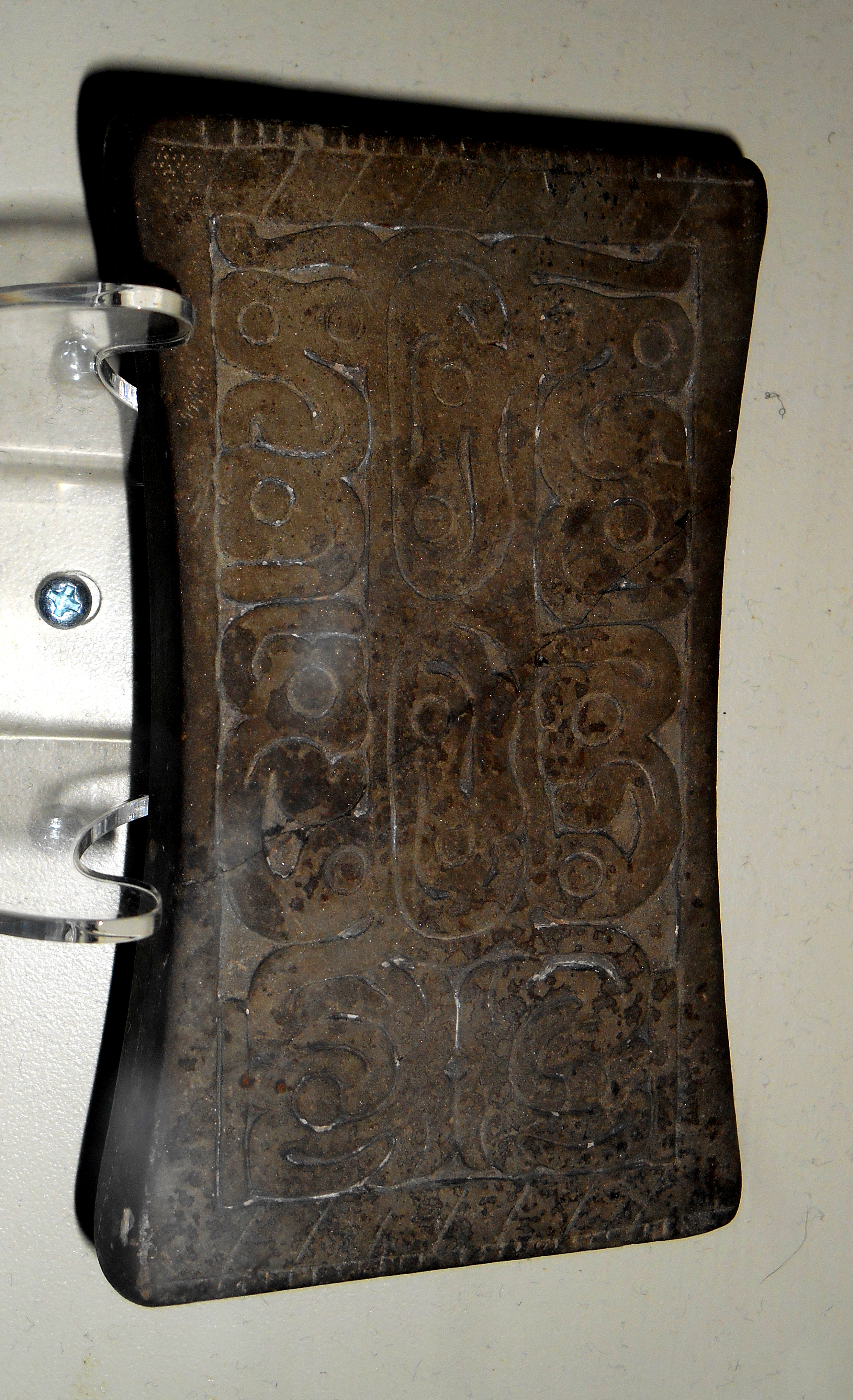
Luwian/Hittite Glyphs

Luwian glyph for Deus (god), glyph number 502, Ala (wing of army), sound ‘i’, and sound ‘sa’

Opposite this we find another Baal which is described by glyphs Caelum #182 (heaven) and the right side is a variation on Deus #360 (god). This symbol is very close to glyph #502 which has no meaning attached to it. The tail repeats the Mille glyph suggesting again a vast number. This is easily translated as ‘gods came from heaven’ and is just another way of saying in modern terms many powerful comets came.
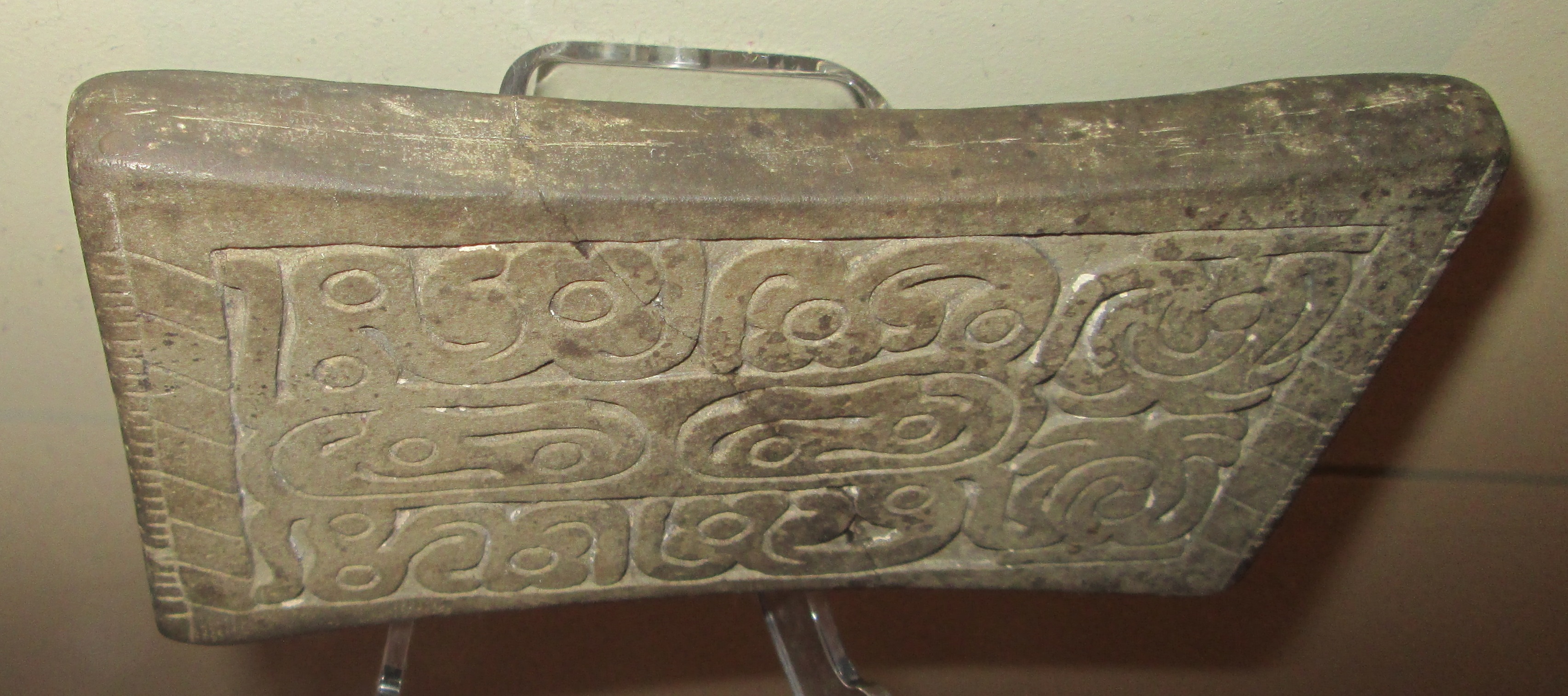
Prophet Symbol

Prophet Symbol

The sweeping tails of the central comet are the feathers on the head of the prophet glyph.

Wing symbol meaning troops - Ala 78

Wing symbol meaning troops – Ala 78

Beneath this in the upper right panel the idea is expounded upon. Glyph # 78 for ‘wing’ is an army wing or troops. It lies above a circle-dot. This suggests the two comets arrived with troops making craters.

Glyph for sound 'i'

Glyph for sound ‘i’


The upper left panel explains more. The first is the upright with the dot for sound ‘i’ found in glyph #209. The two connected circle-dots form two ‘sa’. This ‘sa-sa’ suggests repeated ‘s.’ This spells out i-s-s or the name of the Egyptian god Isis. But it also resembles two Anglo words, ice and sess. The first we understand and the second we hear in sis-ter. Sess is a seat. Ice-sess than implies an ice-seat and so we may hazard to guess that Isis is ‘ice-sess.’ These glyphs are followed by another circle-dot for another ‘sa’ such as we hear in ‘see.’ It is next to the glyph for Caelum or heaven which is connected to the comet or the central pole. Putting this together we have ‘the seat within the ice from which all heaven can be seen at the pole.’ This is the North Pole. A long distant ancestor tells us the meaning of a Goddess in a far distant land with symbols long forgotten and words we still use.
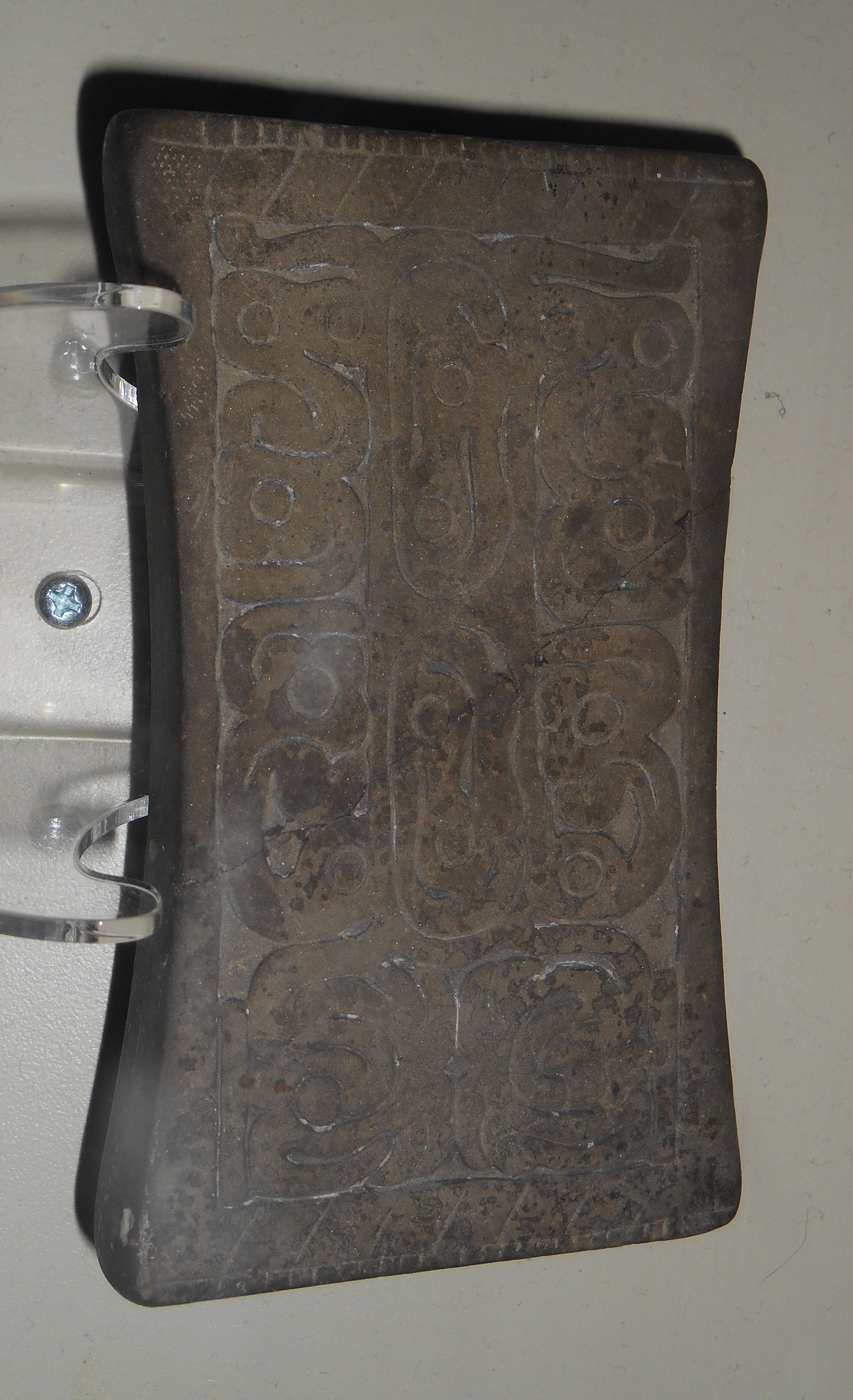
Luwian Glyphs for Halpa (help), sound 'hwi', Cornu (horn) or sound 'su', and sound 'sa'

Luwian Glyphs for Halpa (help), sound ‘hwi’, Cornu (horn) or sound ‘su’, and sound ‘sa’

In the lower left panel find the glyph for ‘hwi’ #329 in the two twirls. The original way the word why was spelled was hwy. So it asks very clearly, “Why?” The symbol for Halpa or help lies above it which reiterates the exclamation. Towards the pole is the symbol for ‘sa’ #402. Above this is symbol #108 Cornu meaning a horn with sound ‘su’ probably meaning ‘to sow.’ The sequence suggests “Help! Why! A comet sown”

Luwian Glyphs

Glyphs for Lituus (a staff), sound ‘ha’ or ‘pa’, and Malus (evil))

The bottom right panel gives us once again the ‘sa’ for ‘see’ with Lituus #378, a staff. Then there is cross hatching which suggests glyph #224 with sounds ‘pa’ or ‘ha.’ ‘Pa’ begins the words pole, power, and post. While ‘ha’ is the Anglo word ‘heah’ which we know as high. The reversed 3 towards the edge is glyph #368 Malus or evil. Putting this together we have ‘to the seeing staff of the pole on high came evil.’

The image on The Wilmington Tablet is composed of many Luwian Hieroglyphs which tell a story.

The image on The Wilmington Tablet is composed of many Luwian Hieroglyphs which tell a story.

This is the same message people on both sides of the world knew, understood, discussed and shared as revealed by their common knowledge of the subject, manner of depiction, and embedded numbers. They ask “Why! On high did this great evil come?”

This leaves the reader still wondering. Could it be? And where? Where is the evidence of this evil? But they tell us. Baal (Deus or god) struck at 56.5 as the Hebrew word for god, Yahweh, echos in its number gematria. Transcribing this word into numbers gives 5,6,5,10 or 56.5. Indeed, further still one must hear the word ‘why’ pronounced the original way ‘hwy’ in the word Yahweh when read left to right or backwards – hewhay.

But we need a second reference to find a location and this they provide. Recall in our prior number list (see Meigs Tablet and Kiefer Tablet) was the number 792 and this is the length of the diagonal of a square of sides 56. It also recalls the diameter of the Earth at 7920 miles. From the line of longitude of greatest displacement they traveled east 79.2 degrees and defined the zero longitude point at Greenwich, England at the same place it is today. This number of degrees was chosen to honor the diameter of the planet. So, reverse their journey! Travel back due west 79.2 degrees of longitude and find the home of Bi-Baal. The reader is encouraged to discover the place for himself. It is summed up by this pun: Holy Bible. Find the holy bible (hole lay bi-Baal) or the hole laid by two Baals.

More to learn about ourselves in upcoming posts.

Next post on Luwian Glyphs in Egyptian Art

Back to very first post on Adena Tablets

Previous Post on Lakin A Tablet

Posts on: The Gaitskill Clay Tablet, Allen Tablet, Grave Creek,

The Kiefer Tablet, Wright, Lakin B and Meigs Tablets,

Berlin Tablet, Gaitskill Stone Tablet,

The Low Tablet, The Waverly TabletMetcalf Stone,

and pdf article on

Hudson Bay as a comet crater of recent origin.